© 2017, IRJET | Impact Factor value: 5.181 | ISO 9001:2008 Certified Journal
| Page
1403
Key Escrowing Problem and Attribute-Based Data Access
Divyashree M S, Dr Prakash
Divyashree M S, Dept. of CSE, Dr. AIT, Bangalore, India
Dr Prakash, Associate Professor for Mtech(CSE), Dr.AIT, Bangalore, India
---***---Abstract –
Flowed limit is the best and convincing approach to manage deal with our information remotely. Since data proprietors and customers are as a rule outside the trusted space of cloud authority centers the data security and get the opportunity to control is the crucial component at the period of sensitive data set away in the cloud. Likewise, now days there are assorted segments are available for data sharing and ensuring security of data proprietor and customer. Key Escrow is the one of the main problem now a day. We can't keep full trust over the key master center since they may be manhandle there advantages. This is prohibited for information sharing conditions. In this paper we focused the present strategy for sharing the data from data proprietor to data customer.Key Words: Attribute-Based Data Scheme, Encryption, cipher-text, mystery key
1. INTRODUCTION
By the days there are heaps of quickly making outlines and coursed part is one of them. Cloud give basic, beneficial stage to store information, secure information, and get to information at any domain with the assistance of web. In like way it gives client adaptable frameworks, storage room and execution.
Essential figure distributed storage are data classification and execution. To keep up information safely from unapproved get to bunches of cryptographic calculations are available. Trusted outsiders are additionally assuming primary part in distributed computing which giving us secure channel to exchanging the information from proprietor to other asked for various clients. Existing framework utilizes the figure content strategies based encryption in which secrecy of the information are made by utilizing information, encryption calculation and the extent of key.
Confided in outsider like key expert, key generators and suppliers, computerized authentication suppliers and verifiers and so on utilized as a part of this situation. Be that as it may, we can’t keep completely trust over these specialist organizations and confided in gatherings. Not everything except rather some of them might be can attempt to take our information and keys. Because of this key Escrow issue might be created under this sort of framework.
Typically every one of the assignments are done over the cloud, for example, verification, document encryption, record unscrambling, key administration. There are loads of client are dynamic simultaneously from various
area and performing heaps of various operations. So execution of the cloud framework possibly corrupting in future. To manage these real issues of existing framework we propose this framework. In which we roll out little improvement in the attribute-based arrangements and evacuate the key escrow issue totally.
Presently we will experience some current framework identified with information sharing and privacy over cloud in short and some of their impediments.
2. LITERATURE SURVEY
These are numerous approaches are characterized with respect to distributed computing security and information sharing according to in the writing.
A. Return to Attribute-Based Data Scheme
Shulan Wang, Kaitai Liang, Joseph K. Liu, Jianyong Chen, Jianping Yu, Weixin Xie[1] return to characteristic based information sharing plan keeping in mind the end goal to unravel the key escrow issue additionally enhance the expressiveness of quality, so that the subsequent plan is friendler to distributed computing applications. They proposed an enhanced two-party key issuing convention that can ensure that neither key specialist nor cloud specialist organization can trade off the entire mystery key of a client independently.
Also, they present the idea of characteristic with weight, being given to upgrade the outflow of trait, which can not just extend the expression from paired to discretionary state, additionally help the intricacy of get to approach. Subsequently, both capacity cost and encryption unpredictability for a figure content are soothed.
© 2017, IRJET | Impact Factor value: 5.181 | ISO 9001:2008 Certified Journal
| Page
1404
expressiveness of quality, so that the subsequent plan is allthe more benevolent to distributed computing application. We propose an enhanced two-part key issuing convention that can ensure that neither key specialist nor cloud specialist organization can trade off the entire mystery key of a client separately. In addition, we present the idea of property with weight, being given to improve the declaration of characteristic, which can not just extend the expression from parallel to self-assertive state, additionally help the many-sided quality of get to approach. Consequently, both capacity cost and encryption many-sided quality for a cipher text are diminished. The execution investigation and the security verification demonstrate that the proposed plan can accomplish effective and secure information partaking in distributed computer.
B. Document Hierarchy Attribute-Based Scheme
A productive document order quality based encryption scheme(FH-CP-ABE) is proposed by Shulan Wang, Junwei Zhou, Joseph K. Liu, Jianing Yu, Jianyong Chen and Weixin Xie[2]. The layered get to structures are incorporated into a solitary get to structure, and after that the various leveled records are encoded are encoded with the coordinated get to structure. The figure content segments identified with properties could be shared by the records. In this way, both figure content stockpiling and time cost of encryption are spared. In addition, the proposed plan is turned out to be secure under the standard presumption. In this review, an effective encryption conspire in view of layered model of the get to structure is proposed in distributed computing, which is named record chain of command CP-ABE plot. FH-CP-ABE augments regular CPABE with a hierarchical structure of get to strategy, in order to accomplish simple, flexible and fine-grainted get to control.
C. Client Centric Data Creation Scheme
In [3] this paper creator proposed a user-driven information secure creation plot(UCDSC) for thesecurity prerequisites of asset proprietors in cloud. In this plan, an information proprietor initially separates in clients into various areas. The information proprietor scrambles information and characterizes diverse secure overseeing arrangement for the information as indicated by spaces. To scramble the information in UCDSC, they display a calculation in view of access control conditions intermediary re-encryption(ACC-PRE),which is ended up being exert mystery secure and chosen-figure content assault(CCA) secure in arbitrary prophet show. The ACC-PRE can decrease the computational overhead of the client’s encryption and troublesomely of key administration, and fulfill the clients necessities for dynamical change of authorization depictions also.
D. Quality Based Proxy Re-Encryption
Kaitai Liang and Willy Susilo proposed [6] a searchable trait based intermediary re-encryption framework. At the point when contrasted with existing frameworks just supporting either searchable trait based usefulness or quality based intermediary re-encryption, this new primitive backings both capacities and give adaptable watchword refresh benefit. In particular, the framework empowers an information properties to productively share his information to a predetermined gathering f clients coordinating a sharing approach and then, the information will keep up its searchable property additionally the comparing seek keyhord(s) can be refreshed after the information sharing. The server however knows nothing about the keyword(s) and the information. The new instrument is appropriate to some certifiable application, for example, electronic well being record frameworks.
E. Two Factor Authentication
Presented [4] another fine-grained two-calculate authentication(2FA)get to control framework for electronic distributed computing administrations. As a client can’t get to the framework on the off chance that they don’t hold both, the component can upgrade the security of the framework, particularly in those situations where numerous clients share a similar PC for electronic cloud administration. what’s more, quality based control in the framework likewise empowers the cloud server to confine the entrance to those clients with a similar arrangement of characteristics while safeguarding client satisfies the required predicate, yet has no clue on the correct personality of the client.
F. Consistent Size Cipher Text Policy
Zhijie Wang, Dijiang Huang, Yan Zhu, Bing Li, and Chun-Jen Chung Proposed another proficient system named constant-measure ciphertext policy comparative Attribute-Based Encryption (CCP-CABE) [7] with the support of negative qualities and trump cards. It inserts the tantamount property scopes of the considerable number of qualities into the client’s viral, and consolidates the characteristic requirements of the considerable number of properties into one bit of ciphertext amid the encryption procedure to implement adaptable get to control approaches with different range connections. In like manner, CCP-CABE accomplishes the effectiveness since it produces steady size keys and ciphertext paying little respect to the quantity of included traits, and it likewise keeps the calculation cost consistent on lightweight cell phones.
G. Unquestionable Outsourced ABE
© 2017, IRJET | Impact Factor value: 5.181 | ISO 9001:2008 Certified Journal
| Page
1405
Shengli Liu, and Siqi Ma[9] first formalize a security model ofABE with obvious outsourced decoding by presenting a confirmation enter in the yield of the encryption calculation. At that point, they exhibits a way to deal with change over any ABE plot with outsourced unscrambling into an ABE conspire with undeniable outsourced decoding. This new approach is straightforward, general and practically ideal. Contrasted and the first outsourced ABE, our obvious outsourced ABE neither builds the client’s and the cloud server’s calculation costs aside from some non-prevailing operation(e.g., hash calculations), nor grows the ciphertext estimate with the exception of including a hash esteem(which is under 20 byte for 80-bit security level).
H. Multi Authority Attribute Based Encryption
The developed CP-ABE component with multi-specialists (MA-ABE) is planned [20] for the useful application. In this paper, creations proposed a productive and secure multi-specialist get to control conspire exchange the registering to the cloud server. This plan actualizes halfway unscrambling operation in cloud server and enhances the client’s decoding proficiency, which can be connected to the situation of access to the internet utilizing cell phones.
I. Quality Based Hybrid Encryption
Circuit ciphertext-approach characteristic based half breed encryption with undeniable appointment has been considered in this work[8]. In such a framework, joined with unquestionable calculation and encode then-macintosh component, the information privacy, the fine-grained get to control and the accuracy of the appointed processing results are very much ensured in the meantime. Additionally, this plan accomplishes security against picked plaintext assaults under the k-multilinear Decisional Diffie-Hellman suspicion.
J. ID-Based Ring Signature
Information offering to a substantial number of members must consider a few issues, including proficiency, information respectability and security of information proprietor. This paper[10] demonstrates improvement security of ID-based ring mark by giving forward security. If a mystery key of any client has been traded off, all past created marks that incorporate this client still stay legitimate. This property is particularly vital to any extensive scale information sharing framework, as it is difficult to ask all information proprietors to re-confirm their information regardless of the possibility that a mystery key of one single client has been traded off.
K. Completely Homomorhphic Encryption
This paper[17] shows that how to diminish a correspondence overhead between cloud server and information proprietor utilizing open key pressure procedure for completely homomorphic encryption conspire over the numbers. At
whatever point we utilize the cloud, client expects Data security, seek precision and less correspondence overhead from the cloud specialist co-ops. All together handle this TRSE(Two Round Searchable Encryption) conspire has been proposed which accomplished high information security through homomorphic encryption and inquiry exactness through vector space show. This proposed plot utilized modified FHEI(completely homomorphic encryption over the whole numbers) which procedure the general population key of substantial size. This vast key is utilized for encryption of watchwords to shroud get to design and hunt design.
3. CORRELATIONS BETWEEN EXISTING
CALCULATIONS
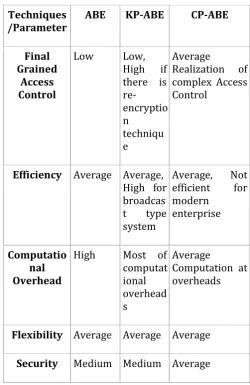
[image:3.595.305.556.312.698.2]A. Examination of ABE Schemes
Table -1: Examination of ABE Schemes
Techniques
/Parameter
ABE
KP-ABE
CP-ABE
Final
Grained
Access
Control
Low
Low,
High
if
there is
re-encryptio
n
techniqu
e
Average
Realization of
complex Access
Control
Efficiency
Average Average,
High for
broadcas
t
type
system
Average,
Not
efficient
for
modern
enterprise
Computatio
nal
Overhead
High
Most of
computat
ional
overhead
s
Average
Computation at
overheads
Flexibility
Average Average Average
© 2017, IRJET | Impact Factor value: 5.181 | ISO 9001:2008 Certified Journal
| Page
1406
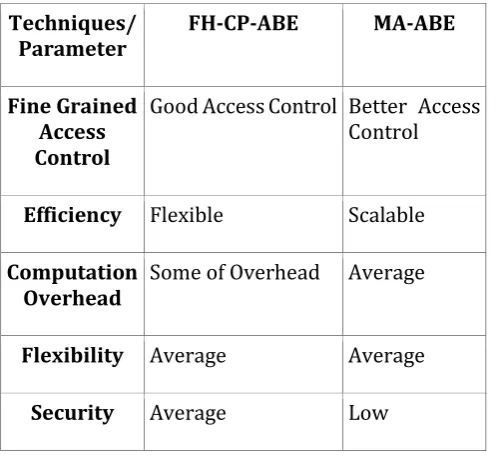
Table -2: Examination of ABE SchemesTechniques/
Parameter
FH-CP-ABE
MA-ABE
Fine Grained
Access
Control
Good Access Control Better Access
Control
Efficiency
Flexible
Scalable
Computation
Overhead
Some of Overhead Average
Flexibility
Average
Average
Security
Average
Low
B. Disadvantages of ABE Schemes
1. ABE
Drawbacks-
Information proprietor needs to utilize each approved client’s open key to encode information.
Confined in the genuine condition.2. KP-ABE
Drawback-
Encryptor can’t choose who can unscramble the scrambled information.
It is unsatisfactory in some application in light of the fact that an information proprietor need to put stock in the key backer.3. CP- ABE
Drawback-
Not satisfying the venture necessities of get to control which require significant effectiveness and adaptablility.
Limitation happens as far as determining arrangements and overseeing client traits.4. HABE
Drawback-
Essentially it is bad for usage.
Since all characteristic in one conjunctive condition might be directed by a similar area expert likewise a similar property might be managed by different space specialists.5. MA-ABE Drawback
Required every expert’s trait set by disjoint and that is to some degree confused.C. Confirmation Techniques with their points of interest and strategy control burdens.
4. PROPOSED WORK
We go for usage of cloud based framework which manages the key escrow issue in information security and make coordinated correspondence occurs between the distinctive clients utilizing cloud specialist organization(CSP) and additionally attempt to diminish the server side load. Get to control is a standout amongst the most essential security instruments in distributed computing. In this propose Attribute-Based get to control conspire we gives an adaptable approach that enables information proprietors to coordinated information get to arrangements inside the encoded information. Additionally in propose framework we will develop the framework to manage the significant weaknesses of existing framework like key escrow issue in information sharing and execution corruption issue.
3. CONCLUSIONS
Distributed computing is most ideal pattern for client which gives numerous advantageous administration. In any case, some place, there is some security or assurance is required against the information put away or action done over the cloud. This paper gives an audit of various verification systems for distributed computing in which various security elements are given. Likewise we audit the distinctive property based get to control instruments utilized as a part of existing framework. It comprise five distinctive trait based encryption plans, for example, ABE(Attribute-Based
Encryption), KP-ABE(Key-strategy quality based
encryption), CP-ABE(Ciphertext-approach),
© 2017, IRJET | Impact Factor value: 5.181 | ISO 9001:2008 Certified Journal
| Page
1407
REFERENCES
[1] Shulan Wang, Kaitai Liang, Joseph K. Liu, Jianyong Ichen,
Jianping Yu, Weixin Xie, “Attribute-Based Data Sharing Scheme Revisited in Cloud Computing”, IEEE Transactions on Information Forensics and Security, 2016.
[2] Shulan Wang, Junwei Zhou, Joseph K. Liu, Jianping Yu,
Jianyong Chen, Weixin Xie,”An Efficient File Hierarchy Attribute-Based Encryption Scheme in Cloud Co mputing”, IEEE Transactions on Information Forensics and Security, 2016
[3] Joseph K. Liu, Man Ho Au, Xinyi Huang, Rongxing Lu and
Jin Li, “Fine-Grainted Two-Factor Access Control for Web-Based Cloud Computing Services”, IEEE Transcations on Information Forensics and Security, vol. 11,No .3, March 2016
[4] SU Mang, LI Fenghua, SHI Guozhen, GENG Kui and
XIONG Jinbo, “A User-Centric Data Secure Creation Scheme in Cloud Computing”, Chinese Journal of Electronics Vol. 25, No. 4, July 2016
[5] Kaitai Liang and Willy Susilo, “Searchable Alloud
Storage”, IEEE Transactions on Information Forensics and Secuirty, 2015
[6] Xinfeng Ye,”Privacy Preserving and Delegated Access
Control for Cloud Applications”, TSINGHUA SCIENCE AND TECHNOLOGY (c) IEEE ISSN 11007-02141 104/101 lpp40-54 Volume 21, Number 1, February 2016
[7] Zhijie Wang, Dijiang Huang, Yan Zhu, Bing Li, and
Chun-Jen Chung, “Efficient Attribute-Based Comparable Data Access Control ” IEEE Transactions on Computers, 2015
[8] Jie Xu, Qiaoyan Wen, Wenmin Li and Zhengping
Jin,”Circuit Ciphertext-Policy Attribute-Based Hybrid Encryption with Verifiable Delegation in Cloud Computing”, IEEE TRANSACTIONS ON PARALLEL AND DISTRIBUTED SYSTEMS, 2015
[9] Baodong Qin, Robert H. Deng, Shengli Liu, and Siqi Ma,
“Attaribute-Based Encryption with Efficient Verifiable Outsourced Decryption”, IEEE TRANSACTIONS ON INFORMATION FORENSICS AND SECURITY, 2015
[10] Xinyi Huang, Joseph K.Liu, Shaohua Tang,Yang Xiang,
Kaitai Liang, Li Xu and Jianying Zhou, “Cost-Effective Authentic and Anonymous Data Sharing with Forward Security”,IEEE TRANSACTIONS ON COMPUTERS, VOL. 64 NO. 4, APRIL 2015
[11] Tao Jiang, Xiaofeng Chen, and Jianfeng Ma, “Public
Integrity Auditing for Shared Dynamic Cloud Data with
Group User Revocation”, IEEE Transactions on Computers, 2015
[12] Ruei-Hau Hsu & Jemin Lee, “Group Anonymous D2D
Communication with End-to-End Security in LTE-A”, 2015 IEEE Conference on Communications and Network Security(CNS)
[13] Guang-liang Guo, Quan Qian*, Rui Zhang, “Different
Implementations of AES Cryptographic Algorithm”, 2015 IEEE 17th International Conference on High
Performance Computing and Communications(HPCC), 2015 IEEE 7th InternationalSymposium on Cyberspace
Safety and Security(CSS), and 2015 IEEE 12th
International Conf on Embedded Software and Systems(ICESS)
[14] Shohreh Hosseinzadeh, Sami Hyrynsalmi, Mauro Conti
and Ville Leppanen “Security and Privacy in Cloud Computing Via Obfuscation and Diversification: a Survey”, 2015 IEEE 7th International Conference on
Cloud Computing Technology and Science
[15] Jindan Zhang, Xu An Wang, Jianfeng Ma “Data Owner
Based Attribute Based Encryption”, 2015 International Conference on Intelligent Networking and Collaborative Systems
[16] Xiaolong Xu & Qun Tu, “Data deduplication mechanism
for cloud storage systems”,2015 International Conference on Cyber-Enabled Distributed Computing and Knowledge Discovery
[17] Mr. Sunil A. Kumbhar, Mr. Chetan J. Awati, “Improving