Journal of Chemical and Pharmaceutical Research
__________________________________________________
ISSN No: 0975-7384 CODEN(USA): JCPRC5
J. Chem. Pharm. Res., 2011, 3(2):786-791
786
Development and optimization of colon targeted compression coated
tablet of Methotrexate
Mukesh R. Patel*, K. R. Patel, N. M. Patel, T. J. Mehta and A. D. Patel
Department of Pharmaceutical Technology, Shri B. M. Shah College of Pharmaceutical Education and Research, Modasa, Gujarat, India
______________________________________________________________________________
ABSTRACT
Colon cancer is one of the most common internal malignancies. Colorectal cancer is second leading cause of deaths in the United States. Various approaches available for The poor site specificity of pH dependent systems, because of large variation in the pH of gastrointestinal tract, was well established. The timed-release systems release their load after a predetermined period of administration. These are designed to resist the release of the drug in stomach and small intestine and release of the drug takes place in coloni.Methotrexate (MTX) is a drug of choice in the treatment of colon cancer and now a days rheumatic disease. MTX is a folate antimetabolite. It is an analog of aminopterin, which is also derived from folic acid. MTX has since been used in the treatment of various malignancies including osteosarcoma, non-Hodgkin's lymphoma, Hodgkin's disease, cutaneous T cell lymphoma (mycosis fungoides), head and neck cancer, lung cancer, colon cancer and breast cancer.The conventional dosage forms which are used for colorectal cancer normally dissolve and absorbs in the stomach and small intestine; thus a very less quantity of dose of drug reaches to colonic region. Aim of present work is to develop and characterize colon targeted tablet of MTX for treatment of colorectal cancer using different polymer and excipient by compression coating technology.
Key Words: Colon cancer, methotrexate, Mycosis, Pro drug.
______________________________________________________________________________
INTRODUCTION
787
cancer as it is in other cancer, as the drug does not reach the target site in effective concentrationii,iii. Thus, effective treatment demands increased dose size, which may lead to undue consequences. To overcome this situation, pharmaceutical technologists have been working on ways to deliver the drug more efficiently to the colon, where it can target the tumor cells. Ciftci and Grovesiv showed that it is possible for a colon targeted delivery system to selectively deliver drug to tissues, not through tissues. It is possible that delivery of small quantities of antineoplastic agent to the inner surface of the colon could destroy small tumors that arise spontaneously in this region, reducing the need for surgery. The poor site specificity of pH dependent systems, because of large variation in the pH of gastrointestinal tract, was well established. The timed-release systems release their load after a predetermined period of administration. These are designed to resist the release of the drug in stomach and small intestine and release of the drug takes place in colonv.
Methotrexate (MTX) is a drug of choice in the treatment of colon cancer and now a days rheumatic disease. MTX is a folate antimetabolite. It is an analog of aminopterin, which is also derived from folic acid. MTX has since been used in the treatment of various malignancies including osteosarcoma, non-Hodgkin's lymphoma, Hodgkin's disease, cutaneous T cell lymphoma (mycosis fungoides), head and neck cancer, lung cancer, colon cancer and breast cancer.
The conventional dosage forms which are used for colorectal cancer normally dissolve and absorbs in the stomach and small intestine; thus a very less quantity of dose of drug reaches to colonic region. Aim of present work is to develop and characterize colon targeted tablet of MTX for treatment of colorectal cancer using different polymer and excipient by compression coating technology
EXPERIMENTAL SECTION
Optimization of polymer in coating material using full factorial design
The amount of HPC-H (X1) and ratio of MCC: Tablettose 80 (X2) in the compression coat were
selected as independent variables. Percentage drug release at 4 h (Q4), 6 h (Q6), 12 h (Q12) and 18
h (Q18) release rate constant (k) and diffusion exponent (n) were selected as dependent variables.
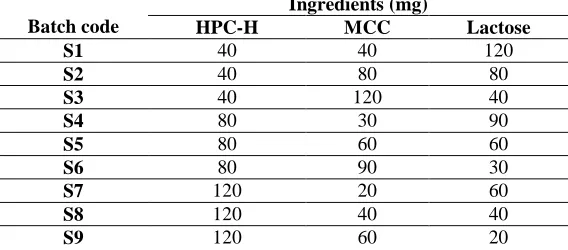
The amount of HPC-H was evaluated at 40, 80 and 120 mg of the total coating weight and ratio of MCC: Tablettose 80 was evaluated at 25:75, 50:50 and 75:25. The core tablets containing MTX (30 mg), Starch 1500 and HPC-M were prepared by direct compression using 8 mm flat punch. The total weight of core tablet was kept 150 mg. In second factorial design composition of core tablet was kept constant as per optimized batch from first factorial design. The composition of core tablet is given in Table 4.11. Total weight of polymer and ratio of Excipient (MCC and lactose) in coating material were optimized in second factorial design. The Composition of coating material for all batches is given in Table 4.13. The weight of coating material was kept 200 mg for all batches.
Compression coating of core tablets
788
was layered uniformly over the tablet. The tablets were compressed to obtain hardness of 6-7 Kg/cm3. The weight of all tablets was kept 350 mg
Statistical analysis
The results of ANOVA for factorial design batches are depicted in Table 8. The results of Tukey test are depicted in Table 4.19. To demonstrate graphically the influence of each factor on responses, the response surface plots were generated using Sigma Plot software (Sigma Plot Software 8.0, SPSS, USA). The response surface plots for factorial are depicted as Figure 5.13. The value of P<0.05 was considered to be significant.
Kinetic treatment of dissolution profiles
Swellable polymer hydrogels have several important characteristics that play an essential role in drug diffusion including swelling ratio and specific mesh or pore size. Swelling ratio describes the amount of water that is contained within the hydrogel at equilibrium and is a function of the network structure, hydrophilicity and ionization of the functional groups. The pore size is the space available for drug transport. The drug characteristics are as important as those of the gel. The size, shape and ionization of the drug affect its diffusion through the gel layervi.
The drug diffusion through most types of polymeric systems is often best described by Fickian diffusion, but other processes in addition to diffusion are also important. There is also a relaxation of the polymer chains, which influences the drug release mechanism. This process is described as non-Fickian or anomalous diffusion. Release from initially dry, hydrophilic glassy polymers that swell when added to water and become rubbery, show anomalous diffusion as a result of the rearrangement of macromolecular chains. The thermodynamic state of the polymer and the penetrant concentration are responsible for the different types of the diffusion. A third class of the diffusion is Case II diffusion, which is a special case of non-Fickian diffusionvii. A simple, semi-empirical equation given by Korsmeyer and Peppasviii (Eq. 4) was used to analyze data of controlled release of drugs from polymer matrices.
Mt/M∞ = ktn --- (4)
Where,
Mt is amount of drug release at time t,
M∞i s t o t a l a m o u n t o f d r u g p r e s e n t i n f o r m u l at i on ,
k is release rate constant depend on geometry of dosage form and n is diffusion exponent indicating the mechanism of drug release.
If the value of n is 0.45 indicate fickian diffusion, between 0.45 and 0.85 indicate anomalous transport and 0.85 or more indicates case-II transport.
CONCLUSION
789
[image:4.595.156.440.527.652.2]appropriate combination of polymer and excipients in coating layer. The release mechanism of MTX from the compression coated tablets was controlled by the rate of water uptake into the core tablet, which in turn was dependent upon the channeling agent used, the type and concentration of polymer. The hydration and swelling of these polymers results in the formation of gel which control the release of MTX from tablet. The hydrophilic lactose forms channels within the coating layer and thus increase the drug release, whereas MCC swell in initial period and atlast erodes along with polymer.
Table 1 Composition of core tablets for all batches in second factorial design
Table 2 Full factorial design for coating material in second factorial design
Batch code Coded level Actual value
(mg)
Actual value (%)
X1 X2
X1 X2
MCC:Lactose HPC-H S1 S2 S3 S4 S5 S6 S7 S8 S9 -1 -1 -1 0 0 0 +1 +1 +1 -1 0 +1 -1 0 +1 -1 0 +1 40 40 40 80 80 80 120 120 120 25:75 50:50 75:25 25:75 50:50 75:25 25:75 50:50 75:25
Table 3 Composition of coating material for all batches in second factorial design
The type of polymer, the type of channeling agent and swellable inert excipients in core as well as compression coat was statistically optimized using factorial design. The tablets of the promising batches were found to be stable for three months under accelerated stability studies. The optimized batches from both factorial design were compared using similarity and
Ingredient Quantity (mg)/ Tablet
Methotrexate HPC-M Starch (Starch – 1500)
30 30 90
Total weight of core tablet was kept 150 mg
Batch code
Ingredients (mg)
HPC-H MCC Lactose
S1 40 40 120
S2 40 80 80
S3 40 120 40
S4 80 30 90
S5 80 60 60
S6 80 90 30
S7 120 20 60
S8 120 40 40
790
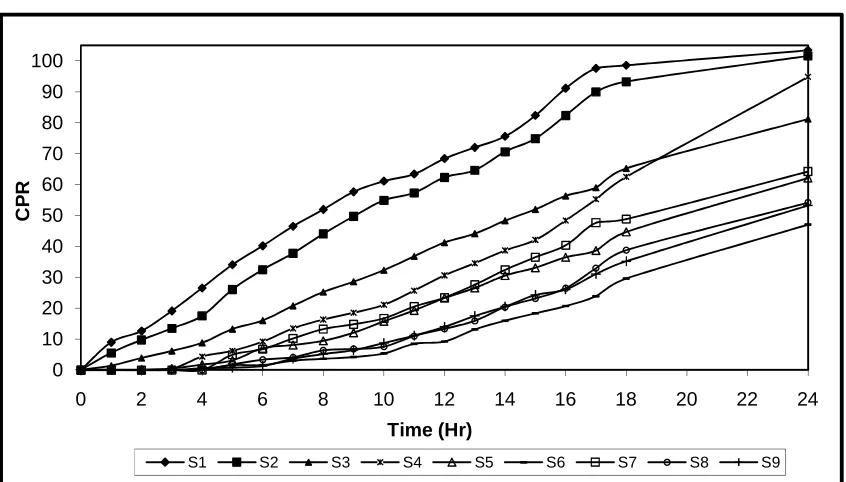
dissimilarity factor. The batches F3 (First factorial design) and S4 (Second factorial design) were found to be similar displayed the zero order release kinetics after lag time of 6 hr.
[image:5.595.156.440.207.345.2]Thus the colon targeted tablet of MTX can be formulated by optimized proportion of HPC and excipients in coating layer as well as in core tablet.
Table 4 Results of evaluation of tablets for factorial design batches
Batch Code
Assay (%) (n = 20)
Average weight (mg) (n =20)
Friability (%)
S1 101.43 342 (1.7) 0.48
S2 103.36 359 (2.9) 0.28
S3 102.54 353 (2.2) 0.42
S4 101.67 344(3.6) 0.38
S5 102.23 340 (1.8) 0.23
S6 102.12 359(2.9) 0.39
S7 99.87 360 (2.3) 0.24
S8 102.48 347 (1.3) 0.41
S9 99.29 362 (3.2) 0.36
Figure 1 Dissolution profiles of tablets for second factorial design
0 10 20 30 40 50 60 70 80 90 100
0 2 4 6 8 10 12 14 16 18 20 22 24
C
P
R
Time (Hr)
[image:5.595.71.494.372.613.2]791
Figure 2 Surface response plot to depict the polymer weight (X1) and the ratio of excipient (X2) on [a] Q4 [b]
Q6 [c]Q12 [d] Q18
-10 -5 0 5 10 15 20 25 30 -1.0 -0.5 0.0 0.5 1.0 -0.5 0.0 0.5 1.0 Q4 X 1 X 2 -10 0 10 20 30 40 50 -0.5 0.0 0.5 1.0 -0.5 0.0 0.5 1.0 Q6 X 1 X 2
[a] [b]
0 1 0 2 0 3 0 4 0 5 0 6 0 7 0 8 0 -1 .0 -0 .5 0 .0 0 .5 1 .0 -0 .5 0 .0 0 .5 1 .0 Q 1 2 X 1 X 2 20 40 60 80 100 120 -1.0 -0.5 0.0 0.5 1.0 -0.5 0.0 0.5 1.0 Q1 8 X 1 X2
[c] [d]
REFERENCES
[1] Mura P and Cirri M., J Drug targt., 11, 2003, 365-71. [2] Mihor F and Iwasa Y., Semin Cancer Biol., 15, 2005, 484-93
[3] Krishnaiah YSR and Satyanarayan S., Advances in controlled and novel drug delivery system, 2001, 89-119
[4] Ciftci K and Groves M., Int J Pharm., 145, 1996, 157-64. [5] Mura P and Cirri M., J Drug targt., 11, 2003, 365-71.