Journal of Chemical and Pharmaceutical Research, 2013, 5(10):377-385
Research Article
CODEN(USA) : JCPRC5
ISSN : 0975-7384
Comparative 4f–4f absorption spectral study for the interactions of
Pr(III) with selected urea and thiourea: Energy and electric dipole
intensity parameters
N. Yaiphaba
Department of Chemistry, D. M. College of Science, Imphal, Manipur, India
_____________________________________________________________________________________________
ABSTRACT
The complexation of urea and thiourea with Pr(III) has been studied in different organic solvents like methanol (CH3OH), acetonitrile (CH3CN), dioxane (C4H8O2) and DMF (C3H7NO) and their equimolar mixtures by employing
absorption difference and comparative absorption spectrophotometry. The complexation of Pr(III) with ureas and thioureas is indicated by the changes in the absorption intensity following the subsequent changes in the oscillator strength of different 4f–4f bands and Judd-Ofelt intensity (Tλ) parameters. The other spectral parameters like energy interaction parameters namely Slater–Condon (Fk), Racah (Ek), Lande (ξ4f), Nephelauxetic ratio (β) and bonding
parameters (b1/2) are further computed to explain the nature of complexation. The difference in the energy parameters with respect to donor atoms and solvents reveal that the chemical environment around the lanthanide ions has great impact on f–f transition and any change in the environment result in modification of the spectra. Various solvents and their equimolar mixtures are also used to discuss the participation of solvents in the complexation.
Key words: 4f–4f Transition spectra, oscillator strength, pseudohypersensitive, nephelauxetic effect
_____________________________________________________________________________________________
INTRODUCTION
The photophysical property of lanthanides has been becoming an active area of research to both chemists and spectroscopists for many years, because of their potential applications in many fields. Most of these applications are based on their luminescent and absorption spectral properties of lanthanides [1-4]. The 4f–4f transition spectra of lanthanide have been found to exhibit significant sensitivity towards even minor change in the immediate coordination environment around lanthanide ion through variation in the absorption spectral pattern, degree of red shift and intensification of 4f–4f bands. The intensities of these hypersensitive transitions [5–9]have also been used extensively between outer and inner sphere coordination, in identifying the coordinating sites of ligands, in determining the immediate coordination environment and in predicting the coordination number of lanthanides. Recently, Khan et al. [10] have used the intensity and band shapes for both hypersensitive and non-hypersensitive transitions in studying the effect of changes in the environment upon 4f–4f absorption spectra of Ho(III) and Er(III) complexes with thiocyanate and 2,2-bipyridine. Our interest in the present study lies in investigating the interaction behaviour of hard metal ion, Pr(III) with ally urea/thiourea and phenyl urea/thiourea having different donor atom with different π-electron density.
______________________________________________________________________________
donor sites (N & O in ureas and N & S in thioureas) which possess different affinities towards different metal ions. The interaction are studied by computation of various spectral parameters namely energy interaction (Slator– Condon (Fk’s), nephelauxetic effect (β), bonding (b1/2) and percent covalency (δ) parameters) and intensity
parameters (oscillator strength and Judd–Ofelt parameters).
EXPERIMENTAL SECTION
2.1 Materials
Ureas (allyl ureas and phenyl urea) and thiourea (allyl thiourea and phenyl thiourea,) from Sisco Chemical Laboratories, Praseodymium(III) nitrate hexahydrate (99.9%) purity from M/S Indian Rare Earths Ltd. are used for synthesis and spectral analysis. The solvents used are CH3OH, CH3CN, DMF and Dioxane which are of A/R grade
from E. Merk.
The absorption spectra of Pr(III) complex with ureas/thioureas were recorded on Perkin Elmer Lambda-35 UV–Vis Spectrometer in the range 350-910 nm. The concentrations of all the solutions were maintained at 0.01 mol L-1. The temperature of all observations was maintained by using Perkin Elmer PTP1 Peltier-temperature system. For a typical absorption study, a solution of Pr(III) nitrate (0.01 mol L-1) and urea (0.01 mol L-1) in double distilled water were added and the resultant mixture was stirred for sufficient time to form the complex in solution. The solution was scanned for the absorption spectra in the spectral region 350 nm – 1000 nm.
2.2 Methods
Nephelauxetic ratio has long been regarded as a measure of covalency. The Nephelauxetic effect has been interpreted in terms of Slater-Condon and Racah parameters, by the ratio of the free ion and complex ion [11-12].
K f K C f K C K
E
E
or
F
F
β
=
(1)Where, FK (K= 2,4,6) is the Slater-Condon parameters and EK, the Racah parameters for complex (C) and free ions
(f) respectively. The bonding parameter and percent covalency are calculated as
2 1 2 1
2
β
1
b
=
−
(2)100
β
β
1
δ
×
−
=
(3)In the electronic transition of 4f-4f, the energy, Eso arises from the most important magnetic interactions, while the
spin orbit interactions may be written as,
4f so
so
A
ξ
E
=
(4)Where Aso is the angular part of spin orbit interaction and ξ4f is the radial integral and is known as Lande’s
parameter. By first order approximation the energy Ej of the jth level is given by Wong[13] as
4f 4f j K K j 4f o K oj 4f K j
ξ
ξ
E
F
F
E
)
ξ
,
(F
E
)
ξ
,
F
(
E
∆
∂
∂
+
∆
∂
∂
+
=
(5)Where Eoj is the zero order energy of the jth level.
______________________________________________________________________________
4f 4f j 2,4,6 K K j j∆ξ
ξ
E
F
E
∆
E
∂
∂
+
∂
∂
=
∑
= (7)By using the zero order energy and partial derivatives of Pr(III) ion given by Wong (7), the above equation can be solved by least squares technique and the value of ∆FK and ∆ξ4f can be found out. From these values the value of
F2, F4, F6 and ξ4f are found out by using equation (6).
The calculation of the band intensities is based upon the theoretical treatment derived by Judd and Ofelt [14]. They considered the transitions are essentially electric dipole in character and the oscillator strength corresponding to the induced electric dipole transition ΨJ →Ψ/J/ as given by
2 N (λλ N 2,4,6 λ
λ
σ
(f
ψ
J
||
U
||
f
ψ
J
)
T
P
=
∑
′
′
=
(8)
Where U(λ) is matrix element of rank λ. The three quantitiesT2,T4and T6 are related to the radial parts of the 4fN wave
functions, the wave functions of perturbing configurations of which the nearest is 4fN-15d.
The measured intensity of an absorption band is related to the probability (P) for the absorption of radiant energy (oscillator strength) by the expression:
( )
σ
d
σ
ε
e
N
2303mc
P
2 i2
∫
=
π
or
P
4
.
318
10
ε
( )
σ
d
σ
i 9
∫
−
×
=
(9)Where ε is the molar absorptivity at the energy σ (cm-1) and other symbols have their usual meaning. From these values the value of T2,T4and T6 are calculated by using
( )
[ ]
[ ]
( )
[ ]
( )
6 2 6 4 2 4 2 2 2obs
U
T
U
T
U
T
ν
P
+
+
=
(10)RESULTS AND DISCUSSION
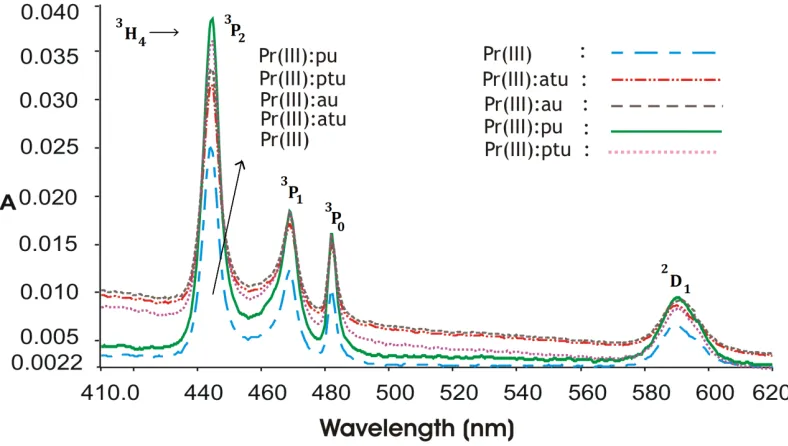
Figure 1 shows the comparative absorption spectra of Pr(III) and Pr(III) with different urea and thiourea in DMF as solvent while Figure 2 shows the comparative absorption spectra of Pr(III) with pu in methanol, acetonitrile, dioxane and DMF. Pr(III) ions observed four energy bands (3H4 3P2, 3P1, 3P0 and 1D2) in the visible spectral
______________________________________________________________________________
[image:4.595.104.498.68.291.2]Figure 1 Comparative absorption spectra of Pr(III), Pr(III):atu, Pr(III):au:, Pr(III):ptu, Pr(III):pu in DMF
Figure 2 Comparative absorption spectra of Pr(III):pu in Methanol, Acetonitrile, dioxane and DMF
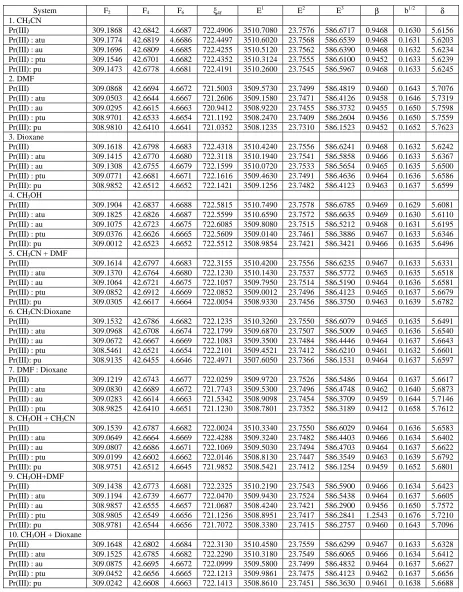
On complexation of Pr (III) with the ureas and thioureas, we observed reduction in the values of interelectronic repulsion parameters, Slator–Condon and spin–orbit coupling constant (Table 1). This phenomenon is referred to as nephelauxetic effect. Nephelauxetic effect is taken as a measure of metal–ligand covalent bonding. This effect may be visualized to be due to an expansion of the wave functions which results from interaction between the metal cations and neighbouring ligands. The Nephelauxetic effect increases as the co-ordination number decreases. For spectral studies on the structures of coordination compounds of lanthanides in solution, any evidence of the relationship between the Nephelauxetic band shift and the structure is of special interest. The variation in the value of Ek (k = 2, 4, 6) corresponds to that in the value of (Fk), since they are interrelated. Misra et al. [17-18] observed a
general decrease in the value of Fk, Ek and ξ4f parameters as compared to corresponding parameters of the free ion.
______________________________________________________________________________
Table 1 Computed value of energy interaction Slater Condon Fk (cm-1), Spin orbit interaction ξξξξ4f (cm-1), Racah energy EK (cm-1),
Nephelauxetic ratio (ββββ), bonding (b1/2) and covalency (δδδδ) parameters of Pr(III), Pr(III):atu, Pr(III):au, Pr(III) : ptu and Pr(III): pu
systems in different organic solvents :
System F2 F4 F6 ξ4f E1 E2 E3 β b1/2 δ
1. CH3CN
Pr(III) 309.1868 42.6842 4.6687 722.4906 3510.7080 23.7576 586.6717 0.9468 0.1630 5.6156 Pr(III) : atu 309.1774 42.6819 4.6686 722.4497 3510.6020 23.7568 586.6539 0.9468 0.1631 5.6203 Pr(III) : au 309.1696 42.6809 4.6685 722.4255 3510.5120 23.7562 586.6390 0.9468 0.1632 5.6234 Pr(III) : ptu 309.1546 42.6701 4.6682 722.4352 3510.3124 23.7555 586.6100 0.9452 0.1633 5.6239 Pr(III): pu 309.1473 42.6778 4.6681 722.4191 3510.2600 23.7545 586.5967 0.9468 0.1633 5.6245 2. DMF
Pr(III) 309.0868 42.6694 4.6672 721.5003 3509.5730 23.7499 586.4819 0.9460 0.1643 5.7076 Pr(III) : atu 309.0503 42.6644 4.6667 721.2606 3509.1580 23.7471 586.4126 0.9458 0.1646 5.7319 Pr(III) : au 309.0295 42.6615 4.6663 720.9412 3508.9220 23.7455 586.3732 0.9455 0.1650 5.7598 Pr(III) : ptu 308.9701 42.6533 4.6654 721.1192 3508.2470 23.7409 586.2604 0.9456 0.1650 5.7559 Pr(III): pu 308.9810 42.6410 4.6641 721.0352 3508.1235 23.7310 586.1523 0.9452 0.1652 5.7623 3. Dioxane
Pr(III) 309.1618 42.6798 4.6683 722.4318 3510.4240 23.7556 586.6241 0.9468 0.1632 5.6242 Pr(III) : atu 309.1415 42.6770 4.6680 722.3118 3510.1940 23.7541 586.5858 0.9466 0.1633 5.6367 Pr(III) : au 309.1308 42.6755 4.6679 722.1599 3510.0720 23.7533 586.5654 0.9465 0.1635 5.6500 Pr(III) : ptu 309.0771 42.6681 4.6671 722.1616 3509.4630 23.7491 586.4636 0.9464 0.1636 5.6586 Pr(III): pu 308.9852 42.6512 4.6652 722.1421 3509.1256 23.7482 586.4123 0.9463 0.1637 5.6599 4. CH3OH
Pr(III) 309.1904 42.6837 4.6688 722.5815 3510.7490 23.7578 586.6785 0.9469 0.1629 5.6081 Pr(III) : atu 309.1825 42.6826 4.6687 722.5599 3510.6590 23.7572 586.6635 0.9469 0.1630 5.6110 Pr(III) : au 309.1075 42.6723 4.6675 722.6085 3509.8080 23.7515 586.5212 0.9468 0.1631 5.6195 Pr(III) : ptu 309.0376 42.6626 4.6665 722.5609 3509.0140 23.7461 586.3886 0.9467 0.1633 5.6346 Pr(III): pu 309.0012 42.6523 4.6652 722.5512 3508.9854 23.7421 586.3421 0.9466 0.1635 5.6496 5. CH3CN + DMF
Pr(III) 309.1614 42.6797 4.6683 722.3155 3510.4200 23.7556 586.6235 0.9467 0.1633 5.6331 Pr(III) : atu 309.1370 42.6764 4.6680 722.1230 3510.1430 23.7537 586.5772 0.9465 0.1635 5.6518 Pr(III) : au 309.1064 42.6721 4.6675 722.1057 3509.7950 23.7514 586.5190 0.9464 0.1636 5.6581 Pr(III) : ptu 309.0852 42.6912 4.6669 722.0852 3509.0012 23.7496 586.4123 0.9465 0.1637 5.6679 Pr(III): pu 309.0305 42.6617 4.6664 722.0054 3508.9330 23.7456 586.3750 0.9463 0.1639 5.6782 6. CH3CN:Dioxane
Pr(III) 309.1532 42.6786 4.6682 722.1235 3510.3260 23.7550 586.6079 0.9465 0.1635 5.6491 Pr(III) : atu 309.0968 42.6708 4.6674 722.1799 3509.6870 23.7507 586.5009 0.9465 0.1636 5.6540 Pr(III) : au 309.0672 42.6667 4.6669 722.1083 3509.3500 23.7484 586.4446 0.9464 0.1637 5.6643 Pr(III) : ptu 308.5461 42.6521 4.6654 722.2101 3509.4521 23.7412 586.6210 0.9461 0.1632 5.6601 Pr(III): pu 308.9135 42.6455 4.6646 722.4971 3507.6050 23.7366 586.1531 0.9464 0.1637 5.6597 7. DMF : Dioxane
Pr(III) 309.1219 42.6743 4.6677 722.0259 3509.9720 23.7526 586.5486 0.9464 0.1637 5.6617 Pr(III) : atu 309.0830 42.6689 4.6672 721.7743 3509.5300 23.7496 586.4748 0.9462 0.1640 5.6873 Pr(III) : au 309.0283 42.6614 4.6663 721.5342 3508.9098 23.7454 586.3709 0.9459 0.1644 5.7146 Pr(III) : ptu 308.9825 42.6410 4.6651 721.1230 3508.7801 23.7352 586.3189 0.9412 0.1658 5.7612 8. CH3OH + CH3CN
Pr(III) 309.1539 42.6787 4.6682 722.0024 3510.3340 23.7550 586.6029 0.9464 0.1636 5.6583 Pr(III) : atu 309.0649 42.6664 4.6669 722.4288 3509.3240 23.7482 586.4403 0.9466 0.1634 5.6402 Pr(III) : au 309.0807 42.6686 4.6671 722.1069 3509.5030 23.7494 586.4703 0.9464 0.1637 5.6622 Pr(III) : ptu 309.0199 42.6602 4.6662 722.0146 3508.8130 23.7447 586.3549 0.9463 0.1639 5.6792 Pr(III): pu 308.9751 42.6512 4.6645 721.9852 3508.5421 23.7412 586.1254 0.9459 0.1652 5.6801 9. CH3OH+DMF
Pr(III) 309.1438 42.6773 4.6681 722.2325 3510.2190 23.7543 586.5900 0.9466 0.1634 5.6423 Pr(III) : atu 309.1194 42.6739 4.6677 722.0470 3509.9430 23.7524 586.5438 0.9464 0.1637 5.6605 Pr(III) : au 308.9857 42.6555 4.6657 721.0687 3508.4240 23.7421 586.2900 0.9456 0.1650 5.7572 Pr(III) : ptu 308.9805 42.6549 4.6656 721.1256 3508.8951 23.7417 586.2841 1.2543 0.1676 5.7210 Pr(III): pu 308.9781 42.6544 4.6656 721.7072 3508.3380 23.7415 586.2757 0.9460 0.1643 5.7096 10. CH3OH + Dioxane
Pr(III) 309.1648 42.6802 4.6684 722.3130 3510.4580 23.7559 586.6299 0.9467 0.1633 5.6328 Pr(III) : atu 309.1525 42.6785 4.6682 722.2290 3510.3180 23.7549 586.6065 0.9466 0.1634 5.6412 Pr(III) : au 309.0875 42.6695 4.6672 722.0999 3509.5800 23.7499 586.4832 0.9464 0.1637 5.6627 Pr(III) : ptu 309.0452 42.6656 4.6665 722.1213 3509.9861 23.7475 586.4123 0.9462 0.1637 5.6656 Pr(III): pu 309.0242 42.6608 4.6663 722.1413 3508.8610 23.7451 586.3630 0.9461 0.1638 5.6688
______________________________________________________________________________
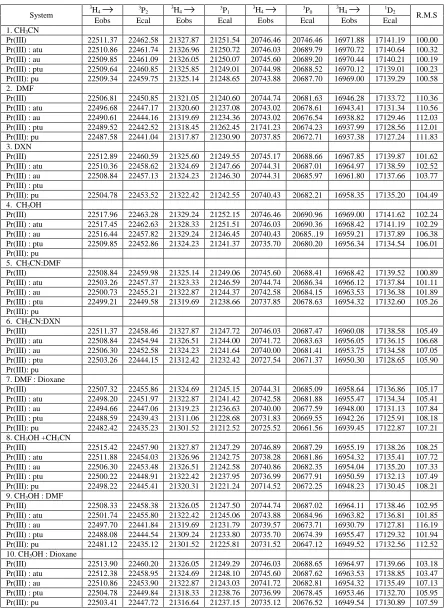
Table 2 Computed and Observed values of Energies(cm-1) and R.M.S. values for Pr(III), Pr(III):atu, Pr(III):au, Pr(III) : ptu and
Pr(III): pu in different organic solvents
System
3H
4
→
3P2 3H4→
3P1 3H4→
3P0 3H4→
1D2R.M.S Eobs Ecal Eobs Ecal Eobs Ecal Eobs Ecal
1. CH3CN
Pr(III) 22511.37 22462.58 21327.87 21251.54 20746.46 20746.46 16971.88 17141.19 100.00 Pr(III) : atu 22510.86 22461.74 21326.96 21250.72 20746.03 20689.79 16970.72 17140.64 100.32 Pr(III) : au 22509.85 22461.09 21326.05 21250.07 20745.60 20689.20 16970.44 17140.21 100.19 Pr(III) : ptu 22509.64 22460.85 21325.85 21249.01 20744.98 20688.52 16970.12 17139.01 100.23 Pr(III): pu 22509.34 22459.75 21325.14 21248.65 20743.88 20687.70 16969.00 17139.29 100.58 2. DMF
Pr(III) 22506.81 22450.85 21321.05 21240.60 20744.74 20681.63 16946.28 17133.72 110.36 Pr(III) : atu 22496.68 22447.17 21320.60 21237.08 20743.02 20678.61 16943.41 17131.34 110.56 Pr(III) : au 22490.61 22444.16 21319.69 21234.36 20743.02 20676.54 16938.82 17129.46 112.03 Pr(III) : ptu 22489.52 22442.52 21318.45 21262.45 21741.23 20674.23 16937.99 17128.56 112.01 Pr(III): pu 22487.58 22441.04 21317.87 21230.90 20737.85 20672.71 16937.38 17127.24 111.83 3. DXN
Pr(III) 22512.89 22460.59 21325.60 21249.55 20745.17 20688.66 16967.85 17139.87 101.62 Pr(III) : atu 22510.36 22458.62 21324.69 21247.66 20744.31 20687.01 16964.97 17138.59 102.52 Pr(III) : au 22508.84 22457.13 21324.23 21246.30 20744.31 20685.97 16961.80 17137.66 103.77 Pr(III) : ptu
Pr(III): pu 22504.78 22453.52 21322.42 21242.55 20740.43 20682.21 16958.35 17135.20 104.49 4. CH3OH
Pr(III) 22517.96 22463.28 21329.24 21252.15 20746.46 20690.96 16969.00 17141.62 102.24 Pr(III) : atu 22517.45 22462.63 21328.33 21251.51 20746.03 20690.36 16968.42 17141.19 102.29 Pr(III) : au 22516.44 22457.82 21329.24 21246.45 20740.43 20685..19 16959.21 17137.89 106.38 Pr(III) : ptu 22509.85 22452.86 21324.23 21241.37 20735.70 20680.20 16956.34 17134.54 106.01 Pr(III): pu
5. CH3CN:DMF
Pr(III) 22508.84 22459.98 21325.14 21249.06 20745.60 20688.41 16968.42 17139.52 100.89 Pr(III) : atu 22503.26 22457.37 21323.33 21246.59 20744.74 20686.34 16966.12 17137.84 101.11 Pr(III) : au 22500.73 22455.21 21322.87 21244.37 20742.58 20684.15 16963.53 17136.38 101.89 Pr(III) : ptu 22499.21 22449.58 21319.69 21238.66 20737.85 20678.63 16954.32 17132.60 105.26 Pr(III): pu
6. CH3CN:DXN
Pr(III) 22511.37 22458.46 21327.87 21247.72 20746.03 20687.47 16960.08 17138.58 105.49 Pr(III) : atu 22508.84 22454.94 21326.51 21244.00 20741.72 20683.63 16956.05 17136.15 106.68 Pr(III) : au 22506.30 22452.58 21324.23 21241.64 20740.00 20681.41 16953.75 17134.58 107.05 Pr(III) : ptu 22503.26 22444.15 21312.42 21232.42 20727.54 20671.37 16950.30 17128.65 105.90 Pr(III): pu
7. DMF : Dioxane
Pr(III) 22507.32 22455.86 21324.69 21245.15 20744.31 20685.09 16958.64 17136.86 105.17 Pr(III) : atu 22498.20 22451.97 21322.87 21241.42 20742.58 20681.88 16955.47 17134.34 105.41 Pr(III) : au 22494.66 22447.06 21319.23 21236.63 20740.00 20677.59 16948.00 17131.13 107.84 Pr(III) : ptu 22488.59 22439.43 21311.06 21228.68 20731.83 20669.55 16942.26 17125.91 108.18 Pr(III): pu 22482.42 22435.23 21301.52 21212.52 20725.52 20661.56 16939.45 17122.87 107.21 8. CH3OH +CH3CN
Pr(III) 22515.42 22457.90 21327.87 21247.29 20746.89 20687.29 16955.19 17138.26 108.25 Pr(III) : atu 22511.88 22454.03 21326.96 21242.75 20738.28 20681.86 16954.32 17135.41 107.72 Pr(III) : au 22506.30 22453.48 21326.51 21242.58 20740.86 20682.35 16954.04 17135.20 107.33 Pr(III) : ptu 22500.22 22448.91 21322.42 21237.95 20736.99 20677.91 16950.59 17132.13 107.49 Pr(III): pu 22498.22 22445.41 21320.31 21221.24 20714.52 20672.25 16948.23 17130.45 108.21 9. CH3OH : DMF
Pr(III) 22508.33 22458.38 21326.05 21247.50 20744.74 20687.02 16964.11 17138.46 102.95 Pr(III) : atu 22501.74 22455.80 21322.42 21245.06 20743.88 20684.96 16963.82 17136.81 101.85 Pr(III) : au 22497.70 22441.84 21319.69 21231.79 20739.57 20673.71 16930.79 17127.81 116.19 Pr(III) : ptu 22488.08 22444.54 21309.24 21233.80 20735.70 20674.39 16955.47 17129.32 101.94 Pr(III): pu 22481.12 22435.12 21301.52 21225.81 20731.52 20647.12 16949.52 17132.56 112.52 10. CH3OH : Dioxane
______________________________________________________________________________
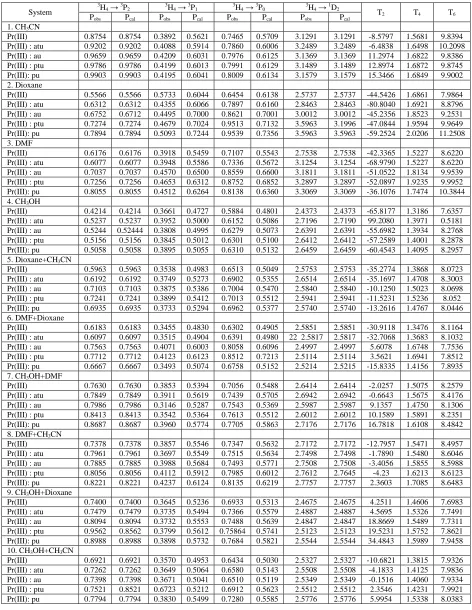
Table 3 Experimental values of oscillator strength (P x 106) (observed and calculated) and Judd-Ofelt parameter (Tλλλλ x 1010) cm-1 for Pr(III), Pr(III):atu, Pr(III):au, Pr(III) : ptu and Pr(III): pu complexes in different organic solvents
System
3
H4→3P2 3H4→3P1 3H4→3P0 3H4→1D2
T2 T4 T6
Pobs Pcal Pobs Pcal Pobs Pcal Pobs Pcal
1. CH3CN
Pr(III) 0.8754 0.8754 0.3892 0.5621 0.7465 0.5709 3.1291 3.1291 -8.5797 1.5681 9.8394 Pr(III) : atu 0.9202 0.9202 0.4088 0.5914 0.7860 0.6006 3.2489 3.2489 -6.4838 1.6498 10.2098 Pr(III) : au 0.9659 0.9659 0.4209 0.6031 0.7976 0.6125 3.1369 3.1369 11.2974 1.6822 9.8386 Pr(III) : ptu 0.9786 0.9786 0.4199 0.6013 0.7991 0.6129 3.1489 3.1489 12.8974 1.6872 9.8745 Pr(III): pu 0.9903 0.9903 0.4195 0.6041 0.8009 0.6134 3.1579 3.1579 15.3466 1.6849 9.9002 2. Dioxane
Pr(III) 0.5566 0.5566 0.5733 0.6044 0.6454 0.6138 2.5737 2.5737 -44.5426 1.6861 7.9864 Pr(III) : atu 0.6312 0.6312 0.4355 0.6066 0.7897 0.6160 2.8463 2.8463 -80.8040 1.6921 8.8796 Pr(III) : au 0.6752 0.6712 0.4495 0.7000 0.8621 0.7001 3.0012 3.0012 -45.2356 1.8523 9.2531 Pr(III) : ptu 0.7274 0.7274 0.4679 0.7024 0.9513 0.7132 3.5963 3.1996 -47.0844 1.9594 9.9649 Pr(III): pu 0.7894 0.7894 0.5093 0.7244 0.9539 0.7356 3.5963 3.5963 -59.2524 2.0206 11.2508 3. DMF
Pr(III) 0.6176 0.6176 0.3918 0.5459 0.7107 0.5543 2.7538 2.7538 -42.3365 1.5227 8.6220 Pr(III) : atu 0.6077 0.6077 0.3948 0.5586 0.7336 0.5672 3.1254 3.1254 -68.9790 1.5227 8.6220 Pr(III) : au 0.7037 0.7037 0.4570 0.6500 0.8559 0.6600 3.1811 3.1811 -51.0522 1.8134 9.9539 Pr(III) : ptu 0.7256 0.7256 0.4653 0.6312 0.8752 0.6852 3.2897 3.2897 -52.0897 1.9235 9.9952 Pr(III): pu 0.8055 0.8055 0.4512 0.6264 0.8138 0.6360 3.3069 3.3069 -36.1076 1.7474 10.3844 4. CH3OH
Pr(III) 0.4214 0.4214 0.3661 0.4727 0.5884 0.4801 2.4373 2.4373 -65.8177 1.3186 7.6357 Pr(III) : atu 0.5237 0.5237 0.3952 0.5000 0.6152 0.5086 2.7196 2.7190 99.2080 1.3971 0.5181 Pr(III) : au 0.5244 0.52444 0.3808 0.4995 0.6279 0.5073 2.6391 2.6391 -55.6982 1.3934 8.2768 Pr(III) : ptu 0.5156 0.5156 0.3845 0.5012 0.6301 0.5100 2.6412 2.6412 -57.2589 1.4001 8.2878 Pr(III): pu 0.5058 0.5058 0.3895 0.5055 0.6310 0.5132 2.6459 2.6459 -60.4543 1.4095 8.2957 5. Dioxane+CH3CN
Pr(III) 0.5963 0.5963 0.3538 0.4983 0.6513 0.5049 2.5753 2.5753 -35.2774 1.3868 8.0723 Pr(III) : atu 0.6192 0.6192 0.3749 0.5273 0.6902 0.5355 2.6514 2.6514 -35.1697 1.4708 8.3003 Pr(III) : au 0.7103 0.7103 0.3875 0.5386 0.7004 0.5470 2.5840 2.5840 -10.1250 1.5023 8.0698 Pr(III) : ptu 0.7241 0.7241 0.3899 0.5412 0.7013 0.5512 2.5941 2.5941 -11.5231 1.5236 8.052 Pr(III): pu 0.6935 0.6935 0.3733 0.5294 0.6962 0.5377 2.5740 2.5740 -13.2616 1.4767 8.0446 6. DMF+Dioxane
Pr(III) 0.6183 0.6183 0.3455 0.4830 0.6302 0.4905 2.5851 2.5851 -30.9118 1.3476 8.1164 Pr(III) : atu 0.6097 0.6097 0.3515 0.4904 0.6391 0.4980 22 2.5817 2.5817 -32.7068 1.3683 8.1032 Pr(III) : au 0.7563 0.7563 0.4071 0.6003 0.8058 0.6096 2.4997 2.4997 5.6078 1.6748 7.7536 Pr(III) : ptu 0.7712 0.7712 0.4123 0.6123 0.8512 0.7213 2.5114 2.5114 3.5621 1.6941 7.8512 Pr(III): pu 0.6667 0.6667 0.3493 0.5074 0.6758 0.5152 2.5214 2.5215 -15.8335 1.4156 7.8935 7. CH3OH+DMF
Pr(III) 0.7630 0.7630 0.3853 0.5394 0.7056 0.5488 2.6414 2.6414 -2.0257 1.5075 8.2579 Pr(III) : atu 0.7849 0.7849 0.3911 0.5619 0.7439 0.5705 2.6942 2.6942 -0.6643 1.5675 8.4176 Pr(III) : au 0.7986 0.7986 0.3146 0.5287 0.7543 0.5369 2.5987 2.5987 9.1357 1.4750 8.1306 Pr(III) : ptu 0.8413 0.8413 0.3542 0.5364 0.7613 0.5512 2.6012 2.6012 10.1589 1.5891 8.2351 Pr(III): pu 0.8687 0.8687 0.3960 0.5774 0.7705 0.5863 2.7176 2.7176 16.7818 1.6108 8.4842 8. DMF+CH3CN
Pr(III) 0.7378 0.7378 0.3857 0.5546 0.7347 0.5632 2.7172 2.7172 -12.7957 1.5471 8.4957 Pr(III) : atu 0.7961 0.7961 0.3697 0.5549 0.7515 0.5634 2.7498 2.7498 -1.7890 1.5480 8.6046 Pr(III) : au 0.7885 0.7885 0.3988 0.5684 0.7493 0.5771 2.7508 2.7508 -3.4056 1.5855 8.5988 Pr(III) : ptu 0.8056 0.8056 0.4112 0.5912 0.7985 0.6012 2.7612 2.7645 -4.23 1.6213 8.6123 Pr(III): pu 0.8221 0.8221 0.4237 0.6124 0.8135 0.6219 2.7757 2.7757 2.3603 1.7085 8.6483 9. CH3OH+Dioxane
Pr(III) 0.7400 0.7400 0.3645 0.5236 0.6933 0.5313 2.4675 2.4675 4.2511 1.4606 7.6983 Pr(III) : atu 0.7479 0.7479 0.3735 0.5494 0.7366 0.5579 2.4887 2.4887 4.5695 1.5326 7.7491 Pr(III) : au 0.8094 0.8094 0.3732 0.5553 0.7488 0.5639 2.4847 2.4847 18.8669 1.5489 7.7311 Pr(III) : ptu 0.9562 0.8562 0.3799 0.5612 0.75864 0.5741 2.5123 2.5123 19.5231 1.5752 7.8621 Pr(III): pu 0.8988 0.8988 0.3898 0.5732 0.7684 0.5821 2.5544 2.5544 34.4843 1.5989 7.9458 10. CH3OH+CH3CN
Pr(III) 0.6921 0.6921 0.3570 0.4953 0.6434 0.5030 2.5327 2.5327 -10.6821 1.3815 7.9326 Pr(III) : atu 0.7262 0.7262 0.3649 0.5064 0.6580 0.5143 2.5508 2.5508 -4.1833 1.4125 7.9836 Pr(III) : au 0.7398 0.7398 0.3671 0.5041 0.6510 0.5119 2.5349 2.5349 -0.1516 1.4060 7.9334 Pr(III) : ptu 0.7521 0.8521 0.6723 0.5212 0.6912 0.5623 2.5512 2.5512 2.3546 1.4231 7.9921 Pr(III): pu 0.7794 0.7794 0.3830 0.5499 0.7280 0.5585 2.5776 2.5776 5.9954 1.5338 8.0383
______________________________________________________________________________
4f–4f bands (irrespective of solvent nature). Consequently, marked variation in the experimentally determined Judd– Ofelt (Tλ) intensity parameters was found. This intensification of 4f–4f bands can be interpreted in terms of interaction of 4f-orbital with ligand wave function. The intensification of bands and red shift were taken as an evidence for the involvement of ligand in complexation. This intensification of 4f–4f bands became more prominent for phenyl than ally urea/thiourea.
In general comparing the variation observed in the energy interaction parameter (Fk and ξ4f) with variation of
oscillator strength and Judd Ofelt parameter (intensity parameter) towards minor coordination changes induced by the bonding of these different ureas and thioureas, it is because of this reason that the discussion of energy interaction parameter and energy parameter has been reduced merely to a minimum while main emphasis has been given for using intensity data for structural elucidation. The significant changes in the Tλ parameters in absence of significant nephelauxetic effect (as observed in present study) also show that the unsymmetrical part of the field has major influence on these parameters. Regarding this, Reisfeld [19] has argued that an increase in covalency is not the sole factor that influences Tλ parameters. The nephelauxetic effect, which is caused by lowering of the excited states of lanthanide ion by the surrounding crystal field, is influenced mainly by the asymmetric part of the crystal field. The values of Tλ parameters change significantly on varying the composition of solvents. T2 is found to be
negative so it is meaningless in the present study. T4 and T6 are affected significantly. Both parameters are related
not only to the immediate coordination changes but also to changes in symmetry properties of the complex species [20]. The different potential donor sites are responsible for the distortion of the polyhedron of oxygen/sulphur around Pr(III), lowering the site symmetry and increasing the probability of the 4f – 4f transition.
Absorption spectra of Pr(III) complex in different organic solvents (Figure 2) clearly shows the affinity of solvents towards the Pr(III) coordination environment. The small differences in the 4f–4f band shape in the different solvents may be related to differences in how the donor groups interact with f-electrons of the lanthanide ion. DMF appears to have strongest influence on Pr(III):pu followed by dioxane and least in acetonitrile. This means that DMF is effective in promoting 4f– 4f electric dipole intensity [21-23], and to cause alternation in strength and symmetry of field about Pr(III). Changes in symmetry around Pr(III) along with invasion of solvent type lead to the intensification of 4f–4f bands.
CONCLUSION
From the above study it can be concluded that (i) The relative sensitivities of different 4f-4f transition bands towards these minor coordination changes and their correlation in terms of different Tλ-parameters also indicated clearly that all the Tλ parameters are exhibiting sensitivities towards the structural changes. In case of Pr(III) , T6 is
most significant followed by T4 while T2 is invalid because sometimes its values is coming negative. ii) Maximum
intensification was induced by phenyl urea while ally thiourea imparted lowest intensity to the 4f – 4f bands. They are observed in the order atu < au < ptu < pu. iii) The solvent also induced varying intensification to the pseudohypersensitive bands; DMF induced maximum intensification followed by solvent mixture comprising of DMF and methanol. Urea in general have been found to be better ligand as compared to analogous thiourea ligands , due to the higher affinity of O-donor atom of ureas by the hard metal ion Ln(III) then S-donor atoms of thioureas . Moreover, the π- electron density have also played a major role towards the intensification of bands.
Acknowledgements
The author acknowledges UGC, New Delhi for financial assistance.
REFERENCES
[1] CK Jorgensen. Absorption Spectra and Chemical Bonding in Complexes, Pergamon Press, Oxford,1962. [2] AA Khan: K Iftikhar. 1994, Polyhedron, 13, 3199–3203.
[3] L Kostova; N Trendafilova; G Momekov. J. Trace Elem. Med. Biol., 2008, 22, 100-106. [4] YU Liang-Cai; LIU Han-Wen; LIU Sheng-Li; Chin. J. Chem. 2008, 26, 2045-2050. [5] RG Pearson. Coord. Chem. Rev., 1990, 100, 403-405.
______________________________________________________________________________
[14] GS Ofelt, J. Chem. Phy., 1962, 37, 511-520.
[15] SN Misra; G Joseph; KJ Shah; K Anjaiah; K Venketasubramanian. Indian Journal of Chemistry, 1990, 29, 267-272.
[16] DG Karrakar. Inorg. Chem., 1967, 6, 1863-1868.
[17] SN Misra; GK Joshi; PP Vaaishnav. Indian J. Pure. Appl. Phys., 1979, 16, 553-558. [18] SN Misra; M Singh, GK Joshi. J. Inorg. Nucl. Chem., 1981, 43, 207-210.
[19] R Reisfeld. Rare Earth Ions: Their Spectroscopy of Cryptates and Inorganic Compounds, Ed; T Schonherr. Structure and Bonding, 2004, 106, 209-235.
[20] SN Misra; SB Mehta. Bull. Chem. Soc. Jpn. 1991, 64, 3653-3658.
[21] Th David Singh; Ch Sumitra; N Yaiphaba; H Debecca Devi; M Indira Devi; N. Rajmuhon Singh. Spectrochim. Acta A, 2005, 61, 1219-1225.
[22] Ch Victory Devi; N Rajmuhon Singh. Spectrochim. Acta A, 2011, 81, 296-303.