Journal of Chemical and Pharmaceutical Research, 2013, 5(9):459-464
Research Article
CODEN(USA) : JCPRC5
ISSN : 0975-7384
Multi-spectrum image fusion using weighted bi-orthogonal self-adaptive
wavelet transform algorithm
FU Yu
The College of Engineering & Design,
Hunan Normal University, Changsha, 410006, China
[email protected]
_____________________________________________________________________________
ABSTRACT
In this paper, an algorithm for multi-spectrum image fusion using weighted bi-orthogonal self-adaptive wavelet transform is put forward, which can make up for the defects that there are faintness of image details in multi-spectrum image fusion of lower contrast image. The self-adaptive method of wavelet coefficients local model maximum which are weighted is used to fuse the high frequency components and the syncretism adaptive method is also chosen to fuse low frequency coefficients. The capability of multi-spectrum image fusion is evaluated by calculating mean grads of image. The experimental results show that the fusion rule of our proposed method is more effective.
Keywords: image fusion; bi-orthogonal self-adaptive wavelet transform; image information entropy; average gradient
_____________________________________________________________________________
INTRODUCTION
In computer vision, Multisensor Image fusion is the process of combining relevant information from two or more images into a single image. The resulting image will be more informative than any of the input images. Multi-spectrum image fusion is a kind of datum fusing technique. We are all used to taking a single photograph of a scene. However, the photographer’s intent is often to capture more than what can be seen in a single photograph. By combining hundreds or even thousands of images we can create images that are much better than a single photograph. Computation to fuse the image set run either in the cloud or on a single machine can result in enhanced images and experiences of the scene. The course of multi-spectrum image fusion is an image synthesis process that can fuse many pictures of the same object which received from the same or different sensors into one picture in a unified coordinate by using appropriate fusion algorithm for image. The complex image can depict the object of research more comprehensive and accurately, as there are information redundancy and complementarities between some images which are waiting for fusing. Multi-spectrum image fusion can provide high-quality image datum for image processing and analysis. Image fusion has become a common term widely used within military, medical diagnostics and treatment,remote sensing, computer vision and other fields [3][10].
very useful tool for fusion. Some other fusion methods are also there, such as Lapacian pyramid based, curvelet transform based etc. These methods show a better performance in spatial and spectral quality of the fused image compared to other spatial methods of fusion.
The images used in image fusion should already be registered. Misregistration is a major source of error in image fusion. Some well-known image fusion methods are: High pass filtering technique, IHS transform based image fusion, PCA based image fusion, Wavelet transform image fusion and pair-wise spatial frequency matching.
The total datum volume of image which is decomposed by using transform is unchanged, because wavelet-transform is non-redundant. Poor correlation deficiencies of information of adjacent image scales are overcome by using wavelet-transform, and it can fully reflect the local mutative characteristics of the original image. It has better effect of fusion than pyramid-decomposition. At the same time, there exist directional peculiarity in wavelet-transform, and we can gain better effect of vision of fused image with the help of this peculiarity. The phase distortion which is brought by the orthogonal filter of orthogonal wavelet transform can cause the fringe information distortion of fusion image, for it has nonlinear phase trait. In the course of fusing horizontal, vertical and diagonal components image detail will become fuzzy, because three high-frequency components of low-contrast images are smaller[2]. We put forward multi-spectrum image fusion algorithm with weighted bi-orthogonal self-adaptive wavelet transform in order to overcome defects mentioned above.
WAVELET DECOMPOSITION OF IMAGE
Multisensor data fusion has become a discipline which demands more general formal solutions to a number of application cases. Several situations in image processing require both high spatial and high spectral information in a single image. This is important in remote sensing. However, the instruments are not capable of providing such information either by design or because of observational constraints. One possible solution for this is data fusion. Supposed 0
,
i l
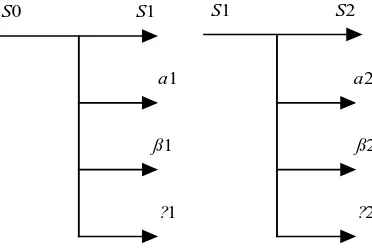
S are the series of remaining scale factors in the scale space, h0and h1are coefficients of low-pass filter and high-pass filter of wavelet function, and these modulus are invariable for all scales[4]. Rapid decomposition of wavelet transform is shown in figure 1.
S0 S1
a1
ß1
?1
S1 S2
a2
ß2
[image:2.595.216.402.414.539.2]?2
Fig. 1: Schematic diagram of the wavelet decomposition
Where
1
, 0 0 ,
,
1
, 1 0 ,
,
1
, 0 1 ,
,
1
, 1 1 ,
,
( 2 ) ( 2 )
( 2 ) ( 2 )
( 2 ) ( 2 )
( 2 ) ( 2 )
j j
i l k m
k n
j j
i l k m
k n
j j
i l k m
k n
j j
i l k m
k n
s h k i h m l s
h k i h m l s
h k i h m l s
h k i h m l s
α
β
γ
−
−
−
−
=∑ − −
=∑ − −
=∑ − −
=∑ − −
(1)
Seen from Figure 1, edges in one scale of the original image can be decomposed into four components in smaller-scale, which are low-frequency component, high frequency component of the level, vertical and diagonal orientation. They represent different information of the original image respectively, and they are gained through four different filters. ,
j i l
s and 1 ,
j i l
s−are obtained by rows and columns orientation low-pass filter, and they are information of the next scale outline. ,
j i l
α is gained by 1 ,
j i l
s− through the row high-pass filter and the column low-pass filter, and it corresponds to the vertical profiles which are mapped by the details information of the level direction. Similarly, ,
express the level profiles which are mapped by the details information of the vertical direction ,
j i l
s , and ,
j i l
γ denotes the details information of the diagonal direction ,
j i l
s [9].
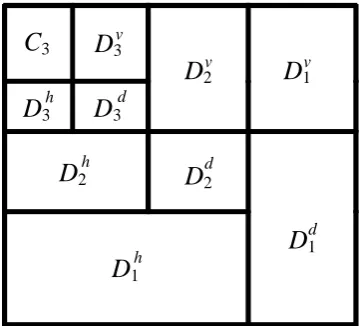
Low-frequency component, high frequency component of the level, vertical and diagonal orientation of image are the results of decomposition of image by two-dimensional wavelet transform. The frame of three layer wavelet decomposition is shown in figure 2. C3is low-frequency component of image, and most of image energy is concentrated in this region. Dj(j 1, 2,3; h v d, , )
λ = λ=
express level, vertical and diagonal component of image, and they are all the details information of image [6].
C
3D
3vv
D
2D
1vd
D
1d
D
2D
2h
D
1h
D
3h
D
3 [image:3.595.216.396.182.345.2]d
Fig. 2: Three layers wavelet decomposition of image The process of fusing is shown in figure 3.
Source image
Source image
coefs
coefs Spatial frequency Spatial frequency
Firing map Firing
map
maximum
Fused coefs Fused
image
reconstruct
Fig. 3: Schematic diagram of basic fusion algorithm
IMPROVED ALGORITHM OF IMAGE FUSION BASED ON WEIGHTED ADAPTIVE BI-ORTHOGONAL WAVELET DECOMPOSITION
Well-designed data fusion strategy is the key to obtain high-quality integration images. The bigger high-frequency component is, the more abundant the details of image are, because it represents the details of image. When we reconstruct image with large absolute value of high-frequency wavelet coefficients, the fused image contains the greater amount of information, that is, the better integration. In order to remedy the edge distortion of image which causes by orthogonal wavelet transform in the course of fusing, improved image fusion algorithm based on adaptive weighted bi-orthogonal wavelet transform is adopted to ameliorate the basic wavelet transform[7]. Concrete steps are as follows:
[image:3.595.189.410.394.526.2]1 1 1 2
, , , ,
, 2 2 , ,
if ( ) ( )
ˆ
else
i k i k i k i k
i k
i k i k
w abs w abs w
w
w
δ δ
>
=
(2)
Where 1 ,
i k
w and 2 ,
i k
w express the wavelet coefficients of two images in scale jand componentλrespectively. 1 ,
i k δ and 2
,
i k δ are coefficients of weight [6].
(3) We process the low-frequency coefficients 1
J C and 2
J
C after the wavelet transform of two images have finished. The fusion rule used by the basic wavelet transform algorithm is selecting larger coefficient in the course of wavelet transform integration commonly, namely, selecting the pixels whose detail features are prominent as image fusing coefficients of band-pass direction (such as absolute value, variance, energy, contrast, etc.). The prerequisite of this rule is assumed that only one image provides useful information, but sometimes this assumption is inappropriate. In many cases, both of the two original images provide useful information. Then the weighted fusion method can serve as a better choice. Therefore, low-frequency coefficients can be ensured by using formula (3) after fusing.
1 2
ˆ
(
(1
)
)
J J J J J
C
=
w C
+ −
w
×
C
(3) Where wJare weighting coefficients.
(4) The reconstruction images can be obtained by using reconstruction formula in which all of the wavelet coefficients wˆi k, and approximation coefficients ofCˆJare used in two-dimensional wavelet transform.
ANALYSIS FOR FUSING EFFECT OF MULTI-SPECTRUM COLOR IMAGE
Abundant detail information is contained in every color images. In order to obtain a clear color image, protect the original color information, to eliminate effect that the lower brightness affects the quality of color image, we can enhance the color image by using formula (4).
' , 1
H j
j L
j
k C k
C C
× > = (4) Where H j
C are high-frequency wavelet coefficients, L j
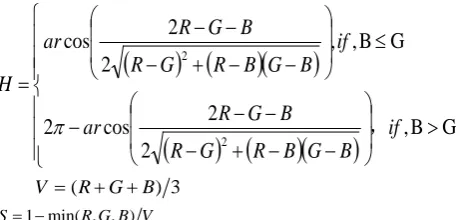
C are low-frequency wavelet coefficients, k is weighted coefficient of high-frequency component, and j is decomposition level of wavelet transform[11]. We can transform tricolor to hue saturation value (HSV) which accords with people's perception beastly by using formula (5).
(
) (
)(
)
(
) (
)(
)
> − − + − − − − ≤ − − + − − − = G B , 2 2 cos 2 G B , , 2 2 cos 2 2 if B G B R G R B G R ar if B G B R G R B G R ar H ,π
( ) 3
V = R+ +G B
1 min( , , )
[image:4.595.75.306.557.667.2]0 0
( ) ( ) ( )
( ) , 0 1, 0,1, , 1
k k
f
K k j r j j
j j
K
r k k
N
S T r w p r w
N N
P r r k L
N
= =
= = ∑ × =∑ ×
= = −
≤≤
(6)
Where N is the total number of pixels, L is gray-scale, NKis frequencies of gray-scale. P rr( )k is frequency that the
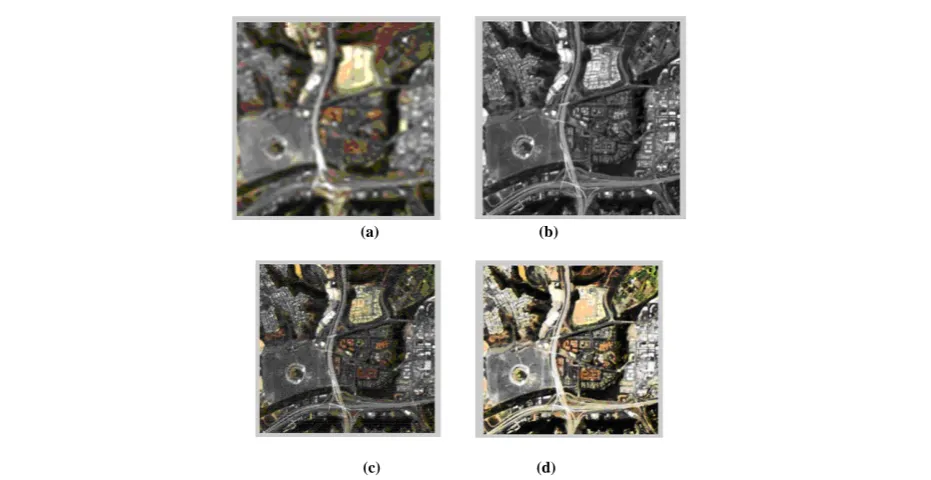
Kth gray-scale appears[12]. Skis the discrete transform of every gray-scale histogram equalization. The result of image fusion is shown in Figure 4 (d), which color image is fused by using improved wavelet transform algorithm that is described in this paper after processing by weighted coefficients[1].
The average gradient not only reflects the tiny details contrast of image, but also reflects the characteristics of texture changes of image. At the same time, it expresses definition of image. If we want to evaluate the capability of fusing image which is fused through multi-spectrum color image, we can define formula (7) to finish it [13].
( )
( )
1_
2 2 2 1 1
1
, ,
M N
x y
i j
G f i j f i j
MN = =
∇ = ∑ ∑ ∆ + ∆ (7)
Where∆xf i j( , ) is first-order differential value of pixels( , )i j in the direction of x, and∆yf(i,j) is first-order
differential value of pixels( , )i j in the direction of y. M and N are rows and columns of image.
(a) (b)
(c) (d)
Fig. 4: fusion of multi-spectrum color image. (a) low-definition multi-spectral image; (b) high-resolution panchromatic image; (c) result of HSV fusion; (d) result of weighted HSV fusion.
[image:5.595.76.542.333.573.2]Performance comparison of multi-spectral image fusion is shown in table 1.
Table 1.Performance comparison of multi-spectral color image fusion
Methods Average gradient of
R
Average gradient of
G average gradient of B
HSV fusing image 13.218 1 13.086 2 12.900 3 HSV weighted fusing image 20.375 9 20.172 1 19.526 1
Seen from table 1, we can conclude that the fusing result of image has smaller distortion and accords with the visual characteristics of the human eye bitterly by using HSV adaptive weighted coefficients to fuse image.
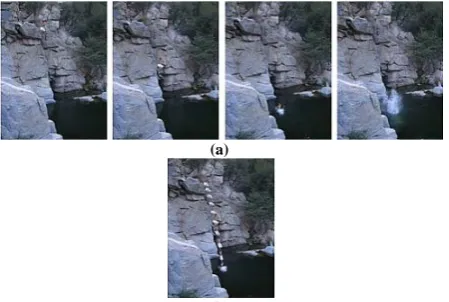
certain events video is the only way to record the moment, as the motion could be a key aspect of that moment. Unfortunately, there are still many challenges with video. Videos tend to be lower resolution and noisier than stills and the display and sharing of videos is still much more challenging than with images.
In this work, we consider the problem of creating a single high-quality still image from a video sequence. The snapshots we produce have higher resolutions, lower noise levels and less blur than the original video frames. In addition, the snapshots preserve salient and interesting objects in the video and uses the best aspects of the video. The result of image fusion is shown in Figure 5.
(a)
[image:6.595.196.421.175.326.2](b)
Fig. 5: fusion of multi-spectrum color image of the snapshots preserve salient and interesting objects in the video. (a) low-definition multi-spectral image in video sequence; (b) result of weighted HSV fusion
CONCLUSION
A multi-spectrum image fusion algorithm based on weighted bi-orthogonal self-adaptive wavelet transform is put forward in this paper. We adopt different amalgamation strategy to fuse multi-spectral color image in experiment. The experimental results show that using image fusion method which is put forward in this article is better than the basic wavelet transform method in image fusion. Obviously, the objective evaluation mechanism of image fusion and subjective visual effects are improved.
Acknowledgment
The paper is supported by “Specialized English Quality Course (for Computer Major)” funded by Hunan Normal University. The author is very grateful for the support provided by the Natural Science Foundation of Guangxi (2013GXNSFAA019336).
REFERENCES
[1]Bayraktar B, Analoui M. Proceedings of SPIE Computational Imaging, 2004,5299:387-398. [2]Chibani Houacine A. Pattern Recog- nition, 2003, 36(4): 879-887.
[3]Choi M, Kim R Y, Nam M R, et al. IEEE Geoscience and Remote Sensing Letters, 2005, 2(2):136-140. [4]Zhang Z, Blum R S. Proceedings of the IEEE, 1999, 87(8): 1315-1326.
[5]Li M, Cai W, Tan Z. Pulse coupled neural network based image fusion. In: Proceedings of the 2nd International Symposium on Neural Networks. Chongqing, China: Springer, 2005. 741-746.
[6]Piella G A. General Framework for Multi-resolution Image Fusion From Pixels to Regions. Elsevier Science, Information Fusion, 2003, 12(5): 225-232.Xu B C, Chen Z. A multi-sensor image fusion algorithm based on PCNN.In:Proceeding of the 5th World Congress on Intelligent Control and Automation. Hangzhou. China: IEEE, 2004, 3679-3682.
[7]Shutao L, James T K, Yaoan W. Pattern Recognition Letters, 2002, 23(8): 985-997. [8]W Gaohong. Journal of Image and Graphics,2001, 16A(4): 38-48.
[9]Zheng Yong-An, Song Jian-She, Zhou Wen-Ming, et al. Acta Automatica Sinica, 2007,33(4):337-341.
[10]Zhiwen WANG,Shaozi LI, Yanping LV, Kaitao YANG. International Journal of Computational Intelligence Systems, 2010, 3(6):745-753.
[11]Zhiwen Wang,Shaozi LI. Information Technology Journal, 2011, 10(12): 2308-2314.