Volume 78 – No.2, September 2013
Watermark based Copyright Protection for Relational
Database
Ramani Sagar V.
Dept. Of Information Science &Engg.
100 Feet ring Road, Banshankari III Stage, Banaglore -560085
ABSTRACT
As information hiding, the digital watermark techniques have been attracting more interests in both research and industrial fields. Relational database is widely used in many information systems, as a tool for storing and managing a data. Major issue to protect the copyright of relational data. In order to make watermarking information more intuitive and easier to identify and to give authorization to the database this idea has been proposed. Ownership verification of a database by inserting an imperceptive watermark in such a way to provide robustness and security against attempts to remove the watermark. To prove ownership of the database watermarking is done using image. Image is converted into the row bits and row bits is encrypted using MD5 security algorithm .This row bits will be embed into the database attribute in terms of watermark. To check the performance of this scheme will be tested based on different types of attacks on the database which shows the robustness of this scheme.
General Terms
Ownership verification, security algorithm ,database watermarking.
Keywords
Database watermarking, image , relational database,MD5 algorithm
1.
INTRODUCTION
Recently, copyright protection of database is important in the field of information technology. This is partly because that the digital data is very easy to be tampered, peculated and illegality copied. Digital watermarking is an approach to cope with this situation. Protection from the piracy of digital assets is usually based upon the embedding of digital watermarks into the data.
1.1
Introduction about watermarking
Ownership verification for digital product by inserting watermark in such a way that it provides robustness against attempts to remove or modification of watermark. It provides a promising method of protecting digital data from illicit copying and manipulation by embedding a secret code directly into the data. In general, the database watermarking techniques consist of two phases: Watermark Embeddingand Watermark Verification. During watermark embeddingphase, a private key K (known only to the owner) is used to embed the watermark W into the original database. The watermarked database is then madepublicly available.
1.2
Copyrighting & Protection
Copyright is a legal concept, enacted by most governments, giving the creator of original work exclusive rights to it, usually for a limited time. One such mechanism is based on Information Hiding. By concealing a resilient rights holder
identity “signature” (watermark) within the digital Work(s) to be protected, Information Hiding for Rights Assessment (Watermarking) enables as an evidence court-time to prove associating particular Works with their respective rights .
1.3
Motivation
In many applications where relational databases are publicly available on the Internet. For example, to provide convenient access to information for users, governmental and public institutions are increasingly required to publish their data on the Internet . The released data are usually in tabular form. They may be statistical data produced by Census Bureau demographic surveys and Federal agencies such as National Center for Education Statistics and Energy Information Administration; they may also be databases released by the Department of Motor Vehicles and Health Maintenance Organizations . In these cases, all released data are public; what is critical for the owner of the data is to make sure that the released data are not tampered with it [1].
[image:1.595.325.538.609.736.2]Databases are the foundations of business systems such as web servers and ERP applications. The data stored within the databases often includes sensitive information such as employee and client details, financial and confidential data. Databases have not been subject to the same security of networks and operating systems and are extremely complex systems. Confidential information kept in databases becomes the purpose of criminals very often. From data of CSI/FBI Computer Crime and Security Survey in 2006 32% organizations found out the unauthorized access to information, 10% organizations –theft of confidential information . Amount of incidents outside of organization and inside it was approximately equal. Respondents of survey estimate the losses caused by various types of computer security incident dropped significantly this year. Total losses are related to the unauthorized access to information and theft of proprietary information for 2006 – $16,651,000 for the 313 spondents. These digits are showing the seriousness of the problem [1].
Volume 78 – No.2, September 2013
2.
LITRETURE SURVEY
In the year of 2000, S. Khanna proposed the idea of controlling the security of database with digital watermark which arouses the researchers’ interests on watermarking database[3]. For embedding images there are two major methods. First method was proposed in 2004 by Zhang[2] . This method uses the order of the marked data for embedding image. Due to the fact that the pixels of image have relative position, and they are sure to be placed in order, this method is vulnerable to conflicting order of embedded marks by some subset attacks. In 2008 Sun introduced another robust technique for embedding images into the database. This method transforms some meaningful images as the copyright information into a bit flow. In this method unlike other algorithms, location of each mark bit (pixel) is calculated according to the hash value that is related to one of the database tuples. Hence this technique can resist against mark out of ordering. On the other hand as this algorithm uses the remainder of hash value modulo length of watermark, to calculate and find specific mark bit location, the algorithm will have a problem if length of watermark (image) increases, or number of database tuples decreases. So this method is vulnerable in placing all of the mark (image) bits and the probability of missing mark bits is notable, especially in case of embedding big size image into the small size database. Watermarking relational databases is a relatively new research area that deals with the legal issue of copyright protection of relation databases. Therefore, literature in this area has been very limited, and focused on embedding short strings of binary bits in randomly selected bit locations in numerical databases. In fact, most bit-level database watermarking algorithms suffer a lack of robustness against bit-level attacks such as bit-setting, bit-resetting and bit-flipping. Other database watermarking algorithms embed watermark information in the statistical properties of the database rather than in the relational data itself.
2.1 Applications of Digital Watermark
for Relational Databases
2.1.1 Ownership Assertion:
Watermarks can be used for ownership assertion. To assert ownership of a relational database, watermark can embed a into database R using some private parameters (e.g. secret key) which is known only to user. Then the watermarked database can make publicly available. Later, suppose any suspects that the relation S published by some has been pirated from the relation R. The set of tuples and attributes in S can be a subset of R. To defeat ownership claiming, one can demonstrate the presence of her watermark in its relation. For such a scheme to work, the watermark has to survive intentional or unintentional data processing operations which may remove or modify the watermark.2.1.2 Fingerprinting:
Fingerprinting aims to identify a traitor. In the applications where database content is publicly available over a network, the content owner would like to discourage unauthorized duplication and distribution by embedding a distinct watermark (or fingerprint) in each copy of the database content. If, at a later point in time, unauthorized copies of the database are found, then the origin of the copy can be determined by retrieving the fingerprint.2.1.3 Fraud and Tamper Detection:
When database content is used for very critical applicationssuch as commercial transactions or medical applications, it is
important to ensure that the content was originated from a specific source and that it had not been changed, manipulated or falsified. This can be achieved by embedding a watermark in the underlying data of the database. Subsequently, when the database is checked, the watermark is extracted.
2.2 Types of Database Watermarking
Need for watermarking database relations to refer their piracy, identify the unique characteristics of relational data which pose new challenges for watermarking, and provide desirable properties of a watermarking system for relational data. Proving ownership rights on outsourced relational databases is a crucial issue in today’s internet-based application environments and in many content distribution applications.2.2.1. Distortion base Watermarking:
The watermarking techniques in this category introduce small changes in the underlying data of the database during embedding phase. The degree of changes should be such that any changes made in the data are tolerable and should not make the data useless. The watermarking can be performed at bit level, or character level, or higher such as attribute or tuple level, over the attribute values of type’s numeric, string, categorical, or any[5].
2.2.2 Distortion frees Watermarking:
Most of the distortion free watermarking techniques are fragile in the sense that in addition to the ownership claiming, they aim at maintaining the integrity of the information in the database. The watermark insertion phase does not depend on any specific type of attribute and does not introduce any distortion in the underlying data of the database.
2.3 Cryptography Overview:
Modern cryptographic mechanisms are mainly based on different, unproven assumptions, concerning easy and hard computation of functions. Cryptography, then, not only protects data from theft or alteration, but can also be used for user authentication. Three types of cryptographic schemes typically used to accomplish these goals: secret key (or symmetric) cryptography, public-key (or asymmetric) cryptography, and hash functions, each of which is described below.
Secret Key Cryptography (SKC): Uses a single key for both encryption and decryption Examples: Data Encryption Standard (DES), Advanced Encryption Standard (AES), Rivest Ciphers,Seeded.
Public Key Cryptography (PKC): Uses one key for encryption and another for decryption . Examples:RSA,Diffie hellman, ElGamal
Hash Functions: Uses a mathematical transformation to irreversibly "encrypt" information Examples: Message Digest (MD) algorithms, hash of variable length,whirpool etc.
2.4 Different Types of Attacks:
Volume 78 – No.2, September 2013
watermarked database may suffer from various types of intentional and unintentional attacks which may damage or erase the watermark, as described below:
2.4.1 Benign Update:
In this case, the tuples or data of any watermarked relation are processed as usual. As a result, the marked tuples may be added, deleted or updated which may remove the embedded watermark or may cause the embedded watermark undetectable . This type of processing are performed unintentionally[5].
2.4.2 Value Modification Attack:
Bit Attack: This attack attempts to destroy the watermark by altering one or more bits in the watermarked data. More information about the marked bit position makes attack more successful. However, in this case usefulness of data is crucial: more alternation may result the data completely useless.
Rounding Attack: Mallory may try to lose the marks contained in a numeric attribute by rounding all the values of the attribute. Success of this attack depends on the estimation of how many bit positions are involved in the watermarking. Underestimation of it may cause the attack unsuccessful, whereas overestimation may cause the data useless[5].
2.4.3 Subset Attack:
Consider a subset of the tuples or attributes of a watermarked relation and by attacking (deleting or updating) on them he may hope that the watermark has been lost[5].2.4.4Superset Attack:
Some new tuples or attributes are added to a watermarked database which can affect the correct detection of the watermark. [image:3.595.53.541.306.623.2]2.4.5 Subset Reverse Order Attack:
Attacker enjoys this attack by exchanging the order or positions of the tuples or attributes in relation which may erase or disturb the watermark[5].Table 1: Comparison between Distortion base watermarking[5]:
Proposed Schemes Watermark Information
Cover Type Granularity Level Verifiability Intent
AHK Algorithm Meaningless bit
pattern Numeric Bit level Blind, private Ownership proof
Gupta et. Algorithm Meaningless bit
pattern Numeric Multi bit level
Blind , reversible,
private Ownership proof
Image Based watermarking Image
Numeric or non numeric multi word
Bit level ,whole attribute value or char level
Blind private Ownership proof and temper detection
Speech based Owners speech Numeric Bit level Blind , private Ownership proof
Content based Database content Numeric Multi bit level Blind ,private
Ownership proof and/or temper detection and localization
Cloud model based
Cloud model with three characteristics Expected value ,entropy, hyper entropy
Numeric Whole attribute
value Non blind private Ownership proof
Categorical attribute based
Meaning full binary
string Categorical Bit level Blind and private Ownership proof
Fake tuple based
Fake information obtain from the database contain
Database table Tuple level Blind private Ownership proof
Virtual attribute
based Database contain Database table Attribute level
Blind , deterministic, private
Temper detection
Others
Meaningful information of any type
Numeric Bit level Blind or non blind
or private Ownership proof
Fingerprinting techniques
Meaningful fingerprint
identifying buyers uniquely
Numeric Bit level Blind private Trailer detection
Table 2: Comparison between distortion free watermarking [5]:
Proposed Schemes Watermark Information
Cover Type Granularity Level Verifiability Intent
Permutation Based A part of group
level Hash value Tuples positions Tuple level Blind private Temper detection
Characteristics based
White image with owner’s mark at four corner
Nil Nil Blind public Temper detection
Binary form relation Relation in binary
form Nil Nil
Blind public or private
Ownership proof or temper detection
R tree based scheme Numeric value identifying owner
Order of entries
[image:3.595.50.537.651.759.2]Volume 78 – No.2, September 2013
3.
DESIGN
Data flow diagram
3.1 Data Flow Diagram –Level 0:
The level 0 is the initial level Data flow diagram and it’s generally called as the context level diagram. . It is common practice for a designer to draw a context-level DFD first which shows the interaction between the system and outside entities. This context-level DFD is then exploded to show more detail of the system being modeled.
The Fig shows the Level 0 data flow diagram. In this level 0 DFD, three external entities have been identified Encrypter who encrypt the given bit image ,Decrypter who identify the given embedded given image & Database.
Database
F
igure 1: Level -0 DFD3.1.1 Data flow diagram for Image embedding in
the database :
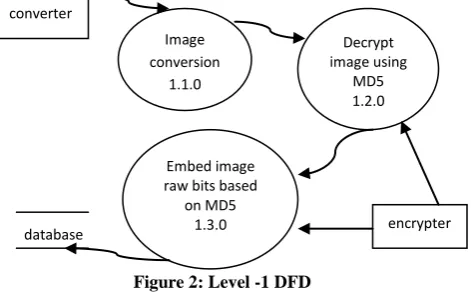
The Level 1 DFD gives more information than the level 0 DFD. Basically there two main process in the database watermarking. First is image embedding into the database and second is image extraction from the database.
This diagram shows the processes contained in to the image embedding phase .Using external entity converter , image is converted into the image raw bits. And the second process shows the image raw bits is encrypted where external entity is encrypter is connected with this process. After in the third process encrypted image raw bits are embedded into the database.
database
Figure 2: Level -1 DFD
3.1.2 Data flow diagram for watermark detection:
This dataflow diagram is related to process of image extraction from the database. First process is showing that extract the image from the database. After in the decryption process the decrypt will decrypt the image using the private key. Third
process is detection of the image base on the raw bits identification.
[image:4.595.311.554.122.319.2] [image:4.595.53.270.281.374.2]Database
Figure 3: Level -1 DFD
3.2 Class Diagram
The class diagram is the main building block of object oriented modeling. It is used both for general conceptual modeling of the systematic of the application, and for detailed modeling translating the models into programming code.
3.2.1 Watermark Insertion:
In this section of the class diagram is related to encryption process. Main class will contain below methods which method is related to which functionality.
Main(): method will initialize the main application
getMD5(): to generate hash value using secret key this encryption method is used
GetConnection(): method will connect the database with application
Concate(): method will concatenate the private key with raw bits for encryption
Image(): this method will get the image
Connectionclose():method will close the connection with the data base
[image:4.595.57.293.539.685.2]getheight( ): return height of the image getwidth( ): return width if the image
Figure 4: Class Diagram for watermark insertion Watermarkinsertion
GetimageInput() GetMD5()
Image() getHeight() getWidth() stringReplaceBit()
Main
Main() Getconnection()
getMD5() ReplaceBit() Connectionclose() converter
Image conversion
1.1.0
1
Decrypt image using
MD5 1.2.0 1. Encrypter
Watermarking process
1.0
decrypter
er
Embed image raw bits based
on MD5
1.3.0 encrypter
Extract image raw bits from tuple attribute
2.1.0 Decrypt
image based on MD5 algo
2.2.0
Detect the watermarked
Volume 78 – No.2, September 2013
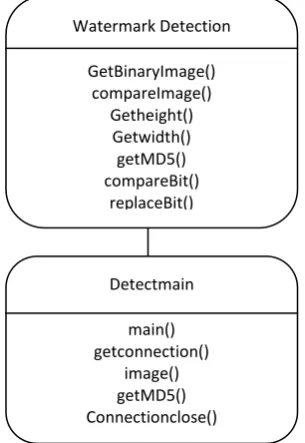
3.3 Watermark Detection
In this section of the class diagram is related to decryption process. Detect Main class will contained below methods which method is related to which functionality.
main():initializing method for application
getconnection():method will connect the database with application
image():method will get the image
connectionClose( ):method will close the connection with the database
GetBinaryImage( ):get the binary raw bits of image from the database
compareImage( ):compare the image with original image getheight( ):return height of the image
getwidth( ):return width if the image
Comparebit( ): compare the extracted raw bits with the original raw bits
[image:5.595.90.243.305.527.2]Replacebit ( ):replace the modified bit with original bit
Figure 5: Class Diagram for watermark detection
5. Implementation
5.1 Modules for database watermarking:
Basically in this project there are two modules and they are 1) watermark insertion into the database2) watermark detection into the database
For both classes method description is as bellow tables:
5.2 Pseudo code:
5.2.1 For insertion Watermark:
1) Take a path for a given database to be watermarked 2) Based on database count no of tuples & no of columns to be watermarked
3) Obtain secret key Sk for MD5 hashing
4) For MD5 hashing obtain primary key P and concatenate with secret key Sk
5) Using MD5 algorithm obtain hash value using combination of P+Sk
6) Mark the tuple based on the hash value If(H_hashvalue mod F= 0) then mark the tuple
Where F= database partitioning value which will be private to the database owner
7) Obtain attribute indexAbased on (H_hashvalue mod V =0) Where V =No of columns of the database
8) Obtain bit indexB which will mark particular bit of attribute based on(H_hashvalue mod ξ= 0) where ξ=private to the owner
9) Select the image bit procedure for the given image bases on hash value generated by the MD5
Select row of image based on (A*V) mod H where H = image height
Select column of image based on H_hashvalue mod W where W = image width
Convert row value into decimal value Convert column value into decimal value
Obtain height & width for marked bit from the image based on hashing algo MD5 concatenated value of row
Select bit of image for marking based on marked bits 10) Select field from database based on hash function
11) Covert attribute field into the binary field
12) Replace in LSB of binary value of attribute with selected image bit
13) Replace new attribute value in the database
5.2.2For watermark Detection:
1) Take a path for a given database 2) Initially totalcount=matchcount=03) Obtain MD5 hashing obtain hash value using P+Sk 4) Detect the tuple based on the following condition IF (H_hashvalues mod F=0)then mark the tuple Where F=data partitioning value which will be private to the owner
Obtain attribute index i = (H_hashvalue mod V=0) where V =No of columns of the database
Obtain bit index B which will mark particular bit of the attribute based on (H_hashvalue mod ξ=0 ) where ξ=private to owner
If(bit index B<=length of selected field ) then
totalcount++
matchcount=matchcount+match(selected field ,bit index, selected bit)
6. RESULT & DISCUSSIONS
6.1 Results Of Diff Attacks Tested on the
local Database:
6.1.1 Attribute Addition attack:
In this type of attack randomly attributes has been added in to the attribute subset of the tuples. Here in this graph it has been shown that even if also attributes added equal to the total attributes subset of the database then also watermark will not be removed using given watermarking scheme.
Watermark Detection
GetBinaryImage() compareImage()
Getheight() Getwidth()
getMD5() compareBit()
replaceBit()
Detectmain
main() getconnection()
Volume 78 – No.2, September 2013
Figure 6:Graph showing attributes addition attack
6.1.2Attribute deletion Attack:
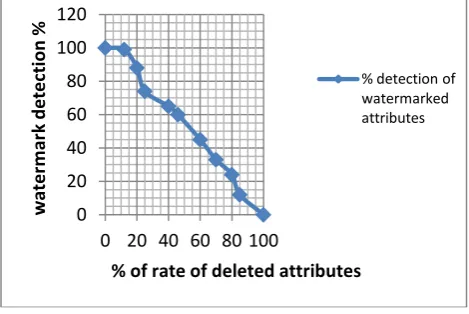
In the given bellow figure it has been shown that eventually when attributes has been removed according to that watermark has been removed. So up to 94% attributes has been deleted watermark has been detected .But when 100 % attribute has been removed it full watermark is removed from the database.
Figure 7:Graph showing Attribute deletion attack
6.1.3Subset Reverse Order Attack:
[image:6.595.304.554.78.272.2]In this attack in the subset of the attributes randomly chosen and after that position of the attribute are randomly disturb or changed. According to that in the given bellow graph up to 100 % reverse ordering of the attribute is done then also 64% of watermark has been detected from the given subset of the database.
Figure 8: Graph Showing Subset reverse order attack
6.2 Screenshots
6.2.1 Watermark insertion phase:
Figure 9:For each and every tuple it based on MD5 generate hash value and calculate attribute index and bit
[image:6.595.53.286.92.269.2]index for each tuple
[image:6.595.55.290.361.518.2]Figure 10: Column and Row value of image
Figure 10: Based on MD5 hashing it will select randomly attribute from the database
Figure 11:For watermarking it will replace LSB with the selected bit of the image and generate new value
0 20 40 60 80 100 120
0 20 40 60 80 100
wat
e
rm
ar
k
d
e
te
ction
%
% of rate of added attributes
% detection of watermarked attributes
0 20 40 60 80 100 120
0 20 40 60 80 100
wat
e
rm
ar
k
d
e
te
ction
%
% of rate of deleted attributes
% detection of watermarked attributes
0 20 40 60 80 100 120
0 20 40 60 80 100
wat
e
rm
ar
k
d
e
te
ction
%
% of rate of deleted attributes
Volume 78 – No.2, September 2013
Figure 12:Same value is replaced in the database in column stock
Figure 13:For next tuple it will check tuple attribute value and here it is not 0 so it will not mark the tuple
6.2.2 Watermark detection phase:
Figure 14:based on selected bit of the image compare a bit of the watermarked attribute
Figure 15:count the total no of watermarked attributes and matched attributes
7. CONCLUSION & FUTURE
ENHANCEMENT
7.1 Conclusion
In the detection phase of the watermarking it is partition based, we are able to detect and locate watermarked tuple attributes as we watermarked in the insertion phase neither watermark generation nor detection depends on any correlation or costly sorting among data items. Each tuple in a table is independently processed; therefore, the scheme is particularly efficient for tuple oriented database operations. This watermarking scheme is robust for two attacks which are attribute addition attacks and subset reverse order attack .and for that result has been shown in the graphs.
7.2 Future Enhancement
For hashing to watermark the database MD5 algorithm is used with concatenation of private key of the relational database instead of that AES algorithm can be used. This scheme is applied on the numeric type attributes only to achieve minimize variation on the attribute .So this scheme can be extended for categorical type attributes also. Here watermarking is done using image and this type of watermarking scheme is distortion base so for the same scheme can be extended for distortion free watermarking also.
8. ACKNOWLEDGEMENT
My guide Mrs. Mamatha H.R. , Associate Professor, IS&E DEPT., PESIT, for the constant help and support extended towards me during this paper work. I would like to take this opportunity to thank her
9. REFERENCES
[1] Andriy Furmanyuk, Mykola Karpinskyy, Bohdan Borowik,” Modern Approaches to the Database Protection”, IEEE International Workshop on Intelligent Data Acquisition and Advanced Computing Systems” 2007
[2] Zhi-Hao Zhang , Xiao-Ming jin, jain-Min wan , “ Watermarking Relational Database Using Image “, IEEE, Proceedings of the Third International Conference on Machine Learning and Cybernetics, Shanghai, 26-29 August 2004
[3] Sanjeev Khanna, Francis Zane.” Watermarking maps: hiding information in structured Data”.Int’l Conf. SODA 2000, San Francisco, California, USA
[4] R. Barnett , “Digital watermarking: applications, techniques and challenges”, Electronics & Communication Engineering Journal AUGUST 1999
[5] Raju Halder, Shantanu Pal , Agostino
Cortesi,”Watermarking Techniques for Relational Databases:Survey”, Classification and Comparison, Journal of Universal Computer Science, vol. 16, no. 21, 2010
[6] Radu Sion, “Database Watermarking for Copyright Protection, Network Security and Applied Cryptography Lab Computer Science”, Stony Brook University
[7] Hossein Moradian Sardroudi, Subariah Ibrahim,” A New Approach for Relational Database Watermarking Using Image,” Universiti Teknologi Malaysia (UTM)”,2006 [8] Yingjiu Li, Robert Huijie Deng, “Publicly Verifiable
Ownership Protection for Relational Databases”, ACM 1-59593-272-0/06/0003, ASIACCS’06, March 21-24, 2006
[9] Hamed khataeimaragheh and Hassan Rashidi,” A Novel Watermarking scheme for detecting and recovering distortions in database tables”, International Journal of Database Management Systems ( IJDMS ) Vol.2, No.3, August 2010
![Figure 1: CSI/FBI Computer Crime Security Survey Data[1]](https://thumb-us.123doks.com/thumbv2/123dok_us/8065113.777617/1.595.325.538.609.736/figure-csi-fbi-computer-crime-security-survey-data.webp)
![Table 2: Comparison between distortion free watermarking [5]:](https://thumb-us.123doks.com/thumbv2/123dok_us/8065113.777617/3.595.53.541.306.623/table-comparison-distortion-free-watermarking.webp)