Exit and Voice in British Workplaces 1979-2000: an Analysis
Using Case Studies and Statistical Material
Donna E Brown
Thesis submitted for the degree of PhD
London School of Economics
UMI Number: U199036
All rights reserved
INFORMATION TO ALL USERS
The quality of this reproduction is dependent upon the quality of the copy submitted.
In the unlikely event that the author did not send a complete manuscript and there are missing pages, these will be noted. Also, if material had to be removed,
a note will indicate the deletion.
Dissertation Publishing
UMI U199036
Published by ProQuest LLC 2014. Copyright in the Dissertation held by the Author. Microform Edition © ProQuest LLC.
All rights reserved. This work is protected against unauthorized copying under Title 17, United States Code.
ProQuest LLC
789 East Eisenhower Parkway P.O. Box 1346
30U9OS3IW0UO03 pue
iBOf^jc/toonusmip
Abstract
The exit-voice model of the labour market hypothesises that employees who
experience a deterioration in working conditions will face a choice between exit or voice.
This thesis uses case study and statistical material to analyse recourse to exit and to voice in
the UK over the period 1979-2000. A major contribution of the thesis comes in its use of
unique data for both statistical and case study analysis. The introductory chapter lays out
the data sets which are employed and discusses their uniqueness.
Chapter 2 illustrates how voice channels have changed over time, before looking at
correlations between collective and individual voice channels and, respectively, satisfaction
with work and labour turnover. The next chapter uses a case study of a food manufacturer
with particularly high absenteeism to test the stylised facts of absence and to investigate
whether absence is a form of voice, indicating unhappiness with conditions of work, or a
form of exit. The fourth chapter examines the strength of voice over time, as illustrated by
trade unions’ and unrepresented employees’ ability to influence workplace change. We
hypothesise that change implies greater employee effort, which should therefore be
accompanied by enhanced remuneration. The link between trade union recognition and the
linking of change and rewards is pursued.
As we discuss in the conclusion, representation in the UK has changed profoundly
over the last twenty five years. Our data confirms the continuation of union influence where
they retain recognition rights, but that this is less common. However, our analysis of new
direct forms of voice shows that they can have positive outcomes for employees and firms.
The thesis makes another contribution in challenging the stylised facts of the phenomena of
Acknowledgements
I would like to thank my formal supervisor Professor David Metcalf and Jonathan
Wadsworth who acted nobly as an informal advisor throughout the life of this thesis; and
Steve McIntosh has also been invaluable in talking through various ideas. Many friends
supported me through the years, Michael Gold, Rajeswary Brown, Maria Daskalaki,
Sukhdev Johal, Catherine Liston-Heyes, David Wilkinson, Theresa Donaghey and Sine
Brown but none more than my long suffering partner Gavin Musson. Without a great deal
of medical help I would have been unable to continue work on the thesis so I owe a great
deal of thanks to Professor Parveen Kumar and to Josephine Lock; in more recent years I
have relied upon Dr Deane Halfpenny, Claire Stilling and Chris Thomas.
Table of Contents
Page
1. Introduction and summary
Introduction
11
Summary
13
2. An examination of voice institutions over time; with an
analysis of the impact of different voice institutions on
workers’ satisfaction and quit rates
Introduction
15
Exit-Voice in the Labour Market
17
Themes and Hypotheses
22
Data
36
Results
43
Conclusions
57
Tables
62
3. Absenteeism
Introduction
76
What Is Meant By “Absenteeism”?
79
Themes and Hypotheses
82
Data
96
Modelling Issues
99
Results
101
Conclusions
117
4. Voice and Workplace Change
Introduction
139
The Context For Negotiated Change
141
Themes & Hypotheses
143
Data
152
Results
156
Conclusions
174
Tables
177
5. Conclusions
Introduction
201
Summary
201
Contribution
205
6. Appendices
Appendix A (chapter 2)
208
Appendix B (chapter 3)
214
Appendix C (chapter4)
233
Tables and Figures
Tables
Page
Chapter 2: Voice
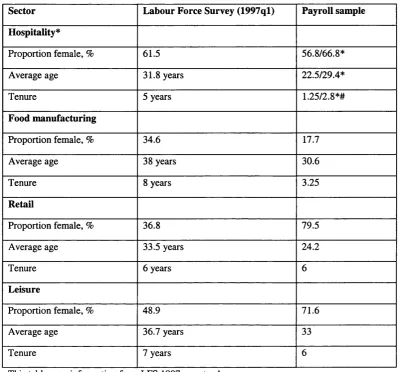
1 A Comparison Of Average Workforce Characteristics In The Primary
Sample With Those In The Labour Force Survey 62
2 A Comparison Of Firm And Industry Wage Means 62
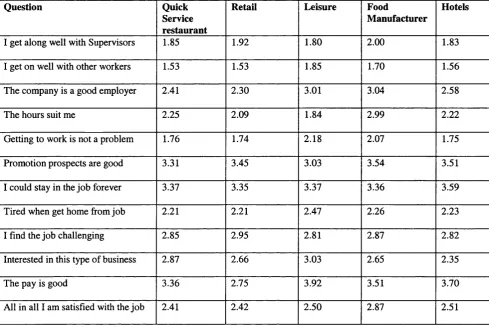
3 Worker Satisfaction With Different Aspects Of The Job, By Company 63
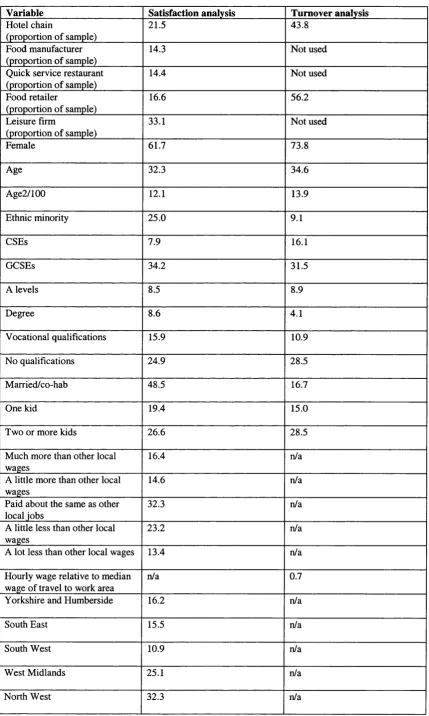
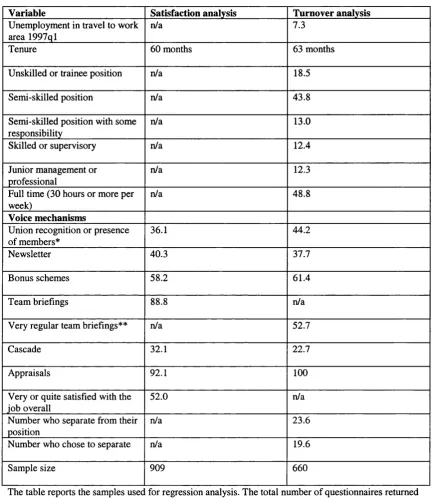
4 Sample Means Of Primary Data Set 64
5 The Incidence Of Voice Mechanisms Over Time,
Work Industrial Relations Surveys 1980/90/98 66
6 The Incidence Of Voice Mechanisms Over Time In The Retail And
Hotel/Restaurant Sectors: Surveys 1980/90/98 67
7 The Incidence Of Voice Mechanisms Over Time In The Food
Manufacturing And Leisure Sectors: Surveys 1980/90/98 68
8 Incidence O f Voice Measures By Site 69
9 Mean Value Of Overall Job Satisfaction, By The Presence Of
Voice Mechanisms 69
10 Cell Proportions For Strength Of Agreement With The Statement
‘All In All I Am Satisfied With The Job’ By Voice Mechanism 70
11 Correlation Coefficients Between Voice Mechanisms And
Satisfaction And Separation Probabilities Of Workers 70
12 Marginal Coefficients From Probit Estimates On Job Satisfaction 71
13 The Marginal Effects Of An Ordered Probit Regression On Employee
Satisfaction, Using A Benchmark Employee 73
Chapter 3: Absenteeism
Page
1 Absence Rates By Industry, WIRS Data 122
2 Absenteeism Statistics For “Bun Factory” 123
3 Absenteeism Variables 124
4 Correlation Matrix For Absenteeism Variables 125
5 Sample Means & Summary Statistics 126
6 Marginal Coefficients For Probit Estimates Of The Probability
O f Time Off 127
7 Benchmark Effects For Estimates Of Probability Of Taking
Voluntary Time Off 128
8 OLS Estimates Of Voluntary Absences: Total Days, Spells And
One-Day Periods 129
9 Marginal Probit Coefficients Indicating The Pressures On Absenteeism 130
10 Satisfaction Levels 131
11 Correlations Between Satisfaction And Absenteeism Variables 132
12 Changes Affecting Workers At The Food Manufacturing Plant 133
13a Difference In Difference Equation For March To May 1995 134
13b Difference In Difference Equation For April To June 1995 134
13c Difference In Difference Equation For October To December 1995 134
13d Difference In Difference Equation For April To June 1996 135
14 Correlations Between Measures Of Absenteeism And Labour Turnover 136
15 Marginal Coefficients From Probit Estimates Of The Probability
O f Leaving 137
Chapter 4: Voice and Workplace Change
1 Negotiations Over Workplace Change, Workplace Industrial
Relations Surveys 1980, 1990, 1998 177
2 CBI Sample Means 178
3 Incidence Of The Introduction Of Workplace Change By Region 180
4 Incidence Of Workplace Change By Sector 182
5 Marginal Effects From Probit Regressions Of The Influences On
The Introduction Of Workplace Change 184
6 Marginal Effects From Probit Estimates O f Influences On The
Introduction Of The Separate Constituents Of Workplace Change 187
7 Ordered Probit Estimates Of The Influences Affecting The Number Of
Individual Constituents Of Workplace Change Which Were
Introduced In Any Year 190
8a Benchmark Effects: Probability Of Multiple Changes: 1979-2000 193
8b Benchmark Effects: Probability Of Multiple Changes 193
9 Correlations Between Workplace Change And Changes To
Hours And Holidays 194
10. OLS Estimates Of Real Wage Increases 195
11 Marginal Effects From Probit Regressions On Changes To
Working Hours 196
12 The Marginal Effects From Probit Regressions On Changes To Holidays 197
13. OLS Estimates Of Real Wage Increases 198
14 The Marginal Effects From Probit Regressions On Changes To
Working Hours 199
15 The Marginal Effects From Probit Regressions On Concessions
Appendices
Page
A1 Primary Data Summary 209
A2 Probit Estimates O f Influences On Job Satisfaction And Labour Turnover 212
B 1 The Manager’s View On Plant Performance, Market
Position And HRM Practices 215
B2 Probability Off July 1995 - June 1996:
Log Likelihood Ratio (Chow) Test 216
B3 Probit Coefficients For Probit Estimates Of The Probability
Of Time Off July 1995 - June 1996, Corresponding To Table 6 217
B4 Probit And Marginal Coefficients For Probit Estimates Of The
Probability Of Involuntary Time Off July 1995 - June 1996 218
B5 Negative Binomial Estimates Of Voluntary Absences:
Total Days And Spells Between July 1995 - June 1996 219
B6 Marginal Probit Coefficients Showing The Pressures On The
Probability Of Being Off Work, July 1995-Junel996,
Corresponding To Table 9 220
B7 Probit Coefficients Corresponding To Table 9, Pressures On The
Probability Of Being Off Work, July 1995-Junel996. 222
B8 Sample Means For The Subset Of Employees Returning
Satisfaction Questionnaires 224
B9 Correlations Between Satisfaction And Absenteeism Variables 225
BlOa Difference In Difference Equation For March To May 1995 226
BlOb Difference In Difference Equation For April To June 1995 226
B 10c Difference In Difference Equation For October To December 1995 227
B lOd Difference In Difference Equation For April To June 1996 227
B 11 Correlations Between Measures Of Absenteeism And Labour Turnover 228
B 12 Probit Coefficients From Estimates Of The Probability O f Leaving
July 1995 - June 1996, Corresponding To Table 15 229
B13 Marginal Coefficients Results Corresponding To Table
15-Pressures On Voluntary Labour Turnover 230
O f Leaving July 1995 - June 1996, Using Lagged Spells Of Absence 232
C l Probit Regressions Of The Influences On The Introduction
O f Workplace Change 234
C2 Probit Estimates Of Influences On The Introduction O f The Separate
Constituents Of Workplace Change 237
C3 OLS Estimates of Real Wage Increases 240
C4 Marginal Effects From Probit Regressions On Changes To
Working Hours 243
C5 Probit Regression Results on Changes to Working Hours 246
C6 The Marginal Effects From Probit Regressions On Changes To Holidays 249
C7 Probit Regressions of the Impact of Workplace Change on
Changes to Holidays 252
C8 OLS Estimates of Real Wage Increases 255
C9 The Marginal Effects From Probit Regressions On Changes To
Working Hours 258
CIO Probit Regressions On Changes To Working Hours 261
C l 1 The Marginal Effects From Probit Regressions On Concessions
On Holidays 264
C12 Probit Regressions On Changes To Holidays 267
Figures
Chapter 3
Chapter 1. Introduction and Summary
Introduction
The exit-voice model of deteriorating relationships argues that consumers or
members of an institution have two options when faced with a decline: they can use voice
to restore the quality of the product or the position of the organisation; or they can choose
to exit the relationship (Hirschman: 1970). This model has an obvious application to the
labour market, suggesting that employees who experience a deterioration in working
conditions face a choice between exit or voice (Freeman: 1976, 1978, 1980). Whilst
Hirschman (1970) originally argued that the choice would reflect the individual’s loyalty,
in the case of an employee the decision will reflect the availability and costs of using voice,
and the availability of alternative work. This thesis uses case study and statistical material
to analyse employees’ recourse to exit and/or voice in the UK over the period 1979-2000.
This period saw a reduction in trade union recognition and membership, and the
development of human resource management emphasising direct communication between
employees and managers and direct involvement schemes designed to capture employees’
tacit knowledge. These changes may have transformed the range of voice options and
affected the cost of choosing to exercise voice. The period also saw two periods of high
(double digit) unemployment and an increase in female labour market participation (Nolan
and Walsh: 1995). These changes may have altered both access to and the cost of exit.
We examine the changing patterns of UK voice mechanisms and the scope of
employee voice using large nationally representative data sets. The pattern of voice across
five national companies is reported, and then data from the same companies is used to
explore the relationship between access to different voice mechanisms and both job
satisfaction and quits. A particularly rich case study explores the issue of absenteeism at a
medium sized food manufacturer in North West London and investigates whether absence
can be construed as a form of exit or a form of voice.
In the tradition of industrial relations, literature from a wide range of disciplines is
used to explore the themes of exit and voice and the associated phenomena of job
sociology, economics, political economy and business history, whilst the techniques are
largely those of a labour economist. A range of data sources are exploited to draw a rich
picture of exit and voice in the UK over the last twenty five years. All chapters rely on the
Workplace Industrial Relations Surveys (WIRS) to provide a sense of context. Drawing on
personnel managers’, financial managers’, trade union representatives’ and, since 1998,
employees’ experiences, the WIRS offer a widely used, rich bank of information. These
surveys represent a collaborative attempt to provide a snapshot of the state of employment
relations at the time of each survey, but also use panel elements to chart changes in
organisational practices. The CBI settlement databank is used to explore the pattern of
workplace change and associated remuneration. Whilst this focuses purely on the private
sector, it offers detailed information on between 950 and 1750 settlement groups for each
year. The survey records changes to working practices, the annual pay settlement and
associated pressures, and organisational characteristics. The sample was based originally
upon the 1978 Census of Production and hence is much broader than members of the CBI
organisation, and has a strong panel element. The surveyors strive to replace organisations
that leave with ones of the same industry and region, to retain the representative nature of
the source.
Another data set is used to explore the pattern of voice mechanisms and their
relationship with job satisfaction and quitting: a five company sample of firms who were
clustered in the bottom quarter of the earnings distribution at the time of data collection,
1996. This sample is interesting not merely for covering workers on relatively low wages,
an area not commonly researched; four of the five also represent the service sector, which
also tends to be neglected. The companies are in the fast food restaurant, leisure, hotel,
retail and food manufacturing industries, and details were provided for plants in six
regional clusters: the South West, North West, West Midlands, the Wales border, North
West London and West Yorkshire. Payroll and personnel information was supplemented
with staff questionnaires recording educational, household composition information and
aspects of job satisfaction. Three firms provided time series information, the retail and hotel
chains and the food manufacturer, which enabled us to pursue issues in greater depth. The
development of a case study of their problems with absenteeism. Each chapter discusses at
length the data used for analysis.
Summary
The first substantive chapter illustrates how voice channels have changed over time,
before looking at correlations between collective and individual voice channels and,
respectively, satisfaction with work and labour turnover. The exit-voice model of the labour
market suggests that providing workers with a channel for grievances and demands may
reduce their propensity to exit. Voice mechanisms also provide workers with opportunities
to offer comments on the work environment and labour process, and may lead them to offer
productivity enhancing suggestions. Such outcomes offer benefits to employers and their
workers. However, unions have been in decline in the UK for more than 20 years, whilst
new individually-oriented voice mechanisms, such as newsletters, quality circles,
appraisals, and team briefings, are increasingly visible. This paper examines the changing
pattern of voice mechanisms in the UK using Workplace Industrial Relations Surveys
(WIRS) for 1980, 1990 and 1998, and in particular looks for evidence that these individual
mechanisms are replacing collective ones. Whilst individual or direct forms of voice have
multiplied, collective forms remain accessible to more than 50 per cent of the surveyed
employees. This chapter then takes a data set of five national UK companies, employing
predominantly female workers in low paid jobs. The picture of voice in this primary data
set is contrasted with that of WIRS. Next, the relationship between different institutional
fora for expressing voice and worker satisfaction is analysed. Job satisfaction is positively
related with the use of direct communication mechanisms, but in contrast to previous work,
there is no evidence of a negative relationship between collective voice and job satisfaction.
Finally, the chapter reinvestigates the relationship between exit and voice using a range of
communication mechanisms as independent variables. Again in contrast to previous work,
union recognition is strongly, positively related to labour turnover, whilst direct financial
involvement is negatively related to quits.
The next chapter uses a case study of a food manufacturer, Bun Factory, with
particularly high absenteeism to investigate whether absence is a form of voice, indicating
demographic and workgroup characteristics is explored, with many relationships running
counter to the stylised facts of absenteeism. Longitudinal analysis, covering a series of
improvements to working conditions, finds no evidence that absence is used to express
voice. However, whilst the discrete improvements have little differential impact across the
skill groups, a decline in absence is exhibited as the changes are rolled in, suggesting that
the outcome was an improved industrial relations climate. The final aim of this chapter is to
identify whether absenteeism is used as a form of exit. A range of “withdrawal” models are
examined, which posit that absenteeism behaviour spills over in to quitting, or that those
who are absent progress to quitting or that absence and exit are alternative forms of
behaviour. Our data suggest that absence may be a form of exit, with employees
progressing from absenteeism to quitting.
The final substantive chapter examines the strength of voice over time, as illustrated by
both trade unions’ and unrepresented employees’ ability to influence workplace issues.
Data from the Workplace Industrial Relations Surveys are used to chart how trade union
negotiation over a range of workplace issues has become less common over time. In the
CBI data set, evidence of the introduction of workplace change, as part of the annual pay
deal, falls over time. This may indicate that managers have been able to shift the frontier of
control in their favour and are able to introduce change without negotiation or alternatively,
that there is little room for further productivity enhancing measures. Given evidence from
other sources, the latter explanation is unlikely. Focusing on negotiations over the rewards
associated with workplace change, the paper hypothesises that change implies greater
employee effort. Therefore it should be accompanied by enhanced remuneration.
Employees’ ability to extract wage compensation for changes has fallen only a little over
the sample period, though recently employees are more likely to be “rewarded” with
improved holidays or working hours arrangements than with enhanced pay rises. Trade
union recognition is positively associated with a greater probability of obtaining
Chapter 2. An Examination Of Voice Institutions Over Time; With An
Analysis Of The Impact Of Different Voice Institutions On Workers’
Satisfaction And Quit Rates
1. Introduction
The exit-voice dichotomy was first discussed by Hirschman in the context of the
declining performance of organisations in 1970. Although the theory was originally
conceived of to explain changes in consumer-buyer relations, this theory lends itself well to
analysis of the labour market. Freeman (1976, 1978, 1980) pioneered the application of
exit-voice theory to the employment relationship, and it has subsequently been used by a
number of academics to illuminate the decision of workers to terminate their employment.
The existence of voice may be of benefit to employees if they feel able to raise grievances
and issues which trouble them. This may feed through to a beneficial effect on morale, their
utility or satisfaction, their productivity and of course the probability of exit. The employer
may benefit if the outcome of voice results in something tangible such as lower labour
turnover, and if the costs of rehiring and training are non-negligible (Mowday et al: 1982).
In the firms examined later in this chapter, employers claim to spend between £200 and
£700 on hiring and training each new recruit. Therefore, voice may offer real benefits in
terms of reducing turnover. Different voice channels may also benefit the employer if they
encourage workers to share their tacit knowledge about the production or service provision
process.
Most existing work focuses on the trade union as the mouthpiece for voice, and
analyses the success of the union as this mouthpiece using nationally representative data
sets. Most of these studies use American data (Freeman: 1976, 1978, 1980; Borjas: 1979):
few have been conducted on the impact of voice mechanisms in the UK. However, it has
been well documented that trade union recognition and membership in most developed
nations has fallen over the last twenty years or so, so relying on trade unions to exercise
voice may no longer be the only option. In the UK, the focus of this study, membership and
there has been a shift from a pluralistic view of industrial relations to a more unitarist
approach, most notably on the part of employers Poole and Mansfield (1993). So whilst
during the 1970s voice mechanisms tended to be formal participatory structures, relying on
representatives, such as shop stewards, worker directors and members of consultative
committees (Marchington et al: 1992a), there has been a substantial growth in interest in
new forms of communication between employers and their staff over the 1980s and 1990s
(Tillsley: 1994). These mechanisms are often more direct, choosing to bypass the use of
labour representatives, and there is a much greater support for schemes to increase the
complexity of the financial relationship between employer and worker.
We are interested in the current pattern of voice and the effects associated with
direct communication channels, as compared to indirect forms of voice. This chapter will
examine the changing incidence of collective and individualistic voice mechanisms in the
UK over the last twenty years using the Workplace Industrial Relations Surveys (WIRS)
series. A five-company data set, comprising regional clusters of sites of nationally
established companies, will be examined for a cross sectional picture of voice mechanisms.
This primary data set has two major strengths. It provides information on sizeable
groupings of employees within identifiable workplaces, so we can choose between
controlling for firm or site specific factors. Additionally, this data can further add to our
knowledge of voice in the UK, as it focuses on service sector workplaces, employing
mainly women and relatively low paid labour. Having offered a picture of the incidence of
different voice mechanisms in branches of these five companies, cross sectional analysis
will be employed to examine the relationship between voice and worker utility or
satisfaction. It may be that satisfaction is a possible stepping stone between voice and exit.
This chapter also uses time series data to re-examine the relationship between voice and
exit in two of the service sector companies.
There are three hypotheses underpinning this research. The first hypothesis is that
voice mechanisms have shifted over time from being collective, representative fora to more
individualistic communication methods. Next we predict that worker utility or satisfaction
is likely to be higher under more direct, company controlled communication mechanisms,
down to workers with this type of mechanisms than through trade union representatives.
These might also satisfy the demand of increasingly better educated workers for both
greater information and more immediate disclosure. Finally, collective procedures give
greater protection to workers, and union recognition often indicates a degree of real power-
sharing. Therefore we hypothesise that employees will be less likely to separate from a
given job if they enjoy some form of collective voice. The structure of the chapter is as
follows: the next section outlines the theoretical work of Hirschman and the application of
his model to the labour market by Freeman. Section 3 discusses literature on employee
voice, and its links with both satisfaction and separations, and generates some testable
hypotheses. The data section introduces both the Workplace Industrial Relations Surveys
and the primary data set and considers methodological issues arising from the choice of data
and techniques, section 4. Section 5 outlines both a longitudinal and cross sectional pattern
of voice mechanisms, before exploring the relationships between voice and satisfaction and
voice and separation. Conclusions are offered in Section 6.
2. Exit-Voice in the Labour Market
Hirschman’s (1970) thesis first presented the dichotomy between exit and voice.
He was concerned primarily with developing a model which could predict behaviour when
the quality of a product one consumed deteriorated. Whilst he did not touch upon analysis
of labour market relationships, he did suggest that the model could be applied to the
behaviour of members of an organisation, such as a trade union, which was in the midst of a
period of decline. Existing competitive theory did not touch upon the behaviour within a
firm, and predicted that an organisation in decline would lose customers, almost
immediately go out of business and be replaced by a more successful operator. This would
restore the competitive nature of the industry, and the speed of adjustment would ensure
that there was little loss in utility to consumers. Hirschman sought to bring a little realism to
economic models and argued that consumers need not exit from their relationship with a
supplier. Instead they could choose to exercise voice in order to encourage an improvement
in the firm’s performance, and presumably the quality of the good. Similarly members of an
institution could chose to remain so and fight for a restoration of previous performance
than economics, and the exercise of voice did not appear a particularly rational economic
activity.
Hirschman believed that the deciding factor when faced with the choice between
voice and exit was loyalty. Whilst loyalty to a product might seem a little unlikely unless an
alternative was rare, this concept makes more sense when considering membership of an
institution. If individuals feel a sense of loyalty, he argues, then it is more likely that they
will stay to press for a restoration of previous high standards or good performance.
However, it is not made clear whether the use of voice at this stage is an alternative or a
prelude to exit. This reference to loyalty is one of the weak spots of Hirschman’s model.
Whilst loyalty is used to explain the choice between the use of exit or voice, he also argues
that the use of voice increases inversely to the probability of exit. This ignores any
consideration of the importance of the ability to articulate grievances for voice, and the
degree of mobility for exit. In the case of employees it seems no more likely that those who
are trapped in a particular job or a situation which deteriorates, will use voice than those
who are mobile. Without the right forms of protection, such as the right to express concerns
through a spokesperson, exercising voice might make this employee’s situation worse - an
outcome which could deter them from making criticisms or contributions. In a critique of
the exit-voice model as applied to the labour market, Boroff and Lewin (1997) suggest that
rather than choosing voice over exit, those who are loyal will stay silent despite their
grievances or dissatisfaction. However, whilst this is a valid criticism their own
interpretation of this model also has flaws. They continue to overlook the issue of
constrained employee mobility, and their data set is comprised of individuals who have
filed a grievance, making their test one of ex-post loyalty. The probability of choosing voice
over exit will also be affected by the costs of voice compared to exit and the probability of
success. Both of these probabilities are increased when several individuals combine
together to exercise their voice, with the caveat that as the group grows larger there may be
a greater probability of free riding. In the case of a membership of an institution, rather than
consumption of a product, forming a group protects individuals from retaliation and hence
they may be more willing to make complaints. Formalisation of the role of voice will also
help to reduce the costs of a response each time action is required to improve performance
model. Those with little ability to find another source for the product (or another job)
locally, or to relocate have little chance to exit the relationship. This lack of an exit option
is likely to limit their use of voice. A final weak spot in the original Hirschman model, and
one that is not touched upon in more recent discussions of exit-voice, is the assumption that
voice should or can be used to restore conditions or performance to the original level. This
implies that the original situation was pareto-optimal and that voice has no role in the fight
for continued improvements, be they in products, services or working conditions.
The exit-voice model has an obvious application with respect to labour turnover;
this application of Hirschman’s model was first explored by Freeman in the 1970s (1976,
1978, 1980). By extending the model to the analysis of dissatisfied group members and
their choice of voice or exit to employees, Freeman (1978) justified the examination of a
subjective variable such as worker satisfaction by economists. Freeman’s work contains
little direct engagement with the philosophical underpinnings of Hirschman’s model. Yet,
whilst within the Hirschman model there is no conception of collective action, Freeman’s
application takes for granted the impossibility of individual activity to improve conditions.
Applied to the labour market, a fall in utility leads to a choice between exit - quitting - or
using a trade union to exercise voice.
Therefore the existence of, and choice between, voice mechanisms is of interest to
both workers and their employers. The existence of voice mechanisms within a workplace
presents the dissatisfied worker with a choice. Exit may entail costs in the form of lost
economic rents and the need to search for a new position, so they may prefer to rely on
voice to raise grievances, bring new issues to the bargaining agenda and establish a system
of jurisprudence or regimen for dealing objectively with situations. Through these differing
roles the trade union can come to represent a “dual authority channel”, (Freeman: 1980, p
647). Firms can also benefit from the provision of voice channels. Vroom (1964) argues
that encouraging participation can bring benefits because generating a greater sense of
democracy will lead to coherent norms and therefore create a unified team. Worker
satisfaction may be higher in the presence of a mechanism for manifesting discontent, and
this may in turn feed into more tangible economic benefits for the firm. If the purported
the establishment of voice mechanisms. Therefore, the firm will retain its firm-specific
human capital and save on hiring and training costs. Turnover has indirect costs too; those
involved in training and mentoring recruits are likely be less productive than when engaged
in their normal tasks, a problem which is lessened by fewer separations.
Whilst trade union presence has traditionally been seen as necessary to persuade
employers to treat employees fairly and offer the best terms and conditions, Freeman (1990)
points out that it is not inconceivable that non-unions firms will offer their workers positive
personnel and labour relations. This may form part of an anti-union strategy or a policy to
improve industrial relations. Similarly the type of institution best suited to expressing voice
may have changed over time. The history of the trade union movement in the US reveals
the importance of creating independent voice mechanisms in order to generate employee
confidence. Whilst works councils or company unions were not uncommon in US firms
during the 1920s they did not embody the degree of independence desired by the workforce
(Fairris: 1997), and dealt with shopfloor issues rather than collective bargaining. These
mechanisms were associated with higher productivity and lower rates of injury, but during
the depression employees saw that these forms of voice were limited and offered no chance
to improve job security. As involuntary exit slowed so discontent grew. The New Deal of
the mid 1930s gave support to workers’ demands for independent voice. Fairris views post
World War II developments in industrial relations negatively. He claims that relations
became more formalised, which reduces the cost of exercising voice, and that trade union
leaders became more instrumental. The government intervened again, though this time in
favour of capital, to identify areas which they considered should definitely be subject to
discussion, such as wages, and those which need not be, such as technical change. The
1990s, he claims, have seen the end of adversarial relations in the US, and unions are no
longer the only suitable channel for voice. This is due to a change in technology and a more
co-operative approach to industrial relations from employers.
The UK, and indeed many other nations, have seen employers attempt to foster a
sense of unitarism within their workplaces (Boxall and Purcell: 2003). New approaches to
employee involvement are evident, involving direct forms of employer-worker
this shift in communication methods to more direct methods represents a desire to sideline
trade unions; Morgan and Sayer (1985) argue that this was particularly true of Foreign
Direct Investment plants springing up in 1980s. However, the drive for change may have
come from both workers and employers, indicating a broader agenda than the side lining of
trade unions. Representative mechanisms in particular may discourage high levels of
involvement, whilst the new types of voice mechanism reflect a change in the
characteristics of the workforce: employees may be less inclined towards mechanisms
which treat them as a homogeneous mass, being more demographically diverse and better
educated. At the same time the passing of the 1999 UK Employment Relations Act, with its
(limited) support for employees’ right to trade union recognition, indicates that trade unions
are once again viewed as an important channel for voice.
Whatever mechanisms are used to channel voice it is vital that they command the
confidence of workers. Whilst the type of voice mechanisms associated with Japanese
industrial relations, such as quality circles and team working, have become widespread Park
(1983) dismisses such fora as being purely motivated by the desire to boost profits without
any form of power sharing:
“participation in Japan aims at mobilising workers at shop-level and enhancing
productivity (micro-economic goals). The participation in Germany is expected to
reach equal distribution of power and influence in the whole society (macro-
economic goals)“ (1983: p i 3).
Kelly and Kelly (1991) point to the historically low levels of trust between workers and
employers to explain poor industrial relations in the UK. New voice mechanisms, which
offer more direct communication or gain sharing can theoretically result in a positive sum
gain, but they may not live up to the theory (Ramsay: 1985). New more direct methods of
communication, emphasising employee involvement, may conceal a desire to subjugate
employees (Delbridge and Tumball: 1994). Communication mechanisms which fail to
protect workers who raise grievances or concerns cannot reduce the costs of voice relative
to exit. Schemes or plans which do not involve power sharing, and fail to instil confidence
capture tacit knowledge. Terry (1999) reports on the collapse of non-union works councils
in the UK, as a worsening of economic conditions resulted in redundancies, illustrating the
need for employees to have independent voice mechanisms.
Hirschman’s theory of exit-voice, though flawed, can usefully be applied to analysis
of the employment relationship. The theory suggests that voice can bring benefits for both
the employer and workers, though as emphasised, channels for voice must operate
independently of managers to gain confidence and should at least act as a restraint to the
arbitrary exercise of power by management. Failure to observe these requirements will
make exit relatively more attractive. The discussion will now move on to look at the pattern
of voice mechanisms in the UK over the last 20 years.
3. Themes and Hypotheses
a) The Pattern Of Voice
A number of typologies of voice mechanisms have been devised, grouping
together separate communication and involvement channels on the basis of their
characteristics, or potential benefits, or the degree of power sharing they entail. Of course,
the simplest application of exit-voice to the employment relationship, as per Freeman in the
late 1970s, would only consider trade unions. This reflects the assumption that voice can
most successfully be exercised collectively, through formal power-sharing channels.
However, trade unionism has been decreasing in many developed counties for some time
and a number of new forms of voice have come to the prominence. Levine and Tyson
(1990) made a thorough analysis of the benefits of different participation or voice
mechanisms, devising a typology encompassing four categories: consultative; substantive;
financial; and representative. Fora such as joint consultative committees (JCCs) and
possibly team briefings represent consultative mechanisms, offering the employees chance
to mention grievances and suggestions without any degree of power sharing. The trade
union differs from the JCC in that it has a right to negotiate, at least over issues such as pay
and working conditions. In this way it represents Freeman’s “dual authority” (1980: p647)
and falls into both the substantive and representative categories. Other forms of voice might
might be autonomous work teams, though this represents a narrow form of direct voice on
quality related issues. The final category, financial schemes, has become increasingly
prevalent in the UK, in the form of bonuses, profit share, share ownership or merit pay.
Marchington et al (1992a) developed a similar typology to classify employee
involvement schemes, in that they too devised categories for representative and financial
schemes. They also introduced two different categories, having identified a number of
“downward” channels for communication of management edicts, such as use of the
management chain, newsletters or cascade meetings. The corresponding “upward” category
covered mechanisms such as quality circles, and possibly team briefings, designed to
encourage problem solving and pass information up the hierarchy.
The trade union is the traditional channel for expressions of worker voice,
constituting an indirect, representative form of communication between employees and
their employer. The trade union has two roles: that of a vested interest; and to act as a sword
of justice. To defend its vested interests the union undertakes to bargain collectively over
wages at the establishment, and in acting as a sword of justice its shop floor representatives
act as a channel for grievances and demands, and challenge any perceived unfairness. This
does not seem to leave much room for the exchange of productivity enhancing ideas, which
suggests that the benefits from using a trade union as the voice channel accrue solely to
labour. However, as Freeman and Medoff explain :
“[OJne reason for the lower quits under unionism is the dilution of managerial
authority over workers by a system of negotiated rules and procedures in which
workers have a right to appeal and obtain reversals of management decisions.”
(1984: p i 07),
which indicates that employers may benefit indirectly from a reduction in workers choosing
the exit option. These lower quit rates will reduce companies’ costs and should theoretically
feed in to higher productivity levels. The jurisprudence role of unions identified by Freeman
and Medoff (1984) probably goes further towards satisfying the sword of justice role of
JCCs are an indirect voice forum, which emerged in Britain following the
recommendations of the Whitley Committee in the 1920s. These can operate on a company-
wide or on a plant basis, in that way resembling the Works Council which is commonly
seen in many mainland European counties. However, whilst Works Councils in Europe are
legally mandated, and in many countries have powers of co-determination, the British JCC
is typically a voluntarist institution. The rules of operation tend to be laid down by
management, and the JCC traditionally only enjoys consultation not negotiating rights. This
form of voice may offer tangible benefits to the employer, without the power-sharing
associated with a trade union. For example, Morishima’s (1991) study of the effects of
Japanese consultative committees found information sharing positively affected firm
profitability and employee productivity. However, workers may gain something from the
presence of a JCC, grievances can be conveyed by representatives rather than having to be
expressed openly, and after all:
“[tlhe voice of a legally mandated works council may be weak compared to that of a
union but it is still a voice that management will hear” (Freeman: 1990, p331).
The decisive factor in determining whether such an institution can work without
legal support is the level of trust which develops between the employer and the workforce.
The workforce is unlikely to use the JCC to raise grievances or offer suggestions for
improvements if these fail to result in job security and gain sharing. Council representatives
will be less well equipped to negotiate with employers than trained union stewards, so non
union councils facing crisis face two potential fates: union take over, or collapse (Terry:
1999). UK health and safety committees represent a form of JCC. They operate at the level
of the establishment, but where unions have recognition their presence is mandatory
(ACAS: 1994). By providing a formal arena for the expression of safety related concerns
they are likely to satisfy a limited voice role.
As outlined by Freeman and Medoff (1984), US grievance procedures are most
commonly found in unionised establishments, though they may be introduced by employers
formalisation of UK industrial relations, so it seems likely that W1RS will show a every
high rate of incidence of formal grievance policies. The provision of grievance policies to
enable dissatisfied workers to pass their complaints upwards is of fundamental importance
in creating room for voice. However, without some form of supporting institution, or means
to guarantee anonymity, the costs of exercising voice in this way will be too high for some
individuals.
Changes in the type of voice mechanisms employed can be explained by the
increase in product market competition, by the changing composition of labour - away from
a homogeneous mass of males open to union recruitment, or more simply by a desire of
managers to follow the latest trend in communication schemes. Others argue that the choice
of voice channels follows cycles or waves of influence, according to whether employers or
workers hold the upper hand in the employment relationship (Ramsay: 1977; Marchington
et al: 1992b). During the 1980s a host of new types of employee involvement mechanisms
were introduced (Leighton et al: 1991; IRS: 1993). The immediate aim of employers was to
improve productivity by encouraging workers to share their ideas (Tillsley: 1994), but it
was in part driven by the desire to generate a more unitarist atmosphere within firms. This
unitarist approach to industrial relations was linked to the rise of human resource
management and this required that firms moved away from reliance on representative fora
in favour of direct communication, both upward and downward. This emphasis on direct
communication fits with the increased role of line managers in running both production
issues and personnel matters. The abandonment of collective voice channels was something
that the UK government actively encouraged during the 1980s.
Drago (1988) defines quality circles as voluntary meetings between workers to
discuss, analyse and solve problems common to the group, performing a role distinct from
that of unions. As such they appear to be substantive, upward voice mechanisms, offering
employers the opportunity to “heighten the contributions made by employees” (Tillsley:
1994, p211), and any tacit knowledge which is shared can strengthen the response to
intensified product market competition. The realisation that workers have valuable
knowledge is relatively new, prior to the 1980s managers throughout British manufacturing
(Morgan and Sayer: 1985). Mechanisms such as quality circles may enable employees and
managers to interact in an informal manner, and might suit a more highly educated
workforce, suspicious of, or impatient with, representative fora. The use of quality circles
has been criticised by Delbridge and Tumball (1994) on the grounds that there is no room
for power sharing and concern for quality may translate into increased work intensity and
pressure on labour. Cooke (1992) found that quality enhancement programmes were most
successful, in raising value added per employee, when combined with union involvement as
this guaranteed some benefit would accrue to the workforce.
Team briefings represent another new type of communication channel. Though
they do not readily fit in to the Levine and Tyson (1990) typology, under the Marchington et
al (1992a) classification, they probably act as both an upward and downward direct voice
mechanism. However, there are no substantive rights attached to membership of a team,
which is likely to deter full and frank communication. In line with this judgement,
Marchington et al. (1992a) found that the vast majority of workers who took part in team
briefings did not feel more committed to their organisation. In contrast the use of
autonomous teams for production purposes indicates a degree of power sharing over a rage
of issues. However, whilst teams have increased in use in the UK (WIRS: 1998), they are
rarely granted autonomy.
Some employers make use of the management chain or newsletters to convey
information. These downward voice mechanisms offer workers no substantive rights and
seem unlikely to elicit worker suggestions or allow dissatisfaction to be manifest through
voice rather than exit. Using the management chain or newsletters has the benefit of being
cheap, and a quick means of passing information down the hierarchy though they are
relatively unpopular with employees (IRS: 1993; Gallie and White: 1993). Marchington et
al (1992a) found that the incidence of upward voice mechanism such as suggestion schemes
and surveys was less common than downward forms. Whilst these have the benefit of
providing protection through anonymity, again they do not offer substantive influence, nor
the opportunity for direct exchange. However, Green and McIntosh (1998) found that these
mechanisms were associated with greater effort, particularly as part of a package including
Alongside their encouragement for individualised communication schemes, during
the 1980s the UK government also encouraged greater financial involvement of workers in
their firms (Marchington et al: 1992b). Organisations have continued to move away from
collectively bargained non-contingent pay in order to reward individuals for their
performance and align the management of human resources with pursuit of organisational
goals (Heery: 2000). Employee voice may also be manifested through employee ownership
of the organisation (Bonin et al: 1993). Greater financial involvement by workers has been
established to boost firms’ financial performance particularly where unions are involved in
monitoring the distribution of benefits (Cooke: 1994). The involvement of trade unions
ameliorates some of the ethical problems, lack of regard for equal opportunities and the
transference of risk to employees, associated with contingent pay (Heery: 2000).
The findings of an NOP survey conducted in 1993 for the Department of
Education and Employment found that 85 per cent of workers were covered by one type of
voice scheme (Tillsley: 1994), but that many workers had access to multiple channels
within their workplace. As new types of involvement schemes are devised and publicised it
seems likely firms will introduce a range of mechanisms to deal with different workplace
issues. But do all provide an opportunity for voice, a means of raising grievances and do
they contribute to a sense of jurisprudence? Distinct from their typology, Marchington et al
(1992a) break down these communication mechanisms into two contrasting groups:
employee involvement schemes and participation mechanisms. They suggest that the
motivations behind the introduction of institutions in each of these categories will differ.
Participation implies a concern for democracy and power sharing. Employee involvement
(El) schemes will be chosen where employers seek to gain greater commitment and effort
or to improve recruitment and retention, and where their use “do[es] not involve any de jure
sharing of authority or power” (Marchington et al.: 1992a, p7). In support of this view,
Gallie and White (1993) report that more than one of half employees surveyed believed that
they exercised a low level of influence through El at their workplace. In contrast, any firm
wishing to successfully establish a collective fora must be prepared to hand over substantive
responsibility.
The literature surveyed suggests that the analysis of the W1RS series will find a
shift in voice mechanisms from collective to individually orientated over time. This will be
mirrored by a higher incidence of direct schemes than representative fora in the cross
sectional primary data. Financial participation will have become more common, and firms
are likely to be using more than one involvement scheme.
b) Voice And Employee Satisfaction
Locke (1976) stresses that in addition to an emphasis on links between satisfaction
and economic outcomes such as absenteeism and turnover and, potentially, productivity
improvements, the relationship between worker satisfaction and well-being should also be
explored. Positive levels of satisfaction have been associated with good mental health and
longevity. Initially, interest in job satisfaction was concentrated amongst psychologists,
with a number of studies conducted between the 1930s and late 1970s. Three separate
schools of thought developed from psychologists’ work: firstly, that extrinsic factors such
as the physical and economic environment would determine satisfaction; secondly, the
Hawthorn studies suggested that social and human relations would play an important role;
thirdly, contemporary analysts have argued that the nature of work itself is important. This
suggests that studies should clearly identify which aspect of job satisfaction they are
examining. One of the complicating issues that arise from the approach typically taken by
psychologists is that studies often rely on a comparison between actual outcomes and
expectations when examining satisfaction levels. Such a comparison throws up the issue of
recall bias if the expectations information is gained retrospectively. One way to deal with
this issue is to use time series data.
Economists showed little interest in satisfaction as a dependent variable until the
1970s. Freeman (1978) was possibly the first economist to argue for the validity of
subjective variables, such as self-reported satisfaction, on the grounds that this variable may
capture non-quantifiable influences, perhaps related to labour market alternatives, physical
conditions of work, or supervision, which otherwise would be missed in an estimation.
Subsequently, many economists have explored the relationship between job satisfaction and
relatively intangible outcomes such as commitment, as well as more quantifiable outcomes.
the part of the workforce (Miller and Monge: 1986; Hammer: 1988; Femie and Metcalf:
1995). Satisfaction levels have also been shown to be correlated with future quits (Freeman:
1978; McEvoy and Cascio: 1985), and productivity levels (Clegg: 1983; Mangione and
Quinn: 1975).
Some data sets permit job satisfaction to be disaggregated in to contentment with a
variety of aspects of the job. Clark (1996, 1997) took such an approach using British
Household Panel Survey data to examine demographic influences on forms of satisfaction.
He confirmed the stylised fact of higher satisfaction for women, which is generally
attributed to their lower expectations and a sample selection effect flowing from the fact
that being the secondary breadwinner (usually) permits them greater freedom to exit
unsatisfactory jobs. Taking this more discriminate approach to satisfaction, Clark found that
women derive satisfaction from intrinsic job attributes and men from extrinsic, see Brown
and McIntosh (2003) for a similarly detailed analysis of facets of job satisfaction. The
success of this disaggregated approach should lead to similar caution when considering the
impact of voice mechanisms on satisfaction. Different voice mechanisms may elicit higher
satisfaction with specific aspects of the job. For instance union provision might be related
to satisfaction with promotion and pay, whereas more modem, direct, communication
methods may lead to greater satisfaction with the employer, or levels of autonomy.
Overall,
“(T)here is hardly a study in the entire literature which fails to demonstrate that
satisfaction at work is enhanced or that other generally acknowledged beneficial
consequences accrue from a genuine increase in workers’ decision-making power”
(Blumberg, 1968 pl23).
However, whilst this quote suggests that voice is an incontrovertibly positive idea, most
empirical work associates the presence of trade unions with lower satisfaction. It has often
been claimed that there is a causality issue underlying this association between higher job
dissatisfaction and union recognition. The US system for gaining recognition often entails a
emphasise the problems inherent in the workplace to justify their role. Similarly within the
UK, it is rational for unions to stress the negative to generate higher membership. The irony
is that whilst the presence of an independent forum for the exercise of voice is theoretically
likely to boost dissatisfaction, it is only within pluralistic working environments, with some
degree of power sharing, that the causes of dissatisfaction can be confronted. Bender and
Sloane (1998) examine whether it is this form of politicisation in the UK which drives low
satisfaction amongst union members; do unions spring up in the “worst” types of
workplaces or do the least satisfied employees self-select into unions? Their results suggest
that the industrial relations climate, which is shaped by the struggle for recognition and
legitimacy, is the major explanatory factor of low satisfaction amongst union members.
According to Borjas (1979) the dissatisfaction felt by union members in the US intensifies
as they age. He offers two reasons for this: firstly, the effects of politicisation are
cumulative; and secondly, the progressive flattening of the age-eamings profile exacerbates
employees’ dissatisfaction. He suggests that this should lead to the diminishment of the
beneficial union influence on the quit rate after around 25 years of service. However, in
view of the seniority bias in US remuneration packages, particularly the provision of
pensions (Freeman and Medoff 1984), this seems unlikely.
There is little empirical work on the impact of non-union voice channels on job
satisfaction, and what there is suggests a limited impact. Clark (1996) built on earlier work
(Locke: 1976), exploring the importance of relative pay in determining satisfaction,
concentrating on the impact of bonuses and share ownership. Whilst in cross tabulations
bonuses and share ownership were positively associated with satisfaction with pay, this
result disappeared under parametric analysis. The introduction of quality circles was linked
with higher levels of satisfaction and a fall in the intention to quit in US workplaces
(Griffin: 1988). However, the effect lasted only 18 months at which point levels of
satisfaction fell to their original level. In the UK 76 per cent of managerial respondents to
an IRS survey (1993) believed that the use of some form of voice had increased job
satisfaction. At the same time workers surveyed by Marchington et al (1992a) seemed to be
more cynical; 44 per cent of employees surveyed believed their employer used
driven by the desire to boost satisfaction. This underlines the importance of trust if voice is
to have a beneficial impact.
b) Hypotheses About Voice And Employee Satisfaction
Different voice mechanisms are likely to convey differential benefits to workers and
their employers but collective voice channels tend to have a negative relationship with
satisfaction. Therefore the emergent hypothesis is that individualistic measures will have a
more positive relationship with satisfaction than collective ones.
c) Voice And Employee Turnover
The exit-voice model of the labour market suggests that labour turnover can be
reduced through the use of certain communication channels. This concern for exit assumes
that labour turnover is a negative outcome. If there are substantial costs to hiring and
training recruits, and an associated impact on productivity levels, then it is likely that
employers will seek ways of reducing voluntary quits. Low labour turnover is a beneficial
outcome if it encourages firms to invest in human capital, increasing the flexibility with
which labour can be employed, thereby potentially improving financial performance and the
interest level of tasks. Employers may also be interested in reducing the probability of poor
job matches, and thereby lowering exit (McEvoy and Cascio: 1985). This however, requires
the use of clear communication or voice before the match is made. Workers may also seek
means of expressing and rectifying low utility as an alternative to exit, and as a means of
defending any economic rents or returns to job-specific skills which they have amassed in
their posts.
A host of studies, predominantly carried out by psychologists, have examined the
impact of worker satisfaction on the propensity to quit. These studies often use the reported
intention to quit, rather than an actual separation, primarily because they do not have time
series information, though this intention is likely to be inflated by disgruntled employees.
Generally satisfaction and quits are negatively related, however this relationship is not
found in this data set. A review of these studies, and a discussion of the issue of
Such was the weight of evidence from existing studies that Locke (1976) argued further
research on the relationship would only be valuable where it disproved the relationship.
This chapter will not attempt to model the relationship between satisfaction and exit, but
concentrates on the relationship between forms of voice and quits.
Eiger and Smith seem convinced of the benefits provided by a voice alternative to
exit. The lack of voice in Telford workplaces:
“while giving managers undisputed authority in the workplace, [it] left exit as the
only obvious option for the workers and could also feed into festering grievances amongst
those workers who remained” (1998, p283).
The result being manifested as high absenteeism, and a lack of commitment as well as
quits.
Freeman (1980) has conducted a number of investigations into the relationship
between exit and voice, represented by trade unions, and was the first to take individual
data rather than more aggregated data. He also took widest possible interpretation of exit:
looking at separations, voluntary quits and tenure. The US union wage differential is
sizeable, and so it is necessary to control for this monopoly or vested interest effect, when
looking at unions and quits. Freeman and Medoff (1984) also introduced a number of
controls for the union impact on the provision of fringes, such as pensions, which is also
very sizeable in the US. The voice effect outweighed the monopoly wage and fringe effect
for all workers, but especially for older labour. Of course the apparent effect of unions in
dampening separations could be due to a selection effect: more stable individuals may be
more likely to join unions. Using longitudinal analysis of the same group as they move
between different environments, Freeman (1980) was able to prove that exit was reduced by
voice rather than a selection effect. Having found repeatedly that unions lowered turnover,
Freeman (1980) and Freeman and Medoff (1984) emphasised the importance of unions in
establishing jurisprudence and grievance systems within the workplace. Freeman (1980)
emphasised the important role grievance procedures play in allowing the exercise of voice.
procedures in the US. Only very strong mechanisms, incorporating automatic recourse to
binding arbitration, reduce exit significantly. This emphasises the need for a degree of
power sharing if voice is to reduce exit.
Miller and Mulvey (1991) undertook a similar analysis with data on young
Australian males. Despite the formal nature of the Australian industrial relations network
they argue that there w