ISSN: 1992-8645 www.jatit.org E-ISSN: 1817-3195
PROSPECTS IN APPLICATION OF THE TECHNOLOGY FOR
OF RECEPTION AND TRANSMISSION OF STREAMING
DATA IN WEB BROWSER
ANTON PAVLOVICH TEYKHRIB
Company NAUMEN (Nau-service), Tatishcheva Street, 49a, 4th Floor, Ekaterinburg, 620028, Russia
ABSTRACT
The paper deals with issues of application of technologies for reception and transmission of streaming data in web browser: definition of the most popular technologies among the major participants of market of streaming data transfer, working with a web browser, the possible scope of application of streaming reception and transmission from a web browser, as well as the prospects for availability of a technology for end-users. The obtained results allowed to conclude that the most popular technology for a main participants of market for streaming data transmission is WebRTC, at that, the main variant of application is making of phone calls. However, in view of support of technology on users' devices, at the current time the best option is support of Adobe Flash RTMFP technology (supported by 99% of users' desktop systems) and WebRTC (supported by 70-80% of users' desktop systems), also, there is growth of number of mobile devices, which supported only WebRTC technology (supported by 30-40% of users' mobile devices). Support of both technologies allows users' access to a wide variety of options, such as communication between users, audio and video conferences, consultations of different kinds, decentralized communications and content delivery system, TV and other broadcasting options.
Keywords: Adobe Flash RTMFP, WebRTC, data streaming, web browser, web browser streaming data transmission.
1. INTRODUCTION
Currently, a web browser is becoming the primary means for user access to various information systems. At that, web-based technology originally had a very limited functionality, oriented on request-response model and transmission of text data for HTTP protocol. A gradual increase of end-user communications has gradually led to need for implementation of communications in a web browser. At the same time, development of technologies for broadband data transfer has resulted in gradual improvement of quality of internet communications, in particular, transition from text communication to voice communications and then to video-communications. Such communications in web browser are allowed by the several technologies: use of various web-browser plugins, such as the most popular Adobe Flash, as well as further implementation of direct support for reception and transmission of streaming data by means of WebRTC. The presented paper discusses issues of transfer of streaming data from a web-browser, which are related with definition of prospectiveness and fields of application of a certain technology of data streaming. First are the main participants of market of reception and
transmission of streaming data from a web browser are reviewed from a point of view of technology of reception and transmission of streaming data. In further, features are discussed, which are brought by technologies of reception and transmission of streaming data in a web browser. After that analysis of trends of technologies support for reception and transmission in a web browser is carried out and conclusions on availability of technologies to end users are made. Obtained results allow to define technologies, which must be supported in information services using Internet communications.
2. REVIEW OF THE MAIN PARTICIPANTS
OF MARKET OF STREAMING DATA TRANSMISSION IN A WEB-BROWSER
ISSN: 1992-8645 www.jatit.org E-ISSN: 1817-3195 of developing of own solution. Nowadays there are
the following participants on the market:
Doubango telecom products
(http://doubango.org/, 2011-2013). The company provides a number of products with open source, which allow reception and transmission of streaming data from a web browser.
SipML5 (http://www.sipml5.org, 2012-2013) — software realization of SIP protocol in a web-browser;
Click2dial (http://click2dial.org, 2013) — software realization of a telephone call in a web-browser;
webrtc2sip (http://www.webrtc2sip.org, 2012-2013) — server software, which allows to receive streaming data from a we-browser and than transfer them to VoIP and backwards;
webrtc4all (http://code.google.com/p/webrtc4all/, 2012) – extension for a web-browser, which provides WebRTC functions in web-browsers supporting it.
VoxImplant (https://voximplant.com/) — Zingaya company product, which provides a cloud platform for developers of communication services and applications.
Versatica company products:
JSSip (http://jssip.net/) — free open source library, which allows to process SIP messages in a web-browser;
Oversip (http://oversip.net) — server software, which allows to convert SIP messages via WebSocket in SIP via UDP.
Twilio (https://www.twilio.com, 2014) — cloud platform that allows to create a communication service and make calls from web browsers and mobile applications.
Plivo (https://www.plivo.com/, 2011-2014) — cloud platform that allows to create a communication service and make calls from web browsers and mobile applications.
TokBox (http://tokbox.com, 2007-2014) — cloud platform for creation of video communications.
Flashphoner Web Call Server
(http://flashphoner.com, 2009-2014) — server software and libraries for web-browsers designed for making calls from a web site.
FreeSwitch (http://www.freeswitch.org, 2014) — free open source server software designed for creation of communication services.
Asterisk (http://www.asterisk.org, 2014) — free open source server software designed for creation of communication services.
Adobe Media Server — software designed for organization of interaction of flash application and VoIP infrastructure [1].
RtcKit (http://rtckit.com 2011-2012) — pioneering service in organization of making calls from a web-browser; currently operation is suspended.
Cumulus (https://github.com/OpenRTMFP/ Cumulus) – server software, including realization of Adobe Flash RTMFP protocol and providing operation using that protocol.
SIP-RTMP gateway
(https://code.google.com/p/siprtmp/, 2012) – free server software designed for operation via RTMP protocol and providing transfer of streaming data using that protocol with following conversion into SIP, however, from 2012 there are no new versions of that product.
Analysis of participants of nowadays market of streaming data transmission from web-browsers allows to make the conclusion that their numbers significantly increase from 2012 [2]. Increase of numbers of the market participants reflects increased interest for the study's subject and practical need for functions of streaming data transfer.
In addition to creation of services using streaming data transmission, in the paper it is necessary to discuss a number of final products, which provide those functions. The examples of that products are as follows:
Google Voice (http://www.google.ru/chat/voice/) — service allowing Gmail service users to make phone calls from a web-browser page. In future the service is planned to be integrated with google hangouts.
Zingaya (http://zingaya.com, 2012-2014) — service allowing companies to place "Online call" button on their web-pages, which allows to make a phone call directly from a browser web-page.
ISSN: 1992-8645 www.jatit.org E-ISSN: 1817-3195 Mail.ru agent (http://agent.mail.ru/, 1999-2014)
— software analogous to Skype; also has a web-browser versions.
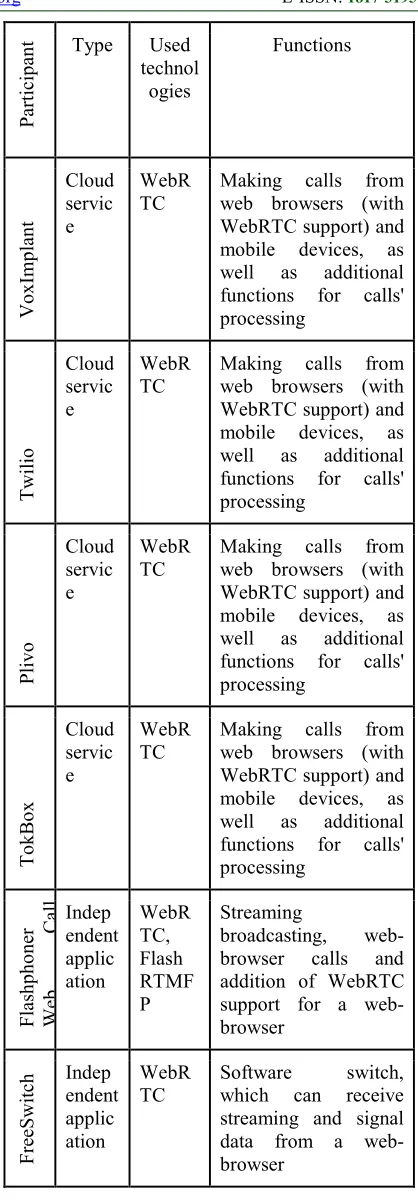
In order to identify main trends on the market of the streaming data let's discuss the aforementioned projects in details and compare their following parameters:
type — discussed both Internet services and traditional applications;
used technologies;
provided functions;
[image:3.612.313.522.83.685.2]Results of the comparison of the mentioned participants are presented in Table 1.
Table 1. Comparative Characteristics Of Widely Used Formats Of Transmission
P ar ti ci p an
t Type Used
technol ogies Functions D o u b an g o t el ec o m Indep endent softwa re, librari es, extens ions for web-brows ers WebR TC
Addition of support of WebRTC in web-browser, realization of SIP in a web-browser,
deciphering of
streaming data, making calls from all web-browsers. V er sa ti ca Librar y realizi ng SIP protoc ol in a web-brows er
WebR TC
Making calls from web-browsers (with WebRTC support) P ar ti ci p an
t Type Used
technol ogies Functions V o x Im p la n t Cloud servic e WebR TC
Making calls from web browsers (with WebRTC support) and mobile devices, as well as additional functions for calls' processing T w il io Cloud servic e WebR TC
Making calls from web browsers (with WebRTC support) and mobile devices, as well as additional functions for calls' processing P li v o Cloud servic e WebR TC
Making calls from web browsers (with WebRTC support) and mobile devices, as well as additional functions for calls' processing T o k B o x Cloud servic e WebR TC
Making calls from web browsers (with WebRTC support) and mobile devices, as well as additional functions for calls' processing F la sh p h o n er W eb C al l Indep endent applic ation WebR TC, Flash RTMF P Streaming
broadcasting, web-browser calls and addition of WebRTC support for a web-browser F re eS w it ch Indep endent applic ation WebR TC
ISSN: 1992-8645 www.jatit.org E-ISSN: 1817-3195 P ar ti ci p an
t Type Used
technol ogies Functions A st er is k Independent applic ation WebR TC
Software PBX, which can receive streaming and signal data from a web-browser A d o b e M ed ia Indep endent applic ation Flash RTMF P
Allows to transfer RTMFP protocol in protocols used in VoIP
R tc K it Cloud servic e Flash RTMF P
Allows to transfer RTMFP protocol in protocols used in VoIP
G o o g le V o ic e/ G o o g le h an g o u ts Cloud servic e Extensi on for a web-browse r in further for WebR TC
Allows to make calls from a web-browser by means of extension for a web-browser or WebRTC Z in g ay a Cloud servic e WebR TC, Flash RTMF P
Allows to make calls from a web-browser for a given company number S k y p e Indep endent applic ation Closed proprie tary protoc ol
Making calls from an installed position M ai l. ru ag en t Indep endent applic ation Flash RTMP
Making calls from an installed position and from a web-browser
P ar ti ci p an
t Type Used
technol ogies Functions C u m u lu s Indep endent applic ation Flash RTMF P
Function of
transmission and reception of streaming data in a web-browser
S IP -R T M P g at ew ay Indep endent applic ation Flash RTMP
Allows to transfer RTMP protocol in protocols used in VoIP
On a basis of comparison of existing project it can be concluded that there are three main modern trends:
1. The major number of participants selected WebRTC technology. Number of participants use Adobe Flash Player. Google Voice is the only product, which allows use of extensions. At that, Google Voice also plans to transfer its technology to WebRTC.
2. For operations with web-browser cloud services and independent applications are used equally.
3. The main application of technology for reception and transmission of streaming data in a web-browser is related with carrying out of various kinds of communications, in particular, making calls becoming increasingly popular.
3. FIELDS OF APPLICATION OF
STREAMING DATA TRANSMISSION
FROM A WEB-BROWSER
The main purpose of reception and transmission of data in a web--browser is reduction of expenses for access to those functions at a workstation of an end user.
In the nowadays sources there are various variants of application of that kind of services:
−conferences;
ISSN: 1992-8645 www.jatit.org E-ISSN: 1817-3195 −interactive TV;
−co-working;
−making phone calls from a web-browser.
On a basis of the analysis of literature on streaming data transmission it can be concluded that one of the main directions for application of that technology are various kinds of conferences. The major parts of the papers focus on that topic:
The study "Advanced Videoconferencing based on WebRTC" [3] discuses prospects of increase of functionality for video-conferences on a basis of WebRTC. The topic of video-conferences is also discussed in "Models for multimedia conference between browsers based on WebRTC" [4], in which several models of conferences' organization are discussed. The author of the paper especially underlines two models, which can be adapted for organization of conferences on a basis of WebRTC, and also propose a protocol, which can be used for organization of such conferences on a basis of SIP/SDP protocols. In addition, Zeidan, Adham, Armin Lehmann and Ulrich Trick in their study "WebRTC enabled multimedia conferencing and collaboration solution" [5] discuss possibilities for transfer from traditional systems to systems based on WebRTC.
Another prospective direction from a point of view of streaming data transmission from a web-browser is decentralized networks for transmission of streaming data. For example, in the study "P2P media streaming with HTML5 and WebRTC" [6] the authors discuss possibility for creation of decentralized communication system on the basis of WebRTC and defince problems, which exist in nowadays web-browsers and limit their application in that field, which didn't allow the authors to create a working prototype.
Moreover, decentralized communications are widely discussed in context of application of Adobe Flash and RTMFP protocols. In particular, in the study Group Audio Application with Flash Multicast Streaming Based on RTMFP" an example of creation of a decentralized application for audio data exchange is discussed [7]. In the study "Distributed technologies in development and management of dynamic systems for network communications" advantages of Adobe Flash technology in comparison to traditional communication systems are discussed, and the conclusions are made about applicability of that technology in various fields [8].
In addition to decentralized communications streaming data transfer can be used for creation of distributed systems for content transfer; in that case server load for data transfer to users of a web site is distributed between those users, which reduces load to a server and increases availability of content. At that, the authors show that use of WebRTC allows to achieve much better performance as compared to Adobe Flash and RTMFP protocols [9].
In the study "Emerging technologies for interactive TV" [10] a concept of interactive TV and two variants of its use are discussed: sport events broadcasting and interactive video. Also features of WebRTC for creation of interactive TV are demonstrated.
Development of technologies for streaming data transfer allows to provide development of specialized services on Internet, such as medical services. In particular, in the study "Telementoring as a Service" [11] it is proposed to use WebRTC to carry out remote monitoring of health conditions of patients. In addition to specialized services, communications on a basis of streaming data from a web-browser are proposed to be used for creation of intelligent platforms for organization of co-working in medicine [12]. Adobe Flash technology with RTMFP protocol is used for remote medical education [13].
Another variant of application of technology for streaming data transmission from a web-browser is creation of a service for co-working for music production, for example, in the study The horgie: Collaborative online synthesizer» it is proposed to create that kind of service on a basis of Adobe Flash technology [14] .
The topic of use of a web-browser for making phone calls is also frequently discussed in literature on information science. In the study «Flash-based audio and video communication in the cloud» it is proposed to provide phone calls function o a basis of Adobe Flash technology [15]. Also, it is proposed to use RTMFP, WebRTC and web-browser extensions [16].
ISSN: 1992-8645 www.jatit.org E-ISSN: 1817-3195
4. SUPPORT OF VARIOUS
TECHNOLOGIES FOR STREAMING
DATA TRANSMISSION IN
WEB-BROWSERS NOWADAYS
Extensions for a web-browser nowadays is not a prospective technology for organization of streaming data transfer. It is related with the fact that one of the leading web-browsers – Chrome – soon will stop supporting extensions [17]. In new versions of the web-browser for Linux operation systems there is no extension support, and in Windows operation system there is need to set it up to enable extension support [18]. Other web-browsers in further also can make the same decision. Stopping of extension support is related with increase safety requirements and possibility to realize extensions functions by other means of a web-browser.
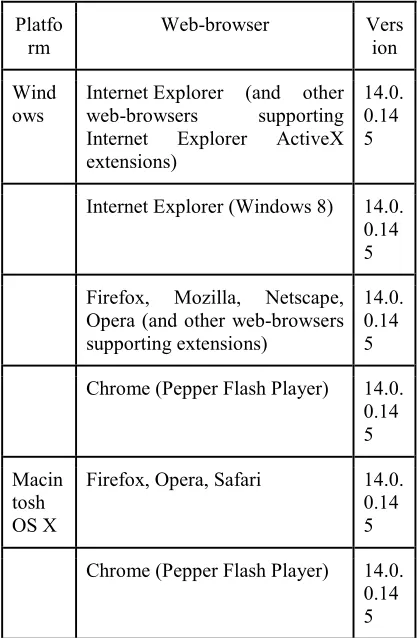
[image:6.612.276.519.72.230.2]Support of Adobe Flash in various versions of a web-browser is presented in Fig. 2.
Table 2. Adobe Flash Support In Various Web-Browsers
Platfo rm
Web-browser Vers
ion
Wind ows
Internet Explorer (and other web-browsers supporting Internet Explorer ActiveX extensions)
14.0. 0.14 5
Internet Explorer (Windows 8) 14.0. 0.14 5
Firefox, Mozilla, Netscape, Opera (and other web-browsers supporting extensions)
14.0. 0.14 5
Chrome (Pepper Flash Player) 14.0. 0.14 5
Macin tosh OS X
Firefox, Opera, Safari 14.0. 0.14 5
Chrome (Pepper Flash Player) 14.0. 0.14 5
Platfo rm
Web-browser Vers
ion
Linux Mozilla, Firefox, SeaMonkey (Flash Player 11.2 the last supported version of Flash Player for Linux.)
11.2. 202. 394
Chrome (Pepper Flash Player) 14.0. 0.14 5
Support of WebRTC in various versions of a web-browser is presented in Fig. 2.
Table 3. Webrtc Support In Various Web-Browsers
Platfo rm
Web-browser
Wind ows
Firefox starting from 22 version, Opera starting from 18 version, Chrome starting from 23 version.
Macin tosh OS X
Firefox starting from 22 version, Opera starting from 18 version, Chrome starting from 23 version.
Linux Firefox starting from 22 version, Opera starting from 18 version, Chrome starting from 23 version.
Andro id, iOS
Firefox starting from 24 version, Opera starting from 12 version, Chrome starting from 29 version.
ORTC technology currently is not supported by existing web-browsers. Support is discussed for Chrome starting from 38 and 39 versions, but so far there is not final decision on it [19].
5. AVAILABILITY OF TECHNOLOGIES
FOR STREAMING DATA TRANSFER FOR USERS
Now, knowing about support of various technologies in web-browsers, let's define a percentage of users, which have access to one of those technologies using the following parameters:
[image:6.612.90.300.413.732.2]ISSN: 1992-8645 www.jatit.org E-ISSN: 1817-3195 sources of statistical data, because data from
different sources is different. We used data from liveinternet.ru, statcounter.com, wikimedia.org. The data will be discussed for several month in order to identify trends;
−Average values for that statistics and the main trend for use of web-browsers;
−Percentage of availability of a technology for end users.
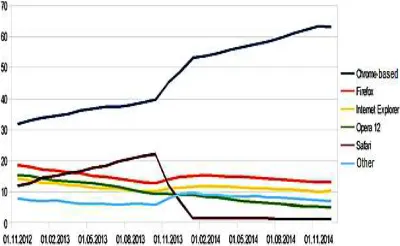
Fig. 2 shows a graph for distribution of web-browses in time according to liveinternet.ru data.
Figure 1. Use Of Web-Browsers In Time According To Data From Liveinternet.Ru
[image:7.612.315.524.77.225.2]For September of 2014 numerical values are presented in Figure 4.
Table 4. Numerical Values For Use Of Web-Browsers In September Of 2014 According To Data From
Liveinternet.Ru
Chrome -based
Firefox Internet Explorer
Opera Safari Others
61,13 13,58 10,66 5,68 1,12 7,83
There is a clear trend for increase of number of Chromium-based web-browsers: Google Chrome, Yandex Browser, Mail.ru web-browsers, Opera, starting from 15 version (that version was after 12 version).
[image:7.612.97.297.272.395.2]Figure 3 shows a graph for distribution of web-browses in time according to statcounter.com data.
Figure 2. Use Of Web-Browsers In Time According To Data From Statcounter.Com
For September of 2014 numerical values are presented in Figure 5.
Table 5. Numerical Values For Use Of Web-Browsers In September Of 2014 According To Data From
Statcounter.Com
Chrome-based
Firefox Internet Explorer
Opera Safari Others
53.54 18.17 12.52 12.62 2.26 0.89
Unfortunately, statcounter.com doesn't provide data on versions of Opera, therefore it is impossible to conclude how many of specified Opera versions are Chromium-based. Despite the fact that statistics is different from liveinternet.ru, there is also a trend for increase of Chrome-based web browsers, which substitute others.
Wikimedia.org provides data only up to September 2014, after that there is no statistics. That data is suitable for the carried out comparison. Fig. 4 shows a graph for distribution of web-browses in time according to wikimedia.org data.
[image:7.612.91.297.527.590.2]ISSN: 1992-8645 www.jatit.org E-ISSN: 1817-3195
Figure 3. Use Of Web-Browsers In Time According To Data From Wikimedia.Org
[image:8.612.96.297.73.235.2]For September of 2014 numerical values are presented in Figure 6.
Table 6. Numerical Values For Use Of Web-Browsers In September Of 2014 According To Data From
Wikimedia.Org
Chrome -based
Firefox Internet Explorer
Opera Safari Others
51.95 18.54 22.24 1.93 5.32 12.02
Thus, on a basis of the obtained data we can define percent of web-browsers, supporting WebRTC — Chrome-based web-browsers and Firefox. Support of WebRTC according to various sources of statistics on September of 2014 is presented in Table 7.
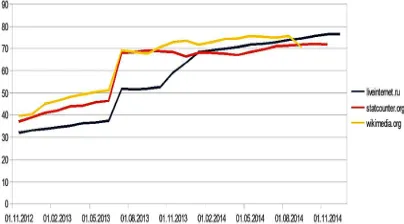
There is a gradual growth of number of users, at that, it should be noted that there is a rapid increase in July 2013, when WebRTC support was provided for Firefox. In further, increase wasn't accompanied by significant leaps, because it was provided not by increase of support of WebRTC by web-browsers, but by increase of number of users of browsers using that technology; source of that kind of growth is limited, which is reflected in decrease of growth speed (liveinternet.ru) or even insignificant decrease (statcounter.org and wikimedia.org). It allows to conclude that in the nearest time support of WebRTC will remain at 70-80% in a case other web-browsers will not implement WebRTC support.
Table 7. WebRTC support (% of users) on September 2014 according to various sources
Source of statistics
Support of WebRTC (% of users)
liveinternet.ru 76.54
statcounter.com 71.71
wikimedia.org 70.49
[image:8.612.320.522.302.414.2]As it can be seen from the table, percentage of users of web-browsers supporting WebRTC is about 70%. Figure 5 shows trends for growth of those parameter for various sources of statistics.
Figure 4. Comparison Of Data On Support Of Webrtc According To Various Sources
6. SUPPORT OF STREAMING DATA
TRANSFER TECHNOLOGIES ON
MOBILE PLATFORMS
Mobile platforms require special attention, because they are one of the most rapidly emerging market segments for web-browsers. For example, Internet statistics agency statcounter.com provides the following graph on growth of number of mobile platforms users in emerging markets and worldwide (Figure 6).
[image:8.612.92.299.375.426.2]ISSN: 1992-8645 www.jatit.org E-ISSN: 1817-3195
Figure 5. Number Of Mobile Platform Users
It should be noted that mobile systems after August of 2012 do not support Adobe Flash technologies [20]. Thus, the only prospective solution for the problem of that study for mobile platforms is WebRTC technology.
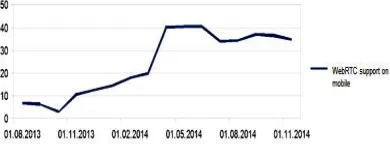
[image:9.612.99.294.426.498.2]Let's discuss support if that technology for moble web-browsers taking into account ratio of mobile operation systems presented on the market of mobile systems. WebRTC is supported in Firefox and Chrome, the difference is that support in mobile web-browsers started from August 2013. Support of WebRTC technology for mobile platforms is presented in Figure 7.
Figure 6. Support Of Webrtc For Mobile Platforms
Figure 7 shows that starting from April 2014 percentage of mobile web-browsers supporting WebRTC is about 30-40%, which is related with big audience of other web-browsers such as Safari for iPhone (39% in November 2014) and default Android browser (18%). Serious change of that tendency is possible only in a case of implementation of WebRTC support for other web-browsers.
7. CONCLUSIONS
Thus, the study allowed to make the following conclusions.
On a basis of comparison of existing projects on application of technology or reception and
transmission of straming data in web-browser there are three modern trends:
1. The major number of participants selected WebRTC technology. Number of participants use Adobe Flash Player. Google Voice is the only product, which allows use of extensions. At that, Google Voice also plans to transfer its technology to WebRTC.
2. For operations with web-browser cloud services and independent applications are used equally.
3. The main application of technology for reception and transmission of streaming data in a web-browser is related with carrying out of various kinds of communications, in particular, making calls becoming increasingly popular.
Results of literature analysis on application of technologies of streaming data reception and transmission in web-browser shows that there are various kinds of application of technologies of streaming data reception and transmission from web-browser different from making calls:
1. Conference;
2. Various kinds of consultations;
3. Decentralized communications and content distribution systems.
Currently the following generalizations on availability and use of streaming data transfer technologies can be made:
1. for desktop platforms:
a) 70-80% of users have access to WebRTC technology;
b) 7099% of users have access to Adobe Flashtechnology;
2. for mobile platforms:
a) 30-40% of users have access to WebRTC technology;
b) there is no further support of Adobe Flash technology.
ISSN: 1992-8645 www.jatit.org E-ISSN: 1817-3195 technology taking into account feature of
web-browsers for any user of a service as it shown in the study Singh and Krishnaswamy (Singh, & Krishnaswamy, 2013).
8. ACKNOWLEDGMENTS
The study was carried out with financial support of the Ministry of Education of the Russian Federation. Applied research unique identifier RFMEFI57914X0009.
REFERENCES:
[1] Adobe Media Gateway: Quick Start Guide.
(2012). Adobe Systems Incorporated. Retrieved
July 19, 2015, from
http://help.adobe.com/en_US/adobemediaserver /amg/gsg.pdf.
[2] Multi-channel operation contact centers will be an advantage for companies. (2013). Retrieved
July 19, 2015, from
http://www.rg.ru/2013/04/30/kol-tcentry.html. [3] Rodríguez, P., Cerviño, J., Trajkovska, I., &
Salvachúa, J. (2012). Advanced
Videoconferencing based on WebRTC. IADIS.
Retrieved July 19, 2015, from
http://oa.upm.es/19199/1/INVE_MEM_2012_1 13875.pdf. ISBN: 978-972-8939-72-4.
[4] Elleuch, W. (2013). Models for multimedia conference between browsers based on WebRTC. IEEE 9th International Conference on Wireless and Mobile Computing, Networking and Communications (WiMob). Retrieved July
19, 2015, from
http://www.computer.org/csdl/proceedings/wim ob/2013/9999/00/06673373.pdf.
[5] Zeidan, A., Lehmann, A., & Trick, U. (2014).
WebRTC enabled multimedia conferencing and collaboration solution. WTC. Retrieved July 19,
2015, from
http://ieeexplore.ieee.org/xpl/articleDetails.jsp?r eload=true&arnumber=6840017&sortType%3D asc_p_Sequence%26filter%3DAND%28p_IS_ Number%3A6839998%29.
[6] Nurminen, Jukka K., et al. (2013). P2P media streaming with HTML5 and WebRTC. IEEE International Conference on Computer Communications. Retrieved July 19, 2015, from
http://cse.aalto.fi/en/midcom-
serveattachmentguid-1e38759af7394f0875911e3956c2dc57a9f4fb64f b6/infocommpaper_cr.pdf.
[7] Xue, Linghong, et al. (2012, July). Group Audio Application with Flash Multicast Streaming Based on RTMFP. Proceedings of the 2012 International Conference on Computer Application and System Modeling. Atlantis Press. Retrieved July 19, 2015, from
http://www.atlantis- press.com/publications/aisr/iccasm-
12/index_iccasm- 12.html?http%3A//www.atlantis-
press.com/php/paper-details.php%3Fid%3D2475.
[8] Vostrov, G., Godinski, M., & Atie, A. (2012). Distributed technologies in development and management of dynamic systems for network communications. Digital technologies, 11, 153-158. Retrieved July 19, 2015, from http://nbuv.gov.ua/j-pdf/ct_2012_11_17.pdf. [9] Zhang, Liang, et al. (2013). Maygh: Building a
CDN from client web browsers. Proceedings of the 8th ACM European Conference on Computer Systems. Retrieved July 19, 2015, from
http://www.ccs.neu.edu/home/amislove/publicat ions/Maygh-EuroSys.pdf.
[10] Dabrowski, M. (2013). Emerging technologies for interactive TV. Proceedings of the 2013 Federated Conference on Computer Science and Information Systems, 787-793. Retrieved
July 19, 2015, from
https://fedcsis.org/proceedings/2013/pliks/176.p df.
[11] Budrionis, A., Augestad, K., Bellika, J. (2013). Telementoring as a Service. Scandinavian Conference on Health Informatics. Retrieved
July 19, 2015, from
http://www.ep.liu.se/ecp/091/003/ecp13091003. pdf.
[12] Andrikos, Christos, et al. (2014). An Intelligent Platform for Hosting Medical Collaborative Services. Artificial Intelligence: Methods and Applications (pp. 354-359). Springer International Publishing. Retrieved July 19, 2015, from http://www.gbv.de/dms/tib-ub-hannover/789697386.pdf.
[13] Konishi, T., Bayanmunkh, B., et al. (2014).
Evaluation of multimedia transport Protocols for distance medical education using the Wideband InterNetworking satellite. Global U.
Retrieved July 19, 2015, from
ISSN: 1992-8645 www.jatit.org E-ISSN: 1817-3195 [14] Herrera, J. (2009). The horgie: Collaborative
online synthesizer. Retrieved July 19, 2015, from
https://ccrma.stanford.edu/~jorgeh/assets/public ations/horgie-selfPublished2009.pdf.
[15] Singh, K., & Carol D. (2011). Flash-based audio and video communication in the cloud.
Retrieved July 19, 2015, from
http://arxiv.org/ftp/arxiv/papers/1107/1107.0011 .pdf.
[16] Singh, K., & Krishnaswamy, V. (2013, April). A case for SIP in Javascript. IEEE Communications Magazine, 4(51). Retrieved
July 19, 2015, from
http://kundansingh.com/papers/2013-sip-js-private.pdf.
[17] Saying Goodbye to Our Old Friend NPAPI.
(2013, September 23). Retrieved July 19, 2015, from blog.chromium.org/2013/09/saying-goodbye-to-our-old-friend-npapi.html.
[18] NPAPI plugins don't work on Chrome version 42 and higher. (2015). Retrieved July 19, 2015, from
https://support.google.com/chrome/answer/6213 033?hl=en.
[19] Google Chrome 38-39 to ship with ORTC / WebRTC 1.1 APIs. (2014, July 1). Retrieved
July 19, 2015, from
http://blog.webrtc.is/2014/07/01/google- chrome-38-39-to-ship-with-ortc-webrtc-1-1-apis/.
[20]Adobe roadmap for the Flash runtimes. (2012).
Retrieved July 19, 2015, from
http://www.adobe.com/devnet/flashplatform/wh itepapers/roadmap.html.