S T U D Y P R O T O C O L
Open Access
Piloting a manualised weight management
programme (Shape Up-LD) for overweight and
obese persons with mild-moderate learning
disabilities: study protocol for a pilot randomised
controlled trial
Rebecca J Beeken
1*, Dimitrios Spanos
1, Sally Fovargue
2, Rachael Hunter
3, Rumana Omar
4, Angela Hassiotis
5,
Michael King
5, Jane Wardle
1and Helen Croker
1Abstract
Background:National obesity rates have dramatically risen over the last decade. Being obese significantly reduces life expectancy, increases the risk of a range of diseases, and compromises quality of life. Costs to both the National Health Service and society are high. An increased prevalence of obesity in people with learning disabilities has been demonstrated. The consequences of obesity are particularly relevant to people with learning disabilities who are already confronted by health and social inequalities. In order to provide healthcare for all, and ensure equality of treatment for people with learning disabilities, services must be developed specifically with this population in mind. The aim of this project is to pilot the evaluation of a manualised weight management programme for overweight and obese persons with mild-moderate learning disabilities (Shape Up-LD).
Methods/Design:An individually randomised, controlled pilot trial in 60 overweight and obese (body mass index≥25) adults (age≥18) with mild-moderate learning disabilities and their carers will be carried out, comparing“Shape Up-LD”with usual care. The manualised Shape Up-LD intervention will involve 12 weekly sessions, which include healthy eating messages, advice on physical activity and use of behaviour change techniques to help people manage their weight. Assessments of participants will be conducted at baseline, 12 weeks and 6 months. Service users and their carers and service providers will also give their perspectives on the experience of Shape Up-LD in qualitative interviews at 12 weeks. Feasibility outcomes will include recruitment rates, loss to follow-up, compliance rates, completion rates, collection of information for a cost-effectiveness analysis and an estimation of the treatment effect on weight.
Discussion:The findings from this study will inform our preparation for a definitive randomised controlled trial to test the efficacy of the programme with respect to weight loss and maintenance in this population. Weight loss through Shape Up-LD could lead to improvements in health and quality of life. Costs to the National Health Service might be reduced through decreased overall service use because of improved health. The programme would also ensure a more equitable service for overweight service users with learning disabilities and fill the current gap in weight management services for this population.
Trial registration:International Standard Randomised Controlled Trial No ISRCTN39605930
Keywords:Learning disabilities, Weight management, Overweight
* Correspondence:[email protected]
1
Department of Epidemiology & Public Health, University College London, 1-19 Torrington Place, London WC1E 6BT, UK
Full list of author information is available at the end of the article
Background
Obesity rates have risen in the UK over the last decade [1]. Being obese reduces life expectancy and increases the risk of a range of conditions including cardiovascular disease and type 2 diabetes [2]. Obese individuals report decreased quality of life and face discrimination in health-care, education and workplace settings [3]. The National Health Service (NHS) was estimated to spend £2.3 billion in 2007 on costs directly related to obesity, with wider costs to society reaching £15.8 billion [4].
An increased prevalence of obesity in people with learning disabilities has been demonstrated in a commu-nity study of 945 adults with learning disabilities, where 39% of women and 28% of men were obese compared with 25% of women and 23% of men in the general po-pulation [5]. Several factors are thought to contribute to the increased risk of overweight and obesity in people with learning disabilities, including physical inactivity and low adherence to healthy diets [6]. The consequences of obesity are particularly relevant to people with learning disabilities, who are already confronted by health and so-cial inequalities [7]. Obesity can exacerbate disabling con-ditions and has been shown to contribute to the already reduced life expectancy of people with learning dis-abilities [7].
In order to provide healthcare for all and ensure equality of treatment for people with learning disabil-ities, services must be developed specifically with this population in mind, taking into account differences in health needs, communication problems and understand-ing [7]. For those individuals who rely on substantial care, carers’attitudes and knowledge may also need to be addressed [8-10]. The National Institute for Health and Clinical Excellence (NICE) Obesity guidelines [11] recognise that the prevalence of obesity is higher in this group and that there are difficulties of access to informa-tion and support. It recommends the inclusion of behav-ioural management principles in lifestyle interventions to address the issue.
A recent review of weight management interventions for adults with learning disabilities [6] revealed a paucity of studies, identifying only eight, and there have since been a few more recent studies [12,13]. Two of the stud-ies described in Hamilton [6] solely focused on increas-ing physical activity levels and had minimal impact on weight outcomes [14,15]. The six other studies drew on behavioural management principles, in line with the gen-eric guidance for adult weight management. Four of these [16-19] were based in the US, and all are relatively old studies. Although they included only small numbers of participants, they broadly found positive effects on weight loss. The two remaining studies [20,21] were conducted in the UK. One consisted of nurse-led health promotion sessions [20], which did not specifically target
obese individuals, but those who were overweight expe-rienced a significant mean reduction in weight of 3.4 kg.
The final study [21] compared the impact of input from a ‘Healthy Living Coordinator’ with a ‘no input’ group. This was the only study to include a relatively large sam-ple (n= 83). Few details are given regarding the nature of the intervention, but it appeared to be largely educational, with some guidance to support behaviour changes (e.g. planning, social support and motivation). There was a small reduction in weight (−1.5 kg) in the intervention group at 12 months and significant increase in weight for the“no input”group (0.9 kg). A longer term follow-up to this study [22] found reductions in body mass index (BMI) in the intervention group over 6 years, but these were not significantly different from changes in the con-trol group. Another review [23] was in broad agreement with these findings and additionally included one qualita-tive study, which suggested such interventions are re-ceived positively by this population group.
The evidence outlined here supports the use of behav-ioural/educational interventions with strategies to support behaviour change for obese individuals with learning dis-abilities. However, most existing studies have limitations. The majority are on small samples and have no control group. Despite this, there are indications for potentially useful strategies to include in interventions, for example, weight monitoring, teaching self-control strategies, exter-nal reinforcement and guidance about planning.
The weight management programme we intend to trial was developed by dietitians, health psychologists and specialists in learning disabilities with input from service users, and it includes the strategies identified by pre-vious research alongside education. Trialling this pro-gramme on a large sample with a control group will give a clear indication of the effectiveness of the programme and its potential to fill the current gap in weight ma-nagement services for people with learning disabilities. In line with Phase 2 of the Medical Research Council (MRC) complex interventions framework [24], the aim of this study is to pilot such a trial.
Study objectives
The key research question is:
Can we design a feasible, large-scale, randomised con-trolled trial (RCT) that will answer the following ques-tion: Is Shape Up-LD more effective than usual care in helping overweight and obese service users with mild-moderate learning disabilities reduce body weight?
addition to the primary outcome measure [reduction in weight (kg)].
This RCT will enable us to:
(1) measure the eligible numbers, recruitment rate, loss to follow-up, compliance and weight SD of
participating overweight and obese service users within two inner London learning disabilities services.
(2) determine the acceptability of randomisation to service users through its effect on dropout rates. (3) determine, through completion rates, the
appropriateness and the acceptability of the outcome measures to service users in order to see whether, in addition to our primary outcome, we can also explore changes in body fat, waist circumference, blood pressure, mental health, quality of life, health and social care resource use, self-esteem, health knowledge and behaviours. (4) measure compliance of the facilitators to the
manualised intervention
(5) estimate the treatment effect with confidence intervals (CI) to determine whether the CI includes a clinically important effect, which will support the need to conduct the full trial.
We will also conduct qualitative interviews with service users, their carers and service providers to assess the ac-ceptability of the treatment and to explore their experience of the treatment including any barriers and/or facilitators to adherence. Findings from these interviews also will enable us to refine the Shape Up-LD intervention further.
Methods/Design Design
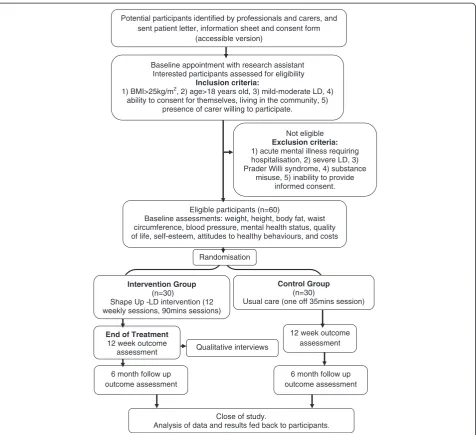
The trial is a two-arm, individually randomised, con-trolled pilot trial in overweight and obese adults with mild-moderate learning disabilities comparing “Shape Up-LD”with usual care. Figure 1 illustrates the pathway through the trial. This trial corresponds to Phase 2 of the MRC’s guidelines for complex interventions: asses-sing feasibility [24].
Recruitment
Participants
Adult service users with mild-moderate learning disabi-lities from two inner London community services.
Recruitment strategy
There are at least 450 service users with mild-moderate learning disabilities in our target areas. Our field testing of the programme with a small group of service users in North East Essex suggested that it is suitable to include service users who are both overweight and obese (as
opposed to restricting the programme to only obese users). Therefore, based on the estimated prevalence rates of obesity and overweight (over 40%) in this popu-lation, at least 180 of these are likely to be eligible for the study. As BMI and weight generally go unrecorded in this population, potential participants will be self-referred or self-referred by their paid or informal carers or professionals in response to posters advertising the study placed in the reception of the services and in local day care facilities for people with learning disabilities.
Individuals who are interested will be checked for eligibility and those who fit the inclusion criteria will be invited to participate via a letter containing the informa-tion sheet. Recruitment will take place over a 12-month period, with service users or service user-primary paid/ informal carer dyads recruited on an on-going basis.
Inclusion criteria
Individuals eligible to take part in the study must be adults (age ≥ 18 years) and classified as overweight (BMI ≥ 25 kg/m2). These are individuals that would benefit from weight loss and for whom linear growth has stopped; therefore weight loss could not compro-mise growth. The study will include only people with learning disabilities in the mild to moderate range (assessed by the scoring system for “Ability & Develop-ment” scale [25]) and who live in the community. Un-healthy weight gain is more common in this specific population group than in individuals with severe to pro-found learning disabilities or individuals living in very re-strictive environments such as institutions [5]. In addition, for individuals who receive regular care, a paid or informal carer must be willing to participate in the intervention.
Exclusion criteria
Individuals fulfilling one or more of the following cri-teria will be excluded: (1) acute mental illness requiring hospitalisation; (2) severe learning disabilities (assessed using the “Ability & Development” scale [25]); (3) sub-stance misuse; (4) a confirmed diagnosis of Prader-Willi syndrome. These individuals would require a more spe-cialised or intensive type of weight loss intervention, dif-ferent from the Shape Up-LD programme.
Consent
questions. The information sheets and consent forms have been developed in an accessible (i.e. easy-to-read) format with input from service users within the “ Cam-den easy info group” of The Advocacy Project. Signed participant consent will be obtained face-to-face from both service users and carers taking part. The right of the participant to refuse to participate without giving reasons must be respected. All participants are free to withdraw at any time from the study without giving rea-sons and without prejudicing further treatment.
Randomisation
Randomisation will be conducted by telephoning an external research coordinator at the Health Behaviour Research Centre, after the service user has provided
informed consent and baseline data. RO (statistician) will generate the randomisation list. The technique of blocking will be employed to ensure equal numbers in the intervention and control arms. When enough dyads have been randomised to the intervention, a group will start the Shape Up-LD sessions.
The interventions
Shape up- LD
The Shape Up-LD programme is a tailored version of Shape Up, a manualised healthy lifestyle programme that helps individuals learn new behaviours to manage their weight. This population-specific version of Shape Up was developed through a partnership between specialist dietitians of the Anglian Community Enterprise (ACE
Randomisation
Not eligible Exclusion criteria: 1) acute mental illness requiring hospitalisation, 2) severe LD, 3) Prader Willi syndrome, 4) substance
misuse, 5) inability to provide informed consent.
Control Group (n=30)
Usual care (one off 35mins session)
Qualitative interviews
Close of study.
Analysis of data and results fed back to participants.
6 month follow up outcome assessment
12 week outcome assessment Eligible participants (n=60)
Baseline assessments: weight, height, body fat, waist circumference, blood pressure, mental health status, quality of life, self-esteem, attitudes to healthy behaviours, and costs
Baseline appointment with research assistant Interested participants assessed for eligibility
Inclusion criteria:
1) BMI>25kg/m2, 2) age>18 years old, 3) mild-moderate LD, 4)
ability to consent for themselves, living in the community, 5) presence of carer willing to participate.
Potential participants identified by professionals and carers, and sent patient letter, information sheet and consent form
(accessible version)
6 month follow up outcome assessment End of Treatment
12 week outcome assessment
Intervention Group (n=30)
[image:4.595.62.539.87.522.2]Shape Up -LD intervention (12 weekly sessions, 90mins sessions)
CIC) and service users with learning disabilities in North East Essex, a specialist dietician from Weight Concern and other learning disabilities professionals within the Camden NHS Trust and Learning Disability Partnership. The original Shape Up programme involves partici-pants attending one 60-min session every week for 8 weeks; however based on our field testing and prior ex-perience of interventions in learning disabilities, we have extended the programme to run for 12 weeks. The add-itional four introductory sessions will give facilitators time to establish a rapport with the participants and provide a foundation for the remainder of the course, through focussing on basic healthy eating messages without any behavioural strategies. The remainder of the course will teach strategies for improving healthy eating and physical activity in line with the original Shape Up.
Shape Up is based on two theories: (1)“social cognitive theory” [26] and (2) “control theory” [27]. The interven-tion focuses on the concepts of self-control, self-efficacy and emotional coping responses. Behavioural techniques introduced in week 5 (and practiced throughout the subsequent weeks of the intervention) will include self-monitoring with the use of food and physical activity diaries, relapse prevention, assertiveness and goal setting.
Tailoring of Shape Up will include pictorial illustration of each session’s messages and use of simple spoken and written communication based on the recommendations of the Royal College of Nursing [28]. The photos used to develop the materials for each session and facilitate com-munication are part of the photo libraries Photosymbols [29] and the Greater Glasgow and Clyde LD Service [30].
The programme structure is as follows: Introductory sessions:
Week 1: Getting to know each other and having fun with“food games”
Week 2: Food groups Week 3: Food portions
Week 4: Thirsty for water (introduction to fluids) Starting to Shape Up:
Week 5: Preparing to Shape Up: How to lose weight (plus goal setting and self-monitoring)
Week 6: Food groups (repeating messages from week 2 with more detail)
Week 7: Food portions and how to serve your food (repeating messages from week 3)
Week 8: Be Active (introduction to physical activity) Week 9: Eating 3 meals and healthy snacks
Week 10: Feeling hungry (cravings and hunger) (relapse prevention, assertiveness)
Week 11: Shopping and cooking
Week 12: Things we have learned and keeping the weight off (weight maintenance)
While each session originally ran for 60 min, field tes-ting suggested that this was not long enough. We have
therefore extended the length of the sessions to 90 min. Where applicable, carers will also attend. Each session will be run at day centres once per week for groups of 4–6 service users and/or pairs of service users and their carers. The sessions will be led by two health profes-sionals who have volunteered to be trained in the deliv-ery of the intervention, at least one of whom will have clinical experience with people with learning disabilities.
Our experience of field testing the intervention and evidence from other studies [8] suggest that carers play an important role in weight management for adults with learning disabilities, and training carers could help them to engage with the programme and understand how best to support their service user. Therefore, carers who will be attending with the participant with learning disabil-ities will be given a half-day information/training session to introduce Shape Up-LD, address questions and ex-plore how behaviour change can be supported. This training will be provided by the group facilitators prior to the first group session.
Control group
Usual care differs between services. Discussions with col-leagues working in this area suggested that a brief one-off discussion about healthy eating and activity will app-roximately reflect what most individuals with learning disabilities currently receive. Therefore, each participant randomised to the control group will be invited to attend a session that will last 30–45 min. Where applicable, carers will be present at the session. A six-page booklet specially developed for people with learning disabilities that is commonly used by health professionals to provide health behaviour advice to service users will be used. The resource is accompanied by “facilitator notes” to assist health professionals in guiding service users through the booklet. The sessions will be delivered by the research as-sistant of the study.
The booklet covers the following topics: (1) the risks of putting on weight; (2) how to follow a healthy bal-anced diet based on the recommendations of the “Eat Well Plate” [31]; (3) the importance of regular eating patterns; (4) exercise advice based on the recommenda-tions of current clinical guidelines [11]. Each participant will be given the specially designed booklets and a DVD (the Camden Audio-visual News DVD) that includes in-formation on healthy eating and exercise [32]. The DVD has been developed for use by health professionals on healthy lifestyles and was produced in partnership with people with learning disabilities that live in Camden.
Training for staff delivering the interventions
intervention. The training for Shape Up-LD will take place over 1 day followed by a half day observing the programme being delivered by the learning disability di-etitians in a community setting in North East Essex. The facilitators who will deliver the usual care will be offered an hour training following the“facilitator notes”that ex-plain how to use the booklet that will be used as part of the usual care intervention.
Measures
Demographics
At baseline, demographic information including age, gender and ethnicity, and the Ability and Development score [25] will be recorded, as will medication use and level of support required.
Physical and biological
Participants will be asked to remove any belts, shoes, socks and heavy outer clothing for all measurements. Weight (kg) (measured to the nearest 100 g) and body fat (%) will be measured using TANITA TBF-300 MA Body Composition Analyser. Participants can opt to re-ceive a printout of the results together with an exp-lanation by the research team or not. Height will be measured, rounded up to the nearest centimetre, using the Leicester Height Measure, a standardised instrument for determining height. Waist circumference (cm) mea-surements will be based on the measurement protocol as recommended by the World Health Organisation (WHO) (2008) [33]. The waist will be measured at the midpoint between the top of the iliac crest and the lower margin of the last palpable rib in the mid auxiliary line. The measurement will be made over light clothing. Blood pressure (mmHg) will be measured using an auto-mated BP monitor (Omron M2 Basic Upper Arm Blood Pressure Monitor) with the patient seated comfortably for 5 min prior to measurement and the arm supported at the level of the heart. All measurements will be taken twice. The final value will be calculated as the mean of the two measurements.
Psychological and behavioural
Service users will complete the following measures:
1. Mental health will be assessed using the“Psychiatric Assessment Schedule for Adults with a
Developmental Disability”checklist (PAS-ADD) [34], a scale that has been used widely in this population and that has good psychometric properties. 2. Quality of life will be measured by QOL for the
person with learning disabilities [35], which has been developed specifically for use in learning disabilities populations and has good internal consistency. It contains 40 items and has four subscales:
‘satisfaction’, competence/productivity’,
‘empowerment/independence’and‘social belonging/
community integration’. We will measure a generic health-related quality of life using the EuroQol-5D (EQ-5D) [36], a five-item, three-level questionnaire, where the resulting 243 health states have associated preference scores obtained from the general
population [37]. The EQ-5D is the generic health-related quality of life measure that is prescribed by NICE [38] for use in economic evaluations for the calculation of Quality-Adjusted Life Years (QALYs). The measure though has not been validated in patients with learning disabilities. The ED-5D will be validated against the QOL for the person with learning disabilities to inform our decision about how to measure quality of life in a main trial. 3. Self-esteem will be measured using the Rosenberg
Self-Esteem Scale adapted for people with learning disabilities [39]. The questionnaire includes six statements followed by five answers rated as“never true”to“always true”. Scoring of the answers will identify participants with“positive self-esteem”and participants with“negative self-esteem”.
4. Knowledge and behaviour change for service users and their carers will be assessed using a simple checklist of the target messages and behaviours. The accessibility of the checklist was reviewed by service users from the Advocacy Project and revised based on their comments. We will also ask participants to bring in shopping receipts for the week prior to each assessment to measure changes in shopping
behaviours and changes in costs of shopping. 5. Attitudes to healthy behaviours for service users and
their carers will be assessed using an adapted measure from the Change4Life Survey [40]. The Change4Life Survey aims to detect changes in attitudes and behaviours attributed to the obesity prevention campaign programme Change4Life. The adapted questionnaire will focus on participants’ attitudes towards the lifestyle changes targeted by the Shape Up-LD programme.
and use of community-based services from the preceding 6 months.
Feasibility
We will record weekly recruitment rates, loss to follow-up, compliance rates (number of sessions attended) and basic costs. We will also record completion rates, num-ber of incorrect responses, time taken to complete and the number of times a participant asks for help for each measure to assess acceptability and appropriateness.
Adherence to treatment protocol
Data on service provider adherence to the Shape Up-LD manual will be assessed by audiotapes of the sessions. All sessions will be audiotaped and transcribed for ana-lysis and rated using a provider checklist based on the components of the intervention. These will be coded by an independent observer and a sub-group will be second coded to ensure reliability.
Follow-up
Follow-up assessments of all physical/biological and psy-chological/behavioural measures will be done at appoint-ments at the end of the treatment period (12 weeks) and then at 6 months to assess maintenance. The measu-rements will be taken by a trained researcher blind to group allocation.
Qualitative interviews
At the 12-week follow-up (end of the active treatment period), ten service users and/or service-user-carer dyads who received Shape Up-LD will be invited to take part in qualitative interviews. The interviews will be semi-structured and will follow an interview schedule that includes open-ended questions. The interviews will ex-plore service user and carer experiences of Shape Up-LD including the acceptability of all elements of the trial, ac-ceptability of the intervention itself, and barriers and/or facilitators to compliance with the intervention. Inter-views will also be conducted with the service providers at 12 weeks to explore their experience of delivering the intervention.
Statistics and data analysis
Sample size and assumptions
No RCTs have been carried out in this area, previous studies have used very different interventions and been of varying quality [6,23], and our own field testing of Shape Up-LD was on a very small sample. We are there-fore unable to estimate the likely effect size of this inter-vention. In this feasibility trial, we will therefore recruit 60 participants. Our objective is to examine whether there is a clinically important change in the outcome due to the intervention. A 5% change in body weight is
considered to be a clinically significant weight loss asso-ciated with health benefits [11].
Data analysis
As this is a feasibility trial, our main aim is to record the feasibility outcomes. We will also compare drop out rates in the experimental and comparator groups to as-sess the acceptability of randomisation. Acceptability of outcomes will be explored through the distribution of missing data among the measures. We will conduct ex-ploratory statistical analyses to estimate effect sizes for a definitive trial, controlling for baseline characteristics such as baseline diet and activity levels, medication use and level of support. We will also calculate figures re-quired for the sample size calculation of the definitive trial, for example, mean, SD and ICCs measuring clus-tering within groups.
Economic analysis
The EQ-5D will be validated against the QOL measure for the person with learning disabilities to give us an in-dication of the suitability of using the EQ-5D for the health economics analysis in a main trial. If the EQ-5D is found to be a suitable measure of QOL in learning disabilities patients, we will calculate the quality-adjusted life years for each patient using the standard formula from Dolan [37]. If not, we will investigate other strat-egies such as mapping or calculating cost per change in another quality of life measure.
We will calculate the costs associated with implemen-ting and delivering Shape Up-LD. General resource use for the Shape Up-LD and usual care group, including carer time, will be collected using the CSRI and costed at national rates using the Personal Social Services Re-search Unit (PSSRU), Office for National Statistics (ONS) and reference cost data.
change in weight will also be calculated and subjected to probabilistic and deterministic tests.
Qualitative analysis
All interviews will be audio recorded, anonymised and transcribed verbatim. The qualitative data software ana-lysis package NVivo will be used to organise the tran-scripts and analyse the data. A thematic analysis will be used to identify the main themes that will form the basis of our results. The procedure of coding and develop-ment of a thematic map will be based on the recommen-dations of Braun and Clarke [43].
Refining of materials
Both the qualitative and quantitative findings will be used to revise the Shape Up-LD materials, depending on the effectiveness of the programme. Findings will be fed back to the Trial Steering Committee, and their com-ments will guide the final draft to be used in a subse-quent full-scale RCT.
Ethical approval, research governance and trial sponsorship
Ethical approval was obtained from the Cornwall & Plymouth Research Ethics Committee via the Integrated Research Approval System (IRAS) (Ref. No. 12/SW/0089, Approval granted 05/04/12). Advice and support on gov-ernance and good clinical practice (GCP) issues will be provided by the PRIMENT Clinical Trials Unit, who will provide Standard Operating Procedures. The trial has been submitted to The International Standard Ran-domised Controlled Trials (ISRCT) and allocated the number ISRCTN 39605930. Camden & Islington NHS Foundation Trust is the sponsor of this trial.
Discussion
There is currently a lack of weight management services tailored to the needs of learning disabilities service users. However, NICE Obesity Guidance [11] emphasises that advice, treatment and care relating to weight manage-ment should be accessible to people with learning dis-abilities. Provision of a population specific service would help to ensure more equitable health care for this group. Shape Up-LD has the potential to fill the current gap in weight management services for people with learning disabilities and could become widely used by NHS dieti-tians working within learning disabilities services. The manualised format of Shape Up-LD permits its replica-tion in different settings, allows the training and supervi-sion of health professupervi-sionals following the strategies and techniques recommended in the manual, and facilitates an audit of the programme.
It is hoped that the proposed research will also benefit the health of NHS users, for example weight management
may reduce the risk of cardiovascular disease and type 2 diabetes and improve mobility. Other predicted benefits to service users include improvements in general self-ma-nagement abilities, quality of life and self-esteem. Carers may also benefit through increased knowledge of healthy behaviours, which could influence their own health behav-iours and in turn impact the day-to-day care they provide, for example through changing shopping habits. The pro-active, problem-solving approach used may also be empo-wering within the user-carer relationship [44]. Costs to the NHS may be reduced through decreases in use of ser-vices (e.g. GP visits, due to improved health of both learn-ing disabilities service users and their carers). This study will lead to us refining the Shape Up- LD manual and ma-terials, and we would hope that use of these resources would become an established part of local service delivery. A subsequent definitive trial could lead to more equitable weight management services for learning disabilities ser-vice users throughout the UK. This research will give us a better understanding of the feasibility of such a trial.
Trial status
Recruitment will commence in September 2012 and is scheduled to continue for 12 months.
Abbreviations
NHS: National Health Service; NICE: National Institute for Health and Clinical Excellence; BMI: Body mass index; MRC: Medical Research Council; RCT: Randomised controlled trial; CI: Confidence intervals; WHO: World Health Organisation; PAS-ADD: Psychiatric Assessment Schedule for Adults with a Developmental Disability”checklist; CSRI: Client Service Receipt Inventory; PSSRU: Personal Social Services Research Unit; ONS: Office for National Statistics; QALY: Quality-adjusted life year; IRAS: Integrated Research Approval System; GCP: Governance and good clinical practice;
ISRCT: International Standard Randomised Controlled Trials.
Competing interests
The authors declare that they have no competing interests.
Authors’contributions
RJB, HC and SF conceived of the study and wrote the funding application with JW, MK, RO and AH. DS and RH have contributed to subsequent refinements of the design and economic analysis plan. RJB drafted the final protocol. DS is the trial manager and also contributed to the adaptation of the weight management intervention and materials. RO is the trial statistician. RH is the health economist for the trial. All authors revised the manuscript, and read and approved the final version.
Acknowledgements
This paper presents independent research funded by the National Institute for Health Research (NIHR) under its Research for Patient Benefit (RfPB) Programme (Grant Reference No. PB-PG-1010-23006). The views expressed are those of the author(s) and not necessarily those of the NHS, the NIHR or the Department of Health. Many thanks to Weight Concern and ACE for the adaptation of the Shape Up intervention and the materials to the needs of people with learning disabilities and also Richard Lohan and Kath Dawson and the Advocacy Project for their help in ensuring our participant materials were accessible.
Author details
1
Department of Epidemiology & Public Health, University College London, 1-19 Torrington Place, London WC1E 6BT, UK.2Anglian Community
London WC1E 6BT, UK.4Department of Statistical Science, University College
London, Gower Street, London WC1E 6BT, UK.5Department of Mental Health Sciences, University College London, Gower Street, London WC1E 6BT, UK.
Received: 29 October 2012 Accepted: 26 February 2013 Published: 12 March 2013
References
1. Craig R, Mindell J, Hirani V:Health Survey for England 2008.London: The Information Centre; 2009.
2. Pi-Sunyer FX:Medical hazards of obesity.Ann Intern Med1993,119:655–660. 3. Fontaine KR, Barofsky I:Obesity and health-related quality of life.Obes Rev
2001,2:173–182.
4. McPherson K, Marsh T, Brown M:Modelling Future Trends in Obesity and the Impact on Health. Foresight Tackling Obesities 2007: Future Choices.2007. http://news.bbc.co.uk/1/shared/bsp/hi/pdfs/22_11_07_modelling_fat.pdf. 5. Melville CA, Cooper SA, Morrison J, Allan L, Smiley E, Williamson A:The
prevalence and determinants of obesity in adults with intellectual disabilities.J Appl Res Intellect Disabil2008,21:425–437.
6. Hamilton S, Hankey CR, Miller S, Melville CA:Review of weight loss interventions for intellectual disabilities.Obes Rev2008,8:339–345. 7. Cooper SA, Melville C, Morrison J:People with intellectual disabilities.
Their health needs differ and need to be recognised and met.BMJ2004,
329:414–415.
8. Spanos D, Hankey CR, Boyle S, Koshy P, Mathews L, Miller S, MacMillan SV, Penpraze V, Pert C, Robinson N, Melville CA:Carers’perspectives of a weight loss intervention for adults with intellectual disabilities and obesity: a qualitative study.JIR. in press.
9. Melville CA, Hamilton S, Miller S, Boyle S, Robinson N, Pert C, Hankey CR:
Carer knowledge and perceptions of healthy lifestyles for adults with intellectual disabilities.JARID2009,22:298–306.
10. NHS, National Health Service, Health Scotland:Health Needs Assessment Report. People with Learning Disabilities in Scotland.Glasgow: NHS Health Scotland; 2004.
11. National Institue for Health and Clinical Excellence:NICE Obesity guideline, NICE Obesity guideline: NICE Obesity guideline. 2006. http://www.nice.org. uk/nicemedia/live/11000/30365/30365.pdf.
12. Melville CA, Boyle S, Miller S, Macmillan S, Penpraze V, Pert C, Spanos D, Mathews L, Robinson N, Murray H, Hankey CR:An open study of the effectiveness of a multi-component weight-loss intervention for adults with intellectual disabilities and obesity.Br J Nutr2011,105:1553–1562. 13. Saunders RR, Saunders MD, Donnelly JE, Smith BK, Sullivan DK, Guilford B, Rondon MF:Evaluation of an approach to weight loss in adults with intellectual or developmental disabilities.IDD2011,49:103–112. 14. Rimmer JH, Heller T, Wang E, Valerio I:Improvements in physical fitness in
adults with Down Syndrome.Am J Ment Retard2004,109:165–174. 15. Podgorski CA, Kessler K, Cacia B, Peterson DR, Henderson CM:Physical
activity intervention for older adults with intellectual disability: report on a pilot project.Ment Retard2004,42:272–283.
16. Fox RA, Haniotes H, Rotatori A:A streamlined weight loss program for moderately retarded adults in a sheltered workshop setting.Appl Res Ment Retard1984,5:69–79.
17. Fox RA, Rosenberg R, Rotatori AF:Parent involvement in a treatment program for obese retarded adults.J Behav Ther Exp Psychiatry1985,
16:45–48.
18. Harris M, Steven R:A pilot investigation of a behavioral weight control program with mentally retarded adolescents and adults: effects on weight, fitness, and knowledge of nutritional and behavioral principles.
Rehabil Psychol1984,29:177–182.
19. McCarran MS, Andrasik F:Behavioral weight-loss for multiply-handicapped adults: assessing caretaker involvement and measures of behavior change.Addict Behav1990,15:13–20.
20. Marshall D, McConkey R, Moore G:Obesity in people with intellectual disabilities. the impact of nurse-led health screenings and health promotion activities.J Adv Nurs2003,41:147–153.
21. Chapman MJ, Craven MJ, Chadwick DD:Fighting Fit? An evaluation of health practitioner input to improve healthy living and reduce obesity for adults with learning disabilities.J Intellect Disabil2005,9:131–144. 22. Chapman MJ, Craven MJ, Chadwich DD:Following up fighting fit: the
long-term impact of health practitioner input on obesity and BMI
among adults with intellectual disabilities.J Intellect Disabil2008,
12:309–323.
23. Jinks A, Cotton A, Rylance R:Obesity interventions for people with a learning disability: an integrative literature review.J Adv Nurs2010,
67:460–71.
24. Craig P, Dieppe P, Macintyre S, Michie S, Nazareth I, Petticrew M:
Developing and evaluating complex interventions: the new medical research council guidance.BMJ2008,337:a1655.
25. Melville CA, Hamilton S, Hankey CA, Miller S, Boyle S:The prevalence and determinants of obesity in adults with intellectual disabilities.Obes Rev
2007,8:223–230.
26. Bandura A, Walters RH:Social Learning and Personality Development.New York: Holt, Rinehart & Winston; 1963.
27. Carver CS, Scheier MF:Control theory: a useful conceptual framework for personality-social, clinical, and health psychology.Psychol Bull1982,
92:111–35.
28. Royal College of Nursing:Meeting the health needs of people with learning disabilities-RCN guidance for nursing staff. http://www.rcn.org.uk/__data/ assets/pdf_file/0004/78691/003024.pdf.
29. Photosymbols Ltd. http://www.photosymbols.com/.
30. Greater Glasgow and Clyde LD Service:Healthy Eating Healthy Living Project. http://www.communityfoodandhealth.org.uk/wp-content/uploads/2011/08/ healthyeatinghealthylivingproject-4755.pdf.
31. Department of Health in association with the Food Standards Agency:
Eat Well. http://www.food.gov.uk/multimedia/pdfs/publication/ eatwellplate0210.pdf.
32. Camden Learning Disabilities Service-Camden Audio-visual News (The CAN). http://www.camden.gov.uk/ccm/navigation/social-care-and-health/ services-for-people-with-disabilities/camden-learning-disabilities-service/. 33. World Health Organisation:WHO Expert Consultation. Waist Circumference
and Waist-to-hip Ratio: Report of WHO Expert Consultation.Geneva: World Health Organisation; 2008.
34. Prosser H, Moss S, Costello H:The Psychiatric Assessment Schedule for Adults With a Developmental Disability (PAS-ADD) Checklist.Manchester, England: University of Manchester, Hester Adrian Research Centre; 1998. 35. Schalock RL, Keith K:Quality of Life Manual.Worthington, OH: IDS; 1993:4–33. 36. EuroQoL: GroupEuroQoL–a new facility for the measurement of
health-related quality of life.Health Policy1990,16:199–208.
37. Dolan P:Modeling valuations for EuroQol health states.Med Care1997,
35:1095–108.
38. National Institute for Clinical Excellence, NICE:Guide to the methods of technology appraisal. http://www.nice.org.uk/niceMedia/pdf/TAP_Methods.pdf. 39. Dagnan D, Sandhu S:Social comparison, self-esteem and depression in
people with intellectual disability.J Intellect Disabil1999,43:372–379. 40. Croker H, Lucas R, Wardle J:Cluster-randomised trial to evaluate the
‘Change for Life’mass media/ social marketing campaign in the UK.
BMC Public Health2012,12:404.
41. Beecham JK, Knapp MRJ:Costing psychiatric interventions. InMeasuring Mental Health Needs.2nd edition. Edited by Thornicroft G, Brewin C, Wing JK. London: Gaskell; 2001:200–224.
42. Briggs AH, Wonderling DE, Mooney CZ:Pulling cost-effectiveness analysis up by its bootstraps: a non-parametric approach to confidence interval estimation.Health Econ1997,6:327–40.
43. Braun V, Clarke V:Using thematic analysis in psychology.Qual Res Psychol
2006,3:77–101.
44. Kerr MP, Fraser W, Felce D:Primary health care for people with a learning disability.Br J Learn Disabil1996,24:3–8.
doi:10.1186/1745-6215-14-71