
281
IMPACT OF MOBILE CONTEXT-AWARE APPLICATIONS
ON HUMAN COMPUTER INTERACTION
1 FERESHTEH FALAH CHAMASEMANI, 2 LILLY SURIANI AFFENDEY
1, 2 Faculty of Computer Science and Information Technology, Universiti Putra Malaysia
E-mail: [email protected] , [email protected]
ABSTRACT
The rapid growth of technological advances and availability of mobile devices has raised the opportunity to innovate feasible context-aware applications with the ability to access information anywhere and anytime. Therefore, this paper intends to review the recent developed mobile context-aware application. The reviewed articles are selected based on their application domains which cover the following six categories: smart space, healthcare, advertising, mobile guide, memory aid and disaster alerting applications. The selected applications are discussed based on their designed techniques, simulations and areas to show their impact on human computer interaction.
Keywords: Context-Aware, Context-Aware Application, Context-Awareness, Mobile Application, Human Computer Interaction,
1. INTRODUCTION
The two basic elements of pervasive computing (ubiquitous) are context-awareness and mobility. Context has been defined as any required knowledge to identify the situation of an entity – person, place or object – according to the interaction among a user and an application; While context-awareness is to provide appropriate services or applications to the user by knowing their contexts and adapting according to their change [1]. Therefore, mobile devices such as smartphones, PDAs (Portable Digital Assistant) and tablet PCs are well suited platform for implementing context-aware application due to their availability and advancements in technologies. A combination of context-aware applications and mobile devices provide a novel opportunity for both end users and application developer to obtain context and response to any change in the context consequently [2]. Hence, the main privilege of mobile context-aware applications is to provide an effective, usable, rapid service and reactions by considering the environmental context (such as location, time, weather condition, seasons and other attributes) and adapting their functionality according to the changing situations in context data without explicit user interaction.
Numerous researches have been conducted to show the effectiveness and robustness of the context-aware services. These efforts focus on
developing novel technology from: network infrastructure needed for implementation (such as network requirement, network protocol, and sensor); middleware foundation which responsible for sharing and processing required information and application services that can be categorized in six classes [3] as: web service, m-commerce, information systems, communication systems, tour guide and smart space according to their services.
The main aim of this paper is to review some of the recent research in context-aware application to show their important role in human computer interaction (HCI). Therefore, the main objectives of this work can be outlined as:
•To review the most relevant and recent context-aware applications of specified categories.
•To analyze and discuss the techniques and approaches used in each application.
•To identify the robustness and weakness of each reviewed applications.
•To show how HCI can benefit from mobile context-aware applications.
282
2. ROLE OF CONTEXT-AWARE
APPLICATIONS
People interact with their environment and others by using implicit information then react in accordance with their deduction and interpretation from the context of current situation. However, computers are not able to infer from implicit situational information of their surrounding environment and interact accordingly. Computer applications and system can obtain the context information in various ways in order to provide more adaptable, flexible and user friendly services. The role of context information becomes more vital in mobile environment where the context change rapidly. The rest of this section provides a brief definition of context and context-aware.
2.1 Context Definition and Types
A general definition of context was given by Dey and Abowd [1]:
“any information that can be used to
characterize the situation of an entity. An entity is a person, place, or object that is considered relevant to the interaction between a user and an application, including the user and applications themselves.”
Context is used to determine user’s intention to perform specific task. Since, it is difficult to specify user’s objective, so context can be utilized for deducing this information and to provide required knowledge for application to make an appropriate reaction to the user’s action. The following are some categories of context information that are practically significant [4],[1]:
1) Environmental Context: include all the surrounding environmental condition (like air quality, temperature, humidity, noise level and light condition) of current location.
2) Activity Context: defines the user’s current
activity including private and professional activities that can be sensed like talking, reading, walking, and running.
3) Temporal Context: consists of temporal factor such as current time, date, and season of the year.
4) Personal (identity) Context: specifies user’s
characteristics and preferences like name, age, sex, contact number, user’s hobbies and interest.
5) Spatial context: involves any information regarding to position of entity (person and object)
for instance orientation, location, acceleration, speed.
6) Vital signs Context: covers all information
related to health state such as heart rate, blood pressure, voice tone, and muscle activity.
Combination of spatial, temporal, activity and personal contexts makes the primary context to understand the current situation of entities, these type of contexts can response basic question about when, where, what, who. The other types classify as secondary context to share a common attributes of entities and show more detail of entity.
2.2 Context-Aware Definition and Categories
According to Dey and Abowd a system is context-aware if “it uses context to provide relevant
information and/or services to the user, where relevancy depends on the user’s task.” They
consider three main characteristics for context-aware application as follows [1]:
•Presenting information and service, include the
applications which either presenting context information to the user or performing appropriate actions to the user by using context.
•Automatic execution of a service, refers to
those applications that according to context changes update and reconfigure the system reaction without any user interaction.
•Tagging context information for later retrieval,
these applications attaching context information with related catching data.
HCI can benefit from context-aware applications by using smart devices in a way that can act autonomously and smartly by reducing the implicit need for users input and interruption. HCI utilizes contexts for offering appropriate services to the user [5]
3. CONTEXT-AWARE APPLICATIONS
283
Figure 1: Classification of Reviewed Context-Aware Applications
3.1 Smart Space
Smart space is one of the growing fields in context-aware applications that make a space intelligent by employing sensors. This category endeavours to enhance the usability of space to make an easier life for people. The functionality of this kind of applications is to control environmental condition of the space (home, classroom, meeting room, hospital, etc.) like air condition, audio, video, heating, lighting condition or even to react (e.g. creating alarm) according to change of security
situation. Lighting control system is an example of smart meeting room.
The lighting control system was proposed to control lighting condition of smart meeting rooms during presentation [6]. The system can sense the brightness changes by real time monitoring of the lighting status and adjust it appropriately so that the audience experience comfortable visual effect during presentation. Although the automatic light condition adjustment is calculated and performed in an undetectable manner, this adjustment can also control manually by human. This system overcomes the two following challenges of manually lighting adjustment: firstly, to make an appropriate manually adjustment several round of try is needed. Secondly, the person should control the lighting condition and do adjustment according to brightness changes constantly during presentation time. Therefore, the manually controlling light status would disturb participant and affect their efficiency and creativity, in addition it would delay the meeting progress.
3.2 Healthcare
Healthcare applications are used for monitoring patients’ physical activities and their health condition by employing context-aware computing. These systems can track normal physical activities of patients to make an alarm in certain situations, for instance provide information about calories used for those actions or other predefined action.
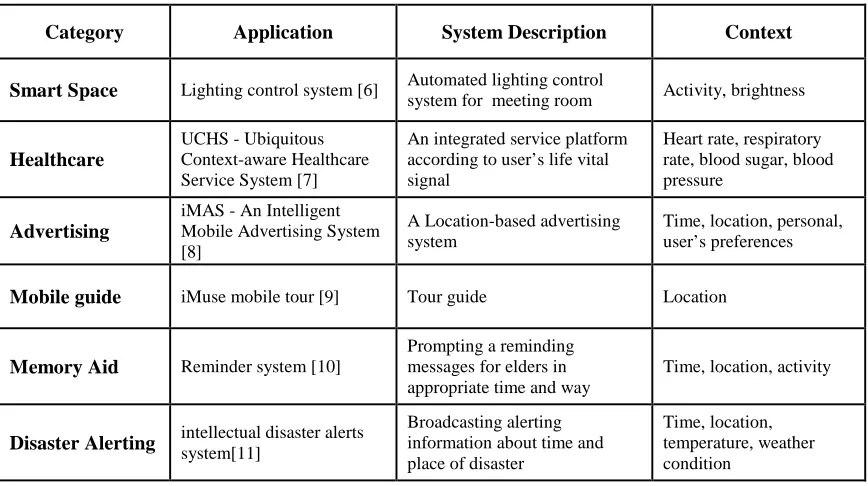
Table 1: Application of Context-Aware Categories
Category Application System Description Context
Smart Space Lighting control system [6] Automated lighting control
system for meeting room Activity, brightness
Healthcare
UCHS - Ubiquitous Context-aware Healthcare Service System [7]
An integrated service platform according to user’s life vital signal
Heart rate, respiratory rate, blood sugar, blood pressure
Advertising
iMAS - An Intelligent Mobile Advertising System [8]
A Location-based advertising system
Time, location, personal, user’s preferences
Mobile guide iMuse mobile tour [9] Tour guide Location
Memory Aid Reminder system [10]
Prompting a reminding messages for elders in appropriate time and way
Time, location, activity
Disaster Alerting intellectual disaster alerts
system[11]
Broadcasting alerting information about time and place of disaster
[image:3.612.90.524.487.730.2]284 LO etal. develop Ubiquitous Context-aware Healthcare Service System (UCHS), which offers efficient nature medicine recommendations to the elderly citizen based on their life vital signal (like blood pressure, blood sugar, heart rate, temperature and respiratory rate) [7]. UCHS provides an integrated platform including Situation-Aware Medical Tourism Service Search Subsystem (SAMTS), Healthy-life Map Guiding Subsystem (HMGS), Intelligent Curative Food Decision Support Subsystem (ICFDSS), and 4D Emergency Indication and Ambulance Dispatch Subsystem (DEIADS). The main functionalities of this system are to provide firstly, Nature Medicine Services (NMS), secondly user’s requirement inference, and finally decision support services to the senior citizen in Taiwan. Figure 2 illustrates the information about calorie of user’s food after using PDA to connect RFID reader in order to sense user’s diet content and calories.
Figure 2: Left) Computing BMI Value, Right) Food’s Name And Calorie [7]
3.3 Advertising
The main characteristics of a good advertisement are to be shown in a correct way, at the right time, to the proper person, by using multiple modalities. Context-aware advertising systems can tackle the aforementioned requirements and provide a recommendation service according to its users’ preferences.
iMAS is an Intelligent Marketing Advertising Services that provides the location-based advertising service (in form of textual and graphical schedule information) to both business and individual by using Global Navigational Satellite Systems (GNSS) and Location Based Services (LBS) [8]. Intelligent advertising services (IAS) as
a part of iMAS is responsible for sending information to the target consumer based on received information from global position system and localized information based on particular geo-location. Moreover, iMAS can also personalise information according to consumer’s preferences.
3.4 Mobile Guide
The main functionality of mobile guide applications is to provide the specific information to the user via mobile devices such as mobile phone, PDA, and tablet PC. Examples of such applications are museum mobile guides. Museum visitors can be equipped with smart devices and interact actively with the museum environment in order to receive various services [12].
iMuse Mobile Tour is an example of mobile guide applications that provides interactive games, predefined and self-defined tours and enable the visitor to obtain necessary information via their personal mobile phone [9]. iMuse provides context-aware information services by using UHF RFID technology. Guidance services of iMuse can be pushed to the visitor’s personal mobile phone by using group support service and without installing any specific software. Figure 3 shows the screenshots of iMuse mobile guide.
Figure 3: Imuse Mobile Guide Screenshots [9]
3.5 Memory Aid
[image:4.612.316.521.437.593.2]285 activity. To ensure elder receive reminder message in a convenient time with low unpleasant impact two issues should be consider: first, to select an appropriate way to deliver a reminder and second, to determine reasonable time to present reminder service.
3.6 Disaster Alerting
A context-aware mobile platform for intellectual disaster alters system should transfer disaster information by means of mobile device [11]. The disaster altering system is an effective application to reduce disaster effects and ruins by timely transmitting altering notification regarding to the place of disaster. Therefore, the system is composed of disaster alerts module (receives the transmitted alerts information of each user’s device), disaster alert receive module (receives information of all disaster alters system), disaster alert database (store all information about disaster alerts, rules, reason, and analyse), risk analysis module (analyse the risk of the received information), styling module (encoding the information into appropriate type according to the user’s device and transmitting it) and item location module (provide proper information based on analysed risk to be sent).
4. ENHANCING HUMAN COMPUTER
INTERACTION
The two main factors that should be considered in HCI are functionality and usability. The services and actions that applications offer to their user defined functionality of applications; while, the usability of certain application’s functionality are defined by the degree and range that certain goals can be accomplished by user adequately and efficiently. Hence, context information can enhance HCI by making application more adaptable, flexible and user friendly.
A challenging area of HCI is context-awareness. Since computers cannot infer from situational information directly or even use in their interactions, this information should be provided explicitly for them. For instance, simple existing user interface are not able to automatically sense and adapt to the current level of noise and light except a user explicitly providing this information. Another example comes from their disability to provide service and information based on the current activity and location. Computer applications can use context information in various ways to provide effective and suitable service especially in
mobile environment, where the user needs and environment change rapidly.
According to Schmidt, Beigl, and Gellersen, the major ways to assist applications is to reduce the user need for inputting necessary information and adapting the context with the input. On the contrary, the system action can be assisted by matching application reaction with context, reducing the interruptions need and finding appropriate time for user interruptions [13]. A sample application of this type is iMAS which act as an intelligent and mobile advertising system. The iMAS uses a vehicular transport system to lead potential consumer to specific location. Here the context is limited to identify the geo-location of vehicular.
Another example is smart space that provides automatic facilities in place such as classroom, meeting room and home by means of sensors. This endeavour enhances the usability of smart space for its residents in different ways. Lighting control system control light condition by using sensor and detect context of the meeting room and the audience and afterward adapt the condition accordingly. Many technologies are used for developing context-aware application.
Moreover, the technology related to recognition of human physical activities, health condition and medical status can be used to recognize context for enhancing HCI. UCHS and reminder system are two examples that use vital signs of people to provide appropriate service to the elderly people accordingly by improving functionality of applications. The intellectual disaster alerts system provides alerts in mobile devices in case of expectation for disaster happening by using context information in order to increase the richness of interaction and communication in HCI. While in iMuse system this richness is covered by providing exhibit information to the museum’s visitor in a usable and flexible manner on their own mobiles. All aforementioned applications attempt to improve implicit access to the context information in order to enhance interaction between application and human to provide more efficient and useful computational services.
5. DISCUSSION
286 they can classify them as contexts and then system will recognize appropriate interaction against context, this information will be utilized to trigger, change, and adapt the system or application behaviour.
The most common utilized type of context information are limited to location, identity and time context since representing, capturing and processing contextual data are very complex and challenging issues. Hence, the most mobile context-aware applications are focused on the user interfaces, handheld and wearable computing, and augmented reality [14]. Among various types of mobile context-aware applications only few of them are commercial products and most development are conducted only in library.
Several problems should be considered before developing and wide adoption of the mobile computing technology. Hardware limitation such as small size of mobile devices’ monitor, reducing energy consumption, interaction and maintaining privacy are major concerns. Therefore, a feasible and efficient context-aware application should utilize lighter and cheaper sensors, try to gather and inference context information accurately by deploying novel techniques, decrease battery consumption and finally consider the legislations and ethics.
5.1 Open Research Issues
HCI can highly benefit from development of mobile context-aware applications. Therefore, three possible approaches to achieve this enhancement are listed as follows: first, considering the combination of multiple modalities such as eye movements, hand-based gestures and touch techniques in designing mobile context-aware applications. Second, further researches are required in the area such as context mapping, scheduling heuristic, information sharing, real-time data mining, wearable sensors, security policies, learning mechanism, virtual reality, and ontology modeling. Third, enhanced context-aware applications need to employ cheaper and lighter sensors (virtual and logical types), efficient ways to reduce power consumption, and innovative ways for information gathering from surroundings.
6. CONCLUSION
This paper reviewed some recent mobile context-aware applications that were developed based on context-aware computing technology. The basic definition of context was provided and different context categories were listed. Then the scope of
review applications was defined by specified classification categories, and a sample application for each group was briefly discussed. Afterward the impact of context-aware application on HCI was explained. It can be concluded from the current research and applications that the context-aware concept is widely used in information technology and it will highly affect the future of human computer interaction.
REFERENCES:
[1] A. K. Dey and G. D. Abowd, "Towards a Better Understanding of Context and Context-awareness," in CHI 2000 Workshop on The
What, Who, Where, When, Why and How of Context-awareness, 2000, pp. 1-6.
[2] M. Baldauf, S. Dustdar, and a. F. Rosenberg, "A Survey on Context-aware Systems,"
International Journal of Ad Hoc and Ubiquitous Computing, vol. 2, 2007, pp. 263–
277.
[3] Y.-m. Lee, J.-y. Hong, W.-i. Oh, H. Kang, and E.-h. Suh, "A review of context-aware computing," in Proceedings of the 11th Annual
Conference of Asia Pacific Decision Sciences Institute, Hong Kong 2006, pp. 546-548.
[4] A.-W. Scheer, T. Feld, M. Göbl, and M. Hoffmann, "Das mobile Unternehmen," in
Mobile Commerce, G. Silberer, J. Wohlfahrt,
and T. Wilhelm, Eds., ed: Gabler Verlag, 2001, pp. 91-110.
[5] S. Mann, "Humanistic intelligence: ‘WearComp’ as a new framework and application for intelligent signal processing," in
Proc. IEEE, 1998, pp. 2123–2151.
[6] C. Li, L. Suna, and X. Hua, "A context-aware lighting control system for smart meeting rooms," Systems Engineering Procedia, vol. 4, pp. 314-323, 2012.
[7] C.-C. Lo, C.-H. Chen, D.-Y. Cheng, and H.-Y. Kung, "Ubiquitous Healthcare Service System with Context-awareness Capability: Design and Implementation," Expert Systems with
Applications, vol. 38, 2011, pp. 4416-4436.
[8] C. Evans, P. Moore, and A. Thomas, "An Intelligent Mobile Advertising System (iMAS): Location-Based Advertising to Individuals and Business," in Complex, Intelligent and Software Intensive Systems (CISIS), 2012 Sixth International Conference on, 2012, pp.
287 [9] A. Fevgas, P. Tsompanopoulou, and P.
Bozanis, "iMuse Mobile Tour: A personalized multimedia museum guide opens to groups," in
Computers and Communications (ISCC), 2011 IEEE Symposium on, 2011, pp. 971-975.
[10] S. Zhou, C.-H. Chu, Z. Yu, and J. Kim, "A context-aware reminder system for elders based on fuzzy linguistic approach," Expert
Systems with Applications, vol. 39, 2012, pp.
9411-9419.
[11] H. Chang, Y. Kang, H. Ahn, C. Jang, and E. Choi, "Context-aware Mobile Platform for Intellectual Disaster Alerts System," Energy
Procedia, vol. 16, Part B, 2012, pp. 1318-1323.
[12] S. Jbara, T. Kuflik, P. Soffer, and O. Stock, "Context Aware Communication Services in Active Museums," in IEEE International
Conference on Software – Science, Technology and Engineering, 2007, pp. 127-135.
[13] A. Schmidt, M. Beigl, and H.-W. Gellersen, "There is more to context than location,"
Computers & Graphics, vol. 23, 1999, pp.
893-90.
![Figure 3: Imuse Mobile Guide Screenshots [9]](https://thumb-us.123doks.com/thumbv2/123dok_us/8913506.960540/4.612.103.286.337.496/figure-imuse-mobile-guide-screenshots.webp)
