Improving Word Representations via Global Context
and Multiple Word Prototypes
Eric H. Huang, Richard Socher∗, Christopher D. Manning, Andrew Y. Ng Computer Science Department, Stanford University, Stanford, CA 94305, USA {ehhuang,manning,ang}@stanford.edu,∗
Abstract
Unsupervised word representations are very useful in NLP tasks both as inputs to learning algorithms and as extra word features in NLP systems. However, most of these models are built with only local context and one represen-tation per word. This is problematic because words are often polysemous and global con-text can also provide useful information for learning word meanings. We present a new neural network architecture which 1) learns word embeddings that better capture the se-mantics of words by incorporating both local and global document context, and 2) accounts for homonymy and polysemy by learning mul-tiple embeddings per word. We introduce a new dataset with human judgments on pairs of words in sentential context, and evaluate our model on it, showing that our model outper-forms competitive baselines and other neural language models.1
1 Introduction
Vector-space models (VSM) represent word mean-ings with vectors that capture semantic and syntac-tic information of words. These representations can be used to induce similarity measures by computing distances between the vectors, leading to many use-ful applications, such as information retrieval (Man-ning et al., 2008), document classification (Sebas-tiani, 2002) and question answering (Tellex et al., 2003).
1
The dataset and word vectors can be downloaded at
http://ai.stanford.edu/∼ehhuang/.
Despite their usefulness, most VSMs share a common problem that each word is only repre-sented with one vector, which clearly fails to capture homonymy and polysemy. Reisinger and Mooney (2010b) introduced a multi-prototype VSM where word sense discrimination is first applied by clus-tering contexts, and then prototypes are built using the contexts of the sense-labeled words. However, in order to cluster accurately, it is important to capture both the syntax and semantics of words. While many approaches use local contexts to disambiguate word meaning, global contexts can also provide useful topical information (Ng and Zelle, 1997). Several studies in psychology have also shown that global context can help language comprehension (Hess et al., 1995) and acquisition (Li et al., 2000).
We introduce a new neural-network-based lan-guage model that distinguishes and uses both local and global context via a joint training objective. The model learns word representations that better cap-ture the semantics of words, while still keeping syn-tactic information. These improved representations can be used to represent contexts for clustering word instances, which is used in the multi-prototype ver-sion of our model that accounts for words with mul-tiple senses.
We evaluate our new model on the standard WordSim-353 (Finkelstein et al., 2001) dataset that includes human similarity judgments on pairs of words, showing that combining both local and global context outperforms using only local or global context alone, and is competitive with state-of-the-art methods. However, one limitation of this evaluation is that the human judgments are on pairs
Global Context
Local Context
scorel scoreg
Document
he walks to the bank
... ...
sum
score
river
water shore
global semantic vector
⋮
play
[image:2.612.81.539.75.220.2]weighted average
Figure 1: An overview of our neural language model. The model makes use of both local and global context to compute a score that should be large for the actual next word (bankin the example), compared to the score for other words. When word meaning is still ambiguous given local context, information in global context can help disambiguation.
of words presented in isolation, ignoring meaning variations in context. Since word interpretation in context is important especially for homonymous and polysemous words, we introduce a new dataset with human judgments on similarity between pairs of words in sentential context. To capture interesting word pairs, we sample different senses of words us-ing WordNet (Miller, 1995). The dataset includes verbs and adjectives, in addition to nouns. We show that our multi-prototype model improves upon the single-prototype version and outperforms other neu-ral language models and baselines on this dataset.
2 Global Context-Aware Neural Language Model
In this section, we describe the training objective of our model, followed by a description of the neural network architecture, ending with a brief description of our model’s training method.
2.1 Training Objective
Our model jointly learns word representations while learning to discriminate the next word given a short word sequence (local context) and the document (global context) in which the word sequence occurs. Because our goal is to learn useful word representa-tions and not theprobabilityof the next word given previous words (which prohibits looking ahead), our model can utilize the entire document to provide
global context.
Given a word sequence s and document d in which the sequence occurs, our goal is to discrim-inate the correct last word insfrom other random words. We compute scores g(s, d) and g(sw, d) whereswisswith the last word replaced by wordw, andg(·,·)is the scoring function that represents the neural networks used. We wantg(s, d)to be larger thang(sw, d)by a margin of 1, for any other word win the vocabulary, which corresponds to the train-ing objective of minimiztrain-ing the ranktrain-ing loss for each (s, d)found in the corpus:
Cs,d= X
w∈V
max(0,1−g(s, d) +g(sw, d)) (1)
Collobert and Weston (2008) showed that this rank-ing approach can produce good word embeddrank-ings that are useful in several NLP tasks, and allows much faster training of the model compared to op-timizing log-likelihood of the next word.
2.2 Neural Network Architecture
We define two scoring components that contribute to the final score of a (word sequence, document) pair. The scoring components are computed by two neural networks, one capturing local context and the other global context, as shown in Figure 1. We now describe how each scoring component is computed.
an ordered list of vectorsx= (x1, x2, ..., xm)where
xiis the embedding of wordiin the sequence, which
is a column in the embedding matrix L ∈ Rn×|V| where|V|denotes the size of the vocabulary. The columns of this embedding matrixL are the word vectors and will be learned and updated during train-ing. To compute the score of local context, scorel,
we use a neural network with one hidden layer:
a1 = f(W1[x1;x2;...;xm] +b1) (2)
scorel = W2a1+b2 (3)
where [x1;x2;...;xm] is the concatenation of the
mword embeddings representing sequence s, f is an element-wise activation function such as tanh, a1 ∈Rh×1is the activation of the hidden layer with
hhidden nodes, W1 ∈ Rh×(mn) and W
2 ∈ R1×h
are respectively the first and second layer weights of the neural network, andb1,b2are the biases of each
layer.
For the score of the global context, we represent the document also as an ordered list of word em-beddings,d = (d1, d2, ..., dk). We first compute the
weighted average of all word vectors in the docu-ment:
c= Pk
i=1w(ti)di
Pk
i=1w(ti)
(4)
wherew(·)can be any weighting function that cap-tures the importance of wordtiin the document. We
use idf-weighting as the weighting function.
We use a two-layer neural network to compute the global context score, scoreg, similar to the above:
a1(g) = f(W1(g)[c;xm] +b(1g)) (5)
scoreg = W2(g)a1(g)+b(2g) (6)
where[c;xm]is the concatenation of the weighted average document vector and the vector of the last word in s, a1(g) ∈ Rh(g)×1
is the activation of the hidden layer with h(g) hidden nodes, W1(g) ∈
Rh(g)×(2n)andW2(g)∈R1×h (g)
are respectively the first and second layer weights of the neural network, andb(1g),b(2g) are the biases of each layer. Note that instead of using the document where the sequence occurs, we can also specify a fixedk > mthat cap-tures larger context.
The final score is the sum of the two scores:
score=scorel+scoreg (7)
The local score preserves word order and syntactic information, while the global score uses a weighted average which is similar to bag-of-words features, capturing more of the semantics and topics of the document. Note that Collobert and Weston (2008)’s language model corresponds to the network using only local context.
2.3 Learning
Following Collobert and Weston (2008), we sample the gradient of the objective by randomly choosing a word from the dictionary as acorruptexample for each sequence-document pair, (s, d), and take the derivative of the ranking loss with respect to the pa-rameters: weights of the neural network and the em-bedding matrixL. These weights are updated via backpropagation. The embedding matrix L is the word representations. We found that word embed-dings move to good positions in the vector space faster when using mini-batch L-BFGS (Liu and No-cedal, 1989) with 1000 pairs of good and corrupt ex-amples per batch for training, compared to stochas-tic gradient descent.
3 Multi-Prototype Neural Language Model
Despite distributional similarity models’ successful applications in various NLP tasks, one major limi-tation common to most of these models is that they assume only one representation for each word. This single-prototype representation is problematic be-cause many words have multiple meanings, which can be wildly different. Using one representa-tion simply cannot capture the different meanings. Moreover, using all contexts of a homonymous or polysemous word to build a single prototype could hurt the representation, which cannot represent any one of the meanings well as it is influenced by all meanings of the word.
model can readily adopt the multi-prototype ap-proach. We present a way to use our learned single-prototype embeddings to represent each con-text window, which can then be used by clustering to perform word sense discrimination (Sch¨utze, 1998). In order to learn multiple prototypes, we first gather the fixed-sized context windows of all occur-rences of a word (we use 5 words before and after the word occurrence). Each context is represented by a weighted average of the context words’ vectors, where again, we use idf-weighting as the weighting function, similar to the document context represen-tation described in Section 2.2. We then use spheri-cal k-means to cluster these context representations, which has been shown to model semantic relations well (Dhillon and Modha, 2001). Finally, each word occurrence in the corpus is re-labeled to its associ-ated cluster and is used to train the word representa-tion for that cluster.
Similarity between a pair of words (w, w0) us-ing the multi-prototype approach can be computed with or without context, as defined by Reisinger and Mooney (2010b):
AvgSimC(w, w0) =
1 K2
k
X
i=1
k
X
j=1
p(c, w, i)p(c0, w0, j)d(µi(w), µj(w0))
(8)
wherep(c, w, i) is the likelihood that wordw is in its clusterigiven contextc,µi(w)is the vector rep-resenting thei-th cluster centroid ofw, andd(v, v0) is a function computing similarity between two vec-tors, which can be any of the distance functions pre-sented by Curran (2004). The similarity measure can be computed in absence of context by assuming uni-formp(c, w, i)overi.
4 Experiments
In this section, we first present a qualitative analysis comparing the nearest neighbors of our model’s em-beddings with those of others, showing our embed-dings better capture the semantics of words, with the use of global context. Our model also improves the correlation with human judgments on a word simi-larity task. Because word interpretation in context is
important, we introduce a new dataset with human judgments on similarity of pairs of words in senten-tial context. Finally, we show that our model outper-forms other methods on this dataset and also that the multi-prototype approach improves over the single-prototype approach.
We chose Wikipedia as the corpus to train all models because of its wide range of topics and word usages, and its clean organization of docu-ment by topic. We used the April 2010 snapshot of the Wikipedia corpus (Shaoul and Westbury, 2010), with a total of about 2 million articles and 990 mil-lion tokens. We use a dictionary of the 30,000 most frequent words in Wikipedia, converted to lower case. In preprocessing, we keep the frequent num-bers intact and replace each digit of the uncommon numbers to “DG” so as to preserve information such as it being a year (e.g. “DGDGDGDG”). The con-verted numbers that are rare are mapped to a NUM-BER token. Other rare words not in the dictionary are mapped to an UNKNOWN token.
For all experiments, our models use 50-dimensional embeddings. We use 10-word windows of text as the local context, 100 hidden units, and no weight regularization for both neural networks. For multi-prototype variants, we fix the number of pro-totypes to be 10.
4.1 Qualitative Evaluations
In order to show that our model learns more seman-tic word representations with global context, we give the nearest neighbors of our single-prototype model versus C&W’s, which only uses local context. The nearest neighbors of a word are computed by com-paring the cosine similarity between the center word and all other words in the dictionary. Table 1 shows the nearest neighbors of some words. The nearest neighbors of “market” that C&W’s embeddings give are more constrained by the syntactic constraint that words in plural form are only close to other words in plural form, whereas our model captures that the singular and plural forms of a word are similar in meaning. Other examples show that our model in-duces nearest neighbors that better capture seman-tics.
Center Word
C&W Our Model
markets firms, industries, stores
market, firms, businesses American Australian,
Indian, Italian
U.S., Canadian, African
illegal alleged, overseas, banned
[image:5.612.332.520.59.215.2]harmful, prohib-ited, convicted
Table 1: Nearest neighbors of words based on cosine sim-ilarity. Our model is less constrained by syntax and is more semantic.
Center Word Nearest Neighbors
bank 1 corporation, insurance, company bank 2 shore, coast, direction
star 1 movie, film, radio star 2 galaxy, planet, moon cell 1 telephone, smart, phone
cell 2 pathology, molecular, physiology
left 1 close, leave, live left 2 top, round, right
Table 2: Nearest neighbors of word embeddings learned by our model using the multi-prototype approach based on cosine similarity. The clustering is able to find the dif-ferent meanings, usages, and parts of speech of the words.
meanings of a word into separate groups, allowing our model to learn multiple meaningful representa-tions of a word.
4.2 WordSim-353
A standard dataset for evaluating vector-space mod-els is the WordSim-353 dataset (Finkmod-elstein et al., 2001), which consists of 353 pairs of nouns. Each pair is presented without context and associated with 13 to 16 human judgments on similarity and re-latedness on a scale from 0 to 10. For example, (cup,drink) received an average score of 7.25, while (cup,substance) received an average score of 1.92.
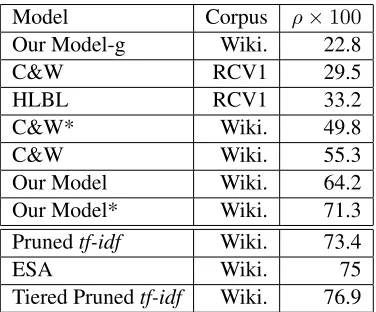
Table 3 shows our results compared to previous methods, including C&W’s language model and the hierarchical log-bilinear (HLBL) model (Mnih and Hinton, 2008), which is a probabilistic, linear neu-ral model. We downloaded these embeddings from Turian et al. (2010). These embeddings were trained on the smaller corpus RCV1 that contains one year of Reuters English newswire, and show similar cor-relations on the dataset. We report the result of
Model Corpus ρ×100
Our Model-g Wiki. 22.8
C&W RCV1 29.5
HLBL RCV1 33.2
C&W* Wiki. 49.8
C&W Wiki. 55.3
Our Model Wiki. 64.2
Our Model* Wiki. 71.3
Prunedtf-idf Wiki. 73.4
ESA Wiki. 75
Tiered Prunedtf-idf Wiki. 76.9
Table 3: Spearman’s ρ correlation on WordSim-353, showing our model’s improvement over previous neural models for learning word embeddings. C&W* is the word embeddings trained and provided by C&W. Our Model* is trained without stop words, while Our Model-g uses only Model-global context. Prunedtf-idf(Reisinger and Mooney, 2010b) and ESA (Gabrilovich and Markovitch, 2007) are also included.
our re-implementation of C&W’s model trained on Wikipedia, showing the large effect of using a dif-ferent corpus.
Our model is able to learn more semantic word embeddings and noticeably improves upon C&W’s model. Note that our model achieves higher corre-lation (64.2) than either using local context alone (C&W: 55.3) or using global context alone (Our Model-g: 22.8). We also found that correlation can be further improved by removing stop words (71.3). Thus, each window of text (training example) con-tains more information but still preserves some syn-tactic information as the words are still ordered in the local context.
4.3 New Dataset: Word Similarity in Context
[image:5.612.79.300.59.159.2]Word 1 Word 2 Located downtown along the east bank of the Des
Moines River ...
This is the basis of allmoneylaundering , a track record of depositing clean money before slipping through dirty money ...
Inside the ruins , there arebatsand a bowl with Pokeys that fills with sand over the course of the race , and the music changes somewhat while inside ...
An aggressive lower order batsman who usuallybatsat No. 11 , Muralitharan is known for his tendency to back away to leg and slog ...
An example of legacy left in the Mideast from these nobles is the Krak des Chevaliers ’ enlargement by the Counts of Tripoli and Toulouse ...
... one should not adhere to a particular explanation , only in such measure as to be ready toabandonit if it be proved with certainty to be false ...
... and Andy ’s getting ready topackhis bags and head up to Los Angeles tomorrow to get ready to fly back home on Thursday
... she encounters Ben ( Duane Jones ) , who arrives in a pickup truck and defends the house against another
packof zombies ... Inpractice, there is an unknown phase delay between
the transmitter and receiver that must be compensated by ” synchronization ” of the receivers local oscillator
[image:6.612.76.529.57.254.2]... but Gilbert did not believe that she was dedicated enough , and when she missed a rehearsal, she was dismissed ...
Table 4: Example pairs from our new dataset. Note that words in a pair can be the same word and have different parts of speech.
batflies”,bathas completely different meanings. It is unclear how this variation in meaning is accounted for in human judgments of words presented without context.
One of the main contributions of this paper is the creation of a new dataset that addresses this issue. The dataset has three interesting characteristics: 1) human judgments are on pairs of words presented in sentential context, 2) word pairs and their contexts are chosen to reflect interesting variations in mean-ings of homonymous and polysemous words, and 3) verbs and adjectives are present in addition to nouns. We now describe our methodology in constructing the dataset.
4.3.1 Dataset Construction
Our procedure of constructing the dataset consists of three steps: 1) select a list a words, 2) for each word, select another word to form a pair, 3) for each word in a pair, find a sentential context. We now describe each step in detail.
In step 1, in order to make sure we select a diverse list of words, we consider three attributes of a word: frequency in a corpus, number of parts of speech, and number of synsets according to WordNet. For frequency, we divide words into three groups, top 2,000 most frequent, between 2,000 and 5,000, and between 5,000 to 10,000 based on occurrences in Wikipedia. For number of parts of speech, we group words based on their number of possible parts of
speech (noun, verb or adjective), from 1 to 3. We also group words by their number of synsets: [0,5], [6,10], [11, 20], and [20, max]. Finally, we sam-ple at most 15 words from each combination in the Cartesian product of the above groupings.
In step 2, for each of the words selected in step 1, we want to choose the other word so that the pair captures an interesting relationship. Similar to Man-andhar et al. (2010), we use WordNet to first ran-domly select one synset of the first word, we then construct a set of words in various relations to the first word’s chosen synset, including hypernyms, hy-ponyms, holonyms, meronyms and attributes. We randomly select a word from this set of words as the second word in the pair. We try to repeat the above twice to generate two pairs for each word. In addi-tion, for words with more than five synsets, we allow the second word to be the same as the first, but with different synsets. We end up with pairs of words as well as the one chosen synset for each word in the pairs.
In step 3, we aim to extract a sentence from Wikipedia for each word, which contains the word and corresponds to a usage of the chosen synset. We first find all sentences in which the word oc-curs. We then POS tag2these sentences and filter out
those that do not match the chosen POS. To find the
2
Model ρ×100
C&W-S 57.0
Our Model-S 58.6
Our Model-M AvgSim 62.8
Our Model-M AvgSimC 65.7
tf-idf-S 26.3
Prunedtf-idf-S 62.5
Prunedtf-idf-M AvgSim 60.4 Prunedtf-idf-M AvgSimC 60.5
Table 5: Spearman’s ρ correlation on our new dataset. Our Model-S uses the single-prototype approach, while Our Model-M uses the multi-prototype approach. AvgSim calculates similarity with each prototype con-tributing equally, while AvgSimC weighs the prototypes according to probability of the word belonging to that prototype’s cluster.
word usages that correspond to the chosen synset, we first construct a set of related words of the chosen synset, including hypernyms, hyponyms, holonyms, meronyms and attributes. Using this set of related words, we filter out a sentence if the document in which the sentence appears does not include one of the related words. Finally, we randomly select one sentence from those that are left.
Table 4 shows some examples from the dataset. Note that the dataset also includes pairs of the same word. Single-prototype models would give the max similarity score for those pairs, which can be prob-lematic depending on the words’ contexts. This dataset requires models to examine context when de-termining word meaning.
Using Amazon Mechanical Turk, we collected 10 human similarity ratings for each pair, as Snow et al. (2008) found that 10 non-expert annotators can achieve very close inter-annotator agreement with expert raters. To ensure worker quality, we only allowed workers with over 95% approval rate to work on our task. Furthermore, we discarded all ratings by a worker if he/she entered scores out of the accepted range or missed a rating, signaling low-quality work.
We obtained a total of 2,003 word pairs and their sentential contexts. The word pairs consist of 1,712 unique words. Of the 2,003 word pairs, 1328 are noun-noun pairs, 399 verb-verb, 140 verb-noun, 97 adjective-adjective, 30 noun-adjective, and 9 verb-adjective. 241 pairs are same-word pairs.
4.3.2 Evaluations on Word Similarity in
Context
For evaluation, we also compute Spearman corre-lation between a model’s computed similarity scores and human judgments. Table 5 compares different models’ results on this dataset. We compare against the following baselines: tf-idf represents words in a word-word matrix capturing co-occurrence counts in all 10-word context windows. Reisinger and Mooney (2010b) found pruning the low-valuetf-idf features helps performance. We report the result of this pruning technique after tuning the thresh-old value on this dataset, removing all but the top 200 features in each word vector. We tried the same multi-prototype approach and used spherical k-means3 to cluster the contexts using tf-idf
repre-sentations, but obtained lower numbers than single-prototype (55.4 with AvgSimC). We then tried using pruned tf-idf representations on contexts with our clustering assignments (included in Table 5), but still got results worse than the single-prototype version of the pruned tf-idf model (60.5 with AvgSimC). This suggests that the prunedtf-idfrepresentations might be more susceptible to noise or mistakes in context clustering.
By utilizing global context, our model outper-forms C&W’s vectors and the above baselines on this dataset. With multiple representations per word, we show that the multi-prototype approach can improve over the single-prototype version with-out using context (62.8 vs. 58.6). Moreover, using AvgSimC4 which takes contexts into account, the
multi-prototype model obtains the best performance (65.7).
5 Related Work
Neural language models (Bengio et al., 2003; Mnih and Hinton, 2007; Collobert and Weston, 2008; Schwenk and Gauvain, 2002; Emami et al., 2003) have been shown to be very powerful at language modeling, a task where models are asked to ac-curately predict the next word given previously seen words. By using distributed representations of
3
We first tried movMF as in Reisinger and Mooney (2010b), but were unable to get decent results (only 31.5).
4
words which model words’ similarity, this type of models addresses the data sparseness problem that n-gram models encounter when large contexts are used. Most of these models used relative local con-texts of between 2 to 10 words. Schwenk and Gau-vain (2002) tried to incorporate larger context by combining partial parses of past word sequences and a neural language model. They used up to 3 previ-ous head words and showed increased performance on language modeling. Our model uses a similar neural network architecture as these models and uses the ranking-loss training objective proposed by Col-lobert and Weston (2008), but introduces a new way to combine local and global context to train word embeddings.
Besides language modeling, word embeddings in-duced by neural language models have been use-ful in chunking, NER (Turian et al., 2010), parsing (Socher et al., 2011b), sentiment analysis (Socher et al., 2011c) and paraphrase detection (Socher et al., 2011a). However, they have not been directly eval-uated on word similarity tasks, which are important for tasks such as information retrieval and summa-rization. Our experiments show that our word em-beddings are competitive in word similarity tasks.
Most of the previous vector-space models use a single vector to represent a word even though many words have multiple meanings. The multi-prototype approach has been widely studied in models of cat-egorization in psychology (Rosseel, 2002; Griffiths et al., 2009), while Sch¨utze (1998) used clustering of contexts to perform word sense discrimination. Reisinger and Mooney (2010b) combined the two approaches and applied them to vector-space mod-els, which was further improved in Reisinger and Mooney (2010a). Two other recent papers (Dhillon et al., 2011; Reddy et al., 2011) present models for constructing word representations that deal with context. It would be interesting to evaluate those models on our new dataset.
Many datasets with human similarity ratings on pairs of words, such as WordSim-353 (Finkelstein et al., 2001), MC (Miller and Charles, 1991) and RG (Rubenstein and Goodenough, 1965), have been widely used to evaluate vector-space models. Moti-vated to evaluate composition models, Mitchell and Lapata (2008) introduced a dataset where an intran-sitive verb, presented with a subject noun, is
com-pared to another verb chosen to be either similar or dissimilar to the intransitive verb in context. The context is short, with only one word, and only verbs are compared. Erk and Pad´o (2008), Thater et al. (2011) and Dinu and Lapata (2010) evaluated word similarity in context with a modified task where sys-tems are to rerank gold-standard paraphrase candi-dates given the SemEval 2007 Lexical Substitution Task dataset. This task only indirectly evaluates sim-ilarity as only reranking of already similar words are evaluated.
6 Conclusion
We presented a new neural network architecture that learns more semantic word representations by us-ing both local and global context in learnus-ing. These learned word embeddings can be used to represent word contexts as low-dimensional weighted average vectors, which are then clustered to form different meaning groups and used to learn multi-prototype vectors. We introduced a new dataset with human judgments on similarity between pairs of words in context, so as to evaluate model’s abilities to capture homonymy and polysemy of words in context. Our new multi-prototype neural language model outper-forms previous neural models and competitive base-lines on this new dataset.
Acknowledgments
The authors gratefully acknowledges the support of the Defense Advanced Research Projects Agency (DARPA) Machine Reading Program under Air Force Research Laboratory (AFRL) prime contract no. FA8750-09-C-0181, and the DARPA Deep Learning program under contract number FA8650-10-C-7020. Any opinions, findings, and conclusions or recommendations expressed in this material are those of the authors and do not necessarily reflect the view of DARPA, AFRL, or the US government.
References
Ronan Collobert and Jason Weston. 2008. A unified ar-chitecture for natural language processing: deep neu-ral networks with multitask learning. InProceedings of the 25th international conference on Machine learn-ing, ICML ’08, pages 160–167, New York, NY, USA. ACM.
James Richard Curran. 2004. From distributional to se-mantic similarity. Technical report.
Inderjit S. Dhillon and Dharmendra S. Modha. 2001. Concept decompositions for large sparse text data us-ing clusterus-ing.Mach. Learn., 42:143–175, January. Paramveer S. Dhillon, Dean Foster, and Lyle Ungar.
2011. Multi-view learning of word embeddings via cca. In Advances in Neural Information Processing Systems (NIPS), volume 24.
Georgiana Dinu and Mirella Lapata. 2010. Measuring distributional similarity in context. InProceedings of the 2010 Conference on Empirical Methods in Natural Language Processing, EMNLP ’10, pages 1162–1172, Stroudsburg, PA, USA. Association for Computational Linguistics.
Ahmad Emami, Peng Xu, and Frederick Jelinek. 2003. Using a connectionist model in a syntactical based lan-guage model. InAcoustics, Speech, and Signal Pro-cessing, pages 372–375.
Katrin Erk and Sebastian Pad´o. 2008. A structured vector space model for word meaning in context. In Proceedings of the Conference on Empirical Meth-ods in Natural Language Processing, EMNLP ’08, pages 897–906, Stroudsburg, PA, USA. Association for Computational Linguistics.
Lev Finkelstein, Evgeniy Gabrilovich, Yossi Matias, Ehud Rivlin, Zach Solan, Gadi Wolfman, and Eytan Ruppin. 2001. Placing search in context: the con-cept revisited. InProceedings of the 10th international conference on World Wide Web, WWW ’01, pages 406–414, New York, NY, USA. ACM.
Evgeniy Gabrilovich and Shaul Markovitch. 2007. Com-puting semantic relatedness using wikipedia-based explicit semantic analysis. In Proceedings of the 20th international joint conference on Artifical intel-ligence, IJCAI’07, pages 1606–1611, San Francisco, CA, USA. Morgan Kaufmann Publishers Inc.
Thomas L Griffiths, Kevin R Canini, Adam N Sanborn, and Daniel J Navarro. 2009. Unifying rational models of categorization via the hierarchical dirichlet process. Brain, page 323328.
David J Hess, Donald J Foss, and Patrick Carroll. 1995. Effects of global and local context on lexical process-ing durprocess-ing language comprehension. Journal of Ex-perimental Psychology: General, 124(1):62–82. Ping Li, Curt Burgess, and Kevin Lund. 2000. The
ac-quisition of word meaning through global lexical co-occurrences.
D. C. Liu and J. Nocedal. 1989. On the limited mem-ory bfgs method for large scale optimization. Math. Program., 45(3):503–528, December.
Suresh Manandhar, Ioannis P Klapaftis, Dmitriy Dligach, and Sameer S Pradhan. 2010. Semeval-2010 task 14: Word sense induction & disambiguation. Word Journal Of The International Linguistic Association, (July):63–68.
Christopher D. Manning, Prabhakar Raghavan, and Hin-rich Schtze. 2008. Introduction to Information Re-trieval. Cambridge University Press, New York, NY, USA.
George A Miller and Walter G Charles. 1991. Contextual correlates of semantic similarity. Language & Cogni-tive Processes, 6(1):1–28.
George A. Miller. 1995. Wordnet: A lexical database for english. Communications of the ACM, 38:39–41.
Jeff Mitchell and Mirella Lapata. 2008. Vector-based models of semantic composition. InIn Proceedings of ACL-08: HLT, pages 236–244.
Andriy Mnih and Geoffrey Hinton. 2007. Three new graphical models for statistical language modelling. In Proceedings of the 24th international conference on Machine learning, ICML ’07, pages 641–648, New York, NY, USA. ACM.
Andriy Mnih and Geoffrey Hinton. 2008. A scalable hierarchical distributed language model. InIn NIPS. Ht Ng and J Zelle. 1997. Corpus-based approaches to
semantic interpretation in natural language processing. AI Magazine, 18(4):45–64.
Siva Reddy, Ioannis Klapaftis, Diana McCarthy, and Suresh Manandhar. 2011. Dynamic and static proto-type vectors for semantic composition. InProceedings of 5th International Joint Conference on Natural Lan-guage Processing, pages 705–713, Chiang Mai, Thai-land, November. Asian Federation of Natural Lan-guage Processing.
Joseph Reisinger and Raymond Mooney. 2010a. A mix-ture model with sharing for lexical semantics. In Pro-ceedings of the 2010 Conference on Empirical Meth-ods in Natural Language Processing, EMNLP ’10, pages 1173–1182, Stroudsburg, PA, USA. Association for Computational Linguistics.
Joseph Reisinger and Raymond J. Mooney. 2010b. Multi-prototype vector-space models of word mean-ing. InHuman Language Technologies: The 2010 An-nual Conference of the North American Chapter of the Association for Computational Linguistics, HLT ’10, pages 109–117, Stroudsburg, PA, USA. Association for Computational Linguistics.
Herbert Rubenstein and John B. Goodenough. 1965. Contextual correlates of synonymy. Commun. ACM, 8:627–633, October.
Hinrich Sch¨utze. 1998. Automatic word sense discrimi-nation. Journal of Computational Linguistics, 24:97– 123.
Holger Schwenk and Jean-luc Gauvain. 2002. Connec-tionist language modeling for large vocabulary con-tinuous speech recognition. InIn International Con-ference on Acoustics, Speech and Signal Processing, pages 765–768.
Fabrizio Sebastiani. 2002. Machine learning in auto-mated text categorization. ACM Comput. Surv., 34:1– 47, March.
Cyrus Shaoul and Chris Westbury. 2010. The westbury lab wikipedia corpus.
Rion Snow, Brendan O’Connor, Daniel Jurafsky, and An-drew Y. Ng. 2008. Cheap and fast—but is it good?: evaluating non-expert annotations for natural language tasks. InProceedings of the Conference on Empirical Methods in Natural Language Processing, EMNLP ’08, pages 254–263, Stroudsburg, PA, USA. Associ-ation for ComputAssoci-ational Linguistics.
Richard Socher, Eric H. Huang, Jeffrey Pennington, An-drew Y. Ng, and Christopher D. Manning. 2011a. Dy-namic pooling and unfolding recursive autoencoders for paraphrase detection. InAdvances in Neural Infor-mation Processing Systems 24.
Richard Socher, Cliff C. Lin, Andrew Y. Ng, and Christo-pher D. Manning. 2011b. Parsing natural scenes and natural language with recursive neural networks. In Proceedings of the 26th International Conference on Machine Learning (ICML).
Richard Socher, Jeffrey Pennington, Eric H. Huang, An-drew Y. Ng, and Christopher D. Manning. 2011c. Semi-supervised recursive autoencoders for predicting sentiment distributions. InProceedings of the 2011 Conference on Empirical Methods in Natural Lan-guage Processing (EMNLP).
Stefanie Tellex, Boris Katz, Jimmy Lin, Aaron Fernan-des, and Gregory Marton. 2003. Quantitative evalu-ation of passage retrieval algorithms for question an-swering. InProceedings of the 26th Annual Interna-tional ACM SIGIR Conference on Search and Devel-opment in Information Retrieval, pages 41–47. ACM Press.
Stefan Thater, Hagen F¨urstenau, and Manfred Pinkal. 2011. Word meaning in context: a simple and effec-tive vector model. InProceedings of the 5th Interna-tional Joint Conference on Natural Language Process-ing, IJCNLP ’11.
Joseph Turian, Lev Ratinov, and Yoshua Bengio. 2010. Word representations: a simple and general method