Multimodal Emoji Prediction
Francesco Barbieri♦ Miguel Ballesteros♠ Francesco Ronzano♥ Horacio Saggion♦ ♦Large Scale Text Understanding Systems Lab, TALN, UPF, Barcelona, Spain
♠IBM Research, U.S
♥ Integrative Biomedical Informatics Group, GRIB, IMIM-UPF, Barcelona, Spain
♦♥{name.surname}@upf.edu, ♠[email protected]
Abstract
Emojis are small images that are commonly included in social media text messages. The combination of visual and textual content in the same message builds up a modern way of communication, that automatic systems are not used to deal with. In this paper we extend recent advances in emoji prediction by putting forward a multimodal approach that is able to predict emojis in Instagram posts. Instagram posts are composed of pictures together with texts which sometimes include emojis. We show that these emojis can be predicted by us-ing the text, but also usus-ing the picture. Our main finding is that incorporating the two syn-ergistic modalities, in a combined model, im-proves accuracy in an emoji prediction task. This result demonstrates that these two modal-ities (text and images) encode different infor-mation on the use of emojis and therefore can complement each other.
1 Introduction
In the past few years the use of emojis in social media has increased exponentially, changing the way we communicate. The combination of visual and textual content poses new challenges for infor-mation systems which need not only to deal with the semantics of text but also that of images. Re-cent work (Barbieri et al., 2017) has shown that textual information can be used to predict emo-jis associated to text. In this paper we show that in the current context of multimodal communica-tion where texts and images are combined in social networks, visual information should be combined with texts in order to obtain more accurate emoji-prediction models.
We explore the use of emojis in the social media platform Instagram. We put forward a multimodal approach to predict the emojis associated to an
In-stagram post, given its picture and text1. Our task
and experimental framework are similar to ( Bar-bieri et al.,2017), however, we use different data (Instagram instead of Twitter) and, in addition, we rely on images to improve the selection of the most likely emojis to associate to a post. We show that a multimodal approach (textual and visual content of the posts) increases the emoji prediction accu-racy compared to the one that only uses textual in-formation. This suggests that textual and visual content embed different but complementary fea-tures of the use of emojis.
In general, an effective approach to predict the emoji to be associated to a piece of content may help to improve natural language processing tasks (Novak et al.,2015), such as information retrieval, generation of emoji-enriched social media con-tent, suggestion of emojis when writing text mes-sages or sharing pictures online. Given that emo-jis may also mislead humans (Miller et al.,2017), the automated prediction of emojis may help to achieve better language understanding. As a con-sequence, by modeling the semantics of emojis, we can improve highly-subjective tasks like senti-ment analysis, emotion recognition and irony de-tection (Felbo et al.,2017).
2 Dataset and Task
Dataset: We gathered Instagram posts published between July 2016 and October 2016, and geo-localized in the United States of America. We con-sidered only posts that contained a photo together with the related user description of at least 4 words and exactly one emoji.
Moreover, as done by Barbieri et al. (2017), we considered only the posts which include one and only oneof the 20 most frequent emojis (the
1In this paper we only utilize the first comment issued by the user who posted the picture.
most frequent emojis are shown in Table3). Our dataset is composed of 299,809 posts, each con-taining a picture, the text associated to it and only one emoji. In the experiments we also considered the subsets of the 10 (238,646 posts) and 5 most frequent emojis (184,044 posts) (similarly to the approach followed byBarbieri et al.(2017)). Task: We extend the experimental scheme of Bar-bieri et al.(2017), by considering also visual infor-mation when modeling posts. We cast the emoji prediction problem as a classification task: given an image or a text (or both inputs in the multi-modal scenario) we select the most likely emoji that could be added to (thus used to label) such contents. The task for our machine learning mod-els is, given the visual and textual content of a post, to predict the single emoji that appears in the input comment.
3 Models
We present and motivate the models that we use to predict an emoji given an Instagram post com-posed by a picture and the associated comment.
3.1 ResNets
Deep Residual Networks (ResNets) (He et al., 2016) are Convolutional Neural Networks which were competitive in several image classification tasks (Russakovsky et al., 2015;Lin et al.,2014) and showed to be one of the best CNN architec-tures for image recognition. ResNet is a feed-forward CNN that exploits “residual learning”, by bypassing two or more convolution layers (like similar previous approaches (Sermanet and Le-Cun, 2011)). We use an implementation of the original ResNet where the scale and aspect ratio augmentation are from (Szegedy et al.,2015), the photometric distortions from (Howard,2013) and weight decay is applied to all weights and biases (instead of only weights of the convolution layers). The network we used is composed of 101 layers (ResNet-101), initialized with pretrained parame-ters learned on ImageNet (Deng et al.,2009). We use this model as a starting point to later finetune it on our emoji classification task. Learning rate was set to 0.0001 and we early stopped the train-ing when there was not improvtrain-ing in the validation set.
3.2 FastText
Fastext (Joulin et al., 2017) is a linear model for text classification. We decided to employ FastText as it has been shown that on specific classifica-tion tasks, it can achieve competitive results, com-parable to complex neural classifiers (RNNs and CNNs), while being much faster. FastText repre-sents a valid approach when dealing with social media content classification, where huge amounts of data needs to be processed and new and relevant information is continuously generated. The Fast-Text algorithm is similar to the CBOW algorithm (Mikolov et al.,2013), where the middle word is replaced by the label, in our case the emoji. Given a set ofN documents, the loss that the model at-tempts to minimize is the negative log-likelihood over the labels (in our case, the emojis):
loss=−1
N n=1
X
N
enlog(softmax(BAxn))
whereen is the emoji included in the n-th Insta-gram post, represented as hot vector, and used as label. A and B are affine transformations (weight matrices), andxnis the unit vector of the bag of features of then-th document (comment). The bag of features is the average of the input words, rep-resented as vectors with a look-up table.
3.3 B-LSTM Baseline
Barbieri et al. (2017) propose a recurrent neural network approach for the emoji prediction task. We use this model as baseline, to verify whether FastText achieves comparable performance. They used a Bidirectional LSTM with character repre-sentation of the words (Ling et al.,2015; Balles-teros et al.,2015) to handle orthographic variants (or even spelling errors) of the same word that oc-cur in social media (e.g.coooooolvscool).
4 Experiments and Evaluation
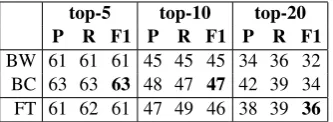
top-5 top-10 top-20 P R F1 P R F1 P R F1 BW 61 61 61 45 45 45 34 36 32 BC 63 63 63 48 47 47 42 39 34 FT 61 62 61 47 49 46 38 39 36
Table 1: Comparison of B-LSTM with word mod-eling (BW), B-LSTM with character modmod-eling (BC), and FastText (FT) on the same Twitter emoji predic-tion tasks proposed byBarbieri et al.(2017), using the same Twitter dataset.
textual inputs. Finally we discuss the contribution of each modality to the prediction task.
We use 80% of our dataset (introduced in Sec-tion 2) for training, 10% to tune our models, and 10% for testing (selecting the sets randomly). 4.1 Feature Extraction and Classifier
To model visual features we first finetune the ResNet (process described in Section3.1) on the emoji prediction task, then extract the vectors from the input of the last fully connected layer (before the softmax). The textual embeddings are the bag of features shown in Section3.2(thexnvectors), extracted after training the FastText model on the emoji prediction task.
With respect to the combination of textual and visual modalities, we adopt a middle fusion ap-proach (Kiela and Clark, 2015): we associate to each Instagram post a multimodal embedding ob-tained by concatenating the unimodal representa-tions of the same post (i.e. the visual and textual embeddings), previously learned. Then, we feed a classifier2with visual (ResNet), textual (FastText),
or multimodal feature embeddings, and test the ac-curacy of the three systems.
4.2 B-LSTM / FastText Comparison
To compare the FastText model with the word and character based B-LSTMs presented by Barbieri et al. (2017), we consider the same three emoji prediction tasks they proposed: top-5, top-10 and top-20 emojis most frequently used in their Tweet datasets. In this comparison we used the same Twitter datasets. As we can see in Table1FastText model is competitive, and it is also able to outper-form the character based B-LSTM in one of the emoji prediction tasks (top-20 emojis). This result suggests that we can employ FastText to represent Social Media short text (such as Twitter or Instra-gram) with reasonable accuracy.
2L2 regularized logistic regression
top-5 top-10 top-20
P R F1 P R F1 P R F1
Maj 7.9 20.0 11.3 2.7 10.0 4.2 0.9 5.0 1.5 W.R. 20.1 20.0 20.1 9.8 9.8 9.8 4.6 4.8 4.7
Vis 38.6 31.1 31.0 26.3 20.9 20.5 20.3 17.5 16.1
Tex 56.1 54.4 54.9 41.6 37.5 38.3 36.7 29.9 31.3
Mul 57.4 56.3 56.7 42.3 40.5 41.1 36.6 35.2 35.5
% 2.3 3.5 3.3 1.7 8 7.3 -0.3 17.7 13.4
Table 2: Prediction results of 5, 10 and top-20 most frequent emojis in the Instagram dataset: Pre-cision (P), Recall (R), F-measure (F1). Experimental settings: majority baseline, weighted random, visual, textual and multimodal systems. In the last line we report the percentage improvement of the multimodal over the textual system.
4.3 Multimodal Emoji Prediction
We present the results of the three emoji classifica-tion tasks, using the visual, textual and multimodal features (see Table2).
The emoji prediction task seems difficult by just using the image of the Instagram post (Visual), even if it largely outperforms the majority base-line3 and weighted random4. We achieve better
performances when we use feature embeddings extracted from the text. The most interesting find-ing is that when we use a multimodal combina-tion of visual and textual features, we get a non-negligible improvement. This suggests that these two modalities embed different representations of the posts, and when used in combination they are synergistic. It is also interesting to note that the more emojis to predict, the higher improvement the multimodal system provides over the text only system (3.28% for top-5 emojis, 7.31% for top-10 emojis, and 13.42 for the top-20 emojis task).
4.4 Qualitative Analysis
In Table3we show the results for each class in the top-20 emojis task.
The emoji with highest F1 using the textual fea-tures is the most frequent one (0.62) and the US flag (0.52). The latter seems easy to pre-dict since it appears in specific contexts: when the word USA/America is used (or when American cities are referred, like #NYC).
The hardest emojis to predict by the text only system are the two gestures (0.12) and (0.13). The first one is often selected when the gold
[image:3.595.99.266.62.123.2]E % Tex Vis MM E % Tex Vis MM
17.46 0.62 0.35 0.69 3.68 0.22 0.15 0.29
9.10 0.45 0.30 0.47 3.55 0.20 0.02 0.26
8.41 0.32 0.15 0.34 3.54 0.13 0.02 0.2
5.91 0.23 0.08 0.26 3.51 0.26 0.17 0.31
5.73 0.35 0.17 0.36 3.31 0.43 0.25 0.45
4.58 0.45 0.24 0.46 3.25 0.12 0.01 0.16
4.31 0.52 0.23 0.53 3.14 0.12 0.02 0.15
4.15 0.38 0.26 0.49 3.11 0.34 0.11 0.36
3.84 0.19 0.1 0.22 2.91 0.36 0.04 0.37
[image:4.595.311.522.62.275.2]3.73 0.13 0.03 0.16 2.82 0.45 0.54 0.59
Table 3: F-measure in the test set of the 20 most fre-quent emojis using the three different models. “%” in-dicates the percentage of the class in the test set
dard emoji is the second one or is often mis-predicted by wrongly selecting or .
Another relevant confusion scenario related to emoji prediction has been spotted by Barbieri et al.(2017): relying on Twitter textual data they showed that the emoji was hard to predict as it was used similarly to . Instead when we con-sider Instagram data, the emoji is easier to pre-dict (0.23), even if it is often confused with .
When we rely on visual contents (Instagram picture), the emojis which are easily predicted are the ones in which the associated photos are simi-lar. For instance, most of the pictures associated to are dog/pet pictures. Similarly, is predicted along with very bright pictures taken outside. is correctly predicted along with pictures related to gym and fitness. The accuracy of is also high since most posts including this emoji are related to fitness (and the pictures are simply either selfies at the gym, weight lifting images, or protein food).
Employing a multimodal approach improves performance. This means that the two modali-ties are somehow complementary, and adding vi-sual information helps to solve potential ambigu-ities that arise when relying only on textual con-tent. In Figure 1 we report the confusion matrix of the multimodal model. The emojis are plotted from the most frequent to the least, and we can see that the model tends to mispredict emojis selecting more frequent emojis (the left part of the matrix is brighter).
4.4.1 Saliency Maps
[image:4.595.74.289.62.211.2]In order to show the parts of the image most rel-evant for each class we analyze the global aver-age pooling (Lin et al.,2013) on the convolutional
Figure 1: Confusion matrix of the multimodal model. The gold labels are plotted as y-axes and the predicted labels as x-axes. The matrix is normalized by rows.
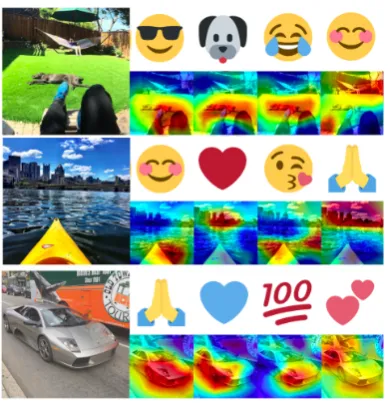
feature maps (Zhou et al.,2016). By visually ob-serving the image heatmaps of the set of Insta-gram post pictures we note that in most cases it is quite difficult to determine a clear association between the emoji used by the user and some par-ticular portion of the image. Detecting the correct emoji given an image is harder than a simple ob-ject recognition task, as the emoji choice depends on subjective emotions of the user who posted the image. In Figure2we show the first four predic-tions of the CNN for three pictures, and where the network focuses (in red). We can see that in the first example the network selects the smile with sunglasses because of the legs in the bottom of the image, the dog emoji is selected while fo-cusing on the dog in the image, and the smiling emoji while focusing on the person in the back, who is lying on a hammock. In the second exam-ple the network selects again the due to the wa-ter and part of the kayak, the heart emoji focus-ing on the city landscape, and the prayfocus-ing emoji focusing on the sky. The same “praying” emoji is also selected when focusing on the luxury car in the third example, probably because the same emoji is used to express desire, i.e. “please, I want this awesome car”.
Figure 2: Three test pictures. From left to right, we show the four most likely predicted emojis and their correspondent class activation mapping heatmap.
I love being these boys’ mommy!!!! #myboys
#mommy ” (associated to picture of two boys wearing two blue shirts). In both examples the tex-tual system predicts . While the multimodal sys-tem correctly predicts both of them: the blue color in the picture associated to (2) helps to change the color of the heart, and the sunny/bright picture of the garden in (1) helps to correctly predict .
5 Related Work
Modeling the semantics of emojis, and their ap-plications, is a relatively novel research problem with direct applications in any social media task. Since emojis do not have a clear grammar, it is not clear their role in text messages. Emojis are con-sidered function words or even affective markers (Na’aman et al.,2017), that can potentially affect the overall semantics of a message (Donato and Paggio,2017).
Emojis can encode different meanings, and they can be interpreted differently. Emoji interpretation has been explored user-wise (Miller et al.,2017), location-wise, specifically in countries (Barbieri et al., 2016b) and cities (Barbieri et al., 2016a), and gender-wise (Chen et al.,2017) and time-wise (Barbieri et al.,2018).
Emoji sematics and usage have been studied with distributional semantics, with models trained on Twitter data (Barbieri et al., 2016c), Twitter data together with the official unicode description (Eisner et al., 2016), or using text from a popu-lar keyboard app Ai et al. (2017). In the same
context, Wijeratne et al. (2017a) propose a plat-form for exploring emoji semantics. In order to further study emoji semantics, two datasets with pairwise emoji similarity, with human annotations, have been proposed: EmoTwi50 (Barbieri et al., 2016c) and EmoSim508 (Wijeratne et al.,2017b). Emoji similarity has been also used for proposing efficient keyboard emoji organization (Pohl et al., 2017). Recently,Barbieri and Camacho-Collados (2018) show that emoji modifiers (skin tones and gender) can affect the semantics vector represen-tation of emojis.
Emoji play an important role in the emotional content of a message. Several sentiment lexicons for emojis have been proposed (Novak et al.,2015; Kimura and Katsurai, 2017; Rodrigues et al., 2018) and also studies in the context of emotion and emojis have been published recently (Wood and Ruder,2016;Hu et al.,2017).
During the last decade several studies have shown how sentiment analysis improves when we jointly leverage information coming from differ-ent modalities (e.g. text, images, audio, video) (Morency et al., 2011; Poria et al., 2015; Tran and Cambria,2018). In particular, when we deal with Social Media posts, the presence of both tex-tual and visual content has promoted a number of investigations on sentiment or emotions (Baecchi et al., 2016;You et al., 2016b,a;Yu et al., 2016; Chen et al.,2015) or emojis (Cappallo et al.,2015, 2018).
6 Conclusions
In this work we explored the use of emojis in a multimodal context (Instagram posts). We have shown that using a synergistic approach, thus re-lying on both textual and visual contents of social media posts, we can outperform state of the art unimodal approaches (based only on textual con-tents). As future work, we plan to extend our mod-els by considering the prediction of more than one emoji per Social Media post and also considering a bigger number of labels.
Acknowledgments
References
Wei Ai, Xuan Lu, Xuanzhe Liu, Ning Wang, Gang Huang, and Qiaozhu Mei. 2017. Untangling emoji popularity through semantic embeddings. In
ICWSM. pages 2–11.
Claudio Baecchi, Tiberio Uricchio, Marco Bertini, and Alberto Del Bimbo. 2016. A multimodal feature learning approach for sentiment analysis of social network multimedia. Multimedia Tools and Appli-cations75(5):2507–2525.
Miguel Ballesteros, Chris Dyer, and Noah A. Smith. 2015. Improved transition-based parsing by mod-eling characters instead of words with lstms. In
Proceedings of the 2015 Conference on Empirical Methods in Natural Language Processing. Associ-ation for ComputAssoci-ational Linguistics, Lisbon, Portu-gal, pages 349–359.
Francesco Barbieri, Miguel Ballesteros, and Horacio Saggion. 2017. Are emojis predictable? In Pro-ceedings of the 2017 Conference of the European Chapter of the Association for Computational Lin-guistics. Association for Computational Linguistics, Valencia, Spain.
Francesco Barbieri and Jose Camacho-Collados. 2018. How Gender and Skin Tone Modifiers Affect Emoji Semantics in Twitter. InProceedings of the 7th Joint Conference on Lexical and Computational Seman-tics (*SEM 2018). New Orleans, LA, United States.
Francesco Barbieri, Luis Espinosa-Anke, and Horacio Saggion. 2016a. Revealing patterns of Twitter emoji usage in Barcelona and Madrid. Frontiers in Artifi-cial Intelligence and Applications. 2016;(ArtifiArtifi-cial Intelligence Research and Development) 288: 239-44..
Francesco Barbieri, German Kruszewski, Francesco Ronzano, and Horacio Saggion. 2016b. How Cos-mopolitan Are Emojis? Exploring Emojis Usage and Meaning over Different Languages with Dis-tributional Semantics. InProceedings of the 2016 ACM on Multimedia Conference. ACM, Amster-dam, Netherlands, pages 531–535.
Francesco Barbieri, Luis Marujo, William Brendel, Pradeep Karuturim, and Horacio Saggion. 2018. Exploring Emoji Usage and Prediction Through a Temporal Variation Lens. In1st International Work-shop on Emoji Understanding and Applications in Social Media (at ICWSM 2018).
Francesco Barbieri, Francesco Ronzano, and Horacio Saggion. 2016c. What does this emoji mean? a vector space skip-gram model for twitter emojis. In
LREC.
Spencer Cappallo, Thomas Mensink, and Cees GM Snoek. 2015. Image2emoji: Zero-shot emoji pre-diction for visual media. In Proceedings of the 23rd ACM international conference on Multimedia. ACM, pages 1311–1314.
Spencer Cappallo, Stacey Svetlichnaya, Pierre Gar-rigues, Thomas Mensink, and Cees GM Snoek. 2018. The new modality: Emoji challenges in pre-diction, anticipation, and retrieval. arXiv preprint arXiv:1801.10253.
Fuhai Chen, Yue Gao, Donglin Cao, and Rongrong Ji. 2015. Multimodal hypergraph learning for mi-croblog sentiment prediction. In Multimedia and Expo (ICME), 2015 IEEE International Conference on. IEEE, pages 1–6.
Zhenpeng Chen, Xuan Lu, Sheng Shen, Wei Ai, Xu-anzhe Liu, and Qiaozhu Mei. 2017. Through a gender lens: An empirical study of emoji us-age over large-scale android users. arXiv preprint arXiv:1705.05546.
J. Deng, W. Dong, R. Socher, L.-J. Li, K. Li, and L. Fei-Fei. 2009. ImageNet: A Large-Scale Hierarchical Image Database. InCVPR09.
Giulia Donato and Patrizia Paggio. 2017. Investigat-ing redundancy in emoji use: Study on a twitter based corpus. InProceedings of the 8th Workshop on Computational Approaches to Subjectivity, Senti-ment and Social Media Analysis. pages 118–126.
Ben Eisner, Tim Rockt¨aschel, Isabelle Augenstein, Matko Boˇsnjak, and Sebastian Riedel. 2016. emoji2vec: Learning emoji representations from their description. arXiv preprint arXiv:1609.08359.
Bjarke Felbo, Alan Mislove, Anders Søgaard, Iyad Rahwan, and Sune Lehmann. 2017. Using millions of emoji occurrences to learn any-domain represen-tations for detecting sentiment, emotion and sar-casm. EMNLP.
Kaiming He, Xiangyu Zhang, Shaoqing Ren, and Jian Sun. 2016. Deep residual learning for image recog-nition. In Proceedings of the IEEE Conference on Computer Vision and Pattern Recognition. pages 770–778.
Andrew G Howard. 2013. Some improvements on deep convolutional neural network based image classification.arXiv preprint arXiv:1312.5402.
Tianran Hu, Han Guo, Hao Sun, Thuy-vy Thi Nguyen, and Jiebo Luo. 2017. Spice up Your Chat: The In-tentions and Sentiment Effects of Using Emoji. In
In Proceeding of the International AAAI Conference on Web and Social Media (ICWSM). AAAI.
Armand Joulin, Edouard Grave, Piotr Bojanowski, and Tomas Mikolov. 2017. Bag of tricks for efficient text classification. InProceedings of the 2017 Confer-ence of the European Chapter of the Association for Computational Linguistics. Association for Compu-tational Linguistics, Valencia, Spain.
Mayu Kimura and Marie Katsurai. 2017. Automatic construction of an emoji sentiment lexicon. In Pro-ceedings of the 2017 IEEE/ACM International Con-ference on Advances in Social Networks Analysis and Mining 2017. ACM, pages 1033–1036.
Min Lin, Qiang Chen, and Shuicheng Yan. 2013. Net-work in NetNet-work. In International Conference on Learning Representations.
Tsung-Yi Lin, Michael Maire, Serge Belongie, James Hays, Pietro Perona, Deva Ramanan, Piotr Doll´ar, and C Lawrence Zitnick. 2014. Microsoft coco: Common objects in context. In European Confer-ence on Computer Vision. Springer, pages 740–755.
Wang Ling, Chris Dyer, Alan W Black, Isabel Tran-coso, Ramon Fermandez, Silvio Amir, Luis Marujo, and Tiago Luis. 2015. Finding function in form: Compositional character models for open vocabu-lary word representation. InProceedings of the 2015 Conference on Empirical Methods in Natural Lan-guage Processing. Association for Computational Linguistics, Lisbon, Portugal, pages 1520–1530.
Tomas Mikolov, Kai Chen, Greg Corrado, and Jef-frey Dean. 2013. Efficient estimation of word representations in vector space. arXiv preprint arXiv:1301.3781.
Hannah Miller, Daniel Kluver, Jacob Thebault-Spieker, Loren Terveen, and Brent Hecht. 2017. Understand-ing emoji ambiguity in context: The role of text in emoji-related miscommunication. In 11th In-ternational Conference on Web and Social Media, ICWSM 2017. AAAI Press.
Louis-Philippe Morency, Rada Mihalcea, and Payal Doshi. 2011. Towards multimodal sentiment analy-sis: Harvesting opinions from the web. In Proceed-ings of the 13th international conference on multi-modal interfaces. ACM, pages 169–176.
Noa Na’aman, Hannah Provenza, and Orion Montoya. 2017. Varying linguistic purposes of emoji in (twit-ter) context. InProceedings of ACL 2017, Student Research Workshop. pages 136–141.
Petra Kralj Novak, Jasmina Smailovi´c, Borut Sluban, and Igor Mozetiˇc. 2015. Sentiment of emojis. PloS one10(12):e0144296.
Henning Pohl, Christian Domin, and Michael Rohs. 2017. Beyond just text: Semantic emoji similar-ity modeling to support expressive communication.
ACM Transactions on Computer-Human Interaction (TOCHI)24(1):6.
Soujanya Poria, Erik Cambria, and Alexander Gel-bukh. 2015. Deep convolutional neural network textual features and multiple kernel learning for utterance-level multimodal sentiment analysis. In
Proceedings of the 2015 conference on empiri-cal methods in natural language processing. pages 2539–2544.
David Rodrigues, Mar´ılia Prada, Rui Gaspar, Mar-garida V Garrido, and Diniz Lopes. 2018. Lis-bon emoji and emoticon database (leed): Norms for emoji and emoticons in seven evaluative dimen-sions. Behavior research methodspages 392–405. Olga Russakovsky, Jia Deng, Hao Su, Jonathan Krause,
Sanjeev Satheesh, Sean Ma, Zhiheng Huang, An-drej Karpathy, Aditya Khosla, Michael Bernstein, Alexander C. Berg, and Li Fei-Fei. 2015. Ima-geNet Large Scale Visual Recognition Challenge.
International Journal of Computer Vision (IJCV)
115(3):211–252.
Pierre Sermanet and Yann LeCun. 2011. Traffic sign recognition with multi-scale convolutional net-works. InNeural Networks (IJCNN), The 2011 In-ternational Joint Conference on. IEEE, pages 2809– 2813.
Christian Szegedy, Wei Liu, Yangqing Jia, Pierre Sermanet, Scott Reed, Dragomir Anguelov, Du-mitru Erhan, Vincent Vanhoucke, and Andrew Ra-binovich. 2015. Going deeper with convolutions. In
Proceedings of the IEEE Conference on Computer Vision and Pattern Recognition. pages 1–9.
Ha-Nguyen Tran and Erik Cambria. 2018. Ensemble application of elm and gpu for real-time multimodal sentiment analysis. Memetic Computing 10(1):3– 13.
Sanjaya Wijeratne, Lakshika Balasuriya, Amit Sheth, and Derek Doran. 2017a. Emojinet: An open ser-vice and api for emoji sense discovery.International AAAI Conference on Web and Social Media (ICWSM 2017). Montreal, Canada.
Sanjaya Wijeratne, Lakshika Balasuriya, Amit Sheth, and Derek Doran. 2017b. A semantics-based mea-sure of emoji similarity. International Confer-ence on Web IntelligConfer-ence (Web IntelligConfer-ence 2017). Leipzig, Germany.
Ian Wood and Sebastian Ruder. 2016. Emoji as emo-tion tags for tweets. InEmotion and Sentiment Anal-ysis Workshop, LREC.
Quanzeng You, Liangliang Cao, Hailin Jin, and Jiebo Luo. 2016a. Robust visual-textual sentiment analy-sis: When attention meets tree-structured recursive neural networks. InProceedings of the 2016 ACM on Multimedia Conference. ACM, pages 1008– 1017.
Quanzeng You, Jiebo Luo, Hailin Jin, and Jianchao Yang. 2016b. Cross-modality consistent regression for joint visual-textual sentiment analysis of social multimedia. InProceedings of the Ninth ACM Inter-national Conference on Web Search and Data Min-ing. ACM, pages 13–22.