489
The binary trio at SemEval-2019 Task 5: Multitarget Hate Speech
Detection in Tweets
Patricia Chiril IRIT
Toulouse University
Farah Benamara IRIT, CNRS Toulouse University [email protected]
V´eronique Moriceau LIMSI-CNRS Univ. Paris-Sud [email protected]
Abhishek Kumar Indian Institute of Science [email protected]
Abstract
The massive growth of user-generated web content through blogs, online forums and most notably, social media networks, led to a large spreading of hatred or abusive messages which have to be moderated. This paper proposes a supervised approach to hate speech detec-tion towards immigrants and women in En-glish tweets. Several models have been de-veloped ranging from feature-engineering ap-proaches to neural ones. We also carried out a detailed error analysis to show main causes of misclassification.
1 Motivation
Social media networks such as Facebook, Twit-ter, blogs and forums, have become a space where users are free to relate events, personal expe-riences, but also opinions and sentiments about products, events or other people. This massive growth of user generated web content, along with the interactivity and anonymity the internet pro-vides, may lead to a large spreading of hatred or abusive messages which have to be moderated.
In spite of no universally accepted definition of hate speech and the way it differs from offensive language, there are some common elements that seem to arise. In particular, these messages may express threats, harassment, intimidation or ”dis-parage a person or a group on the basis of some characteristic such as race, color, ethnicity, gender, sexual orientation, nationality, religion, or other characteristic” (Nockleby,2000).
In this paper, we focus on automatic hate speech detection towards two different targets – immigrants and women and we propose several multi-target hate speech detection systems. The task is performed over a collection of English tweets annotated as conveying hate speech against both immigrants and women, as part of HateE-val@SemEval2019 (Basile et al.,2019). The first
challenge involves building a binary classifier able to determine whether a tweet with a given target (women or immigrants) is hateful or not hateful. For this, we propose both features-based models (relying on both language-dependent and language independent features) and a neural model. We also performed a detailed error analysis to iden-tify main causes of misclassification. Our anal-ysis shows that errors come from several factors, which show the complexity of the task: the pres-ence of irony and sarcasm, the lack of context and implicit hate speech. We also identified tweets for which we question the original label when taking into account the class definition.
The paper is organized as follows. Section 2
briefly presents the current state of the art. Section
3describes our data and models, while Section4
analayses the experiments we carried out on multi-target detection. We conclude by providing some perspectives for future work.
2 Related work
Hateful speech can be expressed at different lin-guistic granularity levels going from lexical to dis-cursive (Cameron,1992). Both sexism and racism can be expressed explicitly or implicitly (see the following tweets from our data) using different pragmatic devices, including:
• Negative opinion, abusive message: Stop tweeting about football. You’re a girl and you opinion doesn’t count. #WomenSuck.
• Stereotype: Illegals are dumping their kids heres o they can get welfare, aid and U.S School Ripping off U.S Taxpayers #SendThemBack ! Stop Alowing illegals to Abuse the Taxpayer #Immigration.
Got to love that cultural enrichment thing go-ing on. #openborders #refugeesnotwelcome #slums.
For most of the harassment and hate speech de-tection tasks, the classifiers still rely on supervised learning, and when creating a new classifier, one may directly feed different types of features to the classical algorithms (Naive Bayes, Logistic Re-gression, Random Forest, SVM) or use deep learn-ing methods that will automatically learn abstract features from data instances. Due to the noise present in the data (especially on social media), many authors choose to combine n-grams (due to their high prediction rate) with a large selection of additional features: linguistic features that take into consideration the POS information, depen-dency relations (long-distance relationship in be-tween words), or word embeddings, which have the advantage of having similar vector representa-tions for different, but semantically similar words. Several approaches incorporate sentiment analy-sis as a supplementary classification step, assum-ing that generally negative sentiment relates to a hateful message (Dinakar et al.,2012;Sood et al.,
2012).
Although within the Automatic Misogyny Iden-tification shared task at IberEval 2018 the best re-sults were obtained with Support Vector Machine models with different feature configurations, there are also a few notable neural networks techniques deployed in order to detect hate speech in tweets that outperform the existing models: in (Badjatiya et al.,2017) the authors used three methods (Con-volutional Neural Network (CNN), Long short-term memory and FastText) combined with either random or GloVe word embeddings. In (Zhang and Luo,2018) the authors implemented two deep neural network models (CNN + Gated Recurrent Unit layer and CNN + modified CNN layers for feature extraction) in order to classify social me-dia text as racist, sexist, or non-hateful.
3 Multitarget hate speech detection systems
Automatically labelling tweets as hateful or not hateful is a challenging task because the language of tweets is full of grammatically and/or syntactic errors, it lacks conversational context, might con-sist of only one or a few words and because they can be indirectly hateful (by employing techniques
such as sarcasm, satire or irony) it makes the task of text-based feature extraction difficult.
3.1 Data
Our data comes from two corpora. The first one, is an already existing corpus containing English tweets annotated for hate speech against immi-grants and women, as part of the HatEval task at SemEval2019 (Basile et al., 2019). The second one was created as a result of the conclusions we had drawn after analyzing the data, i.e. we ob-served that for most of the tweets, even though the message appeared to be positive, just by having a certain hashtag used, it becomes negative. The hashtag importance is also supported by a sim-ple experiment that includes in the pre-processing step hashtag removal. This leads to a decrease in accuracy by 4% and F-score by 5%. Thus we created a new dataset (DATASET++) by collecting the most used hashtags (we used scrape-twitter1) in both hateful (#buildThatWall) and non-hateful tweets (#refugees), as well as the most used hash-tags in the misclassified tweets2.
Table1shows the distribution of the tweets for the task of hate speech detection.
Task #hate #nonHate Total
DATASET 5 512 7 559 13 071 DATASET++ 17 989 21 921 39 909
Table 1: Tweet distribution in the corpora
For the task at hand, several models have been built, all tested using 10-cross-validation. In the next sections, we detail our models and then pro-vide our results.
3.2 Models
Baseline (B).In all the experiments, we used Bag of Words (BoW) model as lexical features. Due to the noise in the data, we performed standard text pre-processing by removing user mentions, URLs, RT, stop words, degraded stop words and the words containing less than 3 characters, and we stemmed all the remaining words by using the Snowball Stemmer3.
Feature-based models. We experimented with several state of the art features that have shown to
1
https://www.npmjs.com/package/scrape-twitter 2
#maga, #usa, #trump, #sendThemBack, #immigration, #noDaca, #deportThemAll, #meToo, #stopTheInvasion, #il-legalAliens, #apathyKills, #withImmigrants
be useful in hate speech detection and we relied on a manually built emoji lexicon that contains 1 644 emojis along with their polarity. We also tested whether by identifying the users opinion we can better classify his attitude as hateful or non-hateful by making use of HurtLex (a multilingual hate word lexicon divided in 17 categories) ( Bassig-nana et al.,2018) and a lexicon containing 1 818 profanity English words created by combining a manually built offensive words list, the noswear-ing dictionary4and an offensive word list5.
We experimented with several combinations of the features above and we used the best perform-ing ones for trainperform-ing four classifiers:
• C1 : combines the length of the tweet with
the number of words in the HurtLex lexicon with a Baseline architecture
• C2 : combines the number of words in the
offensive lexicon, the number of positive and negative emojis and emoticons and the pres-ence of URLs with a Baseline architecture, but applied on the extended dataset
• C3 : combines the number of words in the
offensive lexicon, the number of positive and negative emojis and emoticons and performs linear dimensionality reduction by means of truncated Singular Value Decomposition and used Random Forest only for intermediate classification, whose output were then com-bined and passed onto a final Extreme Gradi-ent Booster classifier
• C4 : the same as C3 but applied on the
ex-tended dataset
Neural model. The last model (C5) used a
Bidirectional LSTM with an attention mechanism. For the task at hand, we used pre-trained on tweets Glove embeddings (Pennington et al.,2014).
4 Results
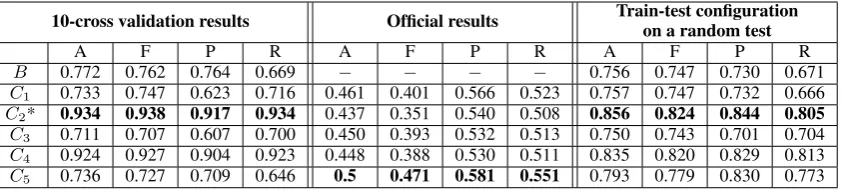
We tried several machine learning algorithms in order to evaluate and select the best performing one. Hereby, the hate speech system baseline is a Random Forest classifier. Table 2 shows how the experiments were set up and presents the re-sults in terms of accuracy (A), macro-averaged F-score (F), precision (P) and recall (R). For each of
4
https://www.noswearing.com/dictionary
5http://www.cs.cmu.edu/ biglou/resources/bad-words.txt
the systems we present the results obtained on 10-cross validation (using the provided train, trial and dev datasets) and the official results.
Among the five systems,C2 represents our best
performing one during the development phase6, whileC5performed best in the evaluation phase.
Due to a significant decrease in both accuracy and F-score on the official test data, we also in-vestigated the influence of the data distribution in the train and test datasets. The results obtained af-ter shuffling and re-splitting the data (while keep-ing the original distribution of the tweets) are also presented in Table 2. It is important to realize that these results were obtained by using a train-test configuration on a random train-test, not by using cross validation. These results are comparable to the ones obtained during the development phase.
As we encountered a significant decrease in the system’s performance in the official test, we de-cided to conduct a deeper analysis in order to iden-tify the main causes of errors.
5 Discussion
Error analysis shows that in the misclassification of hateful instances intervene several factors: the presence of off-topic tweets, the lack of context (as some words that trigger hate in certain con-texts may have different connotations in others) and implicit hate speech that employs stereotypes or metaphors in order to convey hatred.
Although the results of the system employed on the extended dataset seemed promising, we couldn’t see any improvement on the official test dataset. This might be as a result of not having any information on the actual distribution of the tweets (the number of tweets that convey hate towards immigrants and the number of tweets that convey hate towards women, information that might have been useful when extending the dataset), neither on the way the annotation was done and our defi-nition of hate speech (and the way it differs from offensive language) might have been different. We also identified tweets for which we question the original label when taking into account the class definition. Below, we have provided some exam-ples.
Example 1: The first tweet (annotated as not hateful), containing the users opinion on Poland
10-cross validation results Official results Train-test configuration on a random test
A F P R A F P R A F P R
B 0.772 0.762 0.764 0.669 − − − − 0.756 0.747 0.730 0.671
[image:4.595.91.513.62.157.2]C1 0.733 0.747 0.623 0.716 0.461 0.401 0.566 0.523 0.757 0.747 0.732 0.666 C2* 0.934 0.938 0.917 0.934 0.437 0.351 0.540 0.508 0.856 0.824 0.844 0.805 C3 0.711 0.707 0.607 0.700 0.450 0.393 0.532 0.513 0.750 0.743 0.701 0.704 C4 0.924 0.927 0.904 0.923 0.448 0.388 0.530 0.511 0.835 0.820 0.829 0.813 C5 0.736 0.727 0.709 0.646 0.5 0.471 0.581 0.551 0.793 0.779 0.830 0.773
Table 2: Hate speech detection results. Best results are presented in bold font while * marks the system submitted for the official ranking.
receiving immigrants, seems more hateful than the second tweet (hateful), in which the user depicts a series of events.
• If Germans want rapefugees7they can keep them. Poland will not accept a single rapefugee. Not even one!!! Poland remains proud and firm! https://t.co/VHoFrxFjB1
• GERAMNY: African rapefugee climbs into house, steel expensive goods, rook a knife and abuse a girl of the family. https://t.co/fVXhWMYcE8
Example 2: Although in the first tweet (not hateful) the user talks about Donald Trump, which doesn’t fit in the targeted categories, the annota-tion raises problems when trying to classify tweets such as the second one (annotated as hateful).
• I love my religious brothers and sisters, but @realDonaldTrump, FUCK YOU, YOU’RE NOT EVEN A REAL THEOCRAT YOU FAT USLESS BITCH.
• @menzemerized Worse i have proof. A pic-ture i took of you and one you took of me on the same night. Useless ungreatful kunt!
6 Conclusion
This paper proposed several models that can be used in order to identify messages that convey hate towards women and immigrants, incorporat-ing a variety of features for capturincorporat-ing offensive language. Our results revealed good classication performance on the training dataset, but a lower performance on the evaluation data, with a notable decrease in both accuracy and F-score. Error anal-ysis shows that this decrease is mainly due to the
7Accordind to Urban Dictionary, the term rapefugee is usually used when referring to the Muslim refugees coming into Europe in a derogatory way, as refugees are perceived as being more likely to raping people.
lack of context to infer hateful intents, and the way hate speech was defined in the manual annotation of the dataset.
As the meaning of a message might change in different contexts (as it can be highly dependent on knowledge about the world), in our future work we plan on studying ways to retrieve contextual information.
Acknowledgments
This work has been funded by Maison des Sci-ences de l’Homme et de la Soci´et´e de Toulouse under the project AMeSexTo.
References
Pinkesh Badjatiya, Shashank Gupta, Manish Gupta, and Vasudeva Varma. 2017. Deep learning for hate speech detection in tweets. In Proceedings of the 26th International Conference on World Wide Web Companion, pages 759–760. International World Wide Web Conferences Steering Committee.
Valerio Basile, Cristina Bosco, Elisabetta Fersini, Deb-ora Nozza, Viviana Patti, Francisco Rangel, Paolo Rosso, and Manuela Sanguinetti. 2019. Semeval-2019 task 5: Multilingual detection of hate speech against immigrants and women in twitter. In Pro-ceedings of the 13th International Workshop on Se-mantic Evaluation (SemEval-2019). Association for Computational Linguistics.
Elisa Bassignana, Valerio Basile, and Viviana Patti. 2018. Hurtlex: A multilingual lexicon of words to hurt. In 5th Italian Conference on Computational Linguistics, CLiC-it 2018, volume 2253, pages 1–6. CEUR-WS.
Deborah Cameron. 1992. Feminism and Linguistic Theory. Palgrave Macmillan.
John T. Nockleby. 2000. Hate speech. In Encyclo-pedia of the American Constitution (2nd ed., edited by Leonard W. Levy, Kenneth L. Karst et al., pages 1277–1279.
Jeffrey Pennington, Richard Socher, and Christo-pher D. Manning. 2014. Glove: Global vectors for word representation. InEmpirical Methods in Nat-ural Language Processing (EMNLP), pages 1532– 1543.
Sara Owsley Sood, Elizabeth F Churchill, and Judd Antin. 2012. Automatic identification of personal insults on social news sites. Journal of the Ameri-can Society for Information Science and Technology, 63(2):270–285.