Pynini: A Python library for weighted finite-state grammar compilation
Kyle Gorman
Google, Inc.
111 8th Avenue, New York, NY 10011
Abstract
We present Pynini, an open-source library for the compilation of weighted finite-state transducers (WFSTs) and pushdown transducers (PDTs) from strings, context-dependent rewrite rules, and recursive tran-sition networks. Pynini uses the OpenFst library for encoding, modifying, and apply-ing WFSTs and PDTs. We describe the de-sign of this library and the algorithms and interfaces used for compilation, optimiza-tion, and applicaoptimiza-tion, and provide two il-lustrations of the library in use.
1 Introduction
Weighted finite-state transducers (WFSTs) are widely used in speech and language applications. The hypothesis space for tasks like automatic speech recognition (ASR) and optical character recognition can be be represented as a compact, efficiently searchable cascade of WFSTs (Mohri et al., 2002). Manually-generated grammatical re-sources such as pronunciation lexicons and phono-logical rules are also naturally represented as finite-state transducers. One advantage of an end-to-end WFST formulation in complex natural language problems like speech recognition is that WFSTs make it easy to combine “big data” statistical com-ponents like language models and “small batch” re-sources like hand-written grammars. For instance, WFST ASR models may be augmented with a se-ries of weighted rewrite rules modeling pronuncia-tion variapronuncia-tion (Hazen et al., 2005) to reduce word error rate, or composed with an WFST which re-stores punctuation and capitalization to improve transcript readability (Shugrina, 2010).
2 Existing WFST libraries
There are a number of publicly available WFST li-braries, most of them open-source. Roughly speak-ing, these libraries can be divided into three groups. First, libraries like Carmel (Knight and Graehl, 1998) and OpenFst (Allauzen et al., 2007) pro-vide efficient implementations of key algorithms for combining, optimizing, and searching WFSTs. However, such libraries provide little support for users who wish to compile a lexicon or a list of grammatical rules into a WFST, so that even ba-sic grammar-building tasks may be a challenge. A second group of libraries, including HFST (Lindén et al., 2013), Lextools (Sproat, 1995), Kleene (Beesley, 2012), and Thrax (Roark et al., 2012), focus on grammar compilation operations and rely upon the aforementioned libraries for core WFST algorithms. Finally, a third group of libraries, in-cluding Foma (Hulden, 2009) and XFST (Beesley and Karttunen, 2003), provide algorithms and compilation routines for finite-state transducers, though neither supports weighted transducers re-quired by many real-world applications.
2.1 DSL-and-compiler interfaces
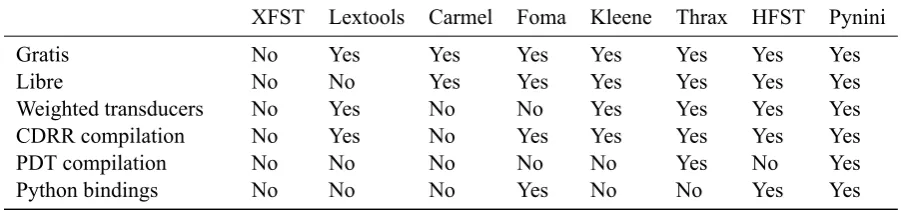
Table 1 summarizes key features of eight libraries which provide some form of grammar compilation support. Among these libraries, the most common interface is a compiler for a library-specific declar-ative, domain-specific language (DSL). There are some advantages for using a domain-specific lan-guage here; for instance, they allow for remarkably terse grammars. However, in our experience, DSL-and-compiler interfaces may also be a substantial impediment to rapid development.
First, these domain-specific languages all make extensive the use of novel operators; e.g., sev-eral employ$as a unary prefix operator denoting the containment of an WFST. Any new language
XFST Lextools Carmel Foma Kleene Thrax HFST Pynini
Gratis No Yes Yes Yes Yes Yes Yes Yes
Libre No No Yes Yes Yes Yes Yes Yes
Weighted transducers No Yes No No Yes Yes Yes Yes
CDRR compilation No Yes No Yes Yes Yes Yes Yes
PDT compilation No No No No No Yes No Yes
[image:2.595.70.521.64.169.2]Python bindings No No No Yes No No Yes Yes
Table 1: Key features of eight publicly available libraries for compilation of finite-state grammars.
comes with a learning curve, but the use of novel operators (with unfamiliar precedence) may make the curve particularly steep.
More generally, these DSLs lack the libraries, programming constructs, and tooling present in popular domain-general programming languages. A user who wishes to compile a pronunciation lex-icon from data stored in an XML file, for exam-ple, has little choice but to write a script in some domain-general programming language to rewrite the XML data into a library-specific format sup-ported by the compiler.
2.2 Introducing Pynini
We propose an alternative approach to this prob-lem. We do not introduce yet another compet-ing DSL-and-compiler standard, nor do we at-tempt to expose a DSL to another programming language, as do Foma and HFST, both of which provide basic Python bindings. Rather we make WFST algorithms and compilation routines “first-class citizens” of an existing domain-general multi-paradigm programming language. The result is a Python extension calledPynini(named in honor of Pāṇini, the renown Sanskrit grammarian). Pynini takes advantage of Python’s substantial standard li-brary, expressive syntax, and tools for debugging, linting, and interactive development.
Pynini is distributed freely as part of the Open-Grm toolkit under the Apache 2.0 license.
2.3 Outline
In what follows, we describe the design and imple-mentation of the Pynini library, focusing on com-pilation and optimization routines (§3). We then present two examples illustrating the use of the li-brary (§4–5), and then conclude with future direc-tions for this project.
3 Design of the library
3.1 Software architecture
Pynini is based on OpenFst (Allauzen et al., 2007), an efficient weighted finite-state transducer library written in C++ 11.1 At the lowest level, OpenFst provides a set of classes (representing WFSTs) and functions (representing WFST algorithms) tem-plated on the semiring of the input FST(s).
A second layer, the OpenFst scripting API, uses virtual dispatch, function registration, and dynamic loading of shared objects to provide a common interface shared by FSTs of different semirings. OpenFst also includes a Python exten-sion module, pywrapfst, which exposes the en-tire scripting API with little additional “syntactic sugar”.2
Pynini extends this architecture at all three lev-els. It is implemented with C++ template functions (some of which are shared with Thrax), a semiring-independent scripting interface, and a Python mod-ule which extendspywrapfst.
3.2 Compilation
Pynini provides a Python class calledFst, which represents a mutable WFST with a user-specified semiring (by default, the tropical semiring). The
epsilon_machine function creates a one-state FST that accepts only the empty string. The
acceptor function compiles a string into a (de-terministic, epsilon-free) FSA. The user may spec-ify how the arcs of the resulting FSA are to be la-beled; by default, each arc in the FSA corresponds to a byte in the input string, but the string may also be interpreted as a UTF-8-encoded string—in which case each arc label corresponds to a code-point in the Unicode Basic Multilingual Plane—or according to a user-provided symbol table. As in
1
At time of writing Pynini depends on OpenFst 1.5.3.
Thrax, a string enclosed in square brackets are in-terpreted as a singlegeneratedsymbol rather than as sequences of bytes or codepoints.
Nearly all Pynini functions permit a string to be passed in place of anFst, in which caseacceptor
then is used to compile the string. One such function is transducer, which takes two FSA (or string) arguments and compiles a transducer that represents their cross-product. The union of many such string pairs can be compiled using the
string_file and string_map functions. The former reads pairs of strings from a tab-separated values (TSV) file, whereas the latter extracts string pairs from a Python dictionary, list, or tuple. Both functions produce a compact prefix tree represen-tation of a map (or multimap) such as a pronuncia-tion dicpronuncia-tionary.
Thecdrewritefunction performs compilation of context-dependent rewrite rules (CDRRs) us-ing an algorithm due to Mohri and Sproat (1996). The replacefunction compiles FSTs from recur-sive transition networks (RTNs; Woods 1970). An RTN is specified as a singlerootFST followed by a set of one or more replacement FSTs, each of which is passed as a keyword argument where the keyword represents the replacement’s correspond-ingnonterminal. If an RTN contains any recursive replacements—i.e., if any FST in the RTN con-tains its nonterminal either directly or indirectly— it lacks a finite expansion and therefore cannot be compiled into an FST, but it can be compiled as a pushdown transducer (PDTs; Allauzen and Riley 2012) using thepdt_replacefunction.
Major functions for constructing FSTs are shown in Figure 1.
3.3 Visualization
Pynini provides several techniques for visualizing FSTs. Invoking Python’sprintstatement on an
Fstprints the FST’s arc list, and thedrawmethod renders an FST as a GraphViz3 image. It is also possible to iterate over the states, arcs, and paths of an FST using thestates,arcs, andpaths meth-ods, respectively.
3.4 Algorithms
All of the major WFST algorithms supported by OpenFst can be invoked via module-level func-tions which return anFstinstance (or raise an ex-ception in the case of run-time failure). A subset of
3http://graphviz.org
OpenFst WFST algorithms, including closure, in-version, and projection, operate destructively (i.e., they mutate their input in-place), and can also be invoked by calling the appropriate instance method on anFstobject. All destructive operations return their mutated input so as to allow chaining.
3.5 Optimization
Core FST operations such as composition, concate-nation, and union tend to introduce many redun-dant arcs and states, and therefore it is desirable (and in some cases necessary) to optimize FSTs during grammar compilation. OpenFst provides four algorithms for this task: epsilon-removal, arc-sum mapping (which merges identically-labeled multiarcs), determinization, and minimization. However, there are complex restrictions on the ap-plication of these algorithms, making manual opti-mization something of a challenge.
Pynini provides an instance method optimize
which applies these four procedures, subject to these algorithmic restrictions and the properties of the input FST. For instance, the minimization algo-rithm is guaranteed to find a minimal FST only in the case that the input is deterministic, and while any acyclic FST over azero-sum-freesemiring is determinizable, this is not necessarily true of FSTs with weighted cycles (Mohri, 2009). Therefore, if an FST is not known to be deterministic and weighted-cycles-free, the optimization routine per-forms both determinization and minizimation on the FST while it is encoded as if it were an un-weighted acceptor (Allauzen et al., 2004).
4 Sample grammar: Finnish harmony
a = epsilon_machine()
b = acceptor("Red Leicester")
c = transducer("Tilsit", "Never at the end of the week, sir") d = string_map({"Stilton": "Sorry", "Gruyère": "No"})
e = replace("[COLOR] [CHEESE]",
COLOR=union("Blue", "Red", "White"),
CHEESE=union("Leicester", "Stilton", "Vinney", "Windsor"))
Figure 1: Examples of various FST construction functions in Pynini.
It first concatenates the stem with an abstract representation of the suffix, and then composes the result with a context-dependent rewrite rule
adessive_harmony.
5 Sample application: T9 decoding
T9 (short for “Text on 9 keys”; Grover et al. 1998) is a patented predictive text entry system. In T9, each character in the “plaintext” alphabet is as-signed to one of the 9 digit keys (0 is usually re-served to represent space) of the traditional 3x4 touch-tone phone grid. For instance, the message
GO HOMEis entered as4604663. Since the result-ing “ciphertext” may be highly ambiguous—this sequence could also be read asGO HOOD, not to mention many nonsensical expressions—a hybrid language model/lexicon is used for decoding.
Figure 3 shows T9 encoding and decoding in Pynini. The first line reads in an language model represented as a weighted finite-state acceptor.4 The second line reads in the encoder table from a string_file, a text file in which each line contains an alphabetic character and its corre-sponding digit key. By computing the concate-native closure of this map, we obtain an FST (T9_ENCODER) which can encode arbitrarily-long plaintext strings.
The k_best function first applies a ciphertext string (a bytestring of digits) to the inverted en-coder FST (T9_DECODER) via composition and output-projection. This creates an intermediate lat-tice of all possible plaintexts consistent with the T9 ciphertext. This is then scored by—that is, composed with—the character LM. Finally, we generate the k shortest paths (i.e., the k highest-probability plaintexts) in the lattice. In the exam-ple given in the figure, the shortest path here is in
4The language model used here is an 8-gram character
lan-guage model with Witten-Bell smoothing, trained on the Wall St. Journal portion of the Penn Treebank using OpenGrm-NGram (Roark et al., 2012). This is somewhat different than the language models used in mobile phone T9 systems.
fact identical to the plaintext.
6 Conclusions
We have described and illustrated the design and implementation of an expressive and extensible open-source library for weighted finite-state gram-mar compilation. In future work, we hope to ex-ploit this library to improve the user experience for developers of grammars and of WFST applications more generally.
Acknowledgements
Thanks to all those who provided valuable in-put during the design of Pynini. Richard Sproat originally suggested to me the idea of developing a Python based finite-state grammar library, dis-cussed many design issues, and contributed the path iteration algorithm. Cyril Allauzen, Steven Bedrick, Myroslava Dzikovska, Mark Epstein, Toby Hawker, Michael Riley, and Ke Wu also pro-vided a lot of useful input. To obtain Pynini, visit
http://pynini.opengrm.org.
References
Cyril Allauzen and Michael Riley. 2012. A
push-down transducer extension for the OpenFst library.
InCIAA, pages 66–77.
Cyril Allauzen, Mehryar Mohri, Michael Riley, and Brian Roark. 2004. A generalized construction of in-tegrated speech recognition transducers. InICASSP, pages 761–764.
Cyril Allauzen, Michael Riley, Johan Schalkwyk, Woj-ciech Skut, and Mehryar Mohri. 2007. OpenFst: A general and efficient weighted finite-state transducer library. InCIAA, pages 11–23.
Kenneth R. Beesley and Lari Karttunen. 2003. Finite
state morphology. CSLI, Stanford, CA.
Kenneth R. Beesley. 2012. Kleene, a free and
open-source language for finite-state programming. In
back_vowel = u("u", "o", "a") neutral_vowel = u("i", "e") front_vowel = u("y", "ö", "ä")
vowel = u(back_vowel, neutral_vowel, front_vowel) archiphoneme = u("A", "I", "E", "O", "U")
consonant = u("b", "c", "d", "f", "g", "h", "j", "k", "l", "m", "n", "p", "q", "r", "s", "t", "v", "w", "x", "z")
sigma_star = u(vowel, consonant, archiphoneme).closure() adessive = "llA"
intervener = u(consonant, neutral_vowel).closure()
adessive_harmony = (cdrewrite(t("A", "a"), back_vowel + intervener, "", sigma_star) *
cdrewrite(t("A", "ä"), "", "", sigma_star)).optimize()
def make_adessive(stem):
return ((stem + adessive) * ur).stringify()
Figure 2: Finnish adessive suffix harmony, implemented with context-dependent rewrite rules.
LM = Fst.read("charlm.fst")
T9_ENCODER = string_file("t9.tsv").closure() T9_DECODER = invert(T9_ENCODER)
def encode_string(plaintext):
return (plaintext * T9_ENCODER).stringify()
def k_best(ciphertext, k):
lattice = (ciphertext * T9_DECODER).project(True) * LM
return shortestpath(lattice, nshortest=k, unique=True).paths()
pt = "THE SINGLE MOST POPULAR CHEESE IN THE WORLD" ct = encode_string(pt)
for (_, opath, _) in k_best(ct, 5): print opath
Dale L. Grover, Martin T. King, and Clifford A. Kushler. 1998. Reduced keyboard disambiguating computer. US Patent 5,818,437.
Timothy J. Hazen, I. Lee Hetherington, Han Shu, and Karen Livescu. 2005. Pronunciation modeling us-ing a finite-state transducer representation. Speech Communication, 46(2):189–203.
Mans Hulden. 2009. Foma: A finite-state compiler and library. InEACL, pages 29–32.
Kevin Knight and Jonathan Graehl. 1998.
Ma-chine transliteration. Computational Linguistics,
24(4):599–612.
Kimmo Koskenniemi. 1983.Two-level morphology: A
general computational model for word-form recog-nition and production. Ph.D. thesis, University of Helsinki.
Krister Lindén, Erik Axelson, Senka Drobac, Sam Hardwick, Juha Kuokkala, Jyrki Niemi, Tommi A. Pirinen, and Miikka Silfverberg. 2013. HFST: A
system for creating NLP tools. InSCFM, pages 53–
71.
Mehryar Mohri and Richard Sproat. 1996. An efficient compiler for weighted rewrite rules. InACL, pages 231–238.
Mehryar Mohri, Fernando Pereira, and Michael
Ri-ley. 2002. Weighted finite-state transducers in
speech recognition. Computer Speech and
Lan-guage, 16(1):69–88.
Mehryar Mohri. 2009. Weighted automata algorithms. In Manfred Droste, Werner Kuich, and Heiko Vogler, editors,Handbook of weighted automata, pages 213– 254. Springer, New York.
Catherine O. Ringen and Orvokki Heinämäki. 1999. Variation in Finnish vowel harmony: An OT
ac-count. Natural Language and Linguistic Theory,
17(2):303–337.
Brian Roark, Richard Sproat, Cyril Allauzen, Michael
Riley, Jeffrey Sorensen, and Terry Tai. 2012.
The OpenGrm open-source finite-state grammar soft-ware libraries. InACL, pages 61–66.
Maria Shugrina. 2010. Formatting time-aligned ASR
transcripts for readability. In NAACL, pages 198–
206.
Richard Sproat. 1995. Lextools: Tools for finite-state linguistic analysis. Technical Report 11522-951108-10TM, Bell Laboratories.
William A. Woods. 1970. Transition network
gram-mars for natural language analysis.Communications