A Weighted Finite State Transducer Implementation of the Alignment
Template Model for Statistical Machine Translation
Shankar Kumar and William Byrne
Center for Language and Speech Processing, Johns Hopkins University,
3400 North Charles Street, Baltimore, MD, 21218, USA
skumar,byrne
@jhu.edu
Abstract
We present a derivation of the alignment tem-plate model for statistical machine translation and an implementation of the model using weighted finite state transducers. The approach we describe allows us to implement each con-stituent distribution of the model as a weighted finite state transducer or acceptor. We show that bitext word alignment and translation un-der the model can be performed with standard FSM operations involving these transducers. One of the benefits of using this framework is that it obviates the need to develop special-ized search procedures, even for the generation of lattices or N-Best lists of bitext word align-ments and translation hypotheses. We evaluate the implementation of the model on the French-to-English Hansards task and report alignment and translation performance.
1
Introduction
The Alignment Template Translation Model (ATTM) (Och et al., 1999) has emerged as a promising modeling framework for statistical machine translation. The ATTM attempts to overcome the deficiencies of word-to-word translation models (Brown et al., 1993) through the use of phrasal translations. The overall model is based on a two-level alignment between the source and the target sentence: a phrase-level alignment between source and target phrases and a word-level alignment between words in these phrase pairs.
The goal of this paper is to reformulate the ATTM so that the operations we intend to perform under a sta-tistical translation model, namely bitext word alignment and translation, can be implementation using standard weighted finite state transducer (WFST) operations. Our main motivation for a WFST modeling framework lies in the resulting simplicity of alignment and translation processes compared to dynamic programming or de-coders. The WFST implementation allows us to use stan-dard optimized algorithms available from an off-the-shelf FSM toolkit (Mohri et al., 1997). This avoids the need to develop specialized search procedures, even for the
gen-TEMPLATE SEQUENCE MODEL PERMUTATION
MODEL PHRASE
PHRASAL TRANSLATION
MODEL
TARGET LANGUAGE MODEL
v 2 v 3
1 v
SOURCE SEGMENTATION
MODEL
u z
TARGET LANGUAGE SENTENCE SENTENCE SOURCE LANGUAGE
source language phrases
alignment templates
target language phrases f f2 f3 f4 f5 f6 f7
v 2 v1 v 3
z z
1 2 3
u u
1 2
e1 e2
1
e4 e5 e6 e e e
3
e
3
7 8 9
a a
[image:1.612.313.541.207.361.2]a1 2 3
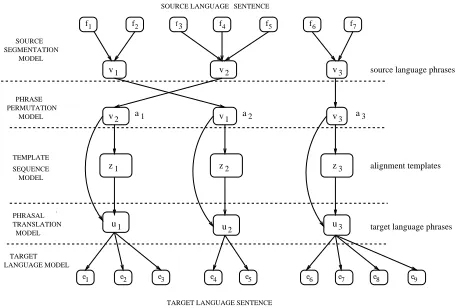
Figure 1: ATTM Architecture.
eration of lattices or N-best lists of bitext word alignment or translation hypotheses.
Weighted Finite State Transducers for Statistical Ma-chine Translation (SMT) have been proposed in the literature to implement word-to-word translation mod-els (Knight and Al-Onaizan, 1998) or to perform trans-lation in an application domain such as the call routing task (Bangalore and Ricardi, 2001). One of the objec-tives of these approaches has been to provide an imple-mentation for SMT that uses standard FSM algorithms to perform model computations and therefore make SMT techniques accessible to a wider community. Our WFST implementation of the ATTM has been developed with similar objectives.
We start off by presenting a derivation of the ATTM that identifies the conditional independence assumptions that underly the model. The derivation allows us to spec-ify each component distribution of the model and imple-ment it as a weighted finite state transducer. We then show that bitext word alignment and translation can be performed with standard FSM operations involving these transducers. Finally we report bitext word alignment and translation performance of the implementation on the Canadian French-to-English Hansards task.
2
Alignment Template Translation Models
We present here a derivation of the alignment template translation model (ATTM) (Och et al., 1999; Och, 2002) and give an implementation of the model using weighted finite state transducers (WFSTs). The finite state model-ing is performed usmodel-ing the AT&T FSM Toolkit (Mohri et al., 1997).
In this model, the translation of a source language sen-tence to a target language sensen-tence is described by a joint probability distribution over all possible segmentations and alignments. This distribution is presented in Figure 1 and Equations 1-7. The components of the overall trans-lation model are the source language model (Term 2), the source segmentation model (Term 3), the phrase per-mutation model (Term 4), the template sequence model (Term 5), the phrasal translation model (Term 6) and the target language model (Term 7). Each of these condi-tional distributions is modeled independently and we now define each in turn and present its implementation as a weighted finite state acceptor or transducer.
(1)
!
(2) " $# %!
(3)
# %!
(4)
&# '!
(5) " # () *!
(6)
+# ', ,(*
(7) We begin by distinguishing words and phrases. We as-sume that is a phrase in the target language sentence that has length- and consists of words
/.0213141305 . Similarly, a phrase
in the source language sentence con-tains words60
213141307
, where86
is the NULL token. We assume that each word in each language can be as-signed to a unique class so that unambiguously spec-ifies a class sequence9
5
and
specifies the class se-quence:
7
6
. Throughout the model, if a sentence
is segmented into phrases
, we say
;
to indi-cate that the words in the phrase sequence agree with the original sentence.
Source Language Model The model assigns
probabil-ity to any sentence
in the source language; this prob-ability is not actually needed by the translation process when
is given. As the first component in the model, a finite state acceptor< is constructed for
.
Source Segmentation Model We introduce the phrase
count random variable
which specifies the number of phrases in a particular segmentation of the source lan-guage sentence. For a sentence of length = , there are
>
?
@? BA
ways to segment it into
phrases. Motivated by this, we choose the distributionC#
as
$#
>
?
@? A
D
? FE
HG(IJ0 D 2131413 =%K
(8)
so thatL
$#
MJ
.
We construct a joint distribution over all phrase seg-mentations MN
0.2131314 as
" $# O " # B$#
(9) where
" # O P
QRTS U)V
WYX "
U
Z M[
\ ]^`_
/a8bdc`e/
1
The normalization constant
f
LMgh
R
i
S
U)V W X
j
U
, is chosen so that
L lkh
R
i
C#
MJ
. Here,WmX
U
is a “unigram” distribution over source language phrases; we assume that we have an inventory of phrases from which this quantity can be estimated. In this way, the likelihood of a particular segmentation is determined by the likelihood of the phrases that result.
We now describe the finite state implementation of the source segmentation model and show how to compute the most likely segmentation under the model:
Ionp
n
K
Nq0rsutvq0w
h
R
i
k
F#() %` C# .
1. For each source language sentence
to be lated, we implement a weighted finite state trans-ducerx that segments the sentence into all possible phrase sequences
permissible given the inven-tory of phrases. The score of a segmentation underx is given by
S
U)V W X
"
U
. We then generate a lattice of segmentations of
(implemented as an acceptor< ) by composing it with the transducerx , i.e.y
<(z{x .
2. We then decompose y into = disjoint subsets
y
E
|G}IJu D 2131413 =%K
)~
V
y
y so thaty
contains all segmentations of the source language sentence with exactly
phrases. To constructy , we create an unweighted acceptor that accepts any phrase sequence of length
; for efficiency, the phrase vocabulary is restricted to the phrases iny .
y
is then obtained by the finite state composition
y
yz .
3. ForJ0
D
141314
=
The normalization factorsf
are obtained by sum-ming the probabilities of all segmentations iny
. This sum can be computed efficiently using lattice forward probabilities (Wessel et al., 1998). For a fixed
, the most likely segmentation iny is found as
n
Nq0rsutvq0w "uR
J
f
U)V
X
"
U
)1
(10)
4. Finally we select the optimal segmentation as
n
q0rsutvqw
k
.
kk+
n
#()%` C#%1
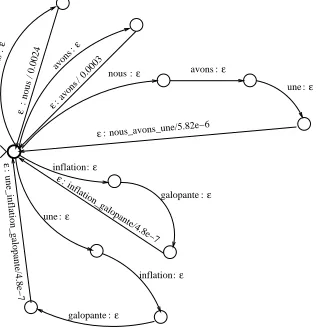
A portion of the segmentation transducer x for the French sentence nous avons une inflation galopante is presented in Figure 2. When composed with< ,x gen-erates the following two phrase segmentations: nous
avons une inflation galopante and nous avons une in-flation galopante. The “ ” symbol is used to indicate
phrases formed by concatenation of consecutive words. The phrases specified by the source segmentation model remain in the order that they appear in the source sen-tence.
nous : ε
avons : ε
:
uneε
avons : ε
nous : ε
inflation: ε
galopante : ε
une :ε
inflation: ε
galopante : ε
ε:
nous / 0.0024
ε: avons / 0.0003
ε: nous_avons_une/5.82e−6
inflation_galopante/4.8e−7 ε:
[image:3.612.109.267.227.393.2]ε: une_inflation_galopante/4.8e−7
Figure 2: A portion of the phrase segmentation transducer
x for the sentence “nous avons une inflation galopante”.
Phrase Permutation Model We now define a model
for the reordering of phrase sequences as determined by the previous model. The phrase alignment sequence
specifies a reordering of phrases into target language phrase order; the words within the phrases remain in the source language order. The phrase sequence
is re-ordered into
i
141313
R
. The phrase alignment se-quence is modeled as a first order Markov process
,#,(%O ,#'
(12)
U)V
.
U
#
U
?
1
with
U
GCIJ0 D 2131314
K . The alignment sequence distri-bution is constructed to assign decreasing likelihood to phrase re-orderings that diverge from the original word order. Suppose
and
i
, we set the Markov chain probabilities as follows (Och et al., 1999)
U
#
U
?
W
?
?
6
O
J
E
&GIJu
D
141313
K
1
(13)
In the above equations, W 6
is a tuning factor and we normalize the probabilities
U
#
U
?
so that
L
V
k
V
i
U
o#
U
?
J .
The finite state implementation of this model involves two acceptors. We first build a unweighted permutation acceptor
that contains all permutations of the phrase sequence
in the source language (Knight and Al-Onaizan, 1998) . We note that a path through
corre-sponds to an alignment sequence
. Figure 3 shows the acceptor
for the source phrase sequence nous avons
une inflation galopante.
A source phrase sequence
of length
words re-quires a permutation acceptor
of D
states. For long phrase sequences we compute a scoretvq0w
U
c #
U
?
for each arc and then prune the arcs by this score, i.e. phrase alignments containing
U
c are in-cluded only if this score is above a threshold. Pruning can therefore be applied while
is constructed.
nous
avons
avons
une_inflation_galopante
une_inflation_galopante une_inflation_galopante
nous
une_inflation_galopante
nous
avons
avons
[image:3.612.320.535.283.356.2]nous
Figure 3: The permutation acceptor
for the source-language phrase sequence nous avons une inflation galopante.
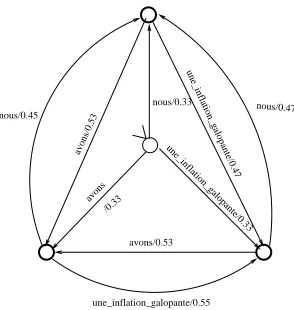
The second acceptor in the implementation of the phrase permutation model assigns alignment probabil-ities (Equation 13) to a given permutation
of the source phrase sequence
(Figure 4). In this example, the phrases in the source phrase sequence are specified as follows:
(nous),0. .
(avons) and
(une inflation galopante). We now show the computa-tion of some of the alignment probabilities (Equacomputa-tion 13) in this example (W
6
\
1 )
J#. ! W"
?
?
6
\ 1$#%
D # . ! W
.
?
?
6
\ 1&& 1
Normalizing these terms gives
' MJ#.d(+
\
1)+*
and
D
#.d
\
1$#% .
Template Sequence Model Here we describe the
main component of the model. An alignment template
9
5
:
7
6
specifies the allowable alignments be-tween the class sequences 9
5
and :
7
6
. is a - , .-0/[J
binary, 0/1 valued matrix which is constructed as follows: If 921 can be aligned to :
, then 31
J ; otherwise31
\
. This process may allow931 to align with the NULL token:
6
, i.e. 21 6 J
, so that words can be freely inserted in translation. Given a pair of class sequences9
5
and:
7
6
, we specify exactly one matrix
.
We say that
9
5
:
7
6
nous/0.47 nous/0.33 nous/0.45 /0.33 avons une_inflation_galopante/0.33 avons/0.53 avons/0.53 une_inflation_galopante/0.55 une_inflation_galopante/0.47
Figure 4: Acceptor that assigns probabilities to per-mutations of the source language phrase sequence nous
avons une inflation galopante (W
6 \ 1 ). if9 5
is the class sequence for and:
7
6
is the class sequence for
.
In Section 4.1, we will outline a procedure to build a library of alignment templates from bitext word-level alignments. Each template
9 5 : 7 6
used in our model has an indexc
in this template library. Therefore any operation that involves a mapping to (from) template sequences will be implemented as a mapping to (from) a sequence of these indices.
We have described the segmentation and permutation processes that transform a source language sentence into phrases in target language phrase order. The next step is to generate a consistent sequence of alignment tem-plates. We assume that the templates are conditionally independent of each other and depend only on the source language phrase which generated each of them
F# '()%O
U)V U # '% U)V U # 1 (14)
We will implement this model using the transducer that maps any permutation
i 141314 R
of the phrase se-quence
into a template sequence
with probability as in Equation 14. For every phrase
, this transducer al-lows only the templates
that are consistent with with probabilityo# , i.e. U #
enforces the consis-tency between each source phrase and alignment tem-plate.
Phrasal Translation Model We assume that a
tar-get phrase is generated independently by each alignment template and source phrase
" #
U)V " U # ',() U)V " U # U 1 (15)
This allows us to describe the phrase-internal
transla-tion model
" #Y
as follows. We assume that each word in the target phrase is produced independently and that the consistency is enforced between the words in and the class sequence 9
5 so that 1 # \ if 1 G
9 1.
We now introduce the word alignment variables
1
c J0 D 141314
- , which indicates that
1 is aligned to within and
.
" #
9 5 : 7 6 ) 5 1 V 1 # 5 1 V 7 V 6 1 1 m# 5 1 V 7 V 6 1 # 1 u ` 1 o# 5 1 V 7 V 6 1 # ` 1 o# )J ) 1 )1 (16)
The term 1 #
is a translation dictionary (Och and Ney, 2000) and
1 0
is obtained as
1 o# 21 L 1 1 (17)
We have assumed that 1 #Y 1 #
, i.e. that given the template, word alignments do not depend on the source language phrase.
For a given phrase
and a consistent alignment tem-plate 9 5 : 7 6
, a weighted acceptorf
can be constructed to assign probability to translated phrases ac-cording to Equations 16 and 17. f
is constructed from four component machines , , and , constructed as follows.
The first acceptor implements the alignment matrix
. It has -/(J
states and between any pair of statesc&J andc
, each arc
corresponds to a word alignment vari-able1
. Therefore the number of transitions between states
c
and c / J
is equal to the number of non-zero val-ues of 1. The
arc from state c J to c has probability 1 o# (Equation 17).
The second machine is an unweighted transducer that maps the index
c GI
\
/J02131314
-K in the phrase [
7
6
to the corresponding word
1.
The third transducer is the lexicon transducer that maps the source word
TG
to the target word ,G
with probability
#
.
The fourth acceptor is unweighted and allows all tar-get word sequences
5
inflation away run
3 /0.5
A
z
F = une inflation galopante E = run away inflation
i=2 i=3
i=1
C
0 : NULL 1 : une 2 : inflation 3 : galopante
D I O
inflation /0.5 /0.01 /0.44
run away
Z
2/0.5 3/1.0 0/1.0
1 2 3 0 1 2 3
E F
inflation galopante : inflation / 0.04
[image:5.612.96.274.92.270.2]galopante : run / 0.50 : inflation / 0.85 NULL : away / 0.01
Figure 5: Component transducers to construct the accep-torf
for an alignment template .
class sequence9
5
. has -/MJ
states. The number of transitions between states
c J and
c
is equal to the number of target language words with class specified by
9 1.
Figure 5 shows all the four component FSTs for build-ing the transducerf
corresponding to an alignment tem-plate from our library. Having built these four machines, we obtainf
as follows. We first compose the four trans-ducers, project the resulting transducer onto the output la-bels, and determinize it under the /
,
semiring. This is implemented using AT&T FSM tools as follows
fsmcompose O I D C #
fsmproject -o#
fsmrmepsilon #
fsmdeterminize
f
.
Given an alignment template
and a consistent source phrase
, we note that the composition and determiniza-tion operadeterminiza-tions assign the probability " #
(Equa-tion 16) to each consistent target phrase . This summa-rizes the construction of a transducer for a single align-ment template.
We now implement a transducer that maps se-quences of alignment templates to target language word sequences. We identify all templates consistent with the phrases in the source language phrase sequence
. The transducer is constructed via the FSM union operation of the transducers that implement these templates.
For the source phrase sequence
(nous avons
une inflation galopante), we show the transducer in
Figure 6. Our example library consists of three tem-plates
, 8. and
.
maps the source word nous to the target word we via the word alignment matrix
specified as
J . 8.
maps the source word
avons to the target phrase have a via the word
align-ment matrix specified as
;Ju
. \ .
maps
: have
ε ε: a
/0.42 /0.07
: run
ε ε: away
ε: ε
ε: ε
ε 2
z:
ε
z3 :
ε: ε
ε:we
Z1
z1 : ε
/0.72 /0.44
:
ε inflation
/0.5 /0.01
Z3
Z2
Figure 6: Transducer that maps the source template sequence
into target phrase sequences
.
the source phrase une inflation galopante to the target phrase run away inflation via the word alignment matrix
specified as
.
\
I
D
K . is built out of the three component acceptors
f
, f .
, and f!
. The acceptorf
1 corresponds to the map-ping from the template
1 and the source phrase
1 to all consistent target phrases 1.
Target Language Model We specify this model as
+# (*[ d )JI
K
where
J8I0
K enforces the requirement that words in the translation agree with those in the phrase sequence. We note that
is modeled as a standard backoff trigram language model (Stolcke, 2002). Such a language model can be easily compiled as a weighted finite state acceptor (Mohri et al., 2002).
3
Alignment and Translation Via WFSTs
We will now describe how the alignment template trans-lation model can be used to perform word-level alignment of bitexts and translation of source language sentences.
Given a source language sentence
and a target sen-tence
, the word-to-word alignment between the sen-tences can be found as
I n
p
n
p
0n
p
+n
p
n
K
q0rsutvq0w X R
i
k
R
i
k
R
i
k
h
R
i
k
" $# ) 1
The variables I n p 0n p +n p
n
K specify the alignment between source phrases and target phrases whilen
gives the word-to-word alignment within the phrase sequences.
Given a source language sentence
, the translation can be found as
Ion p n p n p n p +n p
n
K
qurs+tvqw
i
k
X R
i
k
R
i
k
R
i
k
h
R
i
k
[image:5.612.344.510.92.246.2]where is the translation of .
We implement the alignment and translation proce-dures in two steps. We first segment the source sentence into phrases, as described earlier
Ion
p
n
K
Nq0rsutvq0w
h
R
i
k "
#
` C#
1
(18)
After segmenting the source sentence, the alignment of a sentence pair %
is obtained as
I n
p
n
p
0n
p
K
(19)
q0rsutvq0w
X
R
i
k
R
i
k
R
i
"
p
p
p
#"n
p
n
)1
The translation is the same way as
Ion p 8n np ,0np p
K
(20)
qurs+tvqw
i
k
X
R
i
k
R
i
k
R
i
p
p
p
#"n
p
n
)1
We have described how to compute the optimal seg-mentation
n
} pn
(Equation 18) in Section 2. The seg-mentation process decomposes the source sentence
into a phrase sequencen p
. This process also tags each source phrase n
U
with its position
in the phrase se-quence. We will now describe the alignment and trans-lation processes using finite state operations.
3.1 Bitext Word Alignment
Given a collection of alignment templates, it is not guar-anteed that every sentence pair in a bitext can be seg-mented into phrases for which there exist the consistent alignment templates needed to create an alignment be-tween the sentences. We find in practice that this prob-lem arises frequently enough that most sentence pairs are assigned a probability of zero under the template model. To overcome this limitation, we add several types of “dummy” templates to the library that serve to align phrases when consistent templates could not otherwise be found.
The first type of dummy template we introduce al-lows any source phrase
n
U
to align with any single word target phrase 1. This template is defined as a triple
1
U
I8
1
+n
U
K where
G IJu D 141313
n
K and c G IJu D 2131413
K . All the entries of the matrix are speci-fied to be ones. The second type of dummy template al-lows source phrases to be deleted during the alignment process. For a source phrase n
U
we specify this tem-plate as
U
n
U
) M J0 D 2131413
n
. The third type of template allows for insertions of single word target phrases. For a target phrase 1 we specify this template as
1
1
cl Ju D 2131413
. The probabilities
o#
for these added templates are not estimated; they are fixed as a global constant which is set so as to discourage their use except when no other suitable templates are available.
A lattice of possible alignments between and is then obtained by the finite state composition
p
z z z z
1
(21)
where is an acceptor for the target sentence
. We then compute the ML alignment
n
(Equation 19) by obtain-ing the path with the highest probability, in
. The path
n
determines three types of alignments: phrasal align-ment between the source phrasen
U
and the target phrase
n
U
; deletions of source phrases n
U
; and insertions of tar-get words
1. To determine the word-level alignment be-tween the sentences
and
,we are primarily interested in the first of these types of alignments. Given that the source phrase
n
U
has aligned to the target phrase
n
U
, we look up the hidden template variablen
U
that yielded this alignment. n
U
contains the the word-to-word alignment between these phrases.
3.2 Translation and Translation Lattices
The lattice of possible translations of
is obtained using the weighted finite state composition:
p
z z z z
1
(22)
The translation with the highest probability (Equa-tion 20) can now be computed by obtaining the path with the highest score in
.
In terms of AT&T FSM tools, this can be done as fol-lows
fsmbestpath #
fsmproject ] #
fsmrmepsilon
n
A translation lattice (Ueffing et al., 2002) can be gen-erated by pruning
based on likelihoods or number of states. Similarly, an alignment lattice can be generated by pruning
.
4
Translation and Alignment Experiments
We now evaluate this implementation of the alignment template translation model.
4.1 Building the Alignment Template Library
To create the template library, we follow the procedure reported in Och (2002). We first obtain word alignments of bitext using IBM-4 translation models trained in each translation direction (IBM-4 F and IBM-4 E), and then forming the union of these alignments (IBM-4:
~
9 ). We extract the library of alignment templates from the bitext alignment using the phrase-extract algorithm re-ported in Och (2002). This procedure identifies several alignment templates
9
5
:
7
6
that are consis-tent with a source phrase
the matrix of alignments that occurs most frequently in the training corpus. This is consistent with the intended application of these templates for translation and align-ment under the maximum likelihood criterion; in the cur-rent formulation, only one alignment will survive in any application of the models and there is no reason to retain any of the less frequently occuring alignments. We esti-mate the probabilityo#
by the relative frequency of phrasal translations found in bitext alignments. To restrict the memory requirements of the model, we extract only the templates which have at most #
words in the source phrase. Furthermore, we restrict ourselves to the tem-plates which have a probability
m#
\
1
\
J
for some source phrase
.
4.2 Bitext Word Alignment
We present results on the French-to-English Hansards translation task (Och and Ney, 2000). We measured the alignment performance using precision, recall, and Alignment Error Rate (AER) metrics (Och and Ney, 2000).
Our training set is a subset of the Canadian Hansards which consists of # \ \+\u\
French-English sentence pairs (Och and Ney, 2000). The English side of the bitext had a total of*) &
words (J ) \
unique tokens) and the French side contained J& # )#
words (D ) \ & unique tokens). Our template library consisted of Ju \ *J0/J D templates.
Our test set consists of 500 unseen French sentences from Hansards for which both reference translations and word alignments are available (Och and Ney, 2000). We present the results under the ATTM in Table 1, where we distinguish word alignments produced by the templates from the template library against those produced by the templates introduced for alignment in Section 3.1. For comparison, we also align the bitext using IBM-4 trans-lation models.
Model Alignment Metrics (%)
Precision Recall AER
IBM-4 F 88.9 89.8 10.8
IBM-4 E 89.2 89.4 10.7
IBM-4 84.3 93.8 12.3
ATTM-C 64.2 63.8 36.2
[image:7.612.348.504.335.365.2]ATTM-A 94.5 55.8 27.3
Table 1: Alignment Performance on the French-to-English Hansards Alignment Task.
We first observe that the complete set of word align-ments generated by the ATTM (ATTM-C) is relatively poor. However, when we consider only those word align-ments generated by actual alignment templates (ATTM-A) (and discard the alignments generated by the dummy templates introduced as described in Section 3.1), we obtain very high alignment precision. This implies that
word alignments within the templates are very accurate. However, the poor performance under the recall measure suggests that the alignment template library has relatively poor coverage of the phrases in the alignment test set.
4.3 Translation and Lattice Quality
We next measured the translation performance of ATTM on the same test set. The translation performance was measured using the BLEU (Papineni et al., 2001) and the NIST MT-eval metrics (Doddington, 2002), and Word Er-ror Rate (WER). The target language model was a trigram language model with modified Kneser-Ney smoothing trained on the English side of the bitext using the SRILM tookit (Stolcke, 2002). The performance of the model is reported in Table 2. For comparison, we also report per-formance of the IBM-4 translation model trained on the same corpus. The IBM Model-4 translations were ob-tained using the ReWrite decoder (Marcu and Germann, 2002). The results in Table 2 show that the alignment
Model BLEU NIST WER (%)
IBM-4 0.1711 5.0823 67.5
[image:7.612.98.277.543.617.2]ATTM 0.1941 5.3337 64.7
Table 2: Translation Performance on the French-to-English Hansards Translation Task.
template model outperforms the IBM Model 4 under all three metrics. This verifies that WFST implementation of the ATTM can obtain a performance that compares favor-ably to other well known research tools.
We generate N-best lists from each translation lattice, and show the variation of their oracle-best BLEU scores in Table 3. We observe that the oracle-best BLEU score
Size of N-best list
1 10 100 400 1000
BLEU 0.1941 0.2264 0.2550 0.2657 0.2735
Table 3: Variation of oracle-Best BLEU scores on N-Best lists generated by the ATTM.
increases with the size of the N-Best List. We can there-fore expect to rescore these lattices with more sophis-ticated models and achieve improvements in translation quality.
5
Discussion
standard FSM operations that have already been imple-mented and optimized. It is not necessary to develop spe-cialized search procedures, even for the generation of lat-tices and N-best lists of alignment and translation alter-natives.
The derivation of the ATTM was presented with the in-tent of clearly identifying the conditional independence assumptions that underly the WFST implementation. This approach leads to modular implementations of the component distributions of the translation model. These components can be refined and improved by changing the corresponding transducers without requiring changes to the overall search procedure. However some of the mod-eling assumptions are extremely strong. We note in par-ticular that segmentation and translation are carried out independently in that phrase segmentation is followed by phrasal translation; performing these steps independently can easily lead to search errors.
It is a strength of the ATTM that it can be directly constructed from available bitext word alignments. How-ever this construction should only be considered an ini-tialization of the ATTM model parameters. Alignment and translation can be expected to improve as the model is refined and in future work we will investigate iterative parameter estimation procedures.
We have presented a novel approach to generate align-ments and alignment lattices under the ATTM. These lat-tices will likely be very helpful in developing ATTM pa-rameter estimation procedures, in that they can be used to provide conditional distributions over the latent model variables. We have observed that that poor coverage of the test set by the template library may be why the over-all word alignments produced by the ATTM are relatively poor; we will therefore also explore new strategies for template selection.
The alignment template model is a powerful model-ing framework for statistical machine translation. It is our goal to improve its performance through new training procedures while refining the basic WFST architecture.
Acknowledgments
We would like to thank F. J. Och of ISI, USC for pro-viding us the GIZA++ SMT toolkit, the mkcls toolkit to train word classes, the Hansards 50K training and test data, and the reference word alignments and AER met-ric software. We thank AT&T Labs - Research for use of the FSM Toolkit and Andreas Stolcke for use of the SRILM Toolkit. This work was supported by an ONR MURI grant N00014-01-1-0685.
References
S. Bangalore and G. Ricardi. 2001. A finite-state
ap-proach to machine translation. In Proc. of the North
American Chapter of the Association for Computa-tional Linguistics, Pittsburgh, PA, USA.
P. F. Brown, S. A. Della Pietra, V. J. Della Pietra, and R. L. Mercer. 1993. The mathematics of statistical machine translation: Parameter estimation.
Computa-tional Linguistics, 19(2):263–311.
G. Doddington. 2002. Automatic evaluation of machine translation quality using n-gram co-occurrence statis-tics. In Proc. of HLT 2002, San Diego, CA. USA.
K. Knight and Y. Al-Onaizan. 1998. Translation with finite-state devices. In Proc. of the AMTA Conference, pages 421–437, Langhorne, PA, USA.
D. Marcu and U. Germann, 2002. The ISI ReWrite
Decoder Release 0.7.0b.
http://www.isi.edu/licensed-sw/rewrite-decoder/.
M. Mohri, F. Pereira, and M. Riley, 1997. ATT General-purpose finite-state machine software tools.
http://www.research.att.com/sw/tools/fsm/.
M. Mohri, F. Pereira, and M. Riley. 2002. Weighted finite-state transducers in speech recognition.
Com-puter Speech and Language, 16(1):69–88.
F. Och and H. Ney. 2000. Improved statistical alignment models. In Proc. of ACL-2000, pages 440–447, Hong Kong, China.
F. Och, C. Tillmann, and H. Ney. 1999. Improved align-ment models for statistical machine translation. In
Proc. of the Joint Conf. of Empirical Methods in Nat-ural Language Processing and Very Large Corpora,
pages 20–28, College Park, MD, USA.
F. Och. 2002. Statistical Machine Translation: From
Single Word Models to Alignment Templates. Ph.D.
thesis, RWTH Aachen, Germany.
K. Papineni, S. Roukos, T. Ward, and W. Zhu. 2001. Bleu: a method for automatic evaluation of machine translation. Technical Report RC22176 (W0109-022), IBM Research Division.
A. Stolcke. 2002. SRILM – an extensible language mod-eling toolkit. In Proc. of the International Conference
on Spoken Language Processing, pages 901–904,
Den-ver, CO, USA.http://www.speech.sri.com/projects/srilm/.
N. Ueffing, F. Och, and H. Ney. 2002. Generation of word graphs in statistical machine translation. In Proc.
of the Conference on Empirical Methods in Natural Language Processing, pages 156–163, Philadelphia,
PA, USA.
F. Wessel, K. Macherey, and R. Schlueter. 1998. Using word probabilities as confidence measures. In Proc. of