Original citation:
Khaliji Oskouei, M. and Tamainot-Telto, Zacharie (2014) Effect of packing density on
thermal properties of granular activated carbon packed bed by using of inverse heat
conduction method. In: 10th International Conference on Heat Transfer, Fluid Mechanics
and Thermodynamics (HEFAT2014), Orlando, Florida, 14 - 16 July 2014. Published in:
Proceedings of the 10th International Conference on Heat Transfer, Fluid Mechanics
and Mechanics and Thermodynamics (HEFAT2014) (Number 1569892091). pp. 1-5.
Permanent WRAP url:
http://wrap.warwick.ac.uk/63872
Copyright and reuse:
The Warwick Research Archive Portal (WRAP) makes this work of researchers of the
University of Warwick available open access under the following conditions. Copyright ©
and all moral rights to the version of the paper presented here belong to the individual
author(s) and/or other copyright owners. To the extent reasonable and practicable the
material made available in WRAP has been checked for eligibility before being made
available.
Copies of full items can be used for personal research or study, educational, or
not-for-profit purposes without prior permission or charge. Provided that the authors, title and
full bibliographic details are credited, a hyperlink and/or URL is given for the original
metadata page and the content is not changed in any way.
A note on versions:
The version presented in WRAP is the published version or, version of record, and may
be cited as it appears here.
HEFAT2014 10th International Conference on Heat Transfer, Fluid Mechanics and Thermodynamics 14 – 16 July 2014 Orlando, Florida
Effect of packing density on thermal properties of granular activated carbon packed bed
by using of inverse heat conduction method
Khaliji Oskouei M.* and Tamainot-Telto Z. * Corresponding Author
School of Engineering, University of Warwick, Coventry, CV4 7AL,
UK,
E-mail: [email protected]
ABSTRACT
The ability of granular activated carbon (GAC) to adsorb large mass of refrigerant gases makes it ideal for use in thermal compressor. In order to make thermal compressor economically viable, the size must be reduced and for that reason thermal responses should be increase as much as possible during heating and cooling process. This paper investigates the effect of GAC bed density on the thermal transient responses when a sudden change in temperature is imposed on wall of a test sample reactor. The test sample consists of 1” OD stainless steel with 0.71 [mm] thickness and 200[mm] length that is loaded with compacted granular activated. The granular carbon used is 208C (coconut shell base) with 13×30 mesh size and provided by ‘Chemviron Carbon Company’. To find the heat transfer coefficient of the contact wall/packed carbon (h) and packed bed thermal conductivity (k) a numerical inverse heat conduction method is used in conjunction with an iterative process based on minimizing the Mean Square Error (MSE) from measured temperatures. Experimental work is carried out by measuring the wall and centre temperatures of submerged sample in a temperature controlled water bath at around 85 [oC]. Five samples with the packed bed density ranging from 500 [kg/m3] to 800 [kg/m3] were tested and the results show a quasi-linear increase of both thermal conductivity (k) and heat transfer coefficient of the contact wall/packed carbon (h) with the packed bed density: 0.15 [W/m.K] < k < 0.45 [W/m.K] and 150 [W/m2.K] < h < 1400 [W/m2.K].
INTRODUCTION
The best estimation of packed bed thermal properties such as wall/packed heat transfer coefficient (h) and thermal conductivity (k) are essential for optimizing bed cycling time of adsorption generator therefore cost effective design of thermal compressor. The first step the work is mainly focused on packed inert bed (no refrigerant is used there is adsorption or desorption process involved). The method to estimate the thermal properties from measured temperature change in packed bed is considered as an inverse problem. Heat transfer mechanisms through the
heterogeneous granular carbon packed bed are: conduction through the grain, conduction through the grain to grain contact area, conduction and convention through the gas phase and radiation heat transfer from grain surface and void [1-3]. However, the overall heat transfer in such a heterogeneous media is usually modelled by conduction heat transfer with parameters as apparent [4].
Estimation of thermal properties is very sensitive to the measured quantities [1, 4] and several methods are available in literatures. In general, the thermal conductivity may be measured by either steady state methods or unsteady (transient) methods. Steady state method generates the static temperature field inside the specimen and measures the thermal conductivity directly while the transient method generates dynamic temperature field inside the specimen. The specimen temperature must be uniform. Then a small disturbance on the form of step-wise function is applied to the specimen and measures the thermal conductivity indirectly via the thermal diffusivity.
and inverse numerical method [11]. The accuracy of parameter estimation is strongly influenced by the difference between the real and ideal assumption boundaries. The method used in this research similar to the one described with the key advantages of measuring the temperature at a boundary such a sample external wall. Furthermore the proposed technique will lead to identify both thermal conductivity (k) and heat transfer coefficient of the contact wall/packed carbon (h) with various packed bed densities.
NOMENCLATURE
k [W/m.K] Thermal conductivity of desire GAC packed
h [W/m2.K] heat transfer coefficient of the contact wall/packed carbon T [oC] Temperature
k [W/m.K] Thermal conductivity
r [m] Sample cylinder radiuses
α [m2/s] Thermal diffusivity
mV [kg] Carbon mass for the specific volume A [m2] The domain area for nodal energy flow MSE Mean Square Error
ρ [kg/m3] Carbon packed density
Cp [J/kg.K] specific heat
dt [s] Time increment
dr [m] Radius increment
dz [m] Sample cylinder length
Bi Biot number
Fo Fourier number
Subscripts
1 Represent the node one on a carbon packed surface
i Represent the node number, where i=1,2,…, N n Represent the time
N Maximum number of nodes.
EXPERIMENTAL SET-UP DESCRIPTION
The granular activated carbon (GAC) is 208C (coconut shell base) with 13×30 US sieve mesh size and provided by ‘Chemviron Carbon Company’.
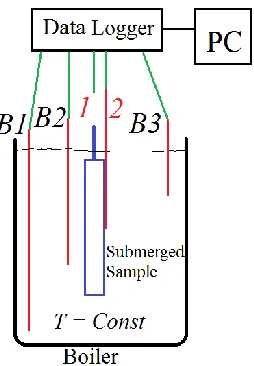
To determine the thermal properties of a sample, the experimental method has been used based on the existing transient method [2, 3]. The experimental setup includes water temperature controlled bath, K-type thermocouples, stainless steel tube containing packed activated carbon, data logger and PC. Five test samples are manufactured: each consists of stainless steel tube with 1” outer diameter, 0.71 [mm] thickness and 200 [mm] length that is loaded with packed activated carbon and sealed in both ends (with provision for a thermocouple placed in the centre as illustrated in Figure 1). The five test samples have the carbon packed density of 546.7 [kg/m3], 661.9 [kg/m3], 707.7 [kg/m3], 749.8 [kg/m3] and 768.1 [kg/m3] respectively. There are five thermocouples associated with set-up and allocated at following positions as shown in Figure 2: one placed at the centre of tube to measure the temperature changes of the activated carbon, one placed on the outside tube wall and other threes allocated in water bath at different heights to check the uniformity of the temperature. 1/8” outer diameter stainless steel tube (Figure 1) with 3 mm inner diameter allocated at middle of container tube as access of the centre thermocouple. All
[image:3.612.324.589.85.233.2]thermocouples are K-type with insulated junction and 1 mm diameter stainless steel sheath.
Figure 1Sample holder dimensions and fabricated model.
Methodology:
a) Experimental procedure
The experimental procedure consists of suddenly plunge the sample that was initially at ambient temperature - into hot water (about 85[oC]). All temperatures are scanned and stored throughout the test with a selected frequency of 0.015 [second] on the data logger.
Figure 2 Measurement set-up, water temperature controlled bath with belt-in thermostat, allocated thermocouple in bath (B1, B2 and B3), sample centre thermocouple (1), sample outside thermocouple (2).
b) Numerical method
Estimation of thermo-physical properties from the experiment data will use two steps. The first step is the elaboration direct explicit numerical method based on energy balance laws aimed to determine the transient temperature profile T(rN, t) of the material. Second step is the inverse
[image:3.612.386.513.376.559.2]identified in the course of this process by comparing the model predictions and the experimental data through the optimization of the mean square error (MSE):
∑ ( ) (1)
b.1) Internal Node:
Internal section modelling (packed carbon only): This is illustrated in Figure 3.
Figure 3 Domain discretization for the energy balance at the carbon packed inner node. Conduction heat, areas that delimit the controlled volume (Ai, Ai+1), dr is the radial increment.
The energy balance for internal node is:
(2)
Or in the discretised form of:
(3)
mv is carbon mass for the specific control volume which is display
on Figure 4. Then replace the carbon mass calculated from density and controlled volume of specific area. The areas and volume are defined as:
{
( )
( )
(4)
By substituting equation (4) in equation (3) and rearrange it becomes:
[ ( )]
[ ]
[ ( )] (5)
Where:
(6)
This non-dimensional number which is called Fourier (Fo); and defined as the ratio of heat conduction to the rate of thermal energy storage.
b.2) Outer Boundary Node:
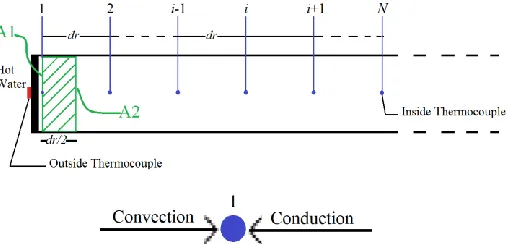
Boundary section modelling (tube internal wall/ packed carbon): This is illustrated in Figure 4. Due the higher thermal conductivity of stainless steel (typical values 17 [W/m.K]) and more importantly the small wall thickness (0.71 [mm]), it is appropriate to assume both tube external and internal wall temperatures are identical.
Figure 4 Domain discretization for the energy balance at the carbon packed surface node (outer boundary node).Contact internal wall/packed carbon heat transfer, conduction heat, areas that delimit the controlled volume (A1, A2), dr is the radial increment.
The energy balance for outside boundaries nodes is:
conv cond (7)
Or in the discretised form of:
(8)
Where:
{
( )
(9)
By substituting equation (9) in equation (8) and rearranging it becomes:
[ ( )]
[ ( )] (10)
Where:
(11)
This non-dimensional number which is called Biot (Bi) and equal to the ratio of heat transfer resistance inside the packed bed to the thermal resistance of the boundary layer.
b.3) Centre Point or Inner Boundary Node:
[image:4.612.30.291.99.277.2] [image:4.612.323.577.146.268.2]Figure 5 Domain discretization for the energy balance at the carbon packed centre node (inner boundary node). Conduction heat, no heat generation at centre node (N) and specific volume,
dr is the radial increment.
By assuming the adiabatic boundary, the energy balance for centre node is:
cond (12)
This means that on the inner boundary we have:
(13)
EXPERIMENTAL RESULT AND ANALYSIS
In this work, the numerical approach is solved and optimized by using the program that is written in MATLAB R2012b. In order to process the iteration process, the time increment is set as 0.3 second and the length step (dr) in radial direction is set as 0.753 [mm].
Figure 6 and Figure 7 show the temperature profiles with minimum (546.7 kg/m3) and maximum (768.1 kg/m3) densities respectively. The gap between both experimental data and model predictions of the temperature in the centre is well minimised. Figure 8 illustrates multiple values of MSE that were explored for first sample (Density is 546.7 kg/m3) in a range of 0.08 < k < 0.2 with an increment of 0.001 [W/m.K] and 90 < h < 200 with an increment of 1 [W/m2.K]. For particular density the minimum of MSE is obtained 0.2358 from minimization process. All the samples were tested and the final results of the thermal conductivity (k) and heat transfer coefficient of the contact wall/packed carbon (h) identified are summed up in Table 1. Overall, fairly good fit with a minimum MSE is obtained for each density.
Density [kg/m3] K [W/m.K] h [W/m2.K] MSE
546.7 0.175 143 0.2358
661.9 0.361 296 0.2272
707.7 0.381 499 0.0561
749.8 0.384 989 0.1434
768.1 0.421 1284 0.1478
Table1 Thermal conductivity (k) and heat transfer coefficient of the contact wall/packed carbon (h).
Figure 6 Temperature profiles with the packed density of 546.7 [kg/m3]: k = 0.175 [W/m.K] and h =143 [W/m2.K].
[image:5.612.30.299.53.168.2]Figure 7 Tempereture profiles with the packed density of 768.1 [kg/m3]: k = 0.421 [W/m.K] and h = 1284 [W/m2.K].
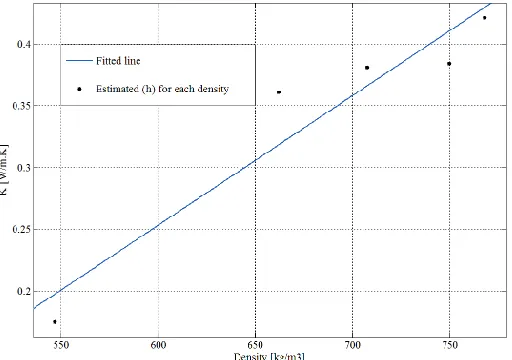
[image:5.612.317.586.297.498.2] [image:5.612.312.590.536.717.2]Figure 9 and Figure 10 show both thermal conductivity (k) and heat transfer coefficient of the contact wall/packed carbon (h) function of packed carbon density respectively. As expected both thermal conductivity (k) and heat transfer coefficient (h) increase quasi-linearly with the density. In fact high the backed density high will be both contact surface between the carbon grains and contact surface between the carbon grains and tube inner wall.
Figure 9 Estimated thermal conductivity versus sample packed density.
Figure 10 Estimated heat transfer coefficients of the contact wall/packed carbon versus sample packed density.
CONCLUSION
The heat transfer coefficient of the contact wall/packed carbon (h) and packed bed thermal conductivity (k) have been estimated using a numerical inverse heat conduction method associated an iterative process based on minimizing the Mean Square Error (MSE) from measured temperatures.
For the five test samples with the packed bed density ranging from 500 [kg/m3] to 800 [kg/m3] the results show a quasi-linear increase of both thermal conductivity (k) and heat transfer coefficient of the contact wall/packed carbon (h) with the
packed bed density: 0.15 [W/m.K] < k < 0.45 [W/m.K] and 150 [W/m2.K] < h < 1400 [W/m2.K].
AKNOWLEGMENTS
The project is supported by EPSRC (Grant EP/J000876/1) and Chemviron Carbons Ltd (Lockett Road, Lancashire WN4 8DE, UK).
REFERENCES
[1] Critoph R. E., Turner L., Heat transfer in granular activated carbon beds in the presence of adsorbable gases. International Journal of Heat and Mass Transfer. 1995;38(9):1577-85.
[2] De Vries Daniel A., The theory of heat and moisture transfer in porous media revisited. International Journal of Heat and Mass Transfer International Journal of Heat and Mass Transfer. 1987;30(7):1343-50.
[3] Mounanga P., Khelidj A., Bastian G., Experimental study and modelling approaches for the thermal conductivity evolution of hydrating cement paste. Advances in cement research. 2004;16:95-104.
[4] Tavman S., Tavman I. H., Evcin S., Measurement of thermal diffusivity of granular food materials. ICHMT, International Communications in Heat and Mass Transfer. 1997;24(7):945-53.
[5] Wang L. W., Metcalf S. J., Critoph R. E., Thorpe R., Tamainot-Telto Z., Thermal conductivity and permeability of consolidated expanded natural graphite treated with sulphuric acid. Carbon. 2011;49(14):4812-9.
[6] Swift David L., The thermal conductivity of spherical metal powders including the effect of an oxide coating. International Journal of Heat and Mass Transfer International Journal of Heat and Mass Transfer. 1966;9(10):1061-74.
[7] Okazaki M., Yamasaki T., Gotoh S., Toei R., Effective thermal conductivity for granular beds of various binary mixtures. J Chem Eng Japan / JCEJ Journal of Chemical Engineering of Japan. 1981;14(3):183-9.
[8] Shulman Z. P., Novichyonok L. N., Belskaya E. P., Khusid B. M., Melnichenko V. V., Thermal conductivity of metal-filled systems. International Journal of Heat and Mass Transfer International Journal of Heat and Mass Transfer. 1982;25(5):643-51.
[9] Vozár L., A computer-controlled apparatus for thermal conductivity measurement by the transient hot wire method. Journal of Thermal Analysis. 1996;46(2):495-505.
[10] Voss T. E. W., Schumann V., Heat flow through granulated material. Fuel. 1934;13(8):8.
![Figure 7 Tempereture profiles with the packed density of 768.1 [kg/m3]: k = 0.421 [W/m.K] and h = 1284 [W/m2.K]](https://thumb-us.123doks.com/thumbv2/123dok_us/9552672.460082/5.612.317.586.297.498/figure-tempereture-profiles-packed-density-kg-w-k.webp)