Journal of Engineering and Applied Sciences 15 (6): 1421-1425, 2020 ISSN: 1816-949X
© Medwell Journals, 2020
AHP-COA Combined Algorithm for Selecting a Digital Production
Machine Design
1
Shiva Shokoohi Mehran,
2Sanaz Vessali,
3Majid Ahmadi and
2Elham Shadkam
1
Department of Industrial Engineering, Faculty of Engineering,
Khayyam University, Mashhad, Iran
2
La Trobe University MEcon, MAccFin, Australia
3
Department of Accounting and Management, Islamic Azad University, Firoozkuh Branch,
Firoozkuh, Iran
Abstract: This study shows a COA algorithm approach in order to find Pareto solutions for multi-objective selection of advanced machining scheme. For multi-purpose evaluation in this approach, the proposed method for focusing and determining the weight value of the evaluation indices enables a Analytical Hierarchical Process (AHP) to enable the engineer to determine a variety of requirements. There are three reverse objectives: cost, quality and operation time, which are built at the same time. A pilot program has been created and its results analyzed. This optimization of the results shows that the algorithm is valid.
Key words: Pareto, requirements, optimization, multi-objective, valid, evaluation
INTRODUCTION
In the field of decision making where the choice of one of the available solutions or the prioritization of solutions has been discussed, it has been several years that decision making methods with multiple MADM indices have emerged. Among these, the hierarchical analysis method (AHP) has been used in management science more than any other method. A number of algorithms have been introduced for multi-objective optimization problems: such as Ant Colony algorithm, COA (Cuckoo Algorithm, Genetic algorithm, particle swarm optimization algorithm, fuzzy optimization algorithm, artificial lattice, etc.), COA algorithm as a global search technology is a particularly suitable method to obtain a global optimal solution to the multi-objective optimization problem because COA has advantages such as excellent flexibility, ease of operation, easy operation and short computational time. Plenty of attention has been gathering around the information production models enabled by the modern Information and Communication Technologies (ICT) and brought to the forefront by collaborative projects such as the Free/Open Source Software (FOSS) movement or the free encyclopedia Wikipedia. On the other hand, researchers such as Webster (2002a, b) have argued against the idea of an ‘information society’. They emphasize the continuities of the current age with former capitalist-oriented social and economic arrangements (Webster, 2002a, b). Kumar maintains that the information explosion ‘has not produced a radical shift in the way industrial societies are organized’ to conclude that ‘the imperatives of profit, power and control seem as
Operation 1
Processing method 1
Processing
method 2
--Processing method N1
Operation 2
Processing method 1
Processing
method 2
---Processing method N2
Operation m
--Processing method 1
Processing
method 2
---Processing method NM
Operation cost general purpose machine C1
Operation cost of universal tooling C2
Depreciation of general purpose machine C3
Wage of operator C4
Cutting time T1
Non-cutting time T2
Servicing time T3
Time of rest T4
Surface quality Q1
Tolerance Q2
Form and position tolerance Q3
Processing Cost C
Processing Time T
Processing Quality Q
Selection of machining
scheme
Level A Level B Level D distanceand-quality based replacement criterion for pool
updating. Ge et al. (2010) proposed a hybrid Chaotic Ant Swarm approach for the graph Coloring problem (CASCOL). This approach was based on a novel swarm intelligence technique called Chaotic Ant Swarm (CAS) and a simple greedy sequential coloring, First-Fit algorithm. This study shows a COA algorithm approach in order to find Pareto solutions for multi-objective selection of advanced machining scheme. For multi-purpose evaluation in this approach, the proposed method for focusing and determining the weight value of the evaluation indices enables a Analytical Hierarchical Process (AHP) to enable the engineer to determine a variety of requirements. There are three reverse objectives: cost, quality and operation time which are built at the same time. A pilot program has been created and its results analyzed. This optimization of the results shows that the algorithm is valid.
MATERIALS AND METHODS
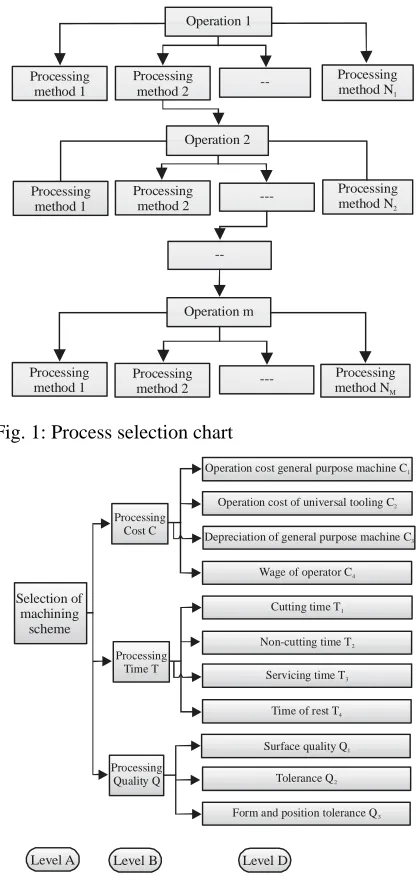
Many or even more real engineering problems in a multi-objective optimization, maximizing performance increasing reliability, reducing costs, etc. but in conventional processing, the choice of machining plan typically only considers one specific evaluation factor. Takes. There are many factors that can influence the choice of processing method such as processing quality, processing costs, processing time, at the same time. In addition to selection one can be influenced by the assorted state and quality of assembly assets, production compatibility, managerial talent and so on. Designing is an implementation of the multi-objective machining problem that is the subject of choice. Here, designing the angular machining is essentially, under constant assembly operations and limited assembly property. The method of choice is illustrated in Fig. 1.
[image:2.612.318.527.92.532.2]The AHP method determines the qualitative weight by creating multilevel decision structures and matrix pairing comparisons. In this research, there are three levels in the structure of different levels of the evaluation model, level A is the target level of machining plan, level B and level D components. The following are significant evaluations and evaluation variables. Cost checking, processing time, quality checking are real components of the evaluation. Processing costs consist of variable costs and fixed costs. Fixed costs are costs that do not change in a business in the applicable period or scale of production such as cost tool set, workshop assembly cost, management cost, unit cost of unit operation, technological equipment, etc. That can be selected at the same workshop or short distance between the region of those production resources, so, shipping time and cost are not taken into account. Therefore, the evaluation variables include the processing cost including the useful general
[image:2.612.321.528.96.301.2]Fig. 1: Process selection chart
Fig. 2: Hierarchical structure for model evaluation cost of the machine, the operating cost of the equipment, the global useful machine depreciation. The hierarchical structure for model evaluation is shown in Fig. 2.
J. Eng. Applied Sci., 15 (6): 1421-1425, 2020
Start
Initialize cuckoos with eggs
Delermine egg laying radius fo each cuckoo
Move all cuckoos toward best environment Lay eggs in different
nests
Some of eggs are
detected and killed Determine cuckoo societies
Find nests with best survival rate Population is less
than max value?
Kill cuckoos in worst area
Let eggs grow
End Yes
No Yes
No
Stop codition satis iedf Check survival of
eggs in nests (get pro it values)f which examines complex issues based on their
interactions and makes them simple to solve. The hierarchical analysis process can be used when the decision-making process has several competing options and decision criteria. The criteria can be quantitative and qualitative. The basis of this decision-making method lies in pairwise comparisons. The decision maker begins by making the decision tree hierarchical. The decision hierarchy tree shows the comparative factors and competing options evaluated in the decision. Then a series of pairwise comparisons is made. These comparisons show the weight of each factor in relation to the competing options evaluated in the decision. Finally, the logic of the hierarchical analysis process combines matrices from paired comparisons to make the optimal decision.
Principles of the analytical hierarchy process: The founder of this method (Thomas Hourly) has outlined the following four principles as the principles of the hierarchical analysis process and has based all calculations, rules and regulations on them.
Reverse condition: If element A’s preference for element B is n, element B’s preference for element A will be 1/n. Homogeneity principle: Element A must be homogenous and comparable to element B. In other words, the superiority of element A over element B cannot be infinite or zero.
Dependency: Each hierarchical element can depend on its higher level element and this dependence can continue linearly to the highest level.
In this step, the problem and purpose of decision making are presented as hierarchical elements of decision making that are related. Decision elements include “decision indicators” and “decision options”. The hierarchical analysis process requires breaking a problem with several indicators into a hierarchy of levels. The high level represents the main purpose of the decision-making process. The second level represents the major and basic indicators which may be broken down into the subsidiary and the more detailed ones at the next level. The last level presents the decision options.
RESULTS AND DISCUSSION
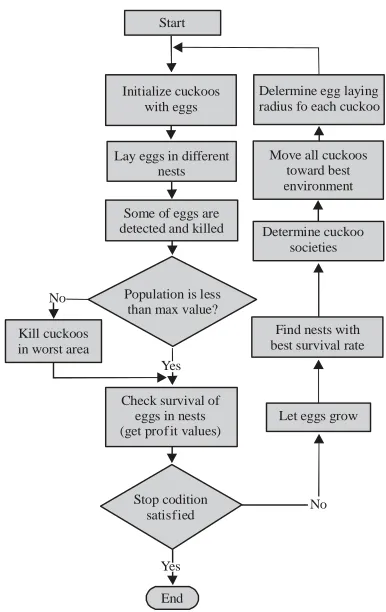
[image:3.612.329.522.91.397.2]In Fig. 3, the Cuckoo optimization algorithm is plotted. Like other evolutionary COA algorithms, it starts with an initial population. A population of cuckoos, this population of eggs that will lay them in a host of birds. Other eggs are identified and killed by the host bird. The amount of eggs hatched indicates the suitability of the locusts in the area. The more eggs in a given area are able to survive and survive, the greater the benefit to
Fig. 3: Flowchart of cuckoo optimization algorithm (Rajabioun, 2011)
the area. Therefore, the situation where most eggs are saved will be the parameter that the COA intends to optimize.
Cuckoo’s are looking for the best area to maximize their egg rescue. Once the chickens hatch and become mature cats, they form communities and groups. Each group has its own area of residence. The best place to live for all cuckoo. All groups will be the next destination for all cuckoo in other groups. All groups are migrating to the best available region. Each group resides in a region close to its current best position. The number of eggs that each cuckoo will lay as well as the distance of the cuckoo from the current optimal area to settle a number of oviposition radii are calculated and formed. The cuckoo then begins to randomly spawn in the lobes within their spawning radius. This stroll continues until it reaches the best location for laying the most profitable area.
J. Eng. Applied Sci., 15 (6): 1421-1425, 2020
[image:4.612.74.271.356.476.2]Fig. 4: GA-AHP
Table 1: Ultimate weight
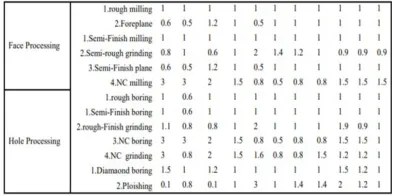
Table 2: Information processing approach
level and 2 μm. Ra0 axis. Evaluation list is available for systems ready to show some computational credit suggestions Table 2.
As can be seen in Fig. 4, design of machine No. 2 and design of No. 2, machine 5 and design of No. 3, machine 9 and design of No. 4, machine 3 and design of No. 5, machine 8 is assigned. It is a way to minimize the cost. The genetic chart has an iterative but convergent and straight line diagram. The cuckoo chart executes the
answer with precision and obtains the exact answer 4979 while the genetic chart has the final answer 6936.
CONCLUSION
In this study, a new optimization algorithm was proposed which was inspired by lifestyle of a bird called cuckoo. Special characteristics of cuckoos in egg laying and breeding had been the basic motivation for development of this new optimization algorithm for selecting a digital production machine design. Digital production is an important system for any manufacturer that needs to increase its competitiveness and profitability. The purpose of digital production is to create more efficient production processes and products. In this research, a new hybrid algorithm is proposed that combines COA-AHP to make ideal decision making of machining plan. As can be said in this problem, a scientific model of machine assembly and plan selection was presented.
REFERENCES
Blochliger, I., and N. Zufferey, 2008. A graph coloring heuristic using partial solutions and a reactive tabu scheme. Comput. Oper. Res., 35: 960-975.
Ge, F., Z. Wei, Y. Tian and Z. Huang, 2010. Chaotic ant swarm for graph coloring. Proceedings of the 2010 IEEE International Conference on Intelligent Computing and Intelligent Systems, October 29-31, 2010, IEEE, Xiamen, China, pp: 512-516.
Guan, X., Y. Wang and L. Tao, 2009. Machining scheme selection of digital manufacturing based on genetic algorithm and AHP. J. Intell. Manuf., 20: 661-669.
6.6
6.4
6.2
6.0
5.8
5.6
5.4
5.2
5.0
0 20 40 60 80 100 120 140 160 180 200
No. of generation
Fitne
[image:4.612.75.272.512.610.2]J. Eng. Applied Sci., 15 (6): 1421-1425, 2020
Langdon, W., 1986. The Whale and the Reactor: A Search for Limits in an Age of High Technology. University of Chicago Press, Chicago, Illinois, USA., ISBN: 9780226902104, Pages: 200.
Lu, Z. and J. K. Hao, 2010. A memetic algorithm for graph coloring. Eur. J. Oper. Res., 203: 241-250.
Rajabioun, R., 2011. Cuckoo optimization algorithm. Applied Soft Comput., 11: 5508-5518.
Ray, B., A.J. Pal, D. Bhattacharyya and T.H. Kim, 2010. An efficient ga with multipoint guided mutation for graph coloring problems. Int. J. Signal Process. Image Process. Pattern Recognit., 3: 51-58.
Webster, F., 2002a. The Information Society Revisited. In: The Handbook of New Media, Lievrouwand, L.A. and S. Livingstone (Eds.). SAGE, London, England, UK., ISBN: 9780761965107, pp: 255-266.