Semantic Role Labeling via Tree Kernel Joint Inference
Alessandro Moschitti, Daniele Pighin and Roberto Basili Department of Computer Science
University of Rome ”Tor Vergata” 00133 Rome, Italy
{moschitti,basili}@info.uniroma2.it [email protected]
Abstract
Recent work on Semantic Role Labeling (SRL) has shown that to achieve high accuracy a joint inference on the whole predicate argument structure should be ap-plied. In this paper, we used syntactic sub-trees that span potential argument struc-tures of the target predicate in tree ker-nel functions. This allows Support Vec-tor Machines to discern between correct and incorrect predicate structures and to re-rank them based on the joint probabil-ity of their arguments. Experiments on the PropBank data show that both classifica-tion and re-ranking based on tree kernels can improve SRL systems.
1 Introduction
Recent work on Semantic Role Labeling (SRL) (Carreras and M`arquez, 2005) has shown that to achieve high labeling accuracy a joint inference on the whole predicate argument structure should be applied. For this purpose, we need to extract fea-tures from the sentence’s syntactic parse tree that encodes the target semantic structure. This task is rather complex since we do not exactly know which are the syntactic clues that capture the relation be-tween the predicate and its arguments. For exam-ple, to detect the interesting context, the modeling of syntax/semantics-based features should take into account linguistic aspects like ancestor nodes or se-mantic dependencies (Toutanova et al., 2004).
A viable approach to generate a large number of features has been proposed in (Collins and Duffy, 2002), where convolution kernels were used to im-plicitly define a tree substructure space. The selec-tion of the relevant structural features was left to the Voted Perceptron learning algorithm. Such success-ful experimentation shows that tree kernels are very promising for automatic feature engineering, espe-cially when the available knowledge about the phe-nomenon is limited.
In a similar way, we can model SRL systems with tree kernels to generate large feature spaces. More in detail, most SRL systems split the labeling pro-cess into two different steps: Boundary Detection (i.e. to determine the text boundaries of predicate arguments) and Role Classification (i.e. labeling such arguments with a semantic role, e.g. Arg0 or Arg1 as defined in (Kingsbury and Palmer, 2002)). The former relates to the detection of syntactic parse tree nodes associated with constituents that corre-spond to arguments, whereas the latter considers the boundary nodes for the assignment of the suitable label. Both steps require the design and extraction of features from parse trees. As capturing the tightly interdependent relations among a predicate and its arguments is a complex task, we can apply tree ker-nels on the subtrees that span the whole predicate argument structure to generate the feature space of all the possible subtrees.
In this paper, we apply the traditional bound-ary (T BC) and role (T RC) classifiers (Pradhan et al., 2005a), which are based on binary predi-cate/argument relations, to label all parse tree nodes corresponding to potential arguments. Then, we
tract the subtrees which span the predicate-argument dependencies of such arguments, i.e. Argument Spanning Trees (ASTs). These are used in a tree kernel function to generate all possible substructures that encoden-ary argument relations, i.e. we carry out an automatic feature engineering process.
To validate our approach, we experimented with our model and Support Vector Machines for the clas-sification of valid and invalid ASTs. The results show that this classification problem can be learned with high accuracy. Moreover, we modeled SRL as a re-ranking task in line with (Toutanova et al., 2005). The large number of complex features provided by tree kernels for structured learning allows SVMs to reach the state-of-the-art accuracy.
The paper is organized as follows: Section 2 intro-duces the Semantic Role Labeling based on SVMs and the tree kernel spaces; Section 3 formally de-fines theASTs and the algorithm for their classifi-cation and re-ranking; Section 4 shows the compara-tive results between our approach and the traditional one; Section 5 presents the related work; and finally, Section 6 summarizes the conclusions.
2 Semantic Role Labeling
In the last years, several machine learning ap-proaches have been developed for automatic role labeling, e.g. (Gildea and Jurasfky, 2002; Prad-han et al., 2005a). Their common characteristic is the adoption of attribute-value representations for predicate-argument structures. Accordingly, our ba-sic system is similar to the one proposed in (Pradhan et al., 2005a) and it is hereby described.
We use a boundary detection classifier (for any role type) to derive the words compounding an ar-gument and a multiclassifier to assign the roles (e.g.
Arg0orArgM) described in PropBank (Kingsbury and Palmer, 2002)). To prepare the training data for both classifiers, we used the following algorithm:
1. Given a sentence from the training-set, generate a full syntactic parse tree;
2. LetP andAbe respectively the set of predicates and the set of parse-tree nodes (i.e. the potential ar-guments);
3. For each pairhp, ai ∈ P × A:
- extract the feature representation set,Fp,a;
- if the subtree rooted in a covers exactly the words of one argument ofp, putFp,ain theT+ set (positive examples), otherwise put it in the
T−set (negative examples).
The outputs of the above algorithm are theT+and
T− sets. These sets can be directly used to train a boundary classifier (e.g. an SVM). Regarding the argument type classifier, a binary labeler for a roler (e.g. an SVM) can be trained on theTr+, i.e. its pos-itive examples and Tr−, i.e. its negative examples, whereT+ = T+
r ∪Tr−, according to the ONE-vs-ALL scheme. The binary classifiers are then used to build a general role multiclassifier by simply se-lecting the argument associated with the maximum among the SVM scores.
Regarding the design of features for predicate-argument pairs, we can use the attribute-values de-fined in (Gildea and Jurasfky, 2002) or tree struc-tures (Moschitti, 2004). Although we focus on the latter approach, a short description of the for-mer is still relevant as they are used by T BC and
T RC. They include the Phrase Type, Predicate
Word, Head Word, Governing Category, Position
and Voice features. For example, the Phrase Type indicates the syntactic type of the phrase labeled as a predicate argument and the Parse Tree Path con-tains the path in the parse tree between the predicate and the argument phrase, expressed as a sequence of nonterminal labels linked by direction (up or down) symbols, e.g.V↑VP↓NP.
A viable alternative to manual design of syntac-tic features is the use of tree-kernel functions. These implicitly define a feature space based on all possi-ble tree substructures. Given two treesT1andT2, in-stead of representing them with the whole fragment space, we can apply the kernel function to evaluate the number of common fragments.
Formally, given a tree fragment space F =
{f1, f2, . . . , f|F|}, the indicator function Ii(n) is equal to 1 if the target fi is rooted at node n and equal to 0 otherwise. A tree-kernel function over t1 and t2 is Kt(t1, t2) =
P
n1∈Nt1
P
n2∈Nt2 ∆(n1, n2), where Nt1 and Nt2
are the sets of thet1’s andt2’s nodes, respectively. In turn ∆(n1, n2) =
P|F|
i=1λl(fi)Ii(n1)Ii(n2), where
0 ≤ λ ≤ 1 and l(fi) is the height of the subtree
frag-S
NP VP
PRP
John
VP CC VP VB NP
and
VB NP
took
DT NN
the book read
PRP$ NN
its title Sentence Parse-Tree
S
NP VP
PRP
John
VP VB NP
took
DT NN
the book took{ARG0, ARG1}
S
NP VP
PRP
John
VP VB NP
read
PRP$ NN
[image:3.612.120.490.55.157.2]its title read{ARG0, ARG1}
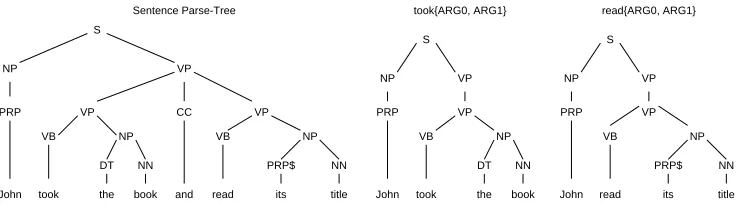
Figure 1: A sentence parse tree with two argument spanning trees (ASTs)
ments. When λ = 1, ∆is equal to the number of common fragments rooted at nodesn1 andn2. As described in (Collins and Duffy, 2002), ∆ can be computed inO(|Nt1| × |Nt2|).
3 Tree kernel-based classification of Predicate Argument Structures
Traditional semantic role labeling systems extract features from pairs of nodes corresponding to a predicate and one of its argument, respectively. Thus, they focus on only binary relations to make classification decisions. This information is poorer than the one expressed by the whole predicate ar-gument structure. As an alternative we can select the set of potential arguments (potential argument nodes) of a predicate and extract features from them. The number of the candidate argument sets is ex-ponential, thus we should consider only those cor-responding to the most probable correct argument structures.
The usual approach (Toutanova et al., 2005) uses a traditional boundary classifier (T BC) to select the set of potential argument nodes. Such set can be as-sociated with a subtree which in turn can be classi-fied by means of a tree kernel function. This func-tion intuitively measures to what extent a given can-didate subtree is compatible with the subtree of a correct predicate argument structure. We can use it to define two different learning problems: (a) the simple classification of correct and incorrect pred-icate argument structures and (b) given the best m structures, we can train a re-ranker algorithm able to exploit argument inter-dependencies.
3.1 The Argument Spanning Trees (ASTs)
We consider predicate argument structures anno-tated in PropBank along with the corresponding TreeBank data as our object space. Given the target
predicate nodepand a node subsets={n1, .., nk} of the parse tree t, we define as the spanning tree rootrthe lowest common ancestor ofn1, .., nkand
p. The node set spanning tree (N ST)psis the sub-tree oftrooted inr from which the nodes that are neither ancestors nor descendants of anyniorpare removed.
Since predicate arguments are associated with tree nodes (i.e. they exactly fit into syntactic constituents), we can define the Argument
Span-ning Tree (AST) of a predicate argument set, {p,{a1, .., an}}, as the N ST over such nodes, i.e. p{a1,..,an}. An AST corresponds to the
min-imal subtree whose leaves are all and only the
words compounding the arguments and the predi-cate. For example, Figure 1 shows the parse tree of the sentence "John took the book and read its title". took{Arg0,Arg1} and read{Arg0,Arg1} are two AST structures associated with the two predicates took and read, respectively. All the other possible subtrees, i.e. N STs, are not valid ASTs for these two predicates. Note that classifyingpsin
AST orN ST for each node subsetsoftis equiva-lent to solve the boundary detection problem.
The critical points for theAST classification are: (1) how to design suitable features for the charac-terization of valid structures. This requires a careful linguistic investigation about their significant prop-erties. (2) How to deal with the exponential number ofN STs.
Sec-Figure 2: Two-step boundary classification. a) Sentence tree; b) Two candidateAST s; c) ExtendedAST -Ord labeling
tion 2), hence avoiding to define explicit features. The second problem can be approached in two ways:
(1) We can increase the recall ofT BCto enlarge the set of candidate arguments. From such set, we can extract correct and incorrect argument structures. As the number of such structures will be rather small, we can apply the AST classifier to detect the cor-rect ones.
(2) We can consider the classification probability provided byT BCandT RC(Pradhan et al., 2005a) and select themmost probable structures. Then, we can apply a re-ranking approach based on SVMs and tree kernels.
The re-ranking approach is the most promising one as suggested in (Toutanova et al., 2005) but it does not clearly reveal if tree kernels can be used to learn the difference between correct or incorrect argument structures. Thus it is interesting to study both the above approaches.
3.2 N ST Classification
As we cannot classify all possible candidate argu-ment structures, we apply theAST classifier just to detect the correct structures from a set of overlap-ping arguments. Given two nodes n1 andn2 of an
N ST, they overlap if eithern1is ancestor ofn2 or vice versa. N STs that contain overlapping nodes are not valid ASTs but subtrees of NSTs may be validAST s. Assuming this, we definesas the set of potential argument nodes and we create two node setss1 =s− {n1}ands2 = s− {n2}. By classi-fying the two newN STsps1 andps2 with theAST
classifier, we can select the correct structures. Of course, this procedure can be generalized to a set of overlapping nodes greater than 2. However, consid-ering that the Precision of T BC is generally high,
the number of overlapping nodes is usually small. Figure 2 shows a working example of the multi-stage classifier. In Frame (a), T BC labels as po-tential arguments (circled nodes) three overlapping nodes related toArg1. This leads to two possible non-overlapping solutions (Frame (b)) but only the first one is correct. In fact, according to the second one the propositional phrase ”of the book” would be incorrectly attached to the verbal predicate, i.e. in contrast with the parse tree. TheAST classifier, ap-plied to the two N STs, is expected to detect this inconsistency and provide the correct output.
3.3 Re-rankingN STs with Tree Kernels
To implement the re-ranking model, we follow the approach described in (Toutanova et al., 2005).
First, we use SVMs to implement the boundary
T BCand roleT RC local classifiers. As SVMs do
not provide probabilistic output, we use the Platt’s algorithm (Platt, 2000) and its revised version (Lin et al., 2003) to trasform scores into probabilities.
Second, we combine T BC and T RC probabil-ities to obtain the m most likely sequences s of tree nodes annotated with semantic roles. As argu-ment constituents of the same verb cannot overlap, we generate sequences that respect such node con-straint. We adopt the same algorithm described in (Toutanova et al., 2005). We start from the leaves and we select themsequences that respect the con-straints and at the same time have the highest joint probability ofT BCandT RC.
Third, we extract the following feature represen-tation:
[image:4.612.71.541.58.149.2]ASTwhich is pruned at the level of argument nodes. (b) Attribute value features (standard features) re-lated to the whole predicate structure. These include the features for each arguments (Gildea and Juras-fky, 2002) and global features like the sequence of argument labels, e.g.hArg0, Arg1, ArgMi.
Finally, we prepare the training examples for the re-ranker considering thembest annotations of each predicate structure. We use the approach adopted in (Shen et al., 2003), which generates all possible pairs from themexamples, i.e.¡m2¢pairs. Each pair is assigned to a positive example if the first mem-ber of the pair has a higher score than the second member. The score that we use is the F1 measure of the annotated structure with respect to the gold standard. More in detail, given training/testing ex-amplesei =ht1i, t2i, vi1, vi2i, wheret1i andt2i are two
ASTs andvi1andvi2are two feature vectors associ-ated with two candidate predicate structuress1 and
s2, we define the following kernels:
1) Ktr(e1, e2) =Kt(t11, t12) +Kt(t21, t22) −Kt(t11, t22)−Kt(t21, t12),
where tji is the j-th AST of the pairei, Kt is the tree kernel function defined in Section 2 andi, j ∈ {1,2}.
2) Kpr(e1, e2) =Kp(v11, v21) +Kp(v21, v22) −Kp(v11, v22)−Kp(v12, v21),
wherevij is thej-th feature vector of the pairei and
Kpis the polynomial kernel applied to such vectors. The final kernel that we use for re-ranking is the following:
K(e1, e2) = Ktr(e1, e2)
|Ktr(e1, e2)|
+ Kpr(e1, e2)
|Kpr(e1, e2)|
Regarding tree kernel feature engineering, the next section show how we can generate more effec-tive features given an established kernel function.
3.4 Tree kernel feature engineering
Consider the Frame (b) of Figure 2, it shows two perfectly identicalN STs, consequently, their frag-ments will also be equal. This prevents the algorithm to learn something from such examples. To solve the problem, we can enrich theN ST sby marking their argument nodes with a progressive number, starting
from the leftmost argument. For example, in the first
N ST of Frame (c), we mark asNP-0andNP-1the first and second argument nodes whereas in the sec-ondN ST we trasform the three argument node la-bels inNP-0,NP-1andPP-2. We will refer to the resulting structure as aAST-Ord (ordinal number). This simple modification allows the tree kernel to generate different argument structures for the above
N STs. For example, from the first N ST in Fig-ure 2.c, the fragments[NP-1 [NP][PP]], [NP
[DT][NN]] and [PP [IN][NP]] are
gener-ated. They do not match anymore with the[NP-0
[NP][PP]], [NP-1 [DT][NN]] and [PP-2
[IN][NP]]fragments generated from the second
N ST in Figure 2.c.
Additionally, it should be noted that the semantic information provided by the role type can remark-ably help the detection of correct or incorrect predi-cate argument structures. Thus, we can enrich the ar-gument node label with the role type, e.g. theNP-0
andNP-1of the correctAST of Figure 2.c become
NP-Arg0andNP-Arg1(not shown in the figure). We refer to this structure asAST-Arg. Of course, to apply theAST-Arg classifier, we need thatT RC labels the arguments detected byT BC.
4 The experiments
The experiments were carried out within the set-ting defined in the CoNLL-2005 Shared Task (Carreras and M`arquez, 2005). In particular, we adopted the Charniak parse trees available at www.lsi.upc.edu/∼srlconll/along with the of-ficial performance evaluator.
All the experiments were performed with the SVM-light-TK software available at http://ai-nlp.info.uniroma2.it/moschitti/ which encodes ST and SST kernels in SVM-light (Joachims, 1999). ForT BCandT RC, we used the linear kernel with a regularization parameter (option
Section 21 Section 23
AST Class. P. R. F1 P. R. F1
− 69.8 77.9 73.7 62.2 77.1 68.9
Ord 73.7 81.2 77.3 63.7 80.6 71.2
[image:6.612.74.300.56.122.2]Arg 73.6 84.7 78.7 64.2 82.3 72.1
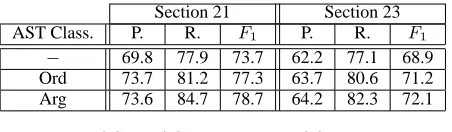
Table 1: AST, AST-Ord, and AST-Arg perfor-mance on sections 21 and 23.
4.1 Classification of whole predicate argument structures
In these experiments, we trained T BC on sections 02-08 whereas, to achieve a very accurate role clas-sifier, we trained T RC on all sections 02-21. To train theAST,AST-Ord (AST with ordinal num-bers in the argument nodes), and AST-Arg (AST with argument type in the argument nodes) clas-sifiers, we applied the T BC and T RC over sec-tions 09-20. Then, we considered all the structures whose automatic annotation showed at least an ar-gument overlap. From these, we extracted 30,220 validASTs and 28,143 non-validASTs, for a total of 183,642 arguments.
First, we evaluate the accuracy of theAST-based classifiers by extracting 1,975ASTs and 2,220
non-ASTs from Section 21 and the 2,159 ASTs and 3,461 non-ASTs from Section 23. The accuracy derived on Section 21 is an upperbound for our clas-sifiers since it is obtained using an ideal syntactic parser (the Charniak’s parser was trained also on Section 21) and an ideal role classifier.
Table 1 shows Precision, Recall and F1 mea-sures of the AST-based classifiers over the above NSTs. Rows 2, 3 and 4 report the performance of
AST,AST-Ord, andAST-Arg classifiers, respec-tively. We note that: (a) The impact of parsing ac-curacy is shown by the gap of about 6% points be-tween sections 21 and 23. (b) The ordinal number-ing of arguments (Ord) and the role type informa-tion (Arg) provide tree kernels with more meaning-ful fragments since they improve the basic model of about 4%. (c) The deeper semantic information generated by theArglabels provides useful clues to select correct predicate argument structures since it improves theOrdmodel on both sections.
Second, we measured the impact of the AST -based classifiers on the accuracy of both phases of semantic role labeling. Table 2 reports the results
on sections 21 and 23. For each of them, Precision, Recall and F1 of different approaches to bound-ary identification (bnd) and to the complete task, i.e. boundary and role classification (bnd+class) are shown. Such approaches are based on differ-ent strategies to remove the overlaps, i.e. with the
AST,AST-Ord andAST-Arg classifiers and using the baseline (RND), i.e. a random selection of non-overlapping structures. The baseline corresponds to the system based onT BCandT RC1.
We note that: (a) for any model, the boundary de-tectionF1 on Section 21 is about 10 points higher than theF1 on Section 23 (e.g. 87.0% vs. 77.9% for RND). As expected the parse tree quality is very important to detect argument boundaries. (b) On the real test (Section 23) the classification introduces la-beling errors which decrease the accuracy of about 5% (77.9 vs 72.9 for RND). (c) TheOrd andArg approaches constantly improve the baseline F1 of about 1%. Such poor impact does not surprise as the overlapping structures are a small percentage of the test set, thus the overall improvement cannot be very high.
Third, the comparison with the CoNLL 2005 re-sults (Carreras and M`arquez, 2005) can only be carried out with respect to the whole SRL task (bnd+class in table 2) since boundary detection ver-sus role classification is generally not provided in CoNLL 2005. Moreover, our best global result, i.e. 73.9%, was obtained under two severe experimental factors: a) the use of just 1/3 of the available train-ing set, and b) the usage of the linear SVM model for the TBC classifier, which is much faster than the polynomial SVMs but also less accurate. However, we note the promising results of the AST meta-classifier, which can be used with any of the best figure CoNLL systems.
Finally, the overall results suggest that the tree kernel model is robust to parse tree errors since pre-serves the same improvement across trees derived with different accuracy, i.e. the semi-automatic trees of Section 21 and the automatic tree of Section 23. Moreover, it shows a high accuracy for the classi-fication of correct and incorrect ASTs. This last property is quite interesting as the best SRL systems
1
(Punyakanok et al., 2005; Toutanova et al., 2005; Pradhan et al., 2005b) were obtained by exploit-ing the information on the whole predicate argument structure.
Next section shows our preliminary experiments on re-ranking using theAST kernel based approach.
4.2 Re-ranking based on Tree Kernels
In these experiments, we used the output ofT BC
and T RC2 to provide an SVM tree kernel with a ranked list of predicate argument structures. More in detail, we applied a Viterbi-like algorithm to gener-ate the 20 most likely annotations for each predicgener-ate structure, according to the joint probabilistic model ofT BCandT RC. We sorted such structures based on theirF1measure and used them to learn the SVM re-ranker described in 3.3.
For training, we used Sections 12, 14, 15, 16 and 24, which contain 24,729 predicate structures. For each of them, we considered the 5 annotations having the highest F1 score (i.e. 123,674 N STs) on the span of the 20 best annotations provided by Viterbi algorithm. With such structures, we ob-tained 294,296 pairs used to train the SVM-based re-ranker. As the number of such structures is very large the SVM training time was very high. Thus, we sped up the learning process by using only the
ASTs associated with the core arguments. From the test sentences (which contain 5,267 structures), we extracted the 20 best Viterbi annotated structures, i.e. 102,343 (for a total of 315.531 pairs), which were used for the following experiments:
First, we selected the best annotation (according to theF1provided by the gold standard annotations) out of the 20 provided by the Viterbi’s algorithm. The resultingF1of 88.59% is the upperbound of our approach.
Second, we selected the top ranked annotation in-dicated by the Viterbi’s algorithm. This provides our baselineF1measure, i.e. 75.91%. Such outcome is slightly higher than our official CoNLL result (Mos-chitti et al., 2005) obtained without converting SVM scores into probabilities.
Third, we applied the SVM re-ranker to select
2
With the aim of improving the state-of-the-art, we applied the polynomial kernel for all basic classifiers, at this time. We used the models developed during our participation to the CoNLL 2005 shared task (Moschitti et al., 2005).
the best structures according to the core roles. We achieved 80.68% which is practically equal to the result obtained in (Punyakanok et al., 2005; Car-reras and M`arquez, 2005) for core roles, i.e. 81%. Their overall F1 which includes all the arguments was 79.44%. This confirms that the classification of the non-core roles is more complex than the other arguments.
Finally, the high computation time of the re-ranker prevented us to use the larger structures which include all arguments. The major complexity issue was the slow training and classification time of SVMs. The time needed for tree kernel function was not so problematic as we could use the fast eval-uation proposed in (Moschitti, 2006). This roughly reduces the computation time to the one required by a polynomial kernel. The real burden is therefore the learning time of SVMs that is quadratic in the num-ber of training instances. For example, to carry out the re-ranking experiments required approximately one month of a 64 bits machine (2.4 GHz and 4Gb Ram). To solve this problem, we are going to study the impact on the accuracy of fast learning algo-rithms such as the Voted Perceptron.
5 Related Work
Recently, many kernels for natural language applica-tions have been designed. In what follows, we high-light their difference and properties.
Section 21 Section 23
bnd bnd+class bnd bnd+class
AST Classifier
RND AST Classifier RND AST Classifier RND AST Classifier RND
- Ord Arg - Ord Arg - Ord Arg - Ord Arg
[image:8.612.68.542.56.130.2]P. 87.5 88.3 88.3 86.9 85.5 86.3 86.4 85.0 78.6 79.0 79.3 77.8 73.1 73.5 73.4 72.3 R. 87.3 88.1 88.3 87.1 85.7 86.5 86.8 85.6 78.1 78.4 78.7 77.9 73.8 74.1 74.4 73.6 F1 87.4 88.2 88.3 87.0 85.6 86.4 86.6 85.3 78.3 78.7 79.0 77.9 73.4 73.8 73.9 72.9
Table 2: Semantic Role Labeling performance on automatic trees usingAST-based classifiers.
outputs. A joint inference stage was applied to re-solve the inconsistency of the different outputs. In (Toutanova et al., 2005), it was observed that there are strong dependencies among the labels of the se-mantic argument nodes of a verb. Thus, to approach the problem, a re-ranking method of role sequences labeled by a T RC is applied. In (Pradhan et al., 2005b), some experiments were conducted on SRL systems trained using different syntactic views.
6 Conclusions
Recent work on Semantic Role Labeling has shown that to achieve high labeling accuracy a joint in-ference on the whole predicate argument structure should be applied. As feature design for such task is complex, we can take advantage from kernel meth-ods to model our intuitive knowledge about the n -ary predicate argument relations.
In this paper we have shown that we can exploit the properties of tree kernels to engineer syntactic features for the semantic role labeling task. The ex-periments suggest that (1) the information related to the whole predicate argument structure is impor-tant as it can improve the state-of-the-art and (2) tree kernels can be used in a joint model to gen-erate relevant syntactic/semantic features. The real drawback is the computational complexity of work-ing with SVMs, thus the design of fast algorithm is an interesting future work.
Acknowledgments
This research is partially supported by the PrestoSpace EU Project#: FP6-507336.
References
Xavier Carreras and Llu´ıs M`arquez. 2005. Introduction to the CoNLL-2005 shared task: Semantic role labeling. In
Pro-ceedings of CoNLL05.
Michael Collins and Nigel Duffy. 2002. New ranking algo-rithms for parsing and tagging: Kernels over discrete struc-tures, and the voted perceptron. In ACL02.
Chad Cumby and Dan Roth. 2003. Kernel methods for re-lational learning. In Proceedings of ICML03, Washington, DC, USA.
Daniel Gildea and Daniel Jurasfky. 2002. Automatic label-ing of semantic roles. Computational Llabel-inguistic, 28(3):496– 530.
T. Joachims. 1999. Making large-scale SVM learning practical. In B. Sch¨olkopf, C. Burges, and A. Smola, editors, Advances
in Kernel Methods - Support Vector Learning.
Paul Kingsbury and Martha Palmer. 2002. From Treebank to PropBank. In Proceedings of LREC’02), Las Palmas, Spain. H.T. Lin, C.J. Lin, and R.C. Weng. 2003. A note on platt’s probabilistic outputs for support vector machines. Technical report, National Taiwan University.
Alessandro Moschitti, Bonaventura Coppola, Daniele Pighin, and Roberto Basili. 2005. Hierarchical semantic role label-ing. In Proceedings of CoNLL05 shared task, Ann Arbor (MI), USA.
Alessandro Moschitti. 2004. A study on convolution kernels for shallow semantic parsing. In Proceedings of ACL’04, Barcelona, Spain.
Alessandro Moschitti. 2006. Making tree kernels practical for natural language learning. In Proceedings of EACL’06, Trento, Italy.
J. Platt. 2000. Probabilistic outputs for support vector ma-chines and comparison to regularized likelihood methods. MIT Press.
Sameer Pradhan, Kadri Hacioglu, Valeri Krugler, Wayne Ward, James H. Martin, and Daniel Jurafsky. 2005a. Support vec-tor learning for semantic argument classification. Machine
Learning Journal.
Sameer Pradhan, Wayne Ward, Kadri Hacioglu, James Martin, and Daniel Jurafsky. 2005b. Semantic role labeling using different syntactic views. In Proceedings ACL’05.
V. Punyakanok, D. Roth, and W. Yih. 2005. The necessity of syntactic parsing for semantic role labeling. In Proceedings
of IJCAI 2005.
Libin Shen, Anoop Sarkar, and Aravind Joshi. 2003. Using ltag based features in parse reranking. In Conference on
EMNLP03, Sapporo, Japan.
Kristina Toutanova, Penka Markova, and Christopher D. Man-ning. 2004. The leaf projection path view of parse trees: Exploring string kernels for hpsg parse selection. In In
Pro-ceedings of EMNLP04.
Kristina Toutanova, Aria Haghighi, and Christopher Manning. 2005. Joint learning improves semantic role labeling. In