CARER: Contextualized Affect Representations for Emotion Recognition
Elvis Saravia, Hsien-Chi Toby Liu, Yen-Hao Huang, Junlin Wu, Yi-Shin Chen∗
National Tsing Hua University Hsinchu, Taiwan
{ellfae, tobbymailbox, yenhao0218, phejimlin, yishin} @gmail.com
Abstract
Emotions are expressed in nuanced ways, which varies by collective or individual expe-riences, knowledge, and beliefs. Therefore, to understand emotion, as conveyed through text, a robust mechanism capable of captur-ing and modelcaptur-ing different lcaptur-inguistic nuances and phenomena is needed. We propose a semi-supervised, graph-based algorithm to produce rich structural descriptors which serve as the building blocks for constructing contextual-ized affect representations from text. The pattern-based representations are further en-riched with word embeddings and evaluated through several emotion recognition tasks. Our experimental results demonstrate that the proposed method outperforms state-of-the-art techniques on emotion recognition tasks.
1 Introduction
Emotions reflect different users’ perspectives to-wards actions and events, therefore they are in-nately expressed in dynamic linguistic forms. Capturing these linguistic variations is challeng-ing because it involves knowledge of lchalleng-inguistic phenomena such as slang and coded words. Pre-vious methods model these linguistic behaviours through rule-based (Volkova and Bachrach,2016) and statistics-based approaches (Becker et al., 2017). These methods construct features that rely on hand-crafted resources; thus, they cannot properly capture theevolvinglinguistic variability found in large-scale opinionated content.
Consider the social posts “Thanks God for
everything” and “Tnx mom for waaaaking me
two hours early. Cant get asleep now”, a
lexicon-based model may not properly represent the emotion-relevant phrases: “waaaaking me”,
“Thanks God”, and“Tnx mom”. First, the word
∗
* Corresponding author
“waaaaking”doesn’t exist in the English
vocab-ulary, hence its referent may vary from its stan-dard form,“waking”. Secondly, knowledge of the semantic similarity between the words“Thanks”
and“Tnx”is needed to establish any relationship
between the last two phrases. Even if such rela-tionship can be established through knowledge-based techniques, it’s difficult to reliably deter-mine the association of these phrases to a group of emotions. This is because traditional methods an-alyze data at the sentence level, which may be less effective as compared to methods that model the corpus as a complex network (Santos et al.,2017). We represent an emotion corpus as a graph, which may suffer less from the problems men-tioned above. This method efficiently captures the global mutual use of linguistic variations found in textual information. This is particularly important for linguistic behaviour that is socially and cultur-ally influenced, as is common in opinionated con-tent. Other advantages of the graph approach are that minimum domain knowledge and manual ef-fort are required to capture important contextual
andlatentinformation, which are useful to
disam-biguate meaning in emotional expressions. As an overview, we first collect an emotion dataset through noisy labels, annotated viadistant
supervision as in (Go et al., 2009). The
con-ventional learning models and deep learning mod-els used for text-based emotion recognition.
The rest of the paper is organized as follows: Section2discusses the relevant literature and dif-ferent aspects of emotion recognition research ad-dressed in this work; then, Section 3 provides details of the proposed methodology for extract-ing contextualized emotion-relevant representa-tions; next, Section 4 lists the constructed emo-tion recogniemo-tion models and comparison models; later, Section 5 discusses the data collection and experimental results; and finally, Section6further explains key insights observed from the results.
2 Related Work
Emotion Lexica: Several works use hand-crafted features and statistics-based approaches to train emotion recognition models (Blitzer et al.,2007;
Wang et al.,2012;Roberts et al.,2012;Qadir and
Riloff, 2013; Volkova et al., 2013; Becker et al.,
2017;Saravia et al.,2016a). Some of these studies
rely on affect lexicons, such asLIWC(Pennebaker
et al., 2007) and WordNet Affect (Strapparava
et al., 2004), to extract emotion features from a
text-based corpus. A recent study trained emotion detection systems built on emoticons and hashtag features (Volkova and Bachrach, 2016). Hand-crafted features are useful for emotion recognition but are usually constrained by manually created resources. Our graph-based features are obtained in an semi-supervised manner, requiring minimum domain expertise and no dependency of linguistic resources that quickly become outdated.
Emotion Corpora: There are several affective datasets such as SemEval-2017 Task 4(Rosenthal
et al.,2017) andOlympic gamesdataset (Sintsova
et al., 2013). However, these datasets are
lim-ited by quantity. We bootstrap a set of noisy labels to obtain large-scale emotion tweets, and then perform annotation via distant supervision as
in (Go et al.,2009;Gonz´alez-Ib´anez et al.,2011;
Wang et al., 2012; Mohammad and Kiritchenko,
2015;Abdul-Mageed and Ungar,2017). In
tion recognition studies, Plutchik’s wheel of emo-tions (Plutchik,2001) or Ekman’s six basic emo-tions (Ekman,1992), are commonly adopted to de-fine emotion categories (Mohammad, 2012;
Sut-tles and Ide,2013). Similar to previous works, we
rely on hashtags to define our emotion categories.
Feature Representations:Recent emotion recog-nition systems employrepresentation learningfor
automatic feature extraction (Poria et al., 2016;
Savigny and Purwarianti, 2017; Abdul-Mageed
and Ungar, 2017). In general, a combination
of word embeddings (Mikolov et al., 2013) and a convolutional neural network (CNN) performs well for sentence classification tasks (Kim,2014;
Zhang et al.,2015). These models learn features
which tend to have high coverage, high adapt-ability, require minimum supervision, and cap-ture contextual information to some extent. We aim to leverage them and combine them with the proposed affect representations. Our graph-based feature extraction algorithm focuses on the un-derlying interactions between important linguistic components. Graph analysis measurements then help to output the building blocks for construct-ing pattern-based features. Hence, the patterns can be constructed to capture important contextual and latent emotion-relevant information.
3 Contextualized Affect Representations
In this section, we introduce a graph-based algo-rithm which helps to output the building blocks used to bootstrap a set of emotion-rich represen-tations. The structural descriptions offered by the graph are particularly efficient at automatically surfacing important information (i.e., contextual and latent information) from a large-scale emotion corpus. Two different measurements are used to surface two families of words, which are in turn used to construct contextualized, pattern-based af-fect representations. The patterns are further en-riched using word embeddings so as to preserve semantic relationship between patterns. After the patterns are constructed, the goal is to assign a weight to each pattern, referred to as a pattern
score, which denotes how important a patternpis
to an emotione. In the context of emotion classi-fication, patterns and their weights play the role of features. The graph-based feature extraction algo-rithm is summarized in the following steps:
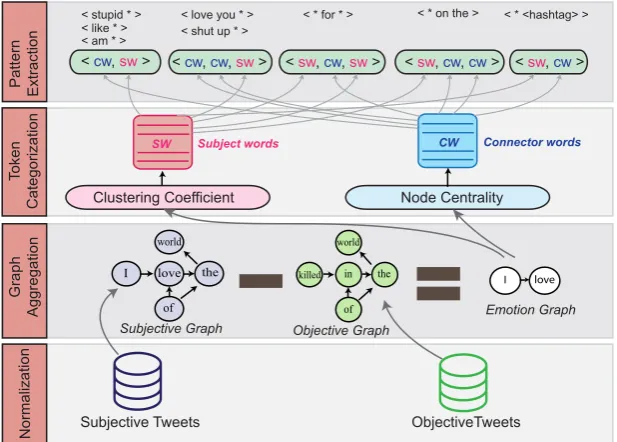
Step 1 (Normalization): First, we collected two separate datasets using the Twitter API: subjective tweetsS (obtained through hashtags as weak la-bels) and objective tweetsO(obtained from Twit-ter feeds of news accounts).1 Both datasets are tokenized by white-spaces and then preprocessed by applying lower case and replacing user men-tions and URLs with a<usermention>and<url>
1Each dataset contains 2+ million tweets.Swas collected
Subjective Tweets ObjectiveTweets
Normalization
killed the
of in
world
of world
the I love
of
I love
Graph
Aggregation
Token
Categorization
Subjective Graph Objective Graph
Emotion Graph
Node Centrality Clustering Coefficient
Subject words Connector words
Pattern Extraction
SW CW
< cw, sw > < cw, cw, sw > < sw, cw, sw > < sw, cw, cw > < sw, cw >
< stupid * > < like * > < am * >
< love you * >
< shut up * > < * for * >
[image:3.595.145.454.67.288.2]< * on the > < * <hashtag> >
Figure 1: An overview of the important steps used to generate graph-based pattern representations.
placeholder, respectively. Hashtags are used as ground-truth in this work, so to avoid any bias we replace them with a<hashtag>placeholder.
Step 2 (Graph Construction): Given the nor-malized objective tweetsO and subjective tweets S, two graphs are constructed: objective graph Go(Vo;Ao) and subjective graph Gs(Vs;As),
re-spectively. Vertices V is a set of nodes which represent the tokens extracted from the corpus. Edges, denoted asA, represent the relationship of words extracted using a window approach. These steps help to preserve the syntactic structure of the data. Given a post “<usermention>last night’s
concert was just awesome !!!!! <hashtag>”,
the resulting arcs are: “<usermention>→ last”, “last→night”, ... , “!!!!!→<hashtag>”.
Step 3 (Graph Aggregation):In this step we ob-tain a set of arcs that represent syntactic structures more common in subjective content. By adjusting graphGswithGo, we obtain a graphGe, referred
to as theemotion graph, which preserves emotion-relevant tokens and is obtained in two steps:
(1). For an arcai ∈ A, its normalized weight
can be computed as shown in Equation1.
w(ai) =
f req(ai)
maxj∈Af req(aj)
(1)
wheref req(ai)is the frequency of arcai.
(2). Subsequently, new weights for arcs ai ∈ Geare assigned based on a pairwise adjustment as
shown in Equation2.
w(ai) =
(
w(asi)−w(aoj), ifaoj =asi ∈Go
w(asi), otherwise
(2) The resulting weights belonging to graph Ge
were adjusted so that the most frequently occur-ring arcs in objective setGoare weakened inGe.
As a result, arcs in Ge that have higher weights
represent tokens that are more common in subjec-tive content. Furthermore, arcsai∈Aeare pruned
based on a thresholdφw2.
Step 4 (Token Categorization): Two different graph measurements are used to extract two fam-ily of words fromGe. These will function as the
building blocks to build contextualized patterns. We formalize this step as follows: Given an ad-jacency matrixM, an entryMi,jis computed as:
Mi,j =
(
1 if nodeiandjare linked inGe
0 otherwise
(3) Then, the eigenvector centrality and clustering coefficient of all vertices inVe are computed and
used to categorize tokens into two types:
(1) Connector Words: To measure the influ-ence of all nodes in graphGe, we utilize
eigenvec-2φ
tor centrality, which is calculated as:
ci=
1
λ
X
j∈Ve
Mi,jcj (4)
whereλdenotes a proportionality factor andci
is the centrality score of nodei.
Givenλas the corresponding eigenvalue, Equa-tion4can be reformulated in vector notation form as Mc = λc, where c is an eigenvector of M. Given a selected eigenvectorc and the eigenvec-tor centrality score of node i, denoted as ci, the
final list of connector words, hereinafter referred to asCW, is obtained by retaining all tokens with ci > φeig 3. CW correspond to the set of nodes
that are very frequent and have high connectivity to high-rank nodes (e.g.,“or”,“and”, and“my”). (2)Subject Words: In contrast, subject words or topical words are usually clustered together, i.e., many subject words are interconnected by the same connector words. Therefore, a coefficient is assigned to all nodes inGeand is computed as:
cli =
P
j6=i;k6=j;k6=iMi,j×Mi,k×Mj,k
P
j6=i;k6=j;k6=iMi,j×Mi,k
× 1 |Ve|
(5) whereclidenotes the average clustering
coeffi-cient of nodeiwhich captures the amount of inter-connectivity among neighbours of nodei. Similar to the connector words, the subject words, here-inafter referred to asSW, are obtained by retain-ing all the tokens with cli > φcl 4. Examples of
subjects words obtained are:“never”and“life”. The subject words represent psychological ori-ented words similar to the LIWC affect lexi-con (Pennebaker et al., 2007), while connector words reflect the set of most common words in the subjective tweets (e.g., pronouns, auxiliary verbs, and conjunctions). As presented by Chung and Pennebaker (2007), both connector words and subject words are important for conveying emo-tion. Influenced by their work, we aim to cap-ture intricate relationships – through the graph – between these two families of words. The graph structure helps to preserve syntax and can auto-matically be used to surface emotion-relevant in-formation.
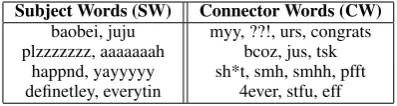
One of the advantages of using graphs to repre-sent syntactic relationships is that rare and impor-tant words are also surfaced. As shown in Table1,
3
φeigis an experimentally determined threshold.
4φ
clis an experimentally defined threshold.
Subject Words (SW) Connector Words (CW)
baobei, juju myy, ??!, urs, congrats plzzzzzzz, aaaaaaah bcoz, jus, tsk
[image:4.595.317.516.62.115.2]happnd, yayyyyy sh*t, smh, smhh, pfft definetley, everytin 4ever, stfu, eff
Table 1: Examples of subject words and connector words automatically extracted from the emotion graphGe.
informal words and misspellings, such as
“de-finetley”, “happnd”, were surfaced. Words
con-taining character repetitions help to express emo-tion intensity (e.g.,“plzzzzzzz”,“aaaaaaah”, and
“yayyyyy”). Interestingly, emotion-related coded
words are also captured (e.g., “juju”, “sh*t”,
“4ever”, and “baobei”5). All these examples
show the benefit of using graph methods to cap-ture emotion-relevant linguistic information.
Step 5 (Pattern Candidates): Given SW and CW, we bootstrap candidate patterns, which are more prevalent in opinionated content, while pre-serving syntactic structure. We provide the tem-plates used to define the candidate patterns in Ta-ble2. (sw andcw represent arbitrary tokens ob-tained from the setsSW andCW, respectively). It is important to clarify that sequences of size two and three were used in this work since this setting experimentally produced the best results.
Step 6 (Basic Pattern Extraction): A naive pat-tern extraction process consists of applying the syntactic templates to a datasetSp6 in an
exhaus-tive manner. In addition, the sw component in each pattern is replaced with a “*” placeholder. This operation allows for unknown subject words, not present in our training corpus, to be considered when constructing features. This can enable many useful applications, such as applying the patterns to other domains. We are interested in patterns that are highly associated with subjectivity, so pat-terns frequently occurring above a threshold are kept and the rest are filtered out. In Table2, we provide examples of the type of basic patterns ex-tracted along with their corresponding templates.
3.1 Enriched Patterns
As they stand, the patterns constructed in the pre-vious step contain limited information relevant to emotion classification. Therefore, the patterns are enriched using continuous word representations so as to preserve semantic relationship between
pat-5
baobeiis a Chinese word used to show strong affection. 6DatasetS
p(size=2+ mil.) is separately collected using
Templates Pattern Examples
< cw, sw > stupid * , like *, am * < cw, cw, sw > love you *, shut up * < sw, cw, sw > * for * < sw, cw, cw > * on the
[image:5.595.100.266.63.126.2]< sw, cw > *<hashtag>
Table 2: Examples of patterns and templates extracted through the basic pattern extraction mechanism.
terns. The motivation behind this step is to focus on patterns that may be more useful for an emo-tion classificaemo-tion task. Alternatively, the whole universe of patterns can also be used, but we show in the experiments that the former method signifi-cantly improves emotion recognition results.
Pre-trained Word Embeddings: First, we ob-tain Twitter-based, pre-trained word embeddings from (Deriu et al., 2017) and reweight them via a sentiment corpus through distant supervi-sion (Read, 2005;Go et al., 2009).7 We trained a fully connected neural network (1 hidden layer) with 10 epochs via backpropagation as in (Deriu
et al.,2017). The embeddings size isd= 52. Note
that term frequency-inverse document frequency
(tf-idf) was used to reduce the vocabulary of words
(from 140K to 20K words).
Word Clusters: We then apply agglomerative clustering to generate clusters of semantically re-lated words through their word embedding
in-formation. To determine the quality of the
clusters, they are compared with WordNet-Affect synsets (Strapparava et al., 2004) and tested for
both homogeneity and completeness. We use
Ward’s method(Ward Jr,1963) as the linkage
cri-terion andcosine distanceas the distance metric. The scikit-learn package (Pedregosa et al.,2011) was used to compute a total ofk= 1500clusters.
Enriched-Pattern Construction:The purpose of the word clusters is to enrich the patterns by pre-serving the semantic relationship between them, which is useful for classification purposes. We achieve this by revising the universe of patterns obtained from the basic pattern extraction step, and check to see if the words represented by the swcomponent exist in any of the word embedding clusters. This is done in an exhaustive manner, en-suring that all possible patterns in the datasetSp
are processed to meet the criteria. Furthermore, patterns that appear< 10times in datasetSp are
filtered out, producing a total of 476,174 patterns.
7We collected approximately 10 million tweets via
senti-ment emoticons (5+ mil. negative and 5+ mil. positive).
The resultingenriched patterns8now contain both the semantic information provided by the word embeddings and the contextual information pro-vided through the graph components, hence the
termcontextualized affect representations.
3.2 Emotion Pattern Weighting
Before using the patterns for classification, they need to be weighted using a weighting mechanism such astf-idf (Leskovec et al.,2014). The weights determine the importance of patterns to each emo-tion category. The proposed pattern weighting scheme used in this work is a customized version
oftf-idf, coined aspattern frequency-inverse
emo-tion frequency(pf-ief), and is defined in two steps. Firstly, we compute forpf as:
pfp,e= log
P
pi∈Pe
f req(pi, e)
+ 1
f req(p, e) + 1 (6)
wheref req(p, e)represents the frequency ofp ine, andpfp,edenotes the logarithmically scaled
frequency of a pattern p in a collection of texts related to emotione.
Then we compute forief as:
iefp = log
f req(p, e) + 1
P
ej∈E
f req(p, ej)
+ 1 (7)
where the inverse emotion frequencyiefp is a
measure of the relevance of pattern p across all emotion categories.
Finally, we obtain a pattern score calculated as:
psp,e=pfp,e×iefp (8)
wherepsp,eis the final score that reflects how
im-portant a patternpis to an emotion classe.
4 Models
In this section, we present the emotion recogni-tion models and comparison models used to evalu-ate the contextualized affect representations. More details are provided in Appendix A.
CARER: The proposed framework combines a multi-layer CNN architecture with a matrix form of the enriched patterns. The input X ∈ Rn×m
denotes an embedding matrix where entry Xi,j
represents the pattern score of enriched pattern i in emotion j. 9 X is fed into two 1-D convolu-tional layers with filters of sizes 3 and 16. The output of this process is passed through a ReLU activation function (Nair and Hinton, 2010) that produces a feature map matrix. A 1-max pool-ing layer (Boureau et al., 2010) of size 3 is then applied to each feature map. The results of the pooling are fed into two hidden layers of dimen-sions 512 and 128 in that order, each applied a dropout (Hinton et al.,2012) of0.5for regulariza-tion. We chose a batch size of128and trained for 4epochs using Adam optimizer (Kingma and Ba, 2014). A softmax function is used to generate the final classifications. We use Keras (Chollet et al., 2015) to implement the CNN architecture.
Baseline Model: As baseline, we present a first-generation model(CARERβ)that employs
prim-itiveenriched patterns‡10. We adopt the CNN ar-chitecture used forCARER, however, this model differs in that the set of patterns used is signifi-cantly smaller as compared to the original size of the enriched patterns. The reason is because a dif-ferent set ofprimitive pattern templateswas used, which captured fewer patterns (187,648). This shows that the proposed method offers flexibility in terms of what templates to use and what size of patterns to generate. This could be useful in cases where there are limited computing and data resources, and for incorporating domain expertise.
Traditional Models: We also compare with var-ious traditional methods (bag of words (BoW), character-level (char), n-grams, and TF-IDF) which are commonly used in sentence classifi-cation. To train the models we use the default stochastic gradient descent (SGD) classifier pro-vided by scikit-learn (Pedregosa et al.,2011).
Deep Learning Models: Among the works that employ deep learning models for emotion recog-nition, they vary by the choice of input:
pre-trained word/character embeddings and
end-to-end learned word/character representations. Our
work differs in that we utilize enriched graph-based representations as input. We compare with convolutional neural networks (CNNs), recurrent neural networks (RNNs), bidirectional gated re-current neural networks (BiGRNNs), and word embeddings (word2vec) (Mikolov et al.,2013).
9
We use a zero-padding strategy as in (Kim,2014). 10‡hereinafter refers to the primitive enriched patterns.
Emotions Amount Hashtags
sadness 214,454 #depressed, #grief
joy 167,027 #fun, #joy
fear 102,460 #fear, #worried
anger 102,289 #mad, #pissed
surprise 46,101 #strange, #surprise
trust 19,222 #hope, #secure
disgust 8,934 #awful, #eww
[image:6.595.333.504.61.171.2]anticipation 3,975 #pumped, #ready
Table 3: Data statistics.
5 Experiments
5.1 Data
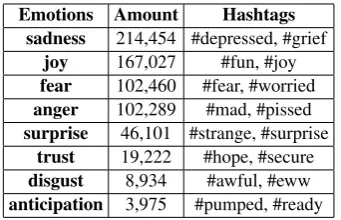
We construct a set of hashtags to collect a sep-arate dataset of English tweets from the Twitter API. Specifically, we use the eight basic emotions: anger, anticipation, disgust, fear, joy, sadness,
surprise, andtrust. The hashtags (339 total) serve
as noisy labels, which allow annotation via distant supervision as in (Go et al.,2009). To ensure data quality, we follow the pre-processing steps pro-posed by (Abdul-Mageed and Ungar,2017), and considered the hashtag appearing in the last po-sition of a tweet as the ground truth. We split the data into training (90%) and testing (10%) datasets. The final distribution of the data and a list of hashtag examples for each emotion are provided in Table 3. In the following section we evaluate the effectiveness of the enriched patterns on several emotion recognition tasks. We use
F1-scoreas the evaluation metric, which is commonly
used in emotion recognition studies due to the im-balanced nature of the emotion datasets.
5.2 Experimental Results
Traditional Features: As shown in Table 4,
TF-IDFmodels produce better results than basic count-based features for both character-level and word-level feature extractors. These findings are consistent with the work of Zhang et al., (2015), where traditional methods, such asn-gram, were found to perform comparable to deep neural net-works on various sentence classification tasks.
Pattern-based Approaches: The results of
CNNBASIC11, which employs the basic
graph-based patternsproposed inStep 6, perform worse
than most of the conventional approaches. Both
CARERβ andCARER, which use the enriched
patterns, acquire better results than CNNBASIC
and all the other conventional approaches. In fact, our method obtains the best F1-score on all eight emotions. We observed that there are significant gains in performance (↑27% and↑12%) when us-ing the enriched patterns as compared to the ba-sic patterns and primitive patterns‡, respectively. This highlights the importance of the pattern en-richment procedure and the benefit of refining the pattern templates. Note that the baseline model,
CARERβ, also performs better than all other the
comparison models including the state-of-the-art methods (DeepMojiandEmoNet).
Comparison to state-of-the-art: Felbo et al., (2017) proposed a state-of-the-art emotion prediction model, DeepMoji, trained on billions of emoji-labeled tweets. We obtained their pre-trained model12 and applied it to our dataset. As shown in Table 4, their model performs as well as other traditional methods. However, our model (CARER) significantly outperforms theirs (↑20%). Moreover, we re-implemented the GRNN model proposed in (Abdul-Mageed and Ungar, 2017). We also outperform their model (EmoNet) which manually trains word embeddings, similar to DeepMoji. The CNNw2v model uses word embeddings trained on billions of tweets (Deriu
et al., 2017), thus it performs better than all the
other approaches, and closer to ours.
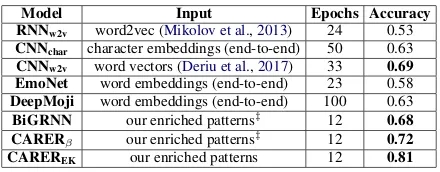
Results with Deep Learning: We offer more comparison with other various deep learning mod-els as evaluated on Ekman’s six basic emotions (i.e., sadness, disgust, anger, joy, surprise, and fear). For theRNNw2vandCNNchar models, dif-ferent inputs are used, as shown in Table 5. We feed the enriched patterns as embeddings to a bidi-rectional GRNN, which along with CAREREK andCARERβoutperform all the other methods. Contextualized Approaches: DeepMojiis built on a stack of Bi-LSTM layers and performs much better with six emotion classes. However, using the enriched patterns as input, CAREREK13 per-forms the best (81%). Note that the number of epochs used to train our models is much lower as compared to the other methods, which pro-vides a strong case of the benefit of contextualiz-ing features prior to traincontextualiz-ing the models. More-over, the important distinction between
connec-tor words and subject words helps to refine and
surface relevant contextual information. We also
12
Model obtained from github.com/bfelbo/deepmoji 13The proposed model trained on six emotions dataset.
69
60
66
53
62 76
68
73
63
70
40 45 50 55 60 65 70 75 80
anger joy sadness surprise F1 Avg.
fastText CARER
[image:7.595.309.523.63.193.2]ch ch
Figure 2: Comparison against Chinese word vectors.
show that the enriched patterns can be applied to other deep learning models besides CNN, such as
BiGRNN, which leaves an opportunity to explore more complex architectures and fusion models in the future. More importantly, for problems that re-quire deeper understanding of contextualized in-formation, there is a need to go beyond traditional features and distributed representations.
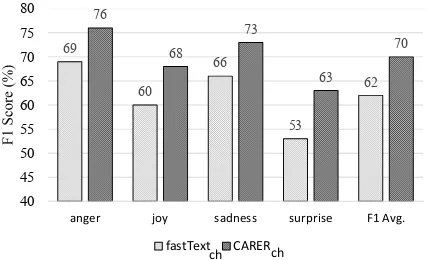
Multilingual Capabilities: We also tested the effectiveness of the proposed feature extraction algorithm for the Chinese language. We col-lected Traditional Chinese datasets14from several of Facebook’s fan pages and applied the same pro-cedures as were done for the English datasets. User comments are considered as documents and the associated user reaction to the root post repre-sents the emotion labels. For comparison, we ob-tained Chinese pre-trained word vectors computed through (Bojanowski et al., 2017), and trained a model (fastTextch) using the proposed CNN ar-chitecture. For our approach (CARERch), we ap-plied the same CNN architecture on the Chinese-based enriched patterns. As shown in Figure 2, our model performs significantly better on all four emotions (average F1 score of 70%). Overall, we show that the approach is not restricted to any spe-cific language and that the enriched features are applicable to other languages and data sources. In the future, we seek to expand our methods to sup-port other complex languages, such as Japanese, French, and Spanish, where there tends to exist fewer linguistic resources.
6 Analysis of Enriched Patterns
6.1 Pattern Coverage and Consistency
One of the advantages of the contextualized en-riched patterns is that they possess high coverage
Models Features anger anticipation disgust fear joy sadness surprise trust F1 Avg.
BoW word frequency 0.53 0.08 0.17 0.53 0.71 0.60 0.36 0.33 0.57
BoWTF-IDF TF-IDF 0.55 0.09 0.18 0.57 0.73 0.62 0.39 0.35 0.60
n-gram word frequency 0.56 0.09 0.17 0.57 0.73 0.64 0.42 0.39 0.61
n-gramTF-IDF TF-IDF 0.58 0.12 0.17 0.60 0.75 0.67 0.47 0.45 0.63
char ngram character frequency 0.49 0.06 0.12 0.46 0.67 0.55 0.30 0.28 0.52
char ngramTF-IDF TF-IDF 0.53 0.07 0.15 0.53 0.71 0.59 0.35 0.31 0.57
LIWC affective words 0.35 0.03 0.11 0.30 0.49 0.35 0.18 0.19 0.35
CNNw2v word embeddings 0.57 0.10 0.15 0.63 0.75 0.64 0.61 0.70 0.65
EmoNet word embeddings 0.36 0.00 0.00 0.46 0.69 0.61 0.13 0.25 0.52
DeepMoji word embeddings 0.60 0.00 0.03 0.49 0.75 0.67 0.20 0.27 0.59
CNNBASIC basic patterns 0.65 0.10 0.22 0.64 0.73 0.56 0.15 0.08 0.52
CARERβ enriched patterns‡ 0.61 0.31 0.34 0.67 0.75 0.68 0.60 0.55 0.67
[image:8.595.75.522.61.207.2]CARER enriched patterns 0.74 0.41 0.43 0.79 0.83 0.82 0.76 0.75 0.79
Table 4: Comparison of our model against various emotion recognition systems:LIWCuses a bag of words approach;CNNw2v
is the proposed CNN model and word vectors obtained from (Deriu et al.,2017);charrefers to character-level features; n-gramemploy unigrams, bigrams, and trigrams as features;CNNBASICuses the proposed CNN architecture with basic patterns; EmoNet(Abdul-Mageed and Ungar,2017) andDeepMoji(Felbo et al.,2017) are state-of-the-art emotion recognition models.
1 87648 150 119
1 31354 938 25
5 6296 18766
938 4
139 7 1117
9 77 698
419 139
6 9
300 0000 24000 00
210000 0 1500 000
900000 30000 0
150 000
1 859184 14873 47
130 1428 92 9592
557755
18 5918 92959
20 30 40 50 60 70 80
0% 10% 20% 30% 40% 50% 60% 70% 80% 90% 100%
Ac
cu
ra
cy
(
%
)
Feature Percentage
[image:8.595.143.454.273.412.2]Patterns LIWC word2vec tweet2vec
Figure 3: Consistency check for various affect resources.
Model Input Epochs Accuracy
RNNw2v word2vec (Mikolov et al.,2013) 24 0.53 CNNchar character embeddings (end-to-end) 50 0.63 CNNw2v word vectors (Deriu et al.,2017) 33 0.69 EmoNet word embeddings (end-to-end) 23 0.58 DeepMoji word embeddings (end-to-end) 100 0.63
BiGRNN our enriched patterns‡ 12 0.68
CARERβ our enriched patterns‡ 12 0.72
CAREREK our enriched patterns 12 0.81
Table 5: Comparison of our method against deep learning models, using Ekman’s 6 emotions and the accuracy metric.
due to the way they were constructed. High cov-erage also means that the enriched patterns should demonstrate stability, in terms of how useful they are in an emotion classification task, even when re-duced to smaller sizes. There are two cases where this could be useful:limited dataandlimited
com-puting resources. Therefore, to test for pattern
consistency, we randomly selected several pattern sizes15 and trained a random forest classifier us-ing the eight emotions dataset. This model per-forms comparable toCARERβ(average F1-score
of 65%), and it has the benefit of faster training
15We employed the primitive patterns‡
used in CARERβ.
time, making it suitable for the aforementioned ex-periment. We compared with the results obtained from theLIWC lexicon (affect dimension) (
Pen-nebaker et al., 2007), word2vec(Mikolov et al.,
2013), andtweet2vec(Deriu et al.,2017).16 As shown in Figure3, due to the limited cover-age of theLIWClexicon, such resources may not be feasible on evolving, large-scale datasets. In contrast,word2veccontains over 3 million unique word embeddings and has been proven effective for text classification. However, if we keep reduc-ing the available word vectors ofword2vec, which is common when there are limited computing re-sources, the accuracy keeps dropping at significant rates.tweet2vec has a similar effect. In the case of our patterns, the classification results remain rela-tively stable, even when reducing the patterns to 30% and 10% of the original size. These results show that the proposed features are feasible to ad-dress the text-based emotion recognition problem. Moreover, the patterns are highly beneficial where
16Models were trained using the random forest
[image:8.595.73.293.449.535.2]Document GT DeepMoji EmoNet CAREREK Enriched Patterns Short text damn what anight joy surprise sadness joy what a{day,rush,pass}
wantit to snow joy sadness fear joy {need,hoping}it
Rare words whaaaaaat. i did not
ex-pect that at all
surprise sadness fear surprise {wondering,what}i
Mixed emotions
gottheeworst sleep ever anger sadness sadness anger got{madd,thatt,bacc}
[image:9.595.70.528.62.135.2]what the fuck isgoingon !? fear anger sadness fear is{ends,finishes}
Table 6: Classified documents in the testing data. Words inbold bluecorrespond to theswcomponent of one of the enriched patterns extracted from the document. Words initalic greenrepresent other relevant word examples found in the clustersw belongs to. Words inbold pinkdenote the connector word/scwin the pattern; E.g.,“it”iscwof patterns “need it”and “hoping it”.GTstands for ground truth.DeepMoji,EmoNet, andCAREREKcorrespond to the models reported in Table5.
there is shortage of computing and linguistic re-sources.
6.2 What’s captured by CARER?
In Table6, we provide samples extracted from the testing data. The examples show different cases where the comparison models struggled to cap-ture important contextual information that helps to determine the emotion conveyed in the text. For instance, in the short text, “damn what a night”, only our model was able to interpret the statement asjoybecause it uses the“what a”pattern and its corresponding subject words to determine that this statement has a stronger association withjoy. Our model also works well for capturing rare words and fordisambiguatingemotional meaning using the enriched and refined contextual information of the patterns. Rare words like “whaaaaaat” and
“thee”help to implicitly convey intense emotional
expressions, which are also captured and consid-ered important by our enriched patterns. Emotion-relevant verbs, such as “want” and “going” are also considered important context that help to con-vey and interpret emotion. Overall, the enriched patterns efficiently capture important emotional information that other models seem to ignore.
7 Conclusion
We proposed a graph-based feature extraction mechanism to extract emotion-relevant represen-tations in an unsupervised manner. The con-textualized affect representations are further en-riched with word embeddings and are used to train several deep learning-based emotion recognition models. The patterns capture implicit and ex-plicit linguistic emotional information which sig-nificantly improves emotion recognition results.
We offered a detailed analysis demonstrating special cases where the patterns are helpful to fur-ther extract and understand emotional information from textual information. For instance, short text
is a challenging problem in emotion recognition and various natural language tasks; the proposed contextualized patterns show promising results in addressing this issue by helping the models to cap-ture nuanced information which is useful to de-termine the overall emotion expressed in a piece of text. The proposed method paves the way for building more interpretable emotion recognition systems which have various implications when in-vestigating human behavioural data (Saravia et al.,
2015, 2016b; Chang et al., 2016) and building
empathy-aware conversational agents.
In the future work, we aim to investigate the graph-based patterns more in-depth and provide a more comprehensive and advanced theoretical dis-cussion of how they are constructed. We also hope to keep improving the pattern weighting mecha-nism so as to improve the overall performance on emotion recognition tasks and minimize trade-off between pattern coverage and performance. We plan to employ transfer learning methods with the proposed enriched patterns and test on other emotion-related problems such as sentiment clas-sification and sarcasm detection. The proposed methodology is also being expanded to support Spanish and Japanese emotion recognition tasks.
Acknowledgements
This research was supported by the Ministry of Science and Technology (#106-2221-E-007-115-MY2 and #106-3114-E-007-013).
References
Muhammad Abdul-Mageed and Lyle Ungar. 2017. Emonet: Fine-grained emotion detection with gated recurrent neural networks. InProc. of ACL.
John Blitzer, Mark Dredze, and Fernando Pereira. 2007. Biographies, bollywood, boom-boxes and blenders: Domain adaptation for sentiment classi-fication. InProc. of ACL.
Piotr Bojanowski, Edouard Grave, Armand Joulin, and Tomas Mikolov. 2017. Enriching word vectors with subword information. Transactions of the Associa-tion for ComputaAssocia-tional Linguistics.
Y-Lan Boureau, Jean Ponce, and Yann LeCun. 2010. A theoretical analysis of feature pooling in visual recognition. InProc. of ICML.
Chun-Hao Chang, Elvis Saravia, and Yi-Shin Chen. 2016. Subconscious crowdsourcing: A feasible data collection mechanism for mental disorder detection on social media. In Advances in Social Networks Analysis and Mining (ASONAM), 2016 IEEE/ACM International Conference on, pages 374–379. IEEE.
Franc¸ois Chollet et al. 2015. Keras. https://
github.com/keras-team/keras.
Cindy Chung and James Pennebaker. 2007. The psy-chological functions of function words. Social com-munication, 1:343–359.
Jan Deriu, Aurelien Lucchi, Valeria De Luca, Aliak-sei Severyn, Simon M¨uller, Mark Cieliebak, Thomas Hofmann, and Martin Jaggi. 2017. Leveraging large amounts of weakly supervised data for multi-language sentiment classification. In Proc. of ICWSM.
Paul Ekman. 1992. An argument for basic emotions.
Cognition & emotion, 6(3-4):169–200.
Bjarke Felbo, Alan Mislove, Anders Søgaard, Iyad Rahwan, and Sune Lehmann. 2017. Using millions of emoji occurrences to learn any-domain represen-tations for detecting sentiment, emotion and sar-casm. InProc of EMNLP.
Alec Go, Richa Bhayani, and Lei Huang. 2009. Twit-ter sentiment classification using distant supervision.
CS224N Project Report, Stanford, 1(2009):12.
Roberto Gonz´alez-Ib´anez, Smaranda Muresan, and Nina Wacholder. 2011. Identifying sarcasm in twit-ter: a closer look. InProc. of ACL.
Geoffrey Hinton, Nitish Srivastava, Alex Krizhevsky, Ilya Sutskever, and Ruslan Salakhutdinov. 2012. Improving neural networks by preventing co-adaptation of feature detectors. arXiv preprint arXiv:1207.0580.
Yoon Kim. 2014. Convolutional neural networks for sentence classification. InProc. of EMNLP.
Diederik Kingma and Jimmy Ba. 2014. Adam: A
method for stochastic optimization. arXiv preprint arXiv:1412.6980.
Jure Leskovec, Anand Rajaraman, and Jeffrey David Ullman. 2014. Mining of massive datasets. Cam-bridge university press.
Tomas Mikolov, Kai Chen, Greg Corrado, and Jef-frey Dean. 2013. Efficient estimation of word representations in vector space. arXiv preprint arXiv:1301.3781.
Saif M Mohammad. 2012. Emotional tweets. InProc. of ACL.
Saif M Mohammad and Svetlana Kiritchenko. 2015. Using hashtags to capture fine emotion cate-gories from tweets. Computational Intelligence, 31(2):301–326.
Vinod Nair and Geoffrey Hinton. 2010. Rectified lin-ear units improve restricted boltzmann machines. In
Proc. of ICML.
Febian Pedregosa, Gal Varoquaux, Alexandre Gram-fort, Vincent Michel, Bertrand Thirion, Olivier Grisel, Mathieu Blondel, et al. 2011. Scikit-learn: Machine learning in Python. Journal of Machine Learning Research, 12:2825–2830.
James Pennebaker, Roger Booth, and Martha Francis. 2007. Linguistic inquiry and word count: Liwc [computer software]. Austin, TX: liwc. net.
Robert Plutchik. 2001. The nature of emotions hu-man emotions have deep evolutionary roots, a fact that may explain their complexity and provide tools for clinical practice.American Scientist, 89(4):344– 350.
Soujanya Poria, Iti Chaturvedi, Erik Cambria, and Amir Hussain. 2016. Convolutional mkl based mul-timodal emotion recognition and sentiment analysis. InProc. of ICDM.
Ashequl Qadir and Ellen Riloff. 2013. Bootstrapped learning of emotion hashtags# hashtags4you. In
Proc. of Computational Approaches to Subjectivity, Sentiment and Social Media Analysis.
Jonathon Read. 2005. Using emoticons to reduce de-pendency in machine learning techniques for senti-ment classification. InProc. of ACL.
Kirk Roberts, Michael Roach, Joseph Johnson, Josh Guthrie, and Sanda Harabagiu. 2012. Empatweet: Annotating and detecting emotions on twitter. In
Proc. of LREC.
Sara Rosenthal, Noura Farra, and Preslav Nakov. 2017. SemEval-2017 task 4: Sentiment analysis in Twitter. In Proceedings of the 11th International Workshop on Semantic Evaluation, SemEval ’17, Vancouver, Canada. Association for Computational Linguistics.
Elvis Saravia, Carlos Argueta, and Yi-Shin Chen. 2015. Emoviz: Mining the world’s interest through emo-tion analysis. InAdvances in Social Networks Anal-ysis and Mining (ASONAM), 2015 IEEE/ACM Inter-national Conference on, pages 753–756. IEEE.
Elvis Saravia, Carlos Argueta, and Yi-Shin Chen. 2016a. Unsupervised graph-based pattern extraction for multilingual emotion classification. Social Net-work Analysis and Mining, 6(1):92.
Elvis Saravia, Chun-Hao Chang, Renaud Jollet De Lorenzo, and Yi-Shin Chen. 2016b. Midas: Mental illness detection and analysis via social me-dia. In Advances in Social Networks Analysis and Mining (ASONAM), 2016 IEEE/ACM International Conference on, pages 1418–1421. IEEE.
Julio Savigny and Ayu Purwarianti. 2017. Emotion classification on youtube comments using word em-bedding. InProc. of ICAICTA.
Valentina Sintsova, Claudiu-Cristian Musat, and Pearl Pu. 2013. Fine-grained emotion recognition in olympic tweets based on human computation. In4th Workshop on Computational Approaches to Subjec-tivity, Sentiment and Social Media Analysis.
Carlo Strapparava, Alessandro Valitutti, et al. 2004. Wordnet affect: an affective extension of wordnet. InProc. of LREC.
Jared Suttles and Nancy Ide. 2013. Distant supervision for emotion classification with discrete binary val-ues. InInternational Conference on Intelligent Text Processing and Computational Linguistics.
Svitlana Volkova and Yoram Bachrach. 2016. Inferring perceived demographics from user emotional tone and user-environment emotional contrast. InProc. of ACL.
Svitlana Volkova, Theresa Wilson, and David
Yarowsky. 2013. Exploring sentiment in social media: Bootstrapping subjectivity clues from multilingual twitter streams. InProc. of ACL.
Wenbo Wang, Lu Chen, Krishnaprasad Thirunarayan, and Amit P Sheth. 2012. Harnessing twitter” big data” for automatic emotion identification. InProc. of SocialCom.
Joe Ward Jr. 1963. Hierarchical grouping to optimize an objective function. Journal of the American Sta-tistical Association.