warwick.ac.uk/lib-publications
Original citation:Liu, Hsu, Hartstein, Máté, Wallace, Gregory J, Davies, Alexander J, Ciomaga Hatnean, Monica, Johannes, Michelle D, Shitsevalova, Natalya, Balakrishnan, Geetha and Sebastian, Suchitra E (2018) Fermi surfaces in Kondo insulators. Journal of Physics: Condensed Matter, 30 (16). 16LT01. doi:10.1088/1361-648X/aaa522
Permanent WRAP URL:
http://wrap.warwick.ac.uk/101666
Copyright and reuse:
The Warwick Research Archive Portal (WRAP) makes this work by researchers of the University of Warwick available open access under the following conditions. Copyright © and all moral rights to the version of the paper presented here belong to the individual author(s) and/or other copyright owners. To the extent reasonable and practicable the material made available in WRAP has been checked for eligibility before being made available.
Copies of full items can be used for personal research or study, educational, or not-for-profit purposes without prior permission or charge. Provided that the authors, title and full
bibliographic details are credited, a hyperlink and/or URL is given for the original metadata page and the content is not changed in any way.
Publisher’s statement:
“This is an author-created, un-copyedited version of an article accepted for publication in: Journal of Physics: Condensed Matter. The publisher is not responsible for any errors or omissions in this version of the manuscript or any version derived from it. The Version of Record is available online at http://dx.doi.org/10.1088/1361-648X/aaa522”
A note on versions:
The version presented here may differ from the published version or, version of record, if you wish to cite this item you are advised to consult the publisher’s version. Please see the ‘permanent WRAP URL’ above for details on accessing the published version and note that access may require a subscription.
Hsu Liu,1∗ M´at´e Hartstein,1∗Gregory J. Wallace,1Alexander J. Davies,1
Monica Ciomaga Hatnean2, Michelle D. Johannes3, Natalya Shitsevalova4,
Geetha Balakrishnan2 and Suchitra E. Sebastian1
1Cavendish Laboratory, Cambridge University, JJ Thomson Avenue, Cambridge CB3 0HE, UK, 2Department of Physics, University of Warwick, Coventry CV4 7AL, UK,
3Center for Computational Materials Science, Naval Research Laboratory, Washington, DC
20375, USA,
4The National Academy of Sciences of Ukraine, Kiev 03680, Ukraine.
∗These authors contributed equally to this work.
E-mail:[email protected]
5 March 2018
Abstract. We report magnetic quantum oscillations measured using torque magnetisation in the Kondo insulator YbB12 and discuss the potential origin of the underlying Fermi surface.
Observed quantum oscillations as well as complementary quantities such as a finite linear specific heat capacity in YbB12 exhibit similarities with the Kondo insulator SmB6, yet also
crucial differences. Small heavy Fermi sections are observed in YbB12 with similarities to
the neighbouring heavy fermion semimetallic Fermi surface, in contrast to large light Fermi surface sections in SmB6which are more similar to the conduction electron Fermi surface. A
rich spectrum of theoretical models is suggested to explain the origin across different Kondo insulating families of a bulk Fermi surface potentially from novel itinerant quasiparticles that couple to magnetic fields, yet do not couple to weak DC electric fields.
Introduction
Evidence for a bulk Fermi surface in the Kondo insulator SmB6has been observed from a variety
of experimental techniques, spanning quantum oscillations in the torque magnetisation [1, 2, 3], finite linear specific heat [1, 2, 4, 5], oscillatory magnetic entropy [2], and magnetic field enhanced thermal conductivity [2, 6]. A remarkable possibility is that the existence of a Fermi surface is more universal to correlated insulators. The observation of a Fermi surface in multiple families of correlated insulators would support a new paradigm that is distinct from the traditional idea where Fermi surfaces are the preserve of Fermi liquids. Here, we experimentally explore the possibility of a bulk Fermi surface in the Kondo insulator YbB12, a material that is
closely related to SmB6 [7].
Kondo insulators are characterised by an energy gap arising from collective f
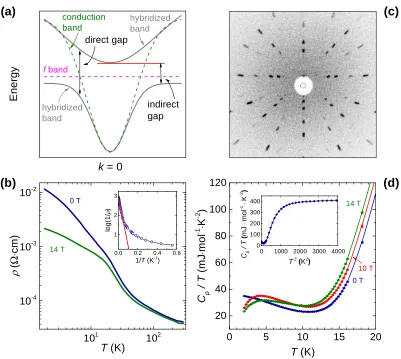
-electron-conduction electron hybridisation, as schematically shown in figure 1(a) [8]. In the case of the Kondo insulator YbB12, collective hybridisation occurs between the f-electron band and two
conduction electron bands (shown in figure 4(a)), leading to a complex hierarchy of gaps. A small indirect gap of size ≈ 5meV in YbB12, similar in size to that in SmB6, is determined
from electrical transport measurements (figures 1(a) and (b), [9, 10]), accompanied by a larger direct hybridisation gap of≈200meV (figure 1(a)) accessed by complementary measurements
such as optical spectroscopy [11] and tunneling spectroscopy [12]. Early observations of a finite linear term in the specific heat capacity (figure 1(d), [13]) and a finite density of states in tunneling experiments [10] led to broad debate about the Kondo insulating mechanism in these materials. In view of the itinerant low energy excitations revealed in the Kondo insulator SmB6 by quantum oscillation measurements [1, 2, 3], we revisit this question by searching for
quantum oscillations in the magnetic torque measured on single crystals of YbB12.
Methods
The growth of single phase YbB12 is challenging given its peritectic phase diagram and
decomposition into YbB66 beyond a very narrow temperature range, necessitating careful
control of temperature and composition during the growth process [14, 15]. Source YbB12
powder was prepared in polycrystalline form by borothermal reduction of a mixture of Yb2O3
(99.998 mass%purity) and amorphous B (99.9 mass%purity) at 1700◦C under vacuum [16].
The material was then isostatically pressed into a cylindrical rod and sintered at 1600◦C in argon
gas flow for several hours. Single crystal growth of YbB12 was carried out at the University
1 0 1 1 0 2 1 0 - 4
1 0 - 3 1 0 - 2
0 . 0 0 . 2 0 . 4 0 . 6
1
2
3
0 5 1 0 1 5 2 0
2 0 4 0 6 0 8 0 1 0 0
1 2 0 ( d )
( c )
( b )
( Ω ⋅ c m )
T ( K )
d i r e c t g a p
h y b r i d i z e d b a n d
i n d i r e c t g a p
E
n
e
rg
y
k = 0 f b a n d
c o n d u c t i o n b a n d
h y b r i d i z e d b a n d
( a )
lo g (1 / )
1 /T ( K - 1)
0 T
1 4 T
0 T
1 0 T
C p / T ( m J ⋅ m o l -1 ⋅ K -2 )
T ( K )
1 4 T
0 1 0 0 0 2 0 0 0 3 0 0 0 4 0 0 0
0
1 0 0 2 0 0 3 0 0 4 0 0
T 2 (K 2
[image:4.612.79.480.120.479.2]) Cp / T ( m J ⋅ m o l -1⋅ K -2)
Figure 1. (a) Schematic depiction of the gap formation in a Kondo insulator by collective hybridisation of thef-electron and conduction electron bands. (b) Measured electrical resistivity as a function of temperature in magnetic fields of 0 T and 14 T. The inset shows the exponential
fit 1/ρ ∝ exp (−2∆/kBT) to the electrical resistivity ρ in YbB12 at 0 T, where ∆ is the
activation gap. The indirect hybridisation bandgap is found to be≈ 5 meV. (c) X-ray Laue back reflection photograph of a crystal of YbB12(on which measured quantum oscillations are
shown in figure 2) along the [001] direction, showing single crystallinity. (d) Measured specific heat capacity divided by temperature of YbB12 at 0 T, 10 T, and 14 T. A finite linear specific
heat coefficient at low temperatures is seen, similar to that observed in SmB6[1, 2, 4, 5]. The
(Ar + 3%H2) at a growth rate of 18 mm/hr with the feed and seed rods counter-rotating at 20–
30 rpm. LuB12single crystals were prepared at the National Academy of Sciences of Ukraine,
Kiev by the inductive floating zone method as described in [16]. Laue x-ray imaging with a Multiwire Laue system was used to determine the quality of the grown crystal boules and to select and orient single crystal samples cut from the as-grown boule. Single crystals were selected that yielded high inverse electrical resistivity residual ratios (figure 1(b)) and well-defined spots in the Laue diffraction pattern, evidencing high single crystal quality (figure 1(c)). Elemental composition analysis was performed on selected single crystals using an FEI Philips XL30 sFEG scanning electron microscope (SEM) to reveal an atomic ratio between Yb and B closely comparable to the stoichiometric ratio of 1 : 12 and distinct from the ratios for YbB6
and for YbB66. Energy dispersive x-ray (EDX) microanalysis on multiple samples provided
comparable results to SEM. Rietveld refinement performed using the Bruker TOPAS software on powder x-ray diffraction data yielded a lattice constant of 7.4686(1) ˚A, agreeing well with published data for YbB12[16].
Torque magnetisation measurements were made on YbB12 and LuB12 in DC magnetic
fields at the University of Cambridge (up to 14 T) and at the National High Magnetic Field Laboratory (NHMFL) in Tallahassee (up to 45 T) using flexible T-shaped BeCu cantilevers of 20 or 50 µm thickness, with the narrow end anchored and the wide end floating above a fixed Cu film. Single crystals of dimensions approximately1×1×0.5 mm3 were mounted on the wide
end of the cantilever. The cantilever and the Cu film form the two plates of a capacitor whose capacitance is measured using a General Radio analogue capacitance bridge in conjunction with a Stanford Research Systems lock-in amplifier. The measured change in capacitance∆C
is proportional to the change in magnetic torque. Specific heat measurements were made using the standard heat capacity option for the Physical Property Measurement System (PPMS) from Quantum Design Inc (figure 1(d)).
Density functional theory Fermi surfaces were calculated with the Wien2k augmented plane wave plus local orbital (APW+lo) code [17]. The modified Becke-Johnson (mBJ) potential was used, which is a semi-local approximation to the exact exchange plus a screening term [18] and which improves the band gap in many semiconductor materials. Application of mBJ resulted in a non-magnetic ground state with an indirect band gap of 21 meV and a direct gap of 80 meV, whereas the standard Perdew Burke Ernzerhof (PBE) potential produced a semimetal with overlapping valence and conduction bands. Spin-orbit coupling was included via the second variational method and resulted in a strong reordering of the bands. Self-consistent calculations were converged using a k-mesh of 15× 15×15 followed by a
non-self-consistent calculation with a30×30×30mesh for calculation of Fermi surfaces. Extremal
Effective masses were obtained by shifting the Fermi energy up/down by 0.7 meV from its original value, obtaining the new cross-sections and then calculating the cyclotron effective mass using the resulting finite differences.
Quantum oscillations in YbB12
Figure 2(a) shows the magnetic torque measured on a single crystal of YbB12 as a function
of DC magnetic fields up to 45 T, from which a monotonic smooth background has been subtracted. Quantum oscillations periodic in inverse magnetic field are observed for magnetic field tilt angles θ spanning [001], [111] to [110] crystal directions, and extending down to
magnetic fields at least as low as 22 T. An example Fourier transform of quantum oscillations in inverse magnetic field shown in figure 2(c) reveals multiple quantum oscillation frequencies between 300 −1500 T. The quantum oscillation frequency >1 kT is seen most clearly in the
high magnetic field range (figure 2(c) inset). While this higher quantum oscillation frequency is close to a harmonic of lower frequency quantum oscillations, there is no obvious observation of frequencies corresponding to harmonics of dominant amplitude low frequency quantum oscillations. The temperature dependence of the measured quantum oscillation amplitude follows a Lifshitz-Kosevich (LK) form, yielding cyclotron effective masses ofm∗/me between
3 − 10 for the various measured quantum oscillation frequencies (figure 2(d), [19, 20]). Figure 2(b) shows the angular dependence of the measured quantum oscillation frequencies for magnetic field tilt angles spanning [001], [111] to [110] crystal directions, which reveals only a subtle variation in quantum oscillation frequency as a function of angle, consistent with a three-dimensional Fermi surface geometry.
We calibrate the absolute amplitude of quantum oscillations we observe in YbB12in units
of µB per Yb unit cell by using the spring constant of the cantilever used to make torque
magnetisation measurements. The method to convert the measured capacitance to absolute units of magnetic torque is the same as that detailed in [2]. Keeping the notation consistent with [2], we have cantilever lengthL= 3.1 mm, distance between cantilever and fixed Cu plate d0 = 0.1 mm, spring constantk = 190 N·m−1, lattice constantau.c. = 0.747 nm, and crystal
volume s3 = 0.9·0.5·0.3 mm3. We thus convert the measured torque magnetisation in terms
of capacitance (C) to an absolute magnetic momentps in units of Bohr magneton per unit cell
by the expression:
∆ps =
20 µ0HsinθM ·
∆C T·pF−1 µBper unit cell. (1)
Here,20 T·pF−1is calculated with the parameters above according to [2], andθM is the angle
0 1 0 0 0 2 0 0 0 0 . 0
0 . 2 0 . 4 0 . 6 0 . 8 1 . 0
0 5 0 0 1 0 0 0 1 5 0 0 2 0 0 0 2 5 0 0 3 0 0 0
0
2
4
3 0 3 5 4 0 4 5
- 4 - 3 - 2 - 1
0
0 3 0 6 0 9 0
2 0 0 4 0 0 6 0 0 8 0 0 1 0 0 0 2 0 0 0
0 1 0 0 0 2 0 0 0 0 . 1
1
1 0
( d )
( c )
( b )
F F T a m p lit u d e ( a rb . u n it s )
F ( T ) 1 . 1 K 1 . 4 K 1 . 9 K 2 . 9 K 3 . 9 K
( a )
2 6 T < 0H < 4 5 T
F F T a m p lit u d e ( a rb . u n it s )
F r e q u e n c y ( T )
3 8°
7 4 ° 6 5° 5 6° 4 7° 2 9° 2 0° 1 3° 6° T o rq u e M a g n e ti s a ti o n ( × 1 0
-3 p
F
)
0H ( T )
[image:7.612.85.479.106.514.2] = - 8°
[ 1 1 1 ] [ 1 1 0 ] [ 0 0 1 ]
F
(
T
)
(°)
0 1 2 3 4 5 6
0 . 0 0 . 2 0 . 4 0 . 6 0 . 8 1 . 0
3 6 T < 0H < 4 5 T
T ( K )
F ≈ 3 0 0 T
m * /m e = 3 ( 1 )
3 7 T < 0H < 4 5 T
F F T a m p lit u d e ( a rb . u n it s )
F r e q u e n c y ( T )
Figure 2. (a) Solid lines show de Haas-van Alphen oscillations measured on a single crystal of YbB12 using torque magnetisation at T = 0.4 K forµ0H oriented at different tilt angles
(θ) away from the [001] crystalline direction, passing through the [111] crystalline direction,
6 7 8 9 1 0 1 1 1 2 - 1 0
- 5
0
5
1 0
Y b B 1 2
T = 0 . 4 K
F ≈ 3 0 0 T ~ [ 0 0 1 ]
T
o
rq
u
e
M
a
g
n
e
ti
s
a
ti
o
n
|
M
(
B
p
e
r
u
n
it
c
e
ll)
×
0
H
(
T
)|
(
×
1
0
-3 )
F /
0H
1 2 3 4
- 1 . 0 - 0 . 5 0 . 0 0 . 5 1 . 0
( b )
T = 1 . 1 K
F = 3 1 T
~ [ 0 0 1 ]
F /
0H
S m B 6
[image:8.612.103.367.111.334.2]( a )
Figure 3. Quantum oscillatory magnetic moment (in µB per unit cell) corresponding to the
measured oscillations versus inverse magnetic field in YbB12in (a), and SmB6in (b) (reproduced
from [2]). Dashed lines represent the calculated magnetic field dependence of the quantum oscillation amplitude from exponential Dingle damping, for a damping factor of≈100T in the case of YbB12, and 30 T in the case of SmB6. The theoretical Lifshitz-Kosevich estimate for the
quantum oscillatory magnetic moment taking into account the angular anisotropy term, Dingle and spin-splitting damping factors is found to be1–4×10⁻⁴µ
Bper unit cell atF/µ0H = 6.9
in the case of YbB12, and0.2–1×10⁻⁴µBper unit cell atF/µ0H = 1.9in the case of SmB6.
We compare the measured size of the quantum oscillations to the theoretical Lifshitz-Kosevich estimate for a quantum oscillatory magnetic moment of bulk origin, including the angular anisotropy term, Dingle and spin-splitting damping factors as detailed in [2]. For the quantum oscillations observed in YbB12, we use the experimentally measured values inferred
from figure 2, and a Dingle damping factor RD = exp(−100 T/µ0H). We find the expected
theoretical amplitude of the magnetic moment for theF ≈300T frequency of YbB12to be of
the order of1–4×10⁻⁴ µ
Bper unit cell atµ0H = 45T. This theoretical estimate is comparable
in order of magnitude to the experimentally measured amplitude of quantum oscillations shown in figure 3(a).
samples with differing impurity concentrations, and examine whether the amplitude of quantum oscillations scales with the Dingle impurity term as would be expected for quantum oscillations arising from the bulk volume of the sample. We measure quantum oscillations in a single crystal of YbB12with more domains in the Laue pattern signaling grain boundaries or inclusions, and
a lower value of inverse electrical residual resistivity ratio than the sample on which quantum oscillations are shown in figures 2 and 3. Quantum oscillations are observed on this sample, with a substantially higher Dingle impurity damping factor of RD = exp(−300 T/µ0H). We find
the amplitude of quantum oscillations observed in this single crystal with increased impurity levels to be more than an order of magnitude lower than the higher quality single crystal shown in figures 2 and 3, as expected for quantum oscillations originating from the bulk of the single crystal rather than from small secondary phase inclusions. Thirdly, we study the neighbouring semimetal YbB6 in the peritectic phase diagram, to examine the likelihood of the observed
quantum oscillations arising from inclusions of this phase. We find that torque magnetisation measurements on pure single crystals of YbB6 yielded no discernible quantum oscillations up
to an applied magnetic field of 14 T under similar experimental conditions of low temperature and high measurement sensitivity, making this an unlikely source of the quantum oscillations observed in single crystals of YbB12. Fourthly, we note the quantum oscillation amplitude
at the highest magnetic fields potentially shows a growth in amplitude beyond that expected solely from Dingle impurity damping for magnetic field tilt angles close to the [001] crystalline direction (figures 2(a) and 3(a)). Especially given that the magnetic field at which an insulator-metal transition occurs in YbB12is lowest (≈ 50T) along the [001] crystalline direction [21],
a rapid increase in quantum oscillation amplitude at high magnetic fields would be a natural consequence of the approach to an insulator-metal phase transition in bulk YbB12, unlike in the
case of a secondary phase inclusion.
Fermi surface origin in YbB12
We explore band structure calculations to shed light on the origin of the Fermi surface observed in YbB12yielding quantum oscillations with low frequency and high effective mass, in contrast
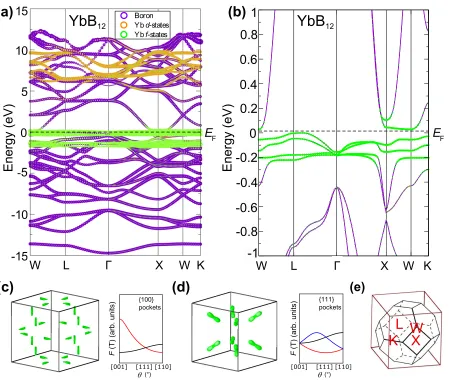
to the quantum oscillations of both low and high frequency and low effective mass observed in SmB6. Band structure calculations of YbB12using the mBJ potential are shown in figure 4.
States at both the valence band maximum and conduction band minimum are mainly derived from Yb f-states, but are heavily hybridised with the dispersive boron s and p states in
the vicinity. We decompose the eigenvectors at each k-point both orbitally and atomically.
Integrating over all k-points, we find, for the 14 states of the Ybf-complex, 13.2 below the
W L Γ X W K -1
-0.8 -0.6 -0.4 -0.2 0 0.2 0.4 0.6 0.8 1
-5
E
n
er
g
y
(e
V
)
E F Boron
Ybd-states
Ybf-states
15
10
5
0
-10
-15
W L Γ X W K
E
n
er
g
y
(e
V
)
E F
W L X W K
1
0
0.8
0.6
0.4
0.2
-0.2
-0.4
-0.6
-0.8
-1
(b)
(a)
Γ
(c)
(d)
(e)
X
K
W
L
E
ner
gy
(eV
)
E
ner
gy
(eV
)
YbB
12YbB
12(°) (°)
[image:10.612.81.530.101.483.2][001] [111] [110] [001] [111] [110]
Figure 4. Calculated band structure of YbB12 shown over a wide energy range in (a) with an
expanded view around the Fermi energyEFin (b). Several characters are projected out of the
eigenvectors at eachk-point and the resulting weight is indicated by a circle of proportional
size. Green circles are Ybf-states, orange circles are Ybd-states, and violet circles are boron states. (c) Small needle-shaped Fermi surfaces of YbB12obtained using the modified
Becke-Johnson potential for a small positive energy shift. Expected angular dependence of the quantum oscillation frequencies in the [001]-[111]-[110] rotation plane are shown by approximating the shown Fermi surfaces as prolate ellipsoids. (d) Small peanut-shaped Fermi surfaces of YbB12 obtained using the modified Becke-Johnson potential for a small negative energy shift.
with experiment [7] and band structure calculations that use a GW potential [22]. Interestingly, application of DFT+U, the most commonly used technique for dealing with metallic f-states,
instead results in all 14 states being filled and corresponds to Yb2+, which is inconsistent with
experiment, as also found by previous band structure calculations [23]. A crucial distinction is therefore seen between the band structure of SmB6 and YbB12. In the case of SmB6, the
boron bands are filled and consequently a single half-filled unhybridised conductiond-electron
band crosses the Fermi energy. Hybridisation of this conduction band with thef-electron band
yields the Kondo gap. In contrast, in the case of YbB12, two partially filled unhybridised s-p
conduction electron bands that are cumulatively half-filled cross the Fermi energy with electron-like character, and are gapped by hybridisation with thef-electron band as shown in figures 4(a)
and 4(b).
Given the absence of a finite electronic density of states at the Fermi energy, constituent neutral quasiparticles have been proposed to explain the observation of a bulk Fermi surface in Kondo insulators. Neutral quasiparticles invoked by various theoretical models include spinons in the case of single band Mott insulating organic spin liquids [24, 25, 26, 27], and in the case of single band Kondo insulators such as SmB6, magnetic excitons [28], composite
excitons [29, 30], Majorana fermions [31, 32, 33], and others [34, 35]. A natural way to think of a Fermi surface of such neutral quasiparticles is in terms of slow fluctuations in space and time between the insulating ground state where a Fermi surface is absent due to filling of the Brillouin zone, and the neighbouring metallised ground state in phase space, which is characterised by a Fermi surface [1, 2]. The character of such a neutral Fermi surface may thus be expected to be akin to the Fermi surface of the neighbouring metallised ground state. Metallisation in the case of SmB6 requires a decoupling of thef-electron and conduction electron bands, resulting
in a solely conduction electron Fermi surface occupying half the Brillouin zone. Accordingly, comparison of the observed Fermi surface in insulating SmB6with a conduction electron Fermi
surface similar to that in metallic LaB6 was found to yield good agreement both in frequency
and effective mass [1, 2]. In contrast, metallisation of YbB12 can arise through two routes:
either (i) a decoupling of thef-electron and conduction electron bands yielding a Fermi surface
corresponding to the conduction electron band, or (ii) an effective relative shift of each of the two hybridised conduction electron bands, yielding a Fermi surface corresponding to a heavy fermion semimetal [29, 30].
We consider the first scenario, and make a comparison of the small heavy Fermi surface sections observed in insulating YbB12 with a conduction electron Fermi surface similar to
that in metallic LuB12. In LuB12, all 14 f-states are well below the Fermi energy in the
10 11 12 13 14 -1.5 -1.0 -0.5 0.0 0.5 1.0 1.5
◌ ؑ׀~׀[111], T= 1.8 K
T or qu e M ag net isa tion ( × 10 -4 pF )
؍0H(T)
LuB12
E
F
Boron
Lud-states
Luf-states
LuB
12 1 0 5 0 -5 -1 0 -1 5W L Γ X W K
(a)
(b)
(c)
(d)
(f)
(g)
θ ~ [110] 11 T < µ0H< 14 T
(e)
E
ner
gy(eV
)
0 1000 2000 3000 4000 5000
0.0 0.2 0.4 0.6 0.8
0 2 4 6 8 10 12 0.0
0.5 1.0
10 11 12 13 14
-0.5 0.0 0.5
◌ ؑ׀~׀[110], T= 1.8 K
T or qu e M ag net isa tion ( × 10 -4 pF )
؍0H(T)
LuB12
θ~[011], T= 1.8 K
F F T a m p lit u d e ( a . u .) F(T) 1.8 K 2.0 K 2.2 K 2.5 K 3.0 K 3.5 K 4.0 K 5.0 K 6.0 K 7.0 K 9.0 K LuB12 F F T a m p lit u d e ( a . u .)
T (K)
θ~[111], T= 1.8 K
LuB
12
θ ~ [110], T = 1.8 K
F = 4.17 kT
m*/m
e = 0.52(1)
LuB
12LuB
12µ0.H (T) 1 5
µ0.H (T)
θ ~ [111], T = 1.8 K
[image:12.612.79.531.95.519.2]LuB
12Figure 5. (a) Calculated band structure of LuB12. Several characters are projected out of the
eigenvectors at each k-point and the resulting weight is indicated by a circle of proportional size. Green circles are Luf-states, orange circles are Lud-states, and violet circles are boron
states. (b) - (d) the Fermi surfaces of LuB12shown together in (b) and separately for clearer
viewing in (c) and (d). (f) - (g) De Haas-van Alphen oscillations measured using torque magnetisation at1.8 K in LuB12. (e) Fourier transform of the magnetic field sweeps taken at
different temperatures. The inset shows the Lifshitz-Kosevich fit (dashed line) to the frequency
F = 4.17 kT. The effective masses m∗/m
e are found to be 0.40(1), 0.53(2), and0.52(1)
for the frequencies2.90kT,3.03kT, and4.17kT forµ0H oriented a few degrees away from
[110], corresponding well to calculated frequencies 2.92 kT and 3.93 kT forµ0H k[110]with
effective massesm∗/meof 0.36 and 0.43 respectively. Frequencies 2.89 kT, 3.51 kT, 3.75 kT,
and 5.64 kT are measured for µ0H oriented a few degrees away from [111], comparable to
calculated frequencies of 2.82 kT and 5.80 kT forµ0H k[111]with effective massesm∗/meof
band structure (figures 5(a)–(d)), and with previous quantum oscillation measurements [36, 38]. A correspondence is not immediately obvious between the observed quantum oscillations with a relatively high effective mass in YbB12 (figure 2(d)) and the large and light conduction
electron Fermi surface expected from band structure and observed in LuB12 (figure 5). It is
possible that owing to subtle materials differences between YbB12 and LuB12, a band shift
could yield small Fermi surface pockets from the conduction electron band similar to those observed in YbB12. Meanwhile quantum oscillations corresponding to large Fermi surface
pockets might not be observed due to even higher effective masses than for the small Fermi surfaces observed. Alternatively, in the second scenario, metallisation in YbB12can be achieved
by a small effective relative shift of the two conduction bands while retaining hybridisation or potentially reduced hybridisation. In this case, small heavy Fermi surface sections characteristic of a heavy fermion semimetal [8] would be expected, as can be seen from performing small energy shifts to the band structure (figures 4(c) and (d)). Such heavy Fermi surface sections would also yield a sizable linear heat capacity as observed in YbB12 (figure 1(d), [13]). This
scenario of a neutral Fermi surface in Kondo insulating YbB12 with properties similar to the
Fermi surface of a heavy fermion semimetal, arising from a small relative shift to the two hybridised conduction bands, is intriguing to pursue theoretically. The realm of Fermi surfaces in Kondo insulators may be even richer than previously thought. Just as materials differences between metals yield differences in band structure and consequently Fermi surface character, we find that differences between the nature off-electron and conduction electron hybridisation
in SmB6and YbB12yield potentially important differences in Fermi surface character between
the two Kondo insulators.
Magnetic field tuning in YbB12
Another salient difference between SmB6 and YbB12 is the effectiveness of magnetic field in
tuning these materials toward an insulator-metal transition. While applied magnetic fields as high as µ0H = 93 T only result in a negative magnetoresistance of ≈ 7 % in SmB6 [39],
applied magnetic fields of µ0H ≈ 45 T are found to reduce the electrical resistivity by an
order of magnitude in YbB12 (figure 1(b), [21]). The enhanced response of YbB12 to applied
magnetic fields compared to SmB6 may reflect small band shifts due to Zeeman splitting or the
involvement of magnetic degrees of freedom in the ground state of YbB12. The close proximity
of YbB12to the insulator-metal transition may be expected to lead to an increased propensity for
the [001] crystalline direction in YbB12 (figures 2(a) and 3(a)). Alternatively, the reduced
charge gap at high magnetic fields could also provide an explanation in terms of conventional quasiparticles tunneling through a narrow energy gap that are more likely to yield quantum oscillations [40, 41, 42, 43]. Taken in conjunction with the observation of a finite linear specific heat capacity (figure 1(d), [13]) even in zero magnetic field, an explanation for the observed quantum oscillations in terms of a Fermi surface originating from novel quasiparticles that couple to a magnetic field but not to a weak DC electric field appears more likely than an origin from conventional tunneling through a magnetic field reduced charge gap.
Summary
The observation of magnetic quantum oscillations in at least two families of Kondo insulators, SmB6 and YbB12, suggests a more universal phenomenon across correlated insulators.
Differences we uncover between the character of the underlying bulk Fermi surface in the two systems further add to the richness of potential Fermi surface models relevant to the broad panorama of Kondo insulators. While the Fermi surface observed in SmB6 corresponds
in geometry and effective mass to the conduction electron Fermi surface, the Fermi surface observed in YbB12 corresponds more closely to that of a heavy fermion semimetal, suggesting
important differences between theoretical models of relevance to each of these systems. The magnetic field tuning we find to influence the quantum oscillations observed in YbB12, while
having little effect on the quantum oscillations in SmB6, further informs our understanding of
the itinerant low energy excitations involved in each of these materials and their approach to the neighbouring insulator-metal quantum critical point. Looking ahead, magnetic field dependent quantum oscillation measurements in other quantities, as well as complementary measurements such as thermal conductivity and nuclear magnetic resonance at low temperatures, are important in the quest to examine the character of the novel itinerant low energy excitations in YbB12. Our results provide further impetus to the search underway for new theoretical
paradigms to explain the unexpected discovery of a bulk Fermi surface in Kondo insulating materials [24, 25, 26, 27, 29, 30, 31, 32, 33, 40, 41, 42, 43].
Acknowledgments
We thank the team at the National Academy of Sciences of Ukraine, Kiev for assistance in the preparation of polycrystalline YbB12 as well as single crystals of LuB12. We are grateful to
Y. Matsuda for discussions of their unpublished measurements on YbB12. We acknowledge
including J. Billings, J. T. Camacho, R. Carrier, E. S. Choi, W. A. Coniglio, B. L. Dalton, D. Freeman, L. J. Gordon, M. Hicks, S. A. Maier, T. P. Murphy, J.-H. Park, J. N. Piotrowski, J. A. Powell, E. Stiers.
H.L, M.H., G.W., A.J.D, and S.E.S. acknowledge support from the Royal Society, the Leverhulme Trust through the award of a Philip Leverhulme Prize, the Winton Programme for the Physics of Sustainability, EPSRC UK (grant number EP/M000524/1) and the European Research Council under the European Unions Seventh Framework Programme (grant number FP/2007-2013)/ERC Grant Agreement number 337425. M.C.H. and G.B. acknowledge financial support from the EPSRC UK (grant number EP/M028771/1). M.D.J. acknowledges support for this project by the Office of Naval Research (ONR) through the Naval Research Laboratory’s Basic Research Program. A portion of this work was performed at the National High Magnetic Field Laboratory, which is supported by National Science Foundation Cooperative Agreement No. DMR-1157490, the State of Florida, and the Department of Energy (DOE).
References
[1] Tan B S, Hsu Y T, Zeng B, Ciomaga Hatnean M, Harrison N, Zhu Z, Hartstein M, Kiourlappou M, Srivastava A, Johannes M D, Murphy T P, Park J H, Balicas L, Lonzarich G G, Balakrishnan G and Sebastian S E 2015Science349287–290
[2] Hartstein M, Toews W H, Hsu Y T, Zeng B, Chen X, Ciomaga Hatnean M, Zhang Q R, Nakamura S, Padgett A S, Rodway-Gant G, Berk J, Kingston M K, Zhang G H, Chan M K, Yamashita S, Sakakibara T, Takano Y, Park J H, Balicas L, Harrison N, Shitsevalova N, Balakrishnan G, Lonzarich G G, Hill R W, Sutherland M and Sebastian S E 2018Nat. Phys.14166–172
[3] Li G, Xiang Z, Yu F, Asaba T, Lawson B, Cai P, Tinsman C, Berkley A, Wolgast S, Eo Y S, Kim D J, Kurdak C, Allen J W, Sun K, Chen X H, Wang Y Y, Fisk Z and Li L 2014Science3461208–1212
[4] Flachbart K, Gab´ani S, Neumaier K, Paderno Y, Pavl´ık V, Schuberth E and Shitsevalova N 2006Physica B
378-380610–611
[5] Gab´ani S, Flachbart K, Konovalova E, Orend´aˇc M, Paderno Y, Pavl´ık V and ˇSebek J 2001 Solid State Commun.117641–644
[6] Boulanger M E, Lalibert´e F, Badoux S, Doiron-Leyraud N, Phelan W A, Koohpayeh S M, McQueen T M, Wang X, Nakajima Y, Metz T, Paglione J and Taillefer L 2017arXiv preprintarXiv:1709.10456
[7] Kasaya M, Iga F, Takigawa M and Kasuya T 1985J. Magn. Magn. Mater.47-48429–435 [8] Hewson A C 1997The Kondo Problem to Heavy Fermions(Cambridge University Press) [9] Sugiyama K, Iga F, Kasaya M, Kasuya T and Date M 1988J. Phys. Soc. Jpn.573946–3953 [10] Bat’kov´a M, Bat’ko I, Konovalova E, Shitsevalova N and Paderno Y 2006Physica B378618–619
[11] Okamura H, Michizawa T, Nanba T, Kimura S i, Iga F and Takabatake T 2005J. Phys. Soc. Jpn.741954– 1957
[12] Ekino T, Umeda H, Iga F, Shimizu N, Takabatake T and Fujii H 1999Physica B259315–316 [13] Iga F, Kasaya M and Kasuya T 1988J. Magn. Magn. Mater.76–77156–158
[16] Werheit H, Filipov V, Shirai K, Dekura H, Shitsevalova N, Schwarz U and Armbr¨uster M 2011 J. Phys. Condens. Matter23065403
[17] Blaha P, Schwarz K, Madsen G, Kvasnicka D and Luitz J 2001wien2k: An augmented plane wave+ local orbitals program for calculating crystal propertiesVienna University of Technology Institute of Materials Chemistry
[18] Tran F and Blaha P 2009Phys. Rev. Lett.102226401
[19] Shoenberg D 1984Magnetic Oscillations in Metals(Cambridge, UK: Cambridge University Press) [20] Landau L 1957Sov. Phys. JETP3920–925
[21] Iga F, Suga K, Takeda K, Michimura S, Murakami K, Takabatake T and Kindo K 2010J. Phys. Conf. Ser.
200012064
[22] Weng H, Zhao J, Wang Z, Fang Z and Dai X 2014Phys. Rev. Lett.112016403 [23] Antonov V N, Harmon B N and Yaresko A N 2002Phys. Rev. B66165209 [24] Anderson P W 1992Phys. Scr.T4211–16
[25] Grover T, Trivedi N, Senthil T and Lee P A 2010Phys. Rev. B81245121 [26] Motrunich O I 2006Phys. Rev. B73155115
[27] Katsura H, Nagaosa N and Lee P A 2010Phys. Rev. Lett.104066403 [28] Knolle J and Cooper N R 2017Phys. Rev. Lett.118096604
[29] Chowdhury D, Sodemann I and Senthil T 2017arXiv preprintarXiv:1706.00418 [30] Sodemann I, Chowdhury D and Senthil T 2018Physical Review B97045152 [31] Coleman P, Miranda E and Tsvelik A 1993Physica B186-188362–364 [32] Baskaran G 2015arXiv preprintarXiv:1507.03477
[33] Erten O, Chang P Y, Coleman P and Tsvelik A M 2017Phys. Rev. Lett.119057603 [34] Pixley J, Yu R, Paschen S and Si Q 2015arXiv preprintarXiv:1509.02907
[35] Kagan Y, Kikion K and Prokof’ev N 1992Physica B182201–208
[36] Heinecke M, Winzer K N J K H, Grieb H, Flachbart K and Paderno Y B 1995Z. Physik B98231–237 [37] Harima H, Yanase A and Kasuya T 1985J. Magn. Magn. Mater.47–48567–569
[38] Okuda N, Suzuki T, Ishii I, Sayaka H, Iga F, Takabatake T, Fujita T, Kadomatsu H and Harima H 2000
Physica B281–282756–757
[39] Wolgast S, Eo Y S, Sun K, Kurdak, Balakirev F F, Jaime M, Kim D J and Fisk Z 2017Phys. Rev. B95245112 [40] Knolle J and Cooper N R 2015Phys. Rev. Lett.115146401
[41] Erten O, Ghaemi P and Coleman P 2016Phys. Rev. Lett.116046403
![Figure 2. (a) Solid lines show de Haas-van Alphen oscillations measured on a single crystalof YbB12 using torque magnetisation at T = 0.4 K for µ0H oriented at different tilt angles(θ) away from the [001] crystalline direction, passing through the [111] cr](https://thumb-us.123doks.com/thumbv2/123dok_us/9430397.448521/7.612.85.479.106.514/oscillations-measured-crystalof-magnetisation-oriented-different-crystalline-direction.webp)
![Figure 3. Quantum oscillatory magnetic moment (in µB per unit cell) corresponding to themeasured oscillations versus inverse magnetic field in YbB12 in (a), and SmB6 in (b) (reproducedfrom [2])](https://thumb-us.123doks.com/thumbv2/123dok_us/9430397.448521/8.612.103.367.111.334/quantum-oscillatory-magnetic-corresponding-themeasured-oscillations-magnetic-reproducedfrom.webp)