Image Compression using Fractal Image
Compression with Multi-Layer Feed Forward
Artificial Neural Network
Shamina Khatun1, Anas Iqbal2
1
M Tech scholar in All Saints College of Technology, RGPV University Bhopal, Madhya Pradesh, India.
2
Professor, Department of Electronics and Communication Engineering, All Saints College Of Technology, RGPV University Bhopal, Madhya Pradesh, India.
Abstract: A compression technique is used to compress the images called Fractal Image compression (FIC) technique. It is a block based image compression; it is used to detecting and coding the existing similarities between different regions in the image. The primary drawback of Fractal Image compression is that the encoding time is relatively high, whereas the decompression is very fast.The proposed scheme has been demonstrated through several experiments including Lena girl, cameraman and very capable results in image compression as well as in reconstructed image over convectional neural network based technique is obtained. The aim of this work is to develop an edge preserving image compressing technique using one hidden layer feed forward neural network which neurons are determined adaptively. The experimental results show that the performance of our Neural Network based Fractal Image compression is deeply improved in terms of encoding time without degrading the image quality as compared to the usual Fractal Image compression.
Keywords: Fractal Image Compression (FIC), Neural Network (NN), Back Propagation Neural Network (BPNN), Iterated Function System (IFS)
I. INTRODUCTION
A number of neural network based image compression technique are classified into two types like lossless and lossy image compression technique. But, currently in early work expand the prospective of neural network to achieve data encoding or decoding, which utilized by many researches for image compression employing the standard “Back propagation training algorithm”. In most of the methods, an image is divided into number of non-overlapping blocks of pixels, and fed as patterns for network training. Image compression is achieved by encoding the pixel blocks into the trained weight set, which is transmitted from the receiving side for reconstruction of theimages.
The main apprehension of the work is to determine the structure of the NN that encodes the image using back propagation training method. The basic aim is to develop an edge preserving image compression technique using one hidden layer feed forward neural network of which the neurons are determined adaptively based on the images to be compressed. The Edge detection step is important data reduction step because it encodes information based on the structure of the image. Using edge detection critical information of the image is conserved while maintaining to one side less important information that successfully reduces active range of the image and elements pixel idleness. As a next step the image is threshold to detect the pixel having less power on the image and therefore removed. A threshold function has been designed using gray level information of the edge detected image and applied to reduce the size of the image further. Finally, thinning operation has been applied which is based on the interpolation method to reduce thickness of the image. Now critical information has been conserved in the single image block while its size has been reduces significantly and fed as a single input pattern of the neural network. It is worth to mention here that processing never destroy spatial information of the original image which has been stored along with the pixel values. The number of pixels present in the PIB determines number of input and output neurons of the NN.
II. FRACTAL IMAGE COMPRESSION
(data). The first, is that the size of memory which is used to store fractal codes is extremely reduced than the amount of memory used to store the original information. The second, is that given that the data is mathematical, in this the image can easily be scaled up or down without disturbing the detail of the image. The fractal image compression technique offers high compression ratio and good image quality of the decoded image.
A. Basic Concept of Image Compression Based on Fractals And Back Propagation Neural Network
A fractal image compression algorithm proposed for Magnetic Resonance Imaging (MRI) images, which can utilizes the self-similarity property of a MRI image and it comprises the three phases namely Training phase, Encoding phase and Decoding phase. The main aim of this fractal image compression technique is used to reduce the search space and speed-up the encoding time. These three phases are detailed in the following sub-sections.
1) Training Phase: In this training phase, the similar MRI images are taken as input images and each images is partitioned into range blocks and domain blocks individually. At the initial stage, the range block of one MRI image is compared with the domain blocks of the same MRI image for which select the best matched domain block for that particular range block in an image and the fractal codes are given as an output.Then the professional system has trained with the indices of range and its best matched domain blocks. The time taken in the training process will not be counted with the encoding time.
Fig 1: Training Process
[image:2.612.222.389.485.714.2]2) Encoding Phase: During the encoding phase, the expert system takes the index of the range block of MRI image one by one as an input and it produces a set of domain blocks for the parallel range block. Then the search will be complete only in the resulted set of domain blocks. Hence the search space is reduced and speed of the encoding time is increased.
III. VARIOUS ALGORITHM
1) DCT (Discrete Cosine Transform): A DCT was initially introduced in 1974 for a vital achievement for the investigation individuals taking a explosion at picture compression. A DCT (Discrete Cosine Transform) are utilized to change the pixels in the first picture into reappearance area coefficients. The DCT is largely utilized as a part of picture compression calculations. It can be viewed as a discrete-time variant of the Fourier cosine collection. It is like Discrete Fourier Transform (DFT). DFT is a procedure for changing over a private into elementary frequency parts. Along these lines DCT can be registered with a Fast Fourier Transform (FFT) like calculation in O (n log n) operations. We have decided for the capacity to de-correlate pixels inside of the spatial area. A DCT is like DFT, which can give a better irregular deduction less coefficients. The coefficients of DCT are authentic valued of composite valued in DFT. In 1942 JPEG had presented the first universal standard for at rest picture Compression with DCT-based. The DCT-based encoder is basically compression of a surge of 8 x8 squares of picture tests. Every 8 x 8 piece advances through every handling step, and yields in packed structure into the information stream. Since adjoining picture pixels are extremely connected the forward DCT (FDCT).
2) Fractal Coding: The fundamental consideration is to decompose the picture into fragments by utilizing standard picture handling procedures, for example, shading partition, edge recognition, and range and surface examination. At that point every part is twisted upward in a library of fractals. The library actually contains codes called iterated capacity framework codes, which are smaller arrangements of numbers. An arrangement of codes for a given picture are determined, such that when the IFS codes are connected to a suitable arrangement of picture squares yield a picture that is a nearby close estimation of the first. This plan is extremely successful for packing pictures that have great consistency and self-closeness.
3) Vector Quantization: The fundamental consideration is to build up a word reference of altered size vectors, called code vectors. Typically, vector is a square of pixel qualities. A picture vector means given picture is then divided into non-overlapping vectors. Every word is referenced in vocabulary and its table in dictionary is utilized as the first's encoding picture vector. In this way, every picture is spoken to by an arrangement of lists that can be further entropy coded.
4) Sub-band Coding: The Sub band coding is the picture is examined to generate the parts containing frequencies in all around characterized groups to the sub groups. As a result, quantization and coding is connected to each of the groups. The quantization and coding suitable for each of the sub groups can be outlined separately is a fundamental complimentary position of this coding.
5) Block Truncation Coding: In this coding, the picture is divided into non-covering pieces of pixels. The boundary and remaking qualities are determined in every piece. At that point a piece's bitmap is incidental by supplanting all pixels whose qualities are more notable than or break even with to the limit by a 1 (0). At that point for every piece in the bitmap, the recreation quality is resolved. In the first piece the values normal of the relating pixels.
6) Run Length Encoding: TheRun-length encoding is slightest complex method for compression which utilized for consecutive. It is extremely helpful in deadly information. This procedure replaces groupings of interchangeable pixels, called keeps running by shorter images. Information made of any mix of images can be compacted by utilizing this encoding. The information contain just 0 and 1. So, it is extremely practical and require not to know the reappearance of experience of images. To replace sequential rehashing events of an image one by one occurrence of the image took after by the quantity of procedures is a fundamental thought for Run-length encoding. At the point when contrasted with other system this technique is much more capable in light of the fact that the information utilizes just two images 0 and 1.
IV. PROPOSED METHODOLOGY
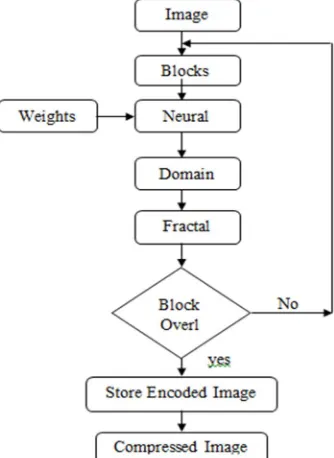
[image:3.612.107.495.649.722.2]The images contained noise. The pre-processing step consisted of removing noise using a median filter. The investigations were carried out in two levels. Initially, images were compressed using Haar wavelet with Huffman coding and the proposed 3-pattern Huffman compression method. The study investigated the compression ratios achieved by the two compression techniques. Figure 3 shows the block diagram of the compression process.
A. Huffman Compression Technique
Huffman codes (Huffman 1952) are digital data compression codes resulted from the work of Prof. David A. Huffman. Huffman codes exploit the entropy of the message to give good compression ratios. Huffman coding is a statistical coding technique that forms the basis for many compression techniques. Huffman compression techniques consist of techniques guaranteed to generate an exact duplicate of input data stream after an expand cycle. This type of compression is used when storing database records, spreadsheets, or word processing file and image formats. In these applications, the loss of even a single bit could be catastrophic. Huffman algorithm can be used in the case of medical image compression where there should not be any loss of information during compression that will affect proper diagnosis.
Huffman coding finds an optimal way to take advantage of varying character frequencies in a particular file. On an average, Huffman coding on standard files could shrink them anywhere from 10% to 30% depending on the character distribution. Huffman coding performs better with skewed distribution. The idea behind the coding is to give less frequent characters and groups of characters, longer codes.
V. SIMULATION RESULT
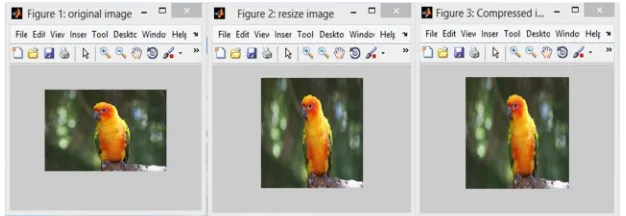
[image:4.612.190.425.314.421.2]For the 4×4 block pixel, first the image (m×n) is divided in a 4×4 block pixel then if there is any residue it is adjusted to fit in this size. Feed forward algorithm is applied on this image and the image is compressed. The obtained image having comparable resolution than the original image but the image size is reduced significantly. This algorithm is applied for different images and result has been analyzed.
Figure 4: Feed Forward Algorithm applied on Lena Image of block size 4×4
[image:4.612.150.463.613.721.2]Figure 5: Feed Forward Algorithm applied on Cameraman Image of block size 4×4
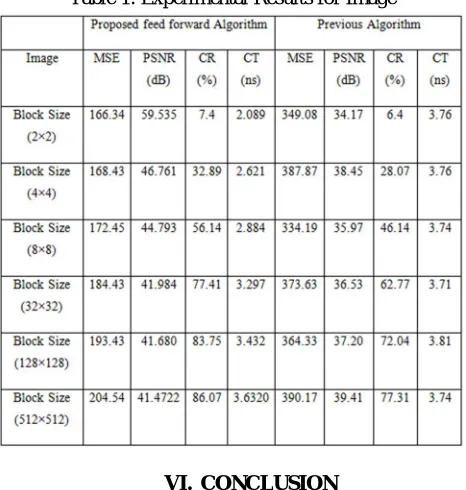
Table 1: Experimental Results for Image
VI. CONCLUSION
A new method for near lossless compression of medical images was proposed. The proposed method made certain improvements on the existing Huffman technique to determine the best component and the most frequent occurring pattern in the image to be processed. The patterns selected by the proposed technique will be the input to the encoder and the output of the encoder would be the compressed image with the footer information. In the current study, two compression techniques were investigated. In the first technique, Haar wavelet with Huffman coding is used for compressing the medical images. The second compression technique proposed is based on an improvement over Huffman compression, namely a 3-pattern Huffman compression method. Simulation results showed that the proposed compression technique achieves better compression.
REFERENCES
[1] Chen J. et al, “The security of Key Derivation Functions in WinRAR”, Journal of Computers, Volume 8, Issue 9, 2013, pp. 2262-2268.
[2] Wang, X., Yang, M., Cour, T., Yu, K, Han, T.X. “Contextual weighting vocabulary tree based image Retrieval”, Proceedings of the IEEE International Conference on Computer Vision 6126244,pp. 209-216.
[3] Wong, Stephen, Zaremba, Loren, Gooden, David, Huang, H.K. “Radiologic Image Compression-a review”, Proceedings of the IEEE 82(3), pp.194-219. [4] Ghadah Al-Khafaji “Image Compression based on Quadtree and Polynomial”, International Journal of Computer Applications (0975-8887) Volume 76-No.3. [5] Ferragina, P, Manzini, G, “On Compressing the Textual Web” Proceedings of the 3rd ACM International Conference on Web Searchand Data Mining.
Pp.391-400.
[6] Kohno, T “Attacking and Repairing the WinZip Encryption Schemes”, Proceedings of the ACM Conference on Computer and Communication Security pp. 72-81.
[7] Li, W, C., Ang, L.-M., Kah, P.S, “Survey of image compression algorithms in wireless sensor networks”, International Symposium on Information Technology 2008, IT Sim 3, 4631875.
[8] Wood, F, Gasthaus, J, Archambeau, C, James, L, Teh, Y.W, “The sequence memorizer”, Communications of the ACM”, 54(2), pp.91-98.
[9] S. Chhikara, and R. Sachdeva, “Image Compression Using Neural Networks.” Imperial Journal of Interdisciplinary Research (IJIR), Vol. 2, no. 7, 2016.
[10] A. Niras, G. Ojha, and S. Sachan, “Lossless Image Compression Using Neural Network.” International Journal of Emerging Technology and Advanced Engineering, Vol. 5, no. 6, June 2015.
[11] R. Hashemian and S. Marivada, “Improved Image Compression Using Fractal Block Coding,” IEEE Electr.Eng., pp. 544–547, 2004.