e-ISSN: 2278-067X, p-ISSN : 2278-800X, www.ijerd.com
Volume 5, Issue 5 (December 2012), PP. 01-07
Image Compression Using Optimization Techniques
1
K.Uma,
2P.Geetha,
3A.Kannan,
4K.Umanath
1Research scholar& Assistant professor, 2Assistant Professor, 3professor, 4Assistant professor 1,2,3,4 Department of CSE, Anna University & VelTech University, Chennai
Abstract: - The FIC is one of our attempts towards the design of robust fractal image compression. The main disadvantage of FIC is the high computational cost. To overcome this drawback, the technique described here utilizes the optimization techniques, like GA, ACO and PSO which greatly decreases the search space for finding the self similarities in the given image. FIC is robust against outliers in the image.
Keywords: - Fractal imge compression,Self similarity property, Optimization Tecniques.
I.
INTRODUCTION
A. Fractal Image Compression
Fractal Compression was first promoted by M.Barnsley, who founded a company based on fractal image compression technology.
Two important properties of a fractal F • F has detail at every level.
• F is exactly, approximately or statistically self-similar.
Fractal techniques based on iterated function systems have been successfully applied to the compression of one dimensional signals and two-dimensional images by finding a fractal representation that models the original signal as closely as possible, and storing the model instead of the original data. In contrast to the typical notion of fractal methods, block based fractal Compression techniques,perform very well on smooth edges, and rather poorly on textured regions. Whereas fractal image compression of 2D medical data, such as X-rays, may blur the textured regions of most interest, fractal volume compression of 3D medical data, such as CTscans, represents edges sharply and yields well defined surfaces.
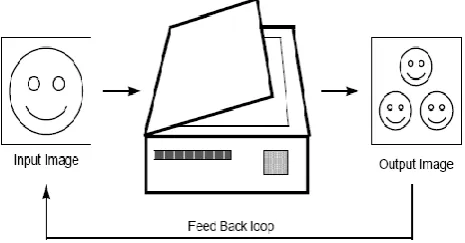
Fractal block-coding compression methods compress data by partitioning the data into small range blocks, and also into larger domain blocks. For each range block, the method finds a domain block that can be transformed into the range block. Some methods focus on searching for the best domain block using simple transformations , whereas other methods focus on using sophisticated deformations to best transform a given domain block into a given range block. This research focuses on the domain- search method. The extension of this search to volumetric data presents the greatest obstacle to the feasibility of fractal volume compression [1] [5]. Imagine Fig.1 is a special type of photocopying machine that reduces the image to be copied by half and reproduces it three times on the copy. What happens when we feed the output of this machine back as input we can observe that all the copies seem to converge to the same final image [3]. Since the copying machine reduces the input image, any initial image placed on the copying machine will be reduced to a point as we repeatedly run the machine, it is only the position and the orientation of the copies that determines what the final image looks like.
As shown in Fig. 2,A common feature of these transformations that run in a loop back mode is that for a above initial image each image is formed from a transformed (and reduced) copies of itself, and hence it must have detail at every scale. That is, the images are fractals. Storing images as collections of transformations could lead to image compression [4].
Fig.2: The first three copies generated on the copying machine
Fractal image compression is also called as fractal image encoding. Fractal image coding methods based on block segmentation. Fractal image coding method based on region segmentation and cross-searching models is a kind of improved fractal coding methods. very high compression ratio, high decompression speed, high bit-rate and resolution independence[2],[3].
B. Self-Similarity Property
To encode an image according to self-similarity property. Each block to be encoded must search in a large pool to find the best match [6][7][8]. For the standard full search method, the encoding process is time-consuming because a large amount of computations of similarity measure are required.
Fig.3: Self-Similarity of Lenna Image in Different Location
A typical image of a face does not contain the type of self-similarity like the fern in Figure 3. The image does contain other type of self-similarity. Figure 4 shows regions of Lena identical, and a portion of the reflection of the hat in the mirror is similar to the original. These distinctions form the kind of self-similarity shown in Figure 3 rather than having the image formed by whole copies of the original (under appropriate affine transformations), here the image will be formed by copies of properly transformed parts of the original [9][10]. These transformed parts do not fit together, in general, to form an exact copy of the original image, and so it must allow some error in our representation of an image as a set of transformations. Fig. 4. Shows a reconstructed image regions of Lena identical, and a portion of the reflection of the hat in the mirror is similar to the original [11].
C. Fractal Image Compression Using Genetic Algorithm
Compression and decompression technology of digital image has become an important aspect in the storing and transferring of digital image in information society. Fractal image coding is the iterated function system. Because of its high compression ratio and simple decompression method, many researchers have done a lot of research on it. At present, researchers focus mainly on how to select and optimize the classification of the range blocks, balance the speed of compression and decompression, increase the compression ratio and improve the quality of image after compression [12]. Especially in the field of reducing the complexity of search. Genetic Algorithm (GA) is a stochastic algorithm simulating the process of natural evolution, which is usually applied to optimize controlled parameters and constrained functions. Especially GA is efficient to solve nonlinear multiple-extreme problems. An improved genetic algorithm proposed for obtaining matching domain blocks of fractal partition in image compression, which uses the partition iterated function system and fractal image compression.[13],[14].
Genetic algorithms (GA’s) are mathematically motivated search techniques that try to emulate biological evolutionary processes to solve optimization problems. Instead of searching one point at a time, GA’s use multiple search points. GA’s attempt to find near-optimal solutions without going through an exhaustive search mechanism. Thus, GA’s can claim significant advantage of large reduction in search space and time. A new method for Fractal image compression using PIFS is derived [15].
In this method uses a simpler classification system for range blocks. Genetic algorithms with elitist model are used in finding the appropriate domain block as well as the appropriate transformation for each range block [15].
D. Fractal Image Compression Using Ant Colony Optimization
A fractal encoding algorithm based on ant Colony algorithm is proposed to reduce encoding time. The ACO algorithm produces a completely identical fractal encoding to that of the conventional full search in reduced time. The algorithm can realize fractal image coding very well and also it has better PSNR, and it gets more compress ratio than traditional block-based partition.
The methods of fractal image compression transfers a digital into a group of contract iterate function System (IFS) model. Encoding IFS’s parameters achieves image compression. This method may gain higher compression ratio, as well as decoding rapidly. To many not strictly self-similar images, the usual fractal image compression method based on block Partition divides the image into non-overlap regular shape block collection. Every block’s iterate function system is found out by local self-similarity. The parameters of all iterate function system form fractal image compression code. Ant colony algorithms are a novel category of evolutionary computing methods for optimization problems.
Ant Colony Optimization (ACO) is a paradigm for designing meta-heuristic algorithms for combinatorial optimization problems. The essential trait of ACO algorithms is the combination of a priori information about the structure of a promising solution with a posteriori information about the structure of previously obtained good solutions [19].
Storing an image, for example, that of a fern in the form of pixel collection, takes up a lot of memory space - about 256 Kb. For an image of 256*256 pixels- if good resolution is required. Nevertheless, it is possible to store a collection of numbers that defines certain transformations capable of generating the fern image, but occupying 4 Kb in memory at the most. If a collection of transformations is capable of generating for image, then the image can be represented in a compact way. Fractal compression describes the scheme to obtain such collection.
E. Fractal Image Compression Using Particle Swarm Optimization
This paper also adopts the particle swarm optimization (PSO) as an alternative searching method. Originated from the evolutionary computation together with the social psychology principle, PSO is a general-purpose optimization algorithm which also uses the concept of fitness.
It provides a mechanism such that individuals in the swarm communicate and exchange information, which is similar to the social behavior of insects and human beings. Because of the mimicking of the social sharing of information, PSO directs particles to search the solution more efficiently. Since the paradigm of PSO requires only primitive mathematical operations, this computationally inexpensive algorithm can be implemented in a few lines of computer code. PSO has been successfully applied in many branches of science and engineering. For FIC, we will use PSO to speedup the search of a near best match block for a given block to be encoded. PSO-based FIC shows that PSO can efficiently find the suitable domain blocks. Meanwhile, the retrieved image quality can be preserved when comparing to the full search FIC.
algorithms and evolutionary programming. It is highly dependent on stochastic processes, like evolutionary programming [16].
Full search FIC can exactly find the best domain block corresponding to each range block, but it is very time-consuming. PSO can provide a faster way to encode the range blocks. PSO is a population-based algorithm for searching global optimum. The original idea of PSO is the simulation of a simplified social behavior. It ties to artificial life, like bird flocking or fish schooling, and has some common features of evolutionary computation. Such as fitness evaluation. For example, PSO is like a GA in that the population is initialized with random potential solutions [17].
Particle swarm optimization has roots in two main component methodologies. Perhaps more obvious are its ties to artificial life (A-life) in general, and to bird flocking, fish schooling, and swarming theory in particular. It is also related, however, to evolutionary computation, and has ties to both genetic algorithms and evolutionary programming. Particle swarm optimization as developed by the authors comprises a very simple concept, and paradigms can be implemented in a few lines of computer code. It requires only primitive mathematical operators, and is computationally inexpensive in terms of both memory requirements and speed. Early testing has found the implementation to be effective with several kinds of problems. [18]
II.
OVERALL FLOW DIAGRAM
Fig. 5. Flow Diagram
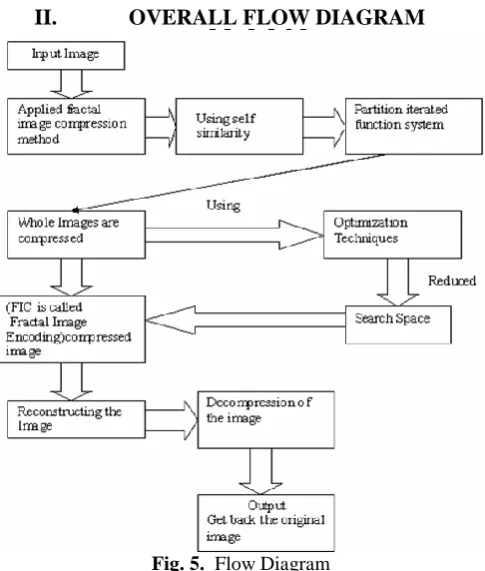
As shown in Fig. 5. The method of fractal image compression transfers a digital image into a group of contract iterated function system model. Encoding IFS’s achieves image compression. and Fractal image compression using different optimization techniques, it reduces the search space .finally get back the original image.
III.
COMPARISION RESULTS AND DISCUSSION
Optimization techniques are a powerful set of tools
Optimization techniques are utilized to reduce the searching time.
Optimization Method can effectively reduce the encoding time while retaining the quality of the retrieved image.
Optimization techniques are used to find optimal solutions for every process.
A. GA (Genetic Algorithm)
Self similarity property
To solve the optimization problems.
B. PSO (Particle Swarm Optimization)
PSO is an alternative searching method.
It is an evolutionary computation method
PSO is a general-purpose optimization technique which also uses the concept of fitness [17].
C. ACO (Ant Colony Optimization Techniques)
ACO is an evolutionary computing method for optimization problems.
ACO is to solve the combinatorial optimization problems.
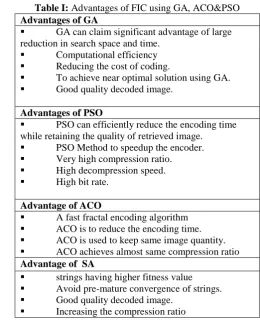
Table I: Advantages of FIC using GA, ACO&PSO
Advantages of GA
GA can claim significant advantage of large reduction in search space and time.
Computational efficiency
Reducing the cost of coding.
To achieve near optimal solution using GA.
Good quality decoded image.
Advantages of PSO
PSO can efficiently reduce the encoding time while retaining the quality of retrieved image.
PSO Method to speedup the encoder.
Very high compression ratio.
High decompression speed.
High bit rate.
Advantage of ACO
A fast fractal encoding algorithm
ACO is to reduce the encoding time.
ACO is used to keep same image quantity.
ACO achieves almost same compression ratio
Advantage of SA
strings having higher fitness value
Avoid pre-mature convergence of strings.
Good quality decoded image.
Increasing the compression ratio
Table II: Comparisons of FIC using GA, ACO,PSO &SA for Lenna image
Types of Algorit hm Ran ge Bloc ks Compressi on Ratio Encodin g Time PSNR in dB
GA 4×4 8×8
6.73:1 2370 26.22
PSO 4×4 8×8
13:1 347 24.43
ACO 4×4 8×8
1.89:1 6500 34.39
SA 4×4 8×8
Table I shows the some of merits of fractal image compression using different optimization techniques and Table II shows the comparisons of fractal image compression for gray level image of lenna of size 256×256 based on exhaustive search using GA,PSO,ACO.Final comparisons result is displayed like PSNR value, compression ratio and encoding time.
D. Performance Comparison
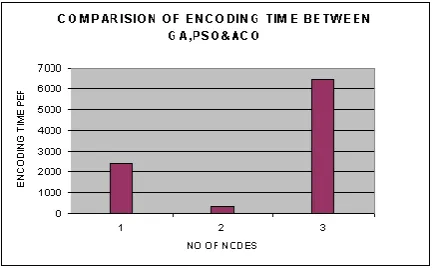
Fig.6. Performance Comparisons of encoding time
Fig.7: Final Performance Result
IV.
CONCULUSION AND FUTURE WORK
Fractal image compression has good robustness against the outliers caused by salt and pepper noise. Also, The Optimization method can effectively reduce the encoding time while retaining the quality of the retrieved image.
The main drawback of FIC is high computational cost .To overcome this drawback using optimization techniques is utilized to reduced the searching time and also can effectively retrieved the quality of the image. In this paper I have compared different optimization techniques in Fractal image compression methods and I have shown comparison results. Here ACO has been produced the best Results compared to other optimization techniques like GA, PSO.
In future, I hope to analyze the system from the point of view of provable security. This would require a more formal description of my system than what I have given here. And I also plan to implement my scheme and do experiment on fractal image compression using different types of optimization techniques.
ACKNOWLEDGEMENT
I wish to express my sincere gratitude to my beloved Panel member Dr.A.Kannan professor, Computer Science&Engg Anna University Chennai for providing an opportunity and extending his timely assistance.
REFERENCES
[1]. M. F. Barnsley and S. Demko, “Iterated function systems and the global construction of fractals,” Proc. Roy. Soc. London A, vol. 399, pp. 243–275, 1985.
[2]. A. E. Jacquin, “Image coding based on a fractal theory of iterated contractive image transformations,” IEEE Trans. Signal Process., vol. 1, no. 1, pp. 18–30, Jan. 1992.
[3]. A. J. Crilly, R. A. Earnshaw, and H. Jones, Fractals and Chaos. New York: Springer-Verlag, 1991. [4]. H. O. Peitgen, J. M. Henriques, and L. F. Penedo, Fractals in the Fundamental and Applied Sciences.
New York: Elsevier, 1991.
[5]. Y. Fisher, Fractal Image Compression: Theory and Application. New York: Springer-Verlag, 1994. [6]. M. F. Barnsley and A. D. Sloan, “A better way to compress images,” BYTE, vol. 13, no. 1, pp. 215–
233, 1988.
[7]. M. Ghazel, G. H. Freeman, and E. R. Vrscay, “Fractal image denoising,” IEEE Trans. Image Process., vol. 12, no. 12, pp. 1560–1578, Dec. 2003.
[8]. R. Pan and S. J. Reeves, “Efficient Huber-Markov edge-preserving image restoration,” IEEE Trans. Image Process., vol. 15, no. 12, pp. 3728–3735, Dec. 2006.
[9]. Z. Wang, D. Zhang, and Y. L. Yu, “Hybrid image coding based on partial fractal mapping,” Signal Process.:Image Commun., vol. 15, pp.767–779, 2000.
[10]. R. Distasi, M. Nappi, and D. Riccio, “A range/domain approximation error-based approach for fractal image compression,” IEEE Trans. Image Process., vol. 15, no. 1, pp. 89–97, Jan. 2006.
[11]. T. K. Truong, J. H. Jeng, I. S. Reed, P. C. Lee, and A. Q. Li, “A fast encoding algorithm for fractal image compression using the DCT inner product,” IEEE Trans. Image Process., vol. 9, no. 4, pp. 529– 535, Apr. 2000.
[12]. L. Vences and I. Rudomin, “Genetic algorithms for fractal image and image sequence compression,” in
Proc. Computacion Visual., 1997, pp. 35–44, Univ. Nacional Autonoma de Mexico.
[13]. S. K. Mitra, C. A. Murthy, and M. K. Kundu, “Technique for fractal image compression using genetic algorithm,” IEEE Trans. Image Process., vol. 4, no. 7, pp. 586–593, Jul. 1998.
[14]. M. S. Wu, J. H. Jeng, and J. G. Hsieh, “Schema genetic algorithm for fractal image compression,” Eng.
Appl. Artif. Intell., vol. 20, pp. 531–538, 2007.
[15]. M. S.Wu,W. C. Teng, J. H. Jeng, and J. G. Hsieh, “Spatial correlation genetic algorithm for fractal image compression,” Chaos, Solitons and Fractals, vol. 28, no. 2, pp. 497–510, 2006.
[16]. J. Kennedy and R. C. Eberhart, “Particle swarm optimization,” in Proc.IEEE Int. Conf. Neural
Networks, Perth, Australia, 1995, vol. 4, pp.1942–1948.
[17]. R. C. Eberhart and J. Kennedy, “A new optimizer using particle swarm theory,” in Proc. IEEE Int. Symp. Micro Machine and Human Science, Nagoya, Japan, 1995, pp. 39–43.
[18]. R. C. Eberhart and Y. H. Shi, “Particle swarm optimization: Developments, applications and resources,” in Proc. IEEE Int. Congr. Evolutionary Computation, Seoul, Korea, 2001, vol. 1, pp. 81– 86.