HOO 2012 Shared Task: UKP Lab System Description
Torsten Zesch†‡ and Jens Haase†
†Ubiquitous Knowledge Processing Lab (UKP-TUDA)
Department of Computer Science, Technische Universit¨at Darmstadt
‡Ubiquitous Knowledge Processing Lab (UKP-DIPF)
German Institute for Educational Research and Educational Information
www.ukp.tu-darmstadt.de
Abstract
In this paper, we describe the UKP Lab system participating in the HOO 2012 Shared Task on preposition and determiner error correction. Our focus was to implement a highly flexi-ble and modular system which can be easily augmented by other researchers. The system might be used to provide a level playground for subsequent shared tasks and enable further progress in this important research field on top of the state of the art identified by the shared task.
1 Introduction
UKP Lab already participated in the previous HOO Shared Task in 2011. Our knowledge-based system (Zesch, 2011) was targeted towards detecting real-word spelling errors, but performed also well on a number of other error classes.1 However, it was not competitive for article and preposition errors where supervised systems based on confusion sets consti-tute the state of the art. Thus, we tailor the HOO 2011 system towards correcting article and prepo-sition errors, but also implement a supervised ap-proach based on confusion sets (Golding and Sch-abes, 1996; Jones and Martin, 1997; Carlson et al., 2001).
We decided to implement a basic system that should be as flexible as possible and might serve as a basis for experiments in future rounds of the shared task. We also plan to model the most successful
1http://clt.mq.edu.au/research/projects/hoo/hoo2011/reports/
hoo2011-UDposter.pdf
systems in our framework as soon as the system de-scriptions are made available.2 This might provide a level playground for subsequent shared tasks and enable real progress in this important field on top of the state of the art identified by the HOO shared task.
2 Supervised Error Detection
We implement a generic framework for article and preposition error detection based on the open-source DKPro framework.3 DKPro is a collection of soft-ware components for natural language processing based on the Apache UIMA framework (Ferrucci and Lally, 2004). It comes with a collection of ready-made modules which can be combined to form more complex applications.
Our goal is to develop a system which is as flex-ible as possflex-ible with respect to (i) linguistic pre-processing, (ii) the extraction of features, and (iii) the applied classification method. We will make the source code publicly available as part of the DKPro infrastructure and hope that this will lower the ob-stacles for participating in future rounds of the HOO Shared Task.
We also provide a reference implementation of the HOO 2012 experiments based on the DKPro Lab framework (Eckart de Castilho and Gurevych, 2011) which enables (i) parameter sweeping, (ii) modeling of interdependent tasks (like e.g. training and test cycles), (iii) generating performance reports, and (iv) storing all experimental results in a convenient manner.
2
We invite other participating teams to help with this effort.
3http://code.google.com/p/dkpro-core-asl/
2.1 Linguistic Preprocessing
For our basic implementation, we only use a few preprocessing steps. We tokenize and sentence split the data with the default DKPro segmenter, and then use TreeTagger (Schmid, 2004) to POS-tag and chunk the sentences. However, the framework al-lows the effortless addition of other preprocessing components, e.g. parsing or named-entity recogni-tion.
2.2 Feature Extraction
We implement a generic feature extraction process based on the ClearTK project (Ogren et al., 2008). ClearTK provides a set of highly flexible feature ex-tractors that access the annotations (e.g. POS tags, chunks, etc.) created by the linguistic preprocessing. One important decision during training is to de-cide which instances should be used for feature ex-traction. In the simplest setting, each token is used to generate an instance, but this would result in a very high number of negative instances for every positive instance. For the error classes RT/UT and RD/UD, a more balanced distribution of instances can be easily enforced by only creating a positive instance if the token equals an element in the corresponding confu-sion set. We create a negative instance by removing or changing the article/preposition.
For articles, we use the confusion set:
{a, an, the, this}4
For prepositions, we use the confusion set:
{as, at, but, by, for, from, in, of, on, out, over, since, than, to, up, with}
The confusion set is a parameter to the feature ex-traction method and can be changed easily. This also makes it possible to apply the framework to other er-ror classes, e.g. for correcting frequently confused words like (accept, except) or (than, then).
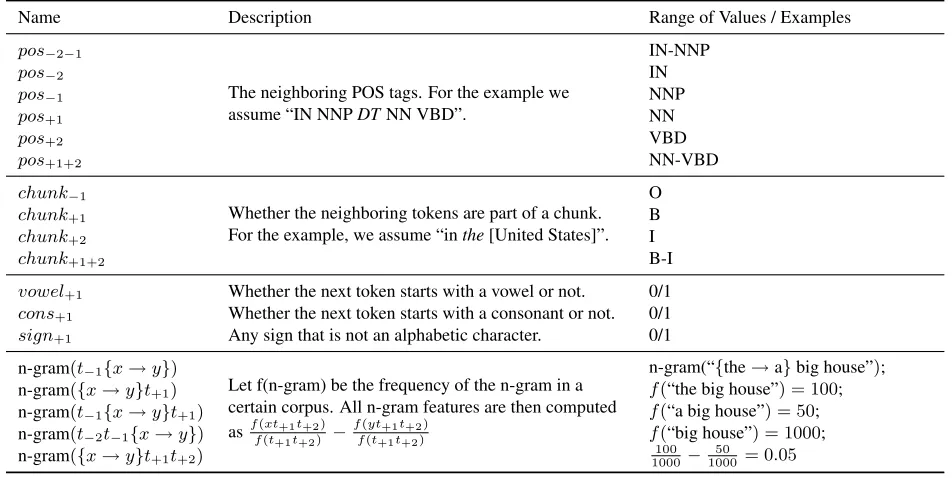
Table 1 lists the set of basic features implemented in the reference system. As our goal was to imple-ment a highly flexible system, we put more effort in the overall architecture than in the feature engi-neering. N-gram features are computed based on the
4In the official runs,anwas not part of the confusion set, but
was specially handled in a post-processing step. In the current version of the framework, we removed this heuristic and now treatanas a normal part of the confusion set.
Google Web1T n-gram corpus (Brants and Franz, 2006) which is accessed using jWeb1T.5
The listed features can be improved in many ways, e.g. the chunk feature could also encode the type of the chunk. As the framework allows to easily add new feature extractors, we are going to integrate the most successful features from the shared task. Due to the modular architecture of ClearTK, the im-plemented feature extractors could even be re-used for other classification tasks unrelated to spelling correction.
2.3 Classification
ClearTK provides a wide range of adapters to well known machine learning frameworks and classifica-tion tools. As of April 2012, the following adapters are supported:
• LIBSVM6
• MALLET7(McCallum, 2002)
• OpenNLP Maxent8
• SVMlight9(Joachims, 1999)
• SVMlight-TK10(Moschitti, 2006)
• Weka11(Hall et al., 2009)
As we can easily switch the classifier, we tried a wide range of classifiers, but SVM worked gen-erally best. For the official runs, we used SVM as implemented in the Weka toolkit with the parameter “BuildLogisticModels” which allows to base a de-tection decision on the confidence of the classifier in order to improve precision.
3 Knowledge-based Error Detection
Besides the supervised system described above, we also apply our knowledge-based system from the HOO 2011 Pilot Round (Zesch, 2011). We re-implemented two state-of-the-art approaches: the
5code.google.com/p/jweb1t/ 6
http://www.csie.ntu.edu.tw/∼cjlin/libsvm/
7http://mallet.cs.umass.edu/ 8http://opennlp.apache.org/ 9
http://svmlight.joachims.org/
Name Description Range of Values / Examples
pos−2−1
The neighboring POS tags. For the example we assume “IN NNPDTNN VBD”.
IN-NNP
pos−2 IN
pos−1 NNP
pos+1 NN
pos+2 VBD
pos+1+2 NN-VBD
chunk−1
Whether the neighboring tokens are part of a chunk. For the example, we assume “inthe[United States]”.
O
chunk+1 B
chunk+2 I
chunk+1+2 B-I
vowel+1 Whether the next token starts with a vowel or not. 0/1 cons+1 Whether the next token starts with a consonant or not. 0/1 sign+1 Any sign that is not an alphabetic character. 0/1
n-gram(t−1{x→y})
Let f(n-gram) be the frequency of the n-gram in a certain corpus. All n-gram features are then computed asf(xt+1t+2)
f(t+1t+2) −
f(yt+1t+2) f(t+1t+2)
n-gram(“{the→a}big house”); f(“the big house”) = 100; f(“a big house”) = 50; f(“big house”) = 1000;
100 1000−
50 1000 = 0.05
n-gram({x→y}t+1)
n-gram(t−1{x→y}t+1)
n-gram(t−2t−1{x→y})
[image:3.612.69.545.58.297.2]n-gram({x→y}t+1t+2)
Table 1: List of features used for classification.
knowledge-based approach (Hirst and Budanitsky, 2005) and the statistical approach (Mays et al., 1991; Wilcox-OHearn et al., 2008). Both approaches mea-sure the contextual fitness of a word and the sur-rounding context. For that purpose, the knowledge-based approach computes the semantic relatedness of a target word with all other words in a certain con-text window. This approach is not suitable for cor-recting article or preposition errors, as these word classes are not linked to the context via lexical-semantic relations. Thus, we only use the statisti-cal approachthat computes the probability of a sen-tence based on a n-gram language model. We use the Google Web1T n-gram data (Brants and Franz, 2006).
Although being generally applicable to article and preposition errors, the statistical approach needs some adaptations in order to achieve acceptable per-formance. In the original definition, the approach computes the probability of all alternative sentences where the target word is replaced with a word from the vocabulary that has low edit distance to the tar-get word. This results in a very high false detection rate. Thus, we (i) limit detections to positions where an article or preposition is already present, and (ii) select the substitution candidate not from all tokens with low edit distance to the original token, but only
from the appropriate confusion set.
As the statistical approach is purely based on n-gram frequencies, while this is only one feature of the supervised approach, we expect the supervised approach to outperform our adapted knowledge-based system by a wide margin.
4 Experimental Setup
We model all experiment pipelines in the previously described framework. As training data, we use the publicly available Brown corpus (Francis W. Nelson and Kuc¸era, 1964), but limit training to 3,700 ran-domly selected sentences in order to speed up the training process.
4.1 Unofficial Runs
Due to technical problems, we were not able to sub-mit all runs in time. We therefore report also unof-ficial runs which we evaluated on the test data that was available for participants for a limited amount of time.12 Although we did not tailor the unofficial runs in any way towards the test data, they have cer-tainly a different status than the official runs. We do not consider this as a major problem, as our basic
12HOO 2012 test data was subject to a strict license and
Detection Recognition Correction
Description Run P R F P R F P R F
Baselines Alwaysthe - 7.09 6.13 6.58 7.09 6.13 6.58 2.00 1.69 1.81
Alwaysof - 11.51 28.54 16.40 11.51 28.54 16.40 1.53 3.81 2.19
Unofficial
2011 Articles;α=.005 - 9.62 8.47 9.00 9.62 8.47 9.00 0.96 0.85 0.90 2011 Prepositions;α=.005 - 18.11 23.04 20.28 18.11 23.04 20.28 9.00 11.42 10.05 2012 Naive Bayes - 9.35 39.32 15.11 9.35 39.32 15.11 1.26 5.29 2.03
2012 SVM - 10.46 33.40 15.93 10.46 33.40 15.93 2.71 8.67 4.13
Official
θRD= 0.95;θRT = 0.8 UD0 8.64 7.73 8.16 4.94 4.42 4.66 1.48 1.32 1.40
θRD= 0.8;θRT= 0.7 UD1 8.36 15.45 10.85 4.18 7.73 5.43 1.19 2.21 1.55
θRD= 0.5;θRT= 0.3 UD2 8.94 31.13 13.88 5.51 19.21 8.57 1.20 4.19 1.87
Table 2: HOO 2012 test data: Results (in %) for article and preposition errors combined.
feature set is not competitive with the best perform-ing systems anyway.
We implemented two baseline systems, one for articles and one for prepositions. The baselines re-place every occurrence of an article/preposition with the most frequent article/preposition from the confu-sion set (thefor articles,of for prepositions).
We also apply the adapted HOO 2011 statistical approach in two versions as described above: one adapted towards articles, and one adapted towards prepositions.
Finally, we use the new framework for supervised error correction based on the basic feature set de-scribed above with two classifiers: Naive Bayes and SVM as implemented in the Weka toolkit version 3.7.5. We treat the correction task as a multi-class problem and only target the error classes RD, RT, UD, UT. The remaining error classes MD and MT (missing articles and prepositions) are more chal-lenging, as it is less obvious how to create good training data from a non-error annotated corpus.
4.2 Official Runs
The three runs that were officially submitted are also based on the SVM implementation in Weka, but we applied the parameter “BuildLogisticMod-els” which allows to base a detection decision on the confidence of the classifier in order to improve precision. We tuned parameters on the training data and report three runs for the threshold combinations (θRD, θRT) = (0.95, 0.8), (0.8, 0.7), and (0.5, 0.3).
5 Results
Table 2 summarizes the results of all runs. As ex-pected, the basic feature set used in our experiments is not competitive with the top-performing systems in the shared task.13 However, some observations can be made from the relative differences between the scores. The thresholds applied in the official runs are not working as expected, as precision is not in-fluenced, while recall drops a lot. The HOO 2011 system based on the statistical approach performs quite well for prepositions, but not for articles. Its performance is comparable to the supervised runs, but this is only due to the limited feature set used in our experiment.
As mentioned above, our focus was to implement a highly flexible and modular system for supervised error correction which can be easily augmented by other researchers. We plan to model the most suc-cessful systems in our framework as soon as the sys-tem descriptions are made available, and we invite other participating teams to help with this effort. The system might provide a level playground for subse-quent shared tasks and enable further progress in this important field of research.
Acknowledgments
This work has been supported by the Volkswagen Foundation as part of the Lichtenberg-Professorship Program under grant No. I/82806.
13
References
Thorsten Brants and Alex Franz. 2006. Web 1T 5-gram Version 1.
Andrew J Carlson, Jeffrey Rosen, and Dan Roth. 2001. Scaling Up Context-Sensitive Text Correction. In Pro-ceedings of IAAI.
Robert Dale, Ilya Anisimoff, and George Narroway. 2012. HOO 2012: A Report on the Preposition and Determiner Error Correction Shared Task. In Proceed-ings of the Seventh Workshop on Innovative Use of NLP for Building Educational Applications, Montreal, Canada.
Richard Eckart de Castilho and Iryna Gurevych. 2011. A lightweight framework for reproducible parame-ter sweeping in information retrieval. In Proceed-ings of the 2011 workshop on Data infrastructurEs for supporting information retrieval evaluation (DESIRE ’11), New York, NY, USA. ACM.
David Ferrucci and Adam Lally. 2004. UIMA: An Ar-chitectural Approach to Unstructured Information Pro-cessing in the Corporate Research Environment. Nat-ural Language Engineering, 10(3-4):327–348. Francis W. Nelson and Henry Kuc¸era. 1964.
Man-ual of information to accompany a standard corpus of present-day edited American English, for use with dig-ital computers.
Andrew R. Golding and Yves Schabes. 1996. Com-bining Trigram-based and feature-based methods for context-sensitive spelling correction. InProceedings of the 34th annual meeting on Association for Com-putational Linguistics, pages 71–78, Morristown, NJ, USA. Association for Computational Linguistics. Mark Hall, Eibe Frank, Geoffrey Holmes, Bernhard
Pfahringer, Peter Reutemann, and Ian H. Witten. 2009. The WEKA Data Mining Software: An Update. SIGKDD Explorations, 11(1).
Graeme Hirst and Alexander Budanitsky. 2005. Correct-ing real-word spellCorrect-ing errors by restorCorrect-ing lexical cohe-sion. Natural Language Engineering, 11(1):87–111, March.
Thorsten Joachims. 1999. Making large-scale SVM learning practical. In B. Scholkopf, C. Burges, and A. Smola, editors,Advances in Kernel Methods - Sup-port Vector Learning.
Michael P Jones and James H Martin. 1997. Contex-tual spelling correction using latent semantic analy-sis. In Proceedings of the Fifth Conference on Ap-plied Natural Language Processing, pages 166–173, Morristown, NJ, USA. Association for Computational Linguistics.
Eric Mays, Fred. J Damerau, and Robert L Mercer. 1991. Context based spelling correction. Information Pro-cessing & Management, 27(5):517–522.
Andrew Kachites McCallum. 2002. MALLET: A Ma-chine Learning for Language Toolkit.
Alessandro Moschitti. 2006. Making tree kernels practi-cal for natural language learning. In Proceedings of the Eleventh International Conference on European Association for Computational Linguistics, Trento, Italy.
Philip V. Ogren, Philipp G. Wetzler, and Steven Bethard. 2008. ClearTK: A UIMA Toolkit for Statistical Nat-ural Language Processing. In Towards Enhanced Interoperability for Large HLT Systems: UIMA for NLP workshop at Language Resources and Evaluation Conference (LREC).
Helmut Schmid. 2004. Efficient Parsing of Highly Am-biguous Context-Free Grammars with Bit Vectors. In Proceedings of the 20th International Conference on Computational Linguistics (COLING 2004), Geneva, Switzerland.
Amber Wilcox-OHearn, Graeme Hirst, and Alexander Budanitsky. 2008. Real-word spelling correction with trigrams: A reconsideration of the Mays, Damerau, and Mercer model. In Proceedings of the 9th inter-national conference on Computational linguistics and intelligent text processing (CICLing).