An Approach to Text Summarization
Sankar K Sobha L
AU-KBC Research Centre AU-KBC Research Centre MIT Campus, Anna University MIT Campus, Anna University
Chennai- 44. Chennai- 44.
[email protected] [email protected]
Abstract
We propose an efficient text summarization technique that involves two basic opera-tions. The first operation involves finding coherent chunks in the document and the second operation involves ranking the text in the individual coherent chunks and pick-ing the sentences that rank above a given threshold. The coherent chunks are formed by exploiting the lexical relationship be-tween adjacent sentences in the document. Occurrence of words through repetition or relatedness by sense relation plays a major role in forming a cohesive tie. The pro-posed text ranking approach is based on a graph theoretic ranking model applied to text summarization task.
1 Introduction
Automated summarization is an important area in NLP research. A variety of automated summariza-tion schemes have been proposed recently. NeATS (Lin and Hovy, 2002) is a sentence position, term frequency, topic signature and term clustering based approach and MEAD (Radev et al., 2004) is a centroid based approach. Iterative graph based Ranking algorithms, such as Kleinberg’s HITS algorithm (Kleinberg, 1999) and Google’s Page-Rank (Brin and Page, 1998) have been traditionally and successfully used in web-link analysis, social
networks and more recently in text processing ap-plications (Mihalcea and Tarau, 2004), (Mihalcea et al., 2004), (Erkan and Radev, 2004) and (Mihal-cea, 2004). These iterative approaches have a high time complexity and are practically slow in dy-namic summarization. Proposals are also made for coherence based automated summarization system (Silber and McCoy, 2000).
We propose a novel text summarization tech-nique that involves two basic operations, namely finding coherent chunks in the document and rank-ing the text in the individual coherent chunks formed.
For finding coherent chunks in the document, we propose a set of rules that identifies the connection between adjacent sentences in the document. The connected sentences that are picked based on the rules form coherent chunks in the document. For text ranking, we propose an automatic and unsu-pervised graph based ranking algorithm that gives improved results when compared to other ranking algorithms. The formation of coherent chunks greatly improves the amount of information of the text picked for subsequent ranking and hence the quality of text summarization.
This paper is organized as follows: section 2 discusses lexical cohesion, section 3 discusses the text ranking algorithm and section 4 describes the summarization by combining lexical cohesion and summarization.
2 Lexical Cohesion
Coherence in linguistics makes the text semantical-ly meaningful. It is achieved through semantic fea-tures such as the use of deictic (a deictic is an expression which shows the direction. ex: that, this.), anaphoric (a referent which requires an ante-cedent in front. ex: he, she, it.), cataphoric (a refe-rent which requires an antecedent at the back.), lexical relation and proper noun repeating elements (Morris and Hirst, 1991). Robert De Beaugrande and Wolfgang U. Dressler define coherence as a “continuity of senses” and “the mutual access and relevance within a configuration of concepts and relations” (Beaugrande and Dressler, 1981). Thus a text gives meaning as a result of union of meaning or senses in the text.
The coherence cues present in a sentence are di-rectly visible when we go through the flow of the document. Our approach aims to achieve this ob-jective with linguistic and heuristic information. The identification of semantic neighborhood, oc-currence of words through repetition or relatedness by sense relation namely synonyms, hyponyms and hypernym, plays a major role in forming a cohesive tie (Miller et al., 1990).
2.1 Rules for finding Coherent chunks
When parsing through a document, the relationship among adjacent sentences is determined by the continuity that exists between them.
We define the following set of rules to find co-herent chunks in the document.
Rule 1
The presence of connectives (such as accordingly, again, also, besides) in present sentence indicates the connectedness of the present sentence with the previous sentence. When such connectives are found, the adjacent sentences form coherent chunks.
Rule 2
A 3rd person pronominal in a given sentence refers to the antecedent in the previous sentence, in such a way that the given sentence gives the complete meaning with respect to the previous sentence. When such adjacent sentences are found, they form coherent chunks.
Rule 3
The reappearance of NERs in adjacent sentences is an indication of connectedness. When such adja-cent sentences are found, they form coherent chunks.
Rule 4
An ontology relationship between words across sentences can be used to find semantically related words across adjacent sentences that appear in the document. The appearance of related words is an indication of its coherence and hence forms cohe-rent chunks.
All the above rules are applied incrementally to achieve the complete set of coherent chunks.
2.1.1 Connecting Word
The ACE Corpus was used for studying the cohe-rence patterns between adjacent sentences of the document. From our analysis, we picked out a set of keywords such that, the appearance of these keywords at the beginning of the sentence provide a strong lexical tie with the previous sentence. The appearance of the keywords “accordingly, again, also, besides, hence, henceforth, however, incidentally, meanwhile, moreover, namely, never-theless, otherwise, that is, then, therefore, thus, and, but, or, yet, so, once, so that, than, that, till, whenever, whereas and wherever”, at the begin-ning of the present sentence was found to be highly coherent with the previous sentence.
Linguistically a sentence cannot start with the above words without any related introduction in the previous sentence.
1. a The train was late.
1. b However I managed to reach the wedding on time.
In Example 1, the connecting word however binds with the situation of the train being late.
Example 2
1. a The cab driver was late. 1. b The bike tyre was punctured. 1. c The train was late.
1 .d Finally, I managed to arrive at the wed-ding on time by calling a cab.
Example 3
1. a The cab driver was late. 1. b The bike tyre was punctured. 1. c The train was late.
1. d I could not wait any more; I finally ma-naged to reach the wedding on time by calling a cab.
In Example 2, the connecting word finally binds with the situation of him being delayed. Similarly, in Example 3, the connecting word finally, though it comes in the middle of the sentence, it still binds with the situation of him being delayed.
2.1.2 Pronominals
In this approach we have a set of pronominals which establishes coherence in the text. From our analysis, it was observed that if the pronominals “he, she, it, they, her, his, hers, its, their, theirs”, appear in the present sentence; its antecedent may be in the same or previous sentence.
It is also found that if the pronominal is not pos-sessive (i.e. the antecedent appears in the previous sentence or previous clause), then the present sen-tence and the previous sensen-tences are connected. However, if the pronominal is possessive then it behaves like reflexives such as “himself”, “herself” which has subject as its antecedent. Hence the pos-sibility of connecting it with the previous sentence is very unlikely. Though pronominal resolution cannot be done at a window size of 2 alone, still we are looking at window size 2 alone to pick guaranteed connected sentences.
Example 4
1. a Ravi is a good boy.
1. b He always speaks the truth.
In Example 4, the pronominal he in the second sen-tence refers to the antecedent Ravi in the first sen-tence.
Example 5
1. a He is the one who got the first prize.
In example 5 the pronominal he is possessive and it doesn’t need an antecedent to convey the mean-ing.
2.1.3 NERs Reappearance
Two adjacent sentences are said to be coherent when both the sentences contain one or more reap-pearing nouns.
Example 6
1. a Ravi is a good boy.
1. b Ravi scored good marks in exams.
Example 7
1. a The car race starts at noon. 1. b Any car is allowed to participate.
Example 6 and Example 7 demonstrates the cohe-rence between the two sentences through reappear-ing nouns.
2.1.4 Thesaurus Relationships
WordNet covers most of the sense relationships. To find the semantic neighborhood between adja-cent sentences, most of the lexical relationships such as synonyms, hyponyms, hypernyms, mero-nyms, holonyms and gradation can be used (Fell-baum 1998). Hence, semantically related terms are captured through this process.
Example 8
1. a The bicycle has two wheels.
1. b The wheels provide speed and stability.
In Example 8, bicycle and wheels are related through bicycle is the holonym of wheels.
2.2 Coherence Finding Algorithm
phases are merged together to give the global cohe-rent chunks in the document.
[image:4.612.78.255.124.382.2].
Figure 1: Flow of Coherence chunker
Figure 1, shows the flow and rule positions in the coherence chunk identification module.
2.3 Evaluation
One way to evaluate the coherence finding algo-rithm is to compare against human judgments made by readers, evaluating against text pre marked by authors and to see the improved result in the computational task. In this paper we will see the computational method to see the improved re-sult.
3 Text Ranking
The proposed graph based text ranking algorithm consists of three steps: (1) Word Frequency Analy-sis; (2) A word positional and string pattern based weight calculation algorithm; (3) Ranking the sen-tences by normalizing the results of step (1) and (2).
The algorithm is carried out in two phases. The weight metric obtained at the end of each phase is
averaged to obtain the final weight metric. Sen-tences are sorted in non ascending order of weight.
3.1 Graph
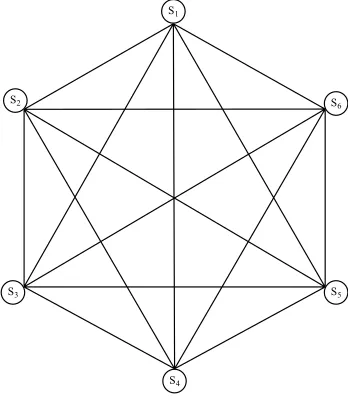
Let G (V, E) be a weighted undirected complete graph, where V is set of vertices and E is set of weighted edges.
S1
S2
S3
S6
S5
[image:4.612.336.510.170.370.2]S4
Figure 2: A complete undirected graph
In figure 2, the vertices in graph G represent the set of all sentences in the given document. Each sen-tence in G is related to every other sensen-tence through the set of weighted edges in the complete graph.
3.2 Phase 1
Let the set of all sentences in document S= {si | 1 ≤
i ≤ n}, where n is the number of sentences in S. The sentence weight (SW) for each sentence is cal-culated by average affinity weight of words in it. For a sentence si= {wj | 1 ≤j ≤mi} where mi is the
number of words in sentence si, (1 ≤ i ≤n) the
af-finity weight AW of a word wj is calculated as
fol-lows:
( , )
( )
( )
j k
k j
IsEqual w w w S
AW w
WC S
∀ ∈
=
∑
(1)where S is the set of all sentences in the given document, wk is a word in S, WC (S) is the total
number of words in S and function IsEqual(x, y) returns an integer count 1 if x and y are equal else integer count 0 is returned by the function.
Input Text
Connecting Word
Possessive Pronoun
Noun Reappearance
Next, we find the sentence weight SW (si) of
each sentence si (1 ≤i≤n) as follows:
1
( )i ( )j
i j i
SW s AW w
m w s
=
∀ ∈
∑
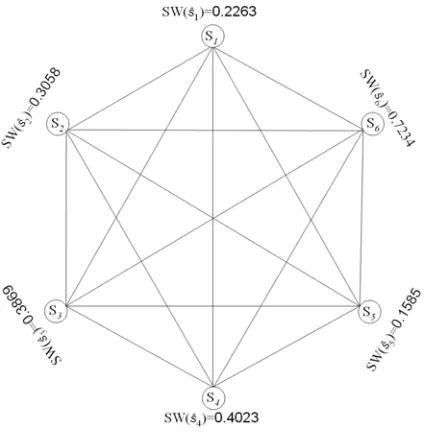
(2) [image:5.612.83.295.442.659.2]At the end of phase 1, the graph vertices hold the sentence weight as illustrated in figure 4.
Figure 2: Sample text taken for the ranking process.
Figure 4: Sample graph of Sentence weight calcu-lation in phase 1
3.3 Compression hash
A fast compression hash function over word wis given as follows:
H (w) = (c1ak-1+c2ak-2 +c3ak-3+...+cka0) mod p (3)
where w= {c1, c2, c3 ... ck} is the ordered set of
ASCII equivalents of alphabets in w and k the total number of alphabets in w. The choice of a=2 per-mits the exponentiations and term wise multiplica-tions in equation 3 to be binary shift operamultiplica-tions on a micro processor, thereby speeding up the hash computation over the text. Any lexicographically ordered bijective map from character to integer may be used to generate set w. The recommenda-tion to use ASCII equivalents is solely for imple-mentation convenience. Set p = 26 (for English), to cover the sample space of the set of alphabets un-der consiun-deration.
Compute H (w) for each word in sentence si to
obtain the hashed set
1 2
( ) { ( ), ( )... (i mi)}
H s = H w H w H w (4)
Next, invert each element in the set H (si) back
to its ASCII equivalent to obtain the set
1 2
ˆ ˆ( ) { ( ), ( )... ( )}i ˆ ˆ ˆmi
H s = H c H c H c (5)
Then, concatenate the elements in set H(s )ˆ i to
obtain the stringsˆi; where sˆi is the compressed
representation of sentence si. The hash operations
are carried out to reduce the computational com-plexity in phase 2, by compressing the sentences and at the same time retaining their structural properties, specifically word frequency, word posi-tion and sentence patterns.
3.4 Levenshtein Distance
Levenshtein distance (LD) between two strings string1 and string2 is a metric that is used to find the number of operations required to convert string1 to string2 or vice versa; where the set of possible operations on the character is insertion, deletion, or substitution.
The LD algorithm is illustrated by the following example
LD (ROLL, ROLE) is 1
LD (SATURDAY, SUNDAY) is 3 [1]"The whole show is dreadful," she cried,
com-ing out of the menagerie of M. Martin.
[2]She had just been looking at that daring specu-lator "working with his hyena" to speak in the style of the program.
[3]"By what means," she continued, "can he have tamed these animals to such a point as to be cer-tain of their affection for."
[4]"What seems to you a problem," said I, inter-rupting, "is really quite natural."
[5]"Oh!" she cried, letting an incredulous smile wander over her lips.
3.5 Levenshtein Similarity Weight
Consider two strings, string1 and string2 where ls1 is the length of string1 and ls2 be the length of string2. Compute MaxLen=maximum (ls1, ls2). Then LSW between string1 and string2 is the dif-ference between MaxLen and LD, divided by Max-Len. Clearly, LSW lies in the interval 0 to 1. In case of a perfect match between two words, its LSW is 1 and in case of a total mismatch, its LSW is 0. In all other cases, 0 < LSW <1. The LSW metric is illu-strated by the following example.
LSW (ABC, ABC) =1 LSW (ABC, XYZ) =0 LSW (ABCD, EFD) =0.25
Hence, to find the Levenshtein similarity weight, first find the Levenshtein distance LD us-ing which LSW is calculated by the equation
ˆ ˆ ˆ ˆ
( , ) ( , )
ˆ ˆ ( , )
ˆ ˆ ( , )
i j i j
i j
i j
MaxLen s s LD s s
LSW s s
MaxLen s s
−
= (6)
where, sˆiandsˆjare the concatenated string
out-puts of equation 5.
3.6 Phase 2
Let S = {si | 1 ≤i ≤ n} be the set of all sentences in
the given document; where n is the number of sen-tences in S. Further, si= {wj | 1 ≤j ≤ m}, where m
[image:6.612.80.296.466.679.2]is the number of words in sentence si.
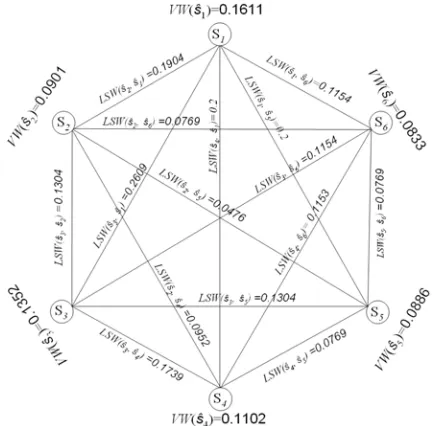
Figure 5: Sample graph for Sentence weight calcu-lation in phase 2
i
s S
∀ ∈ ,find H sˆ ˆ( ) { ( ), ( )... ( )}i = H c H cˆ1 ˆ2 H cˆmi
using equation 3 and 4. Then, concatenate the ele-ments in set H(s )ˆ i to obtain the stringsˆi; where sˆi
is the compressed representation of sentence si.
Each stringsˆi; 1 ≤ i ≤ n is represented as the
vertex of the complete graph as in figure 5
andS={s |1 i n}ˆ ˆi ≤ ≤ . For the graph in figure 5,
find the Levenshtein similarity weight LSW be-tween every vertex using equation 6. Find vertex weight (VW) for each stringsˆi; 1 ≤l ≤ n by
1
ˆ ˆ ˆ
( ) ( , )
ˆ ˆ ˆl
l l i
i
VW s LSW s s
n
s s S
=
∀ ≠ ∈
∑
(7)
4 Text Ranking
The rank of sentence si; 1 ≤i≤n is computed as
ˆ
( ) ( )
( ) ;1
2
i i
i SW s VW s
Rank s = + ≤ ≤i n (8)
where, SW s( )i is calculated by equation 2 of
phase 1 and VW s( )ˆi is found using equation 7 of
phase 2. Arrange the sentences si; 1 ≤i≤n, in non
increasing order of their ranks.
( )i
SW s in phase 1 holds the sentence affinity in terms of word frequency and is used to determine the significance of the sentence in the overall rak-ing scheme. VW s( )ˆi in phase 2 helps in the overall
ranking by determining largest common subse-quences and other smaller subsesubse-quences then as-signing weights to it using LSW. Further, since named entities are represented as strings, repeated occurrences are weighed efficiently by LSW, the-reby giving it a relevant ranking position.
5 Summarization
6 Evaluation
The ROUGE evaluation toolkit is employed to evaluate the proposed algorithm. ROUGE, an au-tomated summarization evaluation package based on Ngram statistics, is found to be highly corre-lated with human evaluations (Lin and Hovy, 2003a).
The evaluations are reported in ROUGE-1 me-trics, which seeks unigram matches between the generated and the reference summaries. The ROUGE-1 metric is found to have high correlation with human judgments at a 95% confidence level and hence used for evaluation. (Mihalcea and Ta-rau, 2004) a graph based ranking model with Rouge score 0.4904, (Mihalcea, 2004) Graph-based Ranking Algorithms for Sentence Extrac-tion, Applied to Text Summarization with Rouge score 0.5023.
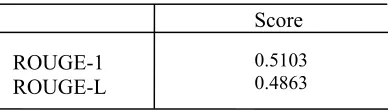
Table 1 shows the ROUGE Score of 567 news articles provided during the Document Under-standing Evaluations 2002(DUC, 2002) using the proposed algorithm without the inclusion of cohe-rence chunker module.
Table 2 shows the ROUGE Score of 567 news articles provided during the Document Under-standing Evaluations 2002(DUC, 2002) using the proposed algorithm after the inclusion of cohe-rence chunker module.
Comparatively Table 2, which is the the ROUGE score for summary including the cohe-rence chunker module gives better result.
7 Related Work
Text extraction is considered to be the important and foremost process in summarization. Intuitive-ly, a hash based approach to graph based ranking algorithm for text ranking works well on the task of extractive summarization. A notable study re-port on usefulness and limitations of automatic sentence extraction is reported in (Lin and Hovy, 2003b), which emphasizes the need for efficient algorithms for sentence ranking and summariza-tion.
8 Conclusions
In this paper, we propose a coherence chunker module and a hash based approach to graph based ranking algorithm for text ranking. In specific, we propose a novel approach for graph based text ranking, with improved results comparative to ex-isting ranking algorithms. The architecture of the algorithm helps the ranking process to be done in a time efficient way. This approach succeeds in grabbing the coherent sentences based on the lin-guistic and heuristic rules; whereas other super-vised ranking systems do this process by training the summary collection. This makes the proposed algorithm highly portable to other domains and languages.
References
ACE Corpus. NIST 2008 Automatic Content Extraction Evaluation(ACE08).
http://www.itl.nist.gov/iad/mig/tests/ace/2008/
Brin and L. Page. 1998. The anatomy of a large scale hypertextualWeb search engine. Computer Networks and ISDN Systems, 30 (1 – 7).
Erkan and D. Radev. 2004. Lexpagerank: Prestige in multi document text summarization. In Proceedings of the Conference on Empirical Methods in Natural Language Processing, Barcelona, Spain, July. Fellbaum, C., ed. WordNet: An electronic lexical
data-base. MIT Press, Cambridge (1998).
Kleinberg. 1999. Authoritative sources in a hyper-linked environment. Journal of the ACM, 46(5):604-632.
ROUGE-1 ROUGE-L
0.5312 0.4978 Score ROUGE-1
ROUGE-L
[image:7.612.87.281.395.450.2]0.5103 0.4863 Score
[image:7.612.84.283.580.633.2]Table 1: ROUGE Score for the news article summarization task without coherence chunker, calculated across 567 articles.
Lin and E.H. Hovy. From Single to Multi document Summarization: A Prototype System and its Evalua-tion. In Proceedings of ACL-2002.
Lin and E.H. Hovy. 2003a. Automatic evaluation of summaries using n-gram co-occurrence statistics. In Proceedings of Human Language Technology Confe-rence (HLT-NAACL 2003), Edmonton, Canada, May. Lin and E.H. Hovy. 2003b. The potential and limitations of sentence extraction for summarization. In Pro-ceedings of the HLT/NAACL Workshop on Automatic Summarization, Edmonton, Canada, May.
Mihalcea. 2004. Graph-based ranking algorithms for sentence extraction, applied to text summarization. In Proceedings of the 42nd Annual Meeting of the Asso-ciation for Computational Linguistics (ACL 2004) (companion volume), Barcelona, Spain.
Mihalcea and P. Tarau. 2004. TextRank - bringing order into texts. In Proceedings of the Conference on Em-pirical Methods in Natural Language Processing (EMNLP 2004), Barcelona, Spain.
Mihalcea, P. Tarau, and E. Figa. 2004. PageRank on semantic networks, with application to word sense disambiguation. In Proceedings of the 20th Interna-tional Conference on ComputaInterna-tional Linguistics (COLING 2004), Geneva, Switzerland.
Miller, G. A., Beckwith, R., Fellbaum, C., Gross, D., Miller, K. J. Introduction to WordNet: An on-line lexical database. Journal of Lexicography (1990). Morris, J., Hirst, G. Lexical cohesion computed by
the-saural relations as an indicator of the structure of text. Computational Linguistics (1991).
Radev, H. Y. Jing, M. Stys and D. Tam. Centroid-based summarization of multiple documents. Information Processing and Management, 40: 919-938, 2004. Robert de Beaugrande and Wolfgang Dressler.
Intro-duction to Text Linguistics. Longman, 1981.