© 2019, IRJET | Impact Factor value: 7.211 | ISO 9001:2008 Certified Journal | Page 2857
COMPARISON OF RELIABILITY OF CIRCULAR AND SQUARE CFST
COLUMNS USING IMPORTANCE SAMPLING METHOD
Jyothi M
1, Khalid Nayaz Khan
2, Dr. N S Kumar
31
Final Year Student, Department of Civil Engineering, Ghousia College of Engineering, Affiliated to VTU, Belagavi,
Ramanagaram-562159, Karnataka, India
2
Ass.Professor, Dpt.of Civil Engineering, Affiliated to VTU, Belagavi, Ramanagaram-562159, Karnataka, India
3
Prof. & Director (R&D), Dpt.of Civil Engineering, Affiliated to VTU, Belagavi, Ramanagaram-562159,
Karnataka, India
---***---Abstract - In this study, analysis of CFST columns is done with the help of ANSYS software. The models are prepared and analyzed in ANSYS software to ascertain the failure loads for different lengths, thickness and slenderness ratios of CFST columns. Here we compare the reliability of both circular and square CFST columns. The analytical Pu values are compared with Codal provisions such as Euro code, AS3600-1999 and BS5400 Code. Graphs are plotted to know the difference between analytical Pu and Codal Pu values. The reliability analysis is carried out to know the design goal so as to achieve the nominal load carrying capacity with less deflection. The reliability analysis is carried out with the help of 2rRel software and the results such as reliability index and probability of failure are tabulated for each CFST model. The reliability analysis is performed by FORM. Simulation technique namely Importance sampling method is used in this work. The Taguchi’s approach is adopted to identify and pick the combination of parameters which yield the best reliability index.
Key Words: CFST, ANSYS, Reliability, Importance
Sampling, FORM, 2R rel.
1.INTRODUCTION
In these days, the composite structural elements are extensively used in tall buildings, bridges and different types of structures. Because of its composite effects, the disadvantage of two materials may be compensated and the benefits may be combined to impart an efficient structural system.
Concrete filled steel structural section columns are an efficient, cost-effective, and aesthetically desirable members through which large compressive loads are supported in buildings. These structural members include a hallow steel tube which is in-packed with concrete and through composite action, advanced load carrying capacity and better fire resistance can be obtained compared to unfilled steel tubes.
The concrete infill and the metal tube work together to provide several key advantages. The steel tube acts as stay-in-place formwork all through casting of the concrete, lowering forming and stripping expenses. It gives lateral
confinement to the infill concrete that could enhance the concrete’s compressive strength and axial deformability, and it offers an easy, rugged, and strong architectural floor finish.
1.1 Concept of Reliability
Reliability of the structure can be described as its potential to satisfy its design reason over a special time period. In its narrowest sense, reliability considers the chance that the systems will not reach any of the desired limits during the time span under reference.
If it does, the probability of failure should be anticipated and that degree of reliability decided.
1.2 First Order Reliability Method
FORM was initially proposed by Hasofer et al. (1974). It is capable of handling non-linear performance functions, and correlated non –normal variables. FORM is also referred to as Mean Value First order second moment method (MVFOSM). FORM linearizes the performance function using Taylor series approximation. FORM uses only mean and standard deviation of the variables. The performance / limit state function is given by Z = R-S
1.3 Importance Sampling Method
Importance sampling specializes in the area of space that contributes the maximum to the failure probability of a system. This characteristic selection enables a better sampling density within the location of interest. Nevertheless, variable independence is assumed, which results in biased effects if the correlation between any pair of variables is different to zero. The information phase summarizes the number of iterations that were run N as well as the probability of failure that was obtained Pf.
2. Material and Methodology
2.1 Material Properties
STEEL:
© 2019, IRJET | Impact Factor value: 7.211 | ISO 9001:2008 Certified Journal | Page 2858 c) Poison’s ratio μ =0.3
d) Density ρ =7850kg/m3 CONCRETE:
a) Grade of Concrete: M20, M30, M40
b) Young’s Modulus E=22360.7Mpa, 27386.1Mpa,
31622.7Mpa
c) Poison’s ratio μ=0.15,0.27,0.33.
d) Density ρ =2400kg/m3
2.2 Section Properties
Table -1a): Details of section properties for Circular CFST
Table -1b): Details of section properties for Square s/c
3.1 Design Codes
EUROCODE:
According to the Euro Code, the ultimate load carrying capacity of columns is calculated by using below equation
Pu=Asfy+Acfc
BS 5400:
According to the BS 5400, the ultimate load carrying capacity of columns is calculated by using below equation
Pu=Asfy+0.675Acfc
AS 3600-1999:
According to the AS 3600-1999, the ultimate load carrying capacity of columns is calculated by using below equation
Pu= Asfy+0.85Acfc
[image:2.595.311.554.320.700.2]6. Results and Comparison
© 2019, IRJET | Impact Factor value: 7.211 | ISO 9001:2008 Certified Journal | Page 2860 Table 6.8: Reliability Analysis Results obtained from
[image:4.595.46.279.126.265.2]FORM method for circular section
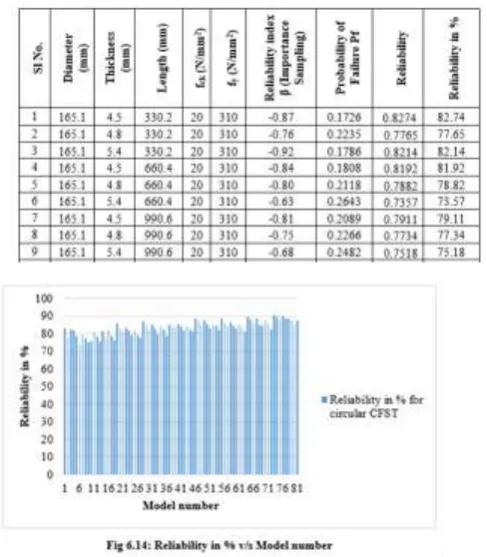
Table 6.9: Reliability Analysis Results obtained from Importance Sampling method for circular section
[image:4.595.37.281.304.583.2]Table 6.10: Reliability Analysis Results obtained from FORM method for square section
Table 6.11: Reliability Analysis Results obtained from Importance Sampling method for square section
[image:4.595.44.554.422.788.2]© 2019, IRJET | Impact Factor value: 7.211 | ISO 9001:2008 Certified Journal | Page 2861
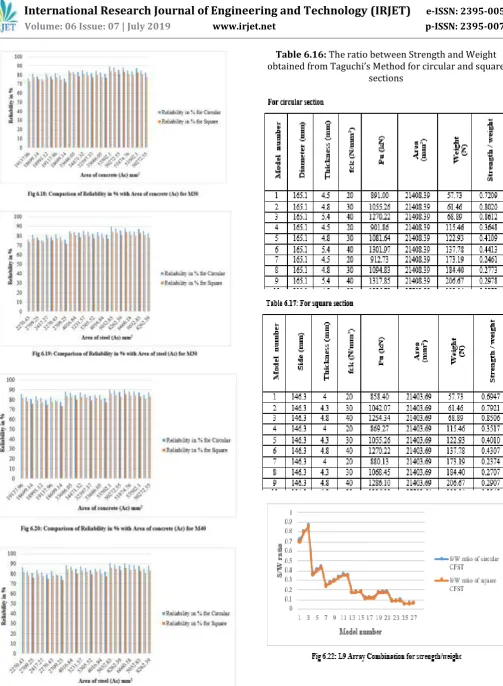
Table 6.16: The ratio between Strength and Weight obtained from Taguchi’s Method for circular and square
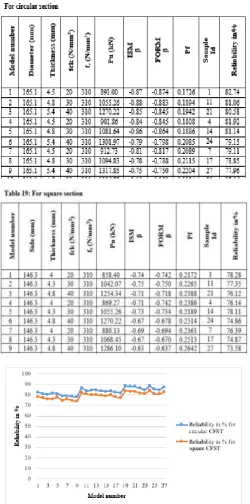
© 2019, IRJET | Impact Factor value: 7.211 | ISO 9001:2008 Certified Journal | Page 2862 Table 6.18: Taguchi’s L9 Orthogonal Array Combination
for Importance sampling method
5. Conclusions
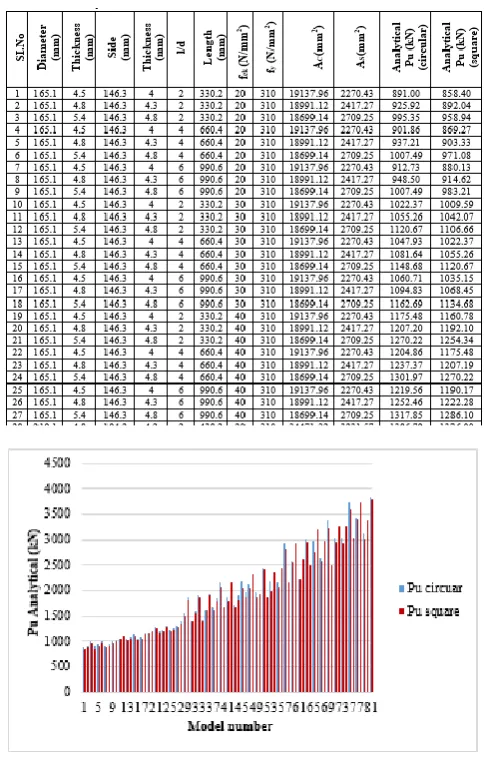
1. The ultimate load Pu obtained from ANSYS1result shows that the ultimate load carrying capacity of CFST tubes increase with increase in thickness of metal (Table: 6.1).
2. Pu value for circular column is more by 1 to 10% to that of square column for same concrete & steel area (Table: 6.1).1
3. Ultimate load Pu obtained from ANSYS for both circular and square sections with various codes like Euro code, BS 5400 and AC3600-1999 shows that Pu obtained from ANSYS is varying about 15 to 20% (Table: 6.2,6.3,6.4)
4. Reliability Percentage of circular column is more compared to that of square column for similar cross sectional areas (Table:12).
5. Results show that the reliability percentage obtained by FORM method and Importance Sampling method are almost similar.
6. From Taguchi method, model-3 gives the best strength to weight ratio for both circular as well as square sections (Graph: 22).
7. Model-19 from Taguchi array gives maximum reliability for circular section (Graph:6.23)
8. Model-24 from Taguchi array gives maximum reliability for square section (Graph: 6.23)
REFERENCES
[1]. Finite Element Analysis Theory and application with ANSYS by Saeed Moaveni, Minnesoter state university Mankato.
[2]. Naveen Kumar S, Khalid Nayaz Khan and Dr. N.S. Kumar (2017) “Reliability analysis of concrete filled steel tube columns by FOSM & Subset simulation Technique” Mtech dissertation 2017.
[3]. Reliability Analysis of composite columns a dissertation by Pankaj Kumar Department of civil engineering IIT Roorke (2002).
[4]. Structural Reliability Methods (2005) by O. Dittevsen and H.O Madsen.
[5]. Reliability Analysis for Structural design (2009) by Milan Holicky.
[6]. Reliability Based Analysis and Design for Civil
Engineers by Devaraj V and Ravindra UVCE, Banglore University, Banglore
[7]. Schneider, S., 1998, “Axially Loaded Concrete Filled Steel tubes,” ASCE, J. Structural Engineering., 124(10), pp.1125-1138.
[8]. AISC: 2005, Load and Resistance Factor Design Specification for Structural Steel Building, American Institute of Steel Construction, Chicago.
© 2019, IRJET | Impact Factor value: 7.211 | ISO 9001:2008 Certified Journal | Page 2863 [10]Dr.B.R.Niranjan0&0Eramma.H.,(2014)“Experiment on
CFST which are triangular fluted under concentric loading”.
[11]. Furlong, R.W., 1967, “Strength of Steel-encased Concrete Beam columns,” J. Structural Engineering; ASCE, 93(5), pp.113-124.
[12]. Shanmugam, N. E., and Lakshmi, 2001, “State of the Art report on Steel Concrete Composite Columns,” J. of Constructional Steel Analysis., 57(1), pp. 1041-1080.
BIOGRAPHIES
Graduated in the year 2017 from PES College of Engineering, Mandya, Affiliated by VTU, Belgaum. Presently perusing Master of Technology in Structural Engineering at Ghousia College of Engineering, Ramanagaram. Also working on this topic for the dissertation under the guidance of
Mr. Khalid Nayaz khan and Dr. N S Kumar.
Associate Professor Dept. of Civil Engineering GCE, Ramanagaram, 562159. He has a Teaching experience of 33 years. Has published about 15 papers in various journals.