Attribute-Based Data Sharing Scheme Revisited in
Cloud Computing
Shulan Wang, Kaitai Liang, Joseph K. Liu, Jianping Yu, Jianyong Chen, Weixin Xie
Abstract—Ciphertext-policy attribute-based encryption (CP-ABE) is a promising encryption technology for secure data sharing in cloud computing, in which data owner can fully control access structure associated with a ciphertext. However, it brings a major drawback which is known as key escrow problem, since the decryption users’ secret keys are issued by an unconditionally trusted third party (i.e. key authority). In addition, there is another problem that most of CP-ABE schemes cannot express arbitrary-state attributes. In this paper, we revisited attribute-based data sharing scheme in order to solve the key escrow issue and improve the ability of attribute expression in cloud computing. An improved two-party key issuing protocol ensures that neither key authority nor cloud service provider can generate the whole secret keys of users individually. Moreover, the function of weighted attribute is provided to enhance the attribute expres-sion, which can not only extend attributes from binary state to arbitrary states, but also reduce the complexity of access policy associated with a ciphertext. Therefore, both ciphertext storage and time cost in encryption are saved. The performance analysis and security proof show that the proposed scheme is efficient to securely achieve data sharing in cloud computing.
Keywords—Cloud computing, Data sharing, Attribute-based en-cryption, Removing escrow, Weighted attribute.
I. INTRODUCTION
C
LOUD computing has become a research hot-spot due to its renowned advantages (e.g. convenience, high scalabil-ity). One of the most promising cloud applications is online data sharing, such as Online Social Networks with more than one billion users [1]. Data owner (DO) stores large amounts of data in cloud for ease of data sharing and cost saving on local management. Meanwhile, cloud service provider (CSP) becomes the manager of user’s data, and key authority (KA) gets more power than ever. However, they cannot be fully trusted since they may reveal DO’s data for benefits. Therefore, how to securely and efficiently share user’s data becomes one of the most challenges in cloud computing [2], [3].Ciphertext-policy attribute-based encryption (CP-ABE) [4]– [9] has been a useful encryption technology to solve the challenging problem of secure data sharing. In CP-ABE, user’s secret key is described by attributes, and ciphertext
Shulan Wang, Jianping Yu, and Weixin Xie are with ATR Key Laboratory of National Defense Technology and College of Information Engineering, Shen-zhen University, ShenShen-zhen, P.R. China (e-mail: [email protected], [email protected], [email protected]).
Kaitai Liang is with Department of Information and Computer Science, Aalto University, Finland (e-mail: [email protected]).
Joseph K. Liu is with Faculty of Information Technology, Monash Univer-sity, Australia (e-mail: [email protected]).
Jianyong Chen is with College of Computer and Software Engineering, Shenzhen University, Shenzhen, P.R. China (e-mail: [email protected]).
is associated with access structure. It enables DO to define access structure over the universe of attribute. User can decrypt ciphertext only if his attributes match the restrictions on predefined access structure.
There will be several challenges if CP-ABE schemes are directly applied in cloud system. Firstly, all users’ secret keys are issued by an unconditionally trusted KA. It brings a major drawback which is known as key escrow problem. By knowing users’ secret keys, the KA can decrypt all ciphertext addressed to specific users. However, the users may not allow the KA with such a power.
Secondly, attribute expression is another challenge. At present, most CP-ABE schemes [4]–[8], [10]–[12] cannot deal with arbitrary-state attributes, but can only express binary state about attributes: “satisfying” and “not-satisfying”. In this paper, the weighted attribute is proposed which can not only extend attributes from binary state to arbitrary states, but also simplify access policy associated with a ciphertext. Thus the storage cost of ciphertext and time cost in encryption can be saved. We use an example to further illustrate our idea.
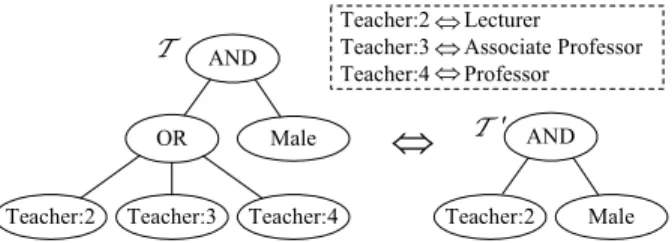
Suppose in a university, teachers are classified into teaching assistant, lecturer, associated professor and full professor. We distribute the weight of the attributes as 1, 2, 3, and 4, and are denoted as “teacher: 1”, “teacher: 2”, “teacher: 3” and “teacher: 4”, respectively. The four attributes can be denoted by one attribute which has just different weights. Especially, it can be arbitrary-state attributes, such as “Teacher: teaching assistant, lecturer, associate professor, full professor”. Furthermore, we assume that an access policy is represented as:T {(“Lecturer” OR “Associate Professor” OR “Full Professor”) AND “Male”} and the existing CP-ABE schemes are executed on the form of access policyT. If our proposed scheme is deployed, theT can be improved asT′ {“teacher: 2” AND “male”}, since the attribute “teacher: 2” denotes the minimum level in the access policy and includes {“teacher: 2”, “teacher: 3” “teacher: 4”} by default. Therefore, the storage overhead of ciphertext and computation complexity in encryption can be reduced. These two structures are shown in Fig. 1. In addition, it can express larger attribute space than ever under the same condition. For example, if the attribute space and weighted set include n
elements, respectively, the proposed scheme can describe n2
different possibilities. In contrast, the previous schemes only show2n different possibilities.
A. Related Work
In 2005, Sahai and Waters [13] proposed fuzzy identity-based encryption (IBE), which was the prototype of attribute-based encryption (ABE). Then, two variants of ABE were
Teacher:2 Lecturer
Teacher:3 Associate Professor Teacher:4 Professor
Û
Û Û Û
Teacher:2 Teacher:3 Teacher:4
OR Male AND T Male AND Teacher:2 ¢ T
Fig. 1. Two equivalent access structures of a ciphertext. T represents a general access policy in the existing CP-ABE schemes. T′ denotes an improved access policy in the proposed scheme.
proposed: key-policy ABE (KP-ABE) [14] and CP-ABE [4], [5], depending on how attributes and policy are associated with a ciphertext and secret keys of users. Later, many CP-ABE schemes with specific features have been presented. For example, [12] presented a novel access control scheme in cloud computing with efficient attribute and user revocation. The computational overhead is significantly eliminated from
O(2N) to O(N) in user key generation by improving CP-ABE construction, where N is the number of attributes. The size of ciphertext is approximately reduced to 1/2. However, the security of the scheme was given only with discussion.
At present, most CP-ABE schemes are constructed on the architecture where a full trusted authority is required to generate the whole secret keys of users with its master secret key as input [4]–[6], [12]–[17]. Thus, the key escrow issue is inherent such that the authority can decrypt all ciphertext encrypted for users. Chase et al. [10] presented a distributed KP-ABE scheme that solved the key escrow problem in a multi-authority system. In this approach, all authorities, which are not joined, are participating in the key generation protocol in a distributed way, such that they cannot pool their data and link multiple attribute sets belonging to the same user. Because there is no centralized authority with master secret information, all attribute authorities should communicate with the other authorities in the system to create a user’s secret key. But, a major disadvantage of this approach is the performance degradation [18], [19]. It results in O(N2) communication overhead on the system setup and on any rekeying phase, and requires each user to store O(N2) additional auxiliary key components in addition to the attribute keys, where N
is the number of authorities in the system. Then, Chow [20] proposed an anonymous private key generation protocol in IBE scheme where KA can issue private key to an authenticated user without knowing the list of the user’s identities. It seems that this approach can properly be used in ABE schemes if attributes are treated as identities. However, this scheme cannot be adopted for CP-ABE since the identity of user is a set of attributes which is not public.
Until 2013, [11] provided an improving security data sharing scheme based on the typical CP-ABE [4]. The key escrow issue is resolved by using an escrow-free key issuing protocol where the key generation center and the data storing center work together to generate secret key for user. Therefore, the computational cost in generating user’s secret key increases since the protocol requires interactive computation between
the both parties.
Besides, Liu et al.[15], [16] presented fine-grained access control scheme with attribute hierarchy, where [15] and [16] are constructed based on [5] and [6], respectively. In these two schemes, the attributes are divided into multiple levels to achieve fine-grained access control for hierarchical attributes, but the attributes can only express binary state as before. Later, Fan et al. [17] proposed an arbitrary-state ABE to solve the issue of the dynamic membership management in an ABE scheme. In this paper, to express arbitrary-state attributes, the traditional attributes are expanded to two parts: attribute and value. For example, the traditional attributes can be denoted as{“Doctor”,“Professor”,“Engineer”}. In this scheme, the improved attributes are denoted as: {Career: “Doctor”,“Professor”,“Engineer”}, where “Career” represents an attribute and “Doctor”,“Professor” and “Engineer” denote values of the attribute “Career”. Accordingly, the computation cost for attributes is more expensive than the traditional schemes under the same number of attributes.
B. Our Contributions
In this study, based on [12], an attribute-based data sharing scheme is proposed in cloud computing, which is denoted as ciphertext-policy weighted ABE scheme with removing escrow (or CP-WABE-RE, for short). It successfully resolves two types of problems: key escrow and arbitrary-sate attribute expression. The contributions of our scheme are as follows:
• we propose an improved key issuing protocol to resolve the key escrow problem of CP-ABE in cloud computing. The protocol can prevent KA and CSP from knowing each other’s master secret key so that none of them can create the whole secret keys of users individually. Thus, the fully trusted KA can be semi-trusted in the proposed scheme. In this case, data confidentiality and privacy can be ensured.
• we present weighted attribute to enhance the expression of attribute. The weighted attribute can not only express arbitrary-state attributes instead of the traditional binary state, but also reduce the complexity of access policy. Thus the storage cost of ciphertext and computation complexity in encryption can be reduced. Besides, it can express larger attribute space than ever under the same condition.
Note that there are significant improvements of our scheme over [17] that the weighted attribute can simplify access policy associated with a ciphertext (as the Fig. 1 shows) under the same ability of expression, which saves the storage cost of ciphertext and time cost in encryption. • we conduct and implement comprehensive experiment for the proposed scheme. The simulation shows that CP-WABE-RE scheme is efficient both in terms of computation complexity and storage cost. In addition, the security of CP-WABE-RE scheme is also proved under the generic group model.
C. Organization
The remaining parts of this paper are organized as follows. Section II discusses preliminaries which contain the related
background. Section III proposes system model of WABE-RE scheme. In section IV, the concrete construction of CP-WABE-RE scheme is presented. The theoretical analysis and experimental simulation are given in section V. In section VI, we provide security proof for the proposed scheme. Finally, conclusions are presented in section VII.
II. PRELIMINARIES
A. Access Structure
Let {P1, . . . , Pn} be a set of parties. A collection A ⊆
2{P1,...,Pn} is monotone if ∀B, C: if B ∈ A and B ⊆ C then C ∈ A. An access structure (respectively, monotone access structure) is a collection (respectively, monotone col-lection) A of non-empty subsets of {P1, . . . , Pn}, i.e., A ⊆
2{P1,...,Pn}\{∅}. The sets in A are called authorization sets. Otherwise, the sets are called unauthorization sets.
In the proposed scheme, the role of the parties is taken by the attributes. Thus,Ais going to include the authorized sets of attributes. Generally, unless stated in another way, the scheme uses an access structure which is a monotone access structure.
B. Bilinear Maps
Let G0 and GT be two groups of prime order p. The
generator of G0 is g. A bilinear mapping ˆe:G0×G0→GT
satisfies the following properties:
• Bilinearity: For any u, v ∈ G0 and a, b ∈ Zp, it has
ˆ
e(ua, vb) = ˆe(u, v)ab.
• Non-degeneracy: There exists u, v ∈ G0 such that
ˆ
e(u, v)̸= 1.
• Computability: For all u, v ∈ G0, there is an efficient computationˆe(u, v).
C. Weighted Access Tree
Let T be a weighted access tree, where root node of the tree is R. To facilitate description of the access tree, several functions and terms are defined as follows.
' 5 & ,QGH[ N& X $WWULEXWH :HLJKW 7HDFKHU ,QGH[ N' ] N5 $ $WWULEXWH :HLJKW 7HDFKHU ,QGH[ N$ [ % $WWULEXWH :HLJKW 6HQLRULW\ ,QGH[ N% \
Fig. 2. An example of weighted access tree structure.
• x denotes a node of tree T. If x is a leaf node, it denotes an attribute with weight. Ifxis a non-leaf node, it denotes a threshold gate, such as “AND”, “OR”,“n-of-m (n<m)”. For example, the nodesC and A denote a threshold gate and an attribute respectively in Fig. 2.
• numx denotes the number of x’s children in T. For
example,numR= 2 in Fig. 2.
• kx denotes threshold value of nodex, where0< kx≤
numx. Whenkx= 1andxis a non-leaf node, it is an
OR gate. Whenkx=numxandxis a non-leaf node, it
is an AND gate. In particular, ifxis a leaf node,kx= 1.
For example, kR = 1 and kC = 2 denote an OR gate and an AND gate respectively in Fig. 2.
• parent(x)represents the parent of the nodexinT. For example,parent(A) = Cin Fig. 2.
• att(x)denotes an attribute associated with the leaf node
xinT.
• index(x) returns an unique value associated with the nodex, where the value is assigned toxfor a given key in an arbitrary manner.
• Txdenotes the sub-tree ofT rooted at the nodex. If a set
of weighted attribute S satisfies the access tree Tx, we
denote it asTx(S) = 1.Tx(S)is recursively computed
as follows. Ifxis a non-leaf node,Tx(S)returns 1 if and
only if at leastkxchildren return 1. Ifxis a leaf node,
thenTx(S)returns 1 if and only if the weight of attribute
ωx fromS must be greater than or equal to the weight
of the leaf node. That isweight(ωx)≥weight(att(x)).
In addition, Morillo et al.[21] proved that every weighted value of the threshold access structure can be defined as a natural number. Unless stated otherwise, the value of weight is a natural number in this paper. In Fig. 2, the access policy is de-noted as:{(“Teacher:1” And “Seniority:2”) OR “Teacher:3”}. If one possesses attributes (“Teacher”, “Seniority”) with weight (“1”, “2”), he can satisfy the tree in Fig. 2; If the other one who possesses attribute (“Teacher”) with weight (“4”), he can also satisfy the access tree.
III. SYSTEMMODEL
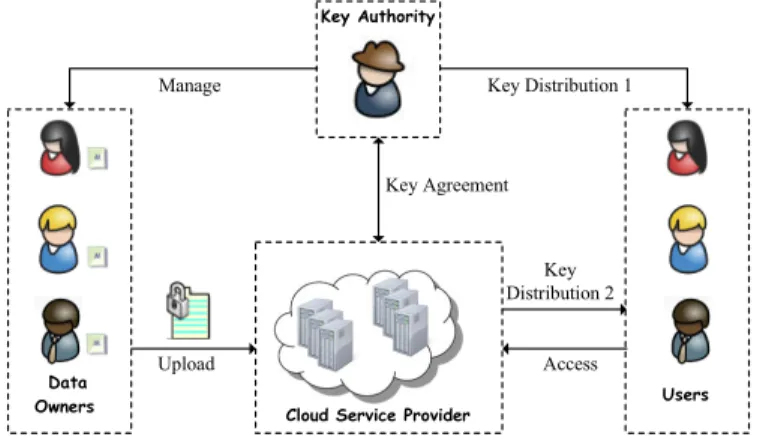
As illustrated in Fig. 3 and Fig. 4, the system model and framework of CP-WABE-RE scheme in cloud computing are given, where the system consists of four types of entities: KA, CSP, DO and Users. In addition, we provide the detailed definition of CP-WABE-RE scheme.
0DQDJH .H\'LVWULEXWLRQ 8SORDG $FFHVV .H\ 'LVWULEXWLRQ .H\$JUHHPHQW &ORXG6HUYLFH3URYLGHU 8VHUV .H\$XWKRULW\ 'DWD 2ZQHUV
Key Authority (KA). It is a semi-trusted entity in cloud system. Namely, KA is honest-but-curious, which can honestly perform the assigned tasks and return correct results. However, it will collect as many sensitive contents as possible. In cloud system, the entity accepts the users’ enrollment. Meanwhile, it not only generates most part of system parameter, but is also in charge of creating most part of secret key for each user.
Cloud Service Provider (CSP). It is the manager of cloud servers. It is also a semi-trusted entity which provides many services such as data storage, computation, and transmission. To solve the key escrow problem, it generates parts of system parameter and secret key for each user.
Data Owners (DO).They are owners of files to be stored in cloud system. They are in charge of defining access structure and executing data encryption operation. They also upload the generated ciphertext to CSP.
Users. They want to access ciphertext stored in cloud system. They download the ciphertext and execute the cor-responding decryption operation.
)LOH0 6\PPHWULF 'HFU\SWLRQ &3:$%(5( 'HFU\SWLRQ FN 8VHUV )LOH&LSKHUWH[W (FN0 &RQWHQW.H\ &LSKHUWH[W&7 .H\6.6HFUHW &63 )LOH0 6\PPHWULF (QFU\SWLRQ .H\6SDFH &3:$%(5( (QFU\SWLRQ $FFHVV 3ROLF\ FN '2 .$ 6HFUHW .H\ 6. FN
Fig. 4. System framework of CP-WABE-RE scheme.
Definition 1. (CP-WABE-RE): The proposed scheme contains the following four phases:
Phase 1:System Initialization. This phase includes
both algorithms: KA.Setup andCSP.Setup.
(1) KA.Setup(1κ) → (PP
1,MSK1). It is executed by KA. The probabilistic operation inputs security parameter κ. It returns public parameterPP1and master secret key MSK1.
(2) CSP.Setup(1κ) → (PP
2,MSK2). This algorithm is run by CSP. It inputs a security parameter κ and generates
PP2 andMSK2.
The system public parameter is PP ={PP1,PP2}, while the master secret key of system is MSK ={MSK1,MSK2} stored by KA and CSP, respectively.
Phase 2:Data Encryption. To improve efficiency of
encryption, DO first encrypts file M with content key ck
by using simple symmetric encryption algorithm, where file ciphertext is denoted asEck(M). Then, the content keyck is
encrypted by the following operation.
DO.Encrypt(PP, ck,A)→(CT).DO inputsPP,ck, and
an access policy A. It encrypts ck and outputs content key
ciphertextCTwhich implicitly containsA. Then, DO delivers
Eck(M)andCTto CSP.
Phase 3:User Key Generation. This phase consists
of KA.KeyGenandCSP.KeyGen.
(1) KA.KeyGen(MSK1, S)→(SK1). KA inputsMSK1
and a set of weighted attributes S. It creates secret keySK1 described byS.
(2) In CSP.KeyGen, we propose an improved two-party key issuing protocol to remove escrow. KA and CSP perform the improved protocol with master secret keys of their own. Thus, none of them can create the whole set of secret keys of users individually. Meanwhile, we assume that KA does not collude with CSP since they are honest as in [22] (otherwise, they can obtain the secret keys of each user by sharing their master secret keys).
CSP.KeyGen(MSK2) → (SK2). CSP inputs MSK2
and the required information. It produces secret keySK2 by executing the following key issuing protocol.
• KeyComKA↔CSP(MSK1, IDt, r,MSK2) → (SK2).
It is an interactive algorithm between KA and CSP. KA inputs MSK1, a user identity IDt, and a personalized
secretr. CSP inputsMSK2andIDt. At last, only CSP
generates a personalized key component SK2 for the corresponding user.
Then, the user constructs the whole secret keySKwith the key components separately receiving from KA and CSP, i.e.
SK ={SK1,SK2}.
Phase 4:Data Decryption. This phase contains both
algorithms:Users.DecryptandData.Decrypt. User first downloads file ciphertextEck(M)and content key ciphertext
CTfrom CSP. If he satisfies conditions, he can get content key
ck by calling Users.Decrypt algorithm. Then, he uses ck
to further decrypt fileM by usingData.Decryptoperation.
(1) Users.Decrypt(PP,SK,CT) → (ck). User inputs
PP,SKdescribed byS, andCTwhich includes access policy A. Only when the weighted attribute setS matches the access policy A, the content keyck is obtained.
(2) Data.Decrypt(Eck(M), ck) → (M). User inputs
Eck(M) and ck. Based on symmetric decryption algorithm,
it outputs fileM.
IV. THE PROPOSEDCP-WABE-RE SCHEME
In this section, we present the construction of CP-WABE-RE system, including five procedures: system initialization, new file creation (data encryption), new user authorization (user key generation), data file access (data decryption), and data file deletion. In addition, the revocation scheme of [11] can be directly used in our proposed scheme. The reason is described as below. The revocation scheme is performed in the phase of data encryption. And the removing escrow is operated in the phase of user key generation. Therefore, in [11], the modification of removing escrow does not affect the use of revocation scheme since they are run in different phases.
A. System Initialization
Let ˆe : G0 ×G0 → GT be a bilinear map, and G0 be bilinear group of prime order p with generator g. Let
H : {0,1}∗ → G0 be a hash function. For any i ∈ Zp
and a set S = {s1, s2, . . . , sm ∈ Zp}, the Lagrange
co-efficient ∆i,S = ∏
l∈S,l̸=i(x−l)/(i−l). In addition, an
universe of attribute set A = {a1, . . . , an} and a set of
weight W = {ω1, . . . , ωn}(ω1 ≤ . . . ≤ ωn) are defined.
Thus the system contains n2 weighted attributes which are
˜
A ={a1: ω1, . . . , a1:ωn, . . . , an :ω1, . . . , an :ωn}, where
the higher hierarchy of attributes is used, the bigger weighted value is distributed.
(1) KA.Setup(1κ). KA runs the algorithm which inputs
security parameter κ. Then, KA chooses randomα1, β ∈Zp
and computes h =gβ andu1 = ˆe(g, g)α1. Lastly, it obtains
PP1 andMSK1 as the formula (1):
PP1={G0, g, h, u1}, MSK1={α1, β} (1)
(2) CSP.Setup(1κ). CSP executes the operation which
inputs security parameter κ. Based on the κ, CSP chooses a random numberα2∈Zpand calculatesu2= ˆe(g, g)α2. Then, it sets PP2 andMSK2 as the formula (2):
PP2={u2}, MSK2={α2} (2) Finally, the public parameter and master secret key of system are denoted asPP ={G0, g, h, u=u1·u2= ˆe(g, g)α}, where
α=α1+α2, andMSK ={{α1, β},{α2}}.
B. New File Creation (Data Encryption)
Before file M is uploaded to CSP, DO processes the file with the following steps: (1) DO picks a unique ID for file
M. (2) It encryptsM with content keyckby using symmetric encryption method, where ck is chosen in a key space. The file ciphertext is denoted as Eck(M), where Eck denotes a
symmetric encryption operation with the keyck. (3) It defines an access structure T and encrypts the ck by running the improved encryption operation. Then, content key ciphertext
CTis returned.
DO.Encrypt(PP, ck,T). The improved algorithm is
ex-ecuted by DO which inputsPP,ck, andT. It outputs content key ciphertext CT.
Firstly, a polynomialqxis selected for each nodex
(includ-ing the leaf nodes) in T. From the root node R, the node’s information of qx is randomly selected from top to bottom
manner. For each node x inT, degree of the polynomial dx
is set tokx−1, where kx is the threshold value.
Then, beginning from the root node R, DO sets qR(0) =
s(s ∈ Zp), where s is randomly selected. And DO
ran-domly selects dR other points of the polynomialqR to define
it completely. For each non-root node x, it sets qx(0) =
qparent(x)(index(x)) and randomly chooses dx other points
to completely define qx. Meanwhile, each leaf node denotes a
weighted attribute.
In the access tree T, let Y be the set of leaf nodes, and
ωi be the minimum weight of each leaf node, which is set by
DO. Then DO computes CTas the formula (3). Finally, DO
sends the integrated ciphertext{ID,CT, Eck(M)} to CSP.
CT = T,C˜=ck·ˆe(g, g)α·s, C=gs ∀y∈Y, i∈[1, n] : Cy =hqy(0)·H(att(y))−ωis,
∀j∈(i, n], Cy,j =H(att(y))−(ωj−ωi)s (3)
To better understand, let us take the Fig. 2 for example here. DO sets the polynomialqR(x)with degree0asqR(x) =sfor node R. At the same time, the polynomial qC(x) is set as
qC(x) =s+crxwith degree1whereqR(u) =qC(0) =sand
cr is randomly chosen in Z∗p from node C. In addition, for
leaf nodes A,B, and D, they are respectively set as: qA(0) =
qC(x) = s+crx, qB(0) = qC(y) = s+cry, and qD(0) =
qR(z) =s.
C. New User Authorization (User Key Generation)
When a user wants to join the cloud system, KA first accepts the user’s enrollment. If he is legal, KA authenticates and assigns a set of weighted attributes S to the user in accordance with his identity or role. Then, KA and CSP will generate secret key SK for the user. The phase consists of
CSP.KeyGen andKA.KeyGen.
(1) CSP.KeyGen. We provide an improved key issuing
protocol between KA and CSP to execute the work of CSP.
KeyComKA↔CSP(MSK1, IDt, r,MSK2). Assume that
user t needs a secret key. Firstly, KA randomly chooses a number r ∈ Zp for the user. Then, KA and CSP perform
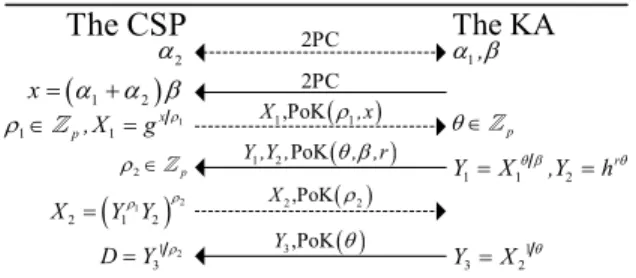
a secure two-party computation (2PC) protocol, where KA inputsMSK1={α1, β}and CSP inputsMSK2={α2}. After the execution of the 2PC protocol, CSP getsx= (α1+α2)β mod p. This can be done via a general 2PC protocol for a simple arithmetic computation [10], [11], [20]. Alternatively, we can do this more efficiently by using the construction in [23]. Note that during the 2PC protocol, KA knows nothing aboutα2 while CSP knows nothing about {α1, β}. After the 2PC protocol, KA and CSP engage the following interactive protocol in order to generate the personalized key component for the user:
1) CSP selects a random number ρ1 ∈ Zp. It calculates
X1=gx/ρ1 =g(α1+α2)β/ρ1 and transmits {X1,PoK(ρ1, x)} to KA, where PoK represents a proof of knowledge of the secret values used in the computation. It can be efficiently realized, e.g. via Schnorr protocol.
2) KA chooses θ ∈ Zp and computes Y1 = X
θ/β
1 =
g(α1+α2)θ/ρ1 and Y
2 = hrθ. It sends {Y1, Y2,PoK(θ, β, r)} to CSP.
3) CSP randomly selects ρ2 ∈ Zp and computes X2 =
(Yρ1 1 Y2)ρ2 = (g(α1+α2)θhrθ)ρ2. It transfers {X2,PoK(ρ2)} to KA. 4) KA calculates Y3 =X 1/θ 2 = (g (α1+α2)hr)ρ2 and sends {Y3,PoK(θ)} to CSP. 5) CSP calculates D =Y31/ρ2 =g(α1+α2)hr = gαhr and
sends a personalized key componentSK2 ={D =gαhr} to the corresponding usert.
Fig. 5 provides a direct description for the above protocol. Here the first step denotes a 2PC protocol which inputs{α1, β}
from KA and {α2} from CSP, and returns x= (α1+α2)β modpto CSP.
7KH&63
3& 7KH.$ [ S ; J U U ' D ' < U ; < <U U [ D D E D E S U ' 3& S T ' U < ;T E< KT 3R. < < T E U 3R. ; U[ 3R. ; U 3R. < T < ; TFig. 5. The improved two-party key issuing protocol. “2PC” denotes a general two-party computation protocol. “Pok” denotes a proof of knowledge of the secret values used in the computation.
(2)KA.KeyGen(MSK1, r, S).KA executes the algorithm
which inputs MSK1, a number r ∈ Zp which has randomly
chosen inCSP.KeyGen, and a set of weighted attributesS. Then, for each weighted attributej∈S, it possesses weighted value ωj(ωj ∈W). Finally, it computes SK1 described by S as the formula (4).
SK1={L=gr,∀j ∈S:Dj =H(j)rωj} (4)
So, user t can construct the whole secret keySK by using the key components separately receiving from the two entities. It is described as the formula (5).
SK ={D=gαhr, L=gr,∀j ∈S:Dj =H(j)rωj} (5)
D. Data File Access (Data Decryption)
In cloud system, legal users can freely query the ciphertext. When a user requests accessing a ciphertext to CSP, it transmits the corresponding ciphertext {ID,CT, Eck(M)} to the user.
The user can obtain content key ck by calling the improved
Users.Decrypt algorithm. Then, he usesck to further
de-crypt the file M using Data.Decrypt operation. If not, he cannot decrypt it.
(1) Users.Decrypt(PP,CT,SK). User inputs PP, CT,
and SKdescribed by S. If the weighted attributes S that the user possesses satisfy access policy T, the user can obtain content key ck. The operation is a recursive algorithm which is defined as below.
1) If xis a leaf node. Let k=att(x),ωk be the weighted
value of the user’s node x, and ωi be the weighted value of
the access policy T’s node x. If k /∈ S or k ∈ S, ωi > ωk,
we note DecryptNode(CT,SK, x) = ⊥. If k ∈ S and
ωi = ωk, we compute DecryptNode(CT,SK, x)1 as the formula (6). If k ∈ S, ωi < ωk and ωk = ωj, we compute
DecryptNode(CT,SK, x)2 as the formula (7).
DecryptNode(CT,SK, x)1
= ˆe(Cx, L)·ˆe(C, Dk)
= ˆe(hqx(0)·H(att(x))−ωis, gr)·e(gˆ s, H(k)rωk)
= ˆe(gβqx(0), gr)·ˆe(H(k)−ωis, gr)·ˆe(gs, H(k)rωk)
= ˆe(g, g)rβqx(0) (if ω
k=ωi)
(6)
DecryptNode(CT,SK, x)2
= ˆe(Cx·Cx,j, L)·ˆe(C, Dk)
= ˆe(hqx(0)H(att(x))−ωisH(att(x))−(ωj−ωi)s, gr) ·ˆe(gs, H(k)rωk)
= ˆe(gβqx(0)·H(k)−ωjs, gr)·ˆe(gs, H(k)rωk)
= ˆe(gβqx(0), gr)·ˆe(H(k)−ωjs, gr)·e(gˆ s, H(k)rωk)
= ˆe(g, g)rβqx(0) (if ω
k =ωj> ωi)
(7)
2) If x is a non-leaf node, DecryptNode(CT,SK, x) is defined: for all nodes z that are children of x, it runs
DecryptNode(CT,SK, z) and stores the output as Fz. Let
Sx be an arbitrary kx-sized set of child nodes z such that
Fz ̸= ⊥. If the nodes don’t exist, Fz = ⊥. If not, Fx
is computed as the formula (8), where k = index(z), and
Sx′ ={index(z) :z∈Sx}. Fx= ∏ z∈Sx F ∆ k,Sx′(0) z = ∏ z∈Sx (ˆe(g, g)r·βqz(0))∆k,S′x(0) = ∏ z∈Sx
(ˆe(g, g)r·βqparent(z)(index(z)))∆k,S′x(0)
= ∏
z∈Sx
(ˆe(g, g)r·βqx(k))∆k,S′x(0)
= ˆe(g, g)r·βqx(0)
(8)
Then, we define the decryption algorithm by calling
DecryptNode(CT,SK, x)1or DecryptNode(CT,SK, x)2 on the root nodeRof the access treeT. If theT is satisfied byS
we defineA= DecryptNode(CT,SK, R) = ˆe(g, g)rβqR(0)=
ˆ
e(g, g)rβs. Thus, the user can gainck with the formula (9). e
C/(ˆe(C, D)/A) =C/(ˆe e(gs, gα·hr)/ˆe(g, g)rβs) =ck·e(g, g)ˆ αs/ˆe(g, g)αs =ck
(9)
(2) Data.Decrypt(Eck(M), ck). User inputs file
cipher-text Eck(M) and content key ck. Based on symmetric
de-cryption algorithm, i.e., DES or AES, the file M can be decrypted as the formula (10), whereDckdenotes a symmetric
decryption operation with the keyck.
Dck[Eck(M)] =M (10)
E. Data File Deletion
Here, we show that data file deletion contains not only discretionary deletion but also mandatory blocking.
Discretionary Deletion. All of the legal data owners can freely delete ciphertext in cloud system. Assume that a DO wants to delete an encrypted file, the procedures of algorithm between DO and CSP are described as below, where the algorithm can adopt any secure signature scheme such as BLS
short signature scheme [24] as the underlying primitive to achieve.
(1) DO sends a request to CSP, which includes file’s ID
and its signature on theID.
(2) CSP verifies these request information. If validation, CSP deletes the corresponding ciphertext. Otherwise, CSP will do nothing.
Mandatory Blocking. To provide legal sharing environ-ment, a new function, i.e., mandatory blocking, is added to the proposed system. The steps are described as below.
(1) When accessing a file, user needs to evaluate how well the file is accessed, such as shopping online and teaching online.
(2) CSP synthesizes these assessments for each file. If some files are not consistent with the evaluation standards, those files would be mandatory blocked by CSP. Meanwhile, DO will receive the private messages explaining the reason. If not, CSP will do nothing.
V. PERFORMANCEANALYSIS
In this section, we analyze and compare the efficiency of the proposed scheme with the schemes [11], [12], and [17] in theoretical and experimental aspects.
A. Theoretical Analysis
1) Key Escrow and Weighted Attribute: Table I shows the problems of key escrow and weighted attribute in each scheme which will affect the security and practicability of cloud system. The key escrow in CP-WABE-RE scheme can be removed by using an improved key issuing protocol for cloud computing. [11] uses escrow-free key issuing protocol to solve the issue. On the contrary, both [12] and [17] don’t involve the problem of key escrow. In addition, the weighted attribute in CP-WABE-RE scheme can not only support arbitrary-state attributes instead of the traditional binary arbitrary-state, but also simplify access policy associated with a ciphertext as opposed to [11] [12]. Unfortunately, [17] can only express arbitrary-state attributes, and cannot simplify the access structure. In Table I, we can find that only CP-WABE-RE scheme can simultaneously support both the features and cloud system. [11] solves the problem of key escrow so it can satisfy environment of cloud system as ours. However, both [12] and [17] cannot remove key escrow. Thus the both schemes cannot be directly applied in cloud computing.
TABLE I. FEATURECOMPARISONS
Scheme Key Escrow Weighted Attribute Cloud System
CP-WABE-RE No Yes Yes
[11] No No Yes
[12] Yes No No
[17] Yes Yes No
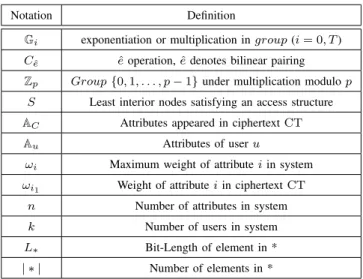
2) Efficiency: In Table II and Table III, we compare ef-ficiency of the above four schemes on storage overhead and computation cost in theory, where the used symbols are defined in Table IV.
To simplify the comparisons, access structure, data re-encryption of [11] [12], and dynamic membership management (that is, user joining, leaving, and attribute updating) of [17] are not included in the following analysis. In addition, the cost of transmission isn’t involved when implementing the interactive protocols in both [11] and our proposed scheme.
TABLE IV. NOTATIONS FOREFFICIENCYCOMPARISONS
Notation Definition
Gi exponentiation or multiplication ingroup(i= 0, T) Ceˆ ˆeoperation,eˆdenotes bilinear pairing
Zp Group{0,1, . . . , p−1}under multiplication modulop S Least interior nodes satisfying an access structure AC Attributes appeared in ciphertextCT
Au Attributes of useru
ωi Maximum weight of attributeiin system
ωi1 Weight of attributeiin ciphertextCT
n Number of attributes in system
k Number of users in system
L∗ Bit-Length of element in * | ∗ | Number of elements in *
In Table II, the schemes are compared in terms ofCTsize,
SKsize,PPsize andMSKsize.CTsize represents the storage overhead in cloud computing and implies the communication cost from DO to CSP, or from CSP to users. SKsize denotes the required storage cost for each user. PP and MSK sizes represent the storage overhead of KA and CSP in terms of public parameter and master secret key.
As shown in Table II, when ωi=ωi1, all attributes possess
equal weights in CP-WABE-RE scheme. Thus our scheme is equivalent to [11] and [12]. Meanwhile, CT size is reduced as (|AC|+ 1)LG0+LGT in CP-WABE-RE scheme, which is equal to [12]’s. Comparing with [11] and [17], the CT size in our proposed scheme and [12] is reduced by nearly half. When ωi ̸= ωi1, CP-WABE-RE scheme can use an attribute
to express(ωi−ωi1+1)attributes which has different weights.
Therefore, it requires smaller storage cost in CT than the others. Moreover, we can find that the SKsize in CP-WABE-RE scheme is equal to [12]’s, which is smaller than [11]’s and [17]’s. Furthermore, when|Au| → ∞, the storage overhead in
our scheme is reduced by nearly half comparing to [11]’s. And the storage cost in our scheme is decreased nearly by 66.67% comparing to [17]’s in theory. In addition, we can also observe that thePPsize is equal among [11], [12], and CP-WABE-RE scheme. And the size of PP in [17] is the longest since it is related to the number of system attributes n and the number of system users k. About the size ofMSK, we can find that the parameter in CP-WABE-RE scheme doesn’t appear to be
TABLE II. EFFICIENCYCOMPARISONS: STORAGECOST
Scheme Size ofCT Size ofSK Size ofPP Size ofMSK
CP-WABE-RE [Σ|AC|
i=1(ωi−ωi1+ 1) + 1]LG0+LGT (|Au|+ 2)LG0 3LG0+LGT 3LZp
[11] (2|AC|+ 1)LG0+LGT (2|Au|+ 1)LG0 3LG0+LGT LZp+LG0 [12] (|AC|+ 1)LG0+LGT (|Au|+ 2)LG0 3LG0+LGT LG0 [17] 2(|AC|+ 1)LG0+ 2LGT (3|Au|+ 1)LG0 (n+ 2)LG0+ 2LGT +knLZp LG0
TABLE III. EFFICIENCYCOMPARISONS: COMPUTATIONCOST
Scheme New File Creation Cost Data File Access Cost New User Authorization Cost CP-WABE-RE {[Σ|AC|
i=1(ωi−ωi1+ 2)] + 1}G0+ 2GT (2|Au|+ 1)Ceˆ+ (2|S|+ 2)GT (|Au|+ 9)G0
[11] (2|AC|+ 1)G0+ 2GT (2|Au|+ 1)Ceˆ+ (2|S|+ 2)GT (2|Au|+ 4)G0
[12] (2|AC|+ 1)G0+ 2GT (2|Au|+ 1)Ceˆ+ (2|S|+ 2)GT (|Au|+ 3)G0
[17] (2|AC|+ 2)G0+ 3GT (3|Au|+ 1)Ceˆ+ (2|S|+ 3)GT (4|Au|+ 2)G0
much different from the others.
In Table III, we evaluate the computation cost of encryption, decryption and key generation. During the new file creation (data encryption), the computation cost in CP-WABE-RE scheme can be reduced as (2|AC| + 1)G0 + 2GT when
ωi = ωi1, which is roughly equal to [11]’s, [12]’s, and
[17]’s. Similar to Table II, when ωi ̸= ωi1, CP-WABE-RE
scheme computes an attribute to represent multiple attributes which possess different weights. Meanwhile, it can simplify access structure associated with a ciphertext. However, the scheme [17] doesn’t possess the feature of our scheme, without expressing arbitrary-state attributes. So, when ωi ̸= ωi1, the
encryption cost in CP-WABE-RE scheme is saved. About data file access (data decryption) cost, the parameter is equal in [11], [12], and CP-WABE-RE scheme. And the decryption cost in [17] is larger than the others. In addition, in the phase of new user authorization (user key generation), our proposed scheme only consumes additional 6G0 of computation cost in solving key escrow issue, comparing with that in [12]. Meanwhile, the key generation cost in CP-WABE-RE scheme is smaller than [11]’s and [17]’s. Furthermore, when |Au| → ∞, the
computation cost in ours is decreased nearly by 50% in theory than [11]’s, where the cost of transmission isn’t involved in the two schemes. At the same time, the cost in ours is reduced by nearly 75% comparing to [17]’s in theory.
B. Experimental Analysis
Now, to validate theoretical analysis proposed in previous subsection, we execute CP-WABE-RE scheme by using the cpabe toolkit and the Java Pairing-Based Cryptography library (JPBC) [25]. Meanwhile, we also simulate the schemes in [11], [12], and [17] at the same condition. The following experiments are conducted using Java on the system with Intel(R) Core(TM) i5-4590 CPU at 3.30 GHz and 8.00GB RAM running Windows 7. To achieve a 80-bit security level, the experiments use a 160-bit elliptic curve group based on the supersingular curve y2 = x3+x over a 512-bit finite
field. In addition, all the simulation results are the mean of 10 trials. The units of storage cost and time are Kilobyte (KB) and second (s).
1) Simulation Analysis of Key Escrow: The storage overhead and computation cost of user secret key are compared as plotted in Fig. 6. The number of weighted attributes used in this simulation isN ={10,20,30,40,50}.
Fig. 6(a) and Fig. 6(b) intuitively show the experimental results. We find that the storage overhead of user secret key in ours is the same as [12]’s, and it is smaller than [11]’s and [17]’s under the same number of attributes. About the computation cost of secret key, the value of our scheme is larger than [12]’s, where the difference of key generation cost is 6G0 according to the above Table III. At the same time, the parameter in CP-WABE-RE scheme is smaller than [11]’s and [17]’s at the same condition. We also observe that all experimental results are gradually increasing and approximately follow a linear relationship with the number of weighted attributes. Therefore, with a small error tolerance, we estimate their limit values, where the mathematical expressions are computed by using the mean algorithm. When N → ∞, the limit value of space saving in CP-WABE-RE scheme is approximately equal to 48.39% comparing to [11]’s. The cost is reduced by nearly half in theory which is consistent with the above efficiency analysis. Comparing with our scheme and [17], the saved storage cost is approximately 64.47% which matches the corresponding limit value in theory. In addition, when N → ∞, comparing with CP-WABE-RE scheme and [11], the maximum of improved efficiency in computation cost approaches to 23.04%. Comparing with our scheme and [17], the reduced computation cost is approximate to 64.88% in Fig. 6(b). However, in Table III, if |Au| → ∞, the corresponding
computation cost can be reduced to 50% and 75% in theory, where the cost of transmission isn’t involved. Remarkably, the cost of transmission comes from the difference between theoretical value and experimental result.
1XPEHURIZHLJKWHGDWWULEXWHV 7 K H V WR UD J H F R V W R I V H F UH W N H \ . % 6WRUDJH&RVWRI6HFUHW.H\LQ&3:$%(5( 6WRUDJH&RVWRI6HFUHW.H\LQ>@ 6WRUDJH&RVWRI6HFUHW.H\LQ>@ 6WRUDJH&RVWRI6HFUHW.H\LQ>@ 1XPEHURIZHLJKWHGDWWULEXWHV 1 H Z X V H U D X WK R UL ] D WL R Q W LP H V &RPSXWDWLRQ&RVWRI6HFUHW.H\LQ&3:$%(5( &RPSXWDWLRQ&RVWRI6HFUHW.H\LQ>@ &RPSXWDWLRQ&RVWRI6HFUHW.H\LQ>@ &RPSXWDWLRQ&RVWRI6HFUHW.H\LQ>@ D E
Fig. 6. Comparison of experimental results of key escrow. (a)The storage cost of secret key. (b)The time cost of new user authorization. The coordinate is storage overhead or time cost of user’s secret key. The abscissa is the number of weighted attributes in user secret key.
1XPEHURIZHLJKWHGDWWULEXWHV 7 K H V WR UD J H F R V W R I F LS K H UW H [ W . % 6WRUDJH&RVWRI&LSKHUWH[WLQ&3:$%(5( 6WRUDJH&RVWRI&LSKHUWH[WLQ>@ 6WRUDJH&RVWRI&LSKHUWH[WLQ>@ 6WRUDJH&RVWRI&LSKHUWH[WLQ>@ 1XPEHURIZHLJKWHGDWWULEXWHV 1 H Z I LOH F UH D WL R Q W LP H V &RPSXWDWLRQ&RVWRI&LSKHUWH[WLQ&3:$%(5( &RPSXWDWLRQ&RVWRI&LSKHUWH[WLQ>@ &RPSXWDWLRQ&RVWRI&LSKHUWH[WLQ>@ &RPSXWDWLRQ&RVWRI&LSKHUWH[WLQ>@ D E
Fig. 7. Comparison of experimental results of weighted attribute. (a)The storage cost of ciphertext. (b)The time cost of new file creation. The abscissa is the number of attributes appeared in ciphertext. The coordinate is storage overhead or time cost of encryption at DO.
2) Simulation Analysis of Weighted Attribute: Next, we measure and analyze the storage overhead and computation cost for encrypting (by a DO) data, where the number of attributes in access policy is N = {10,20,30,40,50}. It should be noticed that the CP-WABE-RE scheme is equivalent to the schemes in [11] and [12] when all attributes possess equal weights (ωi=ωi1), where it has been analyzed in Table
II and Table III. For simplicity, we have omitted the simulation when ωi = ωi1. To show the advantage of the weighted
attribute here, in CP-WABE-RE scheme, the maximum value of each weighted attribute is set to be 5, and the lowest value of each weighted attribute is chosen to encrypt. We implement [11], [12], [17], and our proposed scheme under the equivalent access policy encrypted in ciphertext. Fig. 7 shows the simulation results.
Fig. 7(a) plots the relationship between the storage overhead of ciphertext and the number of weighted attributes in access policy. Fig. 7(b) shows encryption time of ciphertext versus
the number of weighted attributes. When ωi ̸=ωi1 (here we
assume that an attribute can be represented5 attributes which possess different weights), we find that CP-WABE-RE scheme requires less storage cost and encryption time than the others. We also observe that all results approximately follow a linear relationship with the number of weighted attribute in access trees. Similar as the analysis of Fig. 6, we estimate the limit values with a small error tolerance, where the mathematical expressions are computed by using the mean algorithm. For example, in Fig. 7(a), when N → ∞, comparing with CP-WABE-RE scheme and [11], the limit value of space saving is approximately equal to 52.60%. Similarly, the reduced storage cost in ciphertext is 11.77% comparing our scheme to [12]. And comparing with [17], our proposed scheme can save storage cost approximate to 51.71%. In addition, the reduced storage cost in [12] approaches to 46.28% comparing to [11]. In Fig. 7(b), when N → ∞, CP-WABE-RE scheme can save computation cost approximate to 61.68% comparing with [11], [12], and [17], where the computation cost associated with a ciphertext in [11] is approximately equal to [12]’s and [17]’s. It indicates that the results are consistent with the theoretical analysis presented in previous subsection.
VI. SECURITYPROOF
We first present the chosen plaintext attacks (CPA) security proof of our CP-WABE-RE scheme. The security game is identical to those of traditional (fully) CP-ABE systems. We state here the definition of an adaptive CP-ABE security game for the completeness of the security analysis.
1) System Initi. The challenger runs the operations
of KA.Setup and CSP.Setup of CP-WABE-RE
scheme and sends public parameterPPto the adversary A.
2) Phase 1. For the attribute sets S1, . . . , Sq1(∀i ∈
[1, . . . , q1]) chosen by A, he can repeatedly ask C for the secret key SK. Meanwhile, the challenger an-swers the secret keySK by running the algorithms of
CSP.KeyGenandKA.KeyGen.
3) Challenge. A submits two equal length messages
M0, M1 ∈GT and an access treeAto the challenger,
where there should not be any secret key issued to A such that the key satisfiesA. The challenger randomly picks a bitµ∈ {0,1}and encryptsMµwithAby using
the algorithmDO.Encrypt.
4) Phase 2.Same as thePhase 1but with the restriction that the querying key cannot satisfyA.
5) Guess.Aoutputs a guessµˆ of µ. In this game,Acan win the game which is defined as|P r[ˆµ=µ]−(1/2)|. Definition 2. The proposed scheme is said to be secure against CPA if no probabilistic polynomial-time adversaries have non-negligible advantage in the above game.
We use the generic bilinear group model and the random oracle model to prove that no adversary can break the CPA security of our scheme with non-negligible probability. In other words, our security is reduced to mathematical properties of elliptic curve groups as well as security of target collision
resistance hash function. We note that our security proof technique follows that of [4].
Consider two random encodingsξ0,ξ1of an additive group Fp, which is injective maps ξ0, ξ1 : Fp → {0,1}m, where
m > 3log(p). We set G0 = {ξ0(x) : x ∈ Fp} and GT =
{ξ1(x) :x∈Fp}. In the security game, the simulator is given
a random oracle for simulating hash function, and oracles in groups G0,GT and bilinear map ˆe : G0×G0 → GT for
computation queries. We are also given a random oracle to represent the hash functionH. And we refer toG0as a generic bilinear group. Below, we give a lower bound on the advantage of a generic adversary in breaking the security of our scheme. Theorem 1.For any adversaryA, letqbe a bound on the total number of group elements which A receives from queries to the oracles for the hash function, groupsG0,GT, the bilinear
mapeˆand from its interaction with the security game, in which G0 is bilinear group of prime order p with generator g. We have that the advantage ofAin the game isO(q2/p).
Proof. In the challenge phase of a CP-ABE game, the simulator will construct eitherM0e(g, g)ˆ αsor M1ˆe(g, g)αs as the componentC˜. Here, we consider a modified game where
˜
C is either e(g, g)ˆ αs or ˆe(g, g)θ, and θ ∈
R Fp. Now, the
adversary is required to tell if C˜ = ˆe(g, g)αs or e(g, g)ˆ θ. It
is not difficult to see that the modified game can be regarded as a hybrid argument in which the adversary is asked to tell
ˆ
e(g, g)θ from M0ˆe(g, g)αs, and ˆe(g, g)θ from M1e(g, g)ˆ αs. Accordingly, an adversary in the CP-ABE game with advan-tageϵis transformed into an adversaryAin the modified game with advantage at least ϵ2. Below we letg=ξ0(1),gx=ξ0(x) ande(g, g)ˆ x=ξ1(x).
1) System Initi.The simulator chooses α1, α2, β∈R Fp,
and next setsh=gβ,u1= ˆe(g, g)α1,v1=gα1,u2=
ˆ
e(g, g)α2,v
2=gα2 andα=α1+α2. It further sends thePP ={g, h, u=u1u2}toA.
2) Hash Queries.IfAissues a hash query on an attribute
att(y), the simulator returnsgti and stores(t
i, att(y))
intoListH, where t
i ∈RFp.
3) Key Queries.Here we combine the simulations of the algorithms CSP.KeyGen andKA.KeyGen as one key query. We note that it will not bring additional advan-tage forAin winning the game. WhenAqueries a user
i’s secret key for an attribute setS, the simulator works as follows. It chooses ri, wj ∈R Fp, and computes
D = gαgβri, L = gri, ∀ j ∈ S : D
j = H(j)riwj.
The simulator finally sends the secret key to A and stores(SK, i, S)into ListSK.
4) Challenge. A outputs two equal length messages
M0, M1 ∈ GT and an access tree A to the simulator,
where there should not be any secret key issued to A such that the key satisfiesA. The simulator chooses an
s∈RFp, and next uses linear secret sharing technique
to construct sharesλy of sfor all attributesy inAas
in the algorithm DO.Encrypt, where λy is uniformly
and independently random inFp, andλycan be seen as
a linear combination of independent random variables (in Fp) and s. The simulator then chooses θ ∈R Fp,
and sets C˜ = ˆe(g, g)θ, C = gs, ∀ y ∈ Y, i ∈ [1, n], Cy = gβλiH(att(y))−wis, and ∀j ∈ (1, n],
Cy,j =H(att(y))−(wj−wi)s, wherewi, wj∈RFp. The
simulator sends the challenge ciphertext toA.
5) Key Queries.Same as the previous key queries phase but with the restriction that the querying key cannot satisfyA.
6) Guess.Aoutputs a guess bit.
Below we consider unexpected collision. An oracle query can be seen as a rational function ϑ =η/ψ in the variables
θ, α, β, ti, wi,ri, λi and s. Suppose there are two distinct
rational functions ϑ =η/ψ and ϑ′ =η′/ψ′. An unexpected collision event indicates that taking two different queries corresponding to the two functions, we have the same output due to random choice of variables. If the event happens, it means that ϑ = ϑ′, and further ηψ′ −η′ψ = 0. By the Schwartz-Zippel Lemma in [26], [27], the probability of the event isO(1/p). Therefore, the probability of a collision event is at mostO(q2/p). Accordingly, the unexpected collision will not occur in the simulations with probability1−O(q2/p).
Remember that each group element is uniformly and de-pendently chosen in the above simulations. A can tell the difference between θandαselements inGT if there are two
distinct queries ϑandϑ′ leading to the same output. Assume
ϑ′ =γ′θandϑ=γαs, we haveϑ−ϑ′ =γαs−γ′θsuch that
γ′θ+ϑ−ϑ′ =γαs, where γ, γ′ are non-zero constant. We will show that Acannot construct a query forγαsinGT.
We here observe all possible rational function queries in GT by means of bilinear map and the group elements given
toA. It can be seen thatAcan obtain a transcript{g,gβ,gs,
gβλig−tiwis,g−(wj−wi)sti,gαgβr,gr,grwiti}from one query. For another transcript, we set it as{g,gβ,gs,gβλi′g−ti′wi′s,
g−(wj′−wi′)sti′,gαgβr′,gr′,gr′wi′ti′}. We first ignoregβsince the elements withαwill be tagged withβ which is irrelevant to αs. To output a factor αs, we should focus on elements with factors α and s. It is not difficult to see that there are three types of outputs with αs in GT from two transcripts.
One isαs+βrs(resp.αs+βr′s). To outputγαs, we need an elementβrs. However the element does not exist. The second format with αsis(−wj+wi)tiαs+ (−wj+wi)stiβr′ (resp.
(−wj′ +wi′)ti′αs+ (−wj′ +wi′)sti′βr). To eliminate the
part right after +, we need to concentrate on the elements with ti. The elements with βλi −tiwis, and rwiti fail to
construct a cancel-out part as they are lack of a factorwj. For
the element−(wj−wi)sti, we need an element withβr′(resp.
βr). But none of other elements satisfy our requirement. The last format with αsis−tiwiαs+β2λir′−tiwisβr′+αβλi
(resp.−ti′wi′αs+β2λi′r−ti′wi′sβr+αβλi′). If we cannot
find elements to cancel out all of terms except for that ofαs, it indicates thatAfails to constructγαs. For simplicity, we only check with the last termαβλi. It can be seen thatα+βris the
only element withα. Thus, we need aβλi term. Nevertheless,
the term does not exist.
From the above observation, we can therefore state that A fails to construct the query form γαs.
In addition, an improved key issuing protocol is proposed to resolve the key escrow problem of CP-ABE in cloud
computing. In this paper, we assume that they do not collude with each other to share their master secret keys. We say that our proposed key issuing protocol is secure when the following two aspects are satisfied. The first one is that the KA cannot derive the user secret key if the CSP is honest. The other is that the CSP cannot derive the user secret key while the KA is honest. Security analysis about the protocol is described as below.
Theorem 2. The proposed key issuing protocol in section IV-C is a secure protocol for computing gαhr by KA and
CSP. Assume that the underlying arithmetic 2PC and zero knowledge proofs are secure, and (for security against corrupt CSP) that DDH is hard.
Proof. First, to note that D = Y1/ρ2
3 = X 1/ρ2τ 2 = (Yρ1 1 Y2)1/τ =X ρ1/β 1 hr =gα1+α2hr =gαgβr. To show the security we consider the cases of corrupting KA and corrupting CSP respectively.
(1) For a corrupted KA, our simulator proceeds as follows:
SimC: First, it will run the arithmetic 2PC simulator for
computation of (α1+α2)β. In the process, it will extractα1. Next, the simulator will choose random valuesX1∈G0, and send it to KA. It will receiveY1andY2from the adversary KA, and two corresponding zero knowledge proofs. We will extract
βandrfrom the corresponding proofs. Then, it will sendα1,
βandrto the trusted party, and receivegα2·gα1+βr=gα+βr,
which will be CSP’s secret key output.
Consider a hybrid simulator HybC that takes as input of
CSP’s secret α2. It first runs the arithmetic 2PC simulator for the computation ofxwith the correct output value according toα2. Then the simulator completes the protocol as the honest CSP would do. This is clearly indistinguishable from the real CSP’s protocol by the security of the arithmetic 2PC.
Now, assuming that the proof of knowledge scheme is secure,HybC should be indistinguishable from the above
sim-ulatorSimC. This is because the valueX1used bySimCwill
be distributed identically to those inHybC. (Sinceρ1is chosen at random in the real protocol,X1will be distributed uniformly over G0 in the real protocol as in the simulated protocol.) Thus, interaction with our simulation is indistinguishable from interaction with an honest CSP.
(2) For a corrupted CSP, our simulator proceeds as follows:
SimK: First, it will run the arithmetic 2PC simulator for
computation of (α1+α2)β. This 2PC will extract α2 from CSP and output x = (α2 +α1)β mod p. We will choose a random value x ∈ Zp, and give it to the arithmetic 2PC
simulator. Note that this is correctly distributed, since there is someβ such that x= (α2+α1)β mod pfor any x, α1, α2. Next, our simulator will receive X1 from the adversary, and the corresponding zero knowledge proof.ρ1is extracted by the proof system. We will select random valuesY1, Y2∈G0, and send them to CSP. (Again, this will be distributed exactly as in a real execution.) We will receiveX2from the adversary, and use the corresponding proof to extractρ2. Then, it will sendα2 to the trusted party, and receiveD=gα2 ·gα1+βr =gα+βr.
Finally, it will computeY3=Dρ2 and send it to CSP. Consider a hybrid simulator HybK that takes as input of