ROBUST MIXTURE REGRESSION MODEL FITTING BY
LAPLACE DISTRIBUTION
by
YANRU XING
B.Eng., Tianjin Polytechnic University, China, 2002
LL.B., China University of Political Science and Law, China, 2005
A REPORT
submitted in partial fulfillment of the
requirements for the degree
MASTER OF SCIENCE
Department of Statistics
College of Arts and Sciences
KANSAS STATE UNIVERSITY
Manhattan, Kansas
2013
Approved by:
Major Professor
Weixing Song
Copyright
Yanru Xing
Abstract
A robust estimation procedure for mixture linear regression models is proposed in this
report by assuming the error terms follow a Laplace distribution. EM algorithm is
imple-mented to conduct the estimation procedure of missing information based on the fact that
the Laplace distribution is a scale mixture of normal and a latent distribution. Finite sample
performance of the proposed algorithm is evaluated by some extensive simulation studies,
together with the comparisons made with other existing procedures in this literature. A
sensitivity study is also conducted based on a real data example to illustrate the application
of the proposed method.
Key words and phrases:
Least Absolute Deviation; EM Algorithm; Mixture Regression
Model; Normal Mixture; Laplace Distribution
Table of Contents
Table of Contents
iv
List of Figures
v
List of Tables
vi
Acknowledgements
vii
1 Introduction
1
1.1 Mixture Model De_nition . . .
2
1.2 Maximum Likelihood Estimation and EM Algorithm . . .
2
1.3 Normal Mixture . . .
5
1.4 Mixture of Normal Linear Regression Models . . .
6
2 EM Algorithm for Robust Mixture Regression
8
2.1 Laplace Distribution . . .
8
2.2 Mixture Model with Laplace Distribution . . .
11
2.3 EM Algorithm . . .
13
2.4 Trim high leverage points . . .
15
3 Numerical Studies
17
3.1 Simulation Studies . . .
17
3.2 Real Data Example . . .
20
4 Conclusion
28
Bibliography
29
List of Figures
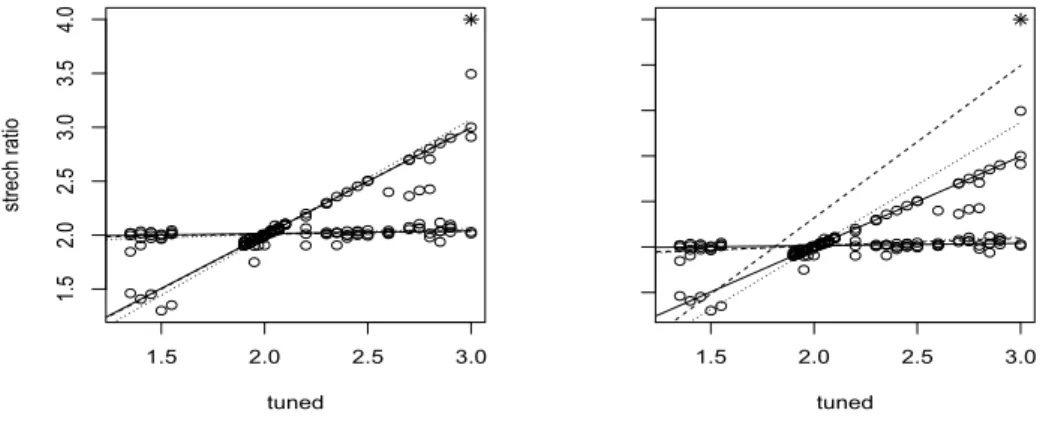
3.1 Figure 3.1 . . .
24
3.2 Figure 3.2 . . .
25
3.3 Figure 3.3 . . .
26
List of Tables
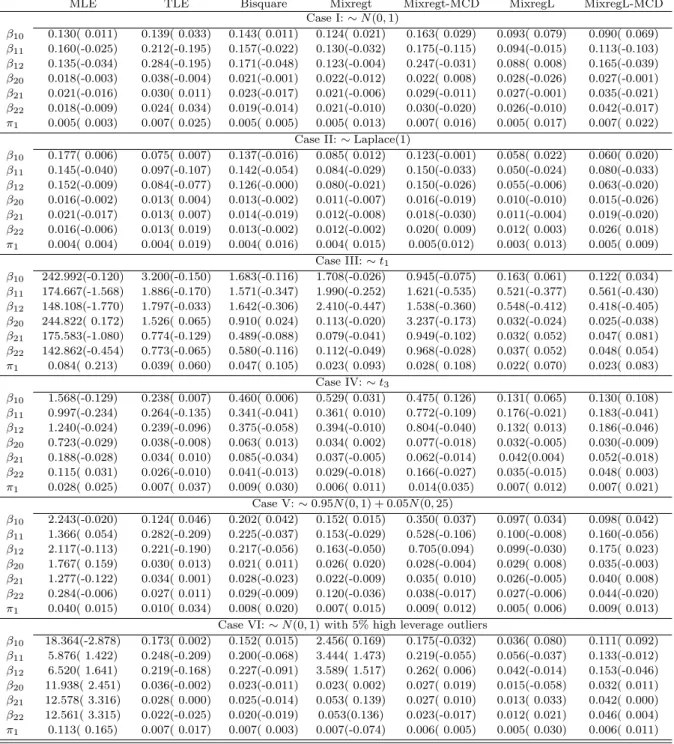
3.1 MSE(Bias) of Point Estimates for n = 100 . . . 21
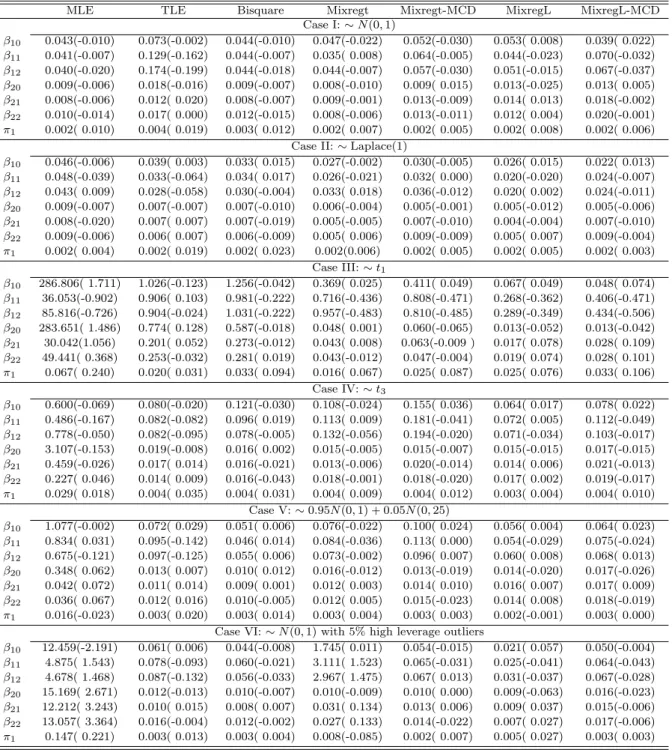
3.2 MSE(Bias) of Point Estimates for n = 200 . . . 22
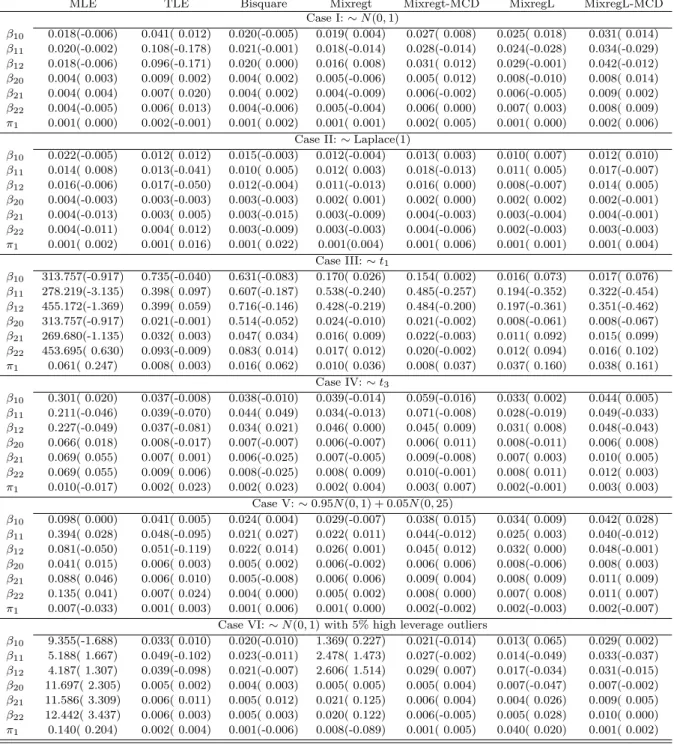
3.3 MSE(Bias) of Point Estimates for n = 400 . . . 23
Acknowledgments
I would like to express my deepest appreciation to Professor Weixing Song, who
continually and convincingly conveyed the spirit of insistence and creation in regard to
research. His exciting attitude in regard to teaching makes him be born for an instructor.
Without his guidance and persistent help, this report would not have been possible.
I also would like to thank Professor Kun Chen for his enthusiastic encouragement and
valuble critiques. I am grateful for Professor Weixin Yao's assistance and guidance. I obtain
most of the theoretical knowledge of Statistics by taking Professor Yao's classes.
Especially, I appreciate Professor Yao's contribution to part of the programming in the
simulation study.
I extend my sincere gratitude to Dr. Guihua Bai for providing me a GRA position.
Finally, I wish to thank my husband Huitao Liu for his support and encouragement
throughout my study.
Chapter 1
Introduction
Finite mixture models have been applied widely in practical and theoretical area over the
years because of its tractability. It can model complex distributions depending on the
choice of its appropriate components. Finite mixtures of distributions have constructed the
mathematical-based method to model various random phenomena; therefore, many science
fields adopt this kind of model to analysis data set, such as, biology, genetics, economics,
physical, medicine, social sciences, and so on. Over 100 years ago, famous biometrician Karl
Pearson (1894) used mixture models to analyzed the data set of measurements on the ratio
of forehead to body length of n=1000 crabs which were sampled from the Bay of Naples. The
mixture model was composed with two normal probability density functions with different
means and variances in certain proportion respectively. He applied the method of moments
to fit this mixture model and obtained his moments-based estimates of the five parameters.
Least absolute deviation (LAD) regression has been widely used in practice if robust
es-timates are desired. The research on its computation and theoretical properties is abundant
in the literature. A detailed survey on this topic can be found in Deilman (1984, 2005). In
this report, LAD will be applied to a class of mixture linear regression models to obtain
robust estimates of the regression coefficients.
Wei (2012) proposed a robust estimation procedure for the mixture linear regression
models based on t distribution by extending McLachlan and Peel (2000)
s
work. The
re-search conducted in this report deals with the same questions as in Wei (2012), but with
the LAD technique, the Laplace distribution, instead of t-distribution, is used for achieving
robustness. In addition, the implementation of Wei (2012) procedure needs to specify the
degrees of freedom in the t-distribution, however, the laplace distribution does not need
to do the step of tuning parameters. Moreover, the natural connection between the LAD
procedure and the MLE procedure based on Laplace error makes the proposed procedure
more appealing.
1.1
Mixture Model Definition
Let
Y
1,
. . .
,
Y
ndenote a random sample of size
n
from
g
components and suppose that the
mixture density
f
(
y
j;
θ
) of
Y
jcan be expressed as following,
f
(
y
j;
θ
) =
gi=1
π
if
i(
y
j;
λ
i)
,
(1.1)
where
π
iis the weight or proportion of the
i
thcomponent, 0
≤
π
i≤
1(
i
= 1
, . . . , g
), and
gi=1
π
i= 1.
θ
= (
π
1, . . . , π
g, λ
1, . . . , λ
i) is the set of unknown parameters and
λ
idenote the
parameter vector of the density function
f
i(
y
j;
λ
i). The
f
i(
y
j;
λ
i) is the density function of
the
i
thcomponent. Let
z
jbe a categorical random variable over from 1 to
g
with probabilities
π
1, . . . , π
g, respectively.
1.2
Maximum Likelihood Estimation and EM
Algo-rithm
Maximum likelihood (ML) is the most commonly used approach to the fitting of mixture
model. The estimate ˆ
θ
is obtained by an appropriate solution of the likelihood equation in
regular situation,
∂L
(
θ
)
The likelihood function of
θ
in model (1.1) is formed by the sample size
n
and given by
L
(
θ
;
y
) =
n j=1(
g i=1π
if
i(
y
j;
λ
i))
.
(1.2)
It is equivalent to maximize the log likelihood function when we want to maximize the
likelihood function and the log likelihood function is suggested as
log
L
(
θ
;
y
) = log(
n j=1(
g i=1π
if
i(
y
j;
λ
i)))
(1.3)
=
n j=1log(
g i=1π
if
i(
y
j;
λ
i))
.
The ML estimate of parameters
θ
can be described as
ˆ
θ
= arg max
n j=1log(
g i=1π
if
i(
y
j;
λ
i))
.
(1.4)
Hence, the solution of the following equation is the ML estimate of
θ
,
∂
log
L
(
θ
;
y
)
∂θ
= 0
.
It is obvious that the above equation does not have explicit solutions unless in trivial case.
However, the solutions of the likelihood equation can be obtained by the application of EM
algorithm (Dempster et al., 1977).
EM algorithm is a very useful method to handle the incomplete-Data problem. In the
procedure of fitting parametric mixture model with EM algorithm, the observed data vector
y
= (
y
1, . . . , y
n)
Tis viewed as being incomplete as the associated component-label vectors,
z
= (
z
1, . . . , z
n)
T, are not observable. Since each
y
jcome from one of the
g
components in
the mixture model,
z
jis a
g
-dimensional vector where
z
ij= (
z
j)
i= 1 or 0 depending on
whether
y
jarise from the
i
thcomponent of the mixture model or not. The complete-data
vector is
The complete Log likelihood log
L
c(
θ
;
y, z
) for complete-data vector
y
cis given by
log
L
c(
θ
;
y, z
) = log
n j=1(
g i=1(
π
if
i(
y
j;
λ
i))
zij)
(1.5)
=
n j=1 g i=1z
ijlog(
π
if
i(
y
j;
λ
i))
=
g i=1 n j=1z
ij(log
π
i+ log
f
i(
y
j;
λ
i))
.
The EM algorithm proceeds iteratively in two steps, E-step (expectation step) and
M-step (maximization M-step). E-M-step handles the unobservable data, which compute the
con-ditional expectation of complete log likelihood given observable vector
y
and using initial
parameter set
θ
(0)for
θ
. The M-step on the (
k
+ 1)
thiteration maximize the expectation in
the E-step with respect to
θ
and obtain the updated estimates
θ
(k+1). The EM algorithm
(iterative procedure) can be summarized as:
1. Input initial values
θ
(0)= (
π
(0) 1, . . . , π
(0)
g
, λ
(0)1, . . . , λ
(0)g) for the parameters.
2. E-step: For the (
k
+ 1)
thiteration, compute
Q
(
θ, θ
(k)) =
E
(log
L
c(
θ
;
y, z
)
|
y, θ
(k))
(1.6)
=
E
(
n j=1 g i=1z
ijlog(
π
if
i(
y
i;
λ
i))
|
y, θ
(k))
=
n j=1 g i=1E
(
z
ij|
y, θ
(k)) log (
π
if
i(
y
j;
λ
i))
.
When compute the expectation of log
L
c(
θ
;
y, z
), we only need to compute the
expecta-tion of
z
ijgiven
y
and
θ
(k),
E
(
z
ij|
y, θ
(k)) =
τ
ij(k+1)=
π
(k) if
i(
y
j;
λ
(ik))
g i=1π
(k) if
i(
y
j;
λ
(ik))
.
(1.7)
3. M-step: compute the estimate of
θ
which maximizes
Q
(
θ, θ
(k)),
4. The E-step and M-step are repeated until certain criterion is satisfied.
1.3
Normal Mixture
Pearson (1894)’s experiment suggests that the normal mixture model is useful in fitting the
data which have asymmetrical distributions. We use the normal mixture as an example to
conduct EM algorithm. The component normal density has mean
μ
iand covariance
σ
i2and
the mixture density function is given by
f
(
y
;
θ
) =
g i=1π
if
i(
y
;
λ
i) =
g i=1π
iφ
i(
y
;
μ
i, σ
i2) =
g i=1π
i√
2
πσ
ie
−(y−2σμi2i)2.
(1.8)
The EM algorithm for normal mixture model is showed as
1. Input initial values for parameters:
π
i(0),
μ
(0)i, and
σ
i2(0).
2. E-step: Compute the expectation of the complete log likelihood given
θ
(k)and
obser-vation
y
at the (
k
+ 1)
thiteration. The procedure is the following:
Q
(
θ, θ
(k)) =
E
(log
L
c(
θ
;
y, z
)
|
y, θ
(k)) =
n j=1 g i=1E
(
z
ij|
y, θ
(k)) log (
π
if
i(
y
j;
λ
i))
.
(1.9)
Let
τ
ij(k+1)=
τ
i(
y
j;
θ
(k)) =
E
(
z
ij|
y, θ
(k)), then
Q
(
θ, θ
(k)) =
n j=1 g i=1τ
ijlog
π
i−
1
2
n j=1 g i=1τ
ijlog 2
πσ
i2−
1
2
n j=1 g i=1τ
ij(
y
j−
μ
i)
2σ
2 i,
(1.10)
τ
(k+1) ij=
π
(k) iφ
i(
y
j;
μ
(ik), σ
2( k) i)
g i=1π
(k) iφ
i(
y
j;
μ
i(k), σ
i2(k))
.
(1.11)
3. M-step: Take the derivative of
Q
(
θ, θ
(k)) with respect to
θ
, we obtain
π
(k+1) i=
n j=1τ
(k+1) ij/n,
(1.12)
μ
(k+1) i=
n j=1τ
(k+1) ijy
j n j=1τ
(k+1) ij,
(1.13)
σ
2(k+1) i=
n j=1τ
(k+1) ij(
y
j−
μ
(ik+1))
2 n j=1τ
(k+1) ij.
(1.14)
1.4
Mixture of Normal Linear Regression Models
Linear regression model has been studied and applied widely in the analysis of statistical
relations between variables. In practice, the data in a data set may originate from different
normal population. Hence the mixture of normal linear regression models is very useful to
solve the practical problems in many fields, like marketing, biology, agriculture, economics,
and so on.
Let
Z
be a latent class variable and define
Z
=
i
(
i
= 1
,
2
, . . . , g
)
. Y
is the scalar response
variable which depends on the
p
-dimensional predictor
X
, and their relations could be
constructed by the following linear regression model:
Y
=
X
β
i+
ε
i, i
= 1
,
2
, . . . , g,
where
β
i= (
β
i1,
. . .
,
β
ip)
,
ε
iand
X
are independent. The density of
ε
ifollows normal
distribution
f
i(
·
) with mean 0 and variance
σ
2i. Suppose
P
(
Z
=
i
) =
π
i, then the conditional
density of
Y
given
X
without observing
Z
is,
f
(
y
|
x, θ
) =
g i=1π
if
i(
y
;
x
β
i, σ
i2)
,
(1.15)
where
θ
= (
π
1, β
1, σ
21, . . . , π
g, β
g, σ
2g)
.
Perform the procedures of EM algorithm as in section 1.3 for
f
(
y
|
x, θ
).
1. Take initial value
θ
(0)= (
π
(0)1
, . . . , π
(0) g, β
1(0), . . . , β
(0) g, σ
12(0), . . . , σ
2(0) g)
.
2. E-step: For the (
k
+1)
thiteration, compute the conditional expectation of the complete
log likelihood,
E
[
Z
ij|
y, θ
(k)] =
τ
ij(k+1)=
π
(k) if
i(
y
j;
x
jβ
( k) i, σ
2( k) i)
g i=1π
(k) if
i(
y
j;
x
jβ
i(k), σ
i2(k))
,
(1.16)
where
f
i(
y
j;
x
jβ
i(k), σ
2( k) i) =
1
σ
(k) i√
2
π
e
−(yj−xj β(ik))2 2σi2(k).
(1.17)
3. M-step: Update the value of parameters depending on
θ
(k).
π
(k+1) i=
n j=1τ
(k+1) ijn
,
(1.18)
β
(k+1) i= arg min
n j=1τ
(k+1) ij(
y
j−
x
jβ
i)(
y
j−
x
jβ
i)
= (
n j=1τ
(k+1) ijx
jx
j)
−1 n j=1τ
(k+1) ijx
jy
j,
(1.19)
σ
2(k+1) i=
n j=1τ
(k+1) ij(
y
j−
x
jβ
i(k+1))
2 n j=1τ
(k+1) ij.
(1.20)
Chapter 2
EM Algorithm for Robust Mixture
Regression
2.1
Laplace Distribution
Let
X
be a p-dimensional vector of explanatory variables, and
Y
be a scalar response
variable. We use a linear regression model to investigate the relationship between
Y
and
X
. For the mixture linear regression setup, we assume that (
X
, Y
) come from one of the
following
g
≥
2 linear regression models with probability
π
i,
i
= 1, 2,
. . .
,
g
,
Y
=
X
β
i+
σ
iε
i, i
= 1
,
2
, . . . , g,
(2.1)
where
gi=1π
i= 1,
β
i’s are unknown
p
-dimensional vectors of regression coefficients,
σ
i’s
are unknown positive scalars. The random error
ε
i’s are assumed to be independent of
X
i’s.
It is commonly assumed that the density functions of
ε
i’s are members in a location-scale
family with mean 0 and variances 1. In this report the design variable
X
is assumed to be
random, but the proposed estimation procedure also works for the fixed design.
If
g
= 1, LAD estimate of
β
is the minimizer of the target function
Q
(
β
) =
nj=1|
Y
j−
X
j
β
|
, where (
X
j, Y
j)
nj=1is a sample from model (2.1). However, if
g >
1, the formulation of
LAD target function is not straightforward since for a sample, we simply do not know which
regression model an observation arises from. Our formulation of the LAD target function
is motivated by the fact that the maximum likelihood estimate of the regression coefficients
given double exponentially distributed random error is indeed the LAD estimator for
g
= 1.
Therefore, for
g
≥
2 case, we assume that
ε
ifollows a double exponential distribution with
location 0 and scale parameter 1
/
√
2, which makes the variance of
ε
ibeing 1,
i
= 1
,
2
, . . . , g
.
Then it is easily seen that for a sample
S
=
{
(
X
j, Y
j)
, j
= 1
,
2
, . . . , n
}
from the model (2.1),
the log likelihood function of
θ
= (
β
1, σ
12, π
1, β
2, σ
22, π
2, . . . , β
g, σ
g2, π
g) can be written as
log
L
(
θ
;
S
) =
n j=1log
g i=1π
i√
2
σ
iexp
(
−
√
2
|
Y
j−
X
jβ
i|
σ
i)
.
(2.2)
Thus the maximum likelihood estimate of
θ
can be obtained by maximizing log
L
(
θ
;
S
)
with respect to
θ
. Usually no explicit solution can be obtained, and some numerical method
will be needed.
For the case
g
= 1, many algorithms are developed in the literature to tackle the
mini-mization problem ˆ
β
= arg min
Q
(
β
), such as the linear programming, least angle regression,
the modified maximum likelihood method by Li and Arce (2004), and others. An often
adopted but ad-hoc scheme for finding the solution
β
is to directly take the derivative of
Q
(
β
) with respect to
β
, and set it equal to 0. Here
σ
2is treated as a nuisance parameter.
By doing this, we obtain
∂Q
(
β
)
∂β
=
−
n j=1X
jsgn
(
Y
j−
X
jβ
) = 0
,
(2.3)
where
sgn
(
·
) is the sign function which takes -1, 0, 1 if the argument is negative, 0
and positive, respectively.
Let
w
j= 1
/
|
Y
j−
X
jβ
|
, and rewrite the equation (2.3) as
nj=1
w
jX
j(
Y
j−
X
jβ
) = 0. Thus by supplying an initial value
β
0for
β
, the updated
value
β
can be found by the weighted least square solution
β
1= (
n j=1w
jX
jX
j)
−1 n j=1w
jX
jY
j.
(2.4)
By iterating the above procedure, one can eventually find an approximate solution to
arg min
θQ
(
θ
).
stated above and an EM algorithm in conjunction with the Laplace distribution is found in
Phillips (2002). For the sake of completeness, we briefly describe the procedure of Phillip
(2002) here.
Andrews and Mallows (1974) showed that a Laplace distribution in fact can be expressed
as a mixture of a normal distribution and another distribution related to exponential
dis-tribution. To be specific, supposed
Z
and
V
be two random variables,
V
has a distribution
with density function
v
−3exp
(
−
(2
v
2)
−1),
v >
0, and given
V
=
v
, the conditional
distribu-tion of
Z
is normal with mean 0 and variance
σ
2/
(2
v
2). The joint density function
f
(
z, v
)
of
Z
and
V
can be written as
f
(
z, v
) =
√
v
πσ
exp
(
−
v
2z
2σ
2)
1
v
3exp
(
−
1
2
v
2)
.
(2.5)
Hence,
Z
marginally has a Laplace distribution with density function
h
ε(
z
) =
exp
(
−
√
2
|
z
|
/σ
)
/
(
√
2
σ
). Based on this finding, Phillips (2002) developed an EM algorithm to search for the
minimizer of
Q
(
β
).
Considering
V
as a latent variable, if
V
could be observed, then the complete
log-Likelihood function of
θ
= (
β, σ
2), based on the sample
P
= (
X
j
, Y
j, V
j)
nj=1, is
log
L
(
θ
;
P
) =
−
n
2
log
πσ
2−
1
σ
2 n j=1V
2 j(
Y
j−
X
jβ
)
2−
n j=1log
V
j2−
1
2
n j=11
V
2 j.
(2.6)
Following the two steps in EM algorithm procedure, assume that
θ
(k)= (
β
(k), σ
2(k)) is the
value in the
k
thiteration, then in the (
k
+ 1)
thiteration, we have to compute the conditional
expectation of the complete log likelihood function log
L
(
θ
;
P
) first, given the observed data
set (
Y
j, X
j)
nj=1and
θ
=
θ
(k), the procedure is showed as
E
[log
L
(
θ
;
P
)
|
S
] =
−
n
2
log
πσ
2−
n j=1E
[
V
j2|
θ
( k),
(
X
j, Y
j)
nj=1](
Y
j−
X
jβ
)
2σ
2−
n j=1E
[log
V
j2|
θ
(k),
(
X
j, X
j)
nj=1]
−
1
2
n j=1E
[
1
V
2 j|
θ
(k),
(
X
j, Y
j)
nj=1]
.
For the next step, maximize the conditional complete log likelihood expectation with
respect to
θ
. Denote
w
j=
E
[
V
j2|
θ
(k),
(
X
j, Y
j)
n(j=1)], and we notice that the third and fourth
terms on the right hand side of the above function do not involve the unknown
regres-sion parameters, such that maximizing the above conditional expectation is equivalent to
maximizing the following terms with respect to
θ
,
−
n
2
log
σ
2−
n j=1w
j(
Y
j−
X
jβ
)
2σ
2.
Phillips (2002) showed
w
j=
E
[
V
j2|
θ
(k),
(
X
j, Y
j)
nj=1] =
σ
(k)/
(
√
2
|
Y
j−
X
jβ
(k)|
), this implies
that the solution of
β
(k+1)indeed is the same as the one based on (2.4). It is also easy to
see that
σ
2(k+1)can be estimated by
σ
2(k+1)= 2
nj=1
w
j(
Y
j−
X
jβ
(k+1)
)
2/n
. The above
methodology will be extended to mixture regression setting.
2.2
Mixture Model with Laplace Distribution
In model (2.1), assume that
ε
i’s follow a Laplace distribution with mean 0 and scale
param-eter 1/
√
2. For
i
= 1
,
2
, . . . , g, j
= 1
,
2
, . . . , n,
denote
Z
ijas latent Bernoulli variables such
that
Z
ij=
1 if
j
th observation (
X
j, Y
j) is from
i
th component;
0 otherwise.
If the full data set
T
=
{
(
X
j, Y
j, Z
ij)
}
i=1,2,...,g;j=1,2,...,nare observable, then the complete
log likelihood function of
θ
= (
β
1, σ
21, π
1, β
2, σ
22, π
2, . . . , β
g, σ
g2, π
g) can be written as
log
L
(
θ
;
T
) =
n j=1 g i=1Z
ijlog
√
π
i2
σ
iexp
(
−
√
2
|
Y
j−
X
jβ
i|
σ
i)
.
(2.7)
From Andrews and Mallows (1974) mentioned above, we know that a Laplace distributed
random variable is a scale mixture of a normal random variable and another variable
re-lated to exponential distribution. Denote
V
j, coupled with (
X
j, Y
j), as the latent scale
variable,
j
= 1
,
2
, . . . , n
, then the complete log likelihood function of
θ
, based on
D
=
{
X
j, Y
j, V
j, Z
ij}
i=1,2,...,g;j=1,2,...,n, has the form
log
L
(
θ
;
D
) =
n j=1 g i=1Z
ijlog
π
i√
V
jπσ
iexp
(
−
V
2 j(
Y
j−
X
jβ
i)
2σ
2 i)
1
V
3 jexp
(
−
1
2
V
2 j)
(2.8)
=
n j=1 g i=1Z
ijlog
π
i−
1
2
n j=1 g i=1Z
ijlog
πσ
2i−
n j=1 g i=1Z
ijV
2 j(
Y
j−
X
jβ
i)
2σ
2 i−
n j=1 g i=1Z
ijlog
V
j2−
1
2
n j=1 g i=1Z
ijV
2 j.
Based on EM algorithm principle, for the E-step, we have to calculate the conditional
expectation
E
[
L
(
θ
;
D
)
|
S, θ
(0)], where
θ
(0)= (
β
(0) 1, σ
2(0) 1, π
(0) 1, . . . , β
(0) g, σ
g2(0), π
(0)g) is a proper
initial value for
θ
and
S
=
{
(
X
j, Y
j)
}
nj=1. Since the last two terms in (2.8) do not involve
the unknown regression parameters, we can simply drop them from the analysis. Thus, to
find
E
[
L
(
θ
;
D
)
|
S, θ
(0)], we only need to calculate the following two terms
τ
ij=
E
[
Z
ij|
S, θ
(0)]
,
δ
ij=
E
[
V
j2|
S, θ
(0), Z
ij= 1]
.
(2.9)
Refer to section 1.3, we obtain
τ
(1) ij=
π
(0) iσ
i−1(0)exp
(
−
√
2
|
Y
j−
X
jβ
i(0)|
/σ
i(0))
g m=1π
(0) mσ
m−1(0)exp
(
−
√
2
|
Y
j−
X
jβ
m(0)|
/σ
(0)m)
.
(2.10)
Follow the same thread as in Phillips (2002) to compute
δ
ijδ
(1) ij=
σ
(0) i√
2
|
Y
j−
X
jβ
i(0)|
.
(2.11)
In the M-step, the following expression will be maximized with respect to
π
i’s,
β
i’s, and
σ
2 i’s,
n j=1 g i=1τ
ijlog
π
i−
1
2
n j=1 g i=1τ
ijlog
σ
i2−
n j=1 g i=1τ
ijδ
ij(
Y
j−
X
jβ
i)
2σ
2 i.
(2.12)
2.3
EM Algorithm
We propose the following EM algorithm to maximize function (2.12).
1. Choose an initial value for
θ
= (
β
1, σ
12, π
i, . . . , β
g, σ
g2, π
g).
2. E-Step: at the (
k
+ 1)
thiteration, calculate
τ
ij(k+1)and
δ
ij(k+1)from equation (2.10) and
(2.11) with (0) replaced by (
k
).
3. M-Step: at the (
k
+ 1)th iteration, use the following formulas to calculate the
maxi-mizer of (2.12):
π
(k+1) i=
1
n
n j=1τ
(k+1) ij,
(2.13)
β
(k+1) i= (
n j=1τ
(k+1) ijδ
(ijk+1)X
jX
j)
−1(
n j=1τ
(k+1) ijδ
ij(k+1)X
jY
j)
,
(2.14)
and
σ
2(k+1) i=
2
nj=1τ
ij(k+1)δ
ij(k+1)(
Y
j−
X
jβ
i(k+1))
2 n j=1τ
(k+1) ij.
(2.15)
4. Repeat steps 2 and 3 until the convergence is obtained.
If we further assume that all
σ
2i
are equal, then in the above EM algorithm, a common
initial value for
σ
2i
should be used, and
σ
2can be updated in M-Step by
σ
2(k+1)=
2
n j=1 g i=1τ
(k+1) ijδ
( k+1) ij(
Y
j−
X
jβ
i(k+1))
2n
.
(2.16)
The robustness of the above EM procedure follows from the adoption of LAD regression.
It is also obvious from the formulae of the updated
β
i’s in each iteration. Note that the
factor reciprocally related to the term
|
Y
j−
X
jβ
i(k)|
, meaning that larger residuals give smaller
values of
δ
(ijk+1), hence, down-weight the corresponding observations when calculating the
estimates.
It is easy to see that when updating
β
i(k+1), the weight
δ
ijcan be simplified to
δ
ij=
1
/
|
Y
j−
X
jβ
i(k)|
. After updating
β
(k+1)
in one population case, we can update
σ
iusing formula
σ
(k+1) i=
√
2
nj=1τ
ij(k+1)δ
ij(k+1)|
Y
j−
X
jβ
i(k+1)|
n j=1τ
(k+1) ij.
(2.17)
Accordingly, when all
σ
2i
´s are assumed to be equal, then one can update the common
variance by
σ
(k+1)=
√
2
nj=1gi=1τ
ij(k+1)δ
ij(k+1)|
Y
j−
X
jβ
i(k+1)|
n
.
(2.18)
The EM algorithm proposed above for calculating the estimate of
β
indeed is an iterated
reweighted least square (IRLS) procedure, as the one proposed in Schlossmacher (1973) for
one population case and the weights are given by
τ
ij(k+1)δ
ij(k+1)in the (
k
+ 1)
thiteration.
Extra attention should be paid when programming the proposed EM algorithm. In the case
of
g
= 1, Schlossmacher (1973) warned that if a perfect LAD fit occurs, i.e.,
Y
j−
X
jβ
ˆ
i= 0
for some
i, j
and ˆ
β
i, then the algorithm will eventually gives
Y
j−
X
jβ
ik≈
0 when iteration
proceeds. As a result,
δ
(ijk+1)which is reciprocally related to
|
Y
j−
X
jβ
ik|
will be very large,
and numerical instability would follow. Although Phillips (2002) noticed that this problem
rarely arises in the case of
g
= 1, this does occur often in our case, which is not out of
expectation, simply because more than one regression models provide more chance for a
perfect LAD fitting. But simply adopting Schlossmacher (1973)’s weight scheme by setting
δ
(k+1)ij
= 0 whenever
|
Y
j−
X
jβ
ik|
< e
for a pre-assigned
e >
0 is not quite reasonable. It makes
much sense to allocate big weights for small residuals and small weights for big residuals.
A cogent argument on this issue is provided in Phillips (2002). In our simulation study, we
simply adopt a hard threshold rule to control the extremely small LAD residuals in each
iteration step. Under this rule,
δ
ij(k+1)will be assigned a value of 10
6for any perfect LAD fit.
We also tried other threshold values, such as 10
8, 10
10in the simulation, all these choices
generate almost identical results. For the sake of brevity, we only report the simulation
results by using 10
6as the threshold value.
It is well known that in IRLS procedure, numerical instability could occur if the weights
are very small. A common way to deal with this issue is to impose a hard threshold on
τ
ij(k+1)obtained in the (
k
+ 1)
thiteration. Namely, for a pre-specified value
e
say, if
τ
ij(k+1)> e
, then
τ
(k+1)ij