23
Uncapacitated phub center problem under uncertainty
Javad Nematian 1*, M.Mohammad Musavi1
1
Department of Industrial Engineering, University of Tabriz, Tabriz, Iran
[email protected], [email protected]
Abstract
Hubs are facilities to collect arrange and distribute commodities in telecommunication networks, cargo delivery systems, etc. In this paper, an uncapacitated phub center problem in case of single allocation and also multiple allocations is introduced in which travel times or transportation costs are considered as fuzzy parameters. Then, by proposing new methods, the presented problem is converted to deterministic mixed integer programming (MIP) problems where these methods are obtained through the implementation of the possibility theory and fuzzy chance-constrained programming. Both possibility and necessity measures are considered separately in the proposed new methods. Finally, the proposed methods are applied on the popular CAB data set. The computational results of our study show that these methods can be implemented for the phub center problem with uncertain frameworks.
Keywords: phub center, fuzzy chance-constrained programming, uncertainty, hub loation
1-Introduction
Hub location is one of the most attractive fields in facility location problems. Hub location problems (HLPs) are classical optimization problems that have many practical applications in telecommunication networks, cargo delivery systems, railroad transports systems, airlines, postal networks and other delivery networks that have multiple send and receive nodes. In hub location problem, commodities (such as cargo, passengers, mails, express packages etc.) are consolidated and distributed by hub nodes to the none-hub nodes (whom are also called spokes).The goal of the HLPs is to optimize the objective function by locating hub nodes and allocating spokes to the hubs. Minimization of transportation costs in hub location problems is achieved by the economy of scale, which happens due to existence of discount factor ( ) in inter-hub connections. Hub location problems are classified by their objective function (Mini-max or Mini-sum), solution space (continuous, discrete or network), determination of the number of hubs to locate, capacity of hubs or links, fixed or variable cost for establishing hubs and allocating spokes and other classification factors. In most of the classical hub location problems, demand of the nodes or in other words, the flow between any origin-destination (O-D) nodes and also transportation cost (or travel time) is considered as deterministic parameters.
*Corresponding author.
ISSN: 1735-8272, Copyright c 2016 JISE. All rights reserved Journal of Industrial and Systems Engineering
Vol. 9, special issue on location allocation and hub modeling, pp 23-39 Winter (February) 2016
However, because of many environmental aspects such as traffic intensity or climate changes, it is required to assume these deterministic parameters as uncertain parameters. One of the suggested approaches to confront uncertain parameters in linear models is fuzzy linear programming. In this research, we study and develop one of the popular hub location problems under fuzzy framework by fuzzy parameters. We considered the uncapacitated phub center problem as the primary model for proposing fuzzy counterpart of this problem. The major properties of this problem are:
• The problem is uncapacitated and there is no limitation in capacity of hubs.
• The objective function is mini-max which means that the maximum flow from any pair of origin - destination will be minimized.
• The number of hubs to be located is exogenous and must be equal to . • No cost has been defined for locating hub nodes.
• Both single and multiple allocations are considered: in single allocation each spoke must be allocated only to one hub but in multiple allocations, none of hub nodes' could be allocated to more than one hub.
This paper proposes the phub center problem with uncertain travel time (or transportation cost) in which the transportation times are considered as fuzzy variables.
The reminder of this paper is organized as follows: Section 2 reviews some related researches to this work. In section 3, the fuzzy uncapacitated phub center mathematical model for both single and multiple allocations are proposed (in possibility and necessity condition),. In section 4 numerical experiments on the problems are presented and finally conclusion and future research are presented in section 5.
2- Literature Review
In the last two decades, hub location problems have gained more attention from researchers and practitioners; however, hub location under uncertain environment is newly discussed and it is state-of-the-art field. In this section at first, we review the researches about classical and original hub location problems briefly. Then some related works to this paper, specifically those considering uncertainty are reviewed in two sub sections containing mathematical modeling and solution methods respectively. O’Kelly (1987) introduced the first mathematical model in HLP. He presented a quadratic integer programming whose objective is to minimize the total delivery cost between nodes and locating a pre-specified number of hubs. The later hub location literatures focused on different kinds of problems such as criterion (objective function), number of hubs to locate (fixed or variable), hub capacity (capacitated or uncapacitated), and kinds of allocation (single or multiple) and so on. The interested reader could review the papers by Campbell and O’Kelly (2012) and Farahani et al(2013) to read full survey of hub location problems and its sub categories.
Campbell (1994) proposed two new hub location problems, which are hub covering and phub center problems. In phub center problem a given number of hubs (p) is located while the maximum flow or travel time is minimized. The specified flow in these problems is considered between all origin-destination nodes. The none-hub nodes in some literatures are called spokes, so the networks containing hubs and none-hubs are called hub and spoke networks. Kara and Tansel (2000) and Ernst et al. (2009) represented different formulations for the phub center problem. In the phub center problem the main issue is time, which is mostly considered in cargo delivering systems.
2-1- Hub location problems with uncertainty
In real world problems, there might be vagueness or ambiguity in the parameters of the model. For example, the flow of commodities from one city to another could be uncertain for the decision makers. This is why optimization under uncertainty is discussed. In the literature of HLPs, there is less attention to the uncertainty of problem and most of the models have been formulated in deterministic environment. Mahdi and Mirzaei (2008) introduced a fuzzy capacitated hub center location problem that locates hub facilities based on qualitative variables. They proposed a hybrid formulation that performs both location
25
and allocation phases with qualitative and quantitative criteria simultaneously. Makui et al. (2002) presented a robust optimization model for multi-objective operation of capacitated phub location problems under uncertainty. They used scenario based robust approach to encounter with uncertainties (Mulvey and Ruszczynsk, 1995). Alumur et al. (2012) proposed a comprehensive model considering all sources of uncertainty and used direct approach for solution. Ghodratnama et al. (2013) proposed a novel fuzzy bi-objective model for a hub covering location–allocation problem, whom its first objective minimizes total cost and its second objective is to minimize the summation of shipping times ‘of commodities by transporters from the origin node to the destination node via hubs. A fuzzy goal programming approach is proposed to obtain solution. A sustainable hub location under mixed uncertainty is formulated by Mohammadi et al. (2014). Niakan et al. (2014) studied on a multi-objective hub location under uncertainty with an inexact rough-interval fuzzy approach. Recently, Yang et al. (2014) developed fuzzy phub center problem with generalized value-at-risk. Also, Qin and Gao(2014) discussed phub location with uncertain flows.Mohammadi and Tavakkoli-Moghaddam (2015) designed a novel bi-objective reliable p-hub center problem. They considered arrival time of shipments as a fuzzy M/M/1 queuing system. As well as fuzzy programming, some researchers interested in robust optimization for confronting uncertainties and proposing robust hub location formulations (Boukani et al. 2014; Shahabi and Unnikrishnan 2014; Ghaffari-Nasab et al. 2015).
2-2- Solution approaches to HLPs under uncertainty
One of the most efficient metaheuristic algorithmswhich is used by many researchers, is genetic algorithm (Kratica and Stanimirović, 2006).The other metaheuristic method is particle swarm
optimization (PSO) algorithm. For example, Kai Yang et al. (2012) proposed a hybrid particle swarm optimization algorithm for fuzzy phub center. They combined PSO with genetic operators and local search (LS) to improve solutions of the problem. Other papers that have been focused on solution approaches for HLPs under uncertainty are as follows: Bashiri et al. (2013) presented a genetic based heuristic to solve the capacitated p-hub center problem. They tested their solution on an example obtained by the fuzzy VIKOR method and the AP (Australian Post) data set to explain the effectiveness of the heuristic. Kai Yang et al. (2012) proposed a new fuzzy phub center with value-at-risk criterion in the objective and presented a genetic algorithm incorporating with local search for solution approach. After that Zade et al. (2014) presented a multi-objective hub maximal covering. They assumed uncertain shipments in the context of the problem and a modified NSGA-II metaheuristic was proposed for the solution of the multi-objective problem. Furthermore, Ghaderi and Rahmaniani (2015) presented metaheuristic approaches for robust hub location problem.
In most of the articles related to phub center problems under uncertainty, the uncertainty approach that has been applied is fuzzy programming and robust optimization. Especially, those who observed fuzzy programming, proposed diverse solution methods for it or presented mathematical modeling with fuzzy parameters, and confronted them by different techniques. According to our literature review, we could not find any papers that encounter uncertain parameters of phub center problem by offering possibility and necessity measures. The most important aim of this paper is to introduce new approaches for the uncapacitated phub center problem in both single and multiple allocation states under fuzzy framework based on the possibility theory (Dubois & Prade, 2001). Therefore, the theorems are obtained to convert the original problem to the deterministic mixed integer programming (MIP) problem for optimistic and pessimistic decision makers separately.
3- Mathematical models
Let G= (N, E) be an undirected complete graph with node set N= {1, 2, … , n} and arc set E. Each arc (i,j) has a cost (time, flow, distance, etc.) where = and satisfies triangular inequity ( ≤ +
∀ , , ). Each origin-destination pair i-j should be connected through hub nodes and it is assumed that there is a pre-defined reduction factor ( such that0 ≤ ≤ 1) between hub nodes so the cost between pairs is reduced, compared to direct connection. Also a given integer number of hubs should be located.
We will discuss fuzzy uncapacitated phub center problem (FUpHCP) in single (FUSApHCP) and multiple (FUMApHCP) states. Mathematical model of phub center originally is proposed by Campel (1994). Then, Ernst et al. (2009) presented linear formulation for phub center. In this research, linear model of Ernst et al. (2009) is used for fuzzy programming.
3-1 The FUSApHCP
The original objective function of phub center model is the following equation: min max, , , ∈ { },
Which has a quadratic objective function and represents the cost (time, money, etc.) between node and node that flows through hub and hub . In other words, the route from node to node is the following scheme:
! − ℎ$% → ℎ$% → ℎ$% → ! − ℎ$%
To include the discount factor in the model, the cost coefficient is transformed as = + + + where α is the discount factor of cost between hub and . is a binary variable such that = 1 if and only if node is allocated to node .The objective function of the linearized USApHCP model and its constraints, proposed by Ernst et al (2009), are as follows:
Indices are:
• i , j : none-hub node index • k , m : hub node index min (
). +. ( ≥ -. + / + , , = 1, … , .1/ 12
- = 1
12
= 1, … , .2/ ≤ , = 1, … , .3/
-12
= .4/ 6{0,1} , = 1, … , .5/ In the above model, objective function minimizes (, where ( is the maximum flow or cost between all origin-destination nodes, which is obtained in the first constraint. The second constraint assures that each none-hub node is allocated to only one hub node . The third constraint means that node must be a hub, if a node like is allocated to it, and the last constraint shows that precisely hubs should be located. In our hub location problem, there are two parameters that could be assumed as uncertain parameters: flow (or monetary cost or travel time) between any O-D pair and the cost of establishing hubs in any node. As noted in the model assumptions, there is no establishing cost for hubs, so the only uncertain parameter is the flow between nodes. For proposing our fuzzy models we use the method which is discussed in details by Nematian (2015).
27
89.?/ = @ A B A
CD E8:8− ?; F 8:− 8;≤ ? ≤ 8:
G E? − 88< :F 8:< ? ≤ 8:+ 8<,I .6/ Where8: defines the center, 8< defines the right spread and 8; is the left spread. D, G: L0,1M → L0,1M with G.0/ = D.0/ = 1 and D.1/ = G.1/ = 0 . R and L are decreasing continuous functions.
By the following problem, the USApHCP is developed to a model with fuzzy variables (FUSApHCP): Problem1:
N (
). +. ( ≥ O-P Q + Q R 12
+ Q S , , = 1, … , .7/ Constraint (2) – (5),
where Q = . :, U , V /=> , Q = . : , U , V /=> and Q = . : , U , V /=>. In the above model, each variable with "tilde sign (~)" over it , shows a fuzzy variable or uncertain parameter.
In order to solve the FUSApHLP, the fuzzy model should be transformed into a deterministic model by using possibility and necessity measures in each constraint with fuzzy variables and applying fuzzy chance-constrained programming (FCCP). Now, problem 1 is converted into the following problem by applying the FCCP:
Problem 2: N (
). +. W ) XO-P Q + Q R 12
+ Q S ≤ (Y ≥ Z , , = 1, … , .8/ Constraint (2) – (5),
where Z is a predetermined possibility level and W )P\∑ P Q + Q R12 + Q ^ ≤ (R is defined as follwes:
W )P(̃ ≤ (R = )$
`a,`bc defghij.k2/, ef.kl/m |k2≤ klo, .9/ where (̃ = ∑ P Q + Q R12 + Q
Now, we obtain the following theorem to convert problem 2 to deterministic programming. Theorem 1:
W )P(̃ ≤ (R ≥ Z ⇔ ∑ . : + : /
12 + : − D∗.Z/\∑ .U + U /12 + U ^ ≤ (
Where D∗.Z/ is pseudo inverse function and is defined as D∗.s/ = sup {+|D.+/ ≥ s}. Z indicates the level of possibility, for example if Z = 1 then the model output would be the same as non-fuzzy mode.
So the complete possibility model is represented by the following problem: Problem 3:
N (
). +. -. : + : / 12
+ : − D∗.Z/ O-.U + U / 12
+ U S ≤ ( , , = 1, … ,
Constraint (2) – (5).
Furthermore, for pessimistic decision makers, we apply the necessity measures in the FCCP approach like the previous model as follows:
Problem 4: N (
). +. w! XO-P Q + Q R 12
+ Q S ≤ (Y ≥ Z , , = 1, … , .12/ Constraint (2) – (5),
where w! P\∑ P Q + Q R12 + Q ^ ≤ (R is defined as w! P(̃ ≤ (R = inf`
a,`bc y? d1 − efghij.k2/, 1 − ef.kl/m |k2≤ klo .13/ Like the possibility model, we obtain the following theorem to transform problem 4 to a deterministic problem.
Theorem 2:
w! P(̃ ≤ (R ≥ Z ⇔ -. : + : / 12
+ : − D∗.1 − Z/ O-.U + U / 12
+ U S ≤ (
(11)
29
Problem 5: N (
). +. -. : + : / 12
+ : − D∗.1 − Z/ O-.U + U / 12
+ U S ≤ ( , , = 1, … ,
Constraint (2) – (5).
3-2- FUMApHCP
In multiple allocations each none-hub node can be allocated to more than one hub node. The mathematical model for multiple allocation of pHub center proposed by Ernst et al. (2009) is as follows: N (
). +. ( ≥ - - k P + + R , = 1, … , 12
12
- - k = 1
12 12
, = 1, … , .16/ - k
12
≤ z , , = 1, … , .17/ - k
12
≤ z , , = 1, … , .18/ - z
12
= .19/ z , k 6{0,1} , , , = 1, … , .20/ The variable k represents the allocation of node to hub and node to hub , so the origin-destination path is − − − . The variable z indicates the index of the hubs that will be established. The process of developing UMApHCP to FUMApHCP is the same as previous section that mentioned above:
Problem 6: N (
). +. ( ≥ - - k P Q + Q + Q R 12
12
, = 1, … , .21/ Constraint (16) – (20).
By applying FCCP approach with possibility measures for the above problem, we have:
Problem 7: N (
). +. W ).( ≥ - - k P Q + Q + Q R 12
/ 12
≥ Z , = 1, … , .22/ Constraint (16) – (20).
Like previous section, we achieve the following proposition: Proposition 1:
W )P(̃ ≤ (R ≥ Z ⇔
- - k P : + : + : R 12
12
− D∗.Z/O- - k PU + U + U R 12
12
S ≤ ( .23/ where (̃ = ∑ 12∑ 12k P Q + Q + Q R.
Then, the possibility model of FUMApHCP is represented as Problem 8:
N (
). +. - -P : + : + : Rk 12
12
− D∗.Z/ - -PU + U + U Rk 12
12
≤ ( .24/
, = 1, … , Constraint (16) – (20).
Furthermore, based on the necessity measures, we have the following problem: Problem 9:
N (
). +. w! .( ≥ - - k P Q + Q + Q R 12
/ 12
≥ Z , = 1, … , .25/ Constraint (16) – (20).
Proposition 2: w! P(̃ ≤ (R ≥ Z ⇔
- - k P : + : + : R 12
12
− D∗.1 − Z/ O- - k PU + U + U R 12
12
31
Finally, the necessity model of FUMApHCP is represented as follows: Problem 10:
N (
). +. - - k P : + : + : R 12
12
− D∗.1 − Z/ O- - k PU + U + U R 12
12
S ≤ ( , = 1, … ,
Constraint (16) – (20).
All obtained deterministic problems are easily solved by one of the MIP solvers.
4-Numerical Experiments
In this paper, we used popular CAB data set for numerical tests. The CAB data set was represented by O’Kelly (1987) for hub location problems. The CAB data set is based on Civil Aeronautics Board in 1970, which is generated from the flow of airline passengers in 25 cities in United States. Numbers in CAB data set are symmetric and satisfies triangular inequity. We used GAMS v24.1.2 to solve fuzzy phub center problem. A PC with Core i5 processor and 8GB RAM was used for performing experiments. For solving our fuzzy models we need to use input data in form of (?2, ?l, ?{) where ?l is the crisp number, and ?2, ?{ are left and right values. The crisp and middle number (?l) is assumed to be the original number in CAB data set. Assume that | is the original number in data set, to generate right and left values the following relation is used: .1 ± ~/|, Where 0 ≤ ~ ≤ 1. The value of ~ depends on level of uncertainty and the decision maker can change it according to his opinion. We assumed ~ = 0.2 so the right and left values are obtained respectively by 1.2| and 0.8|.
We divided numerical tests for solving these two problems (both single and multiple allocations for fuzzy phub center) into several sub problems. These sub problems are generated by using different values for model features. The features conclude the following cases:
• Size of problem: different problem sizes are found by taking the top 10, 15, 20 and 25 nodes from CAB data set.
• Discount factor: various varies of α = {0.2, 0.4, 0.6, 0.8} • Number of hubs to locate: different values of = {2, 3, 4, 5} • Possibility or necessity
• Pseudo inverse functions: the functions G∗.ℎ/ and D∗.Z/ in models represent probability and possibility levels, where G∗.ℎ/ = D∗.ℎ/ = 1 − ℎ. So different probability
Levels are obtained by using ℎ, Z as 0.1 , 0.3 , 0.5 , 0.7 , 0.9 .
Sub problems are shown as ?. k. (, where ? is the size of problem, k is the discount factor value and ( is the value of . For example sub problem 25.2.3 represents 25 nodes with = 0.2 and = 3.
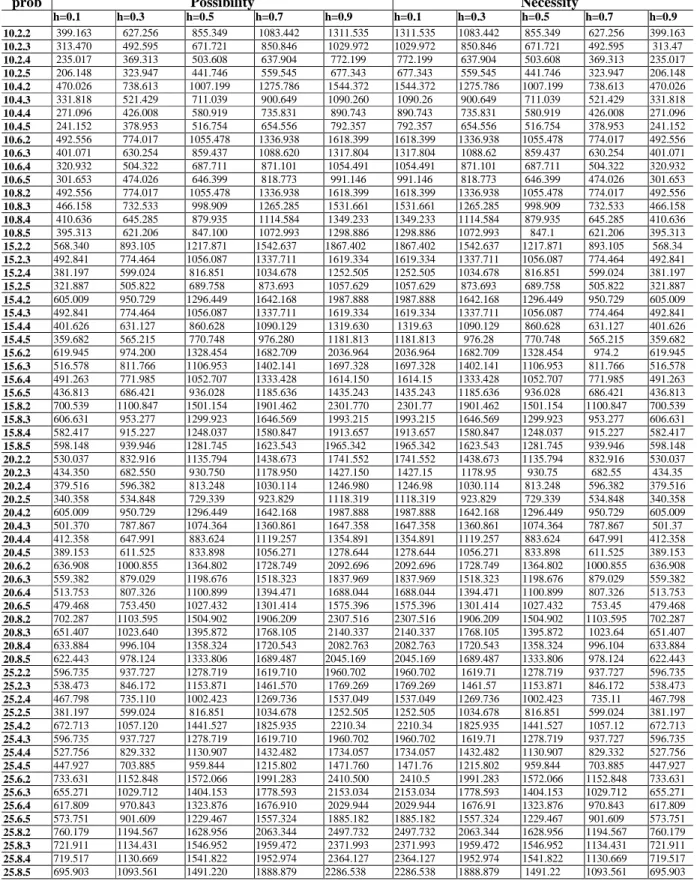
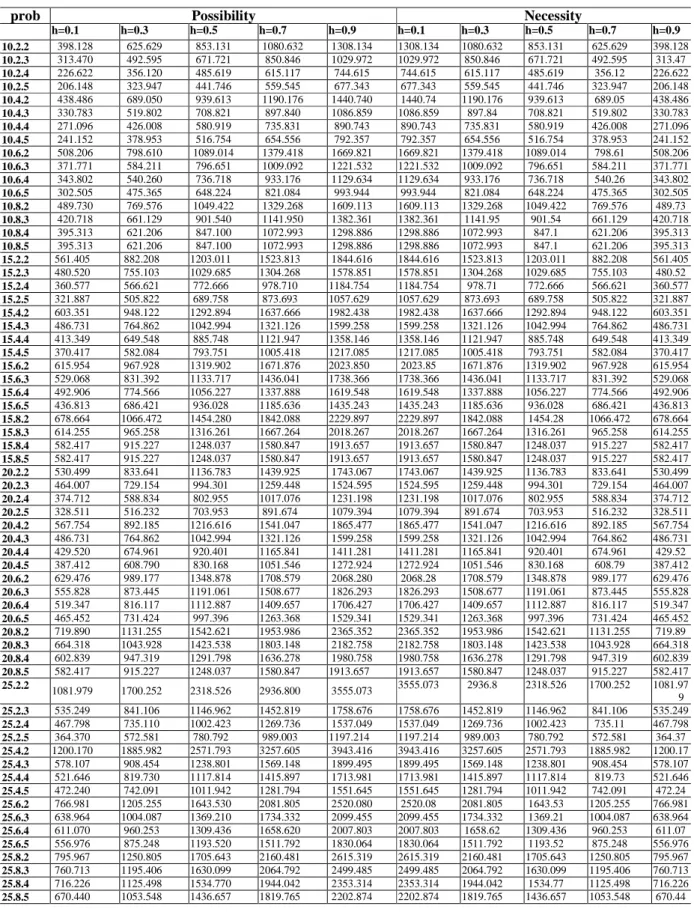
Results for the fuzzy single allocation phub center model are shown in Table I and for the fuzzy multiple allocation phub center model the results are shown in Table II. According to the results of Table I and Table II, in the same problem with the lowest possibility level for possibility-based model and the highest possibility level for necessity-based model, the optimal solutions for both possibility and necessity-based models are same.
Fig.1 and Fig.2 represent the optimal solution for different problems in
possibility cases of minimizing objective functions like phub center, with the increase of function increases too and in necessity cases the optimal value decreases.
Fig. 1.Problem: 10.2.2 of single allocation phub center for po
Fig. 2.Problem: 20.4.3 of Single allocation phub center for necessity
Any decision maker can consider other levels based on his/her circumstances or any other constraints. Therefore, the decision maker’s opinion can be classified as follows:
1. Best optimal solution:
possibility or necessity. The decision maker chooses the best allocation of spokes and the optimal hubs to locate and there is no restriction for selecting the possi
the optimal solution for different problems in the case
possibility cases of minimizing objective functions like phub center, with the increase of function increases too and in necessity cases the optimal value decreases.
Problem: 10.2.2 of single allocation phub center for possibility
Problem: 20.4.3 of Single allocation phub center for necessity
Any decision maker can consider other levels based on his/her circumstances or any other constraints. Therefore, the decision maker’s opinion can be classified as follows:
this vision of the decision maker does not deal with any levels of The decision maker chooses the best allocation of spokes and the optimal hubs to locate and there is no restriction for selecting the possibility/necessity levels.
case thatℎ changes. For the possibility cases of minimizing objective functions like phub center, with the increase of ℎ the objective
ssibility
Problem: 20.4.3 of Single allocation phub center for necessity
Any decision maker can consider other levels based on his/her circumstances or any other constraints.
not deal with any levels of The decision maker chooses the best allocation of spokes and the optimal
33
2. The lowest or highest level: in this point of view, the decision maker chooses only lowest or highest levels of possibility/necessity for locating hubs and allocating none-hub nodes. We considered ℎ = 0.1 as the lowest level and ℎ = 0.9 as the highest level.
3. The middle levels: in this perspective, the decision maker wants to have middle levels. This view happens when the DM does not have absolute information about the levels and decides to have middle levels.
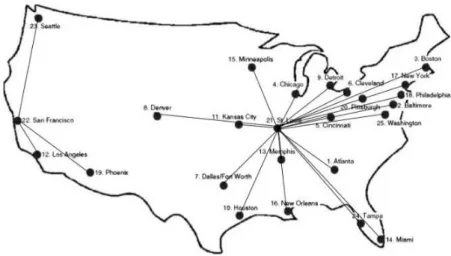
In this section, we treated the possibility/necessity levels of {0.1, 0.3, 0.5, 0.7, 0.9}onlyas sample levels to obtain optimal solutions, so there is no limitation for the decision maker to choose only them to find the optimal solutions. One can choose any other levels between.0,1M to find his/her optimal solutions. The map of the geographical locations of the cities in the CAB data set and the optimal solution for some of the problems is shown on Fig.3 and Fig.4. The optimal solution among all possibility or necessity level is chosen for the problem which is illustrated. Both figures considered only single allocation of the problem.
Fig. 3.Optimal solution of CAB data set with 25 nodes and two numbers of hubs to located with = 0.2
35
Table I. Numerical Results of FUSApHCP for CAB dataset
prob Possibility Necessity
h=0.1 h=0.3 h=0.5 h=0.7 h=0.9 h=0.1 h=0.3 h=0.5 h=0.7 h=0.9 10.2.2 399.163 627.256 855.349 1083.442 1311.535 1311.535 1083.442 855.349 627.256 399.163 10.2.3 313.470 492.595 671.721 850.846 1029.972 1029.972 850.846 671.721 492.595 313.47 10.2.4 235.017 369.313 503.608 637.904 772.199 772.199 637.904 503.608 369.313 235.017 10.2.5 206.148 323.947 441.746 559.545 677.343 677.343 559.545 441.746 323.947 206.148 10.4.2 470.026 738.613 1007.199 1275.786 1544.372 1544.372 1275.786 1007.199 738.613 470.026 10.4.3 331.818 521.429 711.039 900.649 1090.260 1090.26 900.649 711.039 521.429 331.818 10.4.4 271.096 426.008 580.919 735.831 890.743 890.743 735.831 580.919 426.008 271.096 10.4.5 241.152 378.953 516.754 654.556 792.357 792.357 654.556 516.754 378.953 241.152 10.6.2 492.556 774.017 1055.478 1336.938 1618.399 1618.399 1336.938 1055.478 774.017 492.556 10.6.3 401.071 630.254 859.437 1088.620 1317.804 1317.804 1088.62 859.437 630.254 401.071 10.6.4 320.932 504.322 687.711 871.101 1054.491 1054.491 871.101 687.711 504.322 320.932 10.6.5 301.653 474.026 646.399 818.773 991.146 991.146 818.773 646.399 474.026 301.653 10.8.2 492.556 774.017 1055.478 1336.938 1618.399 1618.399 1336.938 1055.478 774.017 492.556 10.8.3 466.158 732.533 998.909 1265.285 1531.661 1531.661 1265.285 998.909 732.533 466.158 10.8.4 410.636 645.285 879.935 1114.584 1349.233 1349.233 1114.584 879.935 645.285 410.636 10.8.5 395.313 621.206 847.100 1072.993 1298.886 1298.886 1072.993 847.1 621.206 395.313 15.2.2 568.340 893.105 1217.871 1542.637 1867.402 1867.402 1542.637 1217.871 893.105 568.34 15.2.3 492.841 774.464 1056.087 1337.711 1619.334 1619.334 1337.711 1056.087 774.464 492.841 15.2.4 381.197 599.024 816.851 1034.678 1252.505 1252.505 1034.678 816.851 599.024 381.197 15.2.5 321.887 505.822 689.758 873.693 1057.629 1057.629 873.693 689.758 505.822 321.887 15.4.2 605.009 950.729 1296.449 1642.168 1987.888 1987.888 1642.168 1296.449 950.729 605.009 15.4.3 492.841 774.464 1056.087 1337.711 1619.334 1619.334 1337.711 1056.087 774.464 492.841 15.4.4 401.626 631.127 860.628 1090.129 1319.630 1319.63 1090.129 860.628 631.127 401.626 15.4.5 359.682 565.215 770.748 976.280 1181.813 1181.813 976.28 770.748 565.215 359.682 15.6.2 619.945 974.200 1328.454 1682.709 2036.964 2036.964 1682.709 1328.454 974.2 619.945 15.6.3 516.578 811.766 1106.953 1402.141 1697.328 1697.328 1402.141 1106.953 811.766 516.578 15.6.4 491.263 771.985 1052.707 1333.428 1614.150 1614.15 1333.428 1052.707 771.985 491.263 15.6.5 436.813 686.421 936.028 1185.636 1435.243 1435.243 1185.636 936.028 686.421 436.813 15.8.2 700.539 1100.847 1501.154 1901.462 2301.770 2301.77 1901.462 1501.154 1100.847 700.539 15.8.3 606.631 953.277 1299.923 1646.569 1993.215 1993.215 1646.569 1299.923 953.277 606.631 15.8.4 582.417 915.227 1248.037 1580.847 1913.657 1913.657 1580.847 1248.037 915.227 582.417 15.8.5 598.148 939.946 1281.745 1623.543 1965.342 1965.342 1623.543 1281.745 939.946 598.148 20.2.2 530.037 832.916 1135.794 1438.673 1741.552 1741.552 1438.673 1135.794 832.916 530.037 20.2.3 434.350 682.550 930.750 1178.950 1427.150 1427.15 1178.95 930.75 682.55 434.35 20.2.4 379.516 596.382 813.248 1030.114 1246.980 1246.98 1030.114 813.248 596.382 379.516 20.2.5 340.358 534.848 729.339 923.829 1118.319 1118.319 923.829 729.339 534.848 340.358 20.4.2 605.009 950.729 1296.449 1642.168 1987.888 1987.888 1642.168 1296.449 950.729 605.009 20.4.3 501.370 787.867 1074.364 1360.861 1647.358 1647.358 1360.861 1074.364 787.867 501.37 20.4.4 412.358 647.991 883.624 1119.257 1354.891 1354.891 1119.257 883.624 647.991 412.358 20.4.5 389.153 611.525 833.898 1056.271 1278.644 1278.644 1056.271 833.898 611.525 389.153 20.6.2 636.908 1000.855 1364.802 1728.749 2092.696 2092.696 1728.749 1364.802 1000.855 636.908 20.6.3 559.382 879.029 1198.676 1518.323 1837.969 1837.969 1518.323 1198.676 879.029 559.382 20.6.4 513.753 807.326 1100.899 1394.471 1688.044 1688.044 1394.471 1100.899 807.326 513.753 20.6.5 479.468 753.450 1027.432 1301.414 1575.396 1575.396 1301.414 1027.432 753.45 479.468 20.8.2 702.287 1103.595 1504.902 1906.209 2307.516 2307.516 1906.209 1504.902 1103.595 702.287 20.8.3 651.407 1023.640 1395.872 1768.105 2140.337 2140.337 1768.105 1395.872 1023.64 651.407 20.8.4 633.884 996.104 1358.324 1720.543 2082.763 2082.763 1720.543 1358.324 996.104 633.884 20.8.5 622.443 978.124 1333.806 1689.487 2045.169 2045.169 1689.487 1333.806 978.124 622.443 25.2.2 596.735 937.727 1278.719 1619.710 1960.702 1960.702 1619.71 1278.719 937.727 596.735 25.2.3 538.473 846.172 1153.871 1461.570 1769.269 1769.269 1461.57 1153.871 846.172 538.473 25.2.4 467.798 735.110 1002.423 1269.736 1537.049 1537.049 1269.736 1002.423 735.11 467.798 25.2.5 381.197 599.024 816.851 1034.678 1252.505 1252.505 1034.678 816.851 599.024 381.197 25.4.2 672.713 1057.120 1441.527 1825.935 2210.34 2210.34 1825.935 1441.527 1057.12 672.713 25.4.3 596.735 937.727 1278.719 1619.710 1960.702 1960.702 1619.71 1278.719 937.727 596.735 25.4.4 527.756 829.332 1130.907 1432.482 1734.057 1734.057 1432.482 1130.907 829.332 527.756 25.4.5 447.927 703.885 959.844 1215.802 1471.760 1471.76 1215.802 959.844 703.885 447.927 25.6.2 733.631 1152.848 1572.066 1991.283 2410.500 2410.5 1991.283 1572.066 1152.848 733.631 25.6.3 655.271 1029.712 1404.153 1778.593 2153.034 2153.034 1778.593 1404.153 1029.712 655.271 25.6.4 617.809 970.843 1323.876 1676.910 2029.944 2029.944 1676.91 1323.876 970.843 617.809 25.6.5 573.751 901.609 1229.467 1557.324 1885.182 1885.182 1557.324 1229.467 901.609 573.751 25.8.2 760.179 1194.567 1628.956 2063.344 2497.732 2497.732 2063.344 1628.956 1194.567 760.179 25.8.3 721.911 1134.431 1546.952 1959.472 2371.993 2371.993 1959.472 1546.952 1134.431 721.911 25.8.4 719.517 1130.669 1541.822 1952.974 2364.127 2364.127 1952.974 1541.822 1130.669 719.517 25.8.5 695.903 1093.561 1491.220 1888.879 2286.538 2286.538 1888.879 1491.22 1093.561 695.903
Table II. Numerical Results of FUMApHCP for CAB dataset
prob Possibility Necessity
h=0.1 h=0.3 h=0.5 h=0.7 h=0.9 h=0.1 h=0.3 h=0.5 h=0.7 h=0.9 10.2.2 398.128 625.629 853.131 1080.632 1308.134 1308.134 1080.632 853.131 625.629 398.128 10.2.3 313.470 492.595 671.721 850.846 1029.972 1029.972 850.846 671.721 492.595 313.47 10.2.4 226.622 356.120 485.619 615.117 744.615 744.615 615.117 485.619 356.12 226.622 10.2.5 206.148 323.947 441.746 559.545 677.343 677.343 559.545 441.746 323.947 206.148 10.4.2 438.486 689.050 939.613 1190.176 1440.740 1440.74 1190.176 939.613 689.05 438.486 10.4.3 330.783 519.802 708.821 897.840 1086.859 1086.859 897.84 708.821 519.802 330.783 10.4.4 271.096 426.008 580.919 735.831 890.743 890.743 735.831 580.919 426.008 271.096 10.4.5 241.152 378.953 516.754 654.556 792.357 792.357 654.556 516.754 378.953 241.152 10.6.2 508.206 798.610 1089.014 1379.418 1669.821 1669.821 1379.418 1089.014 798.61 508.206 10.6.3 371.771 584.211 796.651 1009.092 1221.532 1221.532 1009.092 796.651 584.211 371.771 10.6.4 343.802 540.260 736.718 933.176 1129.634 1129.634 933.176 736.718 540.26 343.802 10.6.5 302.505 475.365 648.224 821.084 993.944 993.944 821.084 648.224 475.365 302.505 10.8.2 489.730 769.576 1049.422 1329.268 1609.113 1609.113 1329.268 1049.422 769.576 489.73 10.8.3 420.718 661.129 901.540 1141.950 1382.361 1382.361 1141.95 901.54 661.129 420.718 10.8.4 395.313 621.206 847.100 1072.993 1298.886 1298.886 1072.993 847.1 621.206 395.313 10.8.5 395.313 621.206 847.100 1072.993 1298.886 1298.886 1072.993 847.1 621.206 395.313 15.2.2 561.405 882.208 1203.011 1523.813 1844.616 1844.616 1523.813 1203.011 882.208 561.405 15.2.3 480.520 755.103 1029.685 1304.268 1578.851 1578.851 1304.268 1029.685 755.103 480.52 15.2.4 360.577 566.621 772.666 978.710 1184.754 1184.754 978.71 772.666 566.621 360.577 15.2.5 321.887 505.822 689.758 873.693 1057.629 1057.629 873.693 689.758 505.822 321.887 15.4.2 603.351 948.122 1292.894 1637.666 1982.438 1982.438 1637.666 1292.894 948.122 603.351 15.4.3 486.731 764.862 1042.994 1321.126 1599.258 1599.258 1321.126 1042.994 764.862 486.731 15.4.4 413.349 649.548 885.748 1121.947 1358.146 1358.146 1121.947 885.748 649.548 413.349 15.4.5 370.417 582.084 793.751 1005.418 1217.085 1217.085 1005.418 793.751 582.084 370.417 15.6.2 615.954 967.928 1319.902 1671.876 2023.850 2023.85 1671.876 1319.902 967.928 615.954 15.6.3 529.068 831.392 1133.717 1436.041 1738.366 1738.366 1436.041 1133.717 831.392 529.068 15.6.4 492.906 774.566 1056.227 1337.888 1619.548 1619.548 1337.888 1056.227 774.566 492.906 15.6.5 436.813 686.421 936.028 1185.636 1435.243 1435.243 1185.636 936.028 686.421 436.813 15.8.2 678.664 1066.472 1454.280 1842.088 2229.897 2229.897 1842.088 1454.28 1066.472 678.664 15.8.3 614.255 965.258 1316.261 1667.264 2018.267 2018.267 1667.264 1316.261 965.258 614.255 15.8.4 582.417 915.227 1248.037 1580.847 1913.657 1913.657 1580.847 1248.037 915.227 582.417 15.8.5 582.417 915.227 1248.037 1580.847 1913.657 1913.657 1580.847 1248.037 915.227 582.417 20.2.2 530.499 833.641 1136.783 1439.925 1743.067 1743.067 1439.925 1136.783 833.641 530.499 20.2.3 464.007 729.154 994.301 1259.448 1524.595 1524.595 1259.448 994.301 729.154 464.007 20.2.4 374.712 588.834 802.955 1017.076 1231.198 1231.198 1017.076 802.955 588.834 374.712 20.2.5 328.511 516.232 703.953 891.674 1079.394 1079.394 891.674 703.953 516.232 328.511 20.4.2 567.754 892.185 1216.616 1541.047 1865.477 1865.477 1541.047 1216.616 892.185 567.754 20.4.3 486.731 764.862 1042.994 1321.126 1599.258 1599.258 1321.126 1042.994 764.862 486.731 20.4.4 429.520 674.961 920.401 1165.841 1411.281 1411.281 1165.841 920.401 674.961 429.52 20.4.5 387.412 608.790 830.168 1051.546 1272.924 1272.924 1051.546 830.168 608.79 387.412 20.6.2 629.476 989.177 1348.878 1708.579 2068.280 2068.28 1708.579 1348.878 989.177 629.476 20.6.3 555.828 873.445 1191.061 1508.677 1826.293 1826.293 1508.677 1191.061 873.445 555.828 20.6.4 519.347 816.117 1112.887 1409.657 1706.427 1706.427 1409.657 1112.887 816.117 519.347 20.6.5 465.452 731.424 997.396 1263.368 1529.341 1529.341 1263.368 997.396 731.424 465.452 20.8.2 719.890 1131.255 1542.621 1953.986 2365.352 2365.352 1953.986 1542.621 1131.255 719.89 20.8.3 664.318 1043.928 1423.538 1803.148 2182.758 2182.758 1803.148 1423.538 1043.928 664.318 20.8.4 602.839 947.319 1291.798 1636.278 1980.758 1980.758 1636.278 1291.798 947.319 602.839 20.8.5 582.417 915.227 1248.037 1580.847 1913.657 1913.657 1580.847 1248.037 915.227 582.417 25.2.2 1081.979 1700.252 2318.526 2936.800 3555.073 3555.073 2936.8 2318.526 1700.252 1081.97 9 25.2.3 535.249 841.106 1146.962 1452.819 1758.676 1758.676 1452.819 1146.962 841.106 535.249 25.2.4 467.798 735.110 1002.423 1269.736 1537.049 1537.049 1269.736 1002.423 735.11 467.798 25.2.5 364.370 572.581 780.792 989.003 1197.214 1197.214 989.003 780.792 572.581 364.37 25.4.2 1200.170 1885.982 2571.793 3257.605 3943.416 3943.416 3257.605 2571.793 1885.982 1200.17 25.4.3 578.107 908.454 1238.801 1569.148 1899.495 1899.495 1569.148 1238.801 908.454 578.107 25.4.4 521.646 819.730 1117.814 1415.897 1713.981 1713.981 1415.897 1117.814 819.73 521.646 25.4.5 472.240 742.091 1011.942 1281.794 1551.645 1551.645 1281.794 1011.942 742.091 472.24 25.6.2 766.981 1205.255 1643.530 2081.805 2520.080 2520.08 2081.805 1643.53 1205.255 766.981 25.6.3 638.964 1004.087 1369.210 1734.332 2099.455 2099.455 1734.332 1369.21 1004.087 638.964 25.6.4 611.070 960.253 1309.436 1658.620 2007.803 2007.803 1658.62 1309.436 960.253 611.07 25.6.5 556.976 875.248 1193.520 1511.792 1830.064 1830.064 1511.792 1193.52 875.248 556.976 25.8.2 795.967 1250.805 1705.643 2160.481 2615.319 2615.319 2160.481 1705.643 1250.805 795.967 25.8.3 760.713 1195.406 1630.099 2064.792 2499.485 2499.485 2064.792 1630.099 1195.406 760.713 25.8.4 716.226 1125.498 1534.770 1944.042 2353.314 2353.314 1944.042 1534.77 1125.498 716.226 25.8.5 670.440 1053.548 1436.657 1819.765 2202.874 2202.874 1819.765 1436.657 1053.548 670.44
37
5- Conclusion
In this paper, we studied uncapacitated phub center problem under uncertainty in the travel time or transportation costs. We presented generic models capturing these different sources of uncertainty for the single and the multiple allocation cases of the problem. Also we proposed new methods to solve the problem for optimistic and pessimistic decision makers separately. Our new approach uses differentpossibility and necessity measures to obtain the optimal solution of the phub center problem. The presented problem is converted to deterministic mixed integer programming problems for convenience of solving with MIP solvers. Finally, for the numerical experiments we performed extensive computational analysis with more than 250 sub problems on the CAB data set.
As one of the future research activities, the proposed approach in confronting uncertain parameters could be implemented on other hub location problems such as hub covering problems, multi objective hub location problems, other capacitated hub location problems and also some new hub location problems like the hub line location problem (Martins et. al. 2015). Another future research suggestion is providing solution methods to efficiently solve more realistic, large-scale instances for this class of fuzzy phub center problem. This includes solving the formulation with met-heuristic algorithms.
References
Alumur, S. A., Nickel, S., & Saldanha-da-Gama, F. (2012). Hub location under uncertainty. Transportation Research Part B: Methodological, 46(4), 529-543.
Bashiri, M., Mirzaei, M., & Randall, M. (2013). Modeling fuzzy capacitated p-hub center problem and a genetic algorithm solution. Applied Mathematical Modelling, 37(5), 3513-3525.
Boukani, F. H., Moghaddam, B. F., & Pishvaee, M. S. 2014. Robust optimization approach to capacitated single and multiple allocation hub location problems. Computational and Applied Mathematics, 1-16. Campbell, J. F., & O'Kelly, M. E. 2012. Twenty-five years of hub location research. Transportation
Science, 46(2), 153-169.
Campbell, J.F., 1994. Integer programming formulations of discrete hub location problems. European Journal of Operational Research 72 (2), 387–405.
Dubois, D. and Prade, H., 2001. Possibility theory, probability theory and multiple-valued logics: A clarification. Annals of mathematics and Artificial Intelligence, 32(1-4), 35-66.
Ernst, A.T., Hamacher, H., Jiang, H., Krishnamoorthy, M., Woeginger, G., 2009. Uncapacitated single and multi-allocation p-hub center problems. Computers and Operations Research 36 (7), 2230–2241.
Niakan, F., Vahdani, B., & Mohammadi, M. 2014. A multi-objective optimization model for hub network design under uncertainty: An inexact rough-interval fuzzy approach. Engineering Optimization, (ahead-of-print), 1-19.
Farahani, R. Z., Hekmatfar, M., Arabani, A. B., & Nikbakhsh, E. 2013. Hub location problems: A review of models, classification, solution techniques, and applications. Computers & Industrial Engineering, 64(4), 1096-1109.
Ghaderi, A., & Rahmaniani, R. 2015. Meta-heuristic solution approaches for robust single allocation p-hub median problem with stochastic demands and travel times. The International Journal of Advanced
Ghaffari-Nasab, N., Ghazanfari, M., & Teimoury, E. 2015. Robust optimization approach to the design of hub-and-spoke networks. The International Journal of Advanced Manufacturing Technology, 76(5-8), 1091-1110.
Ghodratnama, A., Tavakkoli-Moghaddam, R., & Azaron, A. 2013. A fuzzy possibilistic bi-objective hub covering problem considering production facilities, time horizons and transporter vehicles. The
International Journal of Advanced Manufacturing Technology, 66(1-4), 187-206.
Kai Yang, Yankui Liu, Guoqing Yang, 2012. An improved hybrid particle swarm optimization algorithm for fuzzy p-hub center problem. Computers & Industrial Engineering 64 (2013) 133–142
Kai Yang, Yan-Kui Liu, Guo-Qing Yang, 2012. Solving fuzzy p-hub center problem by genetic algorithm incorporating local search. Applied Soft Computing 13 (2013) 2624–2632
Kai Yang, Yankui Liu, Guoqing Yang, 2014. Optimizing fuzzy p-hub center problem with generalized value-at-risk criterion. Applied Mathematical Modelling 38 (2014) 3987–4005
Kara, B.Y., Tansel, B.C., 2000. On the single assignment p-hub center problem. European Journal of Operational Research 125 (3), 648–655.
Kratica, J. and Stanimirović, Z., 2006. Solving the uncapacitated multiple allocation p-hub center problem
by genetic algorithm. Asia-Pacific Journal of Operational Research, 23(04), pp.425-437.
Mahdi, B., & Masoud, M. (2008). Hybrid fuzzy capacitated hub center allocation problem with both qualitative and quantitative variables. World Applied Sciences Journal, 5(4), 507-516.
Makui, A., Rostami, M., Jahani, E., & Nikui, A. (2002). A multi-objective robust optimization model for the capacitated P-hub location problem under uncertainty. Management Science Letters, 2(2), 525-534.
Martins de Sá, E., Contreras, I., Cordeau, J.F., Saraiva de Camargo, R. and de Miranda, G., 2015. The hub line location problem. Transportation Science.
Mohammadi, M., Torabi, S. A., & Tavakkoli-Moghaddam, R. 2014. Sustainable hub location under mixed uncertainty. Transportation Research Part E: Logistics and Transportation Review, 62, 89-115.
Mohammadi, M. and Tavakkoli-Moghaddam, R., 2015. Design of a fuzzy bi-objective reliable p-hub center problem. Journal of Intelligent & Fuzzy Systems, (Preprint), pp.1-18.
Mulvey, J. M. & Ruszczynsk, A. 1995. A new scenario decomposition method for large-scalestochastic optimization. Operations Research, 43, 477–490
Nematian, J. 2015. A fuzzy robust linear programming problem with hybrid variables. International
Journal of Industrial and Systems Engineering, 19(4), 515-546.
O’Kelly, M. E. 1987. A quadratic integer program for the location of interacting hub facilities. European Journal of Operational Research, 32, 393–404.
Shahabi, M., & Unnikrishnan, A. 2014. Robust hub network design problem.Transportation Research
Part E: Logistics and Transportation Review, 70, 356-373.
Qin, Z., & Gao, Y. 2014. Uncapacitated p-hub location problem with fixed costs and uncertain flows. Journal of Intelligent Manufacturing, 1-12.
39
Zade, A. E., Sadegheih, A., & Lotfi, M. M. 2014. A modified NSGA-II solution for a new multi-objective hub maximal covering problem under uncertain shipments. Journal of Industrial Engineering