AUSTRALIAN JOURNAL OF BASIC AND
APPLIED SCIENCES
ISSN:1991-8178 EISSN: 2309-8414 Journal home page: www.ajbasweb.com
Open Access Journal
Published BY AENSI Publication
© 2017 AENSI Publisher All rights reserved
This work is licensed under the Creative Commons Attribution International License (CC BY).
http://creativecommons.org/licenses/by/4.0/
To Cite This Article: Abubaker Ahmed, Abdel Hafiez Hasaballah, Siddig Balal., The Missing Interaction of Internal Market Orientation And Market Sensing On Innovation Capability. Aust. J. Basic & Appl. Sci., 11(2): 91-103, 2017
The Missing Interaction of Internal Market Orientation And Market
Sensing On Innovation Capability
1Abubaker Ahmed, 2Abdel Hafiez Hasaballah, 3Siddig Balal
1Candidate Ph. D, Dept. of Business Administration, College of Business Studies, Sudan University of Science and Technology,Khartoum, Sudan.
2Associate Professor, Dept.of marketing, College of Business & Economics, Qassim University, KSA.
3Associate Professor, Dept. of Business Administration, College of Business Studies, Sudan University of Science and Technology, Khartoum, Sudan.
Address For Correspondence:
Abubaker Mohamed Ahmed, Sudan University of Science and Technology,Dept. of Business Administration,College of Business Studies,Khartoum, Sudan.
E-mail: [email protected].
A R T I C L E I N F O A B S T R A C T Article history:
Received 18 December 2016 Accepted 16 February 2017
Available online 28 February 2017
Keywords:
Internal market orientation, market sensing, innovation capability, and resource based view.
Developing innovation capability (IC) is going to be a great challenge for firms in Sudan.This paper aims to examine the interaction effect of internal market orientation and market sensing on (IC) of firms from a resource point of view and a dynamic capability perspective. Depending on data obtained from 166 Sudanese firms, the study find that the interplay between market sensing and internal market orientation was partially associated with (IC). Furthermore, the study develops theoretical understanding of how the interaction of market sensing and internal market orientation influences (IC). The findings suggest that firms in different industries must devote more attention to identify sources of sustainable competitive advantage by completing and/or integrating resources to develop the (IC) and retaining it for a sustained period of time to survive.Also it highlighted the value of interaction between resources as a new approach that was conducted in researches;this is predominantly significant in today’s challenging business environment.In addition, managers needs to understand that linking marketing effort indirectly through innovation or any other capability is necessarily than directly link to firm performance. Future studies can utilize a multidimensional construct to (IC); moreover, it’s a fruitful avenue if scholars link this model to any other variable.
INTRODUCTION
Developing the (IC) and retaining it in organizations for a sustained period of time is going to be a great challenge for firms representing various industries in Sudan. This effort requires sound, and capacity to generate dynamic resources through integration or interaction of resources to be grounded by business organizations to enhance capabilities and systematically reaping benefits from excellent and well established organizational capabilities to ensure efficiency and effectiveness in the firms. Firms with greater capacity to innovate will be more successful in responding to their environments and develop new capabilities leading to competitive advantage and superior performance. Improved capabilities are wanted for expecting trends and actions before they are appear obvious and then adapting successfully (Krush, et al., 2013).
frequently are mostly implicit(Lankinen, et al., 2007).Therefore, firms that build strategy based on market sensing capability approach will contribute to their long term sustainability since it focuses on the stated needs and wants of the customers (Zehir, et al., 2015).
On the other hand (Song, et al., 2015) argued that implementing market orientation as the right marketing strategy is the key to increase firm’s innovation performance. In this sense scholars seem to agree that IMO enhance employees’ adoption of strategic directors given by superiors (Alanazi, 2015). Furthermore, (Carlos & Rodrigues, 2012) argued that a high amount of IMO, which decides the effective practice of Internal Marketing, improve the reply strategy of the organization, thus rising its productivity.
Market sensing is like market orientation, helps the firms in identifying hidden needs of the customers which helps in introducing new products and services to fulfill the needs of customers (Zafar, et al., 2016). Also dynamic capability (DC) address how competences are renewed over time so as to provide innovative responses to competitor’s strategy changes(Wang, 2015).
In general, market sensing is reported to positively influence innovation(Ardyan, 2016),(Fang, et al., 2014). While,marketing literature (Huhtala, et al., 2014),(Moreira & Silva, 2013) shows a positive association between market orientation and innovation. Despite the call for more examination of the interaction effect of market orientation and other organizational processes and its consequence on firm performance (Zahra, 2008). However, to some extend earlierstudieshave not so far incorporated market sensing (MS) and internal market orientation (IMO) simultaneously as interaction in discussions. Here the paper posits that the interaction of IMO and MS would positively relate to IC, and subsequently, present the data and explain the process by which the hypotheses are tested and elaborate upon the findings and their suggestions for theoretical and managerial implications.
Literature review: 2.1Market Sensing (MS):
Due to some constrains and the dynamic changes that confronted the businessenvironment. Companies now have to be receptive to what the customers want and need in order to be competitive(Cao, et al., 2012), or even survive in some cases. Thus, the management needs to understand customers in all their diversity. (Day, 1994)Consider this kind of understanding as ‘market sensing’. Sensing the environment of the business is a skill that needs to be acquired in all firms, regardless of industry sector.
In literature a number of studies such as(Day, 1994), (Everett, 2014), (Foley & Fahy, 2004), (Wilden, et al., 2009), (Lindblom, et al., 2008),(Bailey, 2014), others remain, discussed the market sensing concept. According to (Day, 2002) as cited in (Bailey, 2014), MS is the continuous ability to learn through the collection and distribution of information about customers, competitorsand relationships in the market(see. (Fang, et al., 2014)). Based on (Menon & Varadarajan, 1992) and (Maltz & Kohli, 1996) MS indicates to a firm’s capacity to employ market information whichgained through written (e.g., official letters) and verbal (e.g., meetings) channels from a variety ofindividual and community sources. (Huber, 1991) has considered market-sensing as the firm’sability of obtaining and disseminatinginformation, and to utilize market knowledge for organizational alteration as requested. MS capability is basically the organization’saptitude to be conscious of transformation in its market and to predictpreciselyanswers to its marketing strategies(Lindblom, et al., 2008).
According to (Lindblom, et al., 2008) MS is conceptualized as a three dimension construct that includes, (i) sensing, (ii) sense-making, and (iii) response. In brief, sensing refers to acquirement of information on different channel members like consumers and competitors beside others, while sense-making concerns with the interpretation of collected information against ancient practices and knowledge. Response refers to the use of the generated and interpreted information in managerial practices. In other words, response is the process of transformingknowledge and the intangible information into noticeable marketing strategy.
2.2 Internal Market Orientation (IMO):
Environmental dynamics and growing competition guide organizations to become more aggressive and to be sensitive to their customers’ satisfaction (SeyedJavadin, et al., 2012). Organizations desiring to expand a stronger market orientation are steadily more believingin an internal marketing viewpoint and extending an IMO to record this. (Gounaris, 2006)ViewIMO as the administrative philosophy underpinning internal marketing tactics.
In the same context recent studies (Lings & Greenley, 2005), (Gounaris, 2006),(Tortosa, et al., 2009)investigative the use of IMO as a tool for judging a firm’s internal marketingeffort,have painted the importance of thinking about employees’ wants in order to be converted into more efficient than firms which focus especially on external markets (Sanchez-Hernandez & Miranda, 2011).
between departments and contributive management. Thus raising the amount of IMO improves the reply strategy of the organization and ultimately, their ability to make happy customers constantly, so that sales and profits increase (see, (Carlos & Rodrigues, 2012)).
In accordance with (Carlos & Rodrigues, 2012) the concept of IMO is referring to an organization’s commitment to generate value for its employees in the course ofsuccessful management to relationships in the middle of employees, supervisors and the management. Based on what have been developed by(Lings, 2004), (Lings & Greenley, 2010),(Sahi, et al., 2013), (Fang, et al., 2014), and (Ruizalba, et al., 2014) the conceptualization of IMO construct where information generation, and information dissemination in addition to responsiveness are the dimensions of the construct is adapted in this paper.
Internal information generation is the process by which a firm obtains information about its internal customers. Gathering internal information means collecting information regarding employees, in other words (Lings & Greenley, 2010) state that generation ofinformation is pertinent to the internal market as it concernswith employees’ awareness of the inputs to their works, the amount produced and the fairness of this exchange.
Internal dissemination of information refers to communications between different departments and between managers and employees (Gounaris, 2006). Similarly (Lings & Greenley, 2010) specify that dissemination of information flanked by management and employees and in the middle of managers relates to information generated internally about the wants of employees, and their necessities, which is shared and communicated across departments.
Responsiveness in IMO refers to the extent to which manager’s reply to information generated about expectationsandneeds ofemployees (see, (Carter & Gray, 2007)). Responsiveness concerns with the implementation of suitable strategies and action devices, the form of required job designs, compensations, share in profits, and non-financial benefits (Linge & Greenley, 2001).
2.3 Innovation Capability (IC):
In strategic management, the importance of organizational capabilitiesis well documented and many authors have considered it as significant organizational resources that facilitate a firm to build competitive advantage (O'Regan & Ghobadian, 2004). Organizational capabilitiesare a firm’s abilities or competences to perform a set of tasks via company resources. As presentedby(Giniuniene & Jurksiene, 2015) the objective of innovation is to use current conditions and opportunities, which have shaped in environment, in sort to frame new value and gain competitive advantage.
From an organizational perspective, innovationin general understood as the successful opening of a new thing or system or embodiment, mixture, or synthesis of knowledge in original, pertinent, appreciated new products, processes, or services (Luecke & Katz, 2003) as cited in (Hao, et al., 2012). Innovation is a means for changing an organization, whether as a response to alterationsthat takes place in its internal or external environment or as a preventive move taken to influence an environment(Panayides, 2006). In same context (Wang & Ahmed, 2004) defined organizational innovativeness as “an organization’s overall innovative capability of introducing new products to the market, or opening up new markets, through merging strategic orientation with innovative behavior and process.
2.4 . The Internal Market Orientation (IMO) and Market Sensing (MS):
Marketing philosophers stress the significance of continuous learning about customers. This learning procedureconnects a series of information processing activities like, generating, distributing and interpreting customers’ wants, responses, and environmental trends (Heusinkveld, et al., 2009). Thus IMO captures a firm’s routines and processes by generating and disseminating information to recognize market opportunities through the emphasizing of internal customers needs, and this capability is likely to strengthen a firm’s market sensing. Similarly, (Celuch, et al., 2002) consider market orientation as anantecedent of organizational market information processing activity as well as how it is used in the firm’s strategy.
On the other hand MS activities provide companies with greater insights on customer needs, these insights, when combined with competitor information, enable companies to discover immature market niches and potential differentiation opportunities(Cao, et al., 2012). According to(Bailey, 2014) when investigating the aspects of MS, there is a clear link to market learning theory and organizational learning which divided into information acquisition, information dissemination, and shared interpretation.
Early research (Day, 2002) defined MS as continuous ability to learn about the market. While (Teece, 2007) view MS as a critical component of dynamic capabilities in the context of identifying opportunities. Therefore, MS is considered not a remote activity at the beginning of a development project, but relevant in eachstage of
the new product development process (Heusinkveld, et al., 2009).Based on the above mentioned IMO and MS
2.5. The resource based view (RBV) and dynamic capability theory (DCT):
Both resource-based theory (RBT) and its extensions dynamic capability point out the significance of the interaction between a firm’s ‘know-what’ knowledge resources and its complementary ‘know-how’ use capabilities (Celuch, et al., 2002). The advantage of ‘know-what’ is enable the firm to be moreefficient and effective by allowing managers to choose the most productive obtainable resource combinations to match market conditions (see, (Slater & Narver, 1995)).In the RBV literature, resources are defined as firm-specific assets, capabilities and organizational processes used by the firm to apply its strategy. Resources that are
rare,valuable, inimitable and non-substitutable (VRIN) are considered as a competitive
advantagesources(Barnney, 1991).
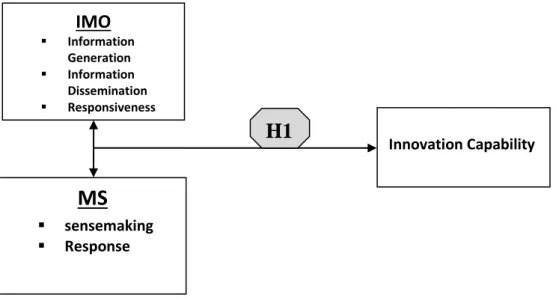
According to(Barnney, 2001)as cited in(Ozkaya, et al., 2015) the RBV defines organizational capabilities as the ability to use resources to create competitive advantage. Capabilities are defined as organizational routines that enable firms to perform distinctive activities (Teece, et al., 1997). Dynamic capabilities are derived from the RBV of the firm, which suggests that resources are developed through specialized routines that create different competencies (Teece, et al., 1997).(Teece, 2007) Defined the deployment of dynamic capability as the process of sensing and seizing market chances and reconfiguring the resource base. Similarly IMO reflects many of the characteristics of a dynamic capability. For example,(Zahra, 2008) point out that information intelligence includes routines to search and disseminate information within the organization allows to recognize market opportunities. According to (Morgan, et al., 2009) the literature points to that while possessing (VRIN) resources might be helpful, firms also need complementary capabilities to be clever to deploy available resources in ways that is suitable to the market conditions faced in arranging to drive organizational capabilities.Depending on the theoretical point of view, this paper will develop more comprehensive and testable hypotheses as depicted in Figure 1.
3 Development of hypotheses:
3.1 The interaction effect of IMO and MS on innovation capability:
Research on marketing capabilities(Rapp, et al., 2010)underscores the significance of the interaction impact between various business resources on firm-specific business processes(Krush, et al., 2013). Moreover ((Kozlenkova, et al., 2013) argue that many articles observe synergistic influencesamongdissimilar resources and capabilities for creating and/or capturing customer value.This is because of the dynamic capability concept which means the firm’s ability to incorporate, build and reconfigure external andinternal competencies to address quickly changing environments (Teece, et al., 1997). According to (Giniuniene & Jurksiene, 2015)researchers ((Eisenhardt & Martin, 2000),(Porter, 1990),(Teece, et al., 1997),(Zollo, 2003)) in the scientific literature recognize dynamic capabilities as a key factor in an organization’s innovativeness and competitiveness.
Different models of interaction in literature have been presented by different scholars. For example, (Song,
et al., 2007)discovered the positive interaction effect of marketing capabilities and marketing strategy type on financial performance.Similarly,(Zhu & Nakata, 2007)discussed the interaction effect of customer orientation and IT capabilities on market performance. Furthermore(Krush, et al., 2013)examined the interaction effect between sales capabilities and marketing dashboards on organizational sensemaking. These models are based on the thought of “resource complementarity” which suggests that a resource might add extra effect when shared with other resource(Amit & Schoemaker, 1993),(Teece, et al., 1997).Thus resources can integrate oneanother. According to (Krush, et al., 2013)the interaction of numerous resources may successfullyhelp in developing single and novel application for the resources.
Hypothesis1:
the interaction between internal market orientation and market sensing positively relates to innovation capability.
Fig. 1: the conceptual model
3.1.1 The interaction effect of information generation and MS on innovation capability:
A firm pursuing an innovative strategy is more likelyto respond to and to seek out new andnovel information during information generation to develop new ideas and discover new opportunities(Wei & Wang, 2011). MS concerns with the process of transforming information into knowledge and then apply strategic course of action. Thus internal information generation integrate the acquisition of information on differentsources like the marketplace, competitors, and customers that may help the firm to be familiar with the value of new information(Wei & Wang, 2011). Furthermore it can contribute to the sensemaking which concerns with the interpretation of generated information. Finally it may also interact with the process of transforming knowledge into noticeable marketing strategy. Therefore:
Hypothesis 1.1:
the interaction between information generation and sensemaking positively relates to innovation capability.
Hypothesis 1.2:
the interaction between information generation and response positively relates to innovation capability.
3.1.2 The interaction effect of information dissemination and MS on innovation capability:
Innovative ideas always come from information exchange among firms (Wang & Chung, 2013). Thus, a high dissemination of information can offer an organization with significant contribution and backgrounds that can help in the interpretation of the information sourced from organization’s environment and subsequently facilitate organizational innovation capability. According to sensemaking perspective firms scan the environment to gather information or data about real or potential changes in the market, and then they jointly interpret or make sense of that collected information(Wei & Wang, 2011).As a result of interpretation and/or sensemaking firms have to respond in order to adapt to environmental changes. Based on the above mentioned the internal information dissemination may have joint effect with MS on innovation capability. Thus:
Hypothesis 1.3:
the interaction between information dissemination and sensemaking positively relates toinnovation capability.
Hypothesis 1.4:
the interaction between information dissemination and response positively relates to innovation capability.
IMO
▪ Information Generation ▪ Information
Dissemination ▪ Responsiveness
MS
▪
sensemaking
▪
Response
Innovation Capability
3.1.3 The interaction effect of responsiveness and MS on innovation capability:
The call of marketing scholars underscores the need for more empirical research examining the complementarity of marketing resources and their combination that facilitate strategic action to improve organizational performance (Krush, et al., 2013). In accordance with (Kohli & Jaworski, 1990)Responsiveness is the exploit taken in response to intelligence that is generated and disseminated. Responsiveness represents a firm’s market sensing activities (Wei & Wang, 2011). In this context the responsiveness to internal information generation and dissemination may interact with the process of market sensing by adding value to develop a common understanding about employees’ needs as internal customers. Therefore suggested that:
Hypothesis 1.5:
the interaction between responsiveness and sensemaking positively relates to innovation capability.
Hypothesis 1.6:
the interaction between responsiveness and response positively relates to innovation capability.
4 Methodology:
4.1 Data collection process:
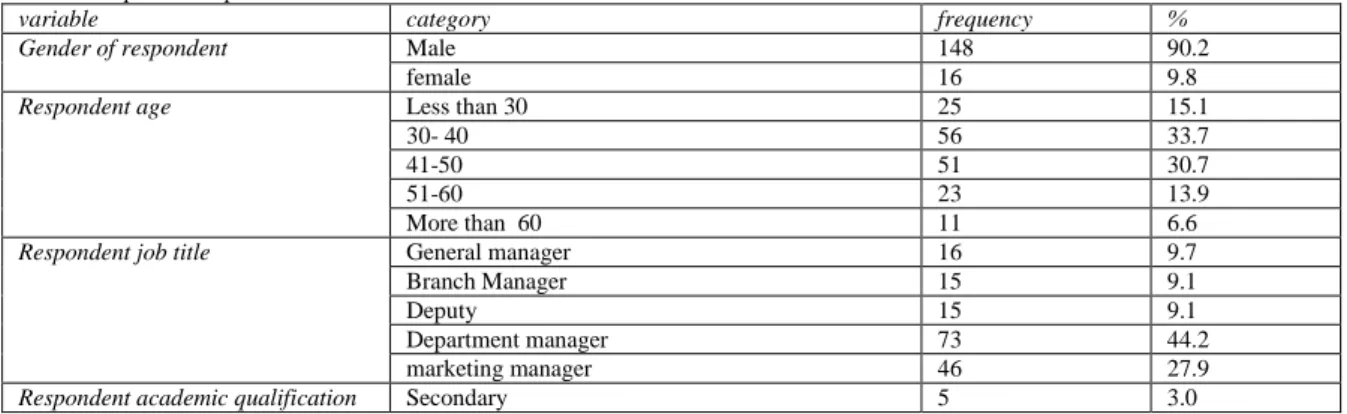
According to (Krush, et al., 2013) the usage of business units as the levels of analysis in past examinationsof resources and capabilities have been shown in(Rapp, et al., 2010)and(Vorhies & Morgan, 2005). The sampling border, consequently, was consisted of top and middle managers inside business units or firms operating in Sudan. A structured questionnaire was firstly developed in English then back to back Arabic translation was conducted. This procedure guarantees that the English and the Arabic versions of the questionnaire haveequal measures. Subsequently, a number of researchers in the same field assessed the correctness and the clearance of questions and measurement items. In the second stage a sample of questionnaire was developed and sent to four academicians served as expert judges to assess the questionnaire's face validity. Several alterations to question wording, modification of items, as well as the format and esthetics of the questionnaire were made for clarity. In stage three, pre-test was conducted upon fifty copies of the surveys distributed to the firms randomly; it reveals that the values of Cronbach’s Alpha test for the variables fall above the 0.70, these variables have an acceptable level of reliability (Sekaran, 2003). Final data collection was survey where convenient sample and self-administrated survey was used to distribute 200 questionnaires to be filled by one of the top or middle managers in 200 firms. A total of 166 valid surveys were received from respondents, represent 83% of the respondents.Based on the descriptive statistics using the frequency analysisshows that (52.4%) of the responded firms were industrial, where (31.9%) were commercial, and (14.5%) services,and just two of these firms (1.2%) has agricultural concern. In term of firm’s number of employees (43.4%) are large firms with more than 150 employees, while the small one’s with less than 50 employees are (27.1%). The firms’ number of employees ranged 50 – 100 is (18.1%), where others ranged 101 – 150 is (11.4%).Concerning the ages (50.6%)are well-established firms with more than 15 years, (13.3%) are newly established firms with less than 5 years, and those ranged from 5 to 15 years is (36.1%). With regard to the markets (55.8%) are domestic markets, where (43%) are both domestic and international markets, and only two firms are deals in international markets.
The majority of the responded firms are fully owned by Sudanese (75.2%), while other country fully owned (9%), a multinational was (15.8%). The competition among the firms is to some extend high because (49.4%) has more than 10 competitors, while (34.1%) has 5 – 10 competitors, beside (15.9%) has less than 5 competitors, and only one firm without competitor.With respect to above mentioned the frequency analysis classified these firms into three productstypes, (36.4%) consuming products, (34.5%) industrial products, and the rest of the firms are for service products. Bellow is Table 1 to presents the general characteristics of respondents.
Table 1: Respondents’ profile
variable category frequency %
Gender of respondent Male 148 90.2
female 16 9.8
Respondent age Less than 30 25 15.1
30- 40 56 33.7
41-50 51 30.7
51-60 23 13.9
More than 60 11 6.6
Respondent job title General manager 16 9.7
Branch Manager 15 9.1
Deputy 15 9.1
Department manager 73 44.2
marketing manager 46 27.9
Graduate 96 57.8
Post Graduate 65 39.1
Respondent years of experience 10 and less 63 38
from 11to 20 67 40.4
More than 21 36 21.7
Source: from data analysis (2015)
4.2 Description of measures:
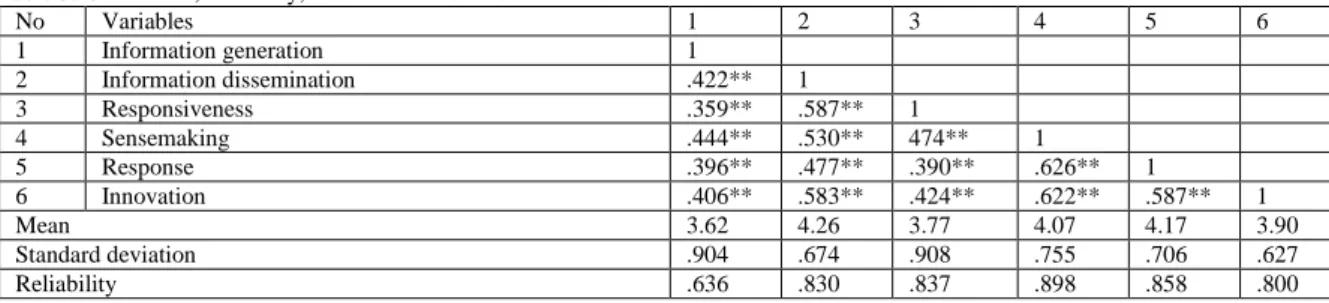
This study used measures adopted and created from available previous studies. All the variables were measured using items for multi-dimensional constructs, Likert’sfive-point scales. Details on dimensions reliability, means, standard deviations andcorrelations are found on Table 3.
The construct of IMO was adopted from (Ruizalba, et al., 2014) which consist of 22 items arranged in three dimensions. However the study shortened the items to 16 by deleting some items in order to meet the satisfactory of respondent’s mood this because respondents oven prefer simplicityand to make the data collection instrument suitable in time and length so as to achieve the respondent’s cooperation, this deleting process is aligned with (Krush, et al., 2013). The scale demonstrated acceptable reliability (α=0.703).
The three sub-construct of market sensing were measured on multi-items scales based on the work of (Lindblom et al., 2008) which orginalydeveloped by (Day, 2002). Howeverthe three dimensions of market sensing defined in the literature was loaded into two dimensions. These were called sensemaking andresponse.The scale alsoconfirmed acceptable reliability (α=0.77).Innovation capability was measured on multi-items scales adopted from (Panayides, 2006). The reliability for innovation was assessed using an internal consistancy is adequate (α=0.80).
Firm size as calculated by the number of employee, and firm age were included as control variables. (Vorhies, et al., 2010)showed the influence of firm size on organizational learning. Moreover the insertion of firm size and firm age as control variables is aligned with (Krush, et al., 2013).
5.Data analysis: 5.1Validity:
For testing the validity and uni-dimensionality of measures to all variables under study exploratory factor analysis was conducted on 16 IMO items, 13 MS items and 5 IC items to decrease data and to recognize the original dimensions. Principle component analysis, with varimax rotation and latent root criterion (eigenvalue >1) was used. As recommended by (Hair, et al., 2010), the factor analysis domenstrated that (KMO) measure of sampling adequacy for all variables exceeded 0.6, Bartlett’s test of sphericity was significant at 0.05, communalities of items greater than 0.50, and the minimum requirement of factor loading 0.50, with value of cross loading exceeds 0.50. Table 2 displays the variables, factor loadings, eigenvalues, and percentage of variance explained by the factors.
Table 2: Factor analysis
Construct Variables/items Factor loading eigenvalues PEV
IMO Inf. Generation 1.06 10.64
KMO = .830 IG1 .874
TVE = 68.993 IG2 .760
BTS = 681.497 Inf. Dissemination 1.18 11.84
ID1 .792
ID2 .779
ID3 .720
ID4 .661
ID4 .541
Responsiveness 4.65 46.52
Res1 .888
Res2 .881
Res3 .645
MS Sensemaking 5.61 56.12
KMO = .897 Sen1 .796
TVE = 69.451 Sen2 .786
BTS = 958.045 Sen3 .752
Sen4 .746
Sen5 .724
Sen6 .708
Response 1.33 13.34
Res1 .862
Res2 .828
Res3 .811
Res4 .703
Inn. Capability innovation 1.17 15.87
TVE = 62.258 Inn2 .628
BTS = 1551.199 Inn3 .597
Inn4 .567
Inn5 .521
On the other hand the reliability test showed in Table 3 demonstrated that alpha for all the dimensions fall above 0.70 and it may decrease to 0.60 in exploratory research as recommended by (Hair, et al., 2010), however the reliability of information generation was greater than 0.60 this also considered as reliable according to (Nunnally, 1978).Therefore it can be concluded that the measures have acceptable level of reliability.
Table 3: Correlation, reliability, mean and standard deviation for all variables
No Variables 1 2 3 4 5 6
1 Information generation 1
2 Information dissemination .422** 1
3 Responsiveness .359** .587** 1
4 Sensemaking .444** .530** 474** 1
5 Response .396** .477** .390** .626** 1
6 Innovation .406** .583** .424** .622** .587** 1
Mean 3.62 4.26 3.77 4.07 4.17 3.90
Standard deviation .904 .674 .908 .755 .706 .627
Reliability .636 .830 .837 .898 .858 .800
**. Correlation is significant at the 0.01 level (two tailed)
5.2 Findings:
A multiple regression analysis was conducted to test the association between interaction of internal market orientation with market sensing on IC, this relationship controlled by two variables (firm size, and firm age). The predictor variables are centered to create the interaction components.
In the proceduresof analysis, the control variables were came in the first step (i.e., model 1), then the interaction component were entered in the second step (i.e., model 2). As showed in Table 4 the results of regression analysis revealed that the two regression models were significant (F= 7.82, p<0.01; F= 27.27, p<0.01).The first model shows that the two control variables (firm size, and firm age) were significant on IC. The two control variables together explain about 10% of the total variation in innovation. The additions of the six components of interaction in model two explain additional about 52% of innovation variance. This means that the summing up of control variables and the interaction components explain 62% of the variance in innovation.
Further analysis of the results in table 4 showed a significant positive interaction effect (ß=2.22, p<0.01) between responsiveness and sensemaking, suggesting that H1.5 is supported. Followed by a significant positive interaction of information dissemination and response (ß=1.93, p<0.01), given H1.4 is supported. The negative interaction effect between information dissemination and sensemaking on IC(ß= -1.45, p<0.05) shows that the information dissemination compound the adverse effects of sensemaking on innovation capability. As such H1.3 is supported. In a same vein, a significant negative interaction effect between responsiveness and response (ß=-2.03, p<0.01) supports H1.6. The interaction between information generation and sensemaking is not significant (ß= -.083, p>0.05) and H1.1 is not supported. Similarly the interaction between information generation and response is not significant (ß= .178, p>0.05), thus H1.2 is supported.
Table 4: Multiple Regression Result:The Relationship between Interaction of Internal Market Orientation withMarket Sensing andInnovation Capability.
Variables DV: Innovation Capability
Step1 Std. Beta
Step2 Std. Beta Control Variables
Firm Size Firm Age
.288*** -.220***
.148** -.084 Model Variables
information generation* sensemaking information generation*response information dissemination* sensemaking information dissemination* response responsiveness* sensemaking responsiveness* response
-.083 .178 -1.452** 1.934*** 2.218*** -2.033*** F value 7.822*** 27.273***
R2 .102 .623
Adjusted R2 .089.600
R2 change .102 .521
F change 7.822*** 30.422***
Discussion:
This study contributes to the extent literature by investigating the interaction effect of IMO and MS on IC. The findings revealed attractive patterns in the middle of these variables. In particular, information dissemination interacts positively with response ofmarket sensing to enhance IC(H1.4). This suggests that a firm that facing high level of internal information dissemination as a result of business environmental change is highly need to concentrates in market sensing that would encourage a firm to be innovative in managing environmental change to keep survive in the future. Also whenever, a firm is confronted by the fierce competition in business environment, there will be a high range of internal information dissemination as strategy to enhance innovation capability by utilization of greater market sensing. This result support (Fang, et al., 2014) who argue that motivating employees to be sensitive to market changes and encouraging them to build and maintain good customer relationship is more important for an organization to develop organizational capabilities that help in achieving superior performance.
In a related manner responsiveness to dissemination also interacts positively with sensemaking to develop IC(H1.5). The logic behind this is contingency theory argues that there is no best way to make decisions and to organize a company. Thus, organization’s decisions and actions are contingent on internal and external situations(Hwang, 2011).Thus, rapidly disseminating of new intelligence to functional unit and coordinating the unit’s synergistic is required (Wang, 2015), to help the firm in the interpretation of the information sourced from firm’s environment and subsequently facilitate organizational innovation capability.
The finding of the negative interaction effects between information dissemination and sensemaking on innovation. Suggest that when a firm engages in MS the internal information dissemination may shift a firm’s concentration and innovation schemes from market wants to employee’s actions. Another interesting finding is that the interaction between responsiveness to dissemination and responseofMShave a propensity to negatively influence IC, demonstrating responsiveness add adverse effect on innovation.The justification for this result according to (Rupcic, 2006, June)is the extent of connection between the functions or corporate units influence the ability to generate market information, distribute and act upon it.
In general the results of this study reinforce a single perspective aligned with RBT and dynamic capability theory. The main hypothesis H1 inspects the optimistic interaction effects of IMO and MS on IC. The findings of the six sub hypotheses generated from H1 show the complementary results these two specific resources encompass on IC. This is because it is through market-sensing and customer-relating the valuable market information is brought into the firm and it can be used to encourage creativity within the firm(Racela, 2014).The positive interaction effect of IMO and MS suggest that the use of IMO heightens the impact MS has on IC. The results also reflect that the positive interaction effect provides an opportunity to the firms to develop ICand to increasebenefit in the marketplace. In effect IMO offer the reliable information about internal customers of organization which efficientlysupports in enhancing the MS efforts in generating market information to firm. In sum the approach of this study provide RBV to look at the value of coordination and integration or interaction between resources and capabilities that is regularly described in market orientation (Narver & Slater, 1990),(Song, et al., 2008),(Stam & Elfring, 2008), (Wang, 2008).
Theoretical implications:
The study was come out with three implications to marketing theory. Firstly it attempts to bridge the knowledge gapby developingdrivers of IC. It has been disputed that the important contribution can be created by examining a mechanism that put together the contributions of many areas and resources that assist in developing firm-specific strategic marketing processes (Krush, et al., 2013). This study suggests that IMO and MS are enhancers to IC.
Secondly, examination of the interaction effect of IMO and MS explains the complementary scopeof the two resources. In doing so, the study answers the researchers calls for more examination of the interplay between market orientation and other organizational resources or capabilities and its influence on firm performance orientation (Narver & Slater, 1990),(Song, et al., 2008),(Stam & Elfring, 2008), (Wang, 2008), and a better understanding of the interaction of marketing resources(Vorhies & Morgan, 2005).
Thirdly, in course of actionfor generating antecedents to IC, the study highlighted the value of interaction between resources as a new approach that was conducted in researches. This is predominantlysignificant in today’s challenging business environment.
Fourthly, the study also contributes to the social exchange literature by illustrating the complementary nature of social exchange relationships in examining the interplay effect of market sensing and internal market orientation on IC.
Managerial implications:
market information process by indicating positive links from the interaction to IC. Managers needs to understand that linking marketing effort indirectly through innovation or any other capability is necessarily than directly link to firm performance.
From managerial point of view, the outcomesafford prescriptive directionconcerning the value of investigative the integration effect of IMO and MS. Testing the frameworkconfirm the value of interaction between IMO and MS in making managers aware to cope with change and complexity of firms’ environment in Sudan. Moreover managers organizesuitable training for research and development staff, including the techniques to assembletimely market intelligence, the employ of the correct sources of intelligence, and the consideration of the limitations of intelligence(Krush, et al., 2013).
Limitations and future research directions:
Similar to any other researches, also this studyconfronted by a number of limitations that should be took about in order to be path for future study regarding this theme. Firstly, the hypotheses of this study were tested using cross-sectional data. However causality cannot be determined from cross- sectional data(Ozkaya, et al., 2015). Therefore a longitudinal data will be valuable to assess the innovation capability. This was recommended as an opportunity for future research project.
Secondly, the study utilized a one-dimensional measure of ICat the time(Panayides, 2006) argued that“literature on innovation suggests that it is present in various forms”. To increase extra insights, future scholars can utilize a multidimensional construct to IC.Thirdly, this study conducted a convenience sampling where the size of sample is restricted to 166 questionnaires. This as such, mightdecrease the chancetogeneralize findings. For further credibility to the findings additional outcomes with other samples may be fruitful avenues for future directions. Additionally the study relies on the responses of top and middle managers where self-administrated survey was used. In this point, self reported bias could be an issue. Thus, it will be interesting source for future research if the data collected from top managers or from sales and marketing executives only using mail survey.
ACKNOWLEDGEMENT
The authors are deeply appreciated and thank the companies and firms operating in Sudan who are responded to the survey and their representatives whom they are filled the questionnaire for their valuable time and effort in making this study valuable.
REFERENCES
Alanazi, T.A., 2015. Consequences of Internal Market Orientation in the Telecom Industry. Research Journal of Social Sciences, 8(3): 11-17.
Amit, R. and P.J. Schoemaker, 1993. Strategic assets and organizational rent. Strategic Management Journal, pp: 33-46.
Ardyan, E., 2016. Market Sensing Capability and SMEs Performance: The Mediating Role of Product Innovativeness Success. DLSU Business & Economics Review, 25(2): 79-97.
Bailey, C.J., 2014. Competing in low-income markets using dynamic and adaptive market sensing capabilities, Pretoria,: Gordon Institute of Business Science, University of Pretoria.
Barnney, J.B., 1991. Firm resources and sustained competitive advantage. journal of management,pp:
99-120.
Barnney, J.B., 2001. Is the resource-based ‘‘view’’ a useful perspective for strategic management research?
Yes.. Academy of Management Review,pp: 41-56.
Cao, H.D.T., L.C. Deivasigamani, R.J. Stanly and R. Sundel, 2012. IBM – Market Sensing. The Australian
Journal of Business and Informatics.
Carlos, V.S. and R.G. Rodrigues, 2012. Internal Market Orientation in Higher Education Institutions – its Inter-Relations with other Organisational Variables. Public Policy and Administration,pp: 690-702.
Carter, D. and L. Gray, 2007. Relational competence, internal market orientation and employee
performance. The Marketing Review, pp: 385-400.
Celuch, K.G., C.J. Kasouf and V. Peruvemba, 2002. The effects of perceived market and learning orientation on assessed organizational capabilities. Industrial Marketing Management, pp: 545-554.
Day, G.S., 1994. The Capabilities of Market-Driven Organizations. Journal of Marketing, pp: 37-52. Day, G.S., 2002. Managing the market learning process. Journal of Business & Industrial Marketing, pp: 240-252.
Everett, R.F., 2014. A Crack in the Foundation: Why SWOT Might Be Less Than Effective in Market Sensing Analysis. Journal of Marketing and Management, Special Issue, pp: 58-78.
Fang, S.-R., E. Chang, C.-C. Ou and C.-H. Chou, 2014. Internal market orientation, market capabilities and learning orientation. European Journal of Marketing,pp: 170-192.
Foley, A. and J. Fahy, 2004. Towards a further understanding of the development of market orientation in the firm: a conceptual framework based on the market-sensing capability. Journal of Strategic Marketing, pp: 219-230.
García-Morales, V.J., M.M. Jiménez-Barrionuevo and L. Gutiérrez-Gutiérrez, 2012. Transformational leadership influence on organizational performance through organizational learning and innovation. Journal of Business Research, pp: 1040-1050.
Giniuniene, J. and L. Jurksiene, 2015. Dynamic Capabilities, Innovation and Organizational Learning: Interrelations and Impact on Firm Performance. Procedia - Social and Behavioral Sciences, pp: 985-991.
Gounaris, S.P., 2006. Internal-market orientation and its measurement. Journal of Business Research, pp: 432-448.
Gounaris, S., A. Vassilikopoulou and K.C. Chatzip, 2010. Internal-market orientation: a misconceived aspect of marketing theory. European Journal of Marketing, pp: 1667-1699.
H.M.A, H. and R. Mahmood, 2013. Mediatory Effect of Entrepreneurial Self Efficacy on the Relationship between Strategic Orientation and SME Performance: A Research Model. International Academic Research Journal of Business and Management, pp: 1-18.
Hair, J.F. et al., 2010. multivariate data anlysis. s.l.:Prentice Hall.
Hao, Q., H. Kasper and J. Muehlbacher, 2012. How does organizational structure influence performance
through learning and innovation in Austria and China. Chinese Management Studies,pp: 36-52.
Heusinkveld, S., J. Benders and R.-J. Berg, 2009.
Frommarketsensingtonewconceptdevelopmentinconsultancies: Therole of
informationprocessingandorganizationalcapabilities. Technovation, pp: 509-516.
hooly, G., G. Greenley, J. Cadogan and J. Fahy, 2005. The performance impact of marketing resource. Journal of Business Research, pp: 18-27.
Huber, G., 1991. Organizational learning: contributing processes and the literatures. Organizational Science, pp: 88-115.
Huhtala, J.P. et al., 2014. Market orientation, innovation capability and business performance: Insights from the global financial crisis. Baltic Journal of Management, 9(2): 134-152.
Hwang, W., 2011. The drivers of ERP implementation and its impact on organizational capabilities and
performance and customer value., Toledo: The University of Toledo.
Hyvo¨nen, S. and M. Tuominen, 2007. Channel collaboration, market orientation and performance advantages: discovering developed and emerging markets. International Review of Retail, Distribution and Customer research, pp: 423-445.
Kohli, A.K. and B.J. Jaworski, 1990. Market orientation: The construct, research propositions, and managerial implications.. Journal of Marketing, pp: 1-18.
Kozlenkova, I.V., S.A. Samaha and R.W. Palmatier, 2013. Resource-based theory in marketing. Journal of Academic Marketing Science, pp: 013-033.
Krush, M.T., R. Agnihotri, K.J. Trainor and E.L. Nowlin, 2013. Enhancing organizational sensemaking: An examination of interactive effects of sales capabilities and marketing dashboards. Industrial Marketing Management, pp: 824-835.
Lankinen, J., M. Rökman and P. Tuominen, 2007. Market-sensing capability and market orientation in the
food industry: empirical evidence from Finland. Bergen - Norway, Norwegian School of Economics and Business Administration, pp: 434-439.
Lindblom, A.T., R.M. Olkkonen, L. Mitronen and S. Kajalo, 2008. Market-Sensing Capability and Business
Performance of Retail Entrepreneurs.. Contemporary Management Research, pp: 219-236.
Linge, I.N. and G.E. Greenley, 2001. The development and validation of a measure of internal market
orientation, Birmingham, United Kingdom: Aston Business School Research Inst.
Lings, I.N., 2004. Internal market orientation Construct and consequences. Journal of Business Research,
pp: 405-413.
Lings, I.N. and G.E. Greenley, 2005. measuring internal market. journal of service research, pp: 290-305. Lings, I.N. and G.E. Greenley, 2010. Internal market orientation and market-oriented behaviours. Journal of
Service Management,pp: 321-343.
Luecke, R. and R. Katz, 2003. Managing Creativity and Innovation, Boston: Harvard Business School Press.
Menon, A. and P.R. Varadarajan, 1992. A Model of Marketing Knowledge Use Within Firms. Journal of Marketing, pp: 53-71.
Moreira, A.C. and P.M. Silva, 2013. Market Orientation, Innovation and Organizational Commitment in
Industrial Firms. TRŽIŠTE Vol. XXV br.2: 123-142.
Morgan, N.A., D.W. Vorhies and C.H. Mason, 2009. RESEARCH NOTES AND COMMENTARIES MARKET ORIENTATION, MARKETING CAPABILITIES, AND FIRM PERFORMANCE. Strategic Management Journal, pp: 909-920.
Narver, J. and S. Slater, 1990. The effect of a market orientation on business profitability. Journal of Marketing, pp:20-35.
Nunnally, J., 1978. Psychometric Theory. New York: McGraw-Hill.
O'Regan, N. and A. Ghobadian, 2004. The importance of capabilities for strategic direction and
performance. Management Decision,pp: 292-312.
Osisioma, H.E., H.N. Nzewi and I.C. Mgbemena, 2016. Dynamic Capabilities and Performance of Selected Commercial Banks in Awka, Anambra State, Nigeria. European Journal of Business and Social Sciences, 4(10): 98-110.
Ozkaya, H.E. et al., 2015. Market orientation, knowledge competence, and innovation. Intern. J. of
Research in Marketing,pp: 309-318.
Panayides, P., 2006. Enhancing innovation capability through relationship management and implications for performance. European Journal of Innovation,pp: 466-483.
Porter, M., 1990. The Competitive Advantage of Nations. Harvard Business Review, pp: 73-93.
Racela, O.C., 2014. Customer orientation, innovation competencies, and firm performance: A proposed conceptual model. Procedia - Social and Behavioral Sciences, 148: 16-23.
Rapp, A., K.J. Trainor and R. Agnihotri, 2010. performance implications of customer linking capabilities: Examining the complementray role of customer orientation and CRM technology. Journal of Business Research, pp: 1229-1236.
Ruizalba, J.L., G. Bermúdez-González, M.A. Rodríguez-Molina and M.J. Blanca, 2014. Internal market orientation: An empirical research in hotel sector. International Journal of Hospitality Management, pp: 11-19.
Rupcic, N., 2006, June. Role of the Market Orientation in the Learning Company Context. Zagreb, University of Zagreb, Faculty of Economics and Business, p: 1644.
Sahi, G.K., S. Lonial, M. Gupta and N. Seli, 2013. Revisiting internal market orientation: a note. Journal of
Services Marketing,pp:385-403.
Sanchez-Hernandez, M.I. and F.J. Miranda, 2011. Linking internal market orientation and new service
performance. European Journal of Innovation Management,pp: 207-226.
Sekaran, U., 2003. Research Methods for Business: Askill Bulding Approach. Carbondale: John Wily & Sons.
SeyedJavadin, S. et al., 2012. How organizational citizenship behavior mediates between internal marketing and service quality. The case of Iranian GAS company. International Journal of Quality & Reliability
Management,pp: 512-530.
Slater, S. and J. Narver, 1995. Market orientation and the learning organization. Journal of Marketing, pp: 63-74.
Song, J., Y. Wei and R. Wang, 2015. Market orientation and innovation performance: Themoderating roles of firm ownership structures. Intern. J. of Research in Marketing,pp: 319-331.
Song, M.C., A.D. Benedetto and R.W. Mason, 2007. Capabilities and financial performance: The moderating effect of strategic type.. Journal of the academy of Marketing Science, pp: 18-34.
Song, M., K. Podoynitsyna, H.B. van der Bij and J.I M. Halman, 2008. Success factors in new ventures: a
meta-analysis. Journal of Product Innovation Management,pp: 7-27.
Stam, W. and T. Elfring, 2008. Entrepreneurial orientation and new venture performance: the moderating role of intra- and extraindustry social capital. Academy of Management Journal,pp: 97-111.
Teece, D.J., 2007. Explicating dynamic capabilities: the nature and microfoundations of (sustainable) enterprise performance. Strategic management journal, pp: 1319-1350.
Teece, D.J., G. Pisano and A. Shuen, 1997. Dynamic capabilities and strategic management. Strategic
Management Journal,pp: 509-533.
Tortosa, V., M.A. Moliner and J. Sa´nchez, 2009. Internal market orientation and its influence on organisational performance. European Journal of Marketing, pp: 1435-1456.
Vorhies, D., L.M. Orr and V.D. Bush, 2010. Improving customer-focused marketing capabilities and firm financial performance via marketing exploration and exploitation. Journal of the Academy of Marketing Science, pp. http://dx.doi.org/10.1007/s11747-010-0228-z.
Wang, C., 2008. Entrepreneurial orientation, learning orientation, and firm performance. Entrepreneurship: Theory & Practice, pp: 635-657.
Wang, C.-H., 2015. The Impact of Market Orientation on Innovation Performance: Does Service Innovation Matter?. Journal of Business Studies Quarterly, 6(3): 77-93.
Wang, C.L. and P.K. Ahmed, 2004. The development and validation of the organizational innovativeness construct using confirmatory factor analysis. European Journal of Innovation Management, pp: 303-13.
Wang, C.L. and H.F.L. Chung, 2013. The moderating role of managerial ties in market orientation and
innovation: An Asian perspective. Journal of Business Research,pp: 2431-2437.
Wei, Y., and Q. Wang, 2011. Making sense of a market information system for superior performance: The roles of organizational responsiveness and innovation strategy. Industrial Marketing Management,pp: 267-277.
Wilden, R., S. Gudergan and I. Lings, 2009. The Effects of Sensing and Seizing of Market Opportunities
and Reconfiguring Activities on the Organisational Resource Base. ANZMAC, pp: 1-10.
Zafar, H., M.H. Hafeez and M.N.M. Shariff, 2016. Relationship Between Market Orientation, Organizational Learning, Relationship Between Market Orientation, Organizational Learning, Impact of Innovation. South East Asia Journal of Contemporary Business, Economics and Law, 9(2): 40-56.
Zahra, S.A., 2008. Being entrepreneurial and market driven: implications for company performance. Journal of Strategy and Management, pp: 125-142.
Zehir, C., M. Köle and H. Yıldız, 2015. The Mediating Role of Innovation Capability on Market Orientation and Export Performance: an Implementation on SMEs in Turkey. Procedia - Social and Behavioral Sciences, 207: 700-708.
Zhu, Z. and C. Nakata, 2007. Reexamining the link between customer orientation and business
performance: The role of information system. Journal of Marketing Theory and Practice,pp: 187-203.