CONTRIBUTION OF WEAK INTERMOLECULAR
INTERACTIONS IN 3-ACETYL COUMARIN DERIVATIVES
Ahsan Elahi and Rajni Kant*
Keywords: Coumarins; PIXEL; hydrogen bonding; intermolecular interactions; lattice energy.
Analysis of the nature of intermolecular interactions is of utmost importance in the field of crystal engineering to facilitate the design of new materials with desirable properties. A better understanding of these interactions and their influence on the crystal packing can be obtained by evaluating the energetics associated with these interactions. In this regard, we have identified from the literature a series of 3-acetyl coumarin derivatives and calculated the lattice energy of these crystal structures by using PIXELC module in Coulomb London Pauli (CLP) package. The lattice energy of all the compouds have been partitioned into corresponding coulombic, polarization, dispersion and repulsion contributions. The important packing motifs have been extracted from the crystal packing for a complete understanding of the nature of intermolecular interactions with quantitative inputs from an evaluation of the interaction energy calculated from Pixel. It is found that most stabilizing molecular pair in most of the structures involve bifurcated C-H…O hydrogen bonding. The weak interactions like C-H…O, π…π and C-H…X ( Cl or Br) also play an important role in the stabilization of the crystal packing.
Corresponding Authors Fax: +91 191 243 2051
E-Mail: [email protected]
[a] Department of Physics& Electronics, University of Jammu , Jammu Tawi -180 006, India.
Introduction
In nature, benzopyran analogues are widespread, and many of them have interesting biological and physical properties.1 Coumarin derivatives have diverse biological
properties, such as enzyme inhibition, hypotoxicity, carcinogenicity, anticoagulant or antibiotic action.2,3
3-Acetylcoumarin and its derivatives have been reported to be effective antimicrobial4 and anticancer agents.5
3-Acetylcoumarin exists in two polymorphic forms i.e. form A (Triclinic) and form B (Monoclinic) and evaluation of lattice energy suggest that form A is thermodynamically more stable.6 Calculation of the lattice energy not only
offers a possible way for polymorph prediction but may also help understand the supramolecular chemistry and self-assembly during the nucleation and crystal growth processes and also help to predict the melting and solubility behaviour of the compounds. In view of the immense biological importance of coumarins, we have identified from the literature a series of 3-Acetylcoumarin derivatives and calculated theoretically their lattice energies.
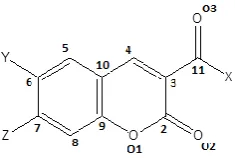
Figure 1. Coumarine moiety and the numbering scheme used.
The Crystallographic Information File (CIF) for each compound was obtained. through the CSD licensed access. All important molecular motifs which provide maximum stabilization to the crystal structure were extracted and the nature and energy of these pairs was determined using PIXEL.7 A representative illustration of the coumarin
moiety indicating the atomic numbering scheme used for the present work is shown in Fig.1. The chemical name, molecular code, position of the substituent(s) and precise crystallographic data for each compound is presented in Table 1a and 1b, respectively.
Table 1a. List of compounds and the position of substituent(s)
Chemical name Substituent
X Y Z
3-Acetyl-6-bromocoumarin (M-1)8 Me Br -
3-Acetyl-6-chlorocoumarin (M-2)9 Me Cl -
3-Acetyl-6-methoxycoumarin
(M-3)10 Me OMe -
3-Acetyl-7-methoxycoumarin
(M-4)11 Me - OMe
3-Acetyl-7-(diethylamino) coumarin
(M-5)12 Me - NEt2
3-(Bromoacetyl)coumarin (M-6)13 CH
2Br - -
3-Dibromoacetylcoumarin (M-7)14 CHBr
2 - -
Theoretical calculations
The lattice energies of all the compounds were calculated by PIXELC module in Couloumb-London-Pauli (CLP) computer program package (version 13.2.2012).7 The total
Table 1b. Precise crystal data for 3-acetylcoumarin derivatives
Data M-1 M-2 M-3 M-4 M-5 M-6 M-7
Formula C11H7BrO3 C11H7ClO3 C12H10O4 C12H10O4 C15H17NO3 C11H7BrO3 C11H6Br2O3
MW 267.08 222.62 218.20 218.20 259.30 267.08 345.98
Crystal system Triclinic Triclinic Triclinic Triclinic Monoclinic Monoclinic Triclinic
Space group P1- P1- P1- P1- C2/c P21/c P1-
a(Å)
b(Å)
c(Å) α(°) β(°) γ(°)
4.029(1) 11.125(2) 11.775(1) 97.339(9) 99.948(9) 90.040(10)
3.988(2) 11.010(7) 11.156(7) 97.078(9) 90.238(10) 100.049(10)
5.424(1) 8.409(2) 11.579(2) 104.58(2) 99.29(1) 90.97(2)
7.1501(6) 8.0640(8) 9.6850(10) 80.247(13) 69.517(10) 72.896(11)
17.269 (2) 7.5203(8) 22.0868(10) 90
108.524 (7) 90
5.2932 (1) 18.4568(5) 9.7473 (3) 90 98.768 (1) 90
7.1998 (17) 8.969 (2) 9.722 (2) 69.094 (5) 85.974 (6) 71.177 (4)
Z 2 2 2 2 8 4 2
R 0.067 0.032 0.063 0.043 0.051 0.024 0.029
Table 2. Lattice energy from CLP (in kcal mol-1)
Molecule ECou EPol EDisp ERep ETot
M-1 -10.038 -2.915 -27.127 16.58 -23.49
M-2 -11.16 -3.608 -29.397 18.59 -25.57
M-3 -13.33 -4.636 -28.68 19.455 -27.17
M-4 -12.523 -4.636 -30.162 23.08 -24.306
M-5 -11.59 -4.58 -32.36 20.76 -27.74
M-6 -15.439 -4.78 -33.34 26.26 -27.29
M-7 -13.05 -4.18 -31.97 22.75 -26.48
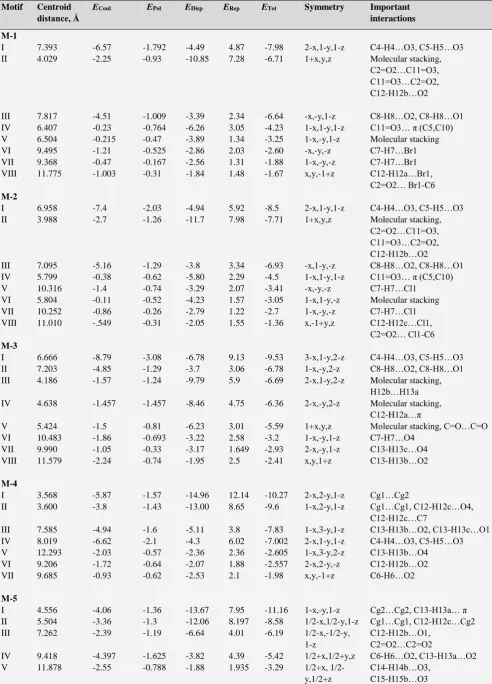
PIXEL energy calculations and were analysed with their interaction energies. The symmetry operator and centroid– centroid distance along with coulombic, polarization, dispersion, repulsion and total interaction energies between the molecular pairs are presented in Table 3. The molecular pairs are arranged in decreasing order of their stabilization energies. The PIXEL method has been preferred for the quantification of intermolecular interactions, primarily because of the following reasons:
It is computationally less demanding.7
It allows partitioning of total interaction energy into corresponding coulombic, polarization, dispersion, and repulsion contribution which facilitates a better understanding of the nature of intermolecular interactions contributing towards the crystal packing.15,16
The energies obtained from PIXEL calculation are generally comparable with high level quantum mechanical calculations.17, 18
Results and Discussion
3-Acetyl-6-bromocoumarin (M-1)
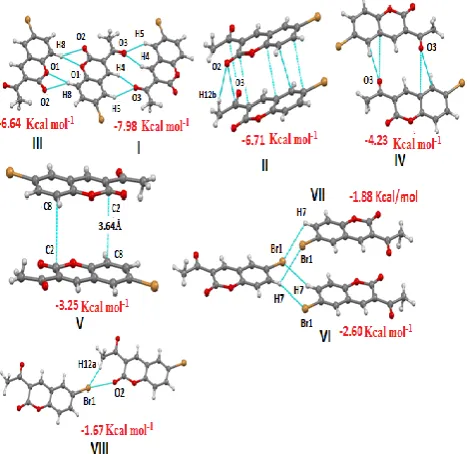
Molecular pairs of M-1 (I-VIII) extracted from crystal structure along with their respective interaction energies are shown in Fig. 2. The most stabilized molecular pair in M-1 shows the presence of bifurcated acceptor C-H…O hydrogen bonding (involving O3 with H4 and H5) forming dimers related by centre of symmetrywith an interaction
energy of -7.98 kcal mol-1 (Fig. 2, motif I) and the
interaction is mainly coulombic in nature (Table 3). The next most stabilized pair involves C=O…C=O interaction where C=O bond in one molecules points towards the carbonyl carbon of the second molecule. Along with these interactions Motif II also involves C-H…O (H12b with O2) and molecular stacking (C-C stacking) and hence resulting in a total interaction energy of -6.71 kcal mol-1 (Fig.2, motif
II).
Table 3 PIXEL interaction energies (I.E.) (kcal mol-1) between molecular pairs related by a symmetry operation and the associated
intermolecular interactions in the crystal
Motif Centroid distance, Å
ECoul EPol EDisp ERep ETot Symmetry Important
interactions M-1
I 7.393 -6.57 -1.792 -4.49 4.87 -7.98 2-x,1-y,1-z C4-H4…O3, C5-H5…O3
II 4.029 -2.25 -0.93 -10.85 7.28 -6.71 1+x,y,z Molecular stacking,
C2=O2…C11=O3, C11=O3…C2=O2, C12-H12b…O2
III 7.817 -4.51 -1.009 -3.39 2.34 -6.64 -x,-y,1-z C8-H8…O2, C8-H8…O1
IV 6.407 -0.23 -0.764 -6.26 3.05 -4.23 1-x,1-y,1-z C11=O3… π (C5,C10)
V 6.504 -0.215 -0.47 -3.89 1.34 -3.25 1-x,-y,1-z Molecular stacking
VI 9.495 -1.21 -0.525 -2.86 2.03 -2.60 -x,-y,-z C7-H7…Br1
VII 9.368 -0.47 -0.167 -2.56 1.31 -1.88 1-x,-y,-z C7-H7…Br1
VIII 11.775 -1.003 -0.31 -1.84 1.48 -1.67 x,y,-1+z C12-H12a…Br1,
C2=O2… Br1-C6 M-2
I 6.958 -7.4 -2.03 -4.94 5.92 -8.5 2-x,1-y,1-z C4-H4…O3, C5-H5…O3
II 3.988 -2.7 -1.26 -11.7 7.98 -7.71 1+x,y,z Molecular stacking,
C2=O2…C11=O3, C11=O3…C2=O2, C12-H12b…O2
III 7.095 -5.16 -1.29 -3.8 3.34 -6.93 -x,1-y,-z C8-H8…O2, C8-H8…O1
IV 5.799 -0.38 -0.62 -5.80 2.29 -4.5 1-x,1-y,1-z C11=O3… π (C5,C10)
V 10.316 -1.4 -0.74 -3.29 2.07 -3.41 -x,-y,-z C7-H7…Cl1
VI 5.804 -0.11 -0.52 -4.23 1.57 -3.05 1-x,1-y,-z Molecular stacking
VII 10.252 -0.86 -0.26 -2.79 1.22 -2.7 1-x,-y,-z C7-H7…Cl1
VIII 11.010 -.549 -0.31 -2.05 1.55 -1.36 x,-1+y,z C12-H12c…Cl1,
C2=O2… Cl1-C6 M-3
I 6.666 -8.79 -3.08 -6.78 9.13 -9.53 3-x,1-y,2-z C4-H4…O3, C5-H5…O3
II 7.203 -4.85 -1.29 -3.7 3.06 -6.78 1-x,-y,2-z C8-H8…O2, C8-H8…O1
III 4.186 -1.57 -1.24 -9.79 5.9 -6.69 2-x,1-y,2-z Molecular stacking,
H12b…H13a
IV 4.638 -1.457 -1.457 -8.46 4.75 -6.36 2-x,-y,2-z Molecular stacking,
C12-H12a…π
V 5.424 -1.5 -0.81 -6.23 3.01 -5.59 1+x,y,z Molecular stacking, C=O…C=O
VI 10.483 -1.86 -0.693 -3.22 2.58 -3.2 1-x,-y,1-z C7-H7…O4
VII 9.990 -1.05 -0.33 -3.17 1.649 -2.93 2-x,-y,1-z C13-H13c…O4
VIII 11.579 -2.24 -0.74 -1.95 2.5 -2.41 x,y,1+z C13-H13b…O2
M-4
I 3.568 -5.87 -1.57 -14.96 12.14 -10.27 2-x,2-y,1-z Cg1…Cg2
II 3.600 -3.8 -1.43 -13.00 8.65 -9.6 1-x,2-y,1-z Cg1…Cg1, C12-H12c…O4,
C12-H12c…C7
III 7.585 -4.94 -1.6 -5.11 3.8 -7.83 1-x,3-y,1-z C13-H13b…O2, C13-H13c…O1
IV 8.019 -6.62 -2.1 -4.3 6.02 -7.002 2-x,1-y,1-z C4-H4…O3, C5-H5…O3
V 12.293 -2.03 -0.57 -2.36 2.36 -2.605 1-x,3-y,2-z C13-H13b…O4
VI 9.206 -1.72 -0.64 -2.07 1.88 -2.557 2-x,2-y,-z C12-H12b…O2
VII 9.685 -0.93 -0.62 -2.53 2.1 -1.98 x,y,-1+z C6-H6…O2
M-5
I 4.556 -4.06 -1.36 -13.67 7.95 -11.16 1-x,-y,1-z Cg2…Cg2, C13-H13a… π
II 5.504 -3.36 -1.3 -12.06 8.197 -8.58 1/2-x,1/2-y,1-z Cg1…Cg1, C12-H12c…Cg2
III 7.262 -2.39 -1.19 -6.64 4.01 -6.19 1/2-x,-1/2-y,
1-z
C12-H12b…O1, C2=O2…C2=O2
IV 9.418 -4.397 -1.625 -3.82 4.39 -5.42 1/2+x,1/2+y,z C6-H6…O2, C13-H13a…O2
V 11.878 -2.55 -0.788 -1.88 1.935 -3.29 1/2+x,
1/2-y,1/2+z
M-6
I 5.918 -10.3 -3.035 -7.48 9.89 -10.94 2-x,1-y,1-z C4-H4…O3, C5-
H5…O3,C5-H5…Br1
II 5.029 -1.69 -1.195 -9.82 5.4 -7.289 1-x,1-y,1-z Molecular stacking
III 5.293 -2.48 -1.21 -8.05 5.73 -6.02 -1+x,y,z C-12-H12b…Br1,
C11=O3…π(C2), Molecular stacking
IV 10.008 -2.98 -1.05 -3.967 4.01 -3.99
1-x,-0.5+y,1.5-z
C6-H6…O2, H6…H12a
V 6.894 -2.65 -0.74 -3.75 3.39 -3.75 x, 1.5-y,-0.5+z C12-H12a…Br1
VI 9.491 -0.93 -0.454 -5.73 3.77 -3.34 1-x,1-y,2-z Molecular stacking
M-7
I 4.952 -4.68 -1.55 -8.84 4.73 -10.34 -x,1-y,-z C11=O3…C4,
C11=O3…O3=C11 C4-H4…Br1
II 6.940 -5.8 -2.39 -15.36 13.5 -10.01 -x,-y,-z Cg1…Cg2
III 8.230 -3.8 -1.4 -11.5 8.24 -8.5 1-x,-y,-z Cg1…Cg2, C7-H7…Br1
IV 5.837 -2.51 -1.09 -4.18 3.34 -4.42 -x,-y,1-z C12-H12…O2
V 9.519 -2.41 -0.95 -3.17 2.61 -3.94 1+x,-1+y,z C8-H8…O3, C8-H8…Br2
VI 9.722 -2.15 -0.526 -2.79 1.72 -3.75 x,y,1+z C5-H5…Br1
Cg1- centre of gravity of pyrone ring (O1-C2-C3-C4-C10-C9) Cg2- centre of gravity of benzene ring(C5-C6-C7-C8-C9-C10)
The combined nature of these interactions is mainly dispersive in nature (Table 3). The third most stabilized interacting pair involves bifurcated donor C-H…O (H8 with O1 and O2) hydrogen bonding generating dimers across the centre of symmetry with an interaction energy of -6.64 kcal mol-1 (Fig.2, motif III). Additional stabilization to the
structure comes from motif IV and V, motif IV involves C=O… π (O3 with C5 and C10) whereas motif V shows molecular stacking involving C2 of Cg1(where Cg1 represents centre of gravity of pyrone ring) and C8 of Cg2 (where Cg2 represents centre of gravity of benzene ring) with C…C distance of 3.64Å.
The interaction energy for IV and V are -4.23 and -3.25 kcal mol-1 respectively. Motif VI and VII involves the
presence of weak C-H…Br interaction (involving H7 and Br1) forming dimers related by inversion centre having an interaction energies of -2.60 and -1.88 kcal mol-1
respectively and are mainly dispersive in nature (Table 3). The least stabilized molecular pair VIII involves C-H…Br (H12a with Br1) and C=O…Br-C (O2 and Br1) having an interaction energy of -1.67 kcal mol-1.
3-Acetyl-6-chlorocoumarin (M-2)
Molecular pairs (I-VIII) extracted from M-2 along with their respective interaction energies are shown in Fig. 3. The packing features of M-2 were almost identical to those observed for M-1 and results in the generation of similar packing motifs. The energies of two bifurcated C-H…O hydrogen bonded pairs (Fig. 3, motif I and III) of M-2 were similar to those observed in M-1(Table 3). The only difference between M-1 and M-2 is the presence of different halogen atom (Cl in place of Br). An important striking feature is that an interaction in which Br is involved in M-1 is replaced by the similar interaction with Cl in M-2. The molecular pairs in which Cl1 is involved are motifs V, VII and VIII with their stabilization energies being -3.41 , -2.7 and -1.36 kcal mol-1 and are dispersive in nature.
Figure 3. Molecular pairs (I-VIII in Table 3) along with their interaction energies calculated with PIXEL (values in red) in M-2.
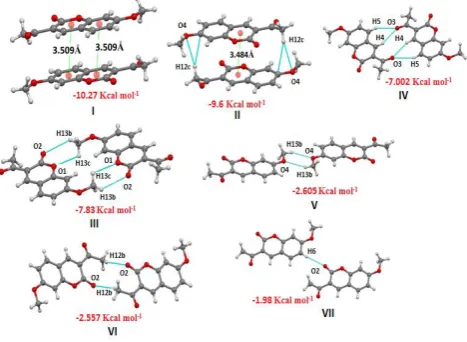
Figure 5. Molecular pairs (I-VII in Table 3) along with their interaction energies calculated with PIXEL (values in red) in M-4.
3-Acetyl-6-methoxy-coumarin (M-3)
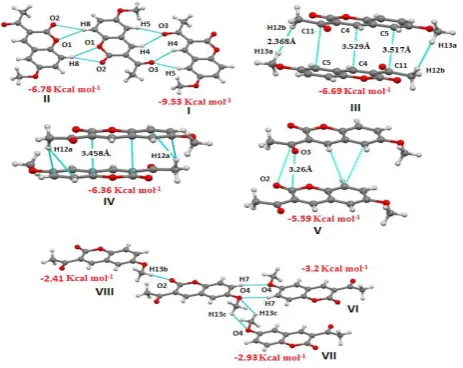
The extracted molecular pairs of M-3 (I –VIII) are shown in Fig. 4. In M-3, halogen atom present at position 6 in case of M-1 and M-2 is replaced by the methoxy group. The major stabilizing motifs are identical whereas due to the presence of methoxy group, least stabilizing motifs involve weak C-H…O interaction in place of C-H…X (Br, Cl) interactions. The two most stabilized molecular pairs (I and II) in M-3 (identical to motifs I and III of M-1 and M-2) shows the presence of bifurcated C-H…O interaction form dimers (Fig. 4, motif I and II) having energies of 9.53 and -6.78 kcal mol-1 respectively. The major contribution to the
stabilization of the pair comes from coulombic component (Table 3). The next two most stabilized molecular pairs (III and IV) involve C-C molecular stacking, along with this interaction motif III also involves C-H…H-C (involving H12b and H13a) with H…H distance being 2.368Å (Fig. 4, motif III) whereas motif IV also involves C-H… π interaction involving H12a with C7 and C8 of Cg2 ring (Fig. 4, motif IV) resulting in a total interaction energy of -6.69 and -6.36 kcal mol-1 respectively. Motif V involves
C=O…C=O and C-C molecular stacking identical to motif II of M-1 and M-2 with an interaction energy of -5.59 kcal mol-1. The remaining three least stabilized interacting pairs
shows the presence of C-H…O interaction with motif VI(involving O4 and H7) and motif VII(involving O4 and H13c) forming dimers. The total interaction energy of the three pairs (VI, VII, VIII) being -3.2, -2.93 and -2.41 kcal mol-1 respectively.
3-Acetyl-7-methoxy-coumarin (M-4)
Molecular pairs of M-4 (I-VIII) extracted from crystal structure along with their respective interaction energies are shown in Fig. 5. The two most stabilized motifs (I and II) show the presence of π… π interaction, a packing feature which is not observed in M-1, M-2 and M-3. Motif I involves double ring stacking (Cg1…Cg2) with an interaction energy of -10.27 kcal mol-1 (Fig. 5, motif I).
Motif II along with a stacking interaction (Cg1…Cg1) also shows the presence of C-H…O (H12c and O4) and C-H… π (H12c and C7 of Cg2) resulting in a total stabilization energy of kcal mol-1 (Fig. 5, motif II). In both the motifs I
and II molecules are arranged in antiparallel arrangement and major contribution to the stabilization comes from dispersion component (Table 3). Additional stabilization to the structure comes from motif III which shows the presence of C-H…O interaction (involving H13b with O2 and H13c with O1) forming dimers generating rings that can be described as having graph set R22 (6) (Fig. 5, motif III). The
stabilization energy of this pair being -7.83 kcal mol-1. Motif
IV of this compound involving bifurcated C-H…O is found to be similar to the most stabilized motif I in M-1, M-2 and M-3 and contributing -7.002 kcal mol-1 (Fig. 5, motif IV)
towards the stabilization. The last three interacting pairs show the presence of C-H…O interaction with motif V and motif VI forming dimers generating rings that can be described as having graph sets R22 (6) to O4 (Fig.5, motif V)
and R22 (12) to O2 (Fig.5, motif VI). The stabilization
energies of the three pairs (V, VI and VII) being 2.605, -2.557 and -1.98 kcal mol-1 respectively.
Figure 6. Molecular pairs (I-V in Table 3) along with their interaction energies calculated with PIXEL (values in red) in M-5.
3-Acetyl-7-(diethylamino)coumarin (M-5)
The extracted molecular pairs of M-5 (I –V) are shown in Fig. 6. The maximum stabilization to the structure comes from π…π interaction which is exhibited by motif I and II. Motif I involves Cg2…Cg2 interaction (Cg2-Cg2 distance being 3.736Å) along with C-H…π (involving H13a with C3 and C4 of Cg1) whereas motif II involves Cg1…Cg1 interaction (Cg1-Cg1 distance being 3.616Å) along with C-H…π (H12a with Cg2) generating dimers with stabilization energy of -11.6 kcal mol-1 (Fig. 6, motif I) and -8.58 kcal
mol-1 (Fig. 6,Motif II) respectively. The combined nature of
these interactions is mainly dispersive in nature (Table 3). The third stabilized pair shows the presence of C=O…C=O in which oxygen atom O2 of pyrone ring of one molecule interacts with carbonyl carbon C2 of pyrone ring of second molecule (Fig. 6, motif III). Along with this interaction motif III also involves C-H…O (involving H12b with O1) interaction and hence form dimer with an interaction energy of -6.19 kcal mol-1. The last two stabilized pairs IV and V
which also provide significant stabilization to the structure shows the presence of bifurcated acceptor C-H…O interaction with stabilization energy of -5.42 kcal mol-1 and
3-(Bromoacetyl)coumarin (M-6)
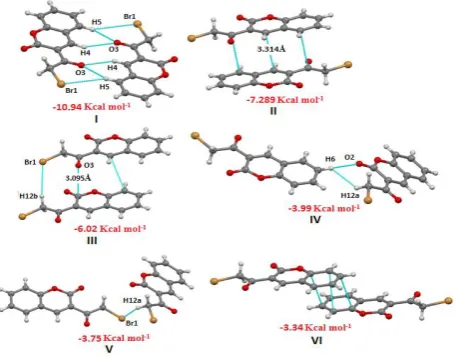
Molecular pairs of M-6 (I-VI) extracted from crystal structure along with their respective interaction energies are shown in Fig. 7. The most stabilized motif I in this structure is similar to the most stabilized motif I as found in M-1, M-2 and M-3. However along with bifurcated C-H…O, it also involves C-H…Br (H5 with Br1) resulting in a stabilization energy of -10.94 kcal mol-1 (Fig. 7, motif I) with major
contribution from coulombic component (-10.3 kcal mol-1)
which is almost equal to total interaction energy of the pair (Table 3). The second stabilized pair involves C…C molecular stacking with a stabilization energy of -7.289 kcal mol-1. The third most stabilized interacting motif show the
presence of C=O…π in which oxygen atom O3 of acetyl group interacts with C2 of Cg1 ring with O3-C2 distance being 3.095Å (Fig. 7, motif III) which is less than the sum of vander waal radii of two atoms. Motif III along with these interactions also involve C-H…Br ( H12b with Br1) and stacking interaction (involving C4 of Cg1 and C8 of Cg2) with C…C distance being 3.401Å and hence resulting in a stabilization energy of -6.02 kcal mol-1 (Fig. 7, motif III).
Motif IV is stabilized by the presence of C-H…O (H6 with O2) and C-H…H-C (involving H6 and H12a) with H…H distance of 2.372Å andhaving an interaction energy of -3.99 kcal mol-1. Additional stabilization to the structure comes
from motif V (C-H…Br ) and VI (molecular stacking) with an interaction energy of -3.75 and -3.34 kcal mol-1
respectively.
Figure 6. Molecular pairs (I-VI in Table 3) along with their interaction energies calculated with PIXEL (values in red) in M-6.
3-Dibromoacetylcoumarin (M-7)
The extracted molecular pairs (I –VI) of M-7 are shown in Fig. 8 along with their stabilization energies. The maximum stabilization to the structure comes from the interaction of oxygen atom O3 of acetyl group of one molecule with the carbon atom C4 of Cg1 ring (O3-C4 distance being 3.272Å) and oxygen atom O3 of acetyl group of second molecule (O3-O3 distance being 3.199Å). Motif I also shows the presence of weak C-H…Br ( involving H4 and Br1) resulting in a total interaction energy of -10.34 kcal mol-1
(Fig. 8, motif I) with major contribution from dispersion component which is almost double the coulombic component (Table 3). The second and third stabilized motifs
(II and III) involves double ring stacking with Cg1…Cg2 distance being 3.567Å and 3.642Å respectively and the molecules are arranged in antiparallel manner. Motif III along with π…π also involves a weak C-H…Br (involving H7 and Br1) interaction. The stabilization energy of the two pairs being -10.01 and -8.5 kcal mol-1 and are mainly
dispersive in nature (Table 3). Motif IV providing additional stabilization to the structure (energy being -4.42 kcal mol-1)
shows the presence of dimeric C-H…O interaction (involving H12 and O2) forming ring that can be described as having graph set R22 (12) (Fig. 8, motif IV) . Motif V is
stabilized by the presence of another C-H…O interaction (H8 with O3) along with C-H…Br (H8 with Br2) with an interaction energy of -3.92 kcal mol-1. The least stabilized
molecular pair VI involves C-H…Br (involving H5 with Br1) having an interaction energy of -3.75 kcal mol-1.
Figure 7. Molecular pairs (I-VI in Table 3) along with their interaction energies calculated with PIXEL (values in red) in M-7.
A careful analysis of some key supramolecular motifs obtained in these compounds leads to the following relevant observations:
The maximum stabilization to the crystal structure in most of these compounds comes from the motifs interacting via bifurcated C-H…O interaction with energy in the range -6 to -11 kcal mol-1, with a major contribution to the stabilization
being coulombic in origin. Hence this motif can be considered as the basic building unit observed in these structures.
The interaction energies of the motifs involving π…π interactions were observed to be in range -8.5 to -11.5 kcal mol-1 whereas the energy of the motifs involving molecular
stacking and C-H…O lies in the range -3 to -7 kcal mol-1
and -2 to -5 kcal mol-1 respectively.
The energy of the molecular pairs involving hydrogen bonds with halogens (Cl or Br) lies in the range -1 to -4 kcal mol-1and are mainly dispersive in nature. This observation is
in agreement with the values reported in case of a similar study made by Panini and Chopra.19
Conclusions
An analysis of the energetics of the neighbouring molecular pairs in 3-acetylcoumarin derivatives shows the presence of different intermolecular interactions participating in the crystal packing. In addition to the significance of coulombic nature of bifurcated C-H…O hydrogen bonds, the stabilizing role of π…π, stacking and C-H…X(Br or Cl) interactions has been realized in these structures. Short intermolecular C-H…X (Br or Cl) occurs in the crystal structure and makes only a minor contribution to the cohesive energy of the crystal but they play an important role in crystal packing. It is of interest to extend this evaluation of energies of molecular pairs in other coumarin derivatives which will enable us to have better understanding of weak intermolecular interactions.
References
1Adeeleke, B. B., Weir, D., Depew, M. C., Wan, J. K. S., Can J
Chem.,1984, 62, 117-120.
2Rosskopt, F., Kraus, J., Franz, G., Pharmazie, 1992, 47, 139-142. 3Hirsh, J., Dalen, J. E., Anderson, D. R., Poller, L., Bussey, H.,
Ansell, J., Deykin, D., CHEST, 2001, 119, 8S-21S.
4Ishii, Y., J Agric. Chem.Soc. Jpn, 1952, 26, 510-513.5Huang,
X.L., Xu, S. P., Fu, Z. D., An, B., Acta Pharm. Sinica, 1996, 31, 421–436.
6Munshi, P., Guru Row, T. N., Crystal Growth and Design, 2006,
6(3),708-718.
7Gavezzotti, A., New J. Chem., 2011, 35, 1360-1368.
8Kokila, M. K., Puttaraja, M., Kulkarni, M. V., Shivaprakash, N. C.,
Acta Cryst C, 1996, 52, 2078-2081.
9Deepak, C., Venugopal, K. N., Jayashree, B. S., Guru Row, T.N.,
Acta Cryst E, 2006, 62, o2310- o2312.
10Stancho, S., Anita, P., Pascal, R., Georgi, A., Ilia, M., Anal. Sci.,
2008, 24, x183-x184.
11Hong, M. H., Cheng, R. L., Yong, Z., De-Chun, Z., Acta Cryst E,
2005, 61, o1864- o1866.
12Christopher, G. H., Charles, S. M., Acta Cryst E, 2006, 62,
o2072–o2074.
13Hazel, A. S., Judith A. K. H., Acta Cryst E,2007, 63, o3895. 14Deepak, C., Venugopala, K. N., Rao, G. K., Guru Row, T. N.,
Acta Cryst E, 2007, 63, o2826.
15Dunitz, J. D., Gavezzotti, A., Cryst. Growth Des., 2012, 12,
5873-5877.
16Dunitz, J. D., Gavezzotti, A., Cryst. Growth Des.,2005, 5,
2180-2189.
17Maschio, L., Civalleri, B., Ugliengo, P., Gavezzotti, A., J. Phys.
Chem. A., 2011, 115, 11179-11186.
18Dunitz, J. D., Gavezzotti, A., Chem. Soc. Rev., 2005, 38,
2622-2633.
19Panini, P., Deepak, C., Cryst Eng Comm., 2013, 15, 3711-3733.