ISSN: 2252-8938, DOI: 10.11591/ijai.v8.i4.pp352-359 352
Intelligent optimization and management system for renewable
energy systems using multi-agent
Chahinaze Ameur1, Sanaa Faquir2, Ali Yahyaouy3
1,3Department of computer science, Faculty of Science Dhar Mehraz, University of Sidi Mohamed Ben Abdallah, Fes, Morocco
2Faculty of Engineering Sciences, Private University of Fes, Fes, Morocco
Article Info ABSTRACT
Article history: Received Aug 12, 2019 Revised Oct 20, 2019 Accepted Nov 4, 2019
Hybrid energy systems (HES) using renewable energy sources are an interesting solution for power stand-alone systems. However, the energy management of such systems is very complex. This paper presents a Multi Agent System (MAS) framework applied to manage the flow of energy in a hybrid stand-alone system. The proposed system consists of photovoltaic panels and a wind turbine along with batteries as storage units. The proposed MAS architecture composed of different agents (photovoltaic agent, wind turbine agent, supervisor agent, load controller agent, and storage agent) was developed to manage the flow of energy between the energy resources and the storage units for an isolated house. The agent-approach for HES is explained and the proposed MAS is presented and a simulation model is developed in the java agent development environment (JADE). The system was tested with empty batteries and full batteries and results showed that the system could satisfy the load demand while maintaining the level of the batteries between 30% (minimum discharging rate) and 80% (maximum charging rate). Keywords: Multi-agent system Photovoltaic panels Renewable energy Wind turbine
Copyright © 2019 Institute of Advanced Engineering and Science. All rights reserved. Corresponding Author:
Chahinaze Ameur,
LIIAN Laboratory, Department of computer science,
Faculty of Science Dhar Mehraz, University of Sidi Mohamed Ben Abdallah, Fes, Morocco.
1. INTRODUCTION
The worldwide community, Governments and industries all around the world have recognized the danger of global warming and are increasingly trying to find alternatives to minimize the greenhouse emissions from fossil fuels. In fact, renewable energy is a promising solution to reduce greenhouse emissions and the use of renewable energy sources presents a tremendous potential for many applications and especially off-grid stand-alone systems [1]. Powering remote sites with renewable sources require the use of storage devices due to the fluctuating nature of the power production. In this paper, we will propose a system titled a hybrid renewable energy system (HRES), since it associates at least two renewable energy sources and a storage element. Many types of renewable energy resources such as wind and solar energy come either directly or indirectly from the sun [2]. A system combining different types of renewable energies is called a hybrid renewable energy system (HRES). Between all existing renewable sources of energy, solar and wind energies are the most commonly used in HRES along with storage units such as batteries to store the excess of energy provided by the input sources [3]. A comparison between different storage units were done in [4] and it was found that batteries are the most appropriate storage units used in HRES. Energy management for HRES was done before using fuzzy logic [5-6], neural network detailed in [7] and genetic algorithm in [8]. The results obtained after applying the fuzzy modeling showed good estimation of the PV and WT powers and the proposed method in [8] has been applied to the analysis of a hybrid system which supplies power for a telecommunication relay station, and good optimization performance has been found.
To resolve this problem in an open dynamic modern electric power system, recent trends for controlling and monitoring HRES operations are moving towards the application of auto- mated agent technology usually called multi agent structures. MAS is an important branch of distributed artificial intelligence [9-10]. MAS can decompose a complicated system into several agents and the collaboration o f these agents can solve various system difficulties and limitations. Multi- agent structures, consist of various independent agents with local information and limited abilities, which are capable of interacting with each other in order to achieve a targeted objective. The inclusion of artificial intelligence and expert system in MAS structure are the additional merits in the design of hybrid controllers in the hybrid system. They facilitate reliability of the system and perform accurate predictions.
Multi-agent technology is not only a subfield of distributed artificial intelligence but also a highly associative research field including economics, philosophy, bionomics and sociology etc. it is a technology where the agent’s correspondence, collaboration and intercommunication are used to achieve a distributed and complicated tasks [11]. MAS and the autonomous agents provide a new method to analyze, design and implement sophisticated applications since they are part of the distributed artificial intelligence domain and they benefit as well from other disciplines such as cognitive sciences, sociology, and social psychology. MAS can optimize a system and enhance its stability and intelligence. It is used widely in many application domains to address various problems quickly:
Industry: The automation of the process and of the production, logistics, the co-operative robots, the Smart Home [12].
Communication (including Telecommunications): The management of networks, electronic commerce [13].
Information: The personal assistance, the search for information, the management of the workflow, the Smart Home [14].
Health: The supervision of the sick, the systems of support [15].
Transportation, logistics: the support of the mobility, the information of the trip [16]
It is used as well to address energy application such as the purchase of the power to support of a crisis center as mentioned in [17]. It is also used in multiple engineering power system applications, such as smart grids [18] and smart homes [19]. The simulation results of smart grids indicate that the proposed multi-agent system can facilitate the seamless transition from grid connected to an island mode when up- stream outages are detected. Authors in [19] show how to reduce problem complexity by dividing the whole problem into independent sub- problems. This denotes the capability of a multi-agent system as a technology for managing the smart grid/home operation. In [20], MAS was applied in service restoration and results have concluded that this method is able to reach sub- optimal target configurations, which are favorably com- pared with those obtained by a mathematical programming approach. A cooperative Multi-agent framework for self-healing mechanisms distribution systems was adopted in [21] and the results of the simulation conducted using the new framework demonstrate the effectiveness of the proposed control structure. In this paper, a power generation system based on multi- agent technology is proposed to manage the energy of an HRES composed of wind and solar energies along with batteries as storage units that will be able to satisfy the load demand for an isolated site. The key motivation for proposing a MAS lies in its inherent benefits such as flexibility, scalability, autonomy to solve complex problem which cannot be solved by conventional control theory. The agents interact between them to collaborate, cooperate and coordinate actions. The paper is structured as follows: the second section introduces principles of multi-agent approaches. The third section de- scribes the hybrid renewable energy system adopted in this research. The fourth section presents the architecture of the energy management system. The fifth section explains multi- agent architecture. The sixth section discusses the results found and finally, a conclusion summarizes the results and presents some perspectives.
2. MULTI-AGENT APPROACH
Due to their complexities and geographical distribution, HRES cannot be easily managed by centralized systems. Intelligent integrated systems must manage the production of renewable energies or help reduce the consumption of the various users of the network. Distributed artificial intelligence and more particularly multi-agent systems appear as an adequate means of solving problems related to autonomous systems. An agent is all that can be seen as perceiving its environment by means of sensors and acting on this environment using effectors autonomously. This definition gives a very general overview on the definition of agents. In [22], Wooldridge and Jennings define an agent as a system, software or not, with the following properties:
Social skills: Agents interact with each other through a language.
Reactivity: Agents perceive their environment and respond in a timely manner to the changes occurring in it.
Proactivity: Agents not only respond to changes in the environment, they can also behave in a way that allows them to act on their own to meet their goals. Finally, Ferber extends these definitions to highlight the importance of the environment.
For Ferber [23], the agent is a physical or virtual entity:
Able to act in an environment.
Can communicate directly with other agents.
Owns its own resources.
Able to perceive his environment (but in a limited way).
Tends to meet its objectives, taking into account the resources and skills at its disposal, and according to its perception, representations and the communications it receives.
3. HYBRID RENEWABLE ENERGY SYSTEM ADOPTED
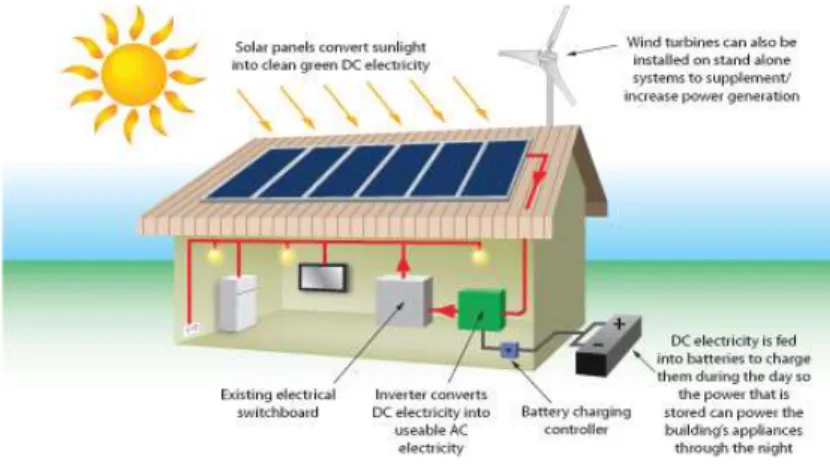
The HRES used in this research is a stand-alone hybrid PV/Wind/Battery system that should supply the electricity to a private house or an apartment in an isolated site. Solar and wind energies were combined in this system as they have the advantage of complementing each other. To implement an HRES on an isolated site, a study was done to be able to determine the required input and output sources required for the system to satisfy a load demand besides the changeable weather conditions: the system requires a combination in series of 16 PV panels composed of 36 cells to provide 1KWc of maximum energy per day, along with a generic wind turbine with a rated power 1KW peak under STC conditions (Temperature 25C and lighting 300 W/m2). The maximum power delivered by the system is 2KW. The system also includes a number of batteries to either store the excess of energy generated by the sources or provide the energy demanded by the load when there is low renewable energy produced [24]. The Figures 1-6 shows the HRES used in this research:
4. ARCHITECTURE OF THE ENERGY MANAGEMENT SYSTEM
4.1. Structure of the studied system
The hybrid system used in this paper is composed of:
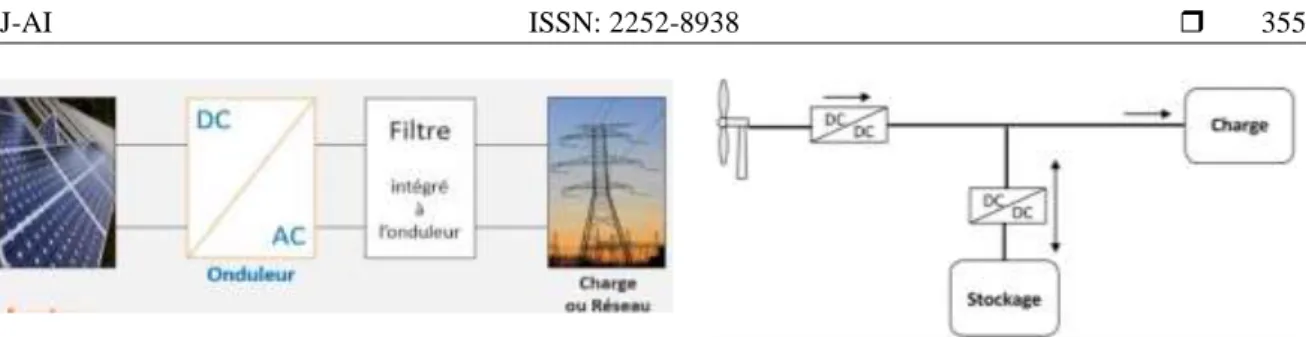
A wind turbine a wind turbine connected to the DC bus using static converters.
Photovoltaic panels Photovoltaic (PV) panels connected to the DC bus using static converters.
Storage units in a HRES, the energies produced by the wind turbines and the PV panels are used to satisfy the load demand for the site. In such systems. Storage units are essential to meet the shortage of renewable energy which are unpredictable by nature. A storage system makes it possible to store the surplus of the energy produced or to supplement the energy required in the case of insufficient energy production. For the system proposed in this paper, two batteries with a 12V voltage and 200Ah as maximum batteries capacity were used as storage units.
Figure 2. Structure of the wind turbine energy
production system Figure 3. Structure of the photovoltaic energy production system
4.2. System operation
The system power (Psys) is calculated from the power generated by the PV panels (Ppv) and the power generated by the Wind turbine (Pw) at each period of time (t). Psys is obtained by the following formula:
P sys(t) = P pv(t) + P w(t) (1)
Figure 4. Wind turbine fluctuation Figure 5. PV panels power fluctuation
Figure 6. Daily load demand variation
To maintain a longer life time for batteries, the batteries state of charge (SOC) should remain between 30% and 80%. The SOC represents the second parameter and is calculated at each period of time t (1 hour) by the following formula:
SOC = P bat/BC (2)
be discharged if it is at its minimum level) SOCmax = 80% (the battery cannot be charged if it is at its maximum level) the maximum and minimum level of the batteries is calculated then as follows:
P bmin = SOCmin ∗BC (3)
P bmax = SOCmax ∗BC (4)
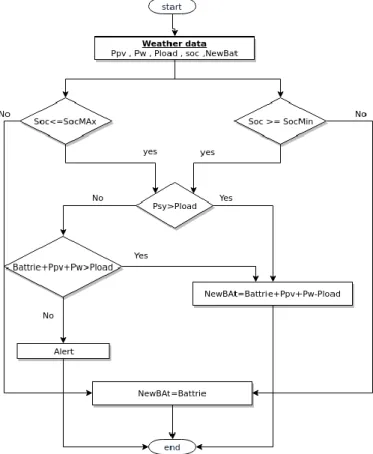
The load demand (Pload) for Figure 7 represents the site. The third parameter considered is NewBat, which shows the battery level, NewBat is calculated at each period by the following formula:
NewBat = Batterie + P pv + P w − P load (5)
Figure 7. Flowchart of the optimal energy management
5. MULTI-AGENT ARCHITECTURE
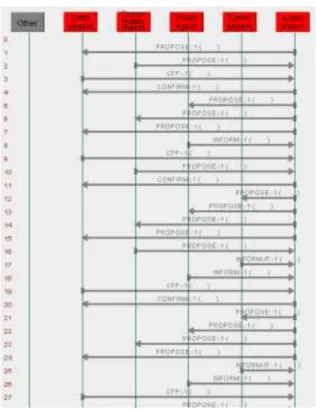
The goal of this work is to propose and develop an agent-based system to intelligently manage the distribution of power demand in a hybrid system. Modeling the sources of production by a multi-agent system makes it possible to form an intelligent system of power. Indeed, every important element in the system is represented by an autonomous agent. The idea is to take advantage of multi-agent systems. Different types of agents for reinforcement learning are designed. Thus, a distributed intelligence can be more efficient than a centralized intelligence. This system has the advantage of knowing, at all times, the current states of wind turbines and PV panels making it possible to apply quickly and reliably the control laws to various components. Agents interact with each other to collaborate, cooperate, and coordinate actions. This structure distributes the treatments on the various agents whose objective is to reduce the complexity and to improve the speed of response to requests. Thus, the system has the advantage of being adaptive and scalable because it increases particularly the flexibility of the adjustment facing the connection or the disconnection of wind/PV panels sources of production. Figure 8 shows multi-agent structure, Figure 9 shows multi-agent modelling.
The proposed multi-agent structure is composed of a cognitive agent called “Supervisor Agent”, several other cognitive agents, each called “WT Agent”, “PV Agent”, “Load Agent” and” Battery Agent”. a. Supervisory Agent: This is a unifying agent allowing:
Receive and calculate the sum of the powers generated by turbine and PV panels.
Receive the requests from the consumer agent.
Store the remaining energy in the battery agent.
Communicate with the turbine and PV panels agent to ensure the supply of the requested power.
Take the necessary decisions in case a turbine and PV panels agent is not able to provide the power. b. WT Agent/PV Agent: the role of each WT/PV is:
Calculate the power produced by the WT/PV.
Communicate with the supervisor agent to respond to mpotential demands.
c. Load Agent: It is the executing agent on the consumer side. It is at the level of houses that have no source of energy specific to them and must refer to large generators to ensure their needs. The role of this agent is to communicate with a supervisor agent and ask how much energy to consume.
Figure 8. Proposed multi-agent structure
6. RESULTS AND DISCUSSIONS
The multi-agent system was tested with batteries filled at their minimum level and other batteries filled to their maximum level as follows:
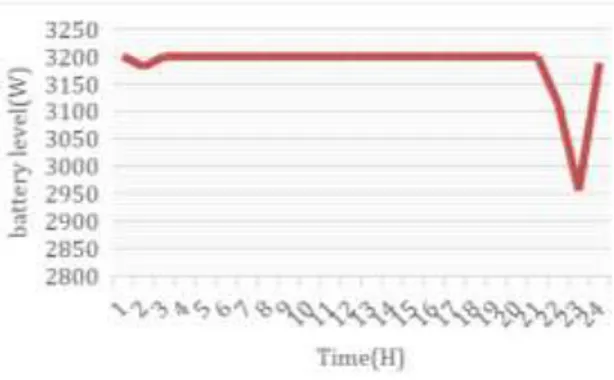
Empty batteries: where the battery starts with its lowest value (Pbat = Pbmin = 1200W). The variation of the batteries level for one day is represented by the graph below: Full batteries: where the battery starts with its maximum value (Pbat = Pbmax = 3200W). The variation of the batteries level for one day as shown in Figure 10.
Figure 10. Battery power curve obtained from the multi-agent in case of a system starting with an empty battery
Figure 11 shows that the batteries level started with its maximum level (3200W). Then it was discharged until the minimum level (1200W) was reached. The batteries then remained constant at their minimum until they were charged again. Once the batteries level reached their maximum, it remained constant. As it is shown from the charts above, the batteries level varies during the day (charging or discharging) while it remains between its minimum and maximum values: Pbmin=1200W and Pbmax=3200W.
Figure 11. Battery power curve obtained from the multi-agent in case of a system starting with a full battery
7. CONCLUSION
In this paper, multi agent system technology is introduced into power systems, and applied in a stand-alone system by collaborating multi-agents in wind-solar hybrid energy system. The multi-agent system approach and the agent’s behaviors can share information and knowledge and enhance single agents ability by communicating among themselves. The system behavior has been observed through a simulation model and it has been demonstrated that the proposed energy management system was able to adapt its response even when the configurations change. As future work, a comparison study will be done between the energy management using fuzzy logic control and the MAS. On the other hand, this work can be improved by increasing the number of agents and performing more testing on the performance of the proposed approach. Learning also can be enhanced by using other intelligent methods like neural networks and Q-learning.
The aim of these improvements is to make the different sources of production smarter in order to improve response times and avoid unnecessary shutdowns of the system.
REFERENCES
[1] B. K.Koua, P. M. E.Koffi, P. Gbaha, S.Tour. “Present status and overview of potential of renewable energy in Cote d’Ivoire,” Renewable and Sustainable Energy Reviews, vol. 41, p. 907-914, 2015.
[2] R. Sims, Renewable energy: A response to climate change, vol. 76, pp.917, 03 2004.
[3] J.Godson, M.Karthick, T.Muthukrishnan, M.S.Sivagamasundari. “Solar PV-Wind hybrid power generation System,” International Journal of Advanced Research in Electrical, Electronics and Instrumentation Engineering, vol. 2, no. 11, p. 2320 3765, 2013.
[4] S. Faquir, A. Yahyaouy, H. Tairi and J. Sabor, “A comparison between storage methods in a hybrid renewable energy system,” in Wotic13, Fes, 2013.
[5] S. Faquir, A. Yahyaouy, H. Tairi and J. Sabor, “Implementing a Fuzzy Logic Based Algorithm to Predict Solar and Wind Energies in a Hybrid Renewable Energy System,” International Journal of Fuzzy System Applications, vol. 4, no. 3, pp. 10-24, 2015.
[6] S. Faquir, A. Yahyaouy, H. Tairi and J. Sabor, “Energy Management in an electrical hybrid system using fuzzy inference control system,” in IESM, Rabat-Morocco, 2013.
[7] Lin, Whei-Min and Hong, Chih-Ming and Chen, Chiung-Hsing, Neural- network-based MPPT control of a stand-alone hybrid power generation system, IEEE transactions on power electronics, vol. 26, no. 12, pp. 3571-3581, 2011.
[8] Hongxing Yang, Wei Zhou, Lin Lu, Zhaohong Fang, Optimal sizing method for stand-alone hybrid solarwind system with LPSP technology by using genetic algorithm, Solar Energy, Volume 82, Issue 4, 2008, Pages 354-36.
[9] McArthur, S.D.J.; Davidson, Euan M.; Catterson, Victoria M.; Dimeas, Aris L.; Hatziargyriou, Nikos D.; Ponci, Ferdinanda, Multi-Agent Sys- tems for Power Engineering ApplicationsPart I: Concepts, Approaches, and Technical Challenges, IEEE Transactions on Power Systems, Vol. 22, No. 4, 2007.
[10] McArthur, S.D.J.; Davidson, Euan M.; Catterson, Victoria M.; Dimeas, Aris L.; Hatziargyriou, Nikos D.; Ponci, Ferdinanda, Multi-agent systems for power engineering applications-Part II: Technologies, standards, and tools for building multi-agent systems, IEEE Transactions on Power Systems, Vol. 22, No. 4, 2007.
[11] Hongchun Shu, Lan Tang Jun Dong, A Survey on Application of Multi- agent System in Power System, Power System Technology, Vol.29, No.6, pp. 27-31.
[12] H. Van, H. Van Dyke Parunak, Practical and industrial applications of agent-based systems.
[13] L. Moreau, ”Stability of multiagent systems with time-dependent communication links,” in IEEE Transactions on Automatic Control, vol. 50, no. 2, pp. 169-182, Feb. 2005.
[14] S. Abras, S. Pesty, S. Ploix and M. Jacomino, ”An Anticipation Mechanism for Power Management in a Smart Home using Multi- Agent Systems,” 2008 3rd International Conference on Information and Communication Technologies: From Theory to Applications, Damascus, 2008, pp. 1-6.
[15] Elhadi Shakshuki, Malcolm Reid. Multi-Agent System Applications in Healthcare: Current Technology and Future Roadmap, Procedia Computer Science, Volume 52, 2015, pp 252-261.
[16] Paul Davidsson, Lawrence Henesey, Linda Ramstedt, Johanna Trnquist, Fredrik Wernstedt, An analysis of agent-based approaches to transport logistics, Transportation Research Part C: Emerging Technologies, Vol- ume 13, Issue 4, 2005, pp 255-271.
[17] Laura Klein, Jun-young Kwak, Geoffrey Kavulya, Farrokh Jazizadeh, Burcin Becerik-Gerber, Pradeep Varakantham, Milind Tambe, Coordinating occupant behavior for building energy and comfort management using multi-agent systems, Automation in Construction, Volume 22, 2012, Pages 525-536.
[18] M. Pipattanasomporn, H. Feroze and S. Rahman, “Multi-agent systems in a distributed smart grid: Design and implementation,” 2009 IEEE/PES Power Systems Conference and Exposition, Seattle, WA, 2009, pp. 1-8.
[19] S. Abras, S. Pesty, S. Ploix and M. Jacomino, ”An Anticipation Mechanism for Power Management in a Smart Home using Multi- Agent Systems,” 2008 3rd International Conference on Information and Communication Technologies: From Theory to Applications, Damascus, 2008, pp. 1-6.
[20] T. Nagata, H. Watanabe, M. Ohno and H. Sasaki, “A multi-agent approach to power system restoration,” PowerCon 2000. 2000 In- ternational Conference on Power System Technology. Proceedings (Cat. No.00EX409), Perth, WA, 2000, pp. 1551-1556 vol.3. doi: 10.1109/ICPST.2000.898202
[21] A. Zidan and E. F. El-Saadany, “A Cooperative Multiagent Framework for Self-Healing Mechanisms in Distribution Systems,” in IEEE Transactions on Smart Grid, vol. 3, no. 3, pp. 1525-1539, Sept. 2012.
[22] Wooldridge M, Jennings NR. Intelligent agents: Theory and practice. The knowledge engineering review. 1995 Jun; 10(2):115-52.
[23] Ferber, Jacques and Weiss, Gerhard, “Multi-agent systems: an i nt r o d u ct i on to distributed artificial intelligence” Addison-Wesley Reading vol. 1, 1999.
[24] S. Faquir, A. Yahyaouy, H. Tairi et J. Sabor, Energy management in a hybrid pv/wind/battery system using a type-1 fuzzy logic computer algorithm, International Journal of Intelligent Engineering Informatics, vol. 4, n 13, pp. 229-244, 2016.