REGULATION OF H2B MONOUBIQUITYLATION BY RNP RECYCLING PROTEIN PRP24
Katie S. Bolling
A thesis submitted to the faculty at the University of North Carolina at Chapel Hill in partial fulfillment of the requirements for the degree of Master’s of Science in the Department of Genetics in the School of
Medicine.
Chapel Hill 2016
ABSTRACT
Katie S. Bolling: Regulation of H2B Monoubiquitylation by RNP Recycling Protein Prp24 (Under the direction of A. Gregory Matera and Brian D. Strahl)
TABLE OF CONTENTS
LIST OF TABLES ... v
LIST OF FIGURES ... vi
LIST OF ABBREVIATIONS ... vii
CHAPTER I ... 1
INTRODUCTION ... 1
METHODS ... 4
RESULTS ... 5
DISCUSSION ... 9
APPENDIX: EFFECT OF ELONGATION RATE ON H2B UBIQUITYLATION ... 12
LIST OF TABLES
Table 1 – Yeast Strains ... 4
Table 2 – Plasmids ... 4
LIST OF FIGURES
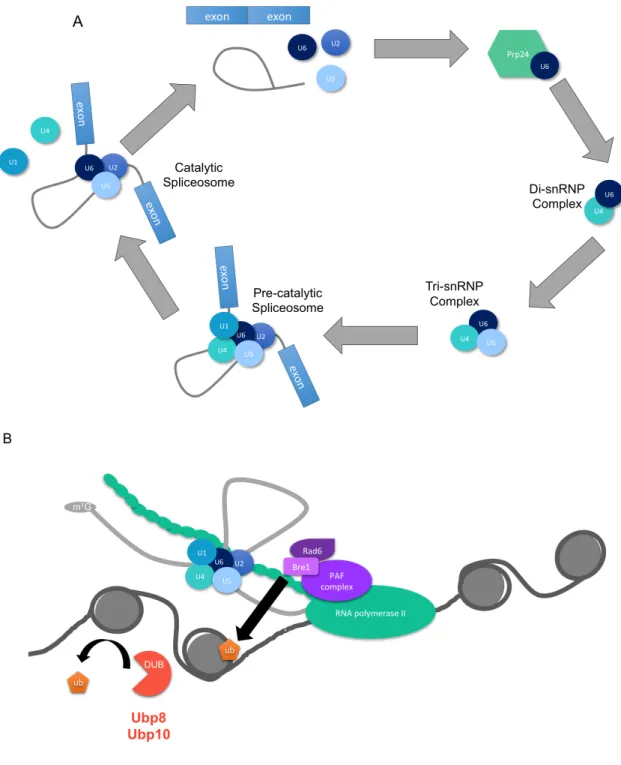
Figure 1 – Splicing and H2B ubiquitylation ... 3
Figure 2 – prp24F87A is sick ... 6
Figure 3 – prp24F87A has increased levels of H2Bub1 ... 7
Figure 4 – Defects in prp24F87A are not due to missplicing ... 8
Figure 5 – U6 overexpression decreases H2Bub1 levels ... 11
Figure A-1 – H2Bub1 levels in rpb1 mutants ... 14
LIST OF ABBREVIATIONS
DUB Deubiquitylating Enzyme
H2Bub1 Monoubiquitylation of H2B at Lysine 120 (humans) or Lysine 123 (yeast)
PTM Post-Translational Modification
RRM RNA Recognition Motif
snRNA Small Nuclear RNA
1
Chapter I Introduction
Expression of eukaryotic genes is a highly intricate and dynamic process involving many layers of regulation. Together, chromatin structure, cis-regulatory elements in DNA, transcription factors, RNA processing, post-translational modifications (PTMs), and numerous other factors determine how the “message” of a gene is interpreted.
One of the most significant and highly conserved steps in this process is splicing of pre-mRNA transcripts. In this process, intronic segments of RNA are removed and exons are ligated together to form the mature mRNA that will be translated into a functional protein product (Figure 1A). Splicing is carried out by the spliceosome, a complex consisting of 5 small nuclear RNAs and their associated proteins (snRNPs). U1 and U2 snRNPs bind to the 5’ splice site and branch point on the intron, respectively. Afterwards, U4, U5, and U6 snRNPs, in a complex known as the tri-snRNP, enter the spliceosome. Several rearrangements take place, ending with exons being ligated together and snRNPs being released along with the intron. The snRNPs can then be recycled into pre-splicing complexes to carry out additional splicing reactions. Splicing is often considered a post-transcriptional process; however, it is widely accepted that much of splicing occurs co-transcriptionally. Given this information, it is almost certain that splicing will influence other transcriptional processes, including histone post-translational modification.
2
suggest that monoubiquitylation of H2B (H2Bub1) may be connected to splicing in budding yeast as well as in humans (Hérissant et al. 2014; Long et al. 2014). H2Bub1 (Figure 1B) is a well-conserved mark closely linked to active transcription and under tight regulation (Wozniak & Strahl 2014). Inhibiting the catalytic activity of Bre1, the E3 ubiquitin ligase responsible for H2Bub1, leads to destabilization of the protein and decreases in H2Bub1 levels. Additionally, highly active deubiquitylating enzymes (DUBs) rapidly remove the mark from H2B (Figure 1B). Whereas the direct impact of H2Bub1 on chromatin structure is debated, data support the importance of the mark in a variety of processes, including genomic stability (Northam & Trujillo 2016), transcription elongation (Pavri et al. 2006), and Notch signaling (Bray et al. 2005), among others. H2Bub1 (Briggs et al. 2002) is a prerequisite for the presence of at least two other histone marks, H3K4 and H3K79 methylation (Briggs et al. 2002; Dover et al. 2002; Sun & Allis 2002). Additionally, mutation of the human homolog of Bre1, Rnf20, as well as several DUBs, has been associated with multiple human cancers (reviewed in Cole, Clifton-Bligh, & Marsh, 2015) and deletion of Bre1 in Drosophila is embryonic lethal (Bray et al. 2005). Further understanding of the how this mark is regulated so closely will be of significant value in determining its impact on gene expression in development and disease. To this end, I investigated the role of splicing factors in regulating H2Bub1.
3
4
Methods
Yeast strains and plasmids
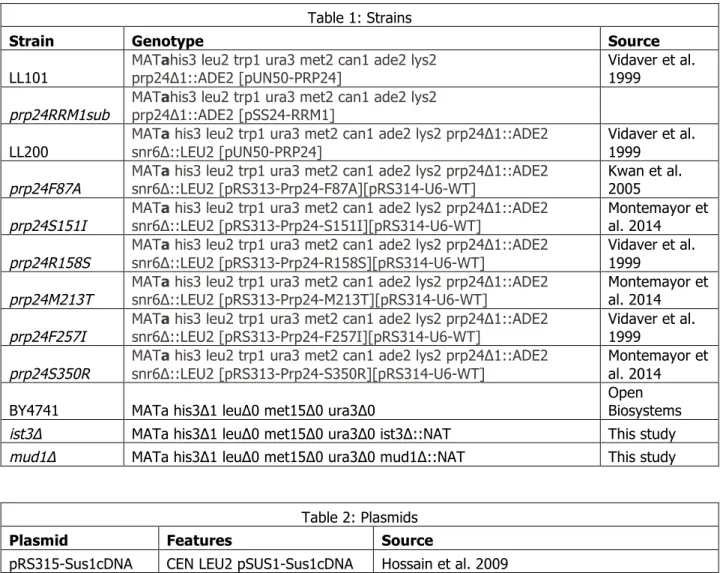
Strains and plasmids used in this study are listed in Tables 1 and 2.
Table 1: Strains
Strain Genotype Source
LL101 MATprp24ahis3 leu2 trp1 ura3 met2 can1 ade2 lys2 Δ1::ADE2 [pUN50-PRP24] Vidaver et al. 1999 prp24RRM1sub MATprp24ahis3 leu2 trp1 ura3 met2 can1 ade2 lys2 Δ1::ADE2 [pSS24-RRM1]
LL200 MATsnr6Δa his3 leu2 trp1 ura3 met2 can1 ade2 lys2 prp24::LEU2 [pUN50-PRP24] Δ1::ADE2 Vidaver et al. 1999 prp24F87A MATsnr6Δa his3 leu2 trp1 ura3 met2 can1 ade2 lys2 prp24::LEU2 [pRS313-Prp24-F87A][pRS314-U6-WT] Δ1::ADE2 Kwan et al. 2005 prp24S151I MATsnr6Δa his3 leu2 trp1 ura3 met2 can1 ade2 lys2 prp24::LEU2 [pRS313-Prp24-S151I][pRS314-U6-WT] Δ1::ADE2 Montemayor et al. 2014 prp24R158S MATsnr6Δa his3 leu2 trp1 ura3 met2 can1 ade2 lys2 prp24::LEU2 [pRS313-Prp24-R158S][pRS314-U6-WT] Δ1::ADE2
Vidaver et al. 1999
prp24M213T MATsnr6Δa his3 leu2 trp1 ura3 met2 can1 ade2 lys2 prp24::LEU2 [pRS313-Prp24-M213T][pRS314-U6-WT] Δ1::ADE2 Montemayor et al. 2014 prp24F257I MATsnr6Δa his3 leu2 trp1 ura3 met2 can1 ade2 lys2 prp24::LEU2 [pRS313-Prp24-F257I][pRS314-U6-WT] Δ1::ADE2 Vidaver et al. 1999 prp24S350R MATsnr6Δa his3 leu2 trp1 ura3 met2 can1 ade2 lys2 prp24::LEU2 [pRS313-Prp24-S350R][pRS314-U6-WT] Δ1::ADE2
Montemayor et al. 2014
BY4741 MATa his3∆1 leu∆0 met15∆0 ura3∆0 Open Biosystems
ist3Δ MATa his3∆1 leu∆0 met15∆0 ura3∆0 ist3∆::NAT This study mud1Δ MATa his3∆1 leu∆0 met15∆0 ura3∆0 mud1∆::NAT This study
Table 2: Plasmids
Plasmid Features Source
pRS315-Sus1cDNA CEN LEU2 pSUS1-Sus1cDNA Hossain et al. 2009 pRS424-SNR6 2µ TRP1 pSNR6-SNR6 Gift from D. Brow FLAG-Bre1 p416 ADH CEN URA3 pADH1-FLAG-BRE1 Wozniak and Strahl 2015
Antibodies
5
Yeast Cell Extracts
A single colony was inoculated overnight to saturation and then diluted to an OD600 0.2 and grown to midlog phase. Five optical densities of cells were isolated and lysed via bead beating in SUMEB (1% SDS, 8 M urea, 10 mM MOPS, pH 6.8, 10 mM EDTA, 0.01% bromphenol blue) for 8 min. Lysates were boiled for 10 min and then isolated. Cell debris were removed via centrifugation, and the supernatant was isolated.
Western Blot Analysis
Cell lysates were loaded onto 15% SDS-PAGE gels and then transferred to PVDF membrane. Membranes were probed overnight (4 °C) with primary antibody. Western blots were visualized using HRP conjugated secondary antibodies and ECL Prime solution (GE Healthcare).
Spotting assays
Fivefold serial dilutions of saturated overnight yeast cultures were plated on YPD or SC medium. Cells were plated at a starting OD600 of 0.5 on the appropriate medium and imaged after 2–4 days of growth at 30°C or 37°C.
Results
A missense mutation in Prp24 causes severe growth defects
6
Prp24-F87A has increased levels of H2Bub1
To determine if the growth defects seen in F87A could be related to changes in H2Bub1, I performed western blots to analyze H2Bub1 levels in F87A yeast strains relative to wildtype. As seen in Figure3A, F87A mutation causes a drastic increase in total levels of H2Bub1 relative to wild-type. Moreover, this increase is specific to the F87A mutation and is not seen in any other Prp24 mutant (Figure 3B).
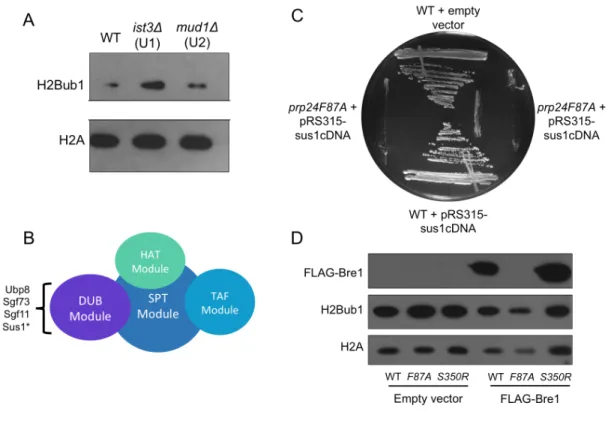
Given the well-studied role of Prp24 in snRNP assembly, it seemed possible that this increase may be caused by defects in splicing efficiency. However, analysis of known splicing mutants showed only a very mild increase in H2Bub1 levels, and only in the mutant with the most severe splicing defects (Figure 4A). Nevertheless, in order to confirm that the prp24F87A phenotypes are not due to missplicing
FIGURE 2: (A) RNA Recognition Motifs (RRMs) of Prp24 and mutations used in this study (B)
7
of a gene directly involved in regulating H2Bub1, I transformed a plasmid (Table 2) containing a cDNA copy of the SUS1 gene, the only intron-containing gene with a known role pertaining to H2B
ubiquitylation. As a member of the SAGA complex, Sus1 is required for Ubp8 function and therefore could impact H2Bub1 levels if significantly misregulated (Figure 4B). However, the addition of SUS1 cDNA has no effect on the growth defects seen in prp24F87A (Figure 4C). Therefore, it is unlikely that splicing defects contribute significantly to the phenotype of prp24F87A.
8
Prp24-F87A affects Bre1 protein levels
Previous studies have shown H2Bub1 levels may be regulated by Bre1 stability (Wozniak & Strahl 2014). To determine if Prp24 influenced H2Bub1 through Bre1 stability, I tested the effects of F87A on Bre1 expression. When F87A cells were transformed with a FLAG-Bre1 containing plasmid, no FLAG was detected, despite significant levels seen in cells with wild-type Prp24 or other Prp24 mutations (Figure 4D). Additionally, the addition of the FLAG-Bre1 plasmid appears to decrease levels of H2Bub1 in F87A cells. Importantly, endogenous Bre1 has not been deleted from these cells. Therefore, it is possible that endogenous levels of Bre1 are much higher than levels of the tagged version. Consistent with this idea, previous studies have shown that FLAG-Bre1 levels expressed from this plasmid are much higher in a bre1∆ background than in wild-type yeast (BRE1). Regardless, FLAG-Bre1 levels are significantly lower in F87A, consistent with an effect of Prp24 on Bre1 regulation.
Figure 4: (A) Western blot comparing levels of H2Bub1 in yeast in which a nonessential splicing protein has been deleted. (B) Representation of the SAGA complex. Asterisk indicates the only intron-containing gene known to impact H2Bub1. (C) Yeast strains grown for 72 hours at 22°C, transformed either with pRS315 empty vector or pRS315-Sus1cDNA. (D)Western blot comparing levels of H2Bub1 and FLAG-Bre1 in strains transformed with empty vector or plasmid bearing FLAG-Bre1. Note that endogenous Bre1 has not been removed from these strains.
9
U6 snRNA rescues F87A growth defects
Overexpression of U6 snRNA has been reported to rescue lethality of snRNP assembly factors (Chen et al. 2006). To determine if the increase in H2Bub1 levels seen in F87A is dependent upon Prp24’s interaction with U6, I overexpressed U6 snRNA in both wild-type and F87A yeast. As seen in Figure 3A, overexpression of U6 partially rescues the growth defects caused by F87A. I next sought to determine if H2Bub1 levels in F87A were also rescued by U6 overexpression. Surprisingly, overexpression of U6 reduced the levels of H2Bub1 not only in the F87A mutant, but in wild-type cells as well (Figure 3B), indicating the U6 may actually function upstream of Prp24 in regulating levels of H2Bub1.
Discussion
There remains a significant gap in understanding the links between RNA processing and histone modification. In this study, I set out to investigate the impact of a highly conserved, essential splicing factor on ubiquitylation of H2B. Using multiple mutants of Prp24, I investigated the impact of altered Prp24 function on viability and H2Bub1, uncovering a novel role for this snRNP recycling factor.
My results show that mutation of a specific residue in the first RNA Recognition Motif of Prp24, F87, significantly increases global levels of H2Bub1. This result is consistent with results obtained in HeLa cells showing that knockdown of Sart3, the human homolog, increase H2Bub1 levels. Importantly, my results indicate that this impact is restricted to a specific region of Prp24, and is not seen when other regions of the protein are mutated. Recent studies have demonstrated that Prp24 is essential for viability even when it’s role in snRNP recycling is not (Burke et al. 2015). Combined with the need for RRM1 despite it’s lack of interaction with U6, this finding has led to the proposal that Prp24 may have additional functions outside of U4/U6 recycling (Burke et al. 2015).
10
Nineteen Complex (Chen et al. 2006). If mutation of F87 were to lead to a decrease in free U6, it would be consistent with the results of Sart3 depletion in HeLa cells (Bell et al. 2002). Further experiments will be needed to test the direct effects of F87A on total levels of U6 snRNA in it’s free form as well as in complex with U4 and other snRNAs.
Mutation of Prp24 at F87 also appears to have a significant impact on Bre1 levels. Previous studies have shown that Bre1 levels are highly sensitive to the ability of Bre1e to catalyze ubiquitylation of H2B, and it has been proposed that destabilization of Bre1 is an important regulator of H2Bub1 levels (Wozniak & Strahl 2014). This hypothesis offers an explanation for the absence of FLAG-Bre1 expression in Prp24-F87A cells. It is possible that high levels of H2Bub1 (potentially saturating amounts), lead to the degradation of Bre1. This is consistent with results showing that FLAG-Bre1 levels are lower when expressed in cells that maintain an endogenous copy of Bre1 compared to cells in which endogenous Bre1 has been deleted (Wozniak & Strahl 2014). This experiment should be repeated in a yeast strain lacking endogenous Bre1, and further experiments will be needed to determine the levels of Bre1 in other mutants with high levels of H2Bub1, such as yeast lacking Ubp8. Nevertheless, it appears evident that Prp24 does have an impact on Bre1 levels. If mutation of Prp24 impacts U6 levels, it is possible that the altered levels of Bre1 are a downstream consequence of the change in U6.
Importantly, the interaction between Prp24 and deubiquitylating enzymes has not been tested. Sart3 has been reported to associate with the human deubiquitylating enzymes Usp15 and Usp4;
however, Usp4 does not appear to catalyze deubiquitylation of H2Bub1. Although Usp15 has been shown to do so in vitro, these results could not be replicated in vivo (Long et al. 2014). No deubiquitylating enzyme that is known to target H2Bub1 has been associated with Sart3 or any of its homologs.
Overall, the data presented in this study support a role for Prp24 in regulation of H2B
11
12
APPENDIX: EFFECT OF ELONGATION RATE ON H2B UBIQUITYLATION
Question under investigation
Does the rate of transcription elongation affect levels of H2Bub1?
Rationale
A 2014 study (Fuchs et al. 2014) reported a correlation between local transcription rates in HeLa cells and H2Bub1 occupancy in NT2 and HTC116 cells. However, these correlation between
transcriptional elongation rate and H2Bub1 levels has not been investigated in the same cell type.
13
Methods
SUMEB yeast cell extracts were prepared and western blots for H2Bub1 were performed as described previously. Spotting assays were performed as described previously.
Strains
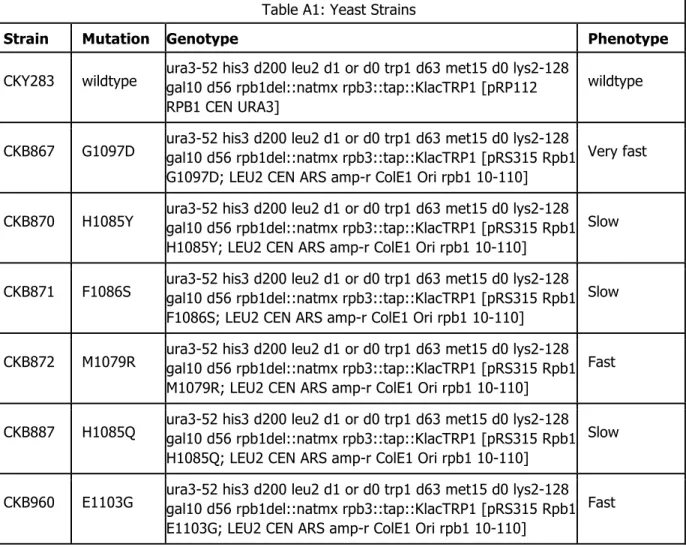
Strains and plasmids used in this study are listed in Table A1. All strains were a gift from C. Kaplan.
Table A1: Yeast Strains
Strain Mutation Genotype Phenotype
CKY283 wildtype ura3-52 his3 d200 leu2 d1 or d0 trp1 d63 met15 d0 lys2-128 gal10 d56 rpb1del::natmx rpb3::tap::KlacTRP1 [pRP112 RPB1 CEN URA3]
wildtype
CKB867 G1097D ura3-52 his3 d200 leu2 d1 or d0 trp1 d63 met15 d0 lys2-128 gal10 d56 rpb1del::natmx rpb3::tap::KlacTRP1 [pRS315 Rpb1 G1097D; LEU2 CEN ARS amp-r ColE1 Ori rpb1 10-110] ]
Very fast
CKB870 H1085Y ura3-52 his3 d200 leu2 d1 or d0 trp1 d63 met15 d0 lys2-128 gal10 d56 rpb1del::natmx rpb3::tap::KlacTRP1 [pRS315 Rpb1 H1085Y; LEU2 CEN ARS amp-r ColE1 Ori rpb1 10-110]
Slow
CKB871 F1086S ura3-52 his3 d200 leu2 d1 or d0 trp1 d63 met15 d0 lys2-128 gal10 d56 rpb1del::natmx rpb3::tap::KlacTRP1 [pRS315 Rpb1 F1086S; LEU2 CEN ARS amp-r ColE1 Ori rpb1 10-110]
Slow
CKB872 M1079R ura3-52 his3 d200 leu2 d1 or d0 trp1 d63 met15 d0 lys2-128 gal10 d56 rpb1del::natmx rpb3::tap::KlacTRP1 [pRS315 Rpb1 M1079R; LEU2 CEN ARS amp-r ColE1 Ori rpb1 10-110]
Fast
CKB887 H1085Q ura3-52 his3 d200 leu2 d1 or d0 trp1 d63 met15 d0 lys2-128 gal10 d56 rpb1del::natmx rpb3::tap::KlacTRP1 [pRS315 Rpb1 H1085Q; LEU2 CEN ARS amp-r ColE1 Ori rpb1 10-110]
Slow
CKB960 E1103G ura3-52 his3 d200 leu2 d1 or d0 trp1 d63 met15 d0 lys2-128 gal10 d56 rpb1del::natmx rpb3::tap::KlacTRP1 [pRS315 Rpb1 E1103G; LEU2 CEN ARS amp-r ColE1 Ori rpb1 10-110]
14
Figure A-1 Western blot showing H2Bub1 levels in various rpb1 strains
Figure A-2 Spotting assay comparing growth in rpb1 strains after 48 hrs at indicated temperatures. Results
15
REFERENCES
de Almeida, S.F. et al., 2011. Splicing enhances recruitment of methyltransferase HYPB/Setd2 and methylation of histone H3 Lys36. Nature structural & molecular biology, 18(9), pp.977–83. Available at: http://www.ncbi.nlm.nih.gov/pubmed/21792193 [Accessed October 17, 2014].
Bell, M. et al., 2002. p110, a novel human U6 snRNP protein and U4/U6 snRNP recycling factor. EMBO Journal, 21(11), pp.2724–2735.
Braberg, H. et al., 2013. From structure to systems: high-resolution, quantitative genetic analysis of RNA polymerase II. Cell, 154(4), pp.775–88. Available at:
http://www.ncbi.nlm.nih.gov/pubmed/23932120 [Accessed July 9, 2014].
Bray, S., Musisi, H. & Bienz, M., 2005. Bre1 is required for Notch signaling and histone modification. Developmental cell, 8(2), pp.279–86. Available at: http://www.ncbi.nlm.nih.gov/pubmed/15691768 [Accessed August 10, 2014].
Briggs, S.D. et al., 2002. Gene silencing: trans-histone regulatory pathway in chromatin. Nature,
418(6897), p.498. Available at: http://www.ncbi.nlm.nih.gov/pubmed/12152067 [Accessed August 27, 2014].
Burke, J.E., Butcher, S.E. & Brow, D. a, 2015. Spliceosome assembly in the absence of stable U4 / U6 RNA pairing. , pp.1–12.
Chen, C.-H. et al., 2006. Functional links between the Prp19-associated complex, U4/U6 biogenesis, and spliceosome recycling. RNA (New York, N.Y.), 12(5), pp.765–774.
Cole, a. J., Clifton-Bligh, R. & Marsh, D.J., 2015. Histone H2B monoubiquitination: roles to play in human malignancy. Endocrine Related Cancer, 22(1), pp.T19–T33. Available at: http://erc.endocrinology-journals.org/cgi/doi/10.1530/ERC-14-0185.
Dover, J. et al., 2002. Methylation of histone H3 by COMPASS requires ubiquitination of histone H2B by Rad6. Journal of Biological Chemistry, 277, pp.28368–28371.
Fuchs, G., Hollander, D. & Voichek, Y., 2014. Co-transcriptional histone H2B monoubiquitylation is tightly coupled with RNA polymerase II elongation rate Co-transcriptional histone H2B monoubiquitylation is tightly coupled with RNA polymerase II elongation rate.
Hérissant, L. et al., 2014. H2B ubiquitylation modulates spliceosome assembly and function in budding yeast. Biology of the Cell, 106(4), pp.126–138. Available at:
http://www.ncbi.nlm.nih.gov/pubmed/24476359 [Accessed August 15, 2014].
Kwan, S.S. & Brow, D.A., 2005. The N- and C-terminal RNA recognition motifs of splicing factor Prp24 have distinct functions in U6 RNA binding The N- and C-terminal RNA recognition motifs of splicing factor Prp24 have distinct functions in U6 RNA binding. , pp.808–820.
16
Montemayor, E.J. et al., 2014. Core structure of the U6 small nuclear ribonucleoprotein at 1 . 7-Å resolution. Nature Publishing Group, 21(6), pp.544–551. Available at:
http://dx.doi.org/10.1038/nsmb.2832.
Northam, M.R. & Trujillo, K.M., 2016. Histone H2B mono-ubiquitylation maintains genomic integrity at stalled replication forks. Nucleic acids research, 44(19), p.gkw658. Available at:
http://nar.oxfordjournals.org/lookup/doi/10.1093/nar/gkw658\nhttp://www.ncbi.nlm.nih.gov/pubme d/27458205.
Pavri, R. et al., 2006. Histone H2B Monoubiquitination Functions Cooperatively with FACT to Regulate Elongation by RNA Polymerase II. Cell, 125(4), pp.703–717.
Raghunathan, P.L., 1998. A Spliceosomal Recycling Factor That Reanneals U4 and U6 Small Nuclear Ribonucleoprotein Particles. Science, 279(5352), pp.857–860. Available at:
http://www.sciencemag.org/cgi/doi/10.1126/science.279.5352.857.
Sun, Z.-W. & Allis, C.D., 2002. Ubiquitination of histone H2B regulates H3 methylation and gene silencing in yeast. Nature, 418(JULY), pp.104–108.
Vidaver, R.M. et al., 1999. Multiple functions of Saccharomyces cerevisiae splicing protein Prp24 in U6 RNA structural rearrangements. Genetics, 153, pp.1205–1218.