rspb.royalsocietypublishing.org
Research
Cite this article:
Comeault AA, Venkat A,
Matute DR. 2016 Correlated evolution of male
and female reproductive traits drive a
cascading effect of reinforcement in
Drosophila
yakuba
.
Proc. R. Soc. B
283
: 20160730.
http://dx.doi.org/10.1098/rspb.2016.0730
Received: 4 April 2016
Accepted: 23 June 2016
Subject Areas:
evolution
Keywords:
reinforcement, cryptic sexual choice,
coevolution, experimental evolution
Authors for correspondence:
Aaron A. Comeault
e-mail: [email protected]
Daniel R. Matute
e-mail: [email protected]
Electronic supplementary material is available
at http://dx.doi.org/10.1098/rspb.2016.0730 or
via http://rspb.royalsocietypublishing.org.
Correlated evolution of male and female
reproductive traits drive a cascading effect
of reinforcement in
Drosophila yakuba
Aaron A. Comeault
1, Aarti Venkat
2and Daniel R. Matute
11Biology Department, University of North Carolina, 250 Bell Tower Drive, Chapel Hill, NC 27599, USA 2Department of Human Genetics, The University of Chicago, 920 East 58th Street, Chicago, IL 60637 USA
Selection against maladaptive hybridization can drive the evolution of repro-ductive isolation in a process called reinforcement. While the importance of reinforcement in evolution has been historically debated, many examples now exist. Despite these examples, we typically lack a detailed understanding of the mechanisms limiting the spread of reinforced phenotypes throughout a
species’ range. Here we address this issue in the fruit flyDrosophila yakuba,
a species that hybridizes with its sister speciesD. santomeaand is undergoing
reinforcement in a well-defined hybrid zone on the island of Sa˜o Tome´.
Within this region, femaleD. yakubashow increased postmating-prezygotic
(gametic) isolation towardsD. santomeawhen compared with females from
allopatric populations. We use a combination of natural collections, fertility assays, and experimental evolution to understand why reinforced gametic
isolation inD. yakubais confined to this hybrid zone. We show that, among
other traits,D. yakubamales from sympatric populations sire fewer progeny
than allopatric males when mated to allopatricD. yakubafemales. Our results
provide a novel example of reinforcement acting on a postmating-prezygotic trait in males, resulting in a cascade of reproductive isolation among conspecific populations.
1. Introduction
Reinforcement can drive the evolution of strong prezygotic reproductive isolation through natural selection acting against the production of maladapted, infertile, or inviable hybrids [1]. Because reinforcement acts through selection against hybrids, it occurs where species hybridize and can result in ‘reproductive charac-ter displacement’ (RCD); a patcharac-tern of stronger reproductive isolation in sympatric versus allopatric regions of a species’ range [2]. While historically controversial [3,4], reinforcement has now been observed in a wide range of taxonomic groups, including fungi [5,6], animals [7–9], and plants [10,11]. Reinforcement could, therefore, be common during the ‘completion’ of speciation [12,13].
Despite an increase in our understanding of reinforcement, important aspects of the process remain underexplored. For example, we generally lack an under-standing of how variation in levels of reinforced reproductive isolation (RRI) across a species’ range, and a pattern of RCD, is maintained. One explanation for the maintenance of RCD is that reinforcement favours phenotypes that are selectively disfavoured in allopatry, confining ‘reinforced’ alleles to areas where hybridization occurs [14–16]. Under this scenario, reinforcement can drive incidental increases in levels of reproductive isolation between conspecific popu-lations (i.e. the ‘cascade reinforcement’ hypothesis [14,15,17]). Recent work supports this hypothesis and suggests that phenotypes favoured by reinforcing selection in sympatry are often disadvantageous in allopatry [18–23]. The types of disadvantages can be diverse; however, because reinforcement frequently acts on traits involved in premating isolation, costs tend to manifest as a reduction in the ability to solicit potential mates when ‘sympatric’ phenotypes are found in allopatry [18–22,24]. To date, all reported cases of fitness costs associated with phenotypes involved in RRI come from studies focusing on individual traits
affecting premating reproductive isolation (e.g. calls in frogs [20] or cuticular hydrocarbons in insects [19]).
Reinforcement is not restricted to premating traits, and postmating-prezygotic barriers can also be involved (e.g. inter-actions between reproductive tracts and gametes [6,25]). Just as occurs with other traits under the influence of sexual selection, postmating-prezygotic traits can influence female and male fitness in different ways and lead to sexual conflict and coevo-lution between the sexes [26,27]. For example, ejaculate traits that directly increase male fitness can have deleterious effects
on female fitness [28,29] and previous work inDrosophilafruit
flies has demonstrated ongoing coevolution between the female reproductive tract and male ejaculate [30,31]. Alternative explanations for correlated evolutionary responses in male and female traits include correlated selective pressures or genetic linkage. Independent of the specific mechanism(s), a correlated evolutionary response to reinforcing selection in both sexes could have cascading effects on levels of reproductive isolation between conspecific populations because ‘sympatric’ traits may become mismatched with conspecific ‘allopatric’ traits (e.g. female preferences and/or male signals).
Drosophila species that hybridize and are undergoing reinforcement [7,9,24,25] provide an opportunity to test the mechanisms maintaining a pattern of RCD despite ongoing
gene flow between conspecific populations.Drosophila yakuba
represents one such species: it is widespread throughout sub-Saharan Africa and, on the island of Sa˜o Tome´, is mostly found in low-altitude (below 1 450 m), semi-dry habitats com-monly associated with humans [32], but hybridizes with its
sister species,Drosophila santomea, in a narrow hybrid zone
on the mountain of Pico de Sa˜o Tome´. Previous work has
shown that female D. yakuba from this hybrid zone show
higher postmating-prezygotic isolation towards males of
D. santomea than do D. yakuba females from outside the hybrid zone [25]. Stronger reproductive isolation between
sympatric D. yakuba and D. santomea is selectively
advan-tageous because hybrid male offspring are sterile and, therefore, costly to produce [33].
The specific trait underlying RRI betweenD. yakuba and
D. santomeais unknown; however, Matute [25] showed that
sympatric femaleD. yakubalay fewer eggs when mated with
D. santomeathan do allopatric females. This finding suggests
that reinforcement inD. yakubadrives the evolution of
postmat-ing-prezygotic traits that affect how the female’s reproductive
tract, or eggs, interact with sperm fromD. santomea. Matute
[25] also used experimental evolution to show that
reinforce-ment in D. yakuba can occur rapidly under laboratory
conditions. Given the relatively short time frame of these exper-iments (10 generations), they show that the genetic variation required for gametic isolation to evolve is segregating within
natural populations ofD. yakuba. There is currently no evidence
for reinforcement inD. santomea[25].
Here, we explore whetherD. yakuba lines that show RRI
fromD. santomeaalso exhibit reduced fertility when crossed with conspecific individuals collected from allopatric popu-lations. We first measure levels of fertility within populations ofD. yakubacollected along an altitudinal transect on Pico de Sa˜o Tome´ when crossed with conspecific genetic backgrounds derived from sympatric and allopatric populations of
D. yakuba. These data allow us to test the ‘cascade
reinforce-ment’ hypothesis and ask whether D. yakuba found in
sympatry withD. santomeashow lower fertility when mated
to conspecifics with ‘allopatric’ genotypes and vice versa.
Second, we use experimental evolution to test whether the evolutionary response to reinforcing selection in populations ofD. yakubacan lead to a correlated decrease in male fertility when mated to conspecific females from allopatric regions of the species’ range. We predict that if reinforcement drives the correlated evolution of female and male traits, we will observe reduced fertility in conspecific crosses between two individuals that differ with respect to whether they are from populations
found in sympatry or allopatry withD. santomea.
2. Material and methods
(a) Isofemale lines collected along an altitudinal
transect on Sa˜o Tome´
We carried out fertility assays (described below) using 100 iso-female lines collected from 10 sites (10 lines per site; see electronic supplementary material, Appendix S1, S2, and table S1 for details), equally distributed with respect to altitude, along an altitudinal transect on the island of Sa˜o Tome´. These sites started at low elevations where onlyD. yakuba were collected (i.e. the seven low-altitude ‘allopatric’ sites) and finished at higher elevations where we observed hybrids betweenD. yakuba
andD. santomea(i.e. the three high-altitude ‘sympatric’ sites). Because D. yakuba only co-occur and hybridize with
D. santomea at high altitudes it is difficult to disentangle the effect of reinforcement from other factors that might influence the traits we assay in this study. To address this issue, we sampled
D. yakubafrom 10 sites on the island of Bioko, spanning the same altitudinal range as the transect on Sa˜o Tome´. Bioko is located to the northeast of Sa˜o Tome´ and whileD. yakubacan be collected here,D. santomeais absent. Our goal was to use these data as a type of natural control and test whether altitude and geography affect levels of fertility between populations ofD. yakuba, indepen-dent of the presence of D. santomea. Below we focus on data collected from the Sa˜o Tome´ transect and briefly summarize paral-lel analyses and results for the Bioko transect. All methods applied to the Sa˜o Tome´ transect were applied in parallel to the Bioko transect (see the electronic supplementary material for details).
(b) Female fertility with
Drosophila santomea
To measure heterospecific fertility, we collected virginD. yakuba
females less than 8 h after eclosion from each of the 100 Sa˜o Tome´ isofemale lines, maintained them in isolation from males for 4 days, and then gave them the opportunity to mate with het-erospecificD. santomeamales (line SYN2005). We carried out these matings by combining an individual male and an individual female in a 100 ml vial containing cornmeal food. We observed all matings for 1 h and obtained a total of 15 mated pairs per line (N¼1 500 females). After mating, we removed males from the vials and allowed each female to oviposit for 10 days, transferring each female to a fresh vial every 24 h. The number of eggs produced over 10 days was taken as an estimate of fertility.
(c) Female fertility with conspecific males with different
genetic backgrounds
If reinforcing selection acting in sympatry indirectly affects levels of fertility between conspecific populations, as predicted by the ‘cascade reinforcement’ hypothesis, we expect that levels of ferti-lity between conspecific matings will be lower when females and males are ‘mismatched’ with respect to their genetic background. To measure levels of conspecific fertility, we counted the number of eggs that a female produced when mated to different, but con-trolled, conspecific male genetic backgrounds. We first measured
rspb.r
oy
alsocietypublishing.org
Pr
oc.
R.
Soc.
B
283
:
20160730
baseline levels of fertility within each isofemale line by crossing females from the same 100 focal lines described above with males from the same line. To measure conspecific fertility when mated to sympatric D. yakuba genotypes, we crossed females from each focal line to males from two ‘tester’ lines derived from females collected in 2005 from the centre of the Sa˜o Tome´ hybrid zone (BOSU1250.5 [sympatricBOSU1250.5] and
SA1 [sympatricSA1]; see the electronic supplementary material
for validation with other sympatric genotypes). To measure female fertility when mated to allopatricD. yakuba genotypes, we crossed females from the 100 focal lines with males from two allopatric tester lines: Ta¨i18 (allopatricTa¨i18), collected in the
Ta¨i forest (Liberia) and SJ2 (allopatricSJ2), collected in the
low-lands of Sa˜o Tome´. We followed the same mating procedure described for heterospecific matings and obtained 15 mated females from each of the 100 focal linemale genotype combi-nations (N¼9 000 females). We then counted the number of eggs produced by each female as described in the Methods Section for ‘Female fertility withD. santomea’. We focused on the number of eggs laid rather than other measures of fertility, such as the proportion of fertilized eggs, because the proportion of laid eggs that are fertilized and viable does not vary betweenD. yakuba
with sympatric or allopatric genetic backgrounds (electronic supplementary material, table S3).
(d) Male fertility with conspecific females with different
genetic backgrounds
To test whether the fertility of males derived from sympatric and allopatric populations varies when crossed with ‘sympatric’ or ‘allopatric’ female genotypes, we crossed male D. yakuba from each focal line to females of the same tester stocks used to assess female fertility: sympatricBOSU1250.5, sympatricSA1, allopatricTa¨i18,
and allopatricSJ2. As with females, we collected virgin males and
allowed them to age for 4 days before crossing them with virgin females of the four tester lines. We then estimated the fertility of a given cross by counting the number of eggs produced by mated females as described above.
(e) Statistical analyses
We used a combination of generalized linear mixed models (GLMMs) and Spearman’s rank correlations to test whether het-erospecific female fertility, conspecific female fertility, and conspecific male fertility varied with respect to the genetic back-grounds of the two individuals involved in a cross. First, we modelled heterospecific female fertility (number of eggs produced per female) as a function of the altitude a female was collected from (a proxy for distance from the hybrid zone and the likelihood of reinforcement). We included isofemale line as a random effect in this model to control for genetic variation found within each sample site. Second, we modelled conspecific female fertility as a function of the altitude a female was collected from, the genetic background of the male line used in the cross (i.e. either sympatric or allopatric), and the interaction between altitude and male genetic background. We included focal isofemale line and male tester line as random effects to account for genetic variation observed within each sampling site and between male tester lines, respectively. Third, we modelled male fertility as a function of altitude, the genetic background of the female tester line used in the cross, and the interaction between altitude and female genetic background. We included the isofemale line of the focal male and the genotype of the female line he was crossed with as random effects. We fitted each of these GLMMs assuming Poisson distrib-uted error with the ‘glmer’ function in the lme4 R library [34]. We predicted that if reinforcing selection has cascading effects on levels of conspecific fertility we should see a significant interaction between the location a focal line was collected from (i.e. altitude)
and the genetic background to which it was crossed on levels of fer-tility. To assess the significance of this interaction we used likelihood ratio tests (LRT, 1 d.f.) which compared models that included versus excluded the altitudegenetic background inter-action. For each full model, we report coefficients of determination (R2) as the proportion of variation in observed fertility that was explained by the model-predicted levels of fertility.
We used Tukey’spost hoccontrasts to determine differences in fertility between different types of matings. We predicted that sympatricD. yakubawould show decreased fertility when mated with allopatric conspecifics and vice versa. For female fertility this analysis resulted in 15 contrasts: females were classified as sympatric or allopatric and males as within-line, sympatric, or allopatric. For male fertility, the analysis resulted in six contrasts: males and females were classified as sympatric or allopatric.
Finally, we used Spearman’s rank correlations to test the directionality of relationships between the altitude a line was col-lected from and fertility in the different types of crosses. Under the cascade reinforcement hypothesis, we predicted that popu-lations ofD. yakubafound in sympatry withD. santomeawould show lower fertility when mated toD. santomea, higher fertility when mated to conspecific tester lines with sympatric genetic backgrounds, and lower fertility when mated to conspecific tester lines with allopatric genetic backgrounds.
(f ) Correlations between heterospecific, conspecific
female and conspecific male fertility
We next tested whether the traits responding to reinforcing selec-tion in sympatry also affected levels of conspecific fertility. We predicted that if there is a correlated response to reinforcing selection in male and femaleD. yakuba, a decrease in heterospe-cific fertility should result in a concomitant decrease in fertility with allopatric D. yakuba (negative correlation). By contrast,
D. yakuba showing higher heterospecific fertility should also show higher fertility with conspecific allopatric genotypes ( posi-tive correlation). We also tested whether mean female and male fertility of an isofemale line was correlated when mated to either conspecific allopatric genotypes or conspecific sympatric geno-types. All correlations were assessed using Spearman’s rank correlation tests in R [34].
(g) Experimental sympatry
Among the lines we sampled on Sa˜o Tome´, we found that as RRI from D. santomea increased (i.e. fertility decreased) fertility between male D. yakuba and allopatric conspecifics decreased (Spearman’sr¼0.90; figure 2a). To test whether this decreased male fertility could evolve as a correlated effect of reinforcing selec-tion, we carried out 10 generations of experimental evoluselec-tion, selecting against hybridization betweenD. yakubaandD. santomea. We kept 23 populations ofD. yakuba, derived from an outbred allo-patric laboratory population, in experimental sympatry with
D. santomea(see electronic supplementary material for details). Experimental populations consisted of 500D. yakuba(equal sex ratio) and 500D. santomea(equal sex ratio). Each generation, we collected virgin flies from the experimental populations within 10 h of eclosion (once they had obtained adult pigmentation), dis-carded hybrids (recognized by their abdominal pigmentation), and reconstituted experimental sympatry by combining 500
D. yakubafrom each experimental population with 500D. santomea
from stock populations. Twenty-three control populations of
D. yakubawere maintained in parallel and contained the same number of conspecifics but lackedD. santomea.
We compared levels of female fertility when mated to
D. santomea, male fertility with sympatricBOSU1250.5 females, and
male fertility with allopatricTa¨i18 females at the onset of the
rspb.r
oy
alsocietypublishing.org
Pr
oc.
R.
Soc.
B
283
:
20160730
experiment and following 10 generations of evolution using general-ized linear models (GLMs) with Poisson distributed error. To test whether female fertility withD. santomeaand male fertility with allopatric or sympatric females changed over the course of the exper-iment, we used LRTs that compared models that included generation as a fixed effect to ‘null’ models lacking this effect. Models were fitted using the ‘glm’ function in R [34]. Finally, we used Spearman’s rank correlation to compare whether there was a correlation between female fertility withD. santomeaand conspecific male fertility when mated to allopatricD. yakubafemales.
3. Results
(a) Female fertility with
Drosophila santomea
We found that levels of gametic isolation betweenD. yakuba
females and D. santomea males vary across the altitudinal
transect as predicted by reinforcement: the altitude that an iso-female line was collected from explains her fertility when mated
to male D. santomea (p,0.000001; table 1 and figure 1a)
and heterospecific fertility is negatively correlated with altitude
(Spearman’s r¼20.98; p,0.000001; table 2). While these
results are based on crosses carried out with males from
a singleD. santomealine, they are consistent with previous work
providing evidence for reinforcement acting in populations of
D. yakubaon the island of Sa˜o Tome´ [25]. We observed no evi-dence for reinforcement along the ‘control’ transect on the island of Bioko (electronic supplementary material, table S5).
(b) Female fertility with conspecific males with
different genetic backgrounds
In contrast with female fertility when mated to heterospecific
D. santomea males, baseline levels of fertility within an isofemale line did not differ across the altitudinal transect
(p¼0.237; table 2). Conspecific female fertility when crossed
with controlled male genotypes did, however, vary depending on the interaction between the collection location of the female line and whether a female was crossed with a sympatric or
allopatric male (LRT, x2¼638.19; p,0.000001; table 1;
figure 1b). We also found a positive correlation between fertility
and the location that a female was collected from when crossed
with sympatric maleD. yakuba(Spearman’sr¼0.37; table 2)
and a marginally significant negative correlation between ferti-lity and altitude when females were crossed with allopatric
D. yakuba(Spearman’sr¼20.23; table 2). These correlations do not exist on the island of Bioko (electronic supplementary material, table S7).
Linear contrasts revealed that the effect of the collection
locationmale genotype interaction was driven by allopatric
femaleD. yakubahaving low fertility when crossed with
sympa-tric conspecifics (electronic supplementary material, table S4). Specifically, allopatric females had lower fertility when crossed with sympatric males than when crossed with allopatric males,
or males from the same line (mean fertility¼74.29 versus 88.74
and 90.50 eggs per female, respectively). We also observed
lower levels of fertility in allopatric femalesympatric male
crosses when compared with sympatric females that were crossed with allopatric males (88.44 eggs per female), sympatric males (83.74 eggs per female), and males from the same line (88.24 eggs per female). Together, these results indicate that allopatric female genotypes will be at a selective disadvantage
in sympatric regions ofD. yakuba’s range because they have
lower fitness when they mate with sympatric males.
(c) Male fertility with conspecific females with different
genetic backgrounds
We next tested whether reinforcing selection acting in sympa-try affected levels of conspecific male fertility by mating males from each focal line (100 lines total) with females from the same four tester lines used to assess conspecific female fer-tility. As with female fertility, we found a significant effect of the interaction between the location a male was collected from (i.e. altitude) and female genotype on levels of fertility
(LRT,x2¼3 707.7;p,0.000001; table 1; figure 1b). We also
found a positive correlation between male fertility with
sympa-tric female genotypes and altitude (Spearman’s r¼0.74;
table 2; figure 1c, light grey boxes) and a strong negative
correlation between male fertility with allopatric female
geno-types and altitude (Spearman’sr¼20.91; table 2; figure 1c,
dark grey boxes). Both of these correlations are absent in
samples collected from the island of Bioko (Spearman’sr¼
0.06 and 0.10, respectively;p.0.1; electronic supplementary
material, table S7).
Linear contrasts comparing male fertility in the different
types of crosses show that the collection locationfemale
background interaction can be explained by lower fertility in crosses that are mismatched with respect to their genetic back-ground: allopatric males had higher fertility when crossed to
allopatric female genetic backgrounds (mean fertility¼90.02
eggs per female) than when crossed to sympatric female genetic backgrounds (87.50 eggs per female) and sympatric males had higher fertility with sympatric female genetic back-grounds (91.67 eggs per female) compared with allopatric
Table 1.
Summary of models testing for an interaction between altitude and the genetic background of a ‘tester’ individual used to carry out a cross (
G
mfor
males and
G
ffor females; sympatric/allopatric) on levels of fertility in 100
D. yakuba
lines sampled along an altitudinal transect on the island of Sa˜o Tome´.
See electronic supplementary material, table S6 for a parallel analysis with
D. yakuba
from Bioko.
p
,
0.000001 is highlighted in italics; Exp. dev., proportion
of residual deviance explained by altitude (heterospecific matings) or the interaction between altitude and the genetic background of the tester line used in a
given cross.
details of models
LRT (
x
2)
exp. dev. (%)
R
2type of fertility
fixed effects
random effects
heterospecific
altitude
isof. line
539.11
5.51
0.95
conspecific (female)
altitude
þ
G
mþ
(altitude
G
m)
isof. line
þ
male line
638.13
0.90
0.18
conspecific (male)
altitude
þ
G
fþ
(altitude
G
f)
isof. line
þ
female line
3707.7
6.51
0.34
rspb.r
oy
alsocietypublishing.org
Pr
oc.
R.
Soc.
B
283
:
20160730
females (71.61 eggs per female; see electronic supplemen-tary material, table S5). Consistent with results for females, the lowest level of fertility we observed was between sympatric maleD. yakubaand allopatric conspecifics (figure 1b,c).
(d) Correlations between heterospecific, conspecific
female and conspecific male fertility
If reinforcing selection has correlated effects on levels of fertility between conspecific populations, we predicted that interspecific fertility would be correlated with conspecific fertility when crossed with allopatric (positively correlated) or sympatric
(negatively correlated) genetic backgrounds. Consistent with
this prediction, the mean interspecific fertility of aD. yakuba
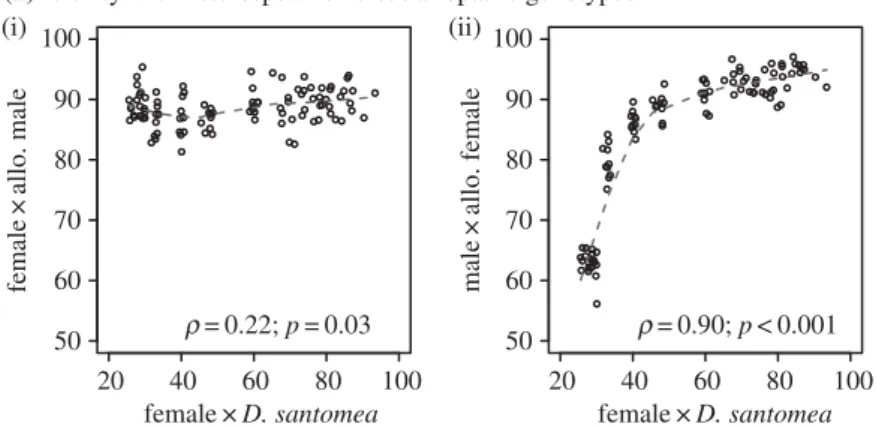
line is positively correlated with mean fertility when crossed
with allopatric conspecifics (Spearman’sp¼0.22 and 0.90 for
female and male fertility, respectively; figure 2a) and negatively
correlated with mean fertility when crossed with sympatric
con-specifics (Spearman’sp¼20.38 and20.72 for female and male
fertility, respectively; figure 2b). We also observed significant
correlations between mean female and male fertility when mated to both allopatric and sympatric genotypes (Spearman’s
r¼0.21 and 0.37, respectively; figure 2c). The only correlation
that was significant among isofemale lines collected on the
0 50 100 150
200 300 400 500 600 700 800 900 1 000 1 100 allopatric male within-line male sympatric male
collection location
no. e
ggs
0 50 100 150
200 300 400 500 600 700 800 900 1 000 1 100 collection location (altitude in m)
allopatric female sympatric female
no. e
ggs
0 50 100 150
200 300 400 500 600 700 800 900 1 000 1 100 collection location
no. e
ggs
(a) fertility with D. santomea
(b) conspecific female fertility
(c) conspecific male fertility
Figure 1.
Levels of heterospecific, conspecific female and conspecific male fertility along a transect on Sa˜o Tome´. (
a
) Isofemale lines collected from the hybrid zone
show lower fertility with
D. santomea
males than females from outside the hybrid zone. (
b
) Fertility of female
D. yakuba
when crossed with conspecific males is
lowest when allopatric females (collection locations below 900 m) were mated to sympatric male genotypes (light grey boxes; see text). (
c
) Fertility of
D. yakuba
males when crossed with conspecific females with controlled genetic backgrounds is lowest for males from the hybrid zone (sympatric genotypes) when they are
mated with female
D. yakuba
from allopatric tester lines (dark grey boxes). On the other hand, males from allopatric populations show higher fertility when mated
to allopatric females (leftmost dark grey boxes compared with right boxes; see text). Grey polygons in each panel demarcate the location of the hybrid zone and
collection locations are given as the altitude of a site (in metres above sea level).
rspb.r
oy
alsocietypublishing.org
Pr
oc.
R.
Soc.
B
283
:
20160730
island of Bioko was between fertility when mated toD. santomea
and male fertility with sympatric femaleD. yakuba(electronic
supplementary material, table S8). However, this relationship
was positive (Spearman’sr¼0.26), the opposite of what we
observed along the Sa˜o Tome´ transect.
(e) Experimental sympatry
Collectively, the results presented above suggest that reinfor-cing selection acting in sympatry can incidentally drive differentiation—and generate reproductive isolation—between
conspecific populations of D. yakuba. We used
experimen-tal evolution to test whether male D. yakuba could evolve
reduced conspecific fertility with either allopatricTa¨i18 or
sympatricBOSU1250.5D. yakubafemales in populations subject to
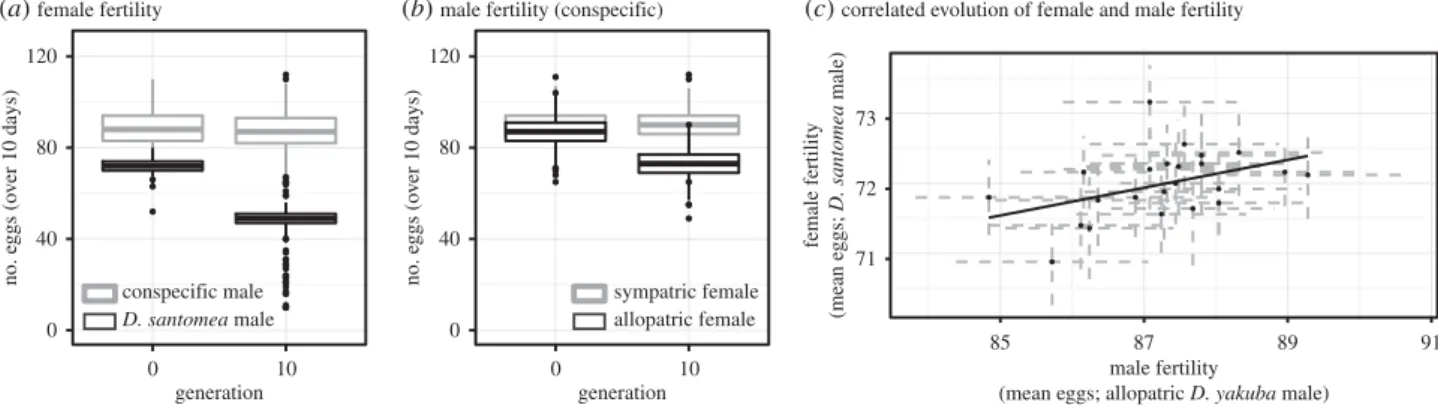
10 generations of reinforcing selection. Confirming that there was an evolutionary response to reinforcing selection, female
D. yakubafrom the experimental populations laid fewer eggs
when mated to D. santomea males after 10 generations of
selection against hybrids (Poisson GLM, LRT: x2¼2 767.7;
d.f.¼1; p,0.000001, figure 3a). Reinforcing selection also
resulted in conspecific differentiation: when mated with
allopatricTa¨i18 females, male fertility significantly decreased
over the course of the experiment (LRT:x2¼743.9; d.f.¼1;
p,0.000001, figure 3b) and there was a significant correlation
between levels of female fertility with heterospecific
60 70 80 90 100 60 70 80 90 100
50 60 70 80 90 100
50 60 70 80 90 100
r= 0.21; p= 0.04 r= 0.37; p< 0.001
male
×
sym. female
female × sym. male
male
×
allo. female
female × allo. female
20 40 60 80 100 20 40 60 80 100
50 60 70 80 90 100
50 60 70 80 90 100
r= 0.22; p= 0.03 r= 0.90; p< 0.001
male
×
allo. female
female
×
allo. male
female ×D. santomea female ×D. santomea
20 40 60 80 100 20 40 60 80 100
50 60 70 80 90 100
(i) (ii)
50 60 70 80 90 100
r= –0.38; p< 0.001 r= –0.72; p< 0.001
female
×
sym. male
male
×
sym. female
female ×D. santomea female ×D. santomea
(a) fertility with heterospecific versus allopatric genotypes
(b) fertility with heterospecific versus sympatric genotypes
(c) conspecific fertility with ‘tester’ genotypes
(i) (ii)
(i) (ii)
Figure 2.
Correlation of fertility between different genetic combinations in natural populations of
D. yakuba
. (
a
) Heterospecific fertility is weakly correlated with
fertility between female
D. yakuba
and allopatric male genotypes (i) but strongly correlated with fertility between male
D. yakuba
and females with allopatric
genotypes (ii). (
b
) Heterospecific fertility is negatively correlated with fertility between female
D. yakuba
and sympatric male genotypes (i) and with fertility
between male
D. yakuba
and sympatric female genotypes (ii). (
c
) Male and female fertility within lines is positively correlated when mated with conspecific
tester lines having either ‘sympatric’ or ‘allopatric’ genetic backgrounds (i and ii, respectively). Dashed lines in all panels are LOWESS smoothers and are included
for illustrative purposes only. Spearman’s rank correlations (
r
) are given in each panel (see text). Fertility is reported as the numbers of eggs produced by an
inseminated female and the axis labels denote the cross-type being considered (focal individual
controlled genetic background). See electronic supplementary
material, table S8 for parallel analysis of
D. yakuba
from the island of Bioko.
rspb.r
oy
alsocietypublishing.org
Pr
oc.
R.
Soc.
B
283
:
20160730
D. santomea and male fertility with conspecific allopatricTa¨i18
females at the end of the experiment (Spearman’s r¼0.69;
p,0.000001; figure 3c). By contrast, we found no change in
male fertility when mated to sympatricBOSU1250.5 females
(LRT:x2¼1.06; d.f.¼1;p¼0.304; figure 3b) and no
correla-tion between heterospecific fertility and fertility in matings
with conspecific sympatricBOSU1250.5 females (Spearman’s
r¼20.046, p¼0.115). Finally, we did not observe any
change in fertility in control populations (female fertility: LRT:
x2¼0.54; d.f.¼1; p¼0.462; male fertility: LRT: x2¼0.89;
d.f.¼1;p¼0.347) and overall levels of fertility following
con-specific matings remained the same (LRT:x2¼2.43; d.f.¼1;
p¼0.12; figure 3a). These results provide experimental
evidence that whenD. yakubafemales evolve gametic isolation
fromD. santomea, males also show a correlated reduction in fertility with conspecific females from allopatric populations.
4. Discussion
In this study, we used the drosophilid flies D. yakuba and
D. santomea to test the hypothesis that reinforcement can have indirect effects on levels of fertility between conspecific
populations.We report three pieces of evidence that together
support this hypothesis. First, sympatric lines of D. yakuba
have reduced fertility when mated with male D. santomea
when compared with allopatricD. yakuba. Second, sympatric
maleD. yakubashow reduced fertility when mated with
allo-patric femaleD. yakuba(tables 1 and 2; figure 2). Third, when
we experimentally evolved populations ofD. yakuba in the
presence ofD. santomeaand imposed selection against
mala-daptive hybridization with D. santomea, populations that
evolved stronger RRI fromD. santomeaalso evolved reduced
conspecific fertility when (experimentally sympatric) males were mated with allopatric females (figure 3).
(a) Correlated evolution of male and female
reproductive traits
Our results provide evidence that reinforcement can drive the correlated evolution of postmating-prezygotic traits in both sexes. This finding is nuanced: while we observed reduced fertility in crosses between allopatric female and sympatric male genotypes, we did not observe a concordant reduction in fertility between sympatric females and allopatric males,
a pattern that would be predicted by simple one-to-one co-evolution. Instead of strict one-to-one coevolution, the patterns of fertility we observed could be explained by differ-ent (and independdiffer-ent) traits responding to reinforcing
selection in female and maleD. yakuba. It is well known that
postcopulatory sexual selection can occur as a result of both (or either) intra and inter-sexual interactions [35], and selection can act on multiple traits including sperm morphology, the number of sperms, female sperm storage, and/or seminal pro-teins [36,37]. A hypothetical mechanism explaining our result is, therefore, that a sympatric male sperm (or seminal fluid)
trait is under selection in sympatricD. yakuba, resulting in a
mismatch between this male trait and female traits found in
allopatry. For example, sperm traits in sympatric D. yakuba
could be responding to selection generated by interactions
occurring with the sperm ofD. santomea in multiply
insemi-natedD. yakubafemales. While this male sperm trait evolves,
the trait used by sympatric femaleD. yakubato detect
conspe-cifics remains unaltered, and a second trait (used to detect heterospecific sperm and limit its ability to fertilize eggs or stimulate ovipositioning) is evolving during reinforcement.
Our results provide indirect evidence supporting the hypothesis that different traits are responding to reinforcing selection in the sexes. First, the geographical cline in female
fer-tility withD. santomeaappears much broader than sympatric
male fertility with allopatric conspecifics (cf. figure 1awith
the light grey boxes in figure 1b and the dark grey boxes in
figure 1c). Second, the relative change in the strength of gametic
isolation fromD. santomeais larger than the reduction in
ferti-lity with allopatric conspecifics during experimental evolution
(cf. the black boxes in figure 3ato those of figure 3b). Work in
other systems has shown that the same traits likely underlie both RRI and within-species mate discrimination [24];
however, to our knowledge, D. yakuba represents the first
example of selection associated with reinforcement driving the evolution of different postmating prezygotic traits in females and males. Future work is needed to develop a better understanding of the specific traits, and genes, involved
in reinforcement inD. yakuba.
(b) Cascading effects of reinforcement
Despite the specific mechanism(s) underlying reduced fertility inD. yakubabeing unknown, our results predict that the move-ment of adaptive ‘sympatric’ alleles into allopatric populations will be constrained due to mismatches between sympatric male
and allopatric female traits. Reinforcement inD. yakuba,
there-fore, adds to the growing number of examples demonstrating that locally adaptive phenotypes subject to reinforcing selec-tion can have costs outside of regions of sympatry [18–24]. These examples provide evidence that the pattern of RCD fre-quently described in cases of reinforcement can be actively maintained by selection acting on ‘reinforced’ alleles between allopatric and sympatric conspecific populations.
Phenotypic differentiation between sympatric and allopa-tric populations can be the result of a variety of processes that do not involve selection acting directly against ‘reinforced’ alleles in allopatry. We assessed four alternative explanations in the populations we studied here and found it unlikely that conspecific differentiation results from (i) local adaptation to temperature (an environmental factor varying with altitude), (ii) forms of reproductive isolation other than gametic interactions, (iii) genetic differentiation due to geographical
Table 2.
Correlations between a
D. yakuba
line’s collection altitude and
fertility when crossed with
D. santomea
(heterospecific),
D. yakuba
from
populations found in sympatry with
D. santomea
(sympatric), and
D. yakuba
from populations found in allopatry from
D. santomea
(allopatric). See
electronic supplementary material, table S7 for parallel analysis with
D. yakuba
from Bioko.
type of fertility
Spearman’s
r
p-
value
female crossed with
D. santomea
2
0.98
,
0.001
within-line
2
0.12
0.237
female crossed with sympatric male
0.37
0.001
female crossed with allopatric male
2
0.23
0.022
male crossed with sympatric female
0.74
,
0.001
male crossed with allopatric female
2
0.91
,
0.001
rspb.r
oy
alsocietypublishing.org
Pr
oc.
R.
Soc.
B
283
:
20160730
isolation, or (iv) large chromosomal inversions limiting admixture between demes (see the electronic supplementary material). Interestingly, we did observe non-zero genetic
differ-entiation (median FST¼0.0503; electronic supplementary
material) among isofemale lines derived from females sampled from opposite ends of the altitudinal transect, suggesting that reinforcing selection acting in sympatry—and selection against sympatric alleles in allopatry—could help drive genetic differ-entiation among conspecific populations; a hypothesis that warrants further investigation.
5. Conclusion
Reinforcement acts on traits involved in prezygotic isolation and may be similar to processes such as speciation by ‘magic’ traits [38] and sensory drive [39] in its ability to promote specia-tion. For example, speciation by magic traits, sensory drive, and reinforcement all affect prezygotic traits either through pleiotropy or tight genetic linkage (magic traits), directly (sen-sory drive), or indirectly (reinforcement). The common thread shared by these three processes is that selection does not directly favour reproductive isolation between conspecific populations; instead, reproductive isolation evolves as an
incidental effect of selection acting on other traits (or through pleiotropy). Reinforcement could, however, be unique in its ability to simultaneously drive speciation between the species directly involved and conspecific populations differentiating as an incidental effect of the process. Future work is needed to determine whether these cascading effects of reinforcement have long-lasting consequences for speciation or are transient patterns that are eventually erased by intraspecific gene flow.
Ethics.Sampling in Sa˜o Tome´ and Equatorial Bioko was done under permits issued by government authorities.
Data accessibility.Dryad (http://dx.doi.org/10.5061/dryad.g5rq3); SRA: SRP077753.
Authors’ contributions.A.A.C. and D.R.M. designed the study, D.R.M. and A.V. performed experiments, all authors contributed to analysing the data, and A.A.C. and D.R.M. wrote the manuscript. Competing interests. We have no competing financial, personal or professional interests that might have influenced this work. Funding.We received no funding for this study.
Acknowledgements.We thank K. Pfennig, R.B. Langerhans, C.H. Martin, P. Nosil, for comments. We are also grateful to J.A. Coyne, K.L Gordon, and members of the Matute lab for helpful scientific discus-sions. We thank P. Andolfatto and I. Ruhl for help with MSG library preparation.
References
1. Dobzhansky T. 1937Genetics and the origin of species. New York, NY: Columbia University Press.
2. Brown WL, Wilson EO. 1956 Character displacement.
Syst. Zool.5, 49 – 64. (doi:10.2307/2411924) 3. Templeton AR. 1981 Mechanisms of speciation—a
population genetic approach.Annu. Rev. Ecol. Syst.
12, 23 – 48. (doi:10.1146/annurev.es.12.110181. 000323)
4. Sanderson N. 1989 Can gene flow prevent reinforcement?Evolution43, 1223 – 1235. (doi:10. 2307/2409358)
5. Anderson JB, Korhonen K, Ullrich RC. 1980 Relationships between European and North
American biological species ofArmillaria mellea.
Exp. Mycol.4, 78 – 86. (doi:10.1016/0147-5975(80)90053-5)
6. Turner E, Jacobson DJ, Taylor JW. 2010 Reinforced postmating reproductive isolation barriers in
Neurospora, an Ascomycete microfungus.J. Evol. Biol.23, 1642 – 1656. (doi:10.1111/j.1420-9101. 2010.02030.x)
7. Noor MA. 1995 Speciation driven by natural selection inDrosophila.Nature375, 674 – 675. (doi:10.1038/375674a0)
8. Pfennig KS. 2003 A test of alternative hypotheses for the evolution of reproductive isolation between spadefoot toads: support for the reinforcement
hypothesis.Evolution57, 2842 – 2851. (doi:10.1554/ 03-228)
9. Jaenike J, Dyer KA, Cornish C, Minhas MS. 2006 Asymmetrical reinforcement andWolbachia
infection inDrosophila.PLoS Biol.4, 1852 – 1862. (doi:10.1371/journal.pbio.0040325)
10. Kay KM, Schemske DW. 2008 Natural selection reinforces speciation in a radiation of neotropical rainforest plants.Evolution62, 2628 – 2642. (doi:10. 1111/j.1558-5646.2008.00463.x)
11. Hopkins R, Guerrero RF, Rausher MD, Kirkpatrick M. 2014 Strong reinforcing selection in a Texas wildflower.Curr. Biol.24, 1 – 5. (doi:10.1016/j.cub. 2014.07.027)
0 40 80 120
0 10
generation
no. e
ggs (o
v
er 10 days)
allopatric female sympatric female
0 40 80 120
0 10
generation
no. e
ggs (o
v
er 10 days)
conspecific male D. santomea male
71 72 73
85 87 89 91
male fertility
(mean eggs; allopatric D. yakuba male)
female fertility
(mean e
ggs;
D. santomea
male)
(a) female fertility (b) male fertility (conspecific) (c) correlated evolution of female and male fertility
Figure 3.
Experimental evidence that gametic isolation and decreased male fertility coevolve after experimental sympatry with
D. santomea
. (
a
) After 10 generations
of experimental sympatry, allopatric
D. yakuba
lines evolved enhanced RRI (black boxes) with no change in conspecific fertility (grey boxes). (
b
) The same evolved
lines also showed a decrease in male fertility when males were mated to an allopatric tester line of
D. yakuba
(black boxes) but no decrease in fertility when mated
to females from a sympatric tester line of
D. yakuba
(grey boxes). (
c
) Within experimental populations, the degree of RRI that evolved over 10 generations (‘female
fertility’; smaller values represent higher levels of isolation) was correlated with levels of male fertility with allopatric
D. yakuba
females. Points in (
c
) represent
means for each of 23 experimental populations and dashed grey lines represent
+
1 standard error (s.e.). Control populations showed no change in gametic
isolation from
D. santomea
, female fertility with conspecific males, male fertility when males were mated with allopatric
D. yakuba
, or male fertility when
mated with sympatric
D. yakuba
(see main text).
rspb.r
oy
alsocietypublishing.org
Pr
oc.
R.
Soc.
B
283
:
20160730
12. Servedio MR, Noor M. 2003 The role of reinforment in speciation: theory and data.Annu. Rev. Ecol. Evol. Syst.34, 339 – 364. (doi:10.1146/132412) 13. Hudson EJ, Price TD. 2014 Pervasive reinforcement
and the role of sexual selection in biological speciation.J. Hered.105, 821 – 833. (doi:10.1093/ jhered/esu041)
14. Howard DJ. 1993 Reinforcement: Origin, dynamics, and fate of an evolutionary hypothesis. InHybrid zones and the evolutionary process(ed. RG Harrison), pp. 46– 69. Oxford, UK: Oxford University Press. 15. Ortiz-Barrientos D, Grealy A, Nosil P. 2009 The
genetics and ecology of reinforcement: Implications for the evolution of prezygotic isolation in sympatry and beyond.Ann. NY Acad. Sci.1168, 156 – 182. (doi:10.1111/j.1749-6632.2009.04919.x) 16. Caisse M, Antonovics J. 1978 Evolution in closely
adjacent plant populations: IX. Evolution of reproductive isolation in clinal populations.Heredity
40, 371 – 384. (doi:10.1038/hdy.1978.44) 17. Abbott Ret al.2013 Hybridization and speciation.
J. Evol. Biol.26, 229 – 246. (doi:10.1111/j.1420-9101.2012.02599.x)
18. Hoskin CJ, Higgie M, McDonald KR, Moritz C. 2005 Reinforcement drives rapid allopatric speciation.
Nature437, 1353 – 1356. (doi:10.1038/ nature04004)
19. Higgie M, Blows MW. 2008 The evolution of reproductive character displacement conflicts with how sexual selection operates within a species.
Evolution62, 1192 – 1203. (doi:10.1111/j.1558-5646.2008.00357.x)
20. Lemmon EM. 2009 Diversification of conspecific signals in sympatry: geographic overlap drives multidimensional reproductive character displacement in frogs.Evolution63, 1155 – 1170. (doi:10.1111/j.1558-5646.2009.00650.x)
21. Hopkins R, Rausher MD. 2014 The cost of reinforcement: selection on flower color in allopatric populations ofPhlox drummondii.Am. Nat.183, 693 – 710. (doi:10.1086/675495)
22. Pfennig KS, Rice AM. 2014 Reinforcement generates reproductive isolation between neighbouring conspecific populations of spadefoot toads.
Proc. R. Soc. B281, 20140949. (doi:10.1098/rspb. 2014.0949)
23. Kozak GM, Roland G, Rankhorn C, Falater A, Berdan EL, Fuller RC. 2015 Behavioral isolation due to cascade reinforcement inLucaniakillifish.Am. Nat.
185, 491 – 506. (doi:10.1086/680023) 24. Bewick ER, Dyer KA. 2014 Reinforcement shapes
clines in female mate discrimination inDrosophila subquinaria.Evolution68, 3082 – 3094. (doi:10. 1111/evo.12515)
25. Matute DR. 2010 Reinforcement of gametic isolation inDrosophila.PLoS Biol.8, e1000341. (doi:10.1371/ journal.pbio.1000341)
26. Panhuis TM, Butlin R, Zuk M, Tregenza T. 2001 Sexual selection and speciation.Trends Ecol. Evol.16, 364– 371. (doi:10.1016/S0169-5347(01) 02160-7) 27. Safran RJ, Scordato ESC, Symes LB, Rodrı´guez RL,
Mendelson TC. 2013 Contributions of natural and sexual selection to the evolution of premating reproductive isolation: a research agenda.Trends Ecol. Evol.28, 643 – 650. (doi:10.1016/j.tree.2013. 08.004)
28. Arnqvist G, Rowe L. 2002 Antagonistic coevolution between the sexes in a group of insects.Nature
415, 787 – 789. (doi:10.1038/415787a) 29. Wigby S, Chapman T. 2005 Sex peptide causes
mating costs in femaleDrosophila melanogaster.
Curr. Biol.15, 447 – 452. (doi:10.1016/j) 30. Rice WR. 1996 Sexually antagonistic male
adaptation triggered by experimental arrest of
female evolution.Nature381, 232 – 234. (doi:10. 1038/381232a0)
31. Holland B, Rice WR. 1999 Experimental removal of sexual selection reverses intersexual antagonistic coevolution and removes a reproductive load.Proc. Natl Acad. Sci. USA96, 5083 – 5088. (doi:10.1073/ pnas.96.9.5083)
32. Lemeunier F, David JR, Tsacas L, Ashburner M. 1986 The melanogaster species group. InThe genetics and biology of Drosophila(eds M Ashburner, HL Carson, JN Thompson). New York, NY: Academic Press.
33. Moehring AJ, Llopart A, Elwyn S, Coyne JA, Mackay TFC. 2006 The genetic basis of postzygotic reproductive isolation betweenDrosophila santomeaandD. yakubadue to hybrid male sterility.Genetics233, 225 – 233. (doi:10.1534/ genetics.105.052985)
34. R Core Team. 2013 R: a language and environment for statistical computing. Vienna, Austria: R Foundation for Statistical Computing.
35. Birkhead TR, Pizzari T. 2002 Postcopulatory sexual selection.Nat. Rev. Genet.3, 262 – 273. (doi:10. 1038/nrg774)
36. Snook RR. 2005 Sperm in competition: not playing by the numbers.Trends Ecol. Evol.20, 46 – 53. (doi:10.1016/j.tree.2004.10.011)
37. Miller GT, Pitnick S. 2002 Sperm-female coevolution inDrosophila.Science298, 1230 – 1233. (doi:10. 1126/science.1076968)
38. Servedio MR, Van Doorn GS, Kopp M, Frame AM, Nosil P. 2011 Magic traits in speciation: ‘magic’ but not rare?Trends Ecol. Evol.26, 389 – 397. (doi:10. 1016/j.tree.2011.04.005)
39. Boughman JW. 2002 How sensory drive can promote speciation.Trends Ecol. Evol.17, 571 – 577. (doi:10.1016/S0169-5347(02)02595-8)