Information Technology and Control 2019/1/48 160
Optimization of PID
Controller Based on Water
Wave Optimization for
an Automatic Voltage
Regulator System
ITC 1/48
Journal of Information Technology and Control
Vol. 48 / No. 1 / 2019 pp. 160-171
DOI 10.5755/j01.itc.48.1.20296
Optimization of PID Controller Based on Water Wave Optimization for an Automatic Voltage Regulator System
Received 2018/03/06 Accepted after revision 2018/12/18
http://dx.doi.org/10.5755/j01.itc.48.1.20296
Corresponding author: [email protected]
Yongquan Zhou
College of Information Science and Engineering, Guangxi University for Nationalities, Nanning 530006, China Key Laboratory of Guangxi High Schools Complex System and Computational Intelligence, Nanning 530006, China; e-mail: [email protected]
Jinzhong Zhang, Xiao Yang, Ying Ling
College of Information Science and Engineering, Guangxi University for Nationalities, Nanning 530006, China; e-mails: [email protected], [email protected], [email protected]
In this paper, a water wave optimization (WWO) algorithm is applied to optimize the optimal Proportional In-tegral Derivate (PID) controller of an Automatic Voltage Regulator (AVR) system to obtain optimal controller parameters. The WWO algorithm with good global search and local search abilities can effectively find the op-timal fitness value of the problem. To verity the effectiveness of the WWO algorithm, we compare the optimiza-tion results between the WWO algorithm and other algorithms, such as the bat algorithm (BA), the crow search algorithm (CSA), the flower pollination algorithm (FPA), the particle swarm optimization (PSO) and the sine cosine algorithm (SCA). The WWO algorithm can find the optimal controller parameters and global optimal solutions by propagation operation, breaking operation and refraction operation. The calculation accuracy of the WWO algorithm is better than that of other algorithms. The experimental results show that the WWO algo-rithm is more efficient and robust in improving the step response of an AVR system, and the optimized results obtained by the WWO algorithm are better than other algorithms.
1. Introduction
The PID controller is one of the earliest proposed feed-back controllers, which has the advantages of simple principle, strong robustness and high reliability, and it is widely used in industrial control systems. The tradi-tional tuning methods, such as stabilization boundary method, decay curve method, dynamic characteristic method and Ziegler Nichols method, have been ac-cepted to design PID controller for AVR system. To optimize the PID controller parameters to obtain the best control accuracy, some heuristic optimization al-gorithms have been put forward by some scholars to solve the problem, which has a wider range of appli-cations. The genetic algorithm is used to tune the PID control gains [15]. The genetic algorithm is applied to design the self-tuning PID controllers [13]. The parti-cle swarm optimization is presented to approach for optimal control parameters of PID in AVR system [3]. Gozde and Taplamacioglu [4] have comparatived per-formance analysis of artificial bee colony algorithm for AVR system. Panda, Sahu and Mohanty [16] have designed and performanced analysis of PID control-ler for an AVR system using simplified particle swarm optimization (PSO). Hasanien [5] has designed optimi-zation of PID controller in AVR system using taguchi combined genetic algorithm (GA) method. The piece-wise function-based gravitational search algorithm was put forward and it was applied to the parameters identification of the AVR system [11]. Tang, Zhao and Han, et al. [19] have presented the imperialist competi-tive algorithm for optimizing the gray PID controller of the AVR system. The teaching learning-based optimi-zation (TLBO) algorithm optimizes PID controller for the AVR system to find out the optimal controller gains [2]. The African Buffalo Optimization (ABO) algorithm was applied to tune the PID controller parameters for an effective AVR system [14].
Optimization is an important research field, and solving optimization problems is a challenging issue. Many traditional methods are not adequate to solve complex optimization problems. During the recent years, there are many famous meta-heuristic algo-rithms which include bat algorithm (BA) [23], crow search algorithm (CSA) [1], flower pollination algo-rithm (FPA) [24], particle swarm optimization (PSO) [7], sine cosine algorithm (SCA) [12] and Water wave optimization (WWO). The WWO algorithm based on shallow wave theory was proposed by Zheng in 2015,
and was applied to solve the function optimization and the high-speed rail scheduling problem [28]. Wu, et al. [20] have proposed the elite opposition-based WWO algorithm to solve function optimization and struc-tural engineering design examples, which verified the effectiveness and feasibility of the modified algorithm. The WWO algorithm was applied to solve the eco-nomic emission dispatch problems. The results show that WWO algorithm has better overall optimization performance [17]. The combination of the water wave optimization and firefly algorithm was successfully ap-plied to solve the IEEE-30 bus system can obtain the optimal control parameters and less active power loss [10]. Moataz Kilany, et al. [8] have introduced an ap-proach of classifying accelerometer data for simple hu-man activities using Support Vector Machine (SVM). Classifier results are being optimized by WWO Algo-rithm. Yun et al. [25] have used the WWO algorithm for flow-shop scheduling problem, and the overall op-timization performance of WWO was superior to oth-er algorithms. The WWO algorithm was used to solve the digital IIR filter design problem, and obtained the better results [27]. The WWO algorithm was applied to solve the multi-area economic dispatch problem, and found the global optimal solution [9]. The WWO algo-rithm was applied to solve the combined economic and emission dispatch problem, and the results shown that the WWO algorithm had certain advantages in solving this problem [18]. Wu et al. [21] have proposed the wa-ter wave optimization algorithm to solve the traveling salesman problem. The WWO algorithm was better than other algorithms. The WWO algorithm was ap-plied to image match and achieved a better match [22]. The combination of the min-max technique and water wave optimization algorithm was applied to solve the multi-objective bidding strategy problem [6]. Zhang et al. [26] have proposed an improved sine cosine wa-ter wave optimization algorithm to solve the function optimization problem, and obtained the faster conver-gence speed and higher calculation accuracy.
algo-Information Technology and Control 2019/1/48 162
rithm has good effectiveness in the PID control pa-rameters tuning.
The article has the following sections: Section 2 in-troduces an AVR system modeling; Section 3 reviews the WWO algorithm; Section 4 mainly PID controller based on the WWO algorithm are proposed; the ex-perimental results and analysis are presented in Sec-tion 5. Finally, SecSec-tion 6 discusses the conclusion and future work.
2. Modeling of an AVR System
Excitation control of synchronous alternator is very important for improving the power system stability and power quality. The purpose of the AVR system is to maintain the generator terminal voltage at the desired value. A simple AVR system consists of four parts: amplifier, exciter, generator and sensor. The four components must be linear, which takes into ac-count time constant and ignores the other nonlinear-ity. The reasonable transfer function of these compo-nents can be given as:
2.1. Amplifier Model
The amplifier model is represented by a gain KA and a time constantτA. The transfer function is given by:
s K S G A A
A( )=1+τ , (1)
where the range of value for KA is [10, 400], the time constant τA is very small, its value is from 0.02 to 0.1 s. 2.2. Exciter Model
The transfer function of an exciter is modeled by a gain of KE and a time constant of τE. The transfer function is represented as:
s K S G E E
E( )=1+τ , (2)
where KE and τE are constants, representing a gain
and a time constant, respectively. KE is in the range of [10, 400], and τE is in the range of 0.5 to 1.0 s.
2.3. Generator Model
The generator model can be represented by a gain KG and a time constantτG, the transfer function is given by:
s K S G G G
G( )=1+τ , (3)
where a gain KG can vary from 0.7 to 1.0, and τG var-ies from 1.0 to 2.0 s.
2.4. Sensor Model
The sensor model can be represented by a gain KS and a time constantτS, the transfer function is given by:
s K S G S S
S( )=1+τ , (4)
where a gain KS can vary from 10 to 400, and τS var-ies from 0.001 to 0.06 s.
The important parameters of the AVR system are tak-en as: KA =1010, τA =0.1, KE =1.0, τE =0.4, KG =1.0,
0 . 1 =
G
τ , KS =1.0 and τS =00.01. The transfer func-.01
tion of the AVR system can be given by:
11 51 . 1 555 . 0 0454 . 0 0004 . 0 10 1 . 0 ) ( ) ( 2 3
4+ + + +
+ = ∆ ∆ s s s s s s V s V ref
t . .(5)
The AVR system has a rise time of 0.261 s, a settling time of 6.97 s, steady state value of 0.909, and peak amplitude of 1.5 volts.
3. WWO Algorithm
The WWO algorithm is a novel evolutionary algo-rithm, which mainly simulates the propagation, re-fraction and breaking operations to find the global optimal solution. For each water wave, it has two
im-Figure 1
Different wave shapes in deep and shallow water s K S G S S
S( )=1+τ , (4)
where a gain KS can vary from 10 to 400, and τS varies from 0.001 to 0.06 s.
The important parameters of the AVR system are taken as: KA=10, τA=0.1, KE=1.0,
4 . 0
=
E
τ , KG=1.0, τG=1.0, KS=1.0 and τS=0.01. The transfer function of the AVR system
can be given by: 11 51 . 1 555 . 0 0454 . 0 0004 . 0 10 1 . 0 ) ( ) ( 2 3
4+ + + +
+ = ∆ ∆ s s s s s s V s V ref
t . (5)
The AVR system has a rise time of 0.261 s, a settling time of 6.97 s, steady state value of 0.909, and peak amplitude of 1.5 volts.
3. WWO Algorithm
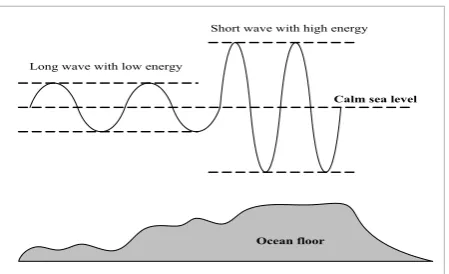
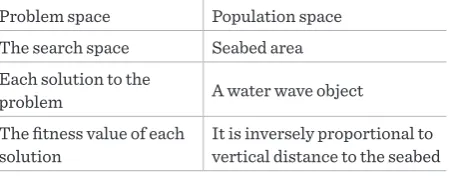
The WWO algorithm is a novel evolutionary algorithm, which mainly simulates the propagation, refraction and breaking operations to find the global optimal solution. For each water wave, it has two important properties: wave height h and wave length λ. They have a close relationship with the fitness value. When a wave travels from deep water (low fitness location) to shallow water (high fitness location), its wave height increases and its wavelength decreases, as illustrated in Figure 1. The correspondence between problem space and population space is shown in Table 1.
Table 1. Correspondence between problem space and population space
Problem space Population space
The search space Seabed area
Each solution to the problem A water wave object
The fitness value of each solution It is inversely proportional to vertical distance to the seabed
Figure 1 Different wave shapes in deep and shallow water
Long wave with low energy
Short wave with high energy
Calm sea level
Table 1
Correspondence between problem space and population space
Problem space Population space The search space Seabed area Each solution to the
problem A water wave object The fitness value of each
solution It is inversely proportional to vertical distance to the seabed portant properties: wave height h and wave length λ. They have a close relationship with the fitness value. When a wave travels from deep water (low fitness loca-tion) to shallow water (high fitness localoca-tion), its wave height increases and its wavelength decreases, as illus-trated in Figure 1. The correspondence between prob-lem space and population space is shown in Table 1.
3.1. Propagation
At each generation, each wave needs to be propagated exactly once. The propagation operator creates a new wave x' by shifting each dimension
d
of the original wave x as) ( ) 1, 1 ( ) ( )
('d x d rand L d
x = + − ⋅λ , (6)
where rand(−11,) is a uniformly distributed random number in the range [−11,], L(d) is the length of d
di-mension search space. If the new position is outside the feasible range, it will be reset to a random position in the range.
When a wave travels from deep water (low fitness location) to shallow water (high fitness location), its wave height increases and its wave length decreases, as illustrated in Figure 1. Thus, after propagation we calculate the fitness of the offspring wave x'.
If f(x′)>f(x), x is replaced by x' in the population, and the wave height of x' is reset to hmax. Otherwise, x is remained, but its height h is decreased by one, which mimics energy dissipation due to inertial re-sistance, vortex shedding, and bottom friction. After each generation, the wave length of each wavex is updated as follows:
) (
) ) (
( min ε max min ε
α
λ
λ
= ⋅ − f x−f + f −f + , (7)where α is the wave length attenuation coefficient of ev-ery water wave, fmin and fmax are minimum and
max-imum fitness values in the entire search space, ε is an infinitesimal positive integer to avoid division-by-zero. 3.2. Breaking
In WWO algorithm, the velocity of the crest exceeds the velocity of the water wave, and the energy of the water wave is increasing. At the same time, the wa-ter wave becomes steeper and steeper, and the wawa-ter wave will break into a series of solitary waves. Once the optimal water wave x* is searched, it will be ex-ecuted by breaking operation. In detail, we randomly select k dimensions (where k is a random number be-tween 1 and kmax), and at each dimension d generate a solitary wave x'. The location update can be given as:
) ( ) 1, 0 ( ) ( )
('d xd N Ld
x = + ⋅β , (8)
where β is the broken wave coefficient and its range is 0.001 to 0.01. If none of the solitary waves are better than x*,x* is remained; Otherwise x* is replaced by the fitness one among the solitary waves.
3.3. Refraction
In wave propagation, if flowing through steep plac-es with deep sea featurplac-es like valleys and mountain, the water wave is not perpendicular to the isobaths, its direction is deflected. The water waves converge in shallow waters and diverge in deep water areas. In order to better simulate the losses of water wave en-ergy, we will reduce the wave height h by one. After multiple propagation operations, the wave height h is reduced to zero, and use a simple way to calculate the position after refraction.
, (9)
where x* is the best solution in the current popu-lation, N(µ,σ) is a Gaussian random number with mean µ and standard deviation σ . The new position is between the original position and the best known position, and the standard deviation σ is equal to the absolute value of their difference. After the refraction operation, the wave height is set to hmax, and at the same time, the wavelength is updated as follows:
)' (
) ( '
x f
x f
λ
Information Technology and Control 2019/1/48 164
The WWO algorithm mainly simulates the dynam-ic motion of water wave and obtains the global opti-mal solution in the search space. The process is from the deep water area to shallow water area. In deep water area, waves have lower fitness values, longer wavelengths, and lower wave heights; in shallow wa-ter area, waves have higher fitness values, shorwa-ter wavelengths, and higher wave heights. The propaga-tion, breaking, and refraction provide a good search mechanism for water wave optimization algorithm. Local search increases the depth of the algorithm and global search increases the breadth of the algorithm. The propagation can make the water wave with a higher fitness value perform local search in a small range, and the water wave with a lower fitness value perform global search in a large range. The breaking turns the optimal water waves into a series of isolat-ed waves, which enhances the dense search near the global optimal solution and improves the calculation accuracy of the algorithm. The refraction can remove the energy-depleted waves, which effectively avoids search stagnation and increases population diversi-ty, generate better waves will replace the poor waves, and it can accelerate the convergence speed of the al-gorithm. The combination of three operations effec-tively balances the global search and local search of the water wave optimization algorithm. The solution procedure is given in Algorithm 1.
Algorithm 1 The solution procedure of the WWO al-gorithm
Input : Define objective function; Output: Global optimal solution x*;
Step 1. Randomly initialize a water wave population Pwith n waves (solutions) that contains parameters
α ,β, and λ;
Step 2. while stop the termination criterion is not satisfied do
Step 3. for each water wavex∈P do
Step 3.1. propagate x to a new x' by using Eq. (6);
Step 3.2. if f(x)'> f(x) then
Step 3.2.1. if f(x)'> f(x*) then Break x' by using Eq. (8); Update x* with x';
Step 3.2.2. Replace x with x' ;
Step 3.3. else Decrease x.h by one; if x.h=0 then
Refract x to a new x' by using Eq. (9) and (10); Step 4. Update the wavelengths by using Eq. (7);
Step 5. return x*.
4. PID Controller Based on the WWO
Algorithm
The PID controller is a linear controller that is used to improve the dynamic response to correct the steady state error. PID controller is applied to the AVR sys-tem to improve the terminal voltage step response. The PID controller transfer function is given as:
s K s K K s U s V d i p e = + +
∆ ) ( ) ( , (11)
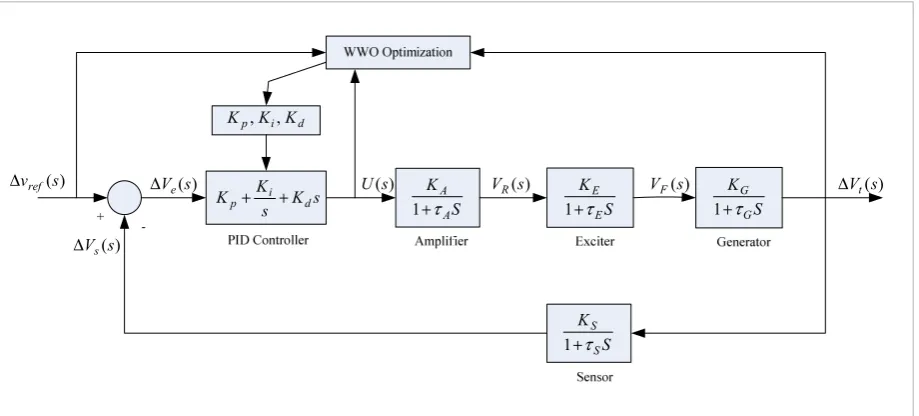
where Kp, Ki, Kd represent the proportional gain, the integral gain and the differential gain, respectively. In order to gain better performance control, the optimal parameters of PID controller are obtained by WWO algorithm. Transfer function model of an AVR system with WWO-PID controllers is given in Figure 2. The maximum overshoot, rise time, steady sate error are used as a typical time domain analysis index. In this paper, the Integral Time multiplied by the Absolute Error (ITAE) is regarded as a perfor-mance indicator in the control design. ITAE is an objective function that contains a time value. ITAE can be given as:
Step 5.return x*.
4. PID Controller Based on the WWO Algorithm
The PID controller is a linear controller that is used to improve the dynamic response to correct the steady state error. PID controller is applied to the AVR system to improve the terminal voltage step response. The PID controller transfer function is given as:
s K s K K s U s V d i p e = + +
∆
) (
)
( , (11)
where Kp, Ki, Kd represent the proportional gain, the integral gain and the differential gain,
respectively.
In order to gain better performance control, the optimal parameters of PID controller are obtained by WWO algorithm. Transfer function model of an AVR system with WWO-PID controllers is given in Figure 2. The maximum overshoot, rise time, steady sate error are used as a typical time domain analysis index. In this paper, the Integral Time multiplied by the Absolute Error (ITAE) is regarded as a performance indicator in the control design. ITAE is an objective function that contains a time value. ITAE can be given as:
ITAE=
∫
0ttVt−Vrefdt, (12)where t is the simulation time, Vt is the terminal voltage and Vref is the reference voltage.
WWO Optimization S K A A τ + 1 S K E E τ + 1 S K G G τ + 1 S K S S τ + 1 s K s K Kp+ i+ d
d i p K K K , ,
PID Controller Amplifier Exciter Generator
Sensor + -) (s VR ) (s vref
∆ ∆Ve(s) U(s) VF(s) ∆Vt(s)
) (s Vs
∆
Figure 2 Transfer function model of an AVR system with WWO-PID controllers
The WWO algorithm has a strong global search ability, which can find the optimal control variables (Kp,Ki,Kd) and the global optimal solution. The lower and upper bounds of the three controller parameters are given in Table 2. The correspondence between the problem space and WWO algorithm space is shown in Table 3.
Table 2 Range of three controller parameters
Controller parameters Min. value Max. value
(12)
where t is the simulation time, Vt is the terminal
voltage and Vref is the reference voltage.
The WWO algorithm has a strong global search abili-ty, which can find the optimal control variables (Kp,
i
The flowchart of parameters tuning of PID using WWO algorithm is depicted in Figure 3 and the solu-tion procedure in AVR system is given in Algorithm 2.
Figure 2
Transfer function model of an AVR system with WWO-PID controllers
S K
A A
1 S
K E E
1 S
K G G
1
S K
S S
1 s
K s K
K i d
p d i p K K K , ,
) (s VR )
(s vref
Ve(s) U(s) VF(s) Vt(s)
) (s Vs
Table 2
Range of three controller parameters
Controller parameters Min. value Max. value
p
K 0 1.5
i
K 0 1.0
d
K 0 1.0
Table 3
Correspondence between ORPD and WWO
The problem space The WWO algorithm space
A collection contains all the optimization schemes
) ,..., ,
(x1 x2 xk to optimize the PID controller parameters in AVR system
A water wave population P with (n1,n2,...,nk) waves
An optimal optimization scheme that obtains proportional gain Kp, the integral gain Ki and the differential gain Kd.
An optimal water wave
Information Technology and Control 2019/1/48 166
Algorithm 2The solution procedure in AVR system
Step 1. Determine the parameters of the AVR system, proportional gainKp, the integral gain Ki and the dif-ferential gainKd;
Step 2. Randomly initialize a population Pof n waves (solutions),iter=0, the wave length reduction coeffi-cient α , the breaking coefficientβ, the wave length λ, and the maximum number itermax, ;
Step 3. Specify the lower and upper bounds on the three controller parameters, for each water wave, apply PID controller with gains specified by that water wave to AVR system and run the whole system steps, calculate the fitness value of each water wave by Eq. (12);
Step 4. Find out the optimal water wave While stop criterion is not satisfied do Step 5. for each wave x∈P do
Step 5.1. Propagate water wave x to a new wave x' by Eq. (6). Step 5.2. if f(x)'> f(x) then
Step 5.2.1.if
p
K 0 1.5
i
K 0 1.0
d
K 0 1.0
Table 3 Correspondence between ORPD and WWO
The problem space The WWO algorithm space
A collection contains all the optimization schemes (x1,x2,...,xk) to optimize the PID controller parameters in AVR system
A water wave population Pwith (n1,n2,...,nk) waves
An optimal optimization scheme that obtains proportional gainKp, the integral gain Ki
and the differential gainKd.
An optimal water wave
The objective evaluation function ITAE The fitness function of the WWO algorithm
The flowchart of parameters tuning of PID using WWO algorithm is depicted in Figure 3 and the solution procedure in AVR system is given in Algorithm 2.
Algorithm 2 The solution procedure in AVR system
Step 1. Determine the parameters of the AVR system, proportional gainKp, the integral gain Ki
and the differential gainKd;
Step 2. Randomly initialize a population Pof n waves (solutions),iter=0, the wave length reduction coefficient α , the breaking coefficientβ, the wave length λ, and the maximum number
max
iter , ;
Step 3. Specify the lower and upper bounds on the three controller parameters, for each water wave, apply PID controller with gains specified by that water wave to AVR system and run the whole system steps, calculate the fitness value of each water wave by Eq. (12);
Step 4. Find out the optimal water wave While stop criterion is not satisfied do Step 5. for each wave x∈P do
Step 5.1. Propagate water wave x to a new wave x' by Eq. (6). Step 5.2. if f(x)'> f(x) then
Step 5.2.1.if f(x)'> f(x*),then break water wave x' by Eq. (8), the current optimal
wave x* will be replaced by water wave x'.
Step 5.2.2. The original water wave x is replaced by the new water wave x' in the population.
Step 5.3.else, wave height h of wave xis reduced by one, which indicates energy consumption.
If x.h=0, then the wave x will perform refraction operation according to Eq.(9) and (10).
Step 5.4. Update the wavelength of all water waves according to Eq. (7).
Step 6. calculate the fitness function of each water wave by Eq. (12);
Step 7. Set iter=iter+1for the iteration control. If iter<itermax, go to Step 5. Step 8. Output the best solution and an optimal controller parameters.
, then break water wave x' by Eq. (8), the current optimal wave x* will be re-placed by water wave x'.
Step 5.2.2. The original water wave x is replaced by the new water wave x' in the population.
Step 5.3.else, wave height h of wave xis reduced by one, which indicates energy consumption. If x.h=0, then the wave x will perform refraction operation according to Eq.(9) and (10).
Step 5.4. Update the wavelength of all water waves according to Eq. (7). Step 6. calculate the fitness function of each water wave by Eq. (12);
Step 7. Set iter=iter+1for the iteration control. If iter<itermax, go to Step 5. Step 8. Output the best solution and an optimal controller parameters.
5. Experiment Results and Analysis
This section mainly contains two important contents: Subsection 5.1 simply introduces the experimental setup; Subsection 5.2 minutely expounds the WWO algorithm to optimize PID controller parameters in the AVR system.
5.1. Experimental Setup
All of the algorithms were programmed in MATLAB R2012a, and numerical experiment was set up on AMD Athlont (tm) II*4640 processor and 4 GB mem-ory.
5.2. WWO Algorithm to Optimize PID Controller Parameters
The WWO algorithm is applied to optimize the PID controller for an AVR system, which finds a set of
op-timal gains that minimize the value of the objective function. In order to better prove the superiority of the WWO algorithm, we compare the WWO [20] with other algorithms which include BA [23], CSA [1], FPA [24], PSO [7] and SCA [12]. The result indicates the WWO algorithm obtains better performance. The important parameters of all algorithms are given in Table 4.
Table 4
Important parameters of six algorithms
Algorithms Parameter values
BA A = 0.25, r = 0.5, f ∈[0, 2], the population size is 50. CSA r ∈[0, 1], fl = 2, aAP = 0.1, the population size is 50. FPA ρ=0.8, the population size is 50.
PSO c1=1.4962, c2=1.4962, ω=0.7298, the population size is 50. SCA r2∈[0,2π],a=2, r4∈[01,], the population size is 50.
WWO λ=0.5, hmax =6, α=1.0026, β∈[0.01, 0.25], kmax = min(12, D/2), the population size is 50.
Table 5
Parameters used in the six algorithms
Control variables BA CSA FPA PSO SCA WWO
Kp 1.2397 1.2963 1.4117 1.2257 1.2517 1.2299
Ki 0.8581 0.6275 0.9743 0.8437 0.8609 0.8474
Kd 0.3946 0.2341 0.4561 0.3938 0.3986 0.3921
Peak amplitude (V) 0.871 1.152 1.164 1.136 1.121 1.128
Settling time (sec) 1.630 1.425 1.920 0.900 0.910 0.900
Rise time (sec) 0.325 0.245 0.200 0.205 0.210 0.190
Best 0.0328 0.0329 0.0330 0.0328 0.0328 0.0327
Worst 0.0395 0.0372 0.0380 0.0409 0.0382 0.0361
Mean 0.0339 0.0344 0.0341 0.0346 0.0344 0.0337
Std 0.0019 0.0012 0.0013 0.0021 0.0015 7.8242e-04
Rank 5 2 3 6 4 1
0 0.2 0.4 0.6 0.8 1 1.2 1.4 1.6 1.8 2
0 0.2 0.4 0.6 0.8 1 1.2 1.4
Time (seconds)
T
er
m
inal
v
ol
tage
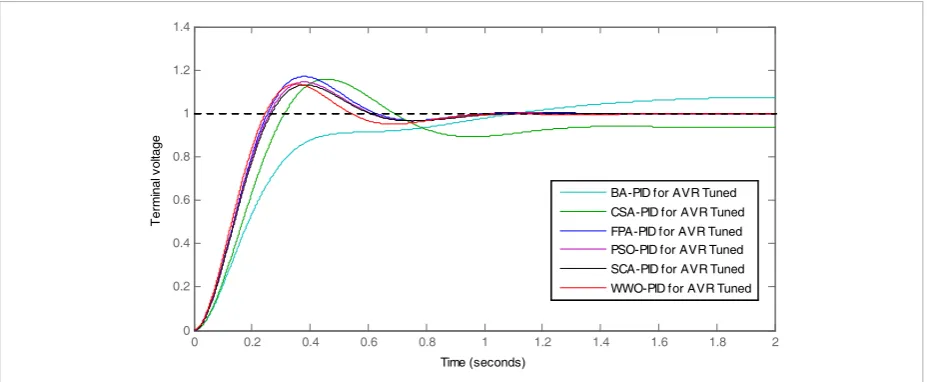
BA-PID for AVR Tuned CSA-PID for AVR Tuned FPA-PID for AVR Tuned PSO-PID for AVR Tuned SCA-PID for AVR Tuned WWO-PID for AVR Tuned
Figure 3
Information Technology and Control 2019/1/48 168
Figure 4
Evolution curves of fitness value
2 4 6 8 10 12 14 16 18 20
0.032 0.034 0.036 0.038 0.04 0.042 0.044 0.046 0.048 0.05
Iterations
Fi
tnes
s F
unc
tion V
al
ue
BA CSA FPA PSO SCA WWO
BA CSA FPA PSO SCA WWO
0.033 0.034 0.035 0.036 0.037 0.038 0.039 0.04 0.041
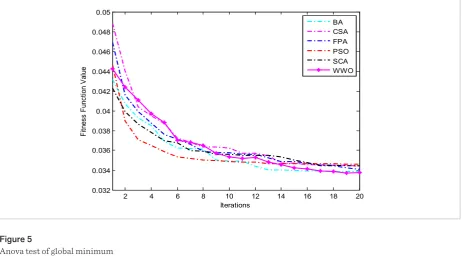
As can be seen in Table 5, the WWO algorithm has a strong global search and local search capability, which can find the optimal parameters of PID controller and global solution. The WWO algorithm could accelerate the convergence speed and improve the calculation ac-curacy. The robustness of PID controller is verified by the WWO algorithm to improve the step transient response of the AVR system of a generator. Compared with other
algorithms, the peak amplitude, settling time and rise time of the WWO algorithm are better. The WWO al-gorithm can find the optimal fitness value, worst fitness value, mean fitness value and standard deviation. This indicates that the WWO algorithm is mainly utilized to determine three optimal AVR system parameters. The controller system could obtain on optimal solution, which demonstrates the efficiency of the PID controller.
Figure 5
BA CSA FPA PSO SCA WWO 0
20 40 60 80 100 120 140
algorithm
Ti
m
e E
xec
ut
ion (
Sec
onds
)
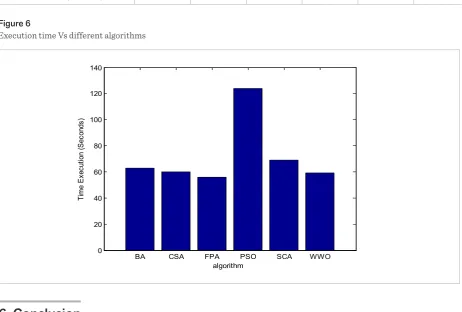
Figure 6
Execution time Vs different algorithms Table 6
Execution time of different algorithms
Algorithm BA CSA FPA PSO SCA WWO
Time execution (Seconds) 63 60 56 124 69 59
As can be seenin Figures 4-5, the WWO algorithm has a strong global search capability. Although the con-vergence speed of the WWO algorithm is not faster, the calculation accuracy of the WWO algorithm is the best among the six algorithms. The WWO algorithm is used to optimize the PID controller parameters in AVR system, which has a good application prospect. The WWO algorithm obtains the optimal gain param-eters, so that it finds the optimal fitness value. This indicates that the WWO algorithm can better balance the exploration and the exploitation. Compared with other algorithms containing BA, CSA, FPA, PSO and SCA, the standard deviation of the WWO algorithm is
much better, which indicates that the robustness and stability is stable. Generally speaking, the overall per-formance of the WWO algorithm is superior to that of other algorithms.
All the algorithms are applied to solve the PID con-troller parameter optimization, aiming to find the global optimal solution. Each algorithm runs inde-pendently 20 times, independent execution time is given in Table 6. Compared with other algorithms, the independent running time of the WWO algorithm is relatively small. The execution time of different algo-rithms can be seen in Figure 6.
6. Conclusion
In this paper, the WWO algorithm is used to deter-mine the parameters of the PID controller for an AVR system. The WWO algorithm contains propagation operation, breaking operation and refraction
algo-Information Technology and Control 2019/1/48 170
rithm could not only find the optimal controller gains and the best fitness value, but also the standard devia-tion is the smallest. In order to expand the applicadevia-tion area of the water wave optimization algorithm, future researches will be applied to the medical field, such as medical image segmentation, cardiac diagnosis, phar-macokinetics, and fault diagnosis.
Acknowledgments
This work was supported by the National Science Foundation of China under Grant Nos. 61563008, and Project of the Guangxi Natural Science Foun-dation under Grants No. 2016GXNSFAA380264. 2018GXNSFAA138146.
References
1. Askarzadeh, A. A Novel Metaheuristic Method for Solving Constrained Engineering Optimization Pro-blems: Crow Search Algorithm. Computers and Struc-tures, 2016, 169, 1-12. https://doi.org/10.1016/j.comps-truc.2016.03.001
2. Chatterjee, S., Mukherjee, V. PID Controller for Au-tomatic Voltage Regulator Using Teaching–learning Based Optimization Technique. International Journal of Electrical Power and Energy Systems, 2016, 77, 418-429. https://doi.org/10.1016/j.ijepes.2015.11.010 3. Gaing, Z. L. A particle Swarm Optimization Approach
for Optimum Design of PID Controller in AVR System. IEEE Transactions on Energy Conversion, 2004, 19(2), 384-391. https://doi.org/10.1109/TEC.2003.821821 4. Gozde, H., M. C. Taplamacioglu. Comparative
Perfor-mance Analysis of Artificial Bee Colony Algorithm for Automatic Voltage Regulator (AVR) System. Journal of the Franklin Institute, 2011, 348(8), 1927-1946. https:// doi.org/10.1016/j.jfranklin.2011.05.012
5. Hasanien, H. M. Design Optimization of PID Controller in Automatic Voltage Regulator System Using Taguchi Combined Denetic Algorithm Method. IEEE Systems Journal, 2013, 7(4), 825-831.https://doi.org/10.1109/ JSYST.2012.2219912
6. Hematabadi, A. A., Foroud, A. A. Optimizing the Mul-ti-objective Bidding Strategy Using Min–Max Tech-nique and Modified Water Wave Optimization Method. Neural Computing & Applications, 2018, 6, 1-19. https:// doi.org/10.1007/s00521-018-3361-0
7. Kennedy, J., Eberhart, R. Particle Swarm Optimizati-on. IEEE International Conference on Neural Ne-tworks, 1995, 4(8), 1942-1948. https://doi.org/10. 1109/ ICNN.1995.488968
8. Kilany, M., Hassanien, A. E., Badr, A. Accelerometer-Ba-sed Human Activity Classification Using Water Wave Optimization Approach. Computer Engineering Con-ference, 2016, 175-180. https://doi.org/10.1109.ICEN-CO.2015.7416344
9. Lakshminarasimman, L., Siva, M., Balamurugan, R. Water Wave Optimization Algorithm for Solving Mul-ti-Area Economic Dispatch Problem. International Journal of Computer Applications, 2017, 167(5), 19-27. https://doi.org/10.5120/ijca2017914247
10. Lenin, K., Ravindhranath Reddy, B., Suryakalavathi, M. Hybridization of Firefly and Water Wave Algorithm for Solving Reactive Power Problem. International Journal of Engineering Research in Africa, 2015, 21, 165-171. https:// doi.org/10.4028/www.scientific.net/JERA.21.165 11. Li, C., Li, H., Kou, P. Piecewise Function Based
Gravi-tational Search Algorithm and Its Application on Para-meter Identification of AVR System. Neurocomputing, 2014, 124(2), 139-148. https://doi.org/10.1016/j.neu-com.2013.07.018
12. Mirjalili, S. SCA: A Sine Cosine Algorithm for Solving Op-timization Problems. Knowledge-Based Systems, 2016, 96, 120-133. https://doi.org/10. 1016/j.knosys.2015.12.022 13. Mitsukura, Y., Yamamoto, T., Kaneda, M. A Design of
Self-Tuning PID Controllers Using a Genetic Algori-thm. American Control Conference, 1999, 36(1), 1361-1365. https://doi.org/10.1109/ACC.1999.783590 14. Odili, J. B., Mohmad, M. K., Noraziah, A.
Parameters-Tu-ning of PID Controller for Automatic Voltage Regula-tors Using the African Buffalo Optimization: Plos One, 2017, 12(4), e0175901. https://doi.org/10.1371/journal. pone.0175901
15. Ota, T., Omatu, S. Tuning of the PID Control Gains by GA. Emerging Technologies and Factory Auto-mation, 1996, 1(1), 272-274. https://doi.org/10.1109/ ETFA.1996.573305
17. Siva, M., Balamurugan, R., Lakshminarasimman, L. Water Wave Optimization Algorithm for Solving Eco-nomic Dispatch Problems with Generator Constraints. International Journal of Intelligent Engineering & Systems, 2016, 9(4), 31-40. https://doi.org/10.22266/ ijies2016.1231.04
18. Siva, M., Balamurugan, R., Lakshminarasimman, L. Water Wave Optimization Algorithm for Solving Com-bined Economic And Emission Dispatch Problem. Jo-urnal of Engineering & Applied Sciences, 2016, 12(6), 1730-1741. https://www.researchgate./net/publicati-on/316595942
19. Tang, Y., Zhao, L., Han, Z., Bi, X., Guang, X. Optimal Gray PID Controller Design for Automatic Voltage Regulator System via Imperialist Competitive Algorithm. Inter-national Journal of Machine Learning and Cybernetics, 2016, 7(2), 229-240. https://doi.org/10.1007/s13042-015-0431-9
20. Wu, X., Zhou, Y., Lu, Y. Elite Opposition-Based Water Wave Optimization Algorithm for Global Optimization. Mathematical Problems in Engineering, 2017, 2017(11), 1-25. https://doi.org/10.1155/2017/3498363
21. Wu, X.-B., Liao, J., Wang, Z.-C. Water Wave Optimizati-on for the Traveling Salesman Problem. InternatiOptimizati-onal Conference on Intelligent Computing, 2015, 9225, 137-146. https://doi.org/10.1007/978-3-3-319-22180-9_14 22. Wang, S., Xu, Y., Pen, Y. A Fast Image Match Method
Ba-sed on Water Wave Optimization and Gray Relational Analysis. IEEE International Conference on Intelligent
Data Acquisition and Advanced Computing Systems: Technology and Applications, 2017, 771-776.https://doi. org/10.1109/IDAACS.2017.8095193
23. Yang, X., He, X. Bat Algorithm: Literature Review and Applications. International Journal of Bio-Ins-pired Computation, 2013, 5(3), 141-149. https://doi. org/10.1504/IJBIC.2013.055093
24. Yang, X. Flower Pollination Algorithm for Global Optimi-zation. Unconventional Computation and Natural Com-putation. Springer Berlin Heidelberg, 2012, 7445(2), 242-243. https://doi.org/10.1007/978-3-642-32894-7_27 25. Yun, X., Feng, X., Lyu, X. A Novel Water Wave
Optimi-zation Based Memetic Algorithm for Flow-Shop Sche-duling. 2016 IEEE Congress on Evolutionary Compu-tation (CEC), 2016, 1971-1976. https://doi.org/10.1109/ CEC.2016.7744029
26. Zhang, J., Zhou, Y., Luo, Q. An Improved Sine Cosine Water Wave Optimization Algorithm for Global Opti-mization. Journal of Intelligent & Fuzzy Systems, 2018, 34(4), 2129-2141. https://doi.org/10.3233/JIFS-171001 27. Zhao, S., Li, Z., Yun, X., Wang, K., Lyu, X., Liu, B. IIR Fil-ters Designing by Water Wave Optimization. IEEE In-ternational Conference on Control & Automation, 2017, 347-352. https://doi.org/10.1109/ICCA.2017.8003085 28. Zheng, Y. Water Wave Optimization: A New