University of New Orleans University of New Orleans
ScholarWorks@UNO
ScholarWorks@UNO
University of New Orleans Theses and
Dissertations Dissertations and Theses
5-16-2008
Lived In
Lived In
Laura Gipson
University of New Orleans
Follow this and additional works at: https://scholarworks.uno.edu/td
Recommended Citation Recommended Citation
Gipson, Laura, "Lived In" (2008). University of New Orleans Theses and Dissertations. 676.
https://scholarworks.uno.edu/td/676
This Thesis is protected by copyright and/or related rights. It has been brought to you by ScholarWorks@UNO with permission from the rights-holder(s). You are free to use this Thesis in any way that is permitted by the copyright and related rights legislation that applies to your use. For other uses you need to obtain permission from the rights-holder(s) directly, unless additional rights are indicated by a Creative Commons license in the record and/or on the work itself.
Lived In
A Thesis
Submitted to the Graduate Faculty of the University of New Orleans in partial fulfillment of the requirements for the degree of
Master of Fine Arts in
Fine Arts
by
Laura Brenholtz Gipson
B.A. University of New Orleans, 2004
ACKNOWLEDGEMENT
I would like to thank the faculty, staff and my fellow students in the Fine Arts Department. I
would especially like to thank Christopher Saucedo, Cheryl Hayes and Lawrence Jenkens, for
their support and insight. I would also like to thank my family for their love and encouragement,
especially my husband Ralph. Finally I would like to acknowledge my parents, George and
TABLE OF CONTENTS
List of Illustrations... iv
Abstract ... v
Introduction ... 1
Rocket Ships... 2
Houses ... 5
Dresses ... 13
Crows ... 20
Monotypes ... 22
Conclusion... 24
Bibliography ... 26
LIST OF ILLUSTRATIONS
Figure 1: Not by the Hair of My Chinni-Chin-Chin... 3
Figure 2: Here on the Outskirts of Memory ...7
Figure 3: One Thing Leads to Another...9
Figure 4: Stitch House...11
Figure 5: Ladder ...14
Figure 6: Setting Her Troubles Adrift ...16
Figure 7: Shed...19
Figure 8: Trouble ...20
ABSTRACT
This thesis is a description and analysis of work that I produced during my Gradate
studies at the University of New Orleans. The central theme of these works is the common
human experience of inner dialogue, an interior experience. Through prints and sculpture I
produce stand-ins for the body. These objects are meant to invite the viewer to sense
recognizable human traits and to experience the works as having been ‘lived in’.
INTRODUCTION
My work is about those things we carry with us. I call upon common human experiences
that we all share. I make objects that explore the inner, invisible experience and I attempt to
make that experience visible. Through sculpture and printmaking I objectify the common
experience of inner dialogue: private thinking. As we will see, these works function as stand-ins
for the body and the mind.
This concept of making stand-ins began somewhat subconsciously in my undergraduate
work as each sculpture would gradually take on a personality and a grouping of sculptures
would become a family. When I returned to school in 2001, to finish the undergraduate work
that I put on hold twenty years earlier, I came back with tremendously more life experience
and a variety of skills. Sculpture was a natural fit for me. Construction skills I learned along
the way would come to inform my work process. This is reflected in both my sculptural work
and in my printmaking. I use an additive process to build my sculptures, starting with an
interior bone structure that supports an exterior skin. I feel that this construction technique is
important to the work, in that it connects the object conceptually to the human body.
Additionally, the armature is often visible and this allows my work process of bones and skin
to be evident in the finished work. What began as a logical method of working became
important to the concept of having the sculptures function as stand-ins. My prints are also
constructed; layer upon layer, built up in order to create a scarred surface that acknowledges
that this object has a history. I take pleasure in using working methods that seem like organic,
integral, logical extensions to other aspects of my life.
I produce familiar objects, utilizing common construction techniques, sometimes pulling
my everyday life experiences but also the impact of a few hero artists. I was introduced to the
artist Robert Stackhouse and his work at the Corcoran School of Art, early in my
undergraduate studies. Viewing slides of his then current work, the A-frame structures, had a
galvanizing effect on my work; in that, his use of the lowly lath as an art material was eye
opening. Many of my sculptures are constructed with this common material. My choices for
sculptural materials were expanded from this experience. Later, an image of Martin Puryear’s
Ladder for Booker T. Washington led me to seek out his work. I was attracted to his quiet
enigmatic sculptures. Both of these artists had an impact on my work and my thinking. Here
was work that wasn’t cast or carved; it was constructed. Other artists I began to look at were
Kiki Smith and Louise Bourgeois. They use their own experiences for source material; they
also invest a sense of magic into commonplace objects and they are not beyond using modest
materials. Their work motivated me to look to my own life and my own surroundings for
inspiration.
In this thesis I will focus on sculptures that can be categorized into four areas: the rocket
ships, the houses, the crows and the dresses. I will also discuss a series of monotypes that act
as supportive material for my sculptural work. The monotypes speak to the experience of inner
dialogue and how that is expressed as a bodily experience.
ROCKET SHIPS
The first work that I constructed in graduate school is a group of sculptures entitled, Not
by the Hair of My Chinni-Chin-Chin (figure 1). This work is a trio of rocket ships; one built of
straw, one of wood and one of bricks. All are approximately eighteen inches high. The straw
rocket ship was constructed by affixing straw to an inner post using twine. Subsequent layers
of this rocket is a wiry mass of straw that is randomly wrapped into place with coarse twine.
The next rocket was built with a thin skin of basswood around a skeletal inner structure. The
outer skin is a series of smooth wooden panels that are held together with tiny wooden pegs.
This configuration closely resembles a sheet metal and rivet assembly. Finally, the brick rocket
was constructed with hundreds of tiny curved bricks that I built by hand. The bricks were then
mortared to a Styrofoam core. I was interested in exploring the building techniques that it
would take to realize this project but I was also interested in the conflation of two narratives.
Not by the Hair of My Chinni-Chin-Chin combines the fairy tale of The Three Pigs and cartoon
imagery of space travel. The small rocket ships all have the bulbous, ponderous look of
imagined space ships.
This project has connections to concepts and techniques that became integral to my work.
The rockets are built of an interior structure that I began to think of as the bones of the work
and connected to that core structure is the surface or skin of the piece. As I stressed earlier, the
structure of the work became a way for me to connect to the concept of the body.
The conflation of the three pigs and rocket ships seemed like a one-liner that could
provoke humor or cause the viewer to internalize a twist in the well-known fairy tale. Bruno
Bettelheim contends in his book The Uses of Enchantment, that in fairy tales, the “internal
processes are externalized”.1 He contends that the three pigs represent one individual in three
stages of development and suggests that this is evident through the similar answers given by
each pig, “Not by the hair of my chinni-chin-chin”.2 Bettelheim states that fairy tales do not so
much provide “useful information about the external world”, but that they are more
informative about the “inner processes taking place in an individual”.3 As we will see, this
concept of the “inner process of an individual” became an important idea to my work. When
Not by the Hair of My Chinni-chin-chin was begun, I was more interested in the rocket ships as
vessels, albeit unlikely vessels. This is because; as I have gotten older I have been able to
consider the human body as a vessel that is full of fallibility and imperfection, a vessel that
holds our thoughts and longings. I was considering exploring the vessel as possible metaphor
for the body and Not by the Hair of My Chinni-chin-chin laid the groundwork for work to
come. Time and a hurricane changed my trajectory from vessels that transport to vessels that
house.
1 Brono Bettlheim, The Uses of Enchantment (New York: Alfred Knopf, 1976) 25. 2 Bettelheim 45.
HOUSES
In 2004, during my undergraduate work, I began to use house imagery in my work. I
believe this came from relating to and reacting against my connection to house, as in
housewife. Years of raising children had embedded the concept of house and home as a large
part of my identity. With the aftermath of Hurricane Katrina I returned to the house imagery.
Traversing the lonesome, damaged landscape of the Lakefront after the storm, one could not
help but see the empty houses as stand-ins for those not present. From here the concept of
stand-ins really took hold in my work.
The first houses were small pedestal sized pieces constructed of lath that had been
collected from storm debris. I was interested in using lath as my material for several reasons.
First, as I stated earlier, I had been exposed to the use of lath as an art material in Robert
Stackhouse’s A-frame structures. Additionally, I was particularly drawn to the beauty of the
cypress lath used as building material in South Louisiana homes; it has such rich tones of
brown and the texture varies form piece to piece revealing marks from its milling. It intrigued
me that this material had been buried within the walls homes for decades.
In researching the work of Rachel Whiteread, I was taken by her idea that a building
could hold memories. As Whiteread worked on Ghost, a concrete cast of a living room, she
questioned whether the activities of life that had gone on in the room could have become
captured in the material structure of that room. 4I became enchanted with the thought that the
lath I was using could have become embedded with the smells, the sounds and the essence of
what had transpired during its entombment within the walls of a house; that the wood could
hold memories of its history. This notion that the materials could hold memories wedded well
with my concept of the work as stand-ins.
Lath, a common material, keeps my sculptures in the realm of the everyday. I am
reminded of James Agee’s call for “the use of the most humble materials to create a lyrical
poetry of everyday experience”.5 Also, lath was a ubiquitous presence outside of gutted homes
following Katrina and this brings up another consideration; using storm debris as an art
material somehow links these works to that time and place in our city’s history. This
connection may be lost on an audience outside of New Orleans but I don’t think that lessens
the work in any way. My final thought about lath has to do with how it functions conceptually
in my work. Lath is the foundational structure that supports the surface skin of plaster walls; it
is the invisible yet vital layer. I use this traditionally interior material as the exteriors of my
work. The work operates conceptually in much the same way. I bring the private interior
processes of an individual to the light of day.
The first houses that I constructed were each approximately 6”x11”x20” and resemble the
shape of a New Orleans shotgun house. These works were experiments and precursors to the
larger houses that came later. Solid House, a solid block of lath is cut into the shape of a long
shotgun house. The long sides of the house reveal stratified layers of lath and the short sides
reveal the stacked ends of the lath. The surface was covered with black encaustic wax that was
then scrapped clean, essentially leaving only the accentuated blackened scars of the surface. I
am interested in having the surface of the work reveal its past and its imperfections. Stitch
House is a work that is later revisited and reworked. In its first form, Stitch House was a small
hollow shell constructed of rectangular rings of lath. Each layer is held one to the other by
hundreds of twisted wire stitches. As we will see, this house retained its footprint but increased
in height. I will discuss this piece in its larger form later on.
Following the small houses, I started work on a house that approximates the length of my
own body, Here on the Outskirts of Memory (figure 2). The scale of this piece became
important to me because of its status as a stand-in. Like the previous houses, itis also
constructed of lath although this structure is more cage-like and encourages the viewer to peer
into the interior.
The house makes an angle toward the right about two thirds of the way towards the back
of the sculpture. Gradually the structure sinks as it proceeds from front to back. Perched within
the sculpture are eight crow decoys that have a dusty white patina. They seem like mysterious
sentinels. There are two small, screened windows at either end of the piece where one can get
an unobstructed glimpse of the interior.
The impulse to make this piece came from reading the poem, The Reconstruction of the
Fictive Space, by Eric Pankey.6 There is a stanza containing a line that resonated with me.
“…But the way, lit by foxfire and firefly, By the flint-flash of grit at the pearl’s heart, Is a past words cannot return to history, To what the swallows inscribe on the air,
And here, on the outskirts of memory, (emphasis added) I look off again into that distance, …”
Given the context of my travels through post-Katrina lakefront and Gentilly, the concept of
memory had become important. All that was salvageable for some in New Orleans was their
memories. Eric Pankey’s poem created a question about the experience of memory. Memory is
similar to “what the swallows inscribe on the air” but is it a place? Could it have outskirts?
Memory is sometimes tricky because it is dimly lit and fragile. Gaston Bachelard states that the
house is the place where thoughts, memories and dreams are integrated.7 The house is an object
that holds memories, like the body.
Here on the Outskirts of Memory became a work about the internal process of memory.
The word “outskirts” had triggered me. If there is a place where memory lives and there is an
outskirts, some distance from the center of this memory/place, then it must surely be almost
forgotten. I set out to objectify a space where memory is concretized but faded. The cage-like
6 Eric Pankey, Oracle Figures (Keene: Ausble Press, 2003) 1.
façade of the piece represents the permeable yet enclosed nature of memory and the work’s
derelict aesthetic represents its imperfections. The sinking posture of the sculpture is more of a
physical representation of the inner dialogue that comes from the tendency one has to be
overwhelmed by events or self-doubt. I chose the crow decoys as a signifier of the deceptive
nature of distant memories but crows come with the additional baggage of myth and folklore.
Some of these stories made my choice of the crow seem appropriate. In Greek and Native
American cultures, the crow was portrayed as a “clever liar”. 8The additional layer of myth
reinforces the decoy’s function as a deceiver.
Figure 3: One Thing Leads to Another, 2007. 56"x19"x8".
8 John M. Marzluff, In the Company of Crows and Ravens (New Haven: Yale University Press,
The next house, On Thing Leads to Another (figure 3), is a shotgun-shaped house made
of blackened lath. The roof of the house is propped open and the viewer can see the interior attic
space of the house. It contains a collection of found school compasses and carpenter’s dividers of
various sizes. The dividers and compasses are in upright anthropomorphic poses. The school
compasses include found pencils of different colors and conditions. Some of the pencils are
indented with the anxious or bored bites of the previous owners. There are four small,
functioning wheels at the base of the sculpture that imply the possibility of movement or
animation. The piece’s vertical measurement is about the height of a small child; scale was
important in order to convey the idea of a human presence.
This piece personifies a restless, discursive mind. I chose to use compasses and
dividers to aid in this illustration. These instruments serve several functions in the world: as
devices of measurement, to describe a boundary, or to circumscribe a circle. In this piece, they
are arranged in such a way as to imply an activity of some kind. They could be dancing, fighting
or possibly in the midst of an escape. Their anthropomorphic, creature-like appearance
contributes to the idea that there could be an activity going on. They could be taking part in
inscribing arcs and circles in the crammed attic space, where I have geographically located the
“mind” of the house. The multiplicity of arcs and circles that could be inscribed by the
compass-creatures would create many intersecting points. Those intersections represent the pattern of one
thought leading to another, or, in other words, the interconnected nature of thoughts. In the
physical sense, the intersections represent neural connections.
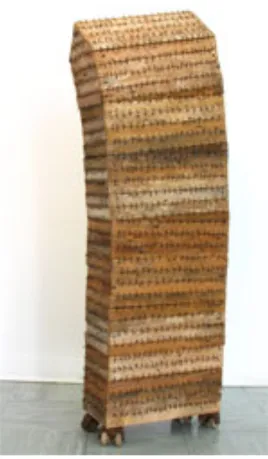
Stitch House (figure 4)was in its earliest form a small pedestal size sculpture that I have
since revisited. It has several similarities to One Thing Leads to Another. It is also the size of a
house, although not in height. It was built by vertically stacking, one on top of the next,
rectangular rings of lath. Each layer is held tightly to the next by hundreds of wire stitches that
are poked through holes, which ring the edges of each layer. The posture of the sculpture is
slightly bent, as if from the waist. This posture along with the scale gives this piece a human
presence.
I see Stitch House as an individual that is displaying an interior process on the exterior.
It represents a public display of private anxious thoughts. The wire stitches protrude from the
wooden surface and create a secondary surface that is an aura of uneasy jittery lines and sharp
points. This secondary surface portrays a nervous energy and it also functions to keep others at a
distance. Furthermore, the tight stitches display an overly cautious behavior. The activity of
repeatedly twisting wire stitches in order to secure one layer of lath to the next displays a certain
lack of trust in that system. Stitch House can’t possibly need so many connecting elements to
keep it upright. Somewhere along the line a sense of security has been lost for this individual.
That loss is further underscored by the sculpture’s bent posture that could imply a figure under a
burden, in contemplation or bearing up under the weight of time and memory.
The concept of bringing an interior behavior to the surface brings to mind the
physically and mentally challenged subjects in the photographs of Diane Arbus. Their flaws were
apparent on the surface.9 The narrative surrounding Stitch House is also about flaws, those that
generally remain submerged as a private process, not normally so visible on the surface. I am
also reminded of Jackie Winsor’s Nail Piece, in which she pounded together an eight-inch stack
of lumber using thousands of nails. Like Nail Piece, Stitch House reveals an activity that is both
ritualistic and obsessive.10
I see the series of houses as a group of individuals. They display human characteristics
through scale and through narratives that reflect a connection to the human condition. They
“house” just as a body houses us as individuals. This concept led me to use the house as a
9 Judith Goldman, “ Diane Arbus: The Gap Between Intention and Effect,” Art Journal, Vol. 34,
No. 1(Autumn 1974), 30-35.
metaphor but I began to feel that my work needed a more direct way to represent the body itself
and its inner life. I began work on a series of dresses.
DRESSES
Dresses have been subject matter for artists since the mid 1960s. The use of the dress as a
subject speaks to the experience of being female in society. I realize that my decision to use
dresses as stand-ins for the body carries baggage of the feminine experience, although I feel that
the concepts I am exploring speak more to the human experience. In the three pieces I will
discuss, I am investigating concepts of transcendence from the habitual, the experience of letting
go and the possibility of change. I don’t think of these concepts as uniquely feminine; I think of
them as uniquely human. The statements of artist Mira Schor resonate with me when she speaks
of femininity as being “…intriguing yet alien to (her) sense of self”. Further, she states that
femininity, “…is a role and costume that women are allowed, indeed encouraged, to put on and
take off, to ‘change’ throughout their lives”.11 This idea of costume as identity is germane to both
the sexes. I’m aware that the dress series has feminine leanings that come through not only in the
choice of the dress but also in some of my work methods that imply handwork or women’s work.
Each of the trio of dresses has a woven superstructure of wire. Also, I use a patchwork surface on
two of the dresses and a sewn surface of cloth on the third. Many of my materials come from the
hardware store and I feel that my use of nontraditional materials helps the work to read as
sculpture first and as dress second.
11 Nina Felshin, “Women’s Work: A Lineage, 1966-94,” Art Journal, Vol.54, No.1 (Spring
Figure 5: Ladder, 2007. 42"x25"22".
The first dress, Ladder (figure 5), is fashioned after a homemade dress form. All of
the dresses in this series reflect this same dress form in the shape of the superstructure. Attached
to the Ladder’s superstructure is the skin of the dress, made from various sized patches of
1/8inch hardware cloth. The patches are secured to the wire superstructure by twists of thin
dress. The interior of the dress houses a series of ladders and platforms that are held in place by
guy wires. The ladders create two routes that climb towards the top of the dress. These two
routes converge at a platform near the top of the dress and from that platform a single ladder
extends through the surface of the dress by means of a trap door in the chest. Ladder is hung
with monofilament from the ceiling at the viewer’s body level and appears to float.
The hardware cloth surface of Ladder is both armoring and permeable. The choice
of metal hardware cloth was for practical and conceptual purposes. I wanted the viewer to see the
interior of the dress and the open grid of the hardware cloth was a practical choice. Conceptually,
I chose the material for its permeability; this reinforces the idea of being able to see through
one’s armor. Finally, if identity is connected to a costume, then the patchwork surface of Ladder
implies the idea of identity as something that one cobbles together.
There are several ideas that are associated with the ladders and platforms of the
dress’ interior. Ladders refer to a means of transport, although it is not necessarily always
upward. The ladder’s function of taking one from here to there can also imply that there has
been a passing of time and the platforms serve as a kind of pause in that passing. The idea of
ascending a ladder is also connected to transcendence or change. This is the concept that
engaged me the most as I worked on this piece. The doorway in the chest becomes a way for
one to get outside oneself. The exit implies that there is a possibility of transcending and
Figure 6: Setting Her Troubles Adrift, 2007. 47"x29"x23".
The second dress in the series, Setting Her Troubles Adrift (figure 6), also built
around the gridded wire dress form, has a surface that is constructed of brass screen. It is similar
to Ladder, in that it is also attached in a patchwork fashion. The screen is secured to the
superstructure with thin copper wire. The posture of the dress reflects a body that appears to be
walking. The hemline of the dress billows to one side, seemingly caught by a breeze. This dress
also hangs from the ceiling and gives the impression of a presence in the exhibition space. The
interior of the Setting Her Troubles Adrift houses thirty or so small wire boats. They are
constructed from bailing wire and resemble simple line drawings of a rowboat. The boats are
suspended from the waistline with clear monofilament and float in a random pattern throughout
the dress’ interior space. In the belly of the dress is a door that allows the boats to exit. Several
boats float freely in the gallery space and allow the size of this piece to be infinite.
Some of the decisions for Setting Her TroublesAdrift were made in order to convey a
particular attitude. The brass screen surface was chosen for its color in order to reference a
precious material. The posture of the dress gives the impression of striding confidence and I
wanted its surface to help in reinforcing a sense of majesty. The tiny boats that reside within the
interior space become the tiny armada of this somewhat majestic figure.
The narrative of this piece is contextualized by the title, Setting Her Troubles Adrift. The
boats present themselves as representative of “her troubles”. Boats are important in this work in
that they carry the concept of journeys or experiences. Here there is an accumulation of
experiences/troubles that are carried within “her” and are eventually released.
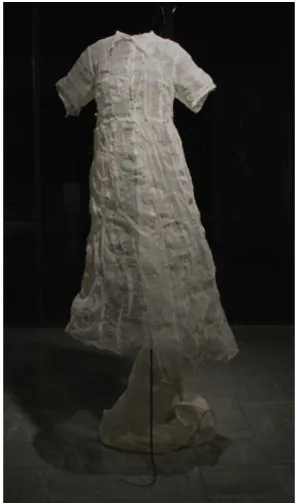
The next dress in the series, Shed (figure 7), also built upon a wire superstructure, has a
surface made of cloth. The fabric is an open weave mull that is traditionally used in
bookbinding. It comes with a certain amount of glue already embedded in the fabric and is quite
stiff to work with. Rinsing some of the glue out of the fabric produces an irregular wrinkled
texture that resembles aging skin. The shape of this dress is slightly different. The previous two
dresses closed in the back with a series of hooks. Shed has a shell-like configuration. The back
the floor in the shape of a vortex. The surface of the dress has random pleats and tucks in the
fabric. These pleats are sewn closed with a dotted line of waxed black thread. The threads that
were leftover after the seams were complete were then pulled towards the center of the dress
and left to hang with the remaining fabric, cascading to the floor. The hanging threads resemble
a black spinal column down through the center of the dress.
I approached Shed differently than the previous two dresses. Shed, having a cloth
exterior, does not covey that sense of armor that metal conveys in the earlier dresses. The
impulse to work with distressed fabric came from viewing Alberto Burri’s work from 1952,
Saco.12 The wounded surface of his work attracted me. I was interested in conveying concepts
of vulnerability and aging in this piece. Shed implies those concepts through the use of fragile
fabric and numerous repairs to the surface. Additionally, the opening in the back of the dress
further reinforces the concept of vulnerability. It runs the length of the dress and suggests a way
into the interior of the dress. The viewer’s eye is drawn into the center of the dress. The shape
of the dress is meant to function as an action, as if the skin of the dress is sloughing off and
cascading to the ground. The texture of the mull makes it an ideal material for representing a
shedding skin.
This work was a way for me to consider skin and what one shows or doesn’t show
on the surface. This idea comes up later in my prints. The surface has numerous repairs and
pleats which function as scars to the surface and help to support the idea of vulnerability. They
also give this individual a history. Furthermore, the many pleats and tucks function as a reference
to accommodating or compromise; the things one tucks into oneself over a lifetime. The dotted
line of the sewn seams becomes not only a way of securing the seams; it becomes a line that is
12 Helen Molesworth, Part Object Part Sculpture (Columbus: Wexner Center for the Arts The
seen and then not seen, a line that connects the interior with the exterior. In this dress, the interior
experience of accommodating is placed on the surface through the pleats and the dotted lines.
My intention was to illustrate the act of shedding those experiences.
The dresses were a way for me to investigate interior life and exterior appearances. The
symbol of the dress speaks to gender but, as I stated earlier, I was more interested in finding a
way to convey a more direct link to the body. Working with the dresses led me to consider the
idea of identity and how changeable that can be. Clothing can be put on and taken off, changing
one’s identity. This idea of costume and identity carried over into another work, Trouble.
CROWS
Crow imagery reappeared in my work with a piece called Trouble (figure 8). The crow
decoys I used in Here on the Outskirts of Memory are made of plastic. Instead of legs, they
stand upright through the use of a single stake. The crows for Trouble are constructed to more
closely resemble the actual bird. They are built around a superstructure of thin wire that forms
the bones of the piece, similar to the construction method that I used with the dresses. Next, a
layer of wet hand-formed paper is placed over the wire skeleton. As the paper dries, it forms a
tight layer around the wire structure. Additional layers of hand formed paper that have been cast
in the shape of the crow decoys are then added in layers to the sculpture. The cast paper retains
some of the details from the surface of the plastic decoys and serves to reference the earlier
work. The birds are painted with an undercoat of purple and a final coat of black, in order to
more closely resemble the iridescent sheen of living crows. Up the back of each bird is a sewn
seam with a series of antique buttons and, in one case, a zipper.
The buttons and zipper imply that these birds are wearing costumes and this
brings up questions relating to identity. This piece speaks of the fluidity of our identity and the
façades that we construct. It also speaks of instinct. I am reminded of Kiki Smith who often
works with animals as stand-ins for human consciousness. She closely identifies with forces of
nature, through animals, “witches, crones and other representatives of the realm of instinct and
the irrational”.13 Recalling her work, I was prompted to reconsider this piece as more than just a
statement on identity and to consider ideas of domestication versus the instinctual. In dressing
the crows up, was I attempting to domesticate them, to deny the fact that they are wild animals?
Trouble became a way of depicting the trouble that can ensue when one ignores the instinctual.
Intuition is more than just an internal mental process. It is an intelligence that comes with a
13 Eleanor Heartney, Helaine Posner, and Nancy Princenthal, After the Revolution Women Who
bodily experience, a gut instinct. In previous work I had expressed the idea of internal mental
processes that are housed in a body. I started to think more about a bodily experience itself. The
monotypes then become a way to work with the intersection of the internal life and the outward
expression of the body that is manifest through gesture and posture.
MONOTYPES
The impulse for making the series of monotypes came from viewing a work of John
Baldassari’s in an exhibition at the Museum of Fine Arts in Houston. In conjunction with his
print, Hell, there was a display that explained why Baldassari had made some of his decisions.
The display showed how he had worked with an image of a man’s face, cropping it various ways
in order to best convey the concept of Hell. The idea of focusing in on a portion of the figure in
order to convey certain information attracted me. I was interested in depicting a way to spot
landmarks on the body that communicated something that was happening internally. I was
looking for gestures or postures that communicate and have a certain commonality. I think of
these as small performances.
All of the monotypes in this series have certain common characteristics. The surface of
each print is constructed from as many as six layers of color. The first layer is a solid foundation
of a single color. Subsequent layers are printed from the inked surface of my former Plexiglas
desktop. I am interested in using a matrix that holds evidence of my mark making. This
particular piece of Plexiglas holds years of information from the numerous times that I cut on its
surface. I also print, using either a relief or intaglio method, from the backsides of my used zinc
plates. I wanted a scratched surface that would allow the colors of previous layers of ink to be
through its scars. After a surface of color is built up, I add a cropped image of a figure, often the
face from the nose down or a portion of the face and the figure’s hands.
Figure 9: On the Spot, 2007. 20"x16".
I use found imagery that is taken from print media. The figure is either posed for
advertising or in what appears to be a guarded moment, as in On the Spot (figure 9). Those are
moments of conventional or conscious body movements, moments when there is intentional
communication through gesture.14 It may be that the communication is trying to deceive;
nonetheless, I am looking for postures that I can understand. There is a commonality to the
pose. They are performances of common experiences such as anxiety, happiness, worry, a
controlling glance or being put on the spot. My imagery of the cropped figure is vague: just
values of light and shadow, with very little line work. Generally the figure occupies about a
third of the composition. Many of the prints have added paper litho imagery of flocks of birds,
star charts or maps. The prints are mounted to heavy watercolor paper and coated with several
layers of encaustic wax. The wax surface serves to give the work a skin and references the body.
I began thinking about the intentional and unintentional communication of gesture and
posture that one uses as a second skin, like clothes. I became interested in how it feels to be in
another’s skin. I can recognize the motivation behind the postures that I have chosen. The layers
of color in the monotypes operate like a skin, full of defects and scars that address the passage
of time and frailty. This is meant as a subtle nod to the human condition. The layering also
operates like a screen that keeps us from fully seeing the underlying layers, just as certain
gestures are meant to divert our attention from what’s really going on. The static-like surface
and the added imagery of birds or star charts function as a kind of visual noise that illustrates
the mental activity surrounding the self-consciousness of the pose. These figures know that they
are being looked at. These prints are a way for me to convey the connection between the
psychological climate and the bodily experience.
CONCLUSION
My work prompts one to recognize pieces of one’s self. I draw upon common human
experiences as my source material. My objects explore the inner experience and are engaged in
making that experience visible. My sculptures are stand-ins for the body. They pose as
individuals that are in the midst of life. We see their flaws and foibles, their very human
The everydayness of my materials does much to keep these objects in the realm of the
common experience, the Everyman. My work is not made with precious materials; many of my
materials are either found or they are purchased at the hardware store. The construction of these
pieces is evident; there isn’t any mysterious joinery. I have constructed these objects in such a
way that any techniques can be seen on the surface. In that way, they attempt to convey a sense
of integrity. What we know of these individuals is either written on their skin or we can see it
through their façade.
BIBLIOGRAPHY
Bachelard, Gaston. The Poetics of Space. Boston: Beacon Press, 1994.
Benezra, Neal. Martin Puryear. Chicago: Art Institute Of Chicago, 1991.
Bettelheim, Bruno. The Uses of Enchantment. New York: Alfred Knopf, 1976.
Crutchfield, Margo A. Martin Puryear. Richmond: Virginia Museum of Fine Arts, 2001.
Elderfield, John. Martin Puryear. New York: The Museum of Modern Art, 2007.
Engberg, Siri. Kiki Smith: A Gathering, 1980-2005. Minneapolis: Walker Art Center, 2005.
Felshin, Nina. "Women's Work: A Lineage, 1966-94". Art Journal, Vol. 54, No.1 Spring, 1995:
71-85.
Goldman, Judith. "Diane Arbus: The Gap Between Intention and Effect ". Art Journal, Vol. 34,
No.1 Autumn 1974: 30-35.
Gruber, Richard J. Stackhouse. Augusta: Morris Museum of Art, 1999.
Heartney, Eleanor, Helaine Posner, and Nancy Princenthal. After the Revolution Women Who
Transformed Contemporary Art. Munich: Prestel, 2007.
Marzluff, John M. In the Company of Crows and Ravens. New Haven: Yale University Press,
2005.
Krout, Maurice H. "Understanding Human Gestures". The Scientific Monthly, Aug. 1939: 167-
172.
Molesworth, Helen. Part Object Part Sculpture. Columbus: Wexner Center for the Arts The Ohio
State University, 2005.
Mullins, Charlotte. Rachel Whiteread. London: Tate Publishing, 2004.
Pankey, Eric. Oracle Figures. Keene: Ausable Press, 2003.
Princenthal, Nancy. "Intuition's Disciplinarian". Art in America January 1990: 131-136.
Sobel, Dean. Jackie Winsor. Milwaukee: Milwaukee Art Museum, 1991.
Weitman, Wendy. Kiki Smith: prints, books and things. New York: Museum of Modern
Art, 2004.
VITA
Laura Gipson was born in North Carolina and grew up in suburban Maryland. She
attended George Washington University and the University of Maryland before moving to New
Orleans in 1980. She continued her education at the University of New Orleans in 1981 but put her
education on hold to raise two sons. She returned to school in 2001 and received her Bachelor of
Arts from the University of New Orleans in 2004. She currently lives with her family in New