Iranian Evolutionary and Educational Psychology Journal
September 2019: 213-221
© University of Hormozgan Publication 2019 DOI: 10.29252/ieepj.1.3.213
http://ieepj.hormozgan.ac.ir The Effectiveness of Creative Thinking Training on the
Critical Thinking and Media Literacy in Students
Samira Zeinali Khoorchani1, Soudabeh Rezaei2, Zohreh Saadatmand3*, Reza Farashbandi4
1. MA Curriculum Planning, Isfahan (Khorasgan) Branch, Islamic Azad University, Isfahan, Iran 2. MA Curriculum Planning, Isfahan (Khorasgan) Branch, Islamic Azad University, Isfahan, Iran
3. Associate professor, Department of Curriculum planning, Isfahan (Khorasgan) Branch, Islamic Azad University, Isafah, Iran *Corresponding Author: [email protected]
4. PhD Student, Department of Philosophy of Education, Isfahan (Khorasgan) Branch, Islamic Azad University, Isfahan, Iran
Introduction
We live in a world which changes so fast that the future knowledge determination is very difficult. Hence, the education system should focus on educating thinking to children in an effective way (Saracho & Spodek, 2009). One of the most successful effors to innovate a program in the field of thinking education is “Philoso -phy for Children (P4C)” that aims to focus more on thinking instead memory in education (Daniel & Auriac, 2011). This program, first created in the United States, and then extended around the world. In the case of Iran, this issue has attracted the attention of many, and in turn, the Kandahar and the Taliban have not killed them-selves or the Taliban. . Undoubtedly, the importance of thinking and reasoning in human life is to the extent that they are referred to as the main distinction between human beings and other beings. In fact, what distin-guishes man from other animals is his remarkable ability to think and reason. Thinking is a process in which we put our information together in an appropriate way so that we can reach a new result. In other words, one’s thinking drives the person in-depth to get a good and meaningful result (Aizikovitsh-Udi & Amit, 2011; Hun-saker, 2005). All theories of education and learning support thinking and research and confirm its key role in learning. In fact, in the field of learning one cannot find a theory in which thinking and research are neglected. The sense of curiosity and truth-seeking is an innate affair that exists within the individual student body and should be gradually activated by providing the right conditions. Obviously, this innate talent must first emerge and flourish in the family and school environment, and then flourish in the environments of other social insti -tutions. But in today’s world, the role of the education system is more significant than other institutions due to
Abstract: The purpose of the present study was to investigate the effectiveness of creative thinking training in thinking and research lesson on students’ critical thinking and media literacy. The sample size of this study consisted of 40 students (20 female and 20
male) in sixth grade elementary school of Isfahan in 2019 that were selected through cluster sampling. The data gathering tool were California Critical Thinking Skills Test and Falsafi Media Literacy Questionnaires. Statistical analysis of covariance was used to
analyze the research hypotheses. The Creative Thinking training Package of Karami (2016) was used to teach creative thinking.
The results indicated there was a significant difference between the two groups in terms of critical thinking and media literacy in the post-test; in other words, creative thinking training increased the critical thinking and media literacy in the experimental group.
The overall result of the study showed that promoting students ‘creative thinking can help to promote students’ critical thinking and media literacy.
Keywords:Creative thinking, Critical thinking, Media literacy, Thinking and research lesson.
economic, scientific, and technical developments. The role of the education system is important because it has a very wide scope and scope and covers a relatively long period of time for the students (D’Alessio, Avolio, & Charles, 2019; Howard, Tang, & Austin, 2015). Creative thinking in a nutshell means being able to create something new or find new and effective ways to do better. In the present age, children and adolescents need to improve their creative thinking skills in order to make the right decisions and solve complex societal problems in order to face the amazing developments of the third millennium. They must enhance their research, problem solving, and search skills. In today’s world, nurturing creative thinking is one of the core pillars of the educa-tional system, and schools play a major role in the development of students’ creative thinking. Psychologists believe that schools can teach people creative ways of thinking and ways to enhance their creative abilities, because it is assumed that children have an innate passion for discovery that education must nurture (Freina, Bottino, & Ferlino, 2018; Lucchiari, Sala, & Vanutelli, 2019). On the one hand, one of the most important facets of human distinction from other creatures is creative thinking. Creative thinking is a skill that combines problem solving and decision making skills with new thoughts or relationships and the ability to discover and choose new solutions. The power of manipulation is in the mind and phenomena, the power of discovering and producing new tools and ideas, all of which are somehow creative. All human beings are more or less creative, and as capable as we are of all kinds of intelligence of varying degrees, it is important to be able to flourish, develop and employ them (Chen & Chiu, 2016; Tsai, 2018). Creative thinking can also be considered the best weapon to combat the problem. Students who do not engage in creative thinking to the slightest difficulty will be wandering if creative students perceive this negative attitude to be pre-war because they believe that the problem is not only a nuisance but a struggle to discover The solution is. Thinking is by far the most efficient and tailored problem-solving tool, but not all issues are of the same type, so thinking techniques are not unique to one particular type (Jankowska & Karwowski, 2019).
On the other hand, an important and influential indicator that is closely related to creative thinking is critical thinking. Individuals need critical thinking skills and competencies to deal with life’s issues and make fun-damental decisions. In order for a person to make an important decision in life, he must be able to analyze, evaluate, and judge his or her living conditions (D’Alessio et al., 2019; Howard et al., 2015; Lucchiari et al., 2019). Having critical thinking skills and abilities allows individuals to process information about themselves in life, objectively reason and derive results from a variety of information types, and effectively, objectively, and tangibly evaluate problems, and Incomplete information, reasoned decision making. In fact, the wise do everything at the command of reason and thought, so critical thinking is responsible (responsible) and skillful thinking that leads to good judgment of oneself, others and society at the present time (Wang, Pascarella, Nel-son Laird, & Ribera, 2015; Yu, Lin, Ho, & Wang, 2015).
In the case of Iran, this issue has been considered and in turn, a plan with name as “Thinking and Research” was entered in the Education System. Undoubtedly, the importance of thinking and reasoning in human life is to the extent that they are referred to as the main distinction between human and other beings. In fact, what distinguishes human from other animals is his remarkable ability to think and reason. Thinking is a process in which we put our information together in an appropriate way so that we can reach a new result. In other words, one’s thinking deeply examines one’s affairs in order to obtain a desirable and reasonable result (D’Alessio et al., 2019; Şendağ & Odabaşı, 2009). All theories of education and learning support the thinking and research and their key role in learning. In fact, in the field of learning one cannot find a theory in which thinking and research are neglected. The sense of curiosity and truth-seeking is an innate affair that exists within the indi -vidual student body and should be gradually activated by providing the right conditions. Obviously, this innate talent must first emerge and flourish in the family and school environment, and then flourish in the environ -ments of other social institutions. But in today’s world, the role of the education system is more significant than other institutions due to economic, scientific, and technical developments. The role of the education sys -tem is important because it has a very wide scope and opportunity and covers a relatively long period of time for the students (D’Alessio et al., 2019). Creative thinking in a nutshell means being able to create something new or find new and effective ways to do better. In the present age, children and adolescents need to improve their creative thinking skills in order to make the right decisions and solve complex societal problems in order to face the amazing developments of the third millennium. They must enhance their research, problem solv-ing, and search skills. In today’s world, nurturing creative thinking is one of the core pillars of the educational system, and schools play a major role in the development of students’ creative thinking. Psychologists believe
that schools can teach people creative ways of thinking and ways to enhance their creative abilities, because it is assumed that children have an innate passion for discovery that education must promote it (Lucchiari et al., 2019).
On the other hand, one of the most important facets of human distinction from other creatures is creative thinking. Creative thinking is a skill that combines problem solving and decision making skills with new thoughts or relationships and the ability to discover and choose new solutions. All human beings are more or less creative, and such as the intelligence has varying degrees, it is important to be able to flourish, develop and employ them (Chen & Chiu, 2016). Creative thinking can also be considered the best weapon to combat the problem. Students who do not engage in creative thinking when face to a small difficulty will be disap -point while creative students perceive it as a challenge to coping. Thinking is by far the most efficient and tailored problem-solving tool, but not all problems are of the same type, so thinking techniques are not unique to one particular type (Jankowska & Karwowski, 2019).
Alternatively, an important and influential indicator that is closely related to creative thinking is critical think -ing. Individuals need critical thinking skills and competencies to deal with life’s issues and make fundamen-tal decisions. In order for a person to make an important decision in life, he must be able to analyze, evaluate, and judge his or her living conditions (D’Alessio et al., 2019). Having critical thinking skills and abilities allows individuals to process information about themselves in life, objectively reason and derive results from a variety of information types, effectively, objectively, and tangibly evaluate problems, and reasoned decision making with an incomplete information,. In fact, the wise do everything at the command of wisdom, so criti-cal thinking is responsible and skillful thinking that leads to good judgment of oneself, others, and society at the present time(Yu et al., 2015).
Critical thinking is reformist thinking, as it affects the discovery of weaknesses and correcting one’s short-comings (Smith et al., 2019), so critical thinking should be considered as an internal process whereby the problematic situation of life is critically analyzed and the solving the problems are wisely identified (Liu, Hsu, Hung, Wu, & Pai, 2019). On the other hand, the most important element of one’s personality is the desire to think and to think critically. Critical thinking helps students solve problems, make decisions in life situations, and develop a stable identity and habit in the person. For a more dynamic society, the more critical thinkers are needed (Bucaro, 2019). Society always needs thinkers who make good judgments on the issues of their community and know when and how to apply thinking skills in their community, and having critical thinking in society helps individuals to be informed and cognizant citizens, and Experience genuine freedom, so critical thinking as an individual’s ability to interpret, analyze, evaluate, and identify social phenomena is a powerful resource in civil and political life (Yu et al., 2015). Given the crucial role of critical thinking in life, the primary purpose of education should be to train critical thinkers beyond the easy acquisition of knowl-edge. Living in today’s complex society requires people who are capable of overcoming their own issues by thinking, gathering and combining information about their lives in a clear framework and perspective, and evaluate them in a good manner and avoid impossible tasks (Elian & Hamaidi, 2018).
Then again, another important and influential indicator that is closely related to creative thinking is the level of media literacy. Media literacy is a kind of skill-based understanding in which different types of media can be separated, and different types of media production can be identified. Media literacy is also a combination of effective media productivity techniques and insights to understand the media. The ability to access, ana-lyze, evaluate, and create messages in various forms based on a conscious and critical understanding of the nature of mass media, techniques used by media producers. Students with media literacy will be able to dis-cover the complex messages found in television, radio, newspapers, magazines, books, billboards, the Inter -net and other independent media. They can also create their own media and participate actively in shaping the media culture, which leads people to use the media intelligently (Mingoia, Hutchinson, Gleaves, & Wilson, 2019). The benchmark of any media literacy program is the critical exposure of students to their own use and understanding of the media, so that they can decrypt information received from different media and enhance their ability to independently judge media content. Undoubtedly, increasing the media literacy of students has become a necessity in cultural policy making, and media literacy education is especially needed for students, especially since they are more influenced by media than other people in the society (Suwana, 2017).
Tiwari, Lai, So, and Yuen (2006), explored the impact of creative thinking training on developing students’
philosophical thinking skills in the course of empirical sciences. The results showed that there was a signif-icant difference between the two groups in terms of dependent variable. In other words, a creative thinking training program develops students’ philosophical thinking skills. Szabo and Schwartz (2011), also investigat-ed the effect of thinking training in group learning on enhancing students’ creative thinking and critical think-ing. The results showed that thinking training in group learning is effective on enhancing students’ creative and critical thinking. Lucchiari et al. (2019), in a study, examined the impact of cognitive pathways to promote classroom creative thinking among Italian elementary students. The results indicated that the trained children had higher levels of creative thinking than untrained children in the control group. On the other hand, El Soufi and See (2019), examined the impact of teaching creative thinking skills on critical thinking of English lan -guage learners in higher education. The results showed that teaching creative thinking skills is effective on critical thinking of English language learners in higher education. Fung (2017), also explored the educational effects of creative thinking on the development of critical thinking in high school students in Hong Kong. The results showed that creative thinking training is effective in developing critical thinking in high school students in Hong Kong. Finally, Groza, Locander, and Howlett (2016), examined the impact of thinking styles on students’ creativity and subjective knowledge. The results showed that thinking styles influenced students’ creativity and students’ subjective knowledge.
In discussing the necessity and importance of research, it should be noted that the process of teaching and transferring science, skills, and values is one of the most important concerns in educational systems. The rele-vance of education to the human and economic development doubles the importance of this issue. One of the tried and tested ways in the evolution of the educational process is to move learning environments to learning based on creativity and thinking skills that will increase educational productivity compared to traditional methods based on preservation and evaluation. Existence an effective environment is very important tool to promote the critical thinking and media literacy. Therefore, education for students to develop creative think-ing requires students to have a clear understandthink-ing of the current situation and, in the next step, to strive for a valid philosophy of education and principles and scientific goals, and a clear picture of the optimal conditions of creative thinking. Today, it has been demonstrated that creative thinking is not a mere innate attribute, but that all humans possess this ability, and all have varying degrees of talent. In addition, factors such as skills, training, flexibility, level of knowledge and awareness, risk taking, fear of failure and failure have a significant impact on students’ creative thinking and innovation (Chemers, Hu, & Garcia, 2001). Alternatively, in the present age, students need to develop their research, problem solving, and search skills in order to deal with the fascinating developments of the Third Millennium. Clearly, to achieve these goals, heavy responsibility is placed on educational centers, especially schools. Hence, this study examines the effectiveness of creative thinking training in on critical thinking and media literacy levels in sixth-grade elementary students in Isfa -han. Results and implications of this research can provide educational authorities, school administrators and teachers with strategies to solve creative thinking problems and develop a plan for increasing their thinking. Therefore, the main question is whether creative thinking training is effective on students’ critical thinking and media literacy levels.
Material and Methods
The research method was pre-test – post-test quasi-experimental method with control group. The sample size was 40 male and female students of sixth grade elementary school in Isfahan which 20 of them in control group and 20 of them in experimental group were assigned. After coordinating with the schools and provid -ing the necessary explanations, the questionnaires were completed. In addition to the classroom train-ing in thinking and research, the experimental group received separate training in creative thinking during the year, whereas the control group received only the same classroom training during the year. The groups were ran-domly selected and pre-tested on experimental groups prior to the experimental intervention, then creative thinking training was applied as an independent variable to assess their impact on the level of critical thinking and media literacy as the dependent variables. For this purpose, Creative Thinking Training - Karami (2016) educational package - was conducted in experimental group during five sessions. Then, in a 60-minute ses -sion, the post-test was performed. In this study, the required information was collected through a questionnaire consisting of the following closed-ended questions, which consisted of three parts:
California Critical Thinking Skills Test (1989): The Critical Thinking Questionnaire is comprised of 34 questions on a 5-point Likert scale (strongly agree to strongly disagree) and interpretive skills include: classification, sentence decoding, meaning clarification, review ideas and ideas analysis; Inferential skills include: Searching for evidence, speculating on alternatives and extracting results; Evaluating skills including: Assessing claims; Evaluating arguments, articulating results, justifying procedures, and presenting reasoning. Inductive includes: logical reasoning in mathematics, Inductive Reasoning Includes: concluding discussion seeking confrontation with related facts. The analysis of the questions in the test yields a total of six scores with five subscales: analysis and interpretation, evaluation of deductions, extraction of logical deductions, deductive reasoning, and deductive reasoning. This tool is useful for evaluating logical thinking ability.
Falsafi (2014) Media Literacy Questionnaire: The Falsafi Media Literacy Questionnaire has 20 items that are used to measure the level of media literacy of individuals. This scale has a five-point Likert ranged from strongly disagree to strongly agree. Questions 1 to 3 to assess media message content perception, questions 4 to 7 to assess awareness of the hidden purpose of media messages, questions 8 to 11 to assess conscious choice of media messages, questions 12 to 16 to assess the critical look at media messages and finally questions 17 to 20 for measuring media message analysis. Falsafi (2014), reported the validity of the media literacy question-naire with the help of factor analysis of 0.82. The reliability of the questionquestion-naire in the present study was 0.81 using Cronbach’s alpha coefficients.
Creative Thinking Educational Package in Thinking and Research Course Karami (2016): In this study, cre-ative thinking education in thinking and research lesson was given to 6th grade elementary students in 5 ses-sions. The contents of this package focused on thinking and research skills. This course is aimed at teachers who wish to integrate creative thinking skills into their classroom, and to do so in a way that is attuned with their students’ learning practices. The course is taught through a combination of short tasks and guided exer -cise. It comes with a workbook that students can fill in along with the training session, or work through on their own time. The sessions are interactive, the activities are simple, and students can practice the skills during the classroom time.
Results
In table 1, the descriptive information of the critical thinking and media literacy were presented. According to Table 1, in the control and experimental groups, the mean of critical thinking in the experimental group was 21.55 and in the control group was 15.35. Also, the mean of media literacy in the experimental group was 11 and in the control group was 8.3. These values indicate that the mean in the control group was lower than it in the experimental group.
Table 1. Descriptive information of critical thinking and media literacy of experimental and control groups in the post-test
Variables Experimental Group Control Group
N Mean SD N Mean SD
Critical Thinking 20 21.55 1.95 20 15.35 1.38
Media Literacy 20 11 1.02 20 8.3 1.03
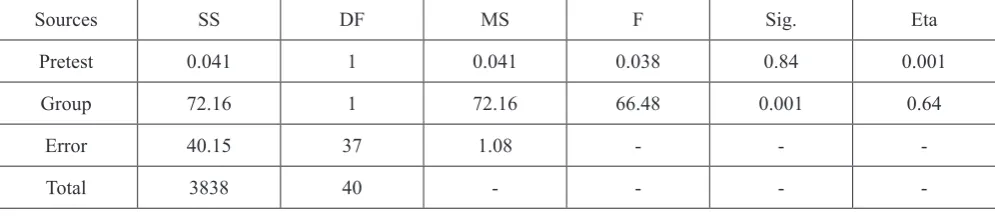
Table 2 presents the results of the analysis of covariance on the effect of creative thinking training on critical thinking and table 3 presents the results of the analysis of covariance on its impact on media literacy. The results showed that according to F value of 131.58 and P value of 0.0001, creative thinking training was effective on critical thinking. Eta coefficient was 0.78. Also, considering the F value of 66.48 and the P value of 0.0001, creative thinking training on media literacy was also effective. Eta coefficient in this analysis was 0.64.
Table 2. Results of One-way Covariance Analysis related to the effect of creative thinking on critical thinking
Sources SS DF MS F Sig. Eta
Pretest 7.03 1 7.03 2.53 0.12 0.064
Group 364.41 1 364.41 131.58 0.001 0.78
Error 102.47 37 2.76 - -
-Total 14110 40 - - -
-Table 3. Results of One-way Covariance Analysis related to the effect of creative thinking on media literacy
Sources SS DF MS F Sig. Eta
Pretest 0.041 1 0.041 0.038 0.84 0.001
Group 72.16 1 72.16 66.48 0.001 0.64
Error 40.15 37 1.08 - -
-Total 3838 40 - - -
-Discussion
According to the results, the creative thinking training was effective on the critical thinking skills of the sixth grade elementary students. Given the Eta coefficient value, it can be said that the effect of creative thinking training on critical thinking is 0.78, which means that creative thinking training accounts for 78% of the variance of critical thinking. The findings were in line with the findings of Lucchiari et al. (2019), Al-Sufi (2019), Fung (2017) and Groza et al. (2016).
One of the main goals of education is to create conditions and facilities that will foster students’ creativity and enhance their knowledge and ability to fit their talents. Achieving this goal requires access to appropriate resources and facilities due to differences in student abilities as well as a large student population, but the current limitations often make it difficult for students to develop programs based on their individual talents and differences. Therefore, it seems necessary to create contexts for talented people who are seeking to deepen and broaden their learning (Fung, 2017). Today, students live in a changing world. Therefore, students need creative, flexible and rigorous thinking skills in order to be able to find solutions to the physical and social development of their environment in addition to facing such problems (Ivan, 2011). Creative thinking training not only enables one to use their past experiences and relate them to new situations. Rather, it causes one to find a connection between things that were previously unrelated, which in their view is new and meaningful. It can also use non-traditional approaches to problem solving and go beyond information that affects as much as possible the level of critical thinking of students (Fisher, 2013).
Critical thinking, which is an integral part of any educational system, can undoubtedly be one of the key goals of world-class education. Because it also affects people’s tendency to interpret information in information recall, adopting ways that reinforce students’ motivation and interest and by challenging intellectual processes, changing passivity and prudence into active dialogue and thinking (Chan, 2019). Instead of transferring knowledge and creating disciplinary arid environments that require only the reproduction of knowledge, schools should provide students with a mental effort to solve problems (thinking) about the validity and reliability and value of information and arguments presented. Judging and distinguishing facts from beliefs to enable them to make logical (critical thinking) decisions (Smith et al., 2019).
The results also showed that creative thinking training improved media literacy in the experimental group compared to the control group. According to the Eta coefficient value, it can be said that the effect of creative thinking training on media literacy is 0.64, which means that creative thinking training explains 64% of the variance of media literacy variable. This finding is consistent with research by Evans (2017), Mingoia et al. (2019), Suwana (2017) and Richardson and Ice (2010).
One of the valuable intellectual abilities that students need in schools is to evaluate the various hearings, readings, ideas, and beliefs they face in life and make logical decisions about them. This ability is called
valuable creative thinking. Creative thinking is becoming increasingly popular these days, as we are always confronted with a lot of misleading information, commercial advertising, and other types of advertising that need to be reassessment (Evans, 2017). Eisner believes that schools need to nurture students’ thinking ability, especially rational and creative thinking, in what they see, hear, and read, so that they can distinguish beliefs from facts, sophistication from rational reasoning, and competence from inadequacy. Therefore, teaching creative thinking as high-level thinking should be taken into consideration as it will be reflected in many decisions and judgments that students will make in the future. On the one hand, the first and foremost obstacle to creative thinking is media literacy. Each country’s media literacy reflects the way people think and respond to different issues.
The importance of media literacy in today’s world is certainly no less important than the literacy itself. Media literacy is as important as the information literacy of people’s social lives in the turbulent age of information that we find ourselves in every day in the face of various media, audio, visual, and written. Without media literacy, students cannot properly select media messages. In the meantime, socio-educational institutions such as education, universities and training centers are responsible for education and training the creative thinking and media literacy.
Along with the results, the present study has been accompanied by limitations that the barriers related to gathering data tool and the study sample attributions are the most important of these limitations. Its recommended in the future studies, researchers investigate the creative thinking training effect on other cognitive and affective variable among other age and educational levels samples.
Declaration of Conflicting Interests
The author(s) declared no potential conflicts of interest with respect to the research, authorship, and/or publication of this article.
Funding
The author(s) received no financial support for the research, authorship, and/or publication of this article.
References
Aizikovitsh-Udi, Einav, & Amit, Miriam. (2011). Developing the skills of critical and creative thinking by probability teaching. Procedia-Social and Behavioral Sciences, 15, 1087-1091.
Bucaro, Anthony C. (2019). Enhancing auditors’ critical thinking in audits of complex estimates. Accounting,
Organizations and Society, 73, 35-49.
Chan, Zenobia CY. (2019). Nursing students’ view of critical thinking as ‘Own thinking, searching for truth,
and cultural influences’. Nurse education today, 78, 14-18.
Chemers, Martin M, Hu, Li-tze, & Garcia, Ben F. (2001). Academic self-efficacy and first year college student
performance and adjustment. Journal of Educational psychology, 93(1), 55.
Chen, Cheng-Huan, & Chiu, Chiung-Hui. (2016). Employing intergroup competition in multitouch de-sign-based learning to foster student engagement, learning achievement, and creativity. Computers & Ed-ucation, 103, 99-113.
D’Alessio, Fernando A, Avolio, Beatrice E, & Charles, Vincent. (2019). Studying the impact of critical think
-ing on the academic performance of executive MBA students. Think-ing Skills and Creativity, 31, 275-283.
Daniel, Marie-france, & Auriac, Emmanuelle. (2011). Philosophy, critical thinking and philosophy for chil-dren. Educational Philosophy and Theory, 43(5), 415-435.
El Soufi, Nada, & See, Beng Huat. (2019). Does explicit teaching of critical thinking improve critical thinking
skills of English language learners in higher education? A critical review of causal evidence. Studies in Educational Evaluation, 60, 140-162.
Elian, Shereen A, & Hamaidi, Diala A. (2018). The Effect of Using Flipped Classroom Strategy on the Aca-demic Achievement of Fourth Grade Students in Jordan. International Journal of Emerging Technologies
in Learning, 13(2).
Evans, EGS. (2017). Modern Educational Psychology: an historical introduction: Routledge.
Falsafi, Gholamreza. (2014). The Study of the Relationship between Media Literacy and Lifestyle (Case Study: 15- to 18-year-old High School Adolescents in Sixth District, Tehran). (Master), Isamic Azad Uni -versity [In Persian], Tehran, Iran.
Fisher, Robert. (2013). Teaching thinking: Philosophical enquiry in the classroom: A&C Black.
Freina, Laura, Bottino, Rosa, & Ferlino, Lucia. (2018). A Learning Path in Support of Computational Think
-ing in the Last Years of Primary School. Paper presented at the International Conference on Games and Learning Alliance.
Fung, Dennis. (2017). The pedagogical impacts on students’ development of critical thinking dispositions:
Experience from Hong Kong secondary schools. Thinking Skills and Creativity, 26, 128-139.
Groza, Mark D, Locander, David A, & Howlett, Charles H. (2016). Linking thinking styles to sales perfor
-mance: The importance of creativity and subjective knowledge. Journal of Business Research, 69(10),
4185-4193.
Howard, Larry W, Tang, Thomas Li-Ping, & Austin, M Jill. (2015). Teaching critical thinking skills: Ability,
motivation, intervention, and the Pygmalion effect. Journal of Business Ethics, 128(1), 133-147.
Hunsaker, Scott L. (2005). Outcomes of creativity training programs. Gifted Child Quarterly, 49(4), 292-299. Ivan, Loredana. (2011). The importance of popularity, rational thinking style and nonverbal sensitivity to
achieve academic success. Procedia-Social and Behavioral Sciences, 29, 725-734.
Jankowska, Dorota M, & Karwowski, Maciej. (2019). Family factors and development of creative thinking. Personality and Individual Differences, 142, 202-206.
Karami, Soheila. (2016). The Effectiveness of Thinking and Research Course on Social Habits of Students in Sixth Elementary School Students in Bushehr. (Master ), Islamic Azad University [In Persian].
Liu, Nai-Yu, Hsu, Wen-Yi, Hung, Chao-An, Wu, Pei-Ling, & Pai, Hsiang-Chu. (2019). The effect of gender
role orientation on student nurses’ caring behaviour and critical thinking. International journal of nursing studies, 89, 18-23.
Lucchiari, Claudio, Sala, Paola Maria, & Vanutelli, Maria Elide. (2019). The effects of a cognitive pathway to promote class creative thinking. An experimental study on Italian primary school students. Thinking Skills
and Creativity, 31, 156-166.
Mingoia, John, Hutchinson, Amanda D, Gleaves, David H, & Wilson, Carlene. (2019). The impact of a social media literacy intervention on positive attitudes to tanning: A pilot study. Computers in Human Behavior, 90, 188-195.
Richardson, Jennifer C, & Ice, Phil. (2010). Investigating students’ level of critical thinking across instruction -al strategies in online discussions. The Internet and Higher Education, 13(1-2), 52-59.
Saracho, Olivia N, & Spodek, Bernard. (2009). Educating the young mathematician: The twentieth century and beyond. Early childhood Education journal, 36(4), 305-312.
Şendağ, Serkan, & Odabaşı, H Ferhan. (2009). Effects of an online problem based learning course on content
knowledge acquisition and critical thinking skills. Computers & Education, 53(1), 132-141.
Smith, Lisa, Gillette, Chris, Taylor, Shawn R, Manolakis, Michael, Dinkins, Melissa, & Ramey, Caleb. (2019). A semester-long critical thinking course in the first semester of pharmacy school: Impact on critical think
-ing skills. Currents in Pharmacy Teach-ing and Learn-ing, 11(5), 499-504.
Suwana, Fiona. (2017). Empowering Indonesian women through building digital media literacy. Kasetsart Journal of Social Sciences, 38(3), 212-217.
Szabo, Zsuzsanna, & Schwartz, Jonathan. (2011). Learning methods for teacher education: The use of online
discussions to improve critical thinking. Technology, Pedagogy and Education, 20(1), 79-94.
Tiwari, Agnes, Lai, Patrick, So, Mike, & Yuen, Kwan. (2006). A comparison of the effects of problem-based
learning and lecturing on the development of students’ critical thinking. Medical education, 40(6), 547-554. Tsai, Chia-Wen. (2018). Applying online competency-based learning and design-based learning to enhance
the development of students’ skills in using PowerPoint and Word, self-directed learning readiness, and ex -perience of online learning. Universal Access in the Information Society. doi: 10.1007/s10209-018-0640-6
Wang, Jui-Sheng, Pascarella, Ernest T, Nelson Laird, Thomas F, & Ribera, Amy K. (2015). How clear and
organized classroom instruction and deep approaches to learning affect growth in critical thinking and need for cognition. Studies in Higher Education, 40(10), 1786-1807.
Yu, Wei-Chieh Wayne, Lin, Chunfu Charlie, Ho, Mei-Hsin, & Wang, Jenny. (2015). Technology Facilitated PBL Pedagogy and Its Impact on Nursing Students’ Academic Achievement and Critical Thinking Dispo -sitions. Turkish Online Journal of Educational Technology-TOJET, 14(1), 97-107.