POLICY BRIEF
Exploring the ‘solution space’ is key:
SOLUTIONS recommends an early-stage
assessment of options to protect and restore
water quality against chemical pollution
Leo Posthuma
1,2, Thomas Backhaus
3, Juliane Hollender
4, Dirk Bunke
5, Werner Brack
6,7*, Christin Müller
6,
Jos van Gils
8, Henner Hollert
7, John Munthe
9and Annemarie van Wezel
10Abstract
Present evaluations of chemical pollution in European surface and groundwater bodies focus on problem descrip-tion and chemical classificadescrip-tion of water quality. Surprisingly, relatively low attendescrip-tion has been paid to soludescrip-tions of chemical pollution problems when those are encountered. Based on evaluations of current practices and avail-able approaches, we suggest that water quality protection, monitoring, assessment and management of chemical pollution can be improved by implementing an early-stage exploration of the ‘solution space’. This follows from the innovative paradigm of solution-focused risk assessment, which was developed to improve the utility of risk assess-ments. The ‘solution space’ is defined as the set of potential activities that can be considered to protect or restore the water quality against hazards posed by chemical pollution. When using the paradigm, upfront exploration of solution options and selecting options that would be feasible given the local pollution context would result in comparative risk assessment outcomes. The comparative outcomes are useful for selecting optimal measures against chemical pollution for management prioritization and planning. It is recommended to apply the solution-focused risk assess-ment paradigm to improve the chemical pollution information for river basin manageassess-ment planning. To operational-ize this, the present paper describes a still-growing database and strategy to find and select technical abatement and/ or non-technical solution options for chemical pollution of surface waters. The solutions database and strategy can be applied to help prevent and reduce water quality problems. Various case studies show that implementing these can be effective, and how solution scenarios can be evaluated for their efficacy by comparative exposure and effect assessment.
© The Author(s) 2019. This article is distributed under the terms of the Creative Commons Attribution 4.0 International License (http://creat iveco mmons .org/licen ses/by/4.0/), which permits unrestricted use, distribution, and reproduction in any medium, provided you give appropriate credit to the original author(s) and the source, provide a link to the Creative Commons license, and indicate if changes were made.
Challenge
Water quality protection, monitoring, assessment and management is a key challenge, especially for chemi-cal pollution [1–4]. Chemical pollution of surface water systems encompasses a group of distinct prob-lems, characterized by highly diverse mixture compo-sitions and associated high diversity of exposures and probable impacts [5, 6], in a context of widely varying
non-chemical stressors and local natural conditions [7]. Consequently, there is a high diversity of protection and impact-driven restoration needs, which are the two key environmental objectives of the European Water Frame-work Directive (Article 4, WFD [1]). Water quality pro-tection and assessment requires an improved coverage of this diversity to understand the water quality problems [6, 8–11] and also approaches to derive and select man-agement solutions for those problems. This holds espe-cially in view of the benefits of a non-toxic environment [12].
The EU-project SOLUTIONS (www.solut ions-proje ct.eu) aimed to address these problems. Due to the
Open Access
*Correspondence: [email protected]
6 Helmholtz Centre for Environmental Research UFZ, Permoserstr. 15,
Leipzig 04318, Germany
diversity of the mixture exposure, the idea of a ‘one-size-fits-all’ approach for protection and restoration is unlikely to be effective. To improve on the current situ-ation, the project adopted a relatively novel risk assess-ment paradigm, solution-focused risk assessassess-ment [13]. This paradigm was proposed by the U.S. National Acad-emy of Sciences after a wide-ranging evaluation of risk assessment practices of the U.S. EPA to improve the util-ity of risk assessments by an early-stage attention on the exploration of the ‘solution space’ for the environmental problem at hand. The ‘solution space’ is defined as the set of potential activities that can be considered to pro-tect or restore the water quality against hazards posed by chemical pollution. The ‘solution space’ is wide. It not only concerns the option to implement a technical abate-ment option on a specific site as a reactive solution (e.g., an improved wastewater treatment installation), but also the strategic development and implementation of sus-tainable chemistry as a proactive solution [14]. A system-atic database to store and retrieve options in the ‘solution space’ is lacking, but would be beneficial to water quality managers.
The solution-focused approach itself is not new, and its power has been established a long time ago. An early example is the successful reduction of the spread of chol-era in nineteenth century London, by removing the han-dle of a drinking water pump [15]. The identified problem was thus an infectious disease, which was at that time thought to be spread via air. Data on the spread of the disease were collected and evaluated on a system-level basis (the disease incidences in a London neighborhood). By considering available information and solution oppor-tunities, the implemented solution was a simple removal of the water pump handle. The WFD (Annex II) also stipulates that water quality managers collect available evidence on a water system-level basis (multiple lines of evidence), to establish the likelihood of stress factors to cause (potential) impacts and to subsequently derive effective programs of measures.
The current WFD-assessment and management cycle has been extensively described in guidances, be it that in the written texts and current practices the emphasis is on problem description and on water quality classification [16]. There is far less attention to the systematic transla-tion of problems into management solutransla-tions (for protec-tion or restoraprotec-tion).
The current assessment and management cycle fol-lows the so-called DPSIR causal framework [8, 17]. This implies that water management practices consider the drivers of water quality reduction (D, e.g., economic activities), the resulting pressure (P, e.g., emissions of chemicals to the water system), the subsequent sta-tus of the water quality (S, e.g., the concentrations of
compounds) and the resulting impacts (I, e.g., species abundance changes). Combining the information on D, P, S and I should yield the management response (R). The DPSIR approach explicitly suggests that the response R may consider potential solutions (the Responses, R) in the format of reductions of D, P, S and I. Water quality assessors are suggested to combine various lines of evi-dence (WFD-Annex II) to establish the need for water quality protection or restoration. It is a lost opportunity for water quality management not to support this step by organizing the systematic storage and retrieval of optional elements in the ‘solution space’, that is: the ‘what can be done?’ question. As shown below, the solution-focused paradigm can be aligned with the DPSIR cycle.
The provision of a database and strategy for exploring the ‘solution space’—and optionally the experiences of others with specific solutions—would serve water qual-ity management practices. The inclusion of a ‘preference ladder’ into such a system would further improve its usefulness.
Thus, the fundamental challenge of water quality man-agement is to improve the utility of the solution-focused risk assessment paradigm, by providing a strategy for and information on the available options in the ‘solution space’, so that practitioners can select practicable options for their specific water quality problems. This challenge was addressed by improving the applicability of the solu-tion-focused risk assessment approach for the problem of chemical pollution and by describing several case stud-ies that show how that serves European water quality management. This was achieved utilizing the conceptual framework [18, 19] and adding new elements to it:
1. a database for technical abatement options and non-technical solution options,
2. a strategy to use the solution-focused approach in practice and
3. chemical footprints (to enable evaluation of trends in chemical pollution threats and to predict approaches to handle future emerging pollutants).
Recommendations
• Implement the innovative paradigm of solution-focused risk assessment [13] to water quality protec-tion, assessment and management of European sur-face waters, in line with employing the DPSIR causal framework at all spatial scales (EU-wide, basin-spe-cific and local water bodies).
• Collate technical abatement and non-technical solu-tion strategies in a database and a strategy, to assist practitioners in identifying and selecting potential (cost-)effective options for preventing or solving chemical pollution problems.
• Combine the information on the ‘solution space’ with lines of evidence collated via the DPSIR approach and (cost-)effectivity to identify the optimum strategy. • Apply sensitive indicators of chemical pollution
(chemical screening, improved concentration-based and effect-based methods) to enable the evaluation of improvements in water quality (lowered chemical pollution stress and/or increased ecological status). • Evaluate solution scenarios using all available lines
of evidence, which not necessarily requires complete data on all aspects of pollution. This can be done ex ante to select the best options, and ex post to evaluate water quality improvement of an implemented man-agement action.
• Employ rigorous operational monitoring to demon-strate that a solution scenario has been effective, and where extra efforts are needed
• Use comprehensive metrics, such as chemical foot-prints, to describe trends in water quality improve-ments following or expected from implementing a solution scenario. Chemical footprints can be used to evaluate options to evaluate strategies to handle future emerging pollutants.
Requirements
Developing effective solutions to water management challenges regarding the problem of chemical pollution requires:
• recognition that current risk assessments have lim-ited utility, as they are often mainly problem oriented rather than solution focused, and are qualitative (binary classification of chemical pollutants) rather than quantitative (continuous ranking of chemical pollution severity);
• agreement that solution-focused risk assessment implies an improved utility of its outcomes for the derivation of management plans, due to an orienta-tion to exploring the ‘soluorienta-tion space’ early on (pro-vided that the problem remains to be comprehen-sively described);
• development and implementation of a sensitive indi-cator system for chemical pollution that shows water quality improvements that result from a set of meas-ures taken, given that the current ‘one-out-all-out’ principle keeps positive trends invisible until the final goal is reached;
• incentives to operationalize the solution-focused risk assessment process by providing suitable guidance. This can be achieved either by adapting existing guid-ance documents from the series of Common Imple-mentation Strategy documents (e.g., [16, 17]), or by providing novel documents; it will also be essential to provide tools for storage and retrieval of solution-oriented options and experiences;
• preventive evaluations of future emerging com-pounds, by modeling future chemical pressures resulting from actual and predictable developments in society;
• recognition that water quality assessors commonly combine multiple lines of evidence to establish the likelihood that chemical pollution affects water qual-ity and to subsequently derive programs of measures; • the active use, evaluation and further improvement
of the solution-focused risk assessment approach.
Achievements
1. The DPSIR causal approach, the conceptual framework and the response issue
The WFD [1] is based on a water systems-level approach, recognizing that water systems are natural systems of river basins that commonly cross multiple national bor-ders and jurisdictions. Water systems may be threatened by the mixtures of chemicals (‘specific pollutants’) that are emitted in significant amounts to the water system. Those result in a highly diverse chemical pollution pat-tern at the site of emission and/or downstream [6, 9].
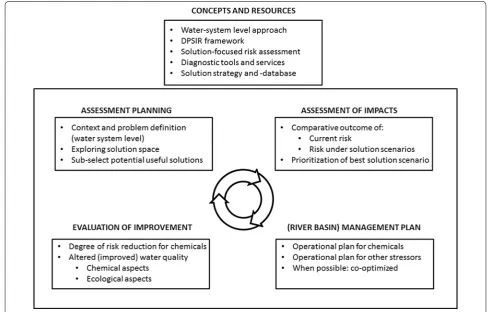
To handle this vast diversity of pollution situations, we suggest that water quality assessors employ a system-atic approach to diagnose water quality problems and their probable causes, as prescribed in the WFD-Annex II. We therefore combined the WFD-suggested DPSIR approach [8, 16]) with the extended conceptual frame-work for solution-focused management of chemical pollution in European waters [13, 19]. The result of the combined concepts is shown in Fig. 1. The present paper focuses specifically on early-stage attention for explor-ing optional Responses (R), that is, to explore the ‘solution space’ when a water quality problem is hypothesized or found. The WFD (Annex VI) does provide already a list of standard measures that can be addressed as potential solutions to be considered for the programs of meas-ures (Additional file 1). The list suggests that the ‘solu-tion space’ is large, but it does not provide a very specific or operational strategy or solution approaches. Figure 1
the entries ‘Chemicals’, ‘Environment’ and ‘Society’), as detailed below.
Given the conceptual framework of Fig. 1 and the tools and services to characterize water quality problems [20], we aimed to systematically collate abatement techniques and management options and strategies and to make the results available for re-use by others encountering a similar chemical pollution problem. Systematic stor-age of those—with or without evaluating them—enables a whole community of users to retrieve collated options and experiences, and thus to explore a wide array of options. Users can retrieve options in the ‘solution space’, to derive programs of measures for their specific problem (see below).
As compared to current practices, the combined framework (Fig. 1) encompasses a change from single chemicals per site to a system-level approach, from a problem description-oriented approach to (also) a solu-tion-targeted approach, and from a limited view on the ‘solution space’ to a systematic basis to recognize that the ‘solution space’ is large.
2. The early exploration of the ‘solution space’
The early management attention to the Response-step (R) of the DPSIR causal cycle can be supported by system-atic collations of data on technical abatement options and a description of the management strategy. To that end, such information was collated in a database of technical abatement options [21], and in a proposal for the sys-tematic evaluation of non-technical solution scenarios (see Additional file 1). Both were designed to be broadly applicable. This supports users in exploring the ‘solution space’ and may help to inspire them to evaluate options they would never have thought of, and the availability of a database of options helps to avoid that ‘the wheel is re-invented over and over again’.
was achieved by an analysis of the installation-specific removal efficiencies of chemicals with different physi-cal–chemical properties. It should be acknowledged that the database can be continuously expanded, based on the experiences gained, which would further improve the value of the technical abatement database.
The non-technical options were found to be highly diverse (Fig. 2). The exploration of prevention and man-agement strategies is currently formatted as a strategy to explore the ‘solution space’ (Fig. 2). Note that this figure is directly derived from and related to the conceptual framework (Fig. 1). It provides a generic scheme that sup-ports end users in exploring the non-technical ‘solution space’. The visualization of the ‘solution space’ in Fig. 2
shows that there are three general levels to approach a pollution problem, going from operational via tactical to strategic options. Note that the discrimination between these levels is not strict. Further details are in Additional file 1. Figure 2 shows how the conceptual framework (Chemicals, Environment, Abatement and Society, Fig. 1) thus in general supports a systematic exploration of the available ‘solution space’ (Fig. 2).
The application of the strategy and the scheme of Fig. 2
are further elaborated in Additional file 1. There are two final remarks on the ‘solution space’ in relation to other
(non-chemical pollution) stress. First, it should be noted that the exploration of the ‘solution space’ in the pre-sent paper focused on chemical pollution only. However, the diagnosis of impacts of all stressors may show that chemical pollution is only part of the problem, or even negligible, and that the ‘solution space’ for the integrated management plan should also consider the solutions to other stressors. Second, it should be noted that a single solution strategy may help reduce the impacts of multiple sources of stress. For example, zonation (between land use and water systems) helps reduce emissions of both nutrients and agricultural chemicals.
3. Prioritizing the intensity of measures against chemical pollution
Diagnostic results—ranking sites and compounds regarding the relative importance of chemical pollu-tion to cause harm—are needed as a first step to help prioritize the need for and intensity of the measures that can be taken to prevent or reduce chemical pollu-tion problems. As any compound (currently in trade, or produced in the future) can pose harm (alone or in a mixture), the WFD and current research therefore con-sider all compounds and their mixtures. The diagnos-tic step is supported by diagnosdiagnos-tic tools and services
(e.g., [6, 10, 11]) and helps to steer management efforts to those sites and compounds that are most problem-atic for reaching the WFD environmental goals (good chemical and ecological status). The exploration of the ‘solution space’ might focus on prioritized water bod-ies and compounds, but would also consider lower-ranked cases where a solution option is relatively easy to implement.
4. Solution‑focused practices
So far, the recommended approaches are introduced as novel concepts, with generic schemes to assist water quality assessors in practice. The combination of the solution-focused framework, the diagnostic approaches and the database and strategy for exploring the ‘solu-tion space’ yields a novel flow diagram (Fig. 3). The dia-gram closely relates to the current WFD-assessment and management cycle, but emphasizes the novel key step (early focus on exploring the ‘solution space’) as well as the aforementioned recommendations to improve current practices (such as to follow the sys-tems-level approach of the WFD).
5. Evidence for improved status
Case studies have shown that the implementation of solution strategies resulted in reduced chemical pollution problems in European surface water systems.
First, the chemical, bioanalytical and ecological tools that are available were used to evaluate chemical pollu-tion in relapollu-tion to the efficacy of wastewater treatment plants (WWTPs) in removal of chemicals and reduc-ing risks and impacts [22, 23]. The evaluation consid-ered WWTP upgrades with an added activated carbon treatment step and considered up- and downstream and before/after comparisons. It was demonstrated that the improved treatment influenced ecosystem exposure (reduced) and quality (improved). The extra carbon treat-ment was beneficial for the chemical, biological and eco-logical status of the receiving water bodies [22–25].
Second, additional studies considered ten riverbank filtration sites along the River Rhine and its tributaries, and looked at modeling, existing data and additional analytical measurements of trace organic compounds to assess the attenuation potential of selected chemi-cals present in the surface water by riverbank filtra-tion. For a site with long retention times to the drinking
water well, the results enabled the categorization into very persistent, partially removable and fully remov-able compounds in the given time scales [26]. For three sites with short travel times, a broad analytical screen-ing enabled categorization of the chemicals into “per-sistent” and “naturally attenuated” classes [27]. For one Dutch site, the efficiency of anaerobic riverbank fil-tration was assessed before and after reverse osmosis treatment, using a battery of bioassays combined with non-target screening. The treatment process of reverse osmosis was characterized in more detail using spiked anaerobic riverbank filtrate [28].
Monitoring can also directly trigger a solution strat-egy or method. Daily wide-scope target and non-target screening of water samples using high-resolution mass spectrometry at River Rhine stations triggered success-ful abatement measures when regulated and non-monitored relevant chemicals were detected [29]. Many pollution sources can be located in river catchments via DPSIR analyses and/or monitoring. The example case studies cited above, as well as scenario studies with models [6], show that corrective measures, such as change in industrial production processes or improved waste management, can significantly reduce or elimi-nate discharges and chemical pollution risks.
6. Exploring future options
The compilation of optional technical abatement and management strategies can be followed by a ‘fitness check’ of expected water quality improvements. Here, the water quality assessor evaluates each option with respect to critical aspects, such as practical implemen-tation, costs and efficacy. Scenario analyses can be run to evaluate the expected improvements in water qual-ity, applying component-based approaches. An example result of such a comparative assessment is shown in a case study of future emission scenarios of chemicals at the European scale under alternative policy strate-gies [6, 30]. The most remarkable result was a highly positive effect (35% less toxic pressure, expressed as multi-substance potentially affected fraction, msPAF) of the phasing out of 26 substances of very high con-cern (SVHC) listed on the REACH Candidate List (out of the 1357 chemicals registered under REACH that were included in the ‘future management’ scenario). This clearly shows the high potential of focused regula-tory measures to reduce the total chemical burden in general [31]. But specifically, the water quality change in relation to SVHC-focused emission reduction meas-ures appeared to be more than proportional, driven by non-linear exposure–effect relationships (see also [32,
33]).
7. Evaluation and communication of trends: chemical footprints
Communicating the output of the changes following from an implemented solution scenario and/or future management scenarios requires an innovative approach for evaluating trends and communicating results. This is key, given the diverse appearances of the chemical pollution problem. A chemical footprint approach was developed for this, providing summary information of the chemical pollution for an area [34, 35]. The chemi-cal footprint indicator provides summary insights in the net likelihood of chemical pollution to cause harm. Indi-cations for a decreasing chemical footprint were found in a retrospective study of a European basin [35], in line with emission reduction policy objectives and efforts and associated observations made with effect-based meth-ods. The chemical footprint indicator can currently pro-vide insights in the chemical footprint at the level of local water bodies. That is, the management-relevant out-comes of current chemical footprint analysis consist of (1) information whether and in how far upstream ‘source’ areas contribute to a local mixture risk, (2) information on the relative importance of chemical emissions to the local mixture toxicity and (3) information on whether and in how far mixture toxicity from a polluted water body is transported to downstream ‘target’ areas [36]. These types of information are key to define programs of measures against pollution and which actors to address (upstream or local) who have shared responsibility in causing risks (1 and 2) and to inform water managers of the downstream areas.
8. Further developments
The success of water quality protection and management regarding chemical pollution depends on the possibility to identify and implement optimal abatement techniques and management approaches [31, 37]. The implementa-tion of the soluimplementa-tion-focused risk assessment paradigm into the practice of European water management is supported by a conceptual framework that guides the assessment process and provides a systematic overview of available abatement and management strategies. The abatement database and the management strategies are continuously expanding, following the continued cycle of water quality management activities and monitoring-based water quality evaluations.
Supplementary information
Additional file 1. Strategy to explore the ‘solution space’ to protect and restore water quality in relation to chemical pollution.
Abbreviations
DPSIR: Drivers, Pressure, Status, Impact and Response; msPAF: multi-substance potentially affected fraction; REACH: registration, evaluation, authorization and restriction of chemicals; SVHC: substances of very high concern; WFD: Water Framework Directive; WWTP: wastewater treatment plant.
Acknowledgements
This article has been prepared as an outcome of the projects SOLUTIONS (European Union’s Seventh Framework Programme for research, technological development and demonstration under Grant Agreement No. 603437), with further support of the Strategic Program RIVM (SPR) as run under the auspices of the Director General of RIVM and RIVM’s scientific advisory board.
Authors’ contributions
LP and AvW conceptualized and drafted the manuscript. All other authors helped to further elaborate the manuscript and contributed specific aspects. All authors read and approved the final manuscript.
Funding Not applicable.
Availability of data and materials
Additional file is provided on strategies to explore the ‘solution space’.
Ethics approval and consent to participate Not applicable.
Consent for publication Not applicable.
Competing interests
The authors declare that they have no competing interests.
Author details
1 RIVM, National Institute for Public Health and the Environment, P.O. Box 1,
3720 BA Bilthoven, The Netherlands. 2 Department of Environmental Science,
Radboud University, Nijmegen, The Netherlands. 3 University of Gothenburg,
Carl Skottsbergs Gata 22B, 40530 Göteborg, Sweden. 4 Eawag, Swiss Federal
Institute of Aquatic Science and Technology, 8600 Dübendorf, Switzerland.
5 Öko-Institut, e.V. Postfach 17 71, 79017 Freiburg, Germany. 6 Helmholtz
Centre for Environmental Research UFZ, Permoserstr. 15, Leipzig 04318, Germany. 7 Department of Ecosystem Analysis, Institute for Environmental
Research, ABBt-Aachen Biology, Aachen, Germany. 8 Deltares, Delft, The
Neth-erlands. 9 IVL Swedish Environmental Research Institute, Valhallavägen 81, 114
28 Stockholm, Sweden. 10 Institute for Biodiversity and Ecosystem Dynamics,
University of Amsterdam, Amsterdam, The Netherlands.
Received: 3 June 2019 Accepted: 3 September 2019
References
1. EC (2000) Directive 2000/60/EC of the European parliament and of the council of 23 October 2000 establishing a framework for Community action in the field of water policy. Off J Eur Commun 2000(327):1–72 2. EEA (2018) European waters—assessment of status and pressures. EEA
Report No. 7/2018, EEA, Copenhagen, Denmark
3. Brack W et al (2018) Towards a holistic and solution-oriented monitoring of chemical status of European water bodies: how to support the EU strategy for a non-toxic environment? Environ Sci Eur 30(1):33 4. EEA (2018) Chemicals in European waters. Knowledge developments.
EEA report 18/2018: Copenhagen, Denmark
5. Posthuma L et al (2019) Species sensitivity distributions for use in environmental protection, assessment, and management of aquatic ecosystems for 12 386 chemicals. Environ Toxicol Chem 38(4):905–917
6. Van Gils J et al The European Collaborative Project SOLUTIONS developed models to provide diagnostic and prognostic capacity and fill data gaps for chemicals of emerging concern. Environ Sci Eur. https ://doi. org/10.1186/s1230 2-019-0248-3
7. Borgwardt F et al (2019) Exploring variability in environmental impact risk from human activities across aquatic ecosystems. Sci Total Environ 652:1396–1408
8. Posthuma L et al (2019) A holistic approach to is key protect, monitor, assess and manage chemical pollution of European surface waters (Policy Brief #1). Environ Sci Eur (subm. 20190603_ESEU-D-19-00072). https ://doi. org/10.1186/s1230 2-019-0243-8
9. Brack W et al (2019) High resolution mass spectrometry to comple-ment monitoring and track emerging chemicals and pollution trends in European water resources. Environ Sci Eur. https ://doi.org/10.1186/s1230 2-019-0230-0
10. Posthuma L et al (2019) Improved component-based methods for mixture risk assessment are key to characterize complex chemical pol-lution in surface waters. Environ Sci Eur. https ://doi.org/10.1186/s1230 2-019-0246-5
11. Brack W et al (2019) Effect-based methods are key. The European Collabo-rative Project SOLUTIONS recommends integrating effect-based methods for diagnosis and monitoring of water quality. Environ Sci Eur 31(1):10. https ://doi.org/10.1186/s1230 2-019-0192-2
12. UN (2019) Global Chemicals Outlook II—From legacies to innovative solutions: Implementing the 2030 agenda for sustainable development. Synthesis report. UN Environment: Geneva, Switzerland
13. U.S. NAS (2009) Science and decisions: advancing risk assessment. National Academies of Science—Committee on Improving Risk Analysis Approaches Used by the U.S. EPA, The National Academies Press 14. Blum C et al (2017) The concept of sustainable chemistry: key drivers for
the transition towards sustainable development. Sustain Chem Pharm 5:94–104
15. Smith GD (2002) Commentary: behind the Broad Street pump: aetiology, epidemiology and prevention of cholera in mid-19th century Britain. Int J Epidemiol 31(5):920–932
16. EC (2003) Common Implementation Strategy for the Water Framework Directive (2000/60/EC). Guidance Document No. 3. Analysis of Pressures and Impacts. EC, CIS-Working Group 2.1—IMPRESS: Brussels, Belgium 17. EC (2005) Common implementation strategy for the Water framework
Directive (2000/60/EC)—Guidance Document No. 13—Overall approach to the classification of ecological status and ecological potential, Euro-pean Commission, Editor. Brussel, Belgium
18. Brack W et al (2015) The SOLUTIONS project: challenges and responses for present and future emerging pollutants in land and water resources management. Sci Total Environ 503–504:22–31
19. Munthe J et al (2017) An expanded conceptual framework for solution-focused management of chemical pollution in European waters. Environ Sci Eur 29(13):1–16
20. Kramer K et al (2019) The RiBaTox web tool: selecting methods to assess and manage the diverse problem of chemical pollution in surface waters. Environ Sci Eur. https ://doi.org/10.1186/s1230 2-019-0244-7
21. van Wezel AP et al (2017) Mitigation options for chemicals of emerging concern in surface waters; operationalising solutions-focused risk assess-ment. Environ Sci Water Res Technol 3(3):403–414
22. Neale PA et al (2017) Integrating chemical analysis and bioanalysis to evaluate the contribution of wastewater effluent on the micropollutant burden in small streams. Sci Total Environ 576:785–795
23. Munz NA et al (2017) Pesticides drive risk of micropollutants in wastewa-ter-impacted streams during low flow conditions. Water Res 110:366–377 24. Munz NA et al (2018) Internal concentrations in gammarids reveal
increased risk of organic micropollutants in wastewater-impacted streams. Environ Sci Technol 18:10347–10358
25. Tlili A et al (2017) Micropollutant-induced tolerance of in situ periphy-ton: establishing causality in wastewater-impacted streams. Water Res 111:185–194
26. Hamann E et al (2016) The fate of organic micropollutants dur-ing long-term/long-distance river bank filtration. Sci Total Environ 545–546:629–640
28. Albergamo V et al (2019) Removal of polar organic micropollutants by pilot-scale reverse osmosis drinking water treatment. Water Res 148:535–545
29. Hollender J, Schymanski EL (2017) Nontarget screening with high resolu-tion mass spectrometry in the environment: ready to go? Environ Sci Technol 51:11505–11512
30. Moritz S et al (2017) Developments in society and implications for emerging pollutants in the aquatic environment. Oeko-Institut Freiburg, Germany
31. Kümmerer K et al (2019) Reducing aquatic micropollutants—increasing the focus on input prevention and integrated emission management. Sci Total Environ 652:836–850
32. van Wezel AP et al (2018) Impact of industrial waste water treatment plants on Dutch surface waters and drinking water sources. Sci Total Environ 640–641:1489–1499
33. Coppens LJC et al (2015) Towards spatially smart abatement of human pharmaceuticals in surface waters: defining impact of sewage treatment plants on susceptible functions. Water Res 81:356–365
34. Posthuma L et al (2014) Beyond safe operating space: finding chemical footprinting feasible. Environ Sci Technol 48(11):6057–6059
35. Zijp MC, Posthuma L, Van de Meent D (2014) Definition and applications of a versatile chemical pollution footprint methodology. Environ Sci Technol 48:10588–10597
36. Van Gils J et al (2018) SOLUTIONS Deliverable D14.1. Modelling frame-work and model-based assessment for substance screening. Deltares, Leipzig
37. Kümmerer K et al (2018) A path to clean water. Science 361(6399):222–224
Publisher’s Note