57
A Novel Method Based on Two Different Thicknesses
of The Sample for Determining Complex Permittivity
of Materials Using Electromagnetic Wave Propagation
in Free Space at X-Band
Ho Manh Cuong
1,*, Vu Van Yem
21Electric Power University
2Hanoi University of Science and Technology, Vietnam
Abstract
In this paper, we present a method for determining complex permittivity of materials using two different thicknesses of the sample placed in free space. The proposed method is based on the use of transmission having
the same geometry with different thicknesses with the aim to determine the complex propagation constant (γ).
The reflection and transmission coefficients (S11 and S21) of material samples are determined using a free-space
measurement system. The system consists of transmit and receive horn antennas operating at X-band. The complex permittivity of materials is calculated from the values of γ, in turns received from S11 and S21. The
proposed method is tested with different material samples in the frequency range of 8.0 – 12.0 GHz. The results show that the complex permittivity determination of low-loss material samples is more accurate than that of high-loss ones. However, the dielectric loss tangent of high-loss material samples is negligibly affected.
Received 04 February 2017; Revised 17 May 2017; Accepted 11 July 2017
Keywords: Complex permittivity, Dielectric loss tangent, Complex propagation constant, S-parameters.
1. Introduction*
The complex propagation constant is determined from scattering S-parameters measurements performed on two lines (Line-Line Method) having the same characteristic impedance but different lengths [1]. Once the parameters are measured either the ABCD [2] or wave cascading matrix (WCM) [3-5] may be used for determining complex propagation constant. The proposed method for determining complex permittivity of materials are structure to connected with device
________
*Corresponding author. E-mail: [email protected] https://doi.org/10.25073/2588-1086/vnucsce.158
measurements such as printed circuit board (PCB) materials [6-12]. Although the proposed methods are simple, quick, and reliable to use. However, it has drawbacks such as the material samples to determine the complex permittivity require structures the type printed circuit board. The measurement of complex permittivity of material can be made by using the transmission/reflection method developed by Weir [13]. The method for determining S-parameters of material in free space are nondestructive and contactless; hence, they are especially suitable for measurement of the complex permittivity (ε*
high-temperature conditions. The most popular methods for determining the parameter of materials are proposed in [14-21]. The errors in free-space measurements are presumed to be due to diffraction effects at the edges of the sample and multiple reflections between the antennas. Diffraction effects at the edges of the sample are minimized by using spot-focusing horn lens antennas as transmitters and receivers. The method proposed by D. K. Ghodgaonkar et al. [14]have developed a free-space TRL (thru, reflect, line) calibration technique which eliminates errors due to multiple reflections. This method is especially suitable for quick, routine, and broad-band measurement of complex permittivity of high-loss materials. However, for materials with dielectric loss tangent less than 0.1, the loss factor measurements are found to be inaccurate because of errors in reflection and transmission coefficient measurements.
In this paper, we propose a method in free space for determining complex permittivity of materials based on the use of transmission having the same geometry with different
thicknesses. Diffraction effects at the edges of the sample and multiple reflections between the antennas are minimized by using two different thicknesses of the sample placed in free space. Our results indicate that the permittivity of material is quite stable in the frequency range of 8.0 – 12.0 GHz. In addition, for materials with dielectric loss tangent less than 0.1, the loss factor measurements are accuracy in the entire frequency band.
The next section describes the theory of our method in detail. The modeling and results are presented in section 3. Finally, section 4 concludes this paper.
2. Theory
The complex permittivity of materials is defined as
* , ,, ,
ε
ε = ε - jε = ε (1- jtanδ ) (1)
where, ε, and ε,, are the real and imaginary
parts of complex permittivity, and tanδε is the
dielectric loss tangent.
S
AMPLE
d1
Antenna 1 Antenna 2
d0 d0
Port 1 Port 2
X T1 Y
1 11
S
1 21
S
Free Space Free Space
(a)
Port 1
SA
MP
LE
d2
Antenna 1 Antenna 2
d0 d0
Port 2
X T2 Y
2 11
S
2 21
S
Free Space Free Space
(b)
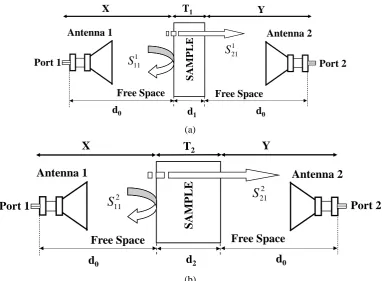
Figure 1 shows two planar sample of thicknesses d1 and
d
2 (d2>d
1) placed in freespace. For both transmissions (a) and (b), the determined two port parameters expressed in ABCD matrix form can be considered as a product of three parts: an input matrix X, including the input coax-to-antenna transition, transmission T , and an output matrix Y, including the output coax-to-antenna transition. It can be shown that the M1 and M2 matrices
are related to X , T and Y by the following equations [2]:
1 1
M = XT Y (2)
2 2
M = XT Y (3)
where Mi, X, Ti, and Y are ABCD matrices
for the corresponding sections as in the Figure 1. Mi can be related to measurable scattering
parameters [22] by equation (4).
i i i i i
12 21 11 22 11
i i
21 22
i
-1
M =
-s -s s s s
s s 1
(4)
The cascade matrix Ti of the homogenous
transmission line i, is defined as
i
i
i
-γd
e 0
T =
γd
0 e
(5)
where γ and di are the complex propagation constant and length of the line. Multiplying the matrix M1 by the inverse matrix of M2, we
obtain (6)
-1 -1 -1
1 2 1 2
M M = XT T X (6)
In (6), notice that -1 1 2
M M is the similar
transformation of T T1 2-1. Using the fact that the trace, which is defined as the sum of the diagonal elements, does not change under the similar transformation in the matrix calculation, we can deduce (7)
-1 -1
1 2 1 2
Tr(M M )=Tr(T T )= 2cosh(γΔd) (7)
where Δd = d - d
2 1
is the length difference of two transmission lines. The complex propagation constant is found from (8)
-1 -1
1 2
1
cosh Tr M M
2 γ =
Δd
(8)
The real part of γ is unique and single valued, but the imaginary part of γ has multiple values. It is defined as
(Δφ - 360n) γ = α+ jβ = α+ j
Δd (9)
where α and β are the real and imaginary parts of the complex propagation constant, n is an integer (n= 0,±1,±2, ), Δφ is the reading of
the instrument (-1800Δφ1800). The phase constant β is defined as
,
0
360
β = ε
λ (10)
where λ0 is the wavelength in free space.
The phase shift of complex propagation constant is the difference between the phase angle ΔΦ measured with two material sample between the two antennas, namely:
2 1
ΔΦ = Φ - Φ (11)
where
, i i
0
-360d ε
Φ =
λ is the phase angle of
material sample (i = 1,2). Consequently the phase shift is given by
,
0
-360Δd ε ΔΦ =
λ (12)
On the other hand, it can be expressed from (9) and (10) as
ΔΦ = Δφ - 360n (13)
Measurements at two frequencies can also be used to solve the phase ambiguity problem [23]. The frequencies are selected in a region such that the difference between dielectric constants, ,
1
ε at f1, 2 ,
ε at f2, is small enough
to permit the following assumption, using (12) and (13):
01 1 1 02 2 2
where λ01 and λ02 are the wavelengths in free
space at f1 and f2, respectively, with f1< f2,
1
n and n2 are the integers to be determined.
For this purpose, a second equation is needed. This equation can be
2 1
n - n = k (15)
where k is an integer.
The integers n1 and n2 can be either equal
(k = 0) or different (k = 1,2, ) depending on the frequency difference and dielectric properties and thickness of material under test. Therefore, two cases can be distinguished: + k = 0
2
01 1 02 2 1
01 02
λ Δφ - λ Δφ n = n =
360(λ - λ ) (16)
+ k 0
01 1 02 2 02
1
01 02 01 02
λ Δφ - λ Δφ λ
n = + k
360(λ - λ ) λ - λ (17)
with
2 1
n = n + k (18)
The complex permittivity of the material is calculated from (7), we obtain
2
* cγ
ε = j2πf
(19)
where f is the frequency and c is the light velocity.
3. Modeling and results
3.1. Modeling
In this part, using the Computer Simulation Technology (CST) software to model system which presented in section 2, matrix S are determined from this modeling.
Figure 2. Modeling determining the parameters of material sample by CST.
In figure 2, two same pyramidal antennas are designed to operate well in the frequency range of 8.0 – 12.0 GHz. The gain and voltage standing wave ratio of the pyramidal horn antennas are 20 dBi and 1.15 at center frequency. In this model, the distance between the antenna and the material sample is 250mm (d0=250mm).
The two selected material samples have parameters as follows: The width and length of 150mm, the thicknesses of 7mm and 12mm. The complex permittivity of material samples:
= 2.8 - j0
*
ε ,ε* = 2.8 - j0.14,ε* = 2.8 - j0.28 and ε* = 2.8 - j0.84. With Δd = 5mm is the length difference of two material samples. The frequencies f1 and
f
2 ( f1< f2) are selected inthe frequency range of 8.0 – 12.0 GHz. The results show that in the entire frequency band.
3.2. Results
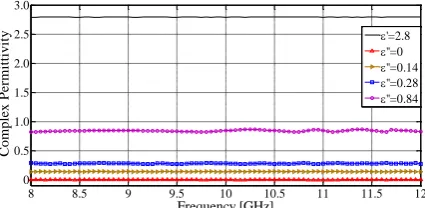
The reflection and transmission coefficients of two planar material samples are determined using the proposed model in section 3.1. The complex permittivity of material samples is calculated by equation (19) in section 2.
8 8.5 9 9.5 10 10.5 11 11.5 12 0
0.5 1.0 1.5 2.0 2.5 3.0
Frequency [GHz]
C
om
pl
ex
P
er
m
it
ti
vi
ty '=2.8
''=0 ''=0.14 ''=0.28 ''=0.84
Figure 3. Complex permittivity of material samples
(Δd = 5mm).
8 8.5 9 9.5 10 10.5 11 11.5 12 -0.5
-0.4 -0.3 -0.2 -0.1 0 0.1 0.2 0.3 0.4 0.5
Frequency [GHz]
R
M
S
E
of
D
iel
ec
tr
ic
L
os
s
T
angent
tan=0 tan=0.05 tan=0.1 tan=0.3
Figure 4. The root mean squared error of dielectric
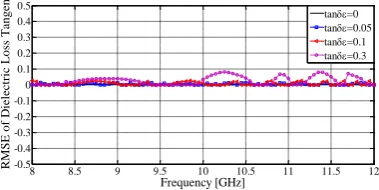
loss tangent the materials (Δd= 5mm).
Figure 4 shows for materials with the dielectric loss tangent less than or equal to 0.1. The root mean squared error (RMSE) changes from 0 to 0.03. When dielectric loss tangent more than 0.1, the RMSE changes from 0 to 0.08. So, the results show that for materials with different dielectric loss tangent, the complex permittivity is nearly identical with the theoretical values. However, the dielectric loss tangent more than 0.1, the complex permittivity is effected by multiple reflections between the antennas. These errors are small and acceptable for high-loss materials.
The results show that the complex permittivity of low-loss material samples obtained by our method is more accurate than that calculated by the method proposed in [14]. However, with high-loss material samples, the root mean squared error of our method is larger than that of the method in [14].
1 2 3 4 5 6 7 8 9 10
-0.02 -0.01 0 0.01 0.02 0.03 0.04 0.05
E
rr
or
Length difference [mm]
'=2.8 ''=0 ''=0.14 ''=0.28 ''=0.84
Figure 5. Error versus length difference of two transmission lines.
Figure 5 shows that the error versus the length defferences of two transmission lines is very small, so that the complex permitivity of material samples is negligibly affected by the different thicknesses of those samples.
4. Conclusion
We propose a method for determining the complex permittivity of materials using two different thicknesses of the sample in free space. The method consists of two antennas placed in free space and the two different thicknesses material samples placed in the middle of the two antennas. The results show that the permittivity of material is quite stable in the frequency range 8.0 - 12.0 GHz. In addition, the dielectric loss tangent of low-loss material samples is determined accurately by using proposed method. Our proposed method is especially suitable for determining complex permittivity of low-loss materials.
This method is applicable in many scientific fields such as: electronics, communications, metrology, mining, surveying, etc. Because this method is nondestructive and contactless, it can be used for broad-band measurement of permittivity under high-temperature conditions.
References
[1] N. K. Das, S. M. Voda, and D. M. Pozar,
"Two Methods for the Measurement of
Substrate Dielectric Constant," IEEE
Transactions on Microwave Theory and Techniques, vol. 35, pp. 636-642, 1987.
[2] L. Moon-Que and N. Sangwook, "An
accurate broadband measurement of substrate dielectric constant," IEEE Microwave and
Guided Wave Letters, vol. 6,
pp. 168-170, 1996.
[3] R. B. Marks, "A multiline method of network
analyzer calibration," IEEE Transactions on Microwave Theory and Techniques, vol. 39, pp. 1205-1215, 1991.
[4] C. Wan, B. Nauwelaers, and W. D. Raedt, "A
simple error correction method for two-port transmission parameter measurement," IEEE Microwave and Guided Wave Letters, vol. 8, pp. 58-59, 1998.
[5] J. A. Reynoso-Hernandez, C. F.
Estrada-Maldonado, T. Parra, K. Grenier, and J.
Graffeuil, "Computation of the wave
in Microwave Conference, 1999 Asia Pacific, vol.2, pp. 266-269, 1999.
[6] J. A. Reynoso-Hernandez, "Unified method for
determining the complex propagation constant of reflecting and nonreflecting transmission
lines," IEEE Microwave and Wireless
Components Letters, vol. 13, pp. 351-353, 2003. [7] Y. Young, "A novel microstrip-line structure employing a periodically perforated ground
metal and its application to highly
miniaturized and low-impedance passive components fabricated on GaAs MMIC," IEEE Transactions on Microwave Theory and Techniques, vol. 53, pp. 1951-1959, 2005. [8] C. You, Y. Sun, and X. Zhu, "Novel wideband
bandpass filter design based on two
transformations of coupled microstrip line," in Antennas and Propagation (APSURSI), IEEE
International Symposium on,
pp. 3369-3372, 2011.
[9] Q. Xue, L. Chiu, and H. T. Zhu, "A transition of microstrip line to dielectric microstrip line for
millimeter wave circuits," in Wireless
Symposium (IWS), IEEE International,
pp. 1-4, 2013.
[10] M. A. Suster and P. Mohseni, "An
RF/microwave microfluidic sensor based on a center-gapped microstrip line for miniaturized
dielectric spectroscopy," in Microwave
Symposium Digest (IMS), IEEE MTT-S International, pp. 1-3, 2013.
[11] J. Roelvink and S. Trabelsi, "A calibration
technique for measuring the complex
permittivity of materials with planar
transmission lines," in 2013 IEEE
International Instrumentation and
Measurement Technology Conference
(I2MTC), pp. 1445-1448, 2013.
[12] L. Tong, H. Zha, and Y. Tian, "Determining the complex permittivity of powder materials
from l-40GHz using transmission-line
technique," in 2013 IEEE International Geoscience and Remote Sensing Symposium - IGARSS, pp. 1380-1382, 2013.
[13] W. B. Weir, "Automatic measurement of
complex dielectric constant and permeability at microwave frequencies," Proceedings of the IEEE, vol. 62, pp. 33-36, 1974.
[14] D. K. Ghodgaonkar. V. V. Varadan, and V.
K. Varadan. "A free-space method for measurement of dielectric constants and loss tangents at microwave frequencies," IEEE
Transactions on Instrumentation and
Measurement, vol. 38, pp. 789-793, 1989.
[15] E. Håkansson, A. Amiet, and A. Kaynak,
"Electromagnetic shielding properties of polypyrrole/polyester composites in the 1-18GHz frequency range," Synthetic metals, vol. 156, pp. 917-925, 2006.
[16] V. V. Varadan and R. Ro, "Unique Retrieval of Complex Permittivity and Permeability of Dispersive Materials From Reflection and Transmitted Fields by Enforcing Causality," IEEE Transactions on Microwave Theory and Techniques, vol. 55, pp. 2224-2230, 2007.
[17] U. C. Hasar, "Unique permittivity
determination of low-loss dielectric materials
from transmission measurements at
microwave frequencies," Progress In
Electromagnetics Research, vol. 107, pp. 31-46, 2010.
[18] J. Roelvink and S. Trabelsi, "Measuring the complex permittivity of thin grain samples by the free-space transmission technique," in
Instrumentation and Measurement
Technology Conference (I2MTC), 2012 IEEE International, pp. 310-313, 2012.
[19] R. A. Fenner and S. Keilson, "Free space
material characterization using genetic
algorithms," in Antenna Technology and Applied Electromagnetics (ANTEM), 2014
16th International Symposium on,
pp. 1-2, 2014.
[20] N. A. Andrushchak, I. D. Karbovnyk, K.
Godziszewski, Y. Yashchyshyn, M. V. Lobur, and A. S. Andrushchak, "New Interference Technique for Determination of Low Loss Material Permittivity in the Extremely High Frequency Range," IEEE
Transactions on Instrumentation and
Measurement, vol. 64, pp. 3005-3012, 2015.
[21] T. Tosaka, K. Fujii, K. Fukunaga, and A.
Kasamatsu, "Development of Complex
Relative Permittivity Measurement System Based on Free-Space in 220– 330-GHz Range," IEEE Transactions on Terahertz Science and Technology, vol. 5, pp. 102-109, 2015.
[22] P. M. Narayanan, "Microstrip Transmission
Line Method for Broadband Permittivity Measurement of Dielectric Substrates," IEEE Transactions on Microwave Theory and Techniques, vol. 62, pp. 2784-2790, 2014.
[23] S. Trabelsi, A.W. Kraszewski, and S. O.
Nelson, “Phase-shift ambiguity in microwave dielectric properties measurements,” IEEE
Transactions on Instrumentation and