Vol. 7, No. 1, 2015, 75-80
ISSN: 2320 –3242 (P), 2320 –3250 (online) Published on 22 January 2015
www.researchmathsci.org
75
International Journal of
BD–Domination in Graphs
M.Bhanumathi1 and M.Kavitha2 1Government Arts College for Women, Pudukkottai-622001, Tamil nadu, India e-mail: [email protected]
Corresponding Author
2
Government Arts College for Women, Pudukkottai-622001, Tamil nadu, India e-mail: [email protected]
Received 2 November 2014; accepted 4 December 2014
Abstract. A vertex v is a boundary vertex of u if d(u, w) ≤ d(u, v) for all w ∈ N(v). A
vertex u have more than one boundary vertex at different distance levels. A vertex v is
called a boundary neighbour of u if v is a nearest boundary of u. A set S ⊆V(G) is a bd – dominating set such that every vertex in V-S has at least one neighbour and at least one boundary neighbour in S. The cardinality of the minimum bd - dominating set is called the bd - domination number and is denoted by γbd(G).In this paper we present several
bounds on the bd - domination number and exact values of particular graphs.
Keywords: Boundary vertex, boundary neighbour, bd – dominating set AMS Mathematics Subject Classification (2010): 05C69, 05C12 1. Introduction and preliminaries
Let G be a finite, simple, undirected graph on n vertices with vertex set V(G) and edge set E(G). For graph theoretic terminology refer to Harary [5], Buckley and Harary [3].
Definition 1.1. The open neighborhoodN(u) of a vertex v is the set of all vertices
adjacent to v in G. N[v] = N(v)∪{v} is called the closed neighborhood of v.
Definition 1.2. A bigraph or bipartite graph G is a graph whose point set V can be
partitioned into two subsets V1 and V2 such that every line of G joins V1 with V2. If
further G contains every line joining the points of V1 to the points of V2 then G is called a complete bigraph. If V1 contains m points and V2 contains n points then the complete
bigraph G is denoted by Km,n.
Definition 1.3. A star is a complete bi graph K1,n.
Definition 1.5. [6] A set D
set of G and for every v
cardinality of minimum eccentric dominating set is called the
number and is denoted by
If D is an eccentric dominating set, then every superset D dominating set. But D″⊆
An eccentric dominating set D is a D″⊆D is an eccentric dominating set.
Definition 1.6. [4] A vertex v is a
N(v). A vertex u have more than one boundary vertex at different distance levels. A vertex v is called a boundary neighbour
number of boundary neighbour of u is called the In 2010, Janakiraman el al.
this, here we have defined parameter.
Theorem 1.1. [6] γed(Kn) = 1. Theorem 1.2. [6] γed(Km,n Theorem 1.3. [6] γed(K1,n
Theorem 1.4. [6] γed(Pn) =
Theorem 1.5. [6] γed(W3 Theorem 1.6. [6] (i) γed(C
(ii) γed(Cn) =
2. BD – Domination Definition 2.1. A set S
has at least one neighbour and at least one boundary neighbour the minimum bd - dominating set is called the
by γγγγbd(G).
Let S ⊆V(G). Then S is known as a
vertex v ∈V – S, S has at least one vertex u such that u A boundary neighbour set S of G is a
subset S′ of S is a boundary neighbour set of G.
76
A set D ⊆ V(G) is an eccentric dominating set if D is a dominating set of G and for every v ∈V−D, there exists at least one eccentric point of v in D. The cardinality of minimum eccentric dominating set is called the eccentric domination
and is denoted by .
If D is an eccentric dominating set, then every superset D′⊇D is also an eccentric
⊆D is not necessarily an eccentric dominating set.
An eccentric dominating set D is a minimal eccentric dominating set if no proper subse D is an eccentric dominating set.
A vertex v is a boundary vertex of u if d(u, w) ≤ d(u, v) for all w
N(v). A vertex u have more than one boundary vertex at different distance levels.
boundary neighbour of u if v is a nearest boundary of u. The
number of boundary neighbour of u is called the boundary degree of u. el al. have defined Eccentric domination in graphs.
this, here we have defined bd – domination number of a given graph and study that
) = 1.
m,n) = 2. 1,n) = 2, n ≥ 2.
) =
3) = 1, γed(W4) = 2, γed(Wn) = 3 for n ≥ 7.
(Cn) = n/2 if n is even.
+ = + + = = odd is and m n if n odd is and m n if n odd is and m n if n 2 3 1 3 1 3 3 3 3
A set S ⊆V(G) is a bd – dominating set such that every vertex in V has at least one neighbour and at least one boundary neighbour in S. The cardinality of
dominating set is called the bd - domination number
V(G). Then S is known as a boundary neighbour set of G if for every S, S has at least one vertex u such that u ∈ E(v).
A boundary neighbour set S of G is a minimal boundary neighbour set of S is a boundary neighbour set of G.
if D is a dominating D, there exists at least one eccentric point of v in D. The
eccentric domination
D is also an eccentric
if no proper subset
≤ d(u, v) for all w ∈
N(v). A vertex u have more than one boundary vertex at different distance levels.
of u if v is a nearest boundary of u. The
defined Eccentric domination in graphs. Motivated by ven graph and study that
such that every vertex in V-S in S. The cardinality of
domination number and is denoted
of G if for every
77
We define S is a minimum boundary neighbour set if S is a boundary neighbour set with minimum cardinality and b(G) be the cardinality of a minimum boundary neighbour set of G and b(G) can be called as boundary number of G.
Let D be a minimum dominating set of a graph G and S be a minimum boundary neighbour set of G.
Clearly, D∪S is a bd-dominating set of a graph G. Hence, γbd(G) ≤γ(G) + b(G).
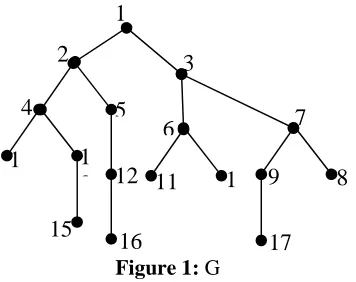
Example 2.1.
Figure 1: G
D1= {1, 4, 5, 6, 7, 15, 16, 17} is a minimum dominating set. γ(G) = 8.
D2 = {1, 4, 5, 6, 7, 8, 10, 15, 16, 17} is a minimum bd – dominating set. γbd(G) = 10.
D3 = {1, 4, 5, 6, 7, 15, 16, 17} is a minimum eccentric dominating set. γed(G) = 8.
Theorem 2.1.
(i) γbd(Kn) = γed(Kn)
(ii) γbd(K1, n) = γed(K1, n) , n≥2
(iii) γbd(Km, n) = γed(Km, n)
(iv) γbd(Cn) = γed(Cn)
(v) γbd(Wn) = γed(Wn)
Proof: In these particular graphs, the boundary neighbours are the eccentric vertices.
Therefore, eccentric dominating set is equal to the boundary dominating set. Hence, we get the above results.
Theorem 2.2. γbd(Pn) = γed(Pn) = γ(Pn) or γ(Pn) + 1.
Proof: The bd – dominating set of Pn must contain two end vertices. Therefore, bd –
dominating set is also the eccentric dominating set. Hence, γbd(Pn) = γed(Pn) = γ(Pn) or γ(Pn) + 1.
Note. For a graph G = Kn+ K1 + K1 + Km, n, m ≥ 2, γbd(G) = 2.
Theorem 2.3. A bd – dominating set D is a minimal bd – dominating set if and only if for
each vertex u ∈ D, one of the following is true.
(i) u is an isolated vertex of D or u has no boundary vertex in D.
(ii) There exists some v ∈ V-D such that N(v) ∩ D = {u} or b(v) ∩ D = {u}. Where b(v) is the boundary neighbour set of v.
1
2 3
4
8
6 7
5
9 1 11 12 1 3 1
17 16
78
Proof: Assume that D is a minimal dominating set of. Then for every vertex u ∈ D,D-{u} is not a bd – dominating set. That is there exists some vertex v in (V-D) ∪ {u} which is not dominated by any vertex in D – {u} or there exists v in (V-D) ∪ {u} such that v has no boundary neighbour in D-{u}.
Case (i) Suppose u = v, then u is an isolate of D or u has no boundary neighbour in D. Case (ii) Suppose v∈V- D
(a) If v is not dominated by D-{u}, but is dominated by D, then v is adjacent to only u in D, that is N(v) ∩ D = {u}.
(b) Suppose v has no boundary neighbour in D – {u} but v has a boundary neighbour in D. Then u is the only boundary neighbour of v in D. That is b(v) ∩ D = {u}. Conversely, suppose that D is bd – dominating set and for each u∈D one of the conditions holds, we show that D is a minimal bd – dominating set.
Suppose that D is not a minimal bd – dominating set, (ie) there exists a vertex u ∈ D such that D – {u} is a bd – dominating set. Hence u is adjacent to at least one vertex v in D – {u} and u has a boundary neighbour in D – {u}.
Therefore, condition (i) does not hold.
Also, if D – {u} is a bd – dominating set, every element x in V – D is adjacent to at least one vertex in D – {u} and x has a boundary neighbour in D – {u}.
Hence, condition (ii) does not hold. This is a contradiction to our assumption that for each u ∈ D, one of the conditions holds.
This proves the theorem.
Observation: 2.1. (i) The pendent vertices are the boundary neighbours of their support
vertices.
(ii) Eccentric vertices are also boundary vertices.
Theorem 2.4. Let T be a tree of order n with n1 pendent vertices. Then γbd(T) ≤γ(T) + n1. Proof: Let T be a tree of order n.
Case (i) Assume D be a dominating set of T. If D contains all the pendent vertices of T,
then D becomes a bd – dominating set. Hence γbd(T) = γ(T). Case (ii) a
If D does not contain the pendent vertices, then we add the boundary neighbours with D. Then we have γbd(T) <γ(T) + n1.
Case (ii) b
All the pendent vertices are the boundary neighbours of T then γbd(T) <γ(T) + n1. Since
the support vertices of the pendant vertices can be removed from D and the pendant vertices can be added. Hence, γbd(T) <γ(T) + n1.
Theorem 2.5. If G is a connected graph with n vertices then γbd(G) ≤⌊2n/3⌋.
Proof: If D is a minimum bd – dominating set, then for v ∈ V-D there exists u ∈ D and w ∈ D such that u is adjacent to v in G and w is boundary dominate a vertex v in G.
79
Theorem 2.6. If G is a caterpillar such that each non pendent vertices is of degree three
then γbd(G) = (n/2) +1.
Proof: Since degree of each non pendent vertex is three, then G is of the following form.
Figure 2:
Pendent vertex set form a bd – dominating set S and it is also a minimum set. Then every vertex v in V-S has a adjacent vertex in S and adjacent pendent vertex is a boundary neighbour of v. Hence γbd(G) = (n/2) +1.
Theorem 2.7. If G is a spider then γbd(G) = ∆(G) +1 = N(u) +1 = n −∆(G).
Proof: Let G be a spider, and u be a vertex of maximum degree ∆(G). N(u) vertices form a dominating set. Adding any one end vertex form a bd - dominating set. Hence γbd(G) = N(u)+1.That is, γbd(G) = ∆(G) +1 = n −∆(G).
Theorem 2.8. If G is a wounded spider then γbd(G) ≤∆(G).
Proof: Let G be a wounded spider. Let u be the vertex of maximum degree ∆(G).
Case (i) If G has one or two wounded legs.
N(u) vertices form a bd – dominating set, since the end vertex of the wounded leg is a boundary neighbour of the other vertices. Hence γbd(G) = ∆(G).
Case (ii) If G has more than two wounded leg.
The end vertices of the non wounded legs and the central vertex u form a dominating set of G. Adding any one end vertex of the wounded leg form a bd - dominating set. Hence
γbd(G) ≤∆(G).
REFERENCES
1. M.Bhanumathi and S.Muthammai, Further results on eccentric domination in graphs, international journal of engineering science, Advanced Computing and
Bio-Technology, 3(4) (2012) 185-190.
2. M.Bhanumathi and S.Muthammai, On eccentric domination in trees, International
Journal of Engineering Science, 2(1) (2011) 38-46.
3. F.Buckley and F.Harary, Distance in graphs, Addison–Wesley, Publishing Company (1990).
4. Gary Chartrand and Ping zhang, Introduction to Graph Theory, Tata McGraw – Hill Publishing Company Limited, New Delhi, 2006.
5. F.Harary, Graph theory, Addition - Wesley Publishing Company Reading, Mass 1972.
6. T.N.Janakiraman, M.Bhanumathi and S.Muthammai, Eccentric domination in graphs,
International Journal of Engineering Science, Computing and Bio-Technology, 1(2)
80
7. R.Begam, M.Palanivelrajan, K.Gunasekaran and A.R.Shahul Hameed, Graceful labeling of some theta related graphs, International Journal of Fuzzy Mathematical
Archive, 2 (2013) 78-84.