ISSN(Online): 2320-9801 ISSN (Print): 2320-9798
I
nternational
J
ournal of
I
nnovative
R
esearch in
C
omputer
and
C
ommunication
E
ngineering
(A High Impact Factor, Monthly, Peer Reviewed Journal)
Vol. 4, Issue 1, January 2016
Simulation & Performance Evaluation of
Optical Access Network Based on
WDM–PON
Riddhi H Solanki1 , Harsha A Gupta2, Ami Lavingia3, Kruti Lavingia4
PG Student, Dept. of Electronics & Communication, SOCET, Ahemdabad, Gujarat, India1
Asst. Professor, Dept. of Electronics & Communication, SOCET, Ahemdabad, Gujarat, India2
Dept. of Electronics & Communication, Ahemdabad, Gujarat, India3
Asst.Professor, Dept. of Computer Science & Engineering, Nirma University, Ahemdabad, Gujarat, India4
ABSTRACT: WDM-PON with its low energy consumption and huge bandwidth availability has been considered to construct an optical access network. The architecture of WDM-PON is been introduced and its performance characteristics is analyzed. The WDM-PON architecture is a bidirectional high speed system consisting of passive components such as circulators and MUX/DEMUX. The introduced system is used to obtain a system bit rate of 40 Gbps. To reduce the overall cost of the proposed system, the bidirectional multiplexed technique is used. Quality factor, bit error rate, and eye diagrams are derived for different transmission distance as well as at various input power level and then it is used to compare the results in order to select the transmission distance that gives the best performance. The pulse shapes used in this paper are non-return to zero pulse. Upstream and downstream data are analyzed using bit error rate analyzer.
KEYWORDS: WDM-PON, Passive Network, RZ Modulation, Circulators, PON Communication.
I. INTRODUCTION
PON stands for Passive optical network which is a technology that modulates the light wave signal from optical line terminal (OLT) which is located at central office (CO) and transmits it through optical fiber to optical network units (ONUs) located at end user. It is designed to provide practically unlimited bandwidth to the subscribers. Passive Optical Network (PON) has earned interest in recent years from network providers and researchers alike due to their tremendous economic advantages for application in last mile services and optical sensing.[1] PONs introduces a good data transmission rate and large bandwidth. It is demonstrated that it is a bidirectional PON system. It is a point to multipoint technology. The PON system can be described as fiber-to-the-curb (FTTC), fiber-to-the building (FTTB), or fiber-to-the-home (FTTH).
Any PON system consists of three main parts:
- Optical line terminal (OLT) at central office (CO)
- Remote node (RN) such as passive splitter or array waveguide grating (AWG) in the channel - Optical network unit (ONU) at end user.
PON networks can be classified into different forms such as broadband PON (BPON), Ethernet PON (EPON), Gigabit PON (GPON), and WDM PON.
ISSN(Online): 2320-9801 ISSN (Print): 2320-9798
I
nternational
J
ournal of
I
nnovative
R
esearch in
C
omputer
and
C
ommunication
E
ngineering
(A High Impact Factor, Monthly, Peer Reviewed Journal)
Vol. 4, Issue 1, January 2016
II. DESIGN & SIMULATION SETUP
The architecture of bidirectional WDM-PON using single fiber based on circulator is shown in Figure. The isolation of optical signals of uplink and downlink can be done using circulators, and hence to realize bidirectional transmission in single fiber. The burst data from clients are uploaded using uplinks and downlinks are applied to transmission download multimedia data to clients, such as audio, video and data services. Bidirectional single fiber WDM-PON can reduce the use of fiber links, as well as the number of network equipments, and hence reduce energy consumption and the cost. [2]
Figure 1: The architecture of bidirectional WDM-PON using single fiber based on circulator [2]
Simulation Setup:
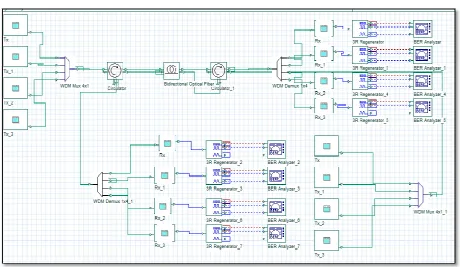
The proposed algorithm is shown in figure 2. The algorithm consists of continuous wave laser as an input light source. Return-to-zero modulation is used and the signal is modulated using Mach-Zehnder Modulator (MZM) at OLT at central office. It is a bidirectional PON system. Four optical signals are multiplexed using MUX. The frequencies of downlink signals are 193.1 THz to 193.4 THz, and that of uplink signals are 228.2 THz to 228.5 THz. Circulators are placed in between the links to isolate the uplink and downlink signals.
ISSN(Online): 2320-9801 ISSN (Print): 2320-9798
I
nternational
J
ournal of
I
nnovative
R
esearch in
C
omputer
and
C
ommunication
E
ngineering
(A High Impact Factor, Monthly, Peer Reviewed Journal)
Vol. 4, Issue 1, January 2016
Figure 2: WDM – PON Simulation Link
The following table shows the list of parameters considered during the simulation of WDM-PON link. Table 1: Simulation Parameters
Parameters Values
Bit Rate 40 Gbps
Modulation Return-to-Zero
Distance 5,10,15,20,25,30,35.40 kms
Power 0dbm, 5dbm, 10dbm
Downlink Signal Frequencies 193.1 to 193.4 THz
Uplink Signal Frequencies 228.2 to 228.5 THz
III. RESULTS & SIMULATION
It is simulated the optical link working at 40 Gbps. The non- linear effects at different transmission distance is taken into consideration. The nonlinear effects are analyzed in terms Q Factor, BER with the use of Eye Diagrams.
Following table shows the impact of nonlinear effects on the Q-factor in accordance to the increase in transmission distance for RZ modulation.
ISSN(Online): 2320-9801 ISSN (Print): 2320-9798
I
nternational
J
ournal of
I
nnovative
R
esearch in
C
omputer
and
C
ommunication
E
ngineering
(A High Impact Factor, Monthly, Peer Reviewed Journal)
Vol. 4, Issue 1, January 2016
Table 2: Q-factor Result
Power 5 km 10 km 15 km 20 km 25 km 30 km 35 km 40 km
0dbm 9.27 9.35 9.01 8.88 8.22 7.50 7.46 7.14
5dbm 9.53 9.56 9.34 9.24 8.87 8.45 8.44 8.07
10dbm 9.59 9.57 9.38 9.27 9.03 8.74 8.67 8.25
Table 3: BER Result
Power 5 km 10 km 15 km 20 km 25 km 30 km 35 km 40 km 0dbm 6.5E-021 3.2E-021 7.7E-020 2.4E-019 8.4E-017 2.6E-014 3.7E-014 4.2E-013 5dbm 5.3E-022 3.9E-022 3.4E-021 8.3E-021 2.6E-019 1.1E-017 1.2E-017 2.9E-016 10dbm 2.8E-022 3.7E-022 2.3E-021 6.3E-021 6.4E-020 8.4E-019 1.6E-018 6.1E-017
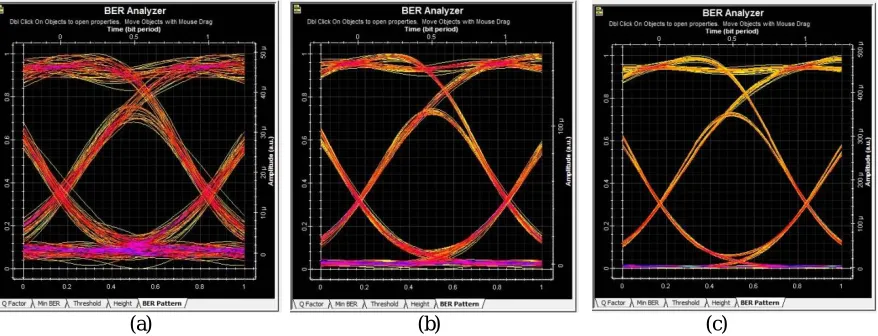
From the table it can be seen that, as the transmission distance increases the value of Q-factor decreases. That is, the signal gets distorted on increase in distance. The eye diagram at 40 km for input power 0dbm, 5dbm and 10dbm is shown in figure 3.
(a) (b) (c)
Figure 3: Eye diagram at input power of (a) 0dbm (b) 5dbm (c) 10dbm.
From the eye pattern it can be seen that as the power level increases the signal gets more cleared. The effect of distortion gets more nullified. But as the input power level gets increased, the effect of nonlinearities affects the performance of output signals. But, with greater input power level, the transmission distance can be increased such as at that distance. The better eye pattern got with sufficient value of Q-factor and lower bit error rate. So, the power level should be kept, considering both the parameters.
IV. CONCLUSION
ISSN(Online): 2320-9801 ISSN (Print): 2320-9798
I
nternational
J
ournal of
I
nnovative
R
esearch in
C
omputer
and
C
ommunication
E
ngineering
(A High Impact Factor, Monthly, Peer Reviewed Journal)
Vol. 4, Issue 1, January 2016
REFERENCES
1. J. Buset, Z. El-Sahn, and D. Plant, “Experimental Demonstration of a 10 Gb/s Subcarrier Multiplexed WDM PON,” IEEE Photo. Technol. Letters, vol. 25, no. 15, Aug. 1, 2013.
2. Yongmin Qi, Ziyang Wang, Jia He, Qiliang , “Design And Performance Analysis Of 2x10 Gb/S Bidirectional Green Wdm-Pon Based On
Circulator” Proceedings of IEEE,2011.
3. K. Grobe, M. Roppelt, A. Autenrieth, J. P. Elbers and M. Eiselt, “ Cost and energy consumption analysis of advanced WDM-PONs”, Communications Magazine,IEEE, vol.49, pp. s25-s32, 2011.
4. P. Chowdhury, M. Tornatore, S. Sarkar and B. Mukherjee, “Building a Green Wireless-Optical Broadband Access Network (WOBAN)”, Lightwave Technology, Journal of, vol.28, pp. 2219-2229, 2010.
5. K. Iwatsuki, “Application and Technical Issues of WDM-PON,” Proc. SPIE 7620, Broadband Access Commun. Techno. IV, 76200C, Jan. 22, 2010.