R E S E A R C H
Open Access
Sparsity-aware multiple relay selection in
large multi-hop decode-and-forward relay
networks
A. Gouissem
1,2, R. Hamila
1*, N. Al-Dhahir
3and S. Foufou
4Abstract
In this paper, we propose and investigate two novel techniques to perform multiple relay selection in large multi-hop decode-and-forward relay networks. The two proposed techniques exploit sparse signal recovery theory to select multiple relays using the orthogonal matching pursuit algorithm and outperform state-of-the-art techniques in terms of outage probability and computation complexity. To reduce the amount of collected channel state information (CSI), we propose a limited-feedback scheme where only a limited number of relays feedback their CSI. Furthermore, a detailed performance-complexity tradeoff investigation is conducted for the different studied techniques and verified by Monte Carlo simulations.
Keywords: Large DF relay networks, Outage probability, MSE, Relay selection
1 Introduction
The basic concept behind cooperative communication can be traced back to [1], where the capacity of a three-node cooperative network was analyzed. Subse-quent works proved in [2–5] that relaying techniques can achieve spatial diversity in wireless networks with only single-antenna nodes. This diversity can be achieved using a multitude of cooperative protocols and under differ-ent design criteria and channel information assumptions [6–11]. Among these protocols, two of the most widely used are the amplify-and-forward (AF) and decode-and-forward (DF) protocols.
However, most of the cooperative protocols in the lit-erature select only one relay to forward the data to the destination node [3]. The idea of single-relay selection was first generalized from dual-hop AF network to multiple-relay selection in [12]. Different schemes of multiple-multiple-relay selection have been also proposed [7, 8, 13], where relays are assumed to cooperate either with full power or do not cooperate, i.e., no relay gain optimization is performed.
Furthermore, to satisfy the growing demand for high-quality multimedia services in next-generation cellular
*Correspondence: [email protected]
1Electrical Engineering Department, Qatar University, Doha, Qatar Full list of author information is available at the end of the article
networks, high data rates have to be provided to the end users. Since mobile stations (MSs) are energy con-strained devices, the transmit power of the MSs cannot be increased indiscriminately. Hence, the data rate can also be increased by reducing the distance between the source and destination node using multi-hop cellular networks whereby the base stations (BSs) would communicate with the faraway and otherwise unreachable MSs in multiple hops through intermediate relays [14–16].
However, when dealing with large DF relay networks [17], and especially in multi-hop cooperative networks [18–20], the relay selection process becomes highly com-plex. In fact, in many applications such as device-to-device (D2D) communication networks and wireless sen-sor networks, a large number of cooperating nodes are used, which leads to a dramatic increase in the complexity of the relay selection process.
Compressive sensing theory has been applied recently in the design of cognitive radio networks [21], finite-impulse-response (FIR) linear equalizers [22], and relay selection schemes in dual-hop networks. In particular, the authors in [23] focus on multiple relay selection with a noisy limited feedback. In [24], a limited-feedback relay selection algorithm is also proposed and investigated for a multi-cast relay network. In addition, a compressive sens-ing (CS)-based relay selection algorithm that reduces the
feedback overhead of relay networks under the assump-tion of noisy feedback channels is presented in [25]. In [26], a full-duplex relay-aided multi-user network is considered and the proposed scheme permits the BS to obtain channel state information (CSI) from a subset of strong users. CS is used also as joint source-channel cod-ing (JSCC) for the source and the relays in multi-relay compressive cooperative schemes [27].
In this paper, we propose and investigate two multi-ple relay schemes for large multi-hop decode-and-forward relay networks. Our proposed schemes exploit the spar-sity of the relay selection vector to select the relays by minimizing the mean-square error (MSE) based on a sparse signal recovery theory. We also propose and inves-tigate a limited-feedback scheme in a multi-hop network, where the source collects only a limited amount of CSI to perform the selection.
In fact, when only few relays are selected from a large number of nodes, the relay selection vector becomes sparse. Hence, based on the sparse signal recovery theory, different signal recovery algorithms such as orthogonal matching pursuit (OMP) may be used to solve the relay selection problem [17, 28]. Based on MSE minimization, we propose two different techniques for multiple-relay selection that reduce both the selection complexity and the outage probability compared with the existent tech-niques such as exhaustive search [12] and the selective decode and forward (SDF) technique [29] with and with-out power control.
The rest of this paper is organized as follows. In Section 2, the system model is presented. The pro-posed selection techniques are introduced and analyzed in Sections 3 and 4, respectively. In Section 5, the com-putational complexities of the different techniques are evaluated and compared. In Section 6, a new approach for a limited feedback is investigated. In Section 7, Monte Carlo simulations are carried out to confirm the analyt-ical derivations and to demonstrate the higher efficiency
of the proposed techniques compared to the conventional approaches. Finally, conclusions are drawn in Section 8.
2 System model
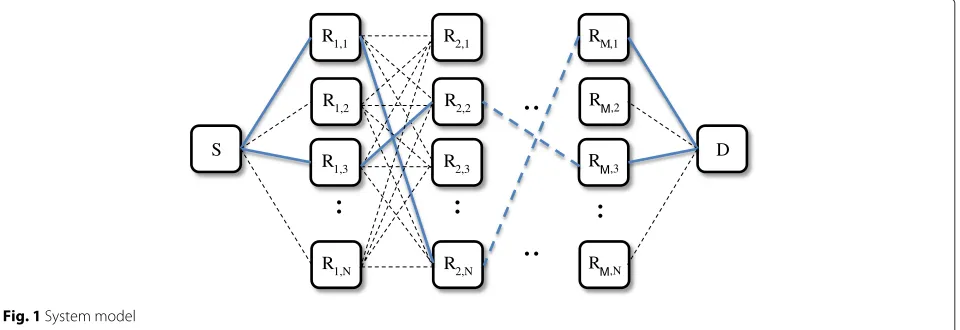
In this paper, the adopted system model consists of one source (S),Mequidistant clusters ofNrelays and one des-tination (D) as shown in Fig. 1. We define also the total number of clusters including the source (cluster 0) and the destination (clusterM+1) asNc=M+2.
For eachi ∈ {1..N}andj ∈ {1..M},Ri,jdenotes thejth relay in theith cluster. All nodes are equipped with a single antenna which can be used in a half-duplex mode for both transmission and reception. The direct link between the source and the destination is ignored due to its assumed large path loss.
The data is transmitted from the source to the desti-nation using K different paths based on a decode-and-forward technique. Different selection schemes are pro-posed in this paper where the paths may be selected directly by the source or at each stage by the nodes forwarding the data.
In addition, each node is assumed to have perfect CSI knowledge of its last hop links. This CSI is used to decode the received signal in the intermediate hops and to combine the different received versions of the signal using maximum ratio combining (MRC) at the destination.
Denote the channel coefficient from a nodeAto a node BashA,B, which is assumed to follow complex Gaussian distribution with mean zero and varianceσA2,B. We assume also that these channels are flat-fading and remain con-stant during the transmission.
Moreover, to analyze the effect of the relay’s positions, we adopt an asymmetric network geometry where the dis-tance from any node in cluster ito any node in cluster i+1 is equal todi. Without loss of generality, the ditance between the source and the destination is normalized to be equal to 1 [30], i.e.,Mi=0di=1.
S
R1,1
R1,2
R1,3
R1,N
R2,1
R2,2
R2,3
R2,N
RM,1
RM,2
RM,3
R
M,N
D
..
..
..
..
..
In the subsequent numerical analysis, the path-loss exponentα is assumed to be equal to 2. Hence, the vari-ance of the complex Gaussian distribution corresponding to the channel linking a nodeAin clusteriwith any node Bin clusteri+1 is expressed by
whereE(.)denotes the expectation of a random variable and the distance between the nodeAand the nodeBis denoted bydA,B.
Considering the linkA → Bat any transmission stage where nodeBreceives from nodeA, the signal denoted by yA,Bis given by
yA,B=hA,BxA+nA,B, (2)
wherexA denotes the transmitted signal by nodeAand nA,Bis the additive white Gaussian noise (AWGN) on the linkA→B.
Next, we propose two techniques to select the relays that will decode and forward the data.
• EndtoEnd relay selection scheme which selects the
bestK paths to forward the data directly by the source
• PerGroup relay selection scheme which divides the
network into different groups and the bestK paths
selections are performed independently for each group
3 EndtoEndrelay selection scheme
3.1 Motivation
As stated in Section 2, K different paths are selected to forward the data from the source to the destination. Then, the different received signals are combined using MRC to reconstruct the original data at the destination. We con-sider first the received signal through one selected path PS→RP1 →RP2..→..D, whereRPi refers to the relay in clusterithat belongs to the pathP.
Since DF is used, the equivalent signal-to-noise ratio (SNR) for the relay network composed by only the pathP can be approximated byγeqP = min(γ1P; ...γMP+1), where
γP
i denotes the SNR of the link corresponding to theith hop inP[31].
Hence, for each selected path P, the transmission becomes equivalent to a transmission over a single link with an equivalent SNR
γP
N0 andN0denotes the noise spectral density.
In this proposed scheme, we force all the relays in one selected pathPto use the same gain factor. In fact, a set of NPathsEtE NM possible paths is present for possible selections. Therefore, we define the relay selection vector gs
gain factor for all the relays in the pathP. Consequently, the equivalent SNR for the pathPbecomes
γP
Consequently, we can also approximate the received signal at the destination through a path P, denoted by yPD, by the signal that passes through a channel with the same characteristics of the adopted system model (zero-mean complex Gaussian) and with the same equivalent received SNR in Eq. (3) and thus also the same outage probability, i.e,
. Consequently, the combined received signal becomes [17]:
yD≈gsH(hx+v) (5)
wherevis anNPathsEtE ×1 AWGN vector with varianceN0,
his anNEtE
Paths× 1 equivalent channel vector defined by
h= h1eq,h2eq, ..,hN
To perform the relay selection, we assume that all the CSI is known by the source. We understand that estimating all the CSI by the source is a complicated task that may induce transmission delays. However, if the channels are slowly varying, less feedback is required to estimate the CSI. Furthermore, based on sparse signal recovery, the amount of CSI feedback can be dramatically reduced as shown in [32, 33]. In addition, this problem is solved by our limited-feedback scheme proposed and investigated in Section 7 where we show that almost the same outage performance can be reached with a limited CSI feedback. The relay selection vectorgsis computed based on the
MSE minimization. From Eq. (5), we deduce that the error signal can be expressed as follows
e=x−yD=x−gsH(hx+v) (6)
Hence, the MSE at the destination is given by
where
Considering the Cholesky factorization of the positive denite matrixR=LLHwhereLis anNPathsEtE ×NPathsEtE lower-triangular matrix, we can rewrite Eq. (8) as follows
MSE=σx2−gsHLL−1h˜− ˜hHL−HLHgs+gsHLLHgs
(9)
By completing the square in Eq. (9), we get
MSE=σx2− ˜hHL−HL−1h˜+ ||LHgs−L−1h˜||22 (10)
For the case where no power control is used (the vec-torgsidentifies only which paths to be used without any
information about transmission power), it is obvious that the optimal solution of Eq. (10) can be found by an exhaus-tive search among all the possibilities of the selected paths [12]. However, as it will be discussed in Section 5, this task requires a high computation complexity. Hence, to simul-taneously reduce the complexity and select a complex vector gsinstead of a Boolean one, we use sparse signal
recovery techniques. In fact, since only a small number of pathsK is selected, the vectorgsbecomes sparse1which
can be exploited to reduce the complexity by sparse signal recovery algorithms and we adopt the OMP algorithm in this paper for its simplicity.
Note that in EndtoEnd, K paths out of N(M−1) are selected. Consequently, even if a large number of relaysK is selected (up toN), the selection vectorgswill remain
sparse by network design and can be computed using OMP.
The expression of the MSE in Eq. (10) is divided into the following two terms:
MSEmin=σx2− ˜hHL−HL−1h˜ (11)
MSEexcess= ||LHgs−L−1h˜||22
Since MSEmindoes not depend ongs, the MSE is
min-imized by minimizing the term MSEexcess which can be
controlled through the path selection vector gs. As in
[17], to select multiple paths which minimize MSE from Eq. (10), we use the OMP algorithm which proceeds by finding, in each iteration, one column of the matrix LH which is the most correlated with the residual error vector obtained by subtracting the contributions of the selected paths in the previous iteration from the vectorL−1h˜, then by solving a least squares problem to obtain a new signal estimate and updating the new set of possible paths.
We adopt the OMP algorithm in [28] for which the stop-ping criterion is the desired number of selected pathsK denoted by
In fact, in each of theK OMP iterations, the path that minimizes MSEexcess is selected until finally obtainingK
paths.
3.3 Independent and dis-joint selection
For theEndtoEndrelay selection scheme, selectingK out of NPathsEtE paths to forward the data to the destination may result in using the same relay in different paths. This should increase the diversity of the system. However, in practice, it may introduce some implementation chal-lenges since the same relay may have to receive different signals from different sources at the same time. Therefore, to deal with these challenges, we propose and differentiate in this section between two different versions ofEndtoEnd relay selection scheme.
3.3.1 Independent selection
When independent selection is performed, OMP algo-rithm is used such that, at each iteration, one column of the matrix LH is selected based only on the updated residual error. Hence, the same relay may be selected simultaneously in multiple paths. Hence, further diver-sity is introduced to the system since channels with high SNR may be used multiple times to improve the outage performance of the system.
However, in practice, this may introduce some imple-mentation challenges since the same relay may have to receive different signals from different sources at the same time. Furthermore, the same relay may have to transmit different data to different relays at the same time. Thus, this might be possible only if orthogonal channels are used based on time division multiplexing (TDM) or frequency division multiplexing (FDM).
At the ith iteration (where, i ∈ {1..K}) of the OMP recovery algorithm, one path is selected between the pos-sible remainingNPathsEtE −i+1 =NM−i+1 columns of the matrixLHbased on the MSE residual error.
3.3.2 Dis-joint selection
When dis-joint selection is performed, the OMP algo-rithm is forced at each step to select one of the paths for which all the relays are never used. Hence, the multiple receptions or transmissions problem for the same relay is solved since all the selected paths are dis-joint. In partic-ular, in step 6 of the OMP algorithm in [28], we remove from the set of indices available for selection the indices of all the paths that have joint relays with the last selected path.
LHfor possible selection instead of(NM−i+1)in joint selectionEndtoEndselection scheme.
4 PerGroupselection scheme
4.1 Motivation
In theEndtoEndselection scheme, the source is assumed to know all the CSI to perform the path selection. How-ever, this might be difficult to implement in practice especially in large relay networks. Furthermore, the num-ber of possible paths NPaths = NM is very high which
results in a high selection complexity. This problem may be solved using the sparse signal recovery theory to reduce the CSI feedback by allowing only relays that have an SNR higher than a certain threshold to send their CSI to the source as in [32, 33]. However, in this section, we propose another solution which consists of dividing the network into independent groups for which the path selections are performed independently from each other.
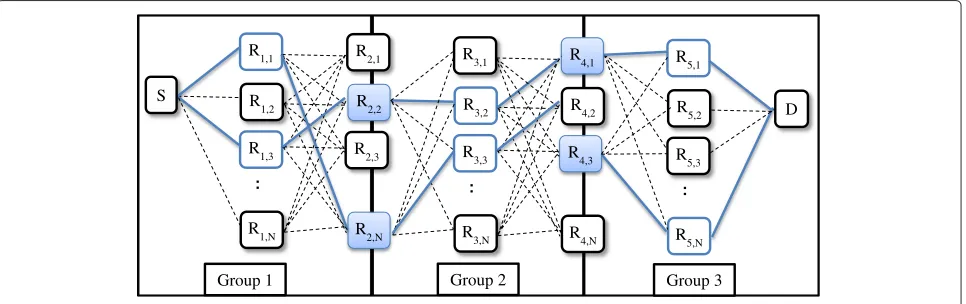
In the PerGroup selection scheme, the network is divided intoNGgroups ofNCpG 1+floor ters, where floor[x] denotes the largest integer less than or equal tox.
The source and the intermediateKrelays at the begin-ning of each group are assumed to have perfect CSI knowledge for all the links in the corresponding group.
4.2 Relay selection
Concerning the relay selection in the first group, the source has to selectK out ofNPathspG|pS NNCpG−1possible
paths to forward the data to the next group. Consequently, we define a virtual destinationD1 at the end of group 1
able to combine all the received signals using MRC2. The
received signal at this virtual destination can be approxi-mated by
, where for each
path,P ∈ P 1, ..,NPathspG|pS, hP1 = min
Hence, and by analogy with the EndtoEnd selection scheme, the OMP algorithm is used to compute the gain selection vector of the first groupg1s by replacinghby its
new expression. Also, similarly to Section 3, both the dis-joint and indepedndent selection schemes are considered in thePerGroupselection technique.
Concerning any other group G, its first cluster con-tains always K relays holding the data forwarded by the previous group which are denoted byR˜i|i=1..K
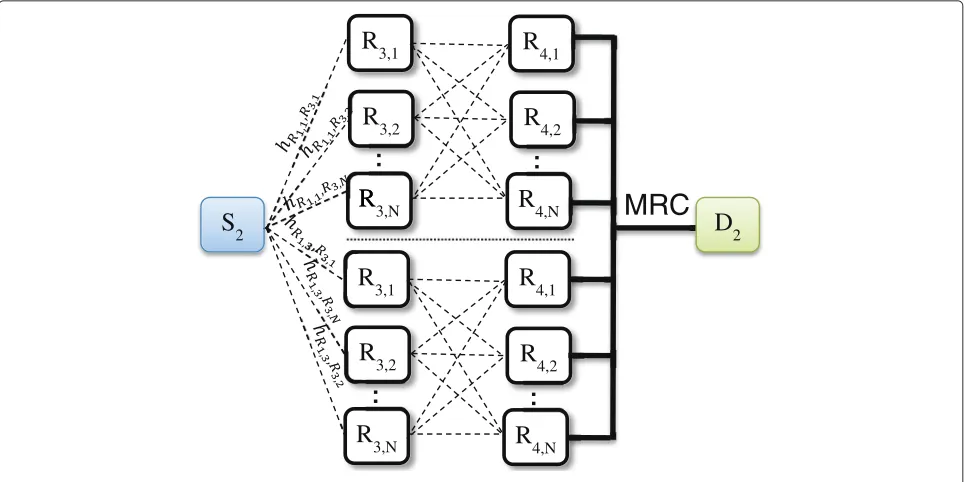
, respectively. By assuming that the groupG−1 forwarded approximately the same data signalx˜to theKrelays in the first cluster of the groupG, this group becomes equiva-lent to a system with only one virtual sourceS2instead of
K sources and one virtual destinationD2 that combines
all the received signals as explained in Fig. 2. In fact, the virtual sourceS2is connected toKduplicates of the
fol-lowing clusters by the channels connectingR˜ito the next clusters wherei∈ {1, ..K}(Fig. 3).
Consequently, each one of the intermediate groups con-tainsNPathspG KNPathspG|pS = K.NNCpG−1possible paths, and
the combined signal by the virtual destinationDGcan be approximated by
Group 1 Group 2 Group 3
R
3,2R
3,1R
3,NR
4,1R
4,2R
4,NMRC
..
..
R
3,1R
3,2R
3,NR
4,1R
4,2R
4,N..
..
S
2R
D
2Fig. 3Equivalent network model for the second group
yDG≈g
G s
H hGx˜+v
(14)
where v is an NPathspG × 1 AWGN vector with variance N0 and hG is an NPathspG × 1 equivalent channel vector
defined by h = h1T |h2T |..|hKTT, where for each
i ∈ {1..K},hi refers to the equivalent channel when the source isR˜i. This equivalent channel is expressed byhi =
h1i,h2i, ..,hN
pG|pS
Paths
i
T
, where for each pathP ∈ P, hPi =
min
hR˜P
(i−1)NCpG,R P
(i−1)NCpG+1 , ..,hRP
i.NCpG−1,R
P i.NCpG
.
Note that to make sure that every relay that received a data forwards it, we force the OMP algorithm to select at each iteration one path referring to a different relayR˜j. In fact, at the iterationi ∈ {1..K},(K−i+1).NPathspG|pS =
(K−i+1).NNCpG−1columns are available inLHfor possible
selection.
In thePerGroupscheme, all the CSI is assumed to be known at the source (or in the K corresponding relays in the first cluster of the intermediate groups). We also proposed a new limited-feedback scheme that makes the source use only partial knowledge of the CSI. We showed that it is better in terms of outage probability to get full CSI especially when Ncpg is small. However, in terms of network throughput, it is better to use a limited feedback since the gain from the CSI knowl-edge becomes at some point not enough to compensate
for the losses in terms of the time needed to collect the CSI.
Concerning the selection criteria ofK, there is no opti-mal choice ofKbecause of the following:
1. In multiple relay selection schemes and when sparse signal recovery theory is not used, it is always better to use more relays to achieve better outage performance. However, using all the relays of the network to forward the data is not practical and may lead to network congestion.
Hence, the optimalK is the total number
of relays, but in practice,K is chosen by the network administrator to make a compromise between the desired outage performance and network congestion.
2. In thePerGroup scheme, K paths out ofN(Ncpg−1)
(orKN(Ncpg−2)in the last group) are selected in each
group, whereN andNcpgdenote the number of
relays per cluster and number of clustersPerGroup,
respectively. Consequently, even if a large number of relaysK is selected (up to N ), the selection vectorgs
will remain sparse and the can be computed using OMP.
3. The sensing matrix is a square full-rank matrix as in [17]. Note that even though the sensing matrix is full-rank and the selection problem is well-posed, the optimal solution is not sparse (all the paths are
selected) and OMP is used to compute the “best”K
5 Computation complexity comparison
5.1 EndtoEnd independent relay selection
5.1.1 Exhaustive search
For the case wheregsis a Boolean vector (no power con-trol ), the optimal EndtoEnd selection can be obtained by exhaustive search where there are
possibilities. To select the best one of them, the complexity of the exhaustive search becomes:
CEtEES−I =ONMK (15)
5.1.2 Proposed model
In the OMP-based proposed technique, K out of the NPaths paths are selected independently. By computing a
sparse vector containingKnon-zero elements based on a measurement vector of lengthNPaths using OMP. Hence,
the computation complexity can be expressed by [17].
CEtEP −I =OK2NM (16)
5.2 EndtoEnd dis-joint relay selection
5.2.1 Exhaustive search
When dis-joint relay selection is performed based on ES, the number of possible combinations of paths is dramati-cally reduced compared to independent selection scheme since the paths have to be dis-joint and not containing any common relay. Hence, we deduce that the computa-tion complexity for theEndtoEnddis-joint ES technique is very small compared to theEndtoEndES independent technique.
CEtEES−D<<CEtEES−I (17)
5.2.2 Proposed model
When dis-joint relay selection is performed based on OMP, at each selection iterationi, the number of possi-ble paths for the selection are reduced fromNM−i+1 to(N−i+1)Mcompared with the independent selection model. Hence, we deduce that the computation complex-ity for theEndtoEnddis-joint OMP technique is very small compared to theEndtoEndindependent OMP technique.
CEtEP −D<<CEtEP −I (18)
5.3 PerGrouprelay selection
5.3.1 Exhaustive search
In the PerGroup relay selection technique, the best K paths for each group ofNCpGare selected. Hence, if inde-pendent selection is performed with the ES algorithm, the computation complexity would be
˜
Hence, we deduce that when dis-joint selection is per-formed, the computation complexity becomes
CpGES <<O
In the PerGroup relay selection technique, the best K paths for each group ofNCpGare selected. Hence, if inde-pendent selection is performed with the OMP algorithm, the computation complexity would be
˜
Hence, we deduce that when dis-joint selection is per-formed, the computation complexity becomes
CPGP <<O
To reduce the computation complexity and also the amount of CSI feedback needed for the relays selection for both theEndtoEndandPerGroupschemes, we inves-tigate in this section a limited-feedback model where the source (or intermediate sources) no longer has full CSI knowledge.
As stated in Section 2, each node is assumed to have perfect knowledge of the CSI corresponding to the links with the relays of the previous cluster. Thus, to limit the amount of CSI feedback, a limited number of nodes are allowed to feedback their CSI to the previous cluster. This is done if the relay already received the CSI from at least one node of the next cluster and if the known SNR for the previous hop is above the feedback threshold. The feed-back thresholdγthis optimized to meet a target feedback
percentage level.
In particular, for a node A in clusteri, the probability thatAhas a link with the next cluster with an SNR above
γthis given by
Pi=Fi(γth)
=1−exp(−λiγth), (23)
whereFidenotes the cumulative density function (CDF) of the channel realizations corresponding to the links in hopi(hi),λi= σ12
i
.
For each possible path from the source to the destina-tion, if the SNR in any intermediate hop is belowγth, then
r=1−
For thePerGroupscheme, by analogy, we get the follow-ing expression for the threshold
γth= −
log(1−r)
i∈Sλi
(26)
whereSdenotes the set of clusters in the group for which the selection is done.
A limited number of pathsKis selected (up toN). As it can be seen in Fig. 8, anEndtoEndscheme using a limited feedback of only 20 % (the source knows the CSI of only 20 % of the paths) has the same outage performance as a system with full CSI knowledge for theEndtoEndscheme (when K = 2,N = 10,Nc = 5). Hence, the amount of feedback can be dramatically reduced without affecting the outage performance.
7 Simulation results
In this section, the simulated performance of the proposed schemes is evaluated in terms of outage probability, bit error rate, and network throughput.
A symbol is considered in outage if it is received at the destination with an equivalent end-end SNR below a predefined threshold [34]. Since MRC is used at the destination, the equivalent end-end SNR of the combined received signal is the sum of the end-end SNRs through theKused paths.
When computing the network throughput, the amount of air-time reserved for feedback is no longer negligible as compared to the transmission time. Hence, we define the achievable throughput as the number of transmitted bits per unit time (bps/Hz). The network throughput is explicitly given by [26]
T=
where γe denotes the equivalent MRC received SNR as detailed in Section 3, Tc is the channel coherence time,
Tmsis the time needed to transmit one feedback,τ = TTmsc , andNp is the number of CSI that need to be collected. Note that when limited feedback is used, the amount of CSI that need to be collected becomesNp = rNpt, where rdenotes the ratio of CSI that need to be collected and Npt denotes the total number of possible paths. To have more insight, we simulate the network throughput forτ = 1/600 [26].
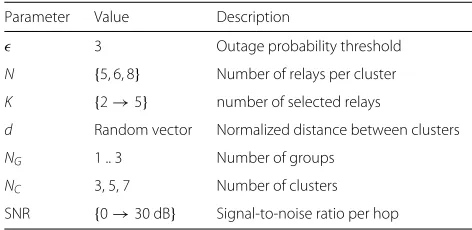
We also compare these results with previously proposed techniques. In fact, to the authors’ knowledge, no previ-ous work has been done for multiple relay selection in multi-hop DF network. However, the authors in [29], pro-posed two multiple relay selection schemes for dual-hop cooperative networks entitled SDF and SDF with power control. Hence, and for a fair comparison with our multi-hop schemes, the selection process for these techniques is repeated every two hops as detailed for thePerGroup selection scheme. We also adapted the ES technique in [12] to our system model by making an exhaustive search over all the possibleEndtoEndpaths or over all the possi-ble paths in each group. In addition, for fair comparison, the same average transmit power per relay constraint is assumed, i.e., the selection vectorgssatisfiesE(gsHgs)=K for all the studied techniques. The simulation parameters used in the simulations are shown in Table 1.
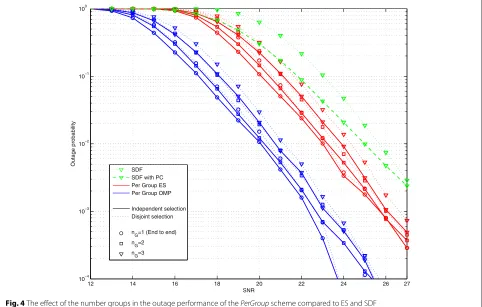
Figure 4 compares the outage performance of the Per-Group(nG=2, 3) and theEndtoEndschemes with ES and SDF (with and without power control) techniques when the number of clusters isN=7,K=2 relays are selected out ofN = 5 at each hop. It can be seen that the bigger the number of groups is, the higher is the outage prob-ability. In fact, it is always better to select based on the CSI of all the hops but at the cost of more CSI that needs to be collected and higher computation complexity. Also, when applying independent selection, the outage proba-bility is always better than dis-joint selection model since it achieves more selection diversity, but at the price of some practical implementation issues that may be caused by allowing one relay receiving (or sending) from (to) different nodes and also higher computation complexity.
It can be seen that the proposed algorithm outperforms the existing techniques in terms of outage probability. In
Table 1Simulation parameters
Parameter Value Description
3 Outage probability threshold
N {5, 6, 8} Number of relays per cluster
K {2→5} number of selected relays
d Random vector Normalized distance between clusters
NG 1 .. 3 Number of groups
NC 3, 5, 7 Number of clusters
12 14 16 18 20 22 24 26 27 10
10 10 10 10
SNR
Outage probability
SDF SDF with PC Per Group ES Per Group OMP
Independent selection Disjoint selection
nG=1 (End to end) nG=2 n
G=3
Fig. 4The effect of the number groups in the outage performance of thePerGroupscheme compared to ES and SDF
1% 10% 20% 30% 40% 50% 60% 70% 80% 90% 100%
10 10 10 10 10 10
Feedback ratio
Outage probability
Independent selection Disjoint selection
nG=1 (End to end), K=2 nG=2 , K=2 nG=2, K=3
fact, the ES technique only determines which K relays should be used unlike the proposed scheme which com-putes also the best gain factor for each relay. Hence, we conclude that the proposed model outperforms ES in terms of outage probability in addition to the computa-tion complexity which is reduced fromCEtEES−I = O(NK) toCEtEP −I=OK2NM−1.
Concerning SDF technique with and without power control, there is no exact expression provided for the com-putation complexity. However, from [29], we deduce that they are linear in function of N. Hence, the EndtoEnd OMP-based scheme does not outperform SDF in terms of computation complexity. However, it can be seen in Fig. 4 that the SDF scheme is outperformed by the proposed scheme in terms of outage probability. When power con-trol is used, the performance of SDF is improved but it is still outperformed by the OMP algorithm. In fact, in addi-tion to the gain achieved by the OMP, the performance gap between SDF and the proposed algorithm is increased due to the two-by-two hops selection process in SDF unlike theEndtoEndOMP scheme where the selection process is done from end to end.
Figure 5 presents the effect of the number of clusters on the outage performance of different techniques (N = 8, K=2, Ncpg=3,Nc=3, 5, 7).
Note that the transmitted signal is decoded and for-warded at each hop. Hence, increasing the number of hops increases the chances of incorrect decoding in the inter-mediate relays. Hence, as it can be seen in Fig. 5, the larger the number of hops, the higher the outage probability [34]. In addition, compared to the independent selection schemes, when the dis-joint selection is applied, all the studied techniques suffer from a loss of outage perfor-mance since the set of possible selected paths is reduced due to the dis-joint selection constraint. However, this loss is compensated by a reduction of the computation complexity. Hence, a compromise between computation complexity and outage performance is achieved between independent and dis-joint selection schemes.
It can be seen also that the proposed scheme outper-forms the SDF technique with and without power control independently from the number of clusters.
Figure 6 compares the BER performance of the dif-ferent studied techniques. It can be seen that—like the outage probability performance measure—the proposed EndtoEndandPerGroupselection schemes outperform ES and SDF techniques in terms of bit error rate. Also, the
EndtoEnd scheme outperfoms thePerGroup in terms of
BER at the price of increased amount of CSI that need to be collected and higher complexity.
6 8 10 12 14 16 18 20 22 24 26
10 10 10 10 10
SNR
Outage probability SDF SDF with PC Per Group ES Per Group OMP
Independent selection Disjoint selection
nC=7 nC=5 nC=3
5 7 9 11 13 15 17 19 20 10
10 10 10
SNR
BER
SDF SDF with PC Per Group ES Per Group OMP
Independent selection Disjoint selection
nG=2 nG=1 (End to end)
Fig. 7The effect of the number of selected relays on the network throughput
2 3 4 5
0.5 1 1.5 2 2.5 3 3.5
K
Network throuput (b/s/Hz)
Per Group OMP with IS Per Group ES with IS Per Group OMP with DS Per Group ES with DS SDF
SDF with PC
Figure 7 presents the effect of the number selected relays on the network throughput (N = 6, K =2..5,Ncpg =4,
Nc = 7). First, it can be seen that increasing the number of selected relays always improves the throughput perfor-mance because in multiple relay selection schemes and when sparse signal recovery theory is not used, it is always better to use more relays to achieve better outage perfor-mance. However, using all the relays of the network to forward the data is not practical and may lead to network congestion. Hence, the optimalK is the total number of relays, but in practice,Kis chosen by the network admin-istrator to make a compromise between the desired outage performance and network congestion. Also, even when selecting five relays at each hop out of six, the selection vector is still sparse since K paths out of N(Ncpg−1) are selected in each group. Furthermore, the outage proba-bility is always reduced when increasing the number of relays because the sensing matrixLHin Eq. (10) is a square full-rank3matrix as in [17].
Note also that when increasing the number of selected relays, the proposedPerGrouptechnique (withNcpg =4)
is outperformed by the SDF technique in terms of net-work throughput since the gain of thePerGroupschemes compared to SDF in terms of outage probability is not worth the time needed to collect all the needed CSI for the selection.
Figure 8 presents the effect of the feedback reduction on the outage probability on thePerGroupandEndtoEnd selection schemes (N=10,K=2, 3,NG=1, 2,Nc=5). It can be seen that when using limited knowledge of the CSI, the outage performance is almost the same for full CSI selection schemes if the feedback percentage is high enough. This feedback percentage threshold is smaller when the number of possible paths is bigger or the number of selected relays is smaller. In particular, when (nG = 1 (EndtoEnd scheme),K = 2)), the knowledge of 20 % of the CSI is enough to achieve the outage performance of full CSI knowledge model. However, for models where the number of paths is lower or the number of selected relays is bigger, a higher feedback percentage is needed to achieve the full CSI selection scheme performance (40 % whennG=2,K=2 and 70 % whennG=2,K=3).
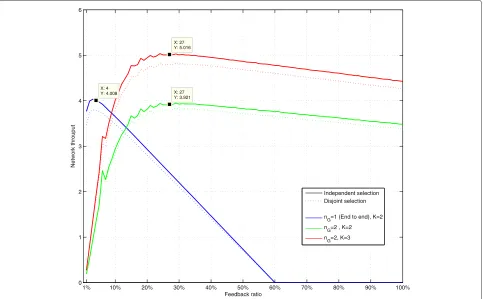
In terms of network throughput, it can be seen in Fig. 9 (N = 10, K = 2, 3, NG = 1, 2, Nc = 5) that for both
the EndtoEnd and PerGroup schemes, when the nodes
feedback more than a specific percentage, the perfor-mance starts decreasing since the gain in the equivalent received SNR is no longer worth the time needed to col-lect the CSI. This feedback percentage threshold is bigger when the number of possible paths is larger and is not affected by the number of selected relays. Note also that forEndtoEndscheme, the system can not be implemented
1% 10% 20% 30% 40% 50% 60% 70% 80% 90% 100%
0 1 2 3 4 5 6
X: 27 Y: 5.016
Feedback ratio
Network throuput
X: 4
Y: 4.008 X: 27 Y: 3.921
Independent selection Disjoint selection
nG=1 (End to end), K=2 nG=2 , K=2 n
G=2, K=3
in practice with a feedback percentage higher than 60 % since the channel would change after the source finished collecting all the CSI unless the channel coherence time is longer.
8 Conclusions
In this paper, two novel techniques were proposed and investigated to select multiple relays in a large multi-hop DF network based on MSE minimization. By exploiting sparse signal recovery theory, these tech-niques improve the outage performance compared to the ES and SDF techniques with and without power con-trol. The computation complexity is also reduced com-pared to the ES technique. Furthermore, performance, feasibility, and selection complexity tradeoffs are con-sidered between the different studied techniques and especially between the EndtoEnd and PerGroup selec-tion schemes. Extensive simulaselec-tions were also conducted to evaluate and compare the performance of the pro-posed techniques with the conventional ones. Finally, we demonstrated that by using the proposed limited-feedback scheme, almost the same outage performance can be achieved while using only partial CSI knowledge of the CSI.
Endnotes
1Note that the maximum number of selected paths K
isN (All the relays are used); and even in this case the selection vector gs remains sparse since the selection is
done among the set of all possible paths.
2We assume the existence of a virtual node that will
combine all the received signals by the end of each group using MRC to be able to compute and optimize the MSE corresponding to that group. However, this MRC is not done in reality unless the last node of that group is the destination.
3Note that even thought the sensing matrixLH is
full-rank and the selection problem is well-posed, the optimal solution is not sparse (all the paths are selected) and OMP is used to compute the ’best’Ksparse solution.
Acknowledgements
This paper was made possible by NPRP grant 6-070-2-024 from the Qatar National Research Fund (a member of Qatar Foundation). The statements made herein are solely the responsibility of the authors.
Competing interests
The authors declare that they have no competing interests.
Author details
1Electrical Engineering Department, Qatar University, Doha, Qatar.2University
of Burgundy, Dijon, France.3Electrical Engineering Department, UT Dallas,
Richardson, TX, USA.4Computer Science and Engineering Department, Qatar
University, Doha, Qatar.
Received: 10 October 2015 Accepted: 28 June 2016
References
1. T Cover, AE Gamal, Capacity theorems for the relay channel. IEEE Trans. Inf. Theory.25(5), 572–584 (1979)
2. A Sendonaris, E Erkip, B Aazhang, inIEEE International Symposium on Information Theory (ISIT). Increasing uplink capacity via user cooperation diversity (Saint-Petersburg, Russia, 1998), p. 156
3. A Sendonaris, E Erkip, B Aazhang, User cooperation diversity-part I: system description. IEEE Trans. Commun.51(11), 1927–1938 (2003)
4. A Sendonaris, E Erkip, B Aazhang, User cooperation diversity-part II: implementation aspects and performance analysis. IEEE Trans. Commun.
51(11), 1939–1948 (2003)
5. JN Laneman, DNC Tse, GW Wornell, Cooperative diversity in wireless networks: efficient protocols and outage behavior. IEEE Trans. Inf. Theory.
50(12), 3062–3080 (2004)
6. A Gouissem, R Hamila, MO Hasna, Outage performance of cooperative systems under IQ imbalance. IEEE Trans. Commun.62(5), 1480–1489 (2014)
7. A Gouissem, MO Hasna, R Hamila, H Besbes, F Abdelkefi, inIEEE Vehicular Technology Conference (VTC Fall). Outage performance of OFDM ad-hoc routing with and without subcarrier grouping in multihop network (Quebec, Canada, 2012), pp. 1–5
8. A Gouissem, MO Hasna, R Hamila, H Besbes, F Abdelkefi, inIEEE 23rd International Symposium on Personal Indoor and Mobile Radio Communications (PIMRC). Optimized selective OFDMA in multihop network, (Sydney, Austraila, 2012), pp. 1348–1353
9. A Gouissem, R Hamila, MO Hasna, inIEEE Global Information Infrastructure Symposium (GIIS). Outage performance of OFDM-based relaying systems under IQ imbalance, (Trento, Italy, 2013), pp. 1–7
10. B Karakaya, HU Sokun, M Uysal, MO Hasna, in20th IEEE Signal Processing and Communications Applications Conference (SIU). Cooperative OFDM systems for UWAC with SNR-based relay selection schemes, (Mugla, Turkey, 2012), pp. 1–4
11. SI Hussain, M-S Alouini, MO Hasna, A diversity compression and combining technique based on channel shortening for cooperative networks. IEEE Trans. Wirel. Commun.11(2), 659–667 (2012)
12. Y Jing, H Jafarkhani, Single and multiple relay selection schemes and their achievable diversity orders. IEEE Trans. Wirel. Commun.8(3), 1414–1423 (2009)
13. Y Hu, KH Li, KC Teh, An efficient successive relaying protocol for multiple-relay cooperative networks. IEEE Trans. Wirel. Commun.11(5), 1892–1899 (2012)
14. R Ananthapadmanabha, BS Manoj, CSR Murthy, in12th IEEE International Symposium on Personal, Indoor and Mobile Radio Communications (PIMRC). Multi-hop cellular networks: the architecture and routing protocols, vol. 2, (San diego , USA, 2001), pp. G-78–G-82
15. A Agarwal, P Kumar, inACM Special Interest Group on Data
Communications (SIGCOMM). Capacity bounds for ad hoc and hybrid wireless networks, vol. 34, No. 3, (Portland, 2004), pp. 71–81
16. O Dousse, P Thiran, M Hasler, inTwenty-First Annual Joint Conference of the IEEE Computer and Communications Societies (INFOCOM). Connectivity in ad-hoc and hybrid networks, vol. 2, (New York, USA, 2002), pp. 1079–1088 17. Junho Lee, N Al-Dhahir, Exploiting sparsity for multiple relay selection
with relay gain control in large af relay networks. IEEE Wireless Commun. Lett.2(3), 347–350 (2013)
18. J Boyer, DD Falconer, H Yanikomeroglu, Multihop diversity in wireless relaying channels. IEEE Trans. Commun.52(10), 1820–1830 (2004) 19. H Li, M Lott, M Weckerle, W Zirwas, E Schulz, inThe 13th IEEE International
Symposium on Personal, Indoor and Mobile Radio Communications (PIMRC). Multihop communications in future mobile radio networks, vol. 1, (Lisbona, Portugal, 2002), pp. 54–58
20. Multihop diversity in wireless relaying channels. IEEE Trans. Commun.
52(9), 1605–1605 (2004)
21. AEl Shafie, N Al-Dhahir, R Hamila, A sparsity-aware cooperative protocol for cognitive radio networks with energy-harvesting primary user. IEEE Trans. Commun.63(9), 3118–3131 (2015)
framework for the design and analysis of sparse fir linear equalizers, (Florida, USA, 2015), pp. 834–838
23. L Wang, G Zhang, G Wei, in2011 6th International ICST Conference on Communications and Networking (CHINACOM). Relay selection with noisy limited feedback, (Harbin, China, 2011), pp. 400–404
24. K Elkhalil, ME Eltayeb, H Shibli, HR Bahrami, TY Al-Naffouri, in2014 IEEE Global Communications Conference (GLOBECOM). Opportunistic relay selection in multicast relay networks using compressive sensing, (Austin, USA, 2014), pp. 3126–3131
25. ME Eltayeb, K Elkhalil, HR Bahrami, TY Al-Naffouri, Opportunistic relay selection with limited feedback. IEEE Trans. Commun.63(8), 2885–2898 (2015)
26. K Elkhalil, ME Eltayeb, A Kammoun, TY Al-Naffouri, HR Bahrami, On the feedback reduction of relay aided multiuser networks using compressive sensing. archived. http://arxiv.org/pdf/1505.00582.pdf Accessed 4 May 2015
27. Z Wang, W Xu, J Lin, in2014 IEEE International Symposium on Wireless Personal Multimedia Communications (WPMC). Compressive cooperative schemes with multiple relays, (Sydney, Australia, 2014), pp. 536–540 28. JA Tropp, AC Gilbert, Signal recovery from random measurements via
orthogonal matching pursuit. IEEE Trans. Inf. Theory.53(12), 4655–4666 (2007)
29. Y Zhang, Y Xu, Y Cai, in2nd, IEEE International Conference on Signal Processing and Communication Systems (ICSPCS). Relay selection utilizing power control for decode-and-forward wireless relay networks (IEEE, Gold Coast, Australia, 2008), pp. 1–5
30. B Lin, PH Ho, LL Xie, X Shen, J Tapolcai, Optimal relay station placement in broadband wireless access networks. IEEE Trans. Mobile Comput.9(2), 259–269 (2010)
31. MR Souryal, BR Vojcic, inProceedings. of IEEE International Conference on Acoustics, Speech and Signal Processing, ICASSP. Performance of
amplify-and-forward and decode-and-forward relaying in Rayleigh fading with turbo codes, vol. 4, (Toulouse, France, 2006), pp. IV–IV
32. ST Qaseem, TY Al-Naffouri, inIEEE International Conference on Communications (ICC). Compressive sensing for reducing feedback in MIMO broadcast channels, (Cape Town, South Africa, 2010), pp. 1–5 33. ME Eltayeb, TY Al-Naffouri, HR Bahrami, Compressive sensing for feedback
reduction in MIMO broadcast channels. IEEE Trans. Commun.62(9), 3209–3222 (2014)
34. B Gui, L Dai, LJ Cimini, Routing strategies in multihop cooperative networks. IEEE Trans. Wirel. Commun.8(2), 843–855 (2009)
Submit your manuscript to a
journal and benefi t from:
7Convenient online submission
7Rigorous peer review
7Immediate publication on acceptance
7Open access: articles freely available online
7High visibility within the fi eld
7Retaining the copyright to your article