ISSN (Print) : 2320 – 3765
ISSN (Online): 2278 – 8875
I
nternational
J
ournal of
A
dvanced
R
esearch in
E
lectrical,
E
lectronics and
I
nstrumentation
E
ngineering
(A High Impact Factor, Monthly, Peer Reviewed Journal)
Website: www.ijareeie.com
Vol. 8, Issue 4, April 2019
A Smart and Efficient Knuckle Pattern
Identification for Security Purpose
K.Priyadarshini1, T.Muruganantham2
Professor, Department of ECE, K.Ramakrishnan College of Engineering, Samayapuram, Trichy,
Tamilnadu, India1
Asst. Professor, Department of ECE, K.Ramakrishnan College of Engineering, Samayapuram, Trichy,
Tamilnadu, India2
ABSTRACT: The texture pattern produced by the finger knuckle bending is highly unique and makes the surface a distinctive biometric identifier. The finger geometry features can be simultaneously acquired from the same image at the same time and integrated to further improve the user-identification accuracy of such a system. The finger back surface images from each user are normalized to minimize the scale, translation, and rotational variations in the knuckle images. This work investigates the possibility of using lowest finger knuckle patterns formed on joints between the metacarpal and proximal phalanx bones for the automated personal identification. We automatically segment such region of interest from the palm dorsal images and normalize them to accommodate illumination, scale and pose variations resulting from the contactless imaging. The normalized knuckle images are investigated for the matching performance using several spatial and spectral domain approaches. We use database of different subjects acquired from the contactless hand imaging to ascertain the performance. This paper evaluates the minor and major knuckle patterns for the performance evaluation. The experimental results presented in this paper provide very encouraging security based values and demonstrates the potential of such unexplored minor finger knuckle patterns for the biometrics applications.
.
KEYWORDS: Knuckle pattern, Spatial domain, Spectral Domain, Biometrics, Finger Knuckle Pattern I. INTRODUCTION
ISSN (Print) : 2320 – 3765
ISSN (Online): 2278 – 8875
I
nternational
J
ournal of
A
dvanced
R
esearch in
E
lectrical,
E
lectronics and
I
nstrumentation
E
ngineering
(A High Impact Factor, Monthly, Peer Reviewed Journal)
Website: www.ijareeie.com
Vol. 8, Issue 4, April 2019
are varieties of recorded forensic images in which only the finger dorsal patterns are available to establish the identity of a suspect. Automated or forensic identification of knuckle.
Forensic identification is the task of determining whether or not observed evidence arose from a known source. It is useful to associate probabilities with identification/exclusion opinions, either for presentation in court or to evaluate the discriminative power of a given set of attributes. At present, in most forensic domains outside of DNA evidence, it is not possible to make such a statement since the necessary probability distributions cannot be computed with reasonable accuracy, although the probabilistic approach itself is well-understood. In principle, it involves determining a likelihood ratio (LR)[16] – the ratio of the joint probability of the evidence and source under the identification hypothesis (that the evidence came from the source) and under the exclusion hypothesis (that the evidence did not arise from the source). Evaluating the joint probability is computationally intractable when the number of variables is even moderately large. It is also statistically infeasible since the number of parameters to be determined from the data is exponential with the number of variables. We generalize this approach to more complex data such as vectors and graphs, which makes LR estimation computationally tractable [9,12]. In paper [22] A modified
UMHexagonS algorithm is employed in which search size of diamond is increased and a search pattern is skipped off and the experimental results of the algorithm employs improved PSNR with just a minimum bit rate increase with the maintenance of the image quality .[23] A real-time uncompressed video diffusion system, where Unequal bit Allocation (UBA) approach are adopted end-to-end.
II. METHODOLOGY
The key objective of our work is to investigate the possibility of using finger knuckle patterns, formed between proximal and the metacarpal phalanx bones (metacar-pophalangeal joints) of the fingers, for automated human identification. It may be noted that prior work available in the literature has investigated the finger knuckle patterns formed on finger dorsal surface joining middle phalanx and proximal phalanx bones (PIP joints), However in the best of our knowledge there has not been any study to ascertain the possibility of exploiting knuckle patterns formed between metacarpal and the proximal phalanx bones of fingers for the automated biometric identification. In this work , we refer such knuckle patterns as the second minor finger knuckle patterns to distinguish with the first minor knuckle patterns formed on DIP joints.
III. KEY FEATURES OF THE SYSTEM DATABASE CREATION
In order to assess the proposed FKP recognition, an FKP database is to be recognized by collecting finger back images of various persons. The FKP images are collected from 5 persons. Four images, left index finger, the left middle finger, the right index finger and the right middle finger are taken for each person. Therefore 20 images are collected. The features of composed FKP images are extracted by using feature extraction method described in above section. These features are trained in neural network. The trained data for each person are saved by specific name. Image processing is the name for operation on image, which aims to look up the image by suppressing the undesired distortion or by enhancing some image feature for further processing. By the process of edge detection the greyscaled images are changed into edges. Many techniques are available for detecting the changes in horizontal direction. Then the changes in vertical direction can be found by testing mix up.
IV. SYSTEM SETUP
ISSN (Print) : 2320 – 3765
ISSN (Online): 2278 – 8875
I
nternational
J
ournal of
A
dvanced
R
esearch in
E
lectrical,
E
lectronics and
I
nstrumentation
E
ngineering
(A High Impact Factor, Monthly, Peer Reviewed Journal)
Website: www.ijareeie.com
Vol. 8, Issue 4, April 2019
proposed system, we refer such knuckle patterns as the second minor finger knuckle patterns to distinguish with the first minor knuckle pat-terns formed on DIP joints. A neural network is a computing model whose layered structure resembles the networked structure of neurons in the brain, with layers of connected nodes. A neural network can learn from data—so it can be trained to recognize patterns, classify data, and forecast future events. A neural network breaks down your input into layers of abstraction. It can be trained over many examples to recognize patterns in speech or images, for example, just as the human brain does. Its behaviour is defined by the way its individual elements are connected and by the strength, or weights, of those connections. These weights are automatically adjusted during training according to a specified learning rule until the neural network performs the desired task correctly.
A. BLOCK DIAGRAM
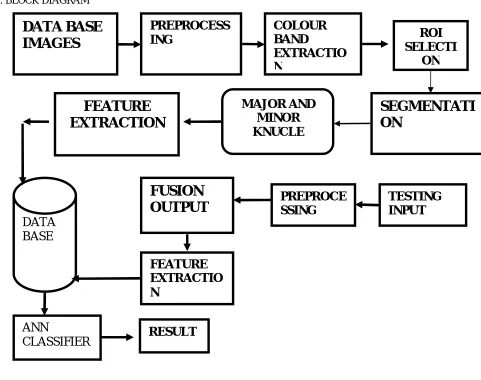
Fig 1 Block Diagram
Fig.1 shows the overall block diagram of the proposed system. Usually the images that are obtained during image acquisition may not be suitable straight for identification and classification purposes because of certain factors, such as noise, lighting variations, climatic conditions, poor resolutions of an images, unwanted background etc. The backside of finger is to be acquired using web cam or smart phone or digital camera. An acquisition system has been developed for the collection of finger-back images. A very user-friendly imaging system is constructed. This imaging system uses a web camera focused against a white
DATA BASE
IMAGES
PREPROCESS
ING
COLOUR
BAND
EXTRACTIO
N
ROI
SELECTI
ON
SEGMENTATI
ON
MAJOR AND
MINOR
KNUCLE
FEATURE
EXTRACTION
DATA
BASE
TESTING
INPUT
PREPROCE
SSING
FUSION
OUTPUT
FEATURE
EXTRACTIO
N
ANN
ISSN (Print) : 2320 – 3765
ISSN (Online): 2278 – 8875
I
nternational
J
ournal of
A
dvanced
R
esearch in
E
lectrical,
E
lectronics and
I
nstrumentation
E
ngineering
(A High Impact Factor, Monthly, Peer Reviewed Journal)
Website: www.ijareeie.com
Vol. 8, Issue 4, April 2019
background under uniform illumination. The camera has been set and fixed at a suitable distance from the imaging surface. Each of these images requires localization of region of interest for the feature extraction. The region of interest is the region having maximum knuckle creases. An ROI can be cropped from the original image for reliable feature. This section proposes an efficient finger-knuckle print ROI extraction technique. The prime objective of any ROI extraction technique is to segment same region of interest consistently from all images. The central knuckle point as can be used to segment any finger-knuckle-print consistently. Since finger-knuckle-print is aligned horizontally, one can now easily extract the central region of interest from any finger-knuckle-print that contains rich and discriminative texture using this point. The proposed ROI extraction algorithm performs in three steps; detection of knuckle area, central knuckle-line and central knuckle-point defined as follows. The central knuckle line is defined as that column of the image with respect to which the knuckle can be considered as symmetric as observed from This line is used to extract the finger-knuckle print ROI. A very specific and symmetric texture is observed around the central knuckle line which is used for its detection. To perceive such a specific texture, a knuckle filter is created by modifying the conventional gabor filter which is defined.
The K means algorithm is a clustering algorithm developed by Dunn, and later on improved by Bezdek. It is useful when the required numbers of clusters are pre-determined; thus, the algorithm tries to put each of the data points to one of the clusters. What makes FCM different is that it does not decide the absolute membership of a data point to a given cluster; instead, it calculates the likelihood (the degree of membership) that a data point will belong to that cluster. Hence, depending on the accuracy of the clustering that is required in practice, appropriate tolerance measures can be put in place. Since the absolute membership is not calculated, it can be extremely fast because the number of iterations required to achieve a specific clustering exercise corresponds to the required accuracy. Color space represents the color in the form of intensity value. We can specify, visualize and create the color by using color space method. There are different color feature extraction methods. Color feature extraction methods: a. Histogram Intersection Method: Histogram Intersection (HI) considers global color Features. The color histograms X and Y with k bins for each, HI is defined as, In Histogram Intersection method, the number of bins makes impact on performance. The large no of bins represent the image in very complex manner it increases the computational complexity.
V. MODULES OF IMAGES
.
Fig.2 Various Input Knuckle Images
ISSN (Print) : 2320 – 3765
ISSN (Online): 2278 – 8875
I
nternational
J
ournal of
A
dvanced
R
esearch in
E
lectrical,
E
lectronics and
I
nstrumentation
E
ngineering
(A High Impact Factor, Monthly, Peer Reviewed Journal)
Website: www.ijareeie.com
Vol. 8, Issue 4, April 2019
VI. RESULT AND CONCLUSION
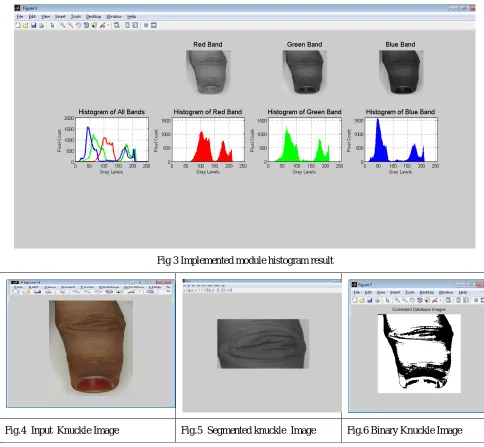
Fig 3 Implemented module histogram result
Fig.4 Input Knuckle Image Fig.5 Segmented knuckle Image Fig.6 Binary Knuckle Image
ISSN (Print) : 2320 – 3765
ISSN (Online): 2278 – 8875
I
nternational
J
ournal of
A
dvanced
R
esearch in
E
lectrical,
E
lectronics and
I
nstrumentation
E
ngineering
(A High Impact Factor, Monthly, Peer Reviewed Journal)
Website: www.ijareeie.com
Vol. 8, Issue 4, April 2019
accuracy of ROI extraction.Fig.5 shows the segmented knuckle image pattern and Fig.6. shows the binary form of knuckle image.
After the pre-processing, we have eliminated random noise and corrected the skewed image in the horizontal direction which is followed by the detection of the center point. From the FKP images, we could find that the brightest area is related to the center point. The ROI extraction method is based on the assertion that the center of the brightest area is the center point of FKP. However, this assertion is not accurate in some conditions, especially when the image skews in the vertical direction, Thus, we propose two-stage center point detection method, which could deal with the skewed images in the vertical direction. The method has two stages to detect the center point Stage I, we will detect the brightest area in FKP images and roughly regard the center of the area as the initial center point; in Stage II, we will relocate the center point according to the angle of the finger skewed in order to pinpoint the precise position. ROI extracted is the extracted output stored colour map stored in output.
Our results demonstrated that the combination of finger knuckle patterns provides better efficient and accurate matching performance results. The results presented from these set of experiments can be considered preliminary, indicating great potential for this region to serve as biometric, and require further work to achieve more accurate performance. This work has investigated the possibility of using second minor finger knuckle image for the personal identification. The approach described in this proposed system is completely automated and uses contactless imaging which is expected to produce/accommodate large variations in images. We also investigated a computationally simpler method of matching such knuckle patterns using local features and achieved out performing results
REFERENCES
[1]Y. Tang and N. Srihari, “Likelihood ratio estimation in forensic identification using similarity and rarity,” Pattern Recognition, vol. 47, no. 3, pp. 945-958, Mar. 2014.
[2] A. Kumar and Ch. Ravikanth, “Personal authentication using finger knuckle surface”, IEEE Trans. Info. Forensics & Security, vol. 4, no. 1, pp. 98-110, Mar. 2009.
[3] AADHAR -Communicating to a billion, Unique Identification Authority of India, An Awareness and Communication Report, ACSAC,http://uidai.gov.in/UID_PDF/Front_Page_Articles/Events/AADHAAR_PDF.pdf.
[4] A. Kumar and Y. Zhou, “Human identification using finger images,”IEEE Trans. Image Processing, vol. 21, pp. 2228-2244, April 2012. [5] S. Ribaric and I. Fratric, “A Biometric identification system based on eigen palm and eigen finger Features”, IEEE Trans. Pat-tern Anal. Mach. Intell., vol. 27, no. 11, Nov. 2005.
[6] A. Kumar and Y. Zhou, “Human identification using knuckle- codes,” Proc. 3rd Intl. Conf. Biometrics, Theory and Applications, Washington D. C., BTAS'09, pp. 147-152, Sep. 2009.
[7] K. Sricharan, A. Reddy and A. G. Ramakrishnan, “Knuckle based hand correlation for user verification,” Proc. SPIEvol.6202, Biometric Technology for Human Identification III, P. J. Flynn, S. Pankanti (Eds.), 2006.
[8] M. Choraś and RafałKozik,“Contactless palm print and knuck-le biometrics for mobile devices,” Pattern Analysis & Applications, vol. 1, no. 15, 2012.
[9] Jeyalakshmi, C Revathi, A ‘Efficient Speech Recognition System for Hearing Impaired Children in Classical Tamil Language’ International Journal of Biomedical Engineering and Technology (IJBET), vol.16(1), 84-100, 2018.
[10] Revathi, A Jeyalakshmi, C “Robust Speech Recognition in Noisy Environment using Perceptual Features and Adaptive Filters”, Proceedings of ‘International Conference on Communication and Electronics Systems (ICCES 2017), pp.692-696, 2018.
[11].Revathi AJeyalakshmi, C Thenmozhi, K “Person authentication using speech as a biometric against play back attacks”, Multimedia tools and applications, 2018.
[12]. Revathi, A Jeyalakshmi, C 2017, ‘A challenging task in recognizing the speech of the hearing impaired using normal hearing models in classical Tamil language’, Journal of Engineering research, vol.5 no.2, pp.110-128, June2017.
[13]. Revathi, A Jeyalakshmi, C Karthick M ‘Speaker Independent Emotion recognition using Combined Feature and Spectral Analysis’International journalof control theory and applications, Vol.10(6), pp 483-492, 2017.
[14].Revathi, A, Jeyalakshmi, C, Muruganantham, T “Perceptual Features based Rapid and Robust Language Identification System for Various Indian Classical Languages”, In: Hemanth D., Smys S. (eds) Computational Vision and Bio Inspired Computing. Springer Lecture Notes in Computational Vision and Biomechanics book series (LNCVB), vol. 28, pp.291-305, 2018.
[15]. Revathi, A Jeyalakshmi, C “Comparative Analysis on the Use of Features and Models for validating Language Identification System”, Proceedings of International Conference on Inventive Computing and Informatics (ICICI 2017), pp.693-698, Nov.2017.
[16].Karthick, M Muruganantham, T Jeyalakshmi, C Revathi, A ‘A high performance HTK based language identification system for various Indian classical languages’ Pakistan journal of Bio-technology, Vol.14(1), pp 77-81, 2017.
[17].Jeyalakshmi, C Murugeswari, B Karthick, M ‘Recognition of Emotions in Berlin speech: A HTK based approach for speaker and Text independent emotion recognition’ Pakistan journal of Bio-technology, Vol.14(1), pp 63-69,2017.
ISSN (Print) : 2320 – 3765
ISSN (Online): 2278 – 8875
I
nternational
J
ournal of
A
dvanced
R
esearch in
E
lectrical,
E
lectronics and
I
nstrumentation
E
ngineering
(A High Impact Factor, Monthly, Peer Reviewed Journal)
Website: www.ijareeie.com
Vol. 8, Issue 4, April 2019
[19] .Jeyalakshmi, CMurugeshwari, B Karthick, M, “HMM and K-NN based Automatic Musical Instrument Recognition” Proceedings of 2nd International conference on I-SMAC (IoT in Social, Mobile, Analytics and Cloud,2018),IEEE sponsored conference.
[20] K.Priyadarshini, D.Jackuline Moni “A high performance VLSI architecture with half pel and quarter pel interpolation for a single frame,” in Proc International science press, pp. 673- 680, 2016.
[21] K.Priyadarshini, D.Jackuline Moni “Analysis of block matching algorithm based on particle swarm optimization and differential evolution”. International Journal of applied engineering research.
[22] K.Priyadarshini, D.Jackuline Moni “A Novel Approach To Improved Unsymmetrical –Cross Multi –Hexagon Grid Search Algorithm” International Journal of Applied Engineering Research Volume 9, Number 24 (2014) pp. 29141-29153.