PSO Approach for Dynamic Economic Load
Dispatch Problem
P.Sivaraman
1, S.Manimaran
2, K.Parthiban3, D.Gunapriya
4 Dept. of Electrical & Electronics Engineering,M.Kumarasamy College of Engineering, Karur, Anna University Regional Office, Madurai, India
M.Kumarasamy College of Engineering, Karur, Tamilnadu, India
M.Kumarasamy College of Engineering, Karur, Tamilnadu, India
Abstract- The main objective of Dynamic Economic Load Dispatch (DELD) is to reduce the total fuel cost of the generators in system. In this paper Particle Swarm Optimization (PSO) algorithm is used to solve the Dynamic Economic Load Dispatch (DELD) problem. DELD is to list the generating units output as to meet the load demand at minimum fuel cost while satisfying all units and operational constraints. Enhancement in scheduling the unit outputs can show the way to fuel cost saving.
Keywords: Dynamic economic load dispatch; particle swarm optimization; ramp rate limit;
I. INTRODUCTION
Economic load dispatch (ELD) problem is one of the basic issues in power system operation. In essence of optimization and its objective is to reduce the total generation costs of the units while satisfying all the constraints. In conventional lambda-iteration method, base point and participation factors method, lagrangian relation method and the gradient methods are used to solve the ELD [1] . In these conventional methods for solution of ELD problems have essential assumption that is incremental cost curves of the units are monotonically increasing piecewise-linear functions[1]. Unfortunately these assumption may cause these methods are infeasible because of its nonlinear characteristics in practical systems [1]. These nonlinear characteristics of a generator include irregular prohibited zones and cost functions which are non smooth or convex and large-scale generating system these conventional
numerical methods more convenient for solving ELD problems artificial intelligent techniques , Hopfield neural network[2] are employed to solve ELD problems for units with piecewise quadratic fuel cost functions and prohibited zones constraint . On the other hand, Hopfield model may suffer from excessive numerical iterations, resulting in large calculations [3]. In the past decade, a global optimization technique known as genetic algorithms (GA) or simulated annealing (SA), which is a form of probabilistic heuristic algorithm, have been used to solve the optimization problems. Though the Genetic Algorithm methods have been employed to solve complex optimization problems, in recent study has identified some deficiencies in Genetic Algorithm performance. Particle swarm optimization (PSO) first introduced by Kennedy and Eberhart, is one of the modern heuristic algorithms. The PSO algorithm technique can produce the high-quality solutions with time and stable convergence characteristic than other stochastic methods. Dynamic economic load dispatch is solving the economic load dispatch in every second power variation. ELD solve the load dispatch economically at fixed power demand that is power is not varying in every seconds and DELD is solve the load dispatch economically at varying power demand in every second.
II. PROBLEM FORMULATION
Objective function
The core objective of economic load dispatch (ELD) is to reduce the operating costs or the generation costs of the power system while satisfying the various constraints in the system. The DELD problem is formulated to find the optimal fuel cost of the generators while fulfilling the all load demands and also fulfilling the various equality and inequality constraints. The objective function is to minimize the total generating cost (total cost of the system) subjected to the various constraints of the system.
Ft = Σ Fi(Pi) (1)
Where
N=Total number of generators, Ft=Total fuel cost,
Pi=Real power output of ith generator.
The cost of every generator represented by a single quadratic cost function defined below
Fi (Pi) = ai Pi2+ biPi+ ci (2)
Where
ai ,bi ,ci are fuel cost functions.
This quadratic equation changes if we consider the valve point effects. A sinusoidal function is added to the existing equation (2) and the equation becomes
Fi(Pi) = ai Pi 2+ biPi+ci+|ei×sin(fi×(Pi,min −Pi))| (3)
Where
ei and fi are cost functions corresponding to valve point loading.
The inequality constraint
Pi,min ≤ Pi≤ Pi,max (4)
The generation power of each generator should place between the minimum and maximum limits. The equality constraint
N
Σ Pi=PD+PLoss (5) i=1
Where
PD = total system demand. PLoss = total transmission line loss.
This is called generator constraints. This is also called power balance equation. The transmission loss can be calculated by the B-coefficients method or power flows analysis. B-coefficients used in the power system are
Pi=PTB T (6) Where
P = Power output of the unit.
III. LEAST PTH NORM ALGORITHM
The particle swarm optimization is a population based stochastic optimization technique introduced by James Kennedy and Russel Eberhart in the year of 1995. PSO based on the concept of swarms and their intelligence as well as their movement. PSO comprises of a collection of creatures (particles) performing the same action in a search space. The swarms are mostly the groups that serve the same purpose like food hunting. The PSO is motivated from the relative behaviour of the creatures that live and move in groups like swarm of birds and school of fishes etc. The above figure.1 shows a swarm of birds. This concept is used in PSO algorithm. Here the birds are analogous to the particles. In PSO there is large multidimensional search space with particles within it. These particles are move freely in the search space looking for the optimal (best possible) solution. Each particle has a particular velocity and position.
The particles and velocity are denoting by vectors Vand X. V= [v1, v2, v3... ]
X= [x1, x2, x3...]
global best. By using the concept of Pbest and Gbest the velocity of each particle is updated
V
ik1
V
ik
c r
1 1
(
Pbest
ik
X
ik)
2 2
(
k k)
i i
c r
Gbest
X
(7)Where
= Inertia weight,1
c
,c
2= Acceleration coefficients,1
r
,r
2= Random number between 0 and 1,k i
X
= Position of individual i,k i
Pbest
= Good position of individual i.k i
Gbest
= Good position of the group.In the equation (7) the inertia weight
is introduced to enable the swarm to fly in the larger search space. The right value of should be
selected so as to provide balance between the local and the global explorations. This reduces the iterations to find the optimal solution.
Figure 1: Position and velocity.
Position updated by the
X
ik1
X
ik
V
ik1 (8)Where
1 k i
X
= current particle position at iteration k+1,k i
X
= particle position at iteration k, 1k i
V
= particle velocity at iteration k+1.In general, the inertia weight can be set according to the following equation.
max min max max
Iter
Iter
(9)Where
max,
min= maximum and minimum weights,
Iter
max= maximum iteration number,
Iter
= current iteration number.A. PSO Algorithm
The step by step procedure of proposed PSO method which is used to solve DELD problem are as given below
Step 1: Read the input data such as fuel cost coefficient and
the various constraints like as generator constraints and transmission line loss coefficients etc.
Step 2: Initialize the population of the particles in random
manner. Also set the iteration counter.
Step 3: Evaluate the fitness for each particles.
Step 4: Now compare the fitness with Pbest and the value of
fitness is improved then set this value as Pbest.
Step 5: Identify the best fitness value which is Gbest. The best
value among the Pbest of all particles is Gbest.
Step 6: Update the velocity of each particles.
The velocity update rule defined by 1
1 1
(
)
k k k k
i i i i
V
V
c r
Pbest
X
2 2
(
)
k k
i i
c r
Gbest
X
Also, the particles fly to a new position using the position update rule
1 1
k k k
i i i
X
X
V
Step 7: If maximum number of iterations reaches then go to
step 8, else increase the iteration counter and go to step2.
Step 8: The particles that generates the newest best is the
solution. This is the optimal solution (result).
The above procedure is illustrated in figure 2.
Figure: 2 Flowchart.
IV. SIMULATION RESULTS
the parameters like as acceleration constants and inertia weight factors, number of iterations and population size are defined. The population size must be set, that it’s not too small or too large. If it’s small there will be inadequate number of particles so there will be difficulty in producing the best possible solution. If the population size is too large then the algorithm will become slow.
Table I Initialization Parameters
Parameters Value
Initial positions Random
Population size 100
No of iterations 300 Acceleration constants:
c1,c2
2.0
Inertia weight:
max,
min 0.9,0.3Table II Data of six generating units Generation
Units
Cost coefficient Pmin Pmax
ai bi ci
G1 .152 38.53 756.79 10 125
G2 .105 46.15 451.32 10 150
G3 .028 40.39 1049.9 35 225
G4 .035 38.30 1243.53 35 210
G5 .021 36.32 1658.56 130 325
G6 .017 38.27 1356.65 125 315
B=1e-5 [.14 .017 .015 .019 .026 .022 .017 .060 .013 .016 .015 .020 .015 .013 .065 .017 .024 .019 .019 .016 .017 .071 .030 .025 .026 .015 .024 .030 .069 .032 .022 .020 .019 .025 .032 .085]
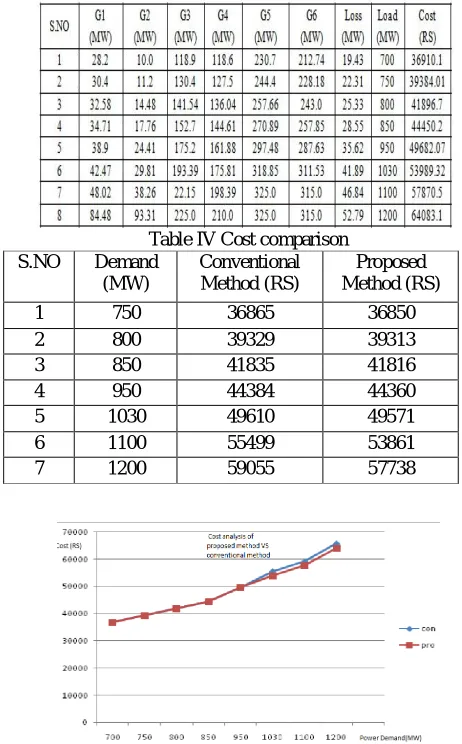
Table III Scheduling of Generating Unit
Table IV Cost comparison
S.NO Demand
(MW)
Conventional Method (RS)
Proposed Method (RS)
1 750 36865 36850
2 800 39329 39313
3 850 41835 41816
4 950 44384 44360
5 1030 49610 49571
6 1100 55499 53861
7 1200 59055 57738
Figure 3: Comparison of proposed method and conventional method.
V CONCULSION
Load dispatch problem here is solved for the six generating units. The work is done by implementing Particle swarm optimization (PSO) in the MATLAB environment.
REFERENCES
[1] S. Orike and D. W. Corne, “A Memetic Algorithm for Dynamic Economic Load Dispatch Optimization”, Proc. 2013 IEEE Symposium Series on Comp. Intelligence (SSCI), Singapore, 15-19 April 2013. [2] S. Orike and D. W. Corne, “Improved Evolutionary Algorithms for
Economic Load Dispatch Optimisation Problems,” In Proceedings of 12th IEEE UK Workshop on Computational Intelligence (UKCI), Edinburgh, 5-7 September 2012.
[3] G. Sreenivasan, C. H. Saibabu and S. Sivanagaraju, “Solution of Dynamic Economic Load Dispatch Problem with Valve Point Loading Effects and Ramp Rate Limits using PSO,” Int’l Journal of Electrical and Computer Engineering, vol. 1, no. 1, September. 2011, pp. 59 – 70 [4] D. He, G. Dong, F. Wang, and Z. Mao, “Optimization of Dynamic
Economic Dispatch with Valve-Point Effect using Chaotic Sequence based Differential Evolution Algorithms,” Journal of Energy Conversion and Management, vol. 52, 2011, pp. 1026 – 1032. Elsevier.
[5] A.I. Selvakumar and K. Thanushkodi, A new particle swarm optimization solution to Non-convex economic dispatch problems, IEEE
Trans.Power Syst,. 22 (February (1)) (2007), pp. 42–51.
[6] Zwe-Lee Gaing, “Particle Swarm Optimization to solving the Economic Dispatch Considering the Generator Constraints”, IEEE Trans. On
Power Systems, Vol.18, No.3, pp. 1187-1195, August 2003.