ISSN (Print) : 2320 – 3765 ISSN (Online): 2278 – 8875
I
nternational
J
ournal of
A
dvanced
R
esearch in
E
lectrical,
E
lectronics and
I
nstrumentation
E
ngineering
(An ISO 3297: 2007 Certified Organization)
Website: www.ijareeie.com
Vol. 6, Issue 2, February 2017
Voice Controlled Wheelchair for Physically
Disabled Person
Prof. Manoj V. Bramhe 1 , Navya Vijay 2 , K. Bhagyashree Rao 3 , Payal Bisen 4 , Riddhi Navsalkar 5 , Tanushri Bajganiya 6
Associate Professor, Head of Department, Dept. of Information Technology, St. Vincent Pallotti College of Engineering
and Technology, Nagpur, India 1
U.G. Student, Dept. of Information Technology, SVPCET, Nagpur, India 2 U.G. Student, Dept. of Information Technology, SVPCET, Nagpur, India 3 U.G. Student, Dept. of Information Technology, SVPCET, Nagpur, India 4 U.G. Student, Dept. of Information Technology, SVPCET, Nagpur, India 5 U.G. Student, Dept. of Information Technology, SVPCET, Nagpur, India 6
ABSTRACT: This paper describes intelligent voice controlled wheelchair which operates on user’s voice commands. The disabled people cannot move from one place to another on their own. They continuously need someone to help them in getting the wheelchair moving. This voice controlled system make them more independent. Powered wheelchairs with the standard joystick interface are unable to be control by many people. A voice controlled wheelchair can provide easy access for physical disabled person who cannot control their movements especially hands. Few patients such as quadraplegic, cerebral palsy and multiple sclerosis are dependent on other people to move from one place to another and due to this they don’t have the freedom of mobility. This voice controlled wheelchair help them to drive the wheelchair without anyone’s help. This system can be controlled by the simple voice commands given by the user. Depending upon the direction specified in the commands, the Arduino will drive the motors. The speech recognition is done by voice recognition module, connected with Arduino. The wheelchair would operate on real analogous voice signal of patient or user using the wheelchair.
KEYWORD: voicecontrol, quadriplegic, cerebral palsy, multiple sclerosis, arduino
I. INTRODUCTION
ISSN (Print) : 2320 – 3765 ISSN (Online): 2278 – 8875
I
nternational
J
ournal of
A
dvanced
R
esearch in
E
lectrical,
E
lectronics and
I
nstrumentation
E
ngineering
(An ISO 3297: 2007 Certified Organization)
Website: www.ijareeie.com
Vol. 6, Issue 2, February 2017
patients. So the development of voice operated wheelchair will solve the query about the mobility of quadraplegic patient and make them independent of mobility.
II. REVIEW OF LITERATURE
People have disabilities with their hands, foot and lower extremities because of which they are unable to perform regular tasks. Many technologies are available to overcome this problem. To overcome this problem, there are several applications in the market which help handicapped people to perform their tasks. [1]
Proposed design supports voice activation system for physically disabled persons incorporating manual operation. If a person is handicapped, they are dependent upon others for their day to day operations such as orientation etc. [2]
Several studies have shown that the independent mobility, which includes power wheelchair, manual wheelchair and walker access the benefit to both children and adults. Independent mobility reduces dependence on caregivers and family members and promotes feelings of self-reliance. Impaired mobility often results in decreased opportunities to socialize, which leads to social isolation, anxiety and depression. While the needs of many individuals with disabilities can be satisfied with traditional manual or power wheelchair, a segment of the disabled community finds it difficult or impossible to use wheelchairs independently. This population includes individuals with low vision, cognitive deficits, etc. [3]
The proposed voice-controlled wheelchair would bring more convenience for the disabled people. The technology can also enhance safety for users who use ordinary joystick-controlled powered wheelchairs, by preventing collisions with walls, fixed objects, furniture and other people. [4]
There are many advantages to such a system like: It reduces human efforts.
This is helpful to physically handicapped people who could not able to operate home appliances with their hand. This will help to save energy to some extent, since some people feels lazy to go and switch off the appliances
manually.
It is easy to operate for the people who are tried and does not need to operate the home appliance manually by hands.
It reduces risk.
The proposed system has certain limitations too such as: It requires extra supply to operate the model. Only the installed voice is recognized by the module. The cost of the module is quite higher.[5]
This kind of system reduces the manual effort for acquiring and distinguishing the command for controlling the motion of a wheelchair. The speed and direction of the wheelchair can be selected using the specified commands. Thus the only thing needed to ride the wheelchair is to have a trained voice. Besides that, the development of this project can be done with less cost and affordable. However this system requires some improvements to make it more reliable. This design could be improved by implementing wireless communication in the wheelchair. By developing this system, we can directly enhance the life style of the disabled people in the community. Lastly, we hope that this kind of system could contribute to the evolution of the wheelchair technology.
ISSN (Print) : 2320 – 3765 ISSN (Online): 2278 – 8875
I
nternational
J
ournal of
A
dvanced
R
esearch in
E
lectrical,
E
lectronics and
I
nstrumentation
E
ngineering
(An ISO 3297: 2007 Certified Organization)
Website: www.ijareeie.com
Vol. 6, Issue 2, February 2017
III. PROPOSED SYSTEM
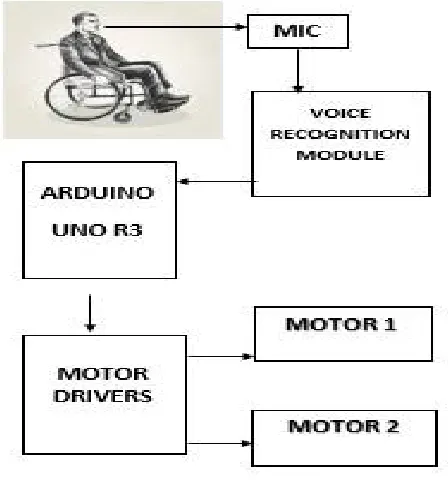
The purpose of this paper is to develop a wheelchair which will move as per the user’s commands. This system works on voice commands given by the wheelchair user. The system is fully independent as the user do not need any other person to help him to move the wheelchair. There are basically five commands, which command is given by the user, accordingly the wheelchair will move. The voice commands of the user is recognized in the first step. Once it is recognized, the commands are converted into its equivalent instructions which drive the system. This system consists of two major modules namely Voice recognition module and motor driving module. The voice recognition is done through voice recognition module. The output of this module is directed to Arduino which uses a motor driver IC to drive the motors.
The voice controlled wheelchair works using unilateral mic, voice recognition module, Arduino and motors. The input to the system is the unilateral mic. It’s capable to take user’s voice commands and not bother about other noises. The mic will be placed as per the user’s comfort. The output is in the form of voice signals and is transferred to the voice recognition module which acts as an interface between mic and Arduino. The Arduino then receive the output from voice recognition module thus converting it into binary code. The system is unable to understand any language other than binary code. Thus, the generated voice command is converted into machine understandable form. This system uses the Arduino uno R3. It is connected with motors to drive the wheelchair anywhere. Motors are responsible for the movement of wheelchair. Hence, motors receives input from the Arduino and depending upon the instruction type, motors moves accordingly. This system uses two motors connected with motor driver. There are five different instructions that can be given to the motors, they are forward, backward, left, right and stop. The movement of wheelchair depends only upon these five commands The wheelchair responds to the voice command from its user to perform any movement’s functions. The basic movement functions include forward direction, left and right turns and stop. In order to recognize the spoken words, the voice recognition processor must be trained with the word spoken out by the user who is going to operate the wheelchair.
.
ISSN (Print) : 2320 – 3765 ISSN (Online): 2278 – 8875
I
nternational
J
ournal of
A
dvanced
R
esearch in
E
lectrical,
E
lectronics and
I
nstrumentation
E
ngineering
(An ISO 3297: 2007 Certified Organization)
Website: www.ijareeie.com
Vol. 6, Issue 2, February 2017
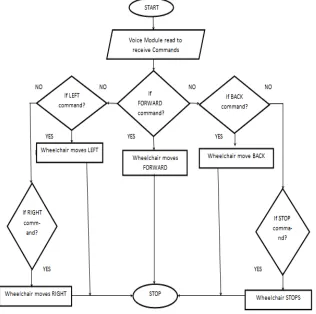
The system would recognize the commands given to it and hence would work or rather respond according to the given command. Below is the flowchart of the acceptance of the commands given to the system. Once the command is given through the mic it hardly takes time for the system to respond accordingly .
Fig 2: flowchart of the commands
A. HARDWARE DESCRIPTION
The system uses four major hardware, they are mic, voice recognition module, Arduino and motors.
1. Mic
This voice controlled wheelchair uses unilateral mic. The unilateral mic is capable of ignoring noises apart from the actual voice commands. The mic receives the voice commands from the user and send it to the voice recognition module.
2. Voice Recognition Module
ISSN (Print) : 2320 – 3765 ISSN (Online): 2278 – 8875
I
nternational
J
ournal of
A
dvanced
R
esearch in
E
lectrical,
E
lectronics and
I
nstrumentation
E
ngineering
(An ISO 3297: 2007 Certified Organization)
Website: www.ijareeie.com
Vol. 6, Issue 2, February 2017
3. Arduino Uno R3
The Arduino Uno R3 acts as an intermediate agent between the voice recognition module and the motors to drive the wheelchair. It is a microcontroller board based on the ATmega328P. It has 14 digital input/output pins, 6 analog inputs, a 16 MHz quartz crystal, a USB connection, a power jack, an ICSP header and a reset button. It contains everything needed to support the microcontroller. It receives the input given to the voice recognition module and converts into the format accepted by the motors and thus the motors works according to the command given. The Arduino needs to be interfaced to the motors as well as the voice control module.
4. D.C Motor
ISSN (Print) : 2320 – 3765 ISSN (Online): 2278 – 8875
I
nternational
J
ournal of
A
dvanced
R
esearch in
E
lectrical,
E
lectronics and
I
nstrumentation
E
ngineering
(An ISO 3297: 2007 Certified Organization)
Website: www.ijareeie.com
Vol. 6, Issue 2, February 2017
B. SCOPE OF THE PROJECT
This system will be a Real-Time Voice controlled Wheelchair for the physically disabled person. This system will
be designed to operate the wheelchair based on the voice of the user and control the movement according to the command given by the operating person. The voice would be given through a unilateral mic and would be converted into binary format by voice recognition kit. Thus this binary format would be checked with the binary code fed to the microcontroller, if true the command will be performed. More specifically, this system is designed to allow an admin and users to give the voice command to the wheelchair. These command would be performed within seconds. On the whole it's basic operation would be left, right, stop, go, back. Basically it's a wheelchair controlled by voice.
C. ADVANTAGES
The patients like quadriplegic and cerebral palsy, lack of force, can easily handle this voice controlled system.
The use of Arduino make the programming of the system easy and thus, reduced the software and hardware interfacing problems.
The system can be operated by giving synthetic voice commands.
The system is fully automated because of the use of Arduino and motor drivers
.
IV. SYSTEM DESCRIPTION
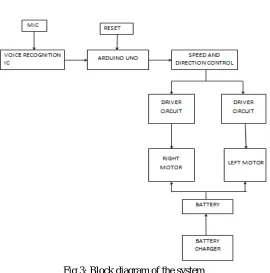
Fig 3: Block diagram of the system
ISSN (Print) : 2320 – 3765 ISSN (Online): 2278 – 8875
I
nternational
J
ournal of
A
dvanced
R
esearch in
E
lectrical,
E
lectronics and
I
nstrumentation
E
ngineering
(An ISO 3297: 2007 Certified Organization)
Website: www.ijareeie.com
Vol. 6, Issue 2, February 2017
produced by the user through the use of this microphone. The voice of the user using the system is already trained and stored in the module. So when the user gives the command, the module matches it with the existing command and gives the output if the voice and the command matches.
Certain people cannot even speak words properly. For them rather than using words as a command, vals can be used. These are just a normal sound which can be formed by any person. It makes the command giving process easy and the cerebral palsy affected people can also use the system. In this system some advanced voice commands are designed so that the highly disabled person can use it. The working of the wheel chair is based on the voice recognition unit which is the heart of the system. There are five types of motions considered, moving forward, moving in reverse direction, moving to the left and moving to the right and stop. The system starts by applying the supply voltage to the speech recognition circuit.
The direction of the wheelchair depends on the user. For the forward command the wheelchair moves in forward direction. For the reverse direction the opposite movement of wheel rotation will occur. The left command is dependent on the mechanism of the wheel ie. right wheel moves forward and left wheel moves backward and right command makes left wheel moves forward and right wheel rotate backward. However all these commands are to be fed into the voice recognition kit via a PC/Laptop. The wheelchair system will go back to the stand by condition or end the whole system by turning off the power supply of the speech recognition board.
Hardware
1. Arduino Uno R3
2. Motor drivers
3. DC magnetized motor(Johnson motors)-4
4. Battery and battery charger
5. Voice recognition module v3.1
6. Mic (Unilateral)
7. laptop/PC (for storing the voice commands)
8. capacitors
ISSN (Print) : 2320 – 3765 ISSN (Online): 2278 – 8875
I
nternational
J
ournal of
A
dvanced
R
esearch in
E
lectrical,
E
lectronics and
I
nstrumentation
E
ngineering
(An ISO 3297: 2007 Certified Organization)
Website: www.ijareeie.com
Vol. 6, Issue 2, February 2017
Fig 4: chair mounted with motors
Above is the image of the chair built manually out of iron. For the proper functioning of the wheels ,four motors are installed in the middle of the wheels on all the four sides. For the proper convenience of sitting on the chair a plastic chair can also be used instead of a metal chair.
V. CONCLUSION
i. The design and implementation of a voice controlled wheelchair for disabled people using arduino and voice recognition module for controlling the motion of a wheelchair is designed. The direction of the wheelchair now can be selected using the specified voice commands.
ii. The design not only reduce the manufacture cost compared with present market but also will give great competitive with other types of electrical wheelchair. The only thing needed to ride the wheelchair is the synthetic voice commands of the person.
iii. A system that can directly enhanced the lifestyle of a physically disabled person in the community is implemented. This project has many advantages like safety, comfort, energy saving, full automation etc.
ISSN (Print) : 2320 – 3765 ISSN (Online): 2278 – 8875
I
nternational
J
ournal of
A
dvanced
R
esearch in
E
lectrical,
E
lectronics and
I
nstrumentation
E
ngineering
(An ISO 3297: 2007 Certified Organization)
Website: www.ijareeie.com
Vol. 6, Issue 2, February 2017
REFERENCES
[1] Pramila Kupkar, Prajakta Pandit, Nikita Dhadhere and PP Jadhav, "Android controlled wheelchair", Imperial Journal of Interdisciplinary Research (IJIR) Volume-2 Issue-6 2016
[2] Apsana S, Renjitha G Nair, "Voice Controlled Wheelchair using Arduino", International Advanced `Research Journal in Science, Engineering and Technology(IARJSET), Vol 3, Issue 3, August 2016
[3] Mr. Tarun Agrawal, "Review on Voice Recognition Module Working", International Journal of Advanced Research in Computer Science and Software Engineering, May 2014
[4] Ms S. D. Suryawanshi Mr. J. S. Chitode Ms. S. S. Pethakar, "Voice Operated Intelligent Wheelchair", 2013.
[5] Kharka Bahadur Rai, Jeetendra Thakur, Nirmal Rai. Voice Controlled Wheel Chair Using Arduino, International Journal of Science, Technology & Management, June 2015
[6] R. Puviarasi, Mritha Ramalingam, Elanchezhian Chinnavan "Low Cost Self-assistive Voice Controlled Technology for Disabled People". International Journal of Modern Engineering Research (IJMER) 4, Jul.-Aug. 2013