Load Balancing of Data in Cloud Computing
Using Packet Size: A Survey Paper
Bhushan D. Patil1, Prof. R. B. Wagh2
M.E. Student, Department of Computer Engineering, R. C. Patel Institute of Technology, Shirpur, India1
Associate Professor,Department of Computer Engineering, R. C. Patel Institute of Technology, Shirpur, India2
ABSTRACT: In the last few years Cloud Computing has become very popular, as it provide a flexible and easy way to
keep and retrieve data and file over the network. In area of cloud computing the biggest issue is about to handling the billions of requests coming dynamically from the end users. To handle such requests efficiently and effectively, various load balancing approaches to distribute the load evenly among the cloud nodes have been proposed in the past years. The traditional Throttled load balancing algorithm distributes the incoming jobs evenly among the Virtual Machines. But these algorithm works well only for environments with homogeneous Virtual Machines. To solve this issue, we have proposed an algorithm with cluster based load balancing which can works well in environment of heterogeneous nodes. This algorithm divides the machines into clusters to reduce the scanning overhead.
KEYWORDS: Virtual machines (VMs)
I. INTRODUCTION
Cloud computing is a complete new technology which develop around the parallel computing, distributed computing, grid computing, and it is the combination and evolution of Virtualization [1]. Cloud computing is a kind of outsourcing of computer program in which users can access the software and applications from wherever they are; the computer programs are being hosted by an outside party and reside in the cloud. Cloud computing have a centralizes server resources on a scalable platform to provide computing resources and services on demand. It is a distributed architecture. Business owners are attracted towards cloud computing concept, because of its features like, Lower initial investment, Easy to manage, faster deployment, Independent on Location, Device independent, Security etc. [2].
Cloud computing is easy way to share processingpower, storage space, bandwidth, memory and software over the internet [2]. Cloud computing provides a flexible and easy way to keep and retrieve data and files. For making large data sets and files available for number of users around the world it requires theseveral techniques to optimize and streamline operations and to improve the performance of users [3].In field of cloud computing load balancing is one of the most important issues. To make cloud computing more efficient and to improve the user satisfaction, there is need of good load balancing[4]. Load balancing means dividing the incoming load or tasks evenly over the nodes of cloud so as to achieve maximum user satisfaction, reduce a response time and maximize the resource utilization [5]. In load balancing general system work load is redistributed among all nodes of the distributed system, to improve both resource utilization and job response time while avoiding a situation where some nodes are overloaded or others are under loaded [6]. Load balancing algorithms are classified as static and dynamic algorithms where static algorithms are mostly suitable for homogeneous and stable environments. However dynamicalgorithm providesthe betterresults in heterogeneous and dynamic environments [3].
Among the all over traditional load balancing approaches most of algorithm do not take into consideration the resource specific demands of the tasks or the heterogeneity of Virtual machines. This can lead to a problem in a cloud environment. To overcome these problems of traditional load balancing algorithms this paper introduced four main policies which includes transfer policy, selection policy, information policy and location policy.
This paper is based on dynamic load balancing algorithm which will serve heterogeneous environments and will consider the resource specific demands of the tasks by using virtual machines with k- means clustering. VMs have divided into cluster by using k-means clustering approach to improve the throughput, execution time, response time and turnaround time.
II. LITERATURESURVEY
Thissection contains some recent contributions in the area of cloud computing. Many researchers used the differentload balancing algorithmto solve the problems in area of cloud computing.
Santosh Kumar, R. H. Goudaret. al. presents research issues, challenges, architecture, platforms and applications in field of cloud computing. This paper also makes comparison betweencloud computing and grid computing. Grid is constructed to complete a specified task, where cloud computing is designed to meet general application. They have introduced the issues in cloud computing like Privacy of user personal data, Reliability on cloud servers, Interoperability of cloud, Compliance. Cloud computing users does not have freedom to physically possess the storage of data, leaving the data storage and control in the hands of cloud providers. Security of data, Costingof Model,Charging Model, Service Level Agreements between the providers and consumers are the challenges in cloud computing [1].
Klaithem Al Nuaimi, Nader Mohamed et.al. have proposed study on algorithm and challenges on load balancing in cloud computing. This paper represents a survey of the current load balancing algorithms developed specifically to suit the cloud computing environments.Designing of a load balancing algorithm that can work for spatially distributed nodes is very challenging task because speed of the network links among the nodes, distance between the client and the task processing nodes, and the distances between the nodes involved in providing theservice have taken into account.Replication, Algorithm Complexity, Point of Failure are challenging issues while designing the load balancing algorithm. Load balancing algorithms are classified into two types, static algorithms and dynamic algorithms. In static load balancing algorithm task is assign to the node which can process the new requests. Dynamic algorithm assignsthe tasks and may dynamically reassign them to the nodes based on the attributes gathered and calculated. This paper conclude that, DDFTP (dual direction downloading algorithm from FTP servers) algorithm is more suitable for Cloud environments and more efficient in terms of storage utilization [3].
GaochaoXu, Junjie Pang, Xiaodong Fu et.al. have investigate a load balancing model based on cloud partitioning for the public cloud. This paper introduced public cloud which has numerous nodes with distributed computing resources in many different geographic locations. This model divides public cloud into several cloud partitions.In this algorithm application of the game theory to the load balancing strategy have improved the efficiency in the public cloud environment [4].
Joseph Doyle, Robert Shortrepresents musical instrument identification: a pattern-recognition approach. This paper tells that large public cloud infrastructure can utilize power which is generated by a multiplicity of power plants. Each power plant will emit different amounts of carbon for a given amount of energy generated. The author have introduced that the service model involves a cloud based service provider (CBSP) providing a large pool of computational and networker sources. This is allocated on demand to the cloud users from the pool. Cloud users can use these resources. In this research carbon intensity of electricity suppliers in various geographical regions is analysed to minimize the environmental impact of a cloud. The author examines the electricity cost, carbon emissions and average service request time for a variety of scenarios [7].
any mitigation agent is in process, if it is in process then discard the request else it forwards the local agent request for further processing [8].
ShridharG.Domanal and G. Ram Mohana Reddy presents novel hybrid scheduling algorithm for load balancing in cloud environment. For designing this algorithm they have combine methodology of Divide-and-Conquer and Throttled algorithmsreferred to as DCBT. It distributes the incoming load in an efficient manner to maximize resource utilization and reduce the execution time of the task in a cloud environment [9].
III.LOAD BALENCING ALGORITHMSWORKINGPRINCIPLE
Cloud computing made up of two things i.e. cloud and computing. Cloud is nothing but the pool of heterogeneous services where computing is mapping of resources like processing. As we know the major issue in domain of cloud computing is load balancing. There are several techniques that are available for load balancing. Load balancing is used to perform the task of resource allocation and scheduling [9][10]. Load balancing techniques are divided into various types as follows:
A. Static Load balancing
In this type cloud requires priorknowledge of nodes like capacity, processing speed,performance capability etc.
B. Dynamic Load balancing
In dynamic environment, load can be changed at run time. These are useful in heterogeneous network.
C. Centralized Load Balancing
Single central node is responsible for maintaining and updating information.
D. Distributed Load Balancing
Here multiple nodes are responsible for maintaining and updating information.Multiple nodes monitor the network to make accurate load balancing decisions.
E. Hierarchical Load Balancing
Hierarchical Load Balancing is used in large homogeneous and heterogeneousnetwork.Different levels of the cloud in load balancing.
Already there exists many load balancing techniques in cloud computing such as CARTON. It uses two parameters named as LB and DRL to improve the performancelevel of the server. Compare and Balance technique based on sampling. It minimizes the number of host machines, for reducing the cost of cloud services. Task scheduling based on Load Balancing approach achieve high resource utilization, by mapping task to virtual machine and then virtual machine to host resources. Honeybee Foraging Behavior Algorithm is a self-organizing and natured inspired algorithm; it has achieved the performance by increasing system size. Biased Random Samplingmethod uses system domain random sampling. It achieves the self-organization for balancing the load across complete system [3]..
IV.METHODOLOGY
The traditional Throttled load balancing algorithm distributes the incoming jobs evenly among the VMs. But the major drawback is that, this algorithm works well for environment with homogeneous VMs and there is an overhead of scanning the entire list of VMs every time a task comes. The aim of this system is to assigning the tasks to suitable nodes in such a manner that load gets distributed evenly. Input file is processed by the node where space is available otherwise it shifted to the other node. This is designed by using the k-mean clustering of virtual machine. Physical machine is converted into a virtual machine and that virtual machine is provided to customer& customer feels that he is actually using the physical machine [10][11].
This system solves the load balancing issue using clustering of virtual machine. The goal of system is as follow: i) Assigning the users request to suitable nodes so that load gets distributed evenly.
ii) Reallocation of VMs to process the request
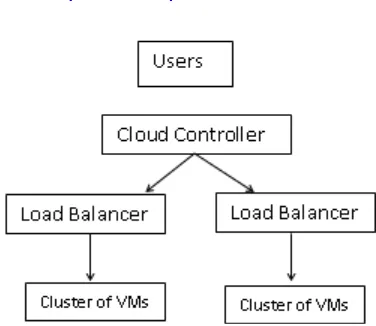
Fig. 1 System Architecture
A. Users
User sends the request to process the file, application etc. over the cloud.
B. Cloud controller
Cloud controller controls the task processing. It makes decision about which nodecontroller or load balancer should be selected for next allocation.
C. Clustering
This system use clustering approach to divide VMs with similar capacities into cluster. It divides n VMs into k clusters using k-means clustering.
D. Load balancer
Load balancer will maintain a list of all the clusters and list of VMs for each cluster. This list maintains the information about minimum and maximum resource specific capacities of each cluster. Dividing the virtual machines into the cluster reduces the scanning overhead the entire list ofVMs from the beginning [5][12].
The following fig. 2 shows in the systems execution flow.First the system initialize the all VMs with their specific resource types, capacities of each resource and also the status of VM is initialized. Clustering is performed on VM to make k clusters by using k-means clustering. Parameters used for clustering are CPU processing speed, Memory and network bandwidth. When cloud controller receives the new request is allocated to the appropriate load balancer. Load balancer has a list of all the clusters and this list is scanned to decide which cluster can handle the incoming request. After selecting the cluster, request is assigned to the appropriate VM in the VM list of that cluster. VM which is available and match the specific demands ofthe task. If more than one VMs satisfy the demands, then VM which found first one will get the task. Remaining resource quantities of that VM is then updated. Status of that VM is changed from AVAILABLE to BUSY and after finishing the process of the request, the status of that VM is changed to AVAILABLE. Load balancer updates the list of VMs capacities.
This system improves the terms waiting time, execution time, Turnaround time and throughput. Where,
Response time= Allocation time of VMs-generation time Execution time= Size of task ÷ CPU speed
Fig.2: Execution Flow of System.
V. CONCLUSION
task as per its requirements .By clustering the VMS into groups this system gives better results in terms waiting time, execution time,turnaround time and throughput..
REFERENCES
1. Santosh Kumar and R. H. Goudar, “Cloud Computing – Research Issues, Challenges, Architecture, Platforms and Applications: A Survey”,International Journal of Future Computer and Communication, vol.1, no.4, Dec. 2012.
2. Gajender Pal, Kuldeep Kumar Barala, Manish Kumar,“ A Review Paper on Cloud Computing”, International Journal for Research in Applied Science and Engineering Technology (IJRASET), vol.2, Sep. 2014.
3. Nuaimi K.A., Mohamed N., Nuaimi M.A.,"A Survey of Load Balancing in Cloud Computing: Challenges and Algorithms”,Network Cloud Computing and Applications (NCCA), 2012 Second Symposium on , pp.13 7 -142, 3-4 Dec. 2012.
4. Xu, Gaochao, Pang, Junjie, Fu, Xiaodong,“ A Load Balancing Model Based on Cloud Partitioning for the Public Cloud”,Tsinghua Science and Technology , vol.18, no.l, pp.34-39, Feb. 2013.
5. Surbhi Kapoor , Dr. Chetna Dabas, “Cluster Based Load Balancing in Cloud Computing”, 2015.
6. Mohammadreza Mesbahi, Amir Masoud Rahmani, “Load Balancing in Cloud Computing: A State of the Art Survey”, in I.J. Modern Education and Computer Science, vol. 3, pp.64-78, March 2016.
7. Joseph Doyle, Robert Shorten, “Stratus: Load Balancing the Cloud for Carbon Emissions Control ”,Cloud Computing, IEEE Transactions on , vol.1, no. 1, pp.1-1, Jan.-June 2013.
8. Aarti Vig, Rajendra Sing, “An Efficient Distributed Approach for Load Balancing in Cloud Computing”,2015 International Conference on Computational Intelligence and Communication Networks, 2015.
9. Shridhar G.Domanal and G. Ram Mohana Reddy, “Load Balancing in Cloud Environment using a NovelHybrid Scheduling Algorithm”, 2015 IEEE International Conference on Cloud Computing in Emerging Markets.
10. M.Bourguiba, K. Haddadou, EI Korbi, “Improving Network VO Virtualization for Cloud Computing”,Parallel and Distributed Systems, IEEE Transactions on, vo1.25, no.3, pp.673-681, March 2014.
11. S. B. Shaw, A. K.Singh, “A survey on scheduling and load balancing techniques in cloud computing environment”,Computer andCommunication Technology (ICCCT), 2014 International Conference on , vol. 4, pp.87-95, 26-28 Sept. 2014.