ISSN(Online): 2320-9801
ISSN (Print): 2320-9798
I
nternational
J
ournal of
I
nnovative
R
esearch in
C
omputer
and
C
ommunication
E
ngineering
(An ISO 3297: 2007 Certified Organization)
Website: www.ijircce.com
Vol. 4, Issue 12, December 2016
The Indian Banknote Recognition Using
Speeded Up Robust Features (SURF)
Mayur Jayram More
Technical Lead in MNC & Student of ME, GHRIET, Wagholi, Savitribai Phule Pune University, Pune, India
ABSTRACT: We develop an automated banknote recognition system which can be very good utility for the fields like Banking operations and other fields of commerce. Our banknote recognition system is robust and effective with the following features: 1) high accuracy, 2) robustness, 3) high efficiency, and 4) ease of use. To make the system robust to avariety of conditions including image of any angle, whether it is rotated or not, doesn’t mater of its background and whether it is worn or wrinkled bills, we propose a component-basedframework by using Speeded Up Robust Features (SURF).We also have employed the spatial relationship of matchedSURF features to detect if there is a bill in the camera view. Thisprocess largely alleviates false recognition and can guide the userto correctly aim at the bill to be recognized. The evaluation of the proposed system (robustness andgeneralizability) on a datasetincluding both positive images (with Indian banknotes) andnegative images (no Indian banknotes) collected under a variety ofconditions. Though in India, automatic banknote recognition is not common, this system is used in many countries. The recognition system takes scanned images of banknotes for recognition. Experimental results are presented which show that this scheme can recognize currently available 10 notes (1, 2, 5, 10, 20, 50, 100, 500, 1000 & 2000) successfully.The proposed algorithm, achieves 100% true recognition rate and 0% false recognition rate.
KEYWORDS: banknote recognition, computer vision, image processing, SURF I. INTRODUCTION
In Bank, if we get number of notes of different denominations, then we have to sort them manually. Same situation occurs many places like shopping mall cash counter, temple donation box or at ATM machine we have manually put the notes of different denomination in different boxes (e.g. 100, 500 & 2000). Today we have Indian currency notes of RS. 1, 2, 5, 10, 20, 50, 100, 500 and 2000.
The recent study in Computer Vision for detection of interest points in a given local image, there are multiple algorithms are available. But for detection of image with minimum errors and stable and robust i.e. strong performance and results,Scale Invariant Feature Transform (SIFT) and Speeded Up Robust Feature (SURF) [2] are used. “The sophisticated designs of local image features make them robust to geometric and photometric variations such as rotation, scaling, viewpoint variation, and illumination change. These properties make them well adapted for detecting objects appearing with different scales and orientations in images.” [1]
Fig. 1: System diagram of the proposed banknote recognition [1]
Fig. 2: Note Teller 2 - Talking Money Identifier [3] II. RELATED WORK
In last some years, there is much research and development happened on this topic to recognize the paper currency for different purpose [5-14] like to help blind or visually impaired people, etc. Some of them have used Artificial Neural Network technique to get the result. Thesetechniques take image of currency from camera, process the image and gives result on the screen in printed format or in audio format.
Fig 2 shows a talking money identifier product in a market “Note Teller 2”, developed by BRYTECH [3]. This is portable machine that can fits in your pocket. This is mainly useful for Blind, Visually Impaired and Deaf-Blind People in US.
ISSN(Online): 2320-9801
ISSN (Print): 2320-9798
I
nternational
J
ournal of
I
nnovative
R
esearch in
C
omputer
and
C
ommunication
E
ngineering
(An ISO 3297: 2007 Certified Organization)
Website: www.ijircce.com
Vol. 4, Issue 12, December 2016
III. PROPOSED ALGORITHM
A. COMPONENT-BASED FRAMEWORK FOR BANKNOTE RECOGNITION
ISSN(Online): 2320-9801
ISSN (Print): 2320-9798
I
nternational
J
ournal of
I
nnovative
R
esearch in
C
omputer
and
C
ommunication
E
ngineering
(An ISO 3297: 2007 Certified Organization)
Website: www.ijircce.com
Vol. 4, Issue 12, December 2016
Fig 3: Reference currency banknotes of Rs 1, 2, 5, 10, 20, 50, 100, 500, 1000 and 2000
B. LOCAL IMAGE FEATURE DETECTION AND REPRESENTATION
In our application the requirement is to detect the currency image in a given input image. The input image may have currency image in any corner, it may be overlapped with some other object, it may be in any angle and it may be folded or wrinkled. There are many conditions that we could get image. It is also possible that input image may don’t have any banknote in it. The SURF algorithm has all these properties to fulfill our requirement and it gives faster results.
B1. Interest Points Detection and Description
Detection and Description points are computationally effective by SURF algorithm. SURF has based on different modules for good performance like Hessian Metrix, box filters, Gaussian derivatives, etc.
B2. SURF Evaluation on Banknotes
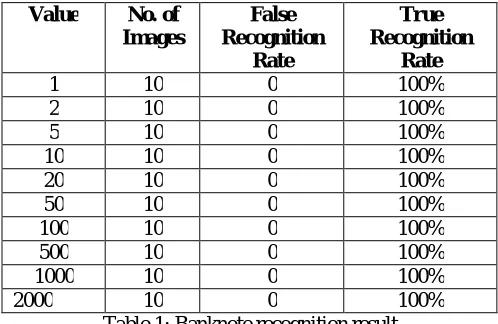
We have taken images of all 10 types of banknotes in different conditions to test the result of application. We also have added negative images which don’t have any banknote. Our aim in this practice is to test performance of application and the result is as shown in Table 1.
Value No. of Images False Recognition Rate True Recognition Rate
1 10 0 100%
2 10 0 100%
5 10 0 100%
10 10 0 100%
20 10 0 100%
50 10 0 100%
100 10 0 100%
500 10 0 100%
1000 10 0 100%
2000 10 0 100%
Table 1: Banknote recognition result
C. ALGORITHM
We have stored the Banknote images (DB_Images) to check input image(I). We will check input image with each stored image.
Calculate KeyPoints of input image Iin
For each stored Image Is
Calculate the KeyPoints of Is
Match the KeyPoints of both Images If ( both are same)
Continue;
IV. BANKNOTE SYSTEM DEVELOPMENT AND RESULTS
The system which will be running on mobile devices or on Computer or laptops. The system will always have three parts like Input Section, Middle layer to compute result and output cancel which will be printed on screen and/or speaker for audible result.
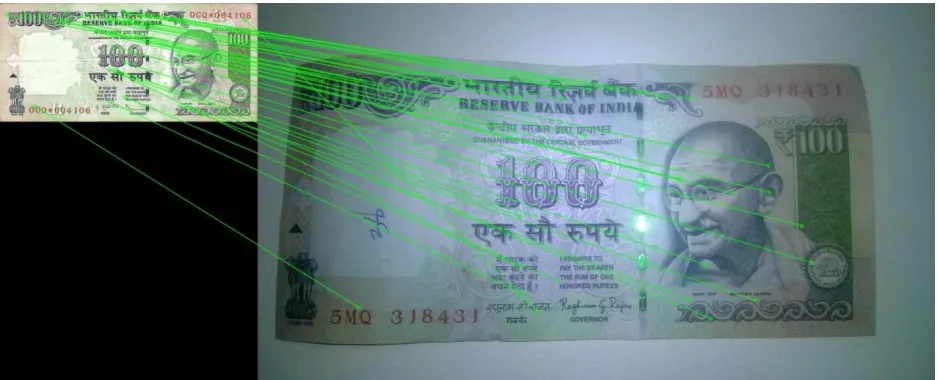
The following Fig shows some result of applications.
Fig 4 : The result of application where input image is contain folded banknote of rs 10 on right side which is taken from internet and saved on hard disk and we have stored image on left side.
ISSN(Online): 2320-9801
ISSN (Print): 2320-9798
I
nternational
J
ournal of
I
nnovative
R
esearch in
C
omputer
and
C
ommunication
E
ngineering
(An ISO 3297: 2007 Certified Organization)
Website: www.ijircce.com
Vol. 4, Issue 12, December 2016
V. CONCLUSION AND FUTURE WORK
In this paper, we have proposed a system to recognise banknote using SURF. It provides true result with 100% accuracy and 0% negative result.
In future we will try to cover the coin recognition part also and will try to cover banknotes of different countries.
REFERENCES
1. Faiz M. Hasanuzzaman, Xiaodong Yang and YingLi Tian, “Robust and Effective Component-based Banknote Recognition for the Blind”, IEEE Transactions on Systems, Man, and Cybernetics--Part C: Applications and Reviews.
2. H. Bay, T. Tuytellars, and L. Gool, “SURF: Speeded Up RobustFeatures”, European Conferecne on Computer Vision, 2006.
3. http://www.dati.org/loan/pictures/big/014-002-206-00_bg.jpg
4. Note Teller 2, http://www.brytech.com/
5. D. Dakopoulos and N.G. Bourbakis, Wearable Obstacle Avoidance Electronic Travel Aids for Blind: A Survey, IEEE Transactions on Systems, Man, and Cybernetics, Part C: Applications and Reviews, Volume: 40 , Issue: 1, 2010 ,
6. N. Giudice and G. Legge, Blind navigation and the role of technology, in The engineering handbook of smart technology for aging, disability, and independence, A.A. Helal, M. Mokhtari, and B. Abdulrazak, Editors. 2008, Wiley: Hoboken, N.J.
7. R. Manduchi, J. Coughlan, and V. Ivanchenko, Search Strategies of Visually Impaired Persons using a Camera Phone Wayfinding System, 11th International Conference on Computers Helping People with Special Needs (ICCHP '08). 2008.
8. R. Manduchi, S, Kurniawan, and H. Bagherinia, Blind Guidance Using Mobile Computer Vision: A Usability Study. ACM SIGACCESS Conference on Computers and Accessibility (ASSETS), 2010.
9. H. Shen, K. Chan, J. Coughlan, and J. Brabyn, A mobile phone system to find crosswalks for visually impaired pedestrians, Technology and Disability, Vol. 20, 2008.
10. H. Shen and J. Coughlan. "Grouping Using Factor Graphs: an Approach for Finding Text with a Camera Phone." Workshop on Graph-based Representations in Pattern Recognition. 2007.
11. E. Tekin, J. Coughlan and H. Shen. "Real-Time Detection and Reading of LED/LCD Displays for Visually Impaired Persons." 2011 IEEE Workshop on Applications of Computer Vision (WACV 2011), 2011.
12. Y. Tian, X. Yang, and A. Arditi, Computer Vision-Based Door Detection for Accessibility of Unfamiliar Environments to Blind Persons, 12th International Conference on Computers Helping People with Special Needs (ICCHP), 2010.
13. X. Yang, Y. Tian, C. Yi, and A. Arditi, Context-based Indoor Object Detection as an Aid to Blind Persons Accessing Unfamiliar Environments, International Conference on ACM Multimedia, 2010.
14. N. Aim and J. Arnott. Computer-Assisted Conversation for Nonvocal People Using Prestored Texts. IEEE Trans. Systems, Many, and Cybernetics, Part C: Applications and Reviews, vol. 28, no. 3, 1998.
BIOGRAPHY
![Fig. 1: System diagram of the proposed banknote recognition [1]](https://thumb-us.123doks.com/thumbv2/123dok_us/1421628.1174717/2.595.82.515.344.614/fig-diagram-proposed-banknote-recognition.webp)