RADIAL BASIS FUNCTION NEURAL NETWORK LEARNING WITH MODIFIED BACKPROPAGATION ALGORITHM
USMAN MUHAMMAD TUKUR
A dissertation submitted in partial fulfilment of the requirements for the award of the degree of
Master of Science (Computer Science)
Faculty of Computing Universiti Teknologi Malaysia
ACKNOWLEDGEMENT
All praises are due to Allah alone the giver of everything. May His blessings and mercy be upon His beloved servant, the best of mankind to set foot on the surface of the earth, Muhammad (SAW), his household, the four rightly guided Khalifah, other companions and the generality of Muslims. I thank Allah the Most Gracious the Most Merciful, for His guidance, His innumerable blessings on me.
I would like to express my sincere gratitude and appreciation to the immense contributions of my supervisor, Prof. Dr. Siti Mariyam Shamsuddin towards the success of this thesis. I don’t have the right words to use in thanking you for all that you have done but to prayer to Allah (SWT) to continue to be your guide and may He reward you with the best in all your life and the hereafter, Ameen.
I earnestly thank and acknowledge the support, encouragement and very useful comments and suggestions of my examiners, Prof.Dr. Habibollah Haron and Dr. Dewi Nasien. Thank you very much and May Allah (SWT) continue to shower his blessings on you. The contributions towards the success of my studies by the members of the Faculty of Computing in particular and UTM community in general is highly appreciated.
ABSTRACT
ABSTRAK
TABLE OF CONTENTS
CHAPTER TITLE PAGE
DECLARATION ii
DEDICATION iii
ACKNOWLEDGMENT iv
ABSTRACT v
ABSTRAK vi
TABLE OF CONTENTS vii
LIST OF TABLES xi
LIST OF FIGURES xiv
LIST OF ABREVIATIONS xv
LIST OF SYMBOLS xvii
LIST OF APPENDICES xix
1 INTRODUCTION
1.1 Overview 1
1.2 Problem Background 4
1.3 Problem Statement 5
1.4 Aim 6
1.5 Objectives 6
1.6 Scope 6
1.7 Importance of the Study 7
2 LITERATURE REVIEW
2.1 Introduction 9
2.2 Artificial Neural Network 10
2.3 Backpropagation Algorithm 14
2.4 Cost Functions 20
2.4.1 Mean Square Error 20
2.4.2 Bernoulli Cost Function 21
2.4.3 The Modified Cost Function 22
2.5 Radial Basis Function Neural Network 23
2.6 Data Clustering 27
2.6.1 Similarity Measures 28
2.6.2 Clustering Techniques 28
2.6.3 K-means Algorithm 29
2.7 Least Mean Squares Algorithm 30
2.8 Dataset 33
2.8.1 The XOR Dataset 33
2.8.2 The Balloon Dataset 33
2.8.3 The Iris Dataset 34
2.8.4 The Cancer Dataset 34
2.8.5 The Ionosphere Dataset 34
2.9 Discretization 35
2.10 Rough Set Toolkit for Data Analysis 36
2.11 Statistical t-test 37
2.12 Summary 38
3 RESEARCH METHODOLOGY
3.1 Introduction 40
3.2 Data Collection and Pre-processing 41
3.2.1 Dataset Attributes Description 42
3.2.2 Network architecture for each Dataset 43
3.2.3 Data Normalization 45
3.2.4 Data Samples Division 45
3.2.5 Creating Training and Testing Sets using
3.3 Dataset Discretization 47
3.4 Experiment Setup for Training Scheme 48
3.4.1 Unsupervised Learning 48
3.4.1.1 K-Means algorithm 48
3.4.1.2 Nearest neighbors algorithm 49
3.4.2 Supervised Learning 49
3.3.2.1 Least Mean Squares algorithm 50
3.5 MBP Parameters and Cost Functions 50
3.6 MBP-RBFNN Training Algorithm 52
3.7 Performance Evaluation Technique 57
4 EXPERIMENTAL RESULT
4.1 Introduction 58
4.2 Experimental Setup 58
4.3 Network Architecture Configurations 59
4.4 Experimental Results using Holdout 60
4.4.1 Results on XOR Dataset 60
4.4.2 Results on Balloon Dataset 62
4.4.3 Results on Iris Dataset 63
4.4.4 Results on Cancer Dataset 65
4.4.5 Results on Ionosphere Dataset 66
4.4.6 Comparison between MBP-RBFN and SBP-
RBFN 68
4.5 Experimental Results using 5-Fold Method 69 4.5.1 Performance Comparison between SBP-
RBFN and MBP-RBFN 69
4.5.2 SBP-RBFN and MBP-RBFN Results
Comparison using Continuous Dataset 70 4.5.2.1 Experimental Results on XOR
Dataset 70
4.5.2.2 Experimental Results on Balloon
Dataset 73
4.5.2.3 Experimental Results on Iris Dataset 75 4.5.2.4 Experimental Results on Cancer
Dataset 77
4.5.2.5 Experimental Results on Ionosphere
Dataset 79
4.5.2.6 Results Comparison Summary for
4.5.3 Results Comparison using Discretized Dataset
for both Algorithms 83
4.5.3.1 Experimental Results on Discretized
XOR Dataset 83
4.5.3.2 Experimental Results on Discretized
Balloon Dataset 86
4.5.3.3 Experimental Results on Discretized
Iris Dataset 88
4.5.3.4 Experimental Results on Discretized
Cancer Dataset 90
4.5.3.5 Experimental Results on Discretized
Ionosphere Dataset 93
4.5.3.6 Results Comparison Summary for
Discretized Dataset using 5-fold 95
4.6 Discussion 100
4.7 Summary 101
5 CONCLUSION
5.1 Introduction 102
5.2 Summary 102
5.3 Contributions of the study 103
5.4 Recommendations for future work 104
REFERENCES 105
LIST OF TABLES
TABLE NO. TITLE PAGE
3.1 Dataset Summary and Architectural Configuration 44
4.1 Network Architecture Configuration 59
4.2 Network Configurations Parameters for all Datasets 60 4.3 Result of SBP-RBFN and MBP-RBFN on XOR
Dataset 61
4.4 Result of SBP-RBFN and MBP-RBFN on Balloon
Dataset 62
4.5 Result of SBP-RBFN and MBP-RBFN on Iris
Dataset 64
4.6 Result of SBP-RBFN and MBP-RBFN on Cancer
Dataset 65
4.7 Result of SBP-RBFN and MBP-RBFN on
Ionosphere Dataset 67
4.8 Results Comparison for SBP-RBFN and
MBP-RBFN 68
4.9 Result of SBP-RBFN and MBP-RBFN on XOR
Training 71
4.10 Result of SBP-RBFN and MBP-RBFN on XOR
Testing 71
4.11 Paired t-test Results for XOR with Continuous
Dataset 72
4.12 Result of SBP-RBFN and MBP-RBFN on
Balloon Training 73
4.13 Result of SBP-RBFN and MBP-RBFN on Balloon
Testing 74
4.14 Paired t-test Results for Balloon with Continuous
Dataset 75
4.15 Result of SBP-RBFN and MBP-RBFN on Iris
4.16 Result of SBP-RBFN and MBP-RBFN on Iris
Testing 76
4.17 Paired t-test Results for Iris with Continuous Dataset 77 4.18 Result of SBP-RBFN and MBP-RBFN on Cancer
Training 78
4.19 Result of SBP-RBFN and MBP-RBFN on Cancer
Testing 78
4.20 Paired t-test Results for Cancer with Continuous
Dataset 79
4.21 Result of SBP-RBFN and MBP-RBFN on
Ionosphere Training 80
4.22 Result of SBP-RBFN and MBP-RBFN on
Ionosphere Testing 80
4.23 Paired t-test Results for Ionosphere with Continuous
Dataset 81
4.24 Result Summary for SBP-RBFN and MBP-RBFN 82 4.25 Training Result of SBP-RBFN and MBP-RBFN on
discretized XOR Dataset 84
4.26 Testing Result of SBP-RBFN and MBP-RBFN on
Discretized XOR Dataset 84
4.27 Paired t-test Results for XOR with Discretized
Dataset 85
4.28 Training Result of SBP-RBFN and MBP-RBFN on
Discretized Balloon Dataset 86
4.29 Testing Result of SBP-RBFN and MBP-RBFN on
Discretized Balloon Dataset 87
4.30 Paired t-test Results for Balloon with Discretized
Dataset 88
4.31 Training Result of SBP-RBFN and MBP-RBFN on
Discretized Iris Dataset 89
4.32 Testing Result of SBP-RBFN and MBP-RBFN on
Discretized Iris Dataset 89
4.33 Paired t-test Results for Iris with Discretized Dataset 90 4.34 Training Result of SBP-RBFN and MBP-RBFN on
Discretized Cancer Dataset 91
4.35 Testing Result of SBP-RBFN and MBP-RBFN on
discretized Cancer Dataset 91
4.36 Paired t-test Results for Cancer with Discretized
Dataset 92
4.37 Training Result of SBP-RBFN and MBP-RBFN on
Discretized Ionosphere Dataset 93
4.38 Testing Result of SBP-RBFN and MBP-RBFN on
4.39 Paired t-test Results for Ionosphere with
Discretized Dataset 95
4.40 Result Summary for SBP-RBFN and MBP-RBFN
with Discretized Dataset 96
4.41 Result Summary for MBP-RBFN with Continuous
and Discretized Dataset 97
4.42 Result Summary for SBP-RBFN with Continuous
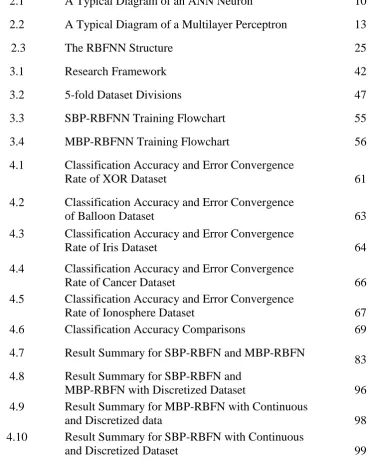
LIST OF FIGURES
FIGURE NO. TITLE PAGE
2.1 A Typical Diagram of an ANN Neuron 10
2.2 A Typical Diagram of a Multilayer Perceptron 13
2.3 The RBFNN Structure 25
3.1 Research Framework 42
3.2 5-fold Dataset Divisions 47
3.3 SBP-RBFNN Training Flowchart 55
3.4 MBP-RBFNN Training Flowchart 56
4.1 Classification Accuracy and Error Convergence
Rate of XOR Dataset 61
4.2 Classification Accuracy and Error Convergence
of Balloon Dataset 63
4.3 Classification Accuracy and Error Convergence
Rate of Iris Dataset 64
4.4 Classification Accuracy and Error Convergence
Rate of Cancer Dataset 66
4.5 Classification Accuracy and Error Convergence
Rate of Ionosphere Dataset 67
4.6 Classification Accuracy Comparisons 69
4.7 Result Summary for SBP-RBFN and MBP-RBFN
83 4.8 Result Summary for SBP-RBFN and
MBP-RBFN with Discretized Dataset 96
4.9 Result Summary for MBP-RBFN with Continuous
and Discretized data 98
4.10 Result Summary for SBP-RBFN with Continuous
LIST OF ABBREVIATIONS
ANN Artificial Neural Network
BMI Body Mass Index
BP Backpropagation
BP-RBFN Backpropagation Radial Basis Function Network DBMS Database Management System
DNA Deoxyribonucleic acid FPG Fasting Plasma Glucose GA Genetic Algorithm
GAP-RBFN Growing and Pruning Radial Basis Function Network GUI Graphical User Interface
HDL High Density Lipids HRL Hand Rock Laboratory
HRPSO Hybrid Recursive Particle Swarm Optimization LDL Low Density Lipids
LMS MBP
Least Mean Squares Modified Backpropagation
MBP-RBFN Modified Backpropagation Radial Basis Function Network MIMO Multi-Input, Multi-Output
MSE Mean Squared Error
NFCM Normalized Fuzzy C-Mean ODBC Open Database Connectivity OPA Optimal Partition Algorithm PSO Particle Swarm Optimization RBFN Radial Basis Function Network
RBFN Radial Basis Function Network
RBFNN Radial Basis Function Neural Network RLS Recursive Least Squares
ROLS Recursive Orthogonal Least Squares ROSETTA
SBP
Rough Set Toolkit for Data Analysis Standard Backpropagation
SBP-RBFN Standard Backpropagation Radial Basis Function Network SI Swarm Intelligence
SOM Self-Organizing Map
LIST OF SYMBOLS
learning rate momentum rate activation function the bias
Output of input layer (i) output of hidden layer (j) output of output layer (k) time in seconds
weight connecting layers (i) to (j) weight connecting layers (j) to (k) weight connecting layers (k) to (j) weight connecting (j) and (i)
change in weight from (k) to (j) at time (t) change in weight from (k) to (j) at time (t) bias of hidden layer (j)
the bias of (k) error of at node (k) target output of (k) net weighted sum
Wi weight of input layer (i) Xi input neuron (i)
weight from (j) to(i) at time (t)
change in weight from hidden layer (j) to input layer (i) at time (t) new normalized value
change in the centre width of (j)
LIST OF APPENDICES
APPENDIX NO TITLE PAGE
A Normalized XOR Data 111
B Normalized Balloon Data 112
C Normalized Iris Dataset 113
D Normalized Cancer Dataset 117
CHAPTER 1
INTRODUCTION
1.1 Overview
Artificial Neural Network (ANN) was developed as a parallel distributed system that is inspired by the biological learning process of the human brain. The primary importance of ANN is its capacity of learning to solve problems through training. There are many types of ANN and among them is Self-Organizing Map (SOM), Backpropagation Neural Network (BPNN), Spiking Neural Network (SNN), Radial Basis Function Neural Network (RBFNN), etc. RBF was first proposed in 1985 and subsequently Lowe and Broomhead (1988), were the first to apply RBF to design neural network. In their design, they compared RBFNN with the multilayer neural network, and they showed the relationship that exists between them. However, Moody and Darken (1989), proposed a new class of neural network, the RBFNN.
problems such as classification problems, function approximation, system control, and time series prediction.
As a result of the above mentioned benefits, RBFNN enjoys patronage in science and engineering. According to Yu et al. (1997) RBFNN has only three layers. Radial function is applied as activation function for all the neurons of the hidden layer. Also, output layer neuron on the other hand, computes a weighted sum. RBFNN training is normally divided into two stages. RBFNN training is in two stages. Between input neurons to hidden neurons is the first stage where clustering takes place using unsupervised learning and nonlinear transformation while on the other hand at the second stage, supervised learning is implemented between the hidden nodes and the output nodes with linear transformation taking place. Clustering algorithms are used to determine the centre and weight of the hidden layer. Least Mean Squares (LMS) algorithm applied between hidden and output layer to determine the weights (Yu et al., 1997). Other clustering algorithms can also be used such as, decision trees, vector quantization, and self-organizing feature maps.
RBFNN‟s hidden node performs distance transformation of the input space. The RBF fundamental design maps non-linear problem into a high dimension space which turns the problem into a linear one. Linear and non-linear mapping is implemented from input to hidden layer and hidden to output layer of RBFNN respectively. The weights thou can be adjusted have a value of 1 between the input layers and the hidden layers (Chen, 2010). The hidden layer nodes determine the behaviour and structure of the network. Gaussian function is used to activate the hidden layer (Qasem and Shamsuddin, 2009).
algorithm has been widely used as training algorithm for ANN (Zweiri et al., 2002), this also applies to RBFNN.
BP algorithm is employed to train ANN in supervised learning mode. Supervised learning is guided by the desired target values for the network. During the training, the aims are to match the network results to the expected target values. Genetic Algorithm (GA) is a famous evolutionary technique also used for training ANN (Mohammed, 2008). In RBFNN training, we need to first determine the cluster centres of the hidden nodes, by using clustering algorithms.
Clustering algorithms are capable of finding cluster centres that best represents the distribution of data. This algorithm has been used for RBFNNs training. K-means algorithms have also been used to train RBFNN with some limitations in real applications. Several other algorithms have been used in clustering such as Manhattan distance, Euclidean distance, DBSCAN algorithm, etc. Particle Swarm Optimization (PSO) (Cui et al., 2005) is another computational intelligence method that has been widely used in data clustering.
Discretization is a method of dividing range of continuous attributes into disjoint regions or intervals. It is one way of reducing data or changing original continuous attribute into discrete attribute as a form of data preprocessing stage (Goharian et al., 2004). The advantages of discretization are reduction in data size and simplification, easier to understand and easy to interpret, faster and accurate training computation process, and the representation is non-linear (Dougherty et al., 1995; Leng and Shamsuddin, 2010; Liu et al., 2002). Based on different theoretical origins there are many types, such as supervised versus unsupervised, global versus local and dynamic versus static (Agre and Peev, 2002; Saad et al., 2002).
1.2 Problem Background
RBFNN is an ANN, which uses RBF as activation functions. RBFNN forms a unique kind of ANN architecture with only three layers. In RBFNN, different layers of the network perform different tasks. This kind of behaviour is the resultant of the primary issue or problem with RBFNN. Therefore, a good practise here is separating the procedure or activities that took place in the hidden and output network layer by using various techniques.
In addition, to train RBFNN, we can take a two-step training strategies. The first step is called unsupervised learning. Unsupervised learning is used to determine RBFNN centres and widths of the clusters with clustering algorithms. This procedure is known as Structure Identification Stage. The second step is called supervised learning. This is employed to determine the weights from hidden to output layers, otherwise known as parameters estimation phase which has high running time.
training with MBP algorithm using discretized data. With the hope that this proposed method will give better classification accuracy and lower error convergence rates.
1.3 Problem Statement
Several parameters in RBFNN trained with SBP (otherwise known as SBP-RBFNN) need to be considered. The activation function, number of nodes in all the three layers, the learning and momentum rates, bias, and minimum error. All these factors will have an effect on the convergence rate of RBF Network training. In this study, the proposed method will use MBP algorithm to train RBFNN to give the optimum pattern of weight for better classification of data. Our focus is limited to the correct classification accuracy and error rate convergence.
The entire problem involves minimization of the error function. This is somewhat complex using the traditional learning methods, primarily due to the existence of the number of units in the hidden layer. MBP algorithm can be applied to obtain the best convergence rate and the classification accuracy of RBFNN training. Therefore, this study will investigate the performance of the MBP-based learning algorithm for RBFNN in terms classification accuracy and error convergence rates.
The research questions of this study can be said as:
1. Could MBP algorithm enhance learning capability of RBFNN with discretized data?
2. How significant is MBP in training the RBFNN with discretized data?
1.4 Aim
This study aims to examine the effectiveness of Modified BP algorithm, with modified cost function in training RBF Network using discretized datasets as opposed to RBFNN Network trained with standard Backpropagation algorithm with respect to error convergence rate, correct classification accuracy and cost function.
1.5 Objectives
The objectives of this study are:
1. To develop a MBP algorithm for RBFNN learning method.
2. To compare the performance of the proposed MBP-RBFNN method with SBP-RBFNN in terms of classification accuracy and error rate.
3. To investigate the effectiveness of discretized dataset on MBP-RBFNN algorithm on continuous dataset.
1.6 Scope
To achieve the stated objectives above, the scope of this study is limited to the following:
1. Five standard datasets: XOR, balloon, Iris Cancer and Ionosphere, will be used in this study.
2. To apply ROSETTA Toolkit for dataset discretization. 3. Modified BP-RBF Network with discretized data.
5. The network architecture consists of three layers: input, hidden and output to standardize the comparison criteria.
6. The coding of the MBP-RBFNN and SBP-RBFNN programs will be in C Language using Microsoft Visual C++ 2010, running on Microsoft Windows 7 Professional on a HP-Compaq-8100 Elite SFF PC running on Intel(R) Core(TM) i5 CPU with 2.00 GB of internal memory and 32-bit OS Machine. 7. SPSS version 16.0 was used to carry out t-test statistical analysis only on the
classification accuracy in k-fold experiments to ascertain the correlation of the results obtained from the two algorithms.
1.7 Importance of the Study
The performance of RBFNN with Modified BP algorithm, standard BP algorithm Network and other methods in literature will be analysed. Hence the best method can be ascertained for RBFNN training. It would be significant in confirming that Modified BP can be successfully be used to solve challenging problems.
1.8 Organization of the Thesis
REFERENCES
Agre, G. and Peev, S., 2002. On supervised and unsupervised discretization, Cybernetics And Information Technologies. 2(2), 43-57.
Akbilgic, O., 2013. Binary Classification for Hydraulic Fracturing Operations in Oil and Gas Wells via Tree Based Logistic RBF Networks, European Journal of Pure and Applied Mathematics. 6(4), 377-386.
Arisariyawong, S. and Charoenseang, S., 2002. Dynamic self-organized learning for optimizing the complexity growth of radial basis function neural networks. Proceedings of the IEEE International Conference on Industrial Technology,
2002., 655-660.
Castellanos, A., Martinez Blanco, A. and Palencia, V., 2007. Applications of radial basis neural networks for area forest. International Journal of Information Theories and Applications. 14(2007), 218-222.
Chang, W.-Y., 2013. Estimation of the state of charge for a LFP battery using a hybrid method that combines a RBF neural network, an OLS algorithm and AGA. International Journal of Electrical Power and Energy Systems, 53, 603-611.
Charytoniuk, W. and Chen, M., 2000. Neural network design for short-term load forecasting. Proceedings of the IEEE International Conference on Electric Utility Deregulation and Restructuring and Power Technologies, 2000., 554-561.
Chen, Y., 2010. Application of a Non-liner Classifier Model based on SVR-RBF Algorithm, Proceedings of the IEEE Power and Energy Engineering Conference (APPEEC), Asia-Pacific, 2010., 1-3.
Cho, T.-H., Conners, R. W. and Araman, P. A., 1991. Fast backpropagation learning using steep activation functions and automatic weight reinitialization, Proceedings of the IEEE International Conference on Systems, Man, and
Chow, M.-Y., Goode, P., Menozzi, A., Teeter, J. and Thrower, J., 1994. Bernoulli error measure approach to train feedforward artificial neural networks for classification problems, Proceedings of the IEEE World Congress on Computational Intelligence on Neural Networks, 1994., 44-49.
Cui, L., Wang, C. and Yang, B., 2012. Application of RBF neural network improved by PSO algorithm in fault diagnosis, Journal of Theoretical and Applied Information Technology, 46(1), 268-273.
Cui, X., Potok, T. E. and Palathingal, P., 2005. Document clustering using particle swarm optimization. Proceedings of the IEEE Swarm Intelligence Symposium, 2005., 185-191.
Dougherty, J., Kohavi, R. and Sahami, M., 1995. Supervised and unsupervised discretization of continuous features. Proceedings of the International Conference on Machine Learning, 1995., 194-202.
Duda, R. O. and Hart, P. E., 1973. Pattern classification and scene analysis. (Vol. 3), Wiley New York.
Edward, R., 2004. An Introduction to Neural Networks. A White paper. Visual Numerics Inc., United States of America.
Falas, T. and Stafylopatis, A.-G., 1999. The impact of the error function selection in neural network-based classifiers.Proceedings of the IEEE International Joint Conference on Neural Networks, 1999., 1799-1804.
Fausett, L., 1994. Fundamentals of Neural Networks Architectures, Algorithms, and Applications (1st ed.)., Pearson.
Feng, D.-Z., Bao, Z. and Jiao, L.-C., 1998. Total least mean squares algorithm. IEEE Transactions on Signal Processing, 46(8), 2122-2130.
Fisher, R. and Marshall, M., 1936. Iris data set. UC Irvine Machine Learning Repository. Available at: http://archive.ics.uci.edu/ml/datasets/Iris.
Goharian, N., Grossman, D. and Raju, N., 2004. Extending the undergraduate computer science curriculum to include data mining.Proceedings of the IEEE International Conference on Information Technology: Coding and
Computing, 2004., 251-254.
Kim, G.-H., Yoon, J.-E., An, S.-H., Cho, H.-H. and Kang, K.-I., 2004. Neural network model incorporating a genetic algorithm in estimating construction costs. Building and Environment, 39(11), 1333-1340.
Kröse, B., Krose, B., van der Smagt, P. and Smagt, P., 1996. An introduction to neural networks, (8 ed.) University of Amsterdam.
Leng, W. Y. and Shamsuddin, S. M., 2010. Writer identification for Chinese handwriting. International Journal of Advance Soft Computing Applications, 2(2), 142-173.
Liu, H., Hussain, F., Tan, C. L. and Dash, M., 2002. Discretization: An enabling technique. Data mining and knowledge discovery, 6(4), 393-423.
Lowe, D. and Broomhead, D., 1988. Multivariable functional interpolation and adaptive networks. Complex systems, 2, 321-355.
McCulloch, W. S. and Pitts, W., 1943. A logical calculus of the ideas immanent in nervous activity. The bulletin of mathematical biophysics, 5(4), 115-133. Mohammed, S. N. Q., 2008. Learning Enhancement of Radial Basis Function with
Particle Swarm Optimization. Masters Thesis, Universiti Teknologi
Malaysia.
Montazer, G. A., Khoshniat, H. and Fathi, V., 2013. Improvement of RBF Neural Networks Using Fuzzy-OSD Algorithm in an Online Radar Pulse Classification System. Applied Soft Computing, 14(2013), 3831-3838.
Moody, J. and Darken, C. J., 1989. Fast learning in networks of locally-tuned processing units. Neural computation, 1(2), 281-294.
Øhrn, A., 2000. Discernibility and rough sets in medicine: tools and applications. Doctor Ingenior, Norwegian University of Science and Technology, Norway. Palmer, A., José Montaño, J. and Sesé, A., 2006. Designing an artificial neural
network for forecasting tourism time series. Tourism Management, 27(5), 781-790.
Pazzani, M., 1993. A reply to Cohen's book review of Creating a Memory of Causal Relationships. Machine Learning, 10(2), 185-190.
Potter, C., Ringrose, M. and Negnevitsky, M., 2004. Short-term wind forecasting techniques for power generation. Proceedings of the Australasian Universities Power Engineering Conference, 2004., 26-29.
Qasem, S. and Shamsuddin, S., 2010. Generalization improvement of radial basis function network based on multi-objective particle swarm optimization. Journal of Artificial Intelligence. 3(1).
Qasem, S. N. and Shamsuddin, S. M., 2009. Hybrid Learning Enhancement of RBF Network Based on Particle Swarm Optimization Advances in Neural Networks. ISNN 2009, pp. 19-29. Springer.
Qu, M., Shih, F. Y., Jing, J. and Wang, H., 2003. Automatic solar flare detection using MLP, RBF, and SVM. Solar Physics, 217(1), 157-172.
Rimer, M. and Martinez, T., 2006. CB3: an adaptive error function for backpropagation training. Neural processing letters, 24(1), 81-92.
Roy, K. and Bhattacharya, P., 2007. Iris recognition based on zigzag collarette region and asymmetrical support vector machines Image Analysis and Recognition pp. 854-865. Springer.
Rumelhart, D. E. and McClelland, J. L., 1986. Parallel distributed processing: explorations in the microstructure of cognition. Volume 1. Foundations. Saad, P., Shamsuddin, S., Deris, S. and Mohamad, D., 2002. Rough set on trademark
images for neural network classifier. International Journal of Computer Mathematics. 79(7), 789-796.
Shahpazov, V. L., Velev, V. B. and Doukovska, L. A., 2013. Design and application of Artificial Neural Networks for predicting the values of indexes on the Bulgarian Stock market. Proceedings of the IEEE Signal Processing Symposium, 2013., 1-6.
Shamsuddin, S. M., Alwee, R., Kuppusamy, P. and Darus, M., 2009. Study of cost functions in Three Term Backpropagation for classification problems. Proceedings of the 2009 IEEE NaBIC '09. World Congress on Nature and
Biologically Inspired Computing, 564-570.
Shamsuddin, S. M., Sulaiman, M. N. and Darus, M., 2001. An improved error signal for the backpropagation model for classification problems. International Journal of Computer Mathematics, 76(3), 297-305.
Sirat, M. and Talbot, C., 2001. Application of artificial neural networks to fracture analysis at the Äspö HRL, Sweden: fracture sets classification. International Journal of Rock Mechanics and Mining Sciences, 38(5), 621-639.
Vakil-Baghmisheh, M.-T. and Pavešić, N., 2004. Training RBF networks with selective backpropagation. Neurocomputing, 62, 39-64.
Van den Bergh, F. (1999). Particle swarm weight initialization in multi-layer perceptron artificial neural networks. Development and Practice of Artificial Intelligence Techniques, 41-45.
Van der Merwe, D. and Engelbrecht, A. P., 2003. Data clustering using particle swarm optimization.Proceedings of the IEEE The Congress on Evolutionary Computation, 2003., 215-220.
Venkatesan, P. and Anitha, S., 2006. Application of a Radial Basis Function Neural Network for Diagnosis of Diabetes mellitus. Current Science-Bangalore, 91(9), 1195.
Wolberg, W. H., Street, W. N., Heisey, D. M. and Mangasarian, O. L., 1995. Computerized breast cancer diagnosis and prognosis from fine-needle aspirates. Archives of Surgery, 130(5), 511. Available at: http://archive.ics.uci.edu/ml/datasets/Breast+Cancer+Wisconsin+%28Origina l%29.
Yao, X., 1993. A review of evolutionary artificial neural networks. International journal of intelligent systems, 8(4), 539-567.
Yi, H., Ji, G. and Zheng, H., 2012. Optimal Parameters of Bp Network for Character Recognition.Proceedings of the IEEE International Conference on Industrial Control and Electronics Engineering (ICICEE), 2012., 1757-1760.
Yu, D., Gomm, J. and Williams, D., 1997. A recursive orthogonal least squares algorithm for training RBF networks. Neural Processing Letters, 5(3), 167-176.
Yufeng, L., Chao, X. and Yaozu, F., 2010. The Comparison of RBF and BP Neural Network in Decoupling of DTG. Proceedings of the Third International Symposium on Computer Science and Computational Technology, 2010.,
Jiaozuo, P.R. China, 159-162.
Zhang, R., Sundararajan, N., Huang, G.-B. and Saratchandran, P., 2004. An efficient sequential RBF network for bio-medical classification problems.Proceedings of the IEEE International Joint Conference on Neural Networks, 2004., 2477-2482.
Zweiri, Y. H., Whidborne, J. F., Althoefer, K. and Seneviratne, L. D., 2002. A new three-term backpropagation algorithm with convergence analysis. Proceedings of the IEEE International Conference on Robotics and
Automation, 2002., 3882-3887.
Zweiri, Y. H., Whidborne, J. F. and Seneviratne, L. D., 2003. A three-term backpropagation algorithm. Neurocomputing, 50, 305-318.