Non-interactive Manual Channel Message
Authentication Based on eTCR Hash Functions
Mohammad Reza Reyhanitabar, Shuhong Wang, and Reihaneh Safavi-Naini
Faculty of Informatics, University of Wollongong, Australia {mrr790, shuhong, rei}@uow.edu.au
Abstract. We present a new non-interactive message authentication protocol in manual channel model (NIMAP, for short) using the weakest assumption on the manual channel (i.e. assuming the strongest adver-sary). Our protocol uses enhanced target collision resistant (eTCR) hash family and is provably secure in the standard model. We compare our protocol with protocols with similar properties and show that the new NIMAP has the same security level as the best previously known NIMAP whilst it is more practical. In particular, to authenticate a message such as a 1024-bit public key, we require an eTCR hash family that can be constructed from any off-the-shelf Merkle-Damg˚ard hash function using randomized hashing mode. The underlying compression function must be evaluated second preimage resistant (eSPR), which is a strictly weaker security property than collision resistance. We also revisit some closely related security notions for hash functions and study their relationships to help understanding our protocol.
Key words: Message authentication, manual channel, eTCR hash fam-ily, randomized hashing, hash function security.
1 Introduction
that is authenticated in the sense that messages over this channel can-not be modified, although they can be delayed, replayed or removed. The channel is low capacity and can only transfer up to a few hundred bits. A manual channel models human assisted channels such as face-to-face communication, telephone conversation between two parties, or commu-nication between two devices facilitated by a human: a person reads a short number on a device display and inputs it into a second device using a keyboard. Theshort authentication stringsent over the manual channel is called SAS [22]. A number of interactive and non-interactive protocols have been proposed in this model and their security has been proven in computational and unconditional security frameworks [8, 7, 1, 17, 12, 15]. In this paper we consider computationally secure non-interactive mes-sage authentication protocols (NIMAPs) in manual channel model and assume aweak manual channel as defined by Vaudenay [22] (see Sect. 2) which corresponds to the strongest adversary. We note that in NIMAP the scarce resource is the bandwidth of the manual channel.
Computationally secure NIMAPs. Several NIMAPs have been
pro-posed in literatures [1, 7, 17, 12]. We briefly review them below and move their details to Appendix A for compact and completeness.
Balfanz, Smetters, Stewart, and Wong [1] (referred to as BSSW proto-col) were the first to propose a manual channel NIMAP that was based on collision resistant hash functions. The basic idea is to send the massage m over the insecure channel, and send its hash value, computed using collision resistant hash function, over the manual channel. Vaudenay [22] proposed a formal security model for manual authentication protocols and gave a security reduction from the security of the protocol to colli-sion resistance property of the hash function. He showed that to guarantee security against an adversary having time T = 2n, the SAS length must be at least 2nbits.
Gehrmann, Mitchell, and Nyberg [7] proposed a number of protocols, MANA I, II and III, of which only MANA I is a NIMAP. MANA I requires low bandwidth for manual channel. For example to make the probability of a successful attack less than about 2−17, one should use a SAS of length about 40 bits. The protocol requires manual channel to also provide confidentiality and Vaudenay in [22] pointed out that the manual channel must be at least stall-free. We will not include MANA I in our comparisons because of these extra requirements on manual channel.
Although compared with BSSW that uses collision resistant hash func-tions, PV protocol has weaker security requirements on hash functions (i.e. second preimage resistance), but it needs a secure trapdoor commit-ment scheme in CRS model which makes it a more demanding protocol. Mashatan and Stinson [12] proposed a new property,Hybrid Collision Resistance(HCR) for hash functions and proposed a NIMAP (referred to as MS protocol) that is provably secure assuming the hash function is HCR. Mashatan et al use random oracle model to show that HCR is a weaker security property than CR for hash functions and so the protocol is of interest because it achieves the same level of security and efficiency as PV protocol without requiring a complex commitment scheme and the added assumption of CRS. In Section 3 we show that there is no clear method of instantiating the hash function used in this protocol to be used for arbitrary length messages. In particular, we point out that popular Merkle-Damg˚ard construction cannot be used for domain extension of HCR functions. This leaves construction of efficient NIMAPs for arbitrary length messages in weak manual authentication model, an open problem.
Our contributions.We propose a new NIMAP in weak manual channel
model that uses a hash function family and is provably secure in standard model. The protocol is based on an enhanced target collision resistant (eTCR) hash function family and can be constructed using randomized hashing mode of a Merkle-Damg˚ard hash function (Theorem 4 of [9]).
The comparison is of of interest because of its direct application to NIMAP and also for grading properties of hash functions.
Paper organization. In Section 2 we describe communication and
se-curity model for manual channel authentication. In Section 3 we give an overview of security notions for hash functions and describe the three se-curity notions, eSPR, eTCR and HCR, that are directly related to our NIMAP and MS protocol. In Sect. 4 we present a new protocol and an-alyze its security. We also compare it with previous protocols and show its potential advantages. The paper is concluded in Sect. 5.
2 Communication and security model
Communication model. We consider the problem of noninteractive
authentication between a sender Alice and a verifier Bob: Alice wants to send a message,M, to Bob such that Bob can be assured that the message has come from Alice (entity authentication) and has not been modified by an adversary Eve (message authentication). It is assumed that Alice and Bob have access to two communication channels; a broadband insecure channel (denoted by−→) and an authenticated narrow-band channel (de-noted by =⇒). It is further assumed that the authenticated narrow-band channel is linked to the identity of the sender, i.e. Alice. In other words when Bob receives a message from this channel he is ensured that it is generated by Alice although the message can be a replay of a previous one. The most important restriction on the narrow-band channel is the limitation on the bandwidth: the channel can transmit messages of length at mostn which in some applicationsn can be as small as 32 bits.
As a real world example of this scenario consider user-aided pairing of two wireless devices (e.g. Bluetooth) such as a mobile phone and a laptop. The user can read a message consisting of a number of characters on the screen of mobile phone and type them on laptop keyboard. In this case the user establishes the authenticated channel manually. These kinds of human controlled authenticated channel are also called manual channels.
Security model.We assume weak authenticated channel modeland the
with some additional security requirements on it is called a strong man-ual channel. It is also assumed that the adversary can employ adaptive chosen message attack: she can adaptively choose the input message to be sent by Alice and make Alice to produce messages of the protocol to be sent over the two channels. The number of such queries made by Eve is her online complexity and is denoted by Q. A second resource of Eve is her offline complexity, denoted byT, denoting the time spent on processing the messages in the attack. We assume that Eve has bounded computational resources.
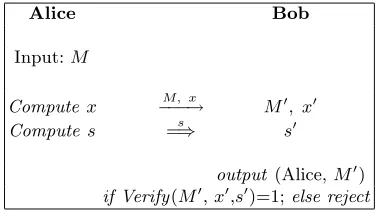
Alice Bob
Input:M
Computex −−−→M, x M′, x′
Computes =s⇒ s′
output (Alice,M′)
if Verify(M′,x′,s′)=1;else reject
Fig. 1.A typical manual channel NIMAP
A typical manual channel NIMAP works as follows (see Figure 1). On input messageM Alice uses (possibly randomized) algorithms to compute a tag x and a short authentication string (SAS) s. The message M to-gether with the tag xare sent over insecure broadband channel and SAS is sent over the authenticated channel. Note thatxmay be a null string in which case no tag will be sent over the insecure channel. Figure 1 shows communication flows in such a protocol. We note that in PV protocol the message might not be explicitly sent over the insecure channel. However the message in their protocol can be transformed (i.e. re-coded) into our representation. The transformation is public and so will not affect security of the protocol. Received messages by Bob are denoted by M′, x′ and s′ to show possible effects of an adversary. The verification process (accept or reject a received message) by Bob is abstractly denoted by a (publicly known ) deterministic binary function Verify(.). The function outputs 1 if the acceptance conditions (specified for the protocol) are satisfied by the received message, and 0 otherwise.
Definition 1 (Adversary). An adversary Eve is said to be a (T, Q, ǫ)
to Alice), time resourceT (time complexity) and is successful with proba-bility at leastǫ, in making Bob output (Alice,M′) whileM′ has never been an input of the protocol on Alice side, i.e. it has never been authenticated by Alice.
A protocol is said to be (T, Q, ǫ)-secure if there exists no (T, Q, ǫ) -breaking adversary against it.
Note that to be considered a successful adversary, Eve should respect the communication and security model described above. For example she can only replay a previously obtained sfrom Alice but she cannot mod-ify it or inject a new one. More specifically if Eve has made Q queries from Alice and has collected a data set {(Mi, xi, si); 1≤i≤Q}, then a successful attacker Eve should find anM′ ∈ {/ Mi; 1≤i≤Q}, any x′ and an s′∈ {s
i; 1≤i≤Q} such thatVerify(M′, x′, s′)=1.
Proving security of a manual channel NIMAP consists of two steps. Firstly one should show that the protocol is (T′,1, ǫ′)-secure, i.e. secure against adversaries that can only make one query from Alice (called one-shot adversaries in [22] ) and have time complexity T′. This is done by transforming such an adversary against the protocol into an adversary that can defeat security assumptions on the underlying building primi-tive(s) of protocol. The second step of proof (i.e., showing that proto-col is (T, Q, ǫ)-secure ) can be done (Lemma 6 in [22]) by transforming a (T, Q, ǫ)-breaking adversary to a (T′,1, ǫ′)-breaking adversary, where ǫ′= ǫ
Q.
3 Hash functions and security notions
Cryptographic hash functions play an important role in design of NIMAPs as well as many other cryptographic protocols like MACs and digital signature schemes. There are numerous informal and formal definitions of security for hash functions. Definitions can be application specific. For example Brown [4] defined Zero-Finder-Resistance as the difficulty of finding a preimage for zero (i.e. finding a domain element that is hashed to 0) and showed it to be a necessary security assumption for the hash functions to prove security of DSA algorithm.
fora family of hash functions, can be found in [5, 6, 13, 14, 16]. UOWHF notion (originally defined in asymptotic security framework in [14]) is also calledTCR (Target Collision Resistance) (rephrased in concrete security framework in [3]).
Informally, for a fixed hash functionH, CR means that it is computa-tionally hard to find two distinct inputsM′6=M that collide under hash function, i.e.H(M) =H(M′). SPR means that for a given inputM, it is computationally hard to findM′ such thatM′6=MandH(M) =H(M′). PR refers to one-wayness property and means that it is computationally hard to find a preimage (domain elementx) for a given hash value (range element y), so that these constitute a valid (input, output) pair for the hash function (i.e.H(x) =y).
Regarding CR notion, there is a foundational problem, that is formal definition of CR security notion can only be given for a family of hash functions (also called keyed hash function) and not for a fixed hash func-tion. There are also some other subtleties regarding formal definitions of security notions for hash functions and studying relationships (implica-tions and separa(implica-tions) between different security no(implica-tions. A brief sum-mary is provided in Appendix B. More details on CR definition dilemma and also a comprehensive formal treatment of security notions (including implications and separations between CR, SPR, PR and TCR notions), can be found in [18, 21, 19].
In comparing two security notions for hash functions, we say that notion A is stronger than notion B if A implies B; that is if a hash functionH satisfies notion A then it also satisfies notion B. For instance, CR is a stronger security notion than SPR and the implication is shown in [18] and [21] for keyed and unkeyed settings, respectively.
3.1 Definitions for eSPR, eTCR and HCR notions
We review in more details three security notions relevant to the discus-sion in the next section. First we recall Merkle-Damg˚ard construction that provides a method of extending domain for hash functions.
Merkle-Damg˚ard construction.For a compression functionH :{0,1}n+b →
{0,1}n, an L-round Merkle-Damg˚ard construction is a method of con-structing a hash function M DL[H] : {0,1}n+L.b → {0,1}n with an ex-tended domain. For an initial value C0 ∈ {0,1}n and a message M =
– The input messageM is divided intoL blocksM1, ..., ML, each block Mi of length bbits.
– The chaining variableC is initialized to C0.
– For i=1 ... L : Ci =H(Ci−1, Mi)
– CL is output as the hash value.
If the input message length is not a multiple of the block length b, proper padding can be used. For a fixed initial value C0 we denote the
transformation byM DC0
L [H] :{0,1}
Lb→ {0,1}n.
Fig. 2.L-round Merkle-Damg˚ard construction
By strengthened Merkle-Damg˚ard we mean Merkle-Damg˚ard with a proper length indicating padding and some fixed initial value. Strength-ened Merkle-Damg˚ard’s construction converts a compression function to a hash function for arbitrary length input while preserving CR property of the compression function.
In the sequel, we use←$ and ←R, to denote randomly selecting (com-puting ) according to a specific distribution (output distribution of a probabilistic algorithm) and uniform distribution, respectively.
For the definition of HCR we follow [12] but parameterize the game explicitly with the length of the randomness (l2). (As noted in [12], l2
and n are security related parameters.) We use a state variable Stateto show the state information that the adversaryAkeeps between its attack phases.
Definition 2 (HCR notion).A compression functionH:{0,1}l1+l2
→ {0,1}n is(T, ǫ)−HCR[l2]if no adversary A, having time at mostT, can
Game(HCR[l2], A)
(M, State)←$ A() //M ∈ {0,1}l1
K← {R 0,1}l2
M′ ←$ A(K, State) //M′ ∈ {0,1}l1+l2
A wins the game ifM′6=M||K and H(M′) =H(M||K)
Note thatHCR[l2] notion for an arbitrary-input-length hash function
H :{0,1}∗ → {0,1}n can be defined by a game in which the adversary can output M ∈ {0,1}∗ and M′∈ {0,1}∗, in the above game.
eSPR notion is defined for a compression function[9], which is a variant of Second-Preimage Resistance. The notion of eSPR is motived by search-ing for properties of a compression function that suffice to ensure that the multi-block randomized extension obtained via Merkle-Damg˚ard it-eration is TCR or eTCR. This will be beneficial because Merkle-Damg˚ard iteration converts a compression function for fixed-input-length to an arbitrary-input-length hash function (family).
Definition 3 (eSPR notion).A compression functionH:{0,1}n+b →
{0,1}n is (T, L, ǫ)- eSPR if no adversary, spending time at most T and using messages of length L(in b-bit blocks), can win the following game with probability at least ǫ. It is assumed that the adversary knows the ini-tial value C0 before starting the game, i.e. either C0 is chosen at random
and given to the adversary (uniform setting) or it is a parameter of the game that the adversary will receive as an ‘advice’ (non-uniform setting).
Game(eSPR, A )
∆1, . . . , ∆L←$ A() //∆i ∈ {0,1}b, L≥2 r← {R 0,1}b
M =∆L⊕r; C=M DCL−01[H](∆1⊕r, ..., ∆L−1⊕r)
(C′, M′)←$ A(C, M) //C′ ∈ {0,1}n, M′ ∈ {0,1}b
A wins the game if C′||M′ 6=C||M and H(C′||M′) =H(C||M) eTCR security notion is defined in [9] for arbitrary-input-length hash functionfamilies. Note that HCR and eSPR security notions were defined for a single hash function or a fixed compression function.
Definition 4 (eTCR notion).An arbitrary-input-length hash function
family,H:{0,1}k×{0,1}∗ → {0,1}n, is(T, ǫ)- eTCR[m], if no adversary
least ǫ. We use a state variable State to keep adversary state between its attack phases:
Game(eTCR[m])
(M, State)←$ A() //M ∈ {0,1}m
K← {R 0,1}k
(K′, M′)←$ A(K, State) //K′ ∈ {0,1}k and M′ ∈ {0,1}∗
A wins the game if (K, M)6= (K′, M′) andH
K(M) =HK′(M′)
As mentioned previously, a method of constructing an eTCR hash func-tion family is using an iterated hash method (e.g. Merkle-Damg˚ard con-struction) with a compression function. Halevi et al’s iterated construc-tion [9] reduces eTCR noconstruc-tion to eSPR property for the compression func-tion (Theorem 1). In [9], the length(in blocks) of the target message M, is denoted by L (L = m/b, where b denotes block length in bits) and is considered as another resource parameter of the adversary. So, alter-natively the adversary can be denoted as a (T, L, ǫ) adversary and the notion can be defined as (T, L, ǫ)-eTCR, instead of specifying parameter m as a superscript.
3.2 Relations among eSPR, eTCR and HCR notions
In this section we study relationships between the three notions, eSPR, eTCR and HCR.
eSPR versus HCR. We show that eSPR notion is not stronger than
HCR notion. That is there exist compression functions that are eSPR but not HCR.
This can be shown by considering the following two relations.
– R1. Halevi et al [9] pointed out a separation between eSPR and SPR
and argued that (depending on the structure of the compression func-tion)there exist compression functions that are eSPR but not SPR. – R2. We showif a compression function is not SPR then it is not HCR
Now if eSPR is stronger than HCR, then combined with R2 we can
conclude that eSPR is stronger that SPR. This contradicts R1 and so
eSPR is not a stronger notion than HCR .
Relation between HCR and eTCR. We show (constructively) that
existence of a (T, ǫ)-HCR[l2] compression function implies existence of a
(T, ǫ)- eTCR compression function family.
Assume that we have a (T, ǫ)-HCR[l2] compression function
H :{0,1}l1+l2
→ {0,1}n. We construct a compression function family as follows:
H = {HK}K∈{0,1}l2, where HK : {0,1}
l1
→ {0,1}n and HK(M) =
H(M||K). To show that the constructed family H is (T, ǫ)- eTCR, we note that an adversary A against eTCR property of the family H can be transformed into an adversary B against HCR property of H with the same advantage. Adversary B plays HCR game against H while ac-cessing A. In the first move, B runs A to choose a message M. After receiving K, B forwards it to A who will generate (K′, M′) such that HK(M) =HK′(M′). Upon receiving (K′, M′) form A, adversary B
out-puts M′||K′ in final move of its HCR game. Clearly B wins HCR game against H whenever A wins eTCR game againstH.
Using Merkle-Damg˚ard construction for HCR. LetM DL[H]
de-note a L-round strengthened Merkle-Damg˚ard construction. We show that a collision finding adversary A against M DL[H] can be used to construct an algorithm B that defeats M DL+1[H] in HCR[l2] sense. We
assume in HCR game |K|=l2 >0 (for l2= 0, HCR is the same as CR).
B works as follows:
Algorithm B invokes A to obtain two colliding messages M and M′ each of lengthLblocks. (Note that a successful adversary against strength-ened Merkle-Damg˚ard construction results in such a collision). In the first move of HCR game against M DL+1[H], algorithm B commits to M and
when receives a random challenge K ∈ {0,1}l2
, it outputs M′||K as col-liding pair with M||K. Clearly B succeeds wheneverA succeeds.
In MS protocol, if the sum of the lengths of the message to be sent (i.e. l1) and the security parameter l2 (e.g. l2 = 70 as in [12]) becomes
C0 as part of input), the hash function cannot provide HCR property as
needed in MS in such a case.
Reduction from eSPR to eTCR. The following theorem reproduced
from [9] gives an explicit construction for eTCR hash function family.
Theorem 1. [9] Assume that h: {0,1}n+b → {0,1}n is a (T, L+ 1, ǫ)
-eSPR compression function that is also (T′, ǫ′)-OWH. The(L+ 1)-round Merkle-Damg˚ard construction based on h as compression function and used in randomized hashing mode, defines a family of hash functionsHfr:
{0,1}b× {0,1}Lb → {0,1}n that is(T−O(L), L, ǫ′+ (L+ 1)ǫ)- eTCR se-cure. This family is constructed asHfr(M) =He(r, M) =M DCL+10 [h](r, M1⊕
r . . . ML⊕r), where M =M1||...||ML and C0 is a known initial value.
As argued in [9], the second property in addition to eSPR , i.e., (T′, ǫ′ )-OWH, is implied by eSPR assuming a mild structural property for the compression function and is redundant. We refer the reader to [9] for more discussion on this matter.
4 A NIMAP based on eTCR hash families
4.1 Protocol description and security reduction
Assume that we have a (T, ǫ)- eTCR hash function family H :{0,1}k× {0,1}<m → {0,1}n, where m is the maximum size of input length( e.g., m= 264). We construct a secure NIMAP between a claimant, Alice, and
a verifier, Bob, in weak manual channel model. The NIMAP is as follows:
1. On input message M, Alice chooses uniformly at random a key x ∈ {0,1}k and computess=Hx(M);
2. Alice sends (M, x) to Bob over the insecure channel and sends s = Hx(M) over the authenticated channel;
3. Bob receives (M′, x′) via insecure channel and s′ via authenticated channel;
4. Bob outputs (Alice,M′) if s′=Hx′(M′) and rejects M′ otherwise.
The proposed protocol is illustrated in Figure 3.
The following Theorem guarantees security of the NIMAP.
Alice Bob
Input:M
x∈R{0,1}k
M, x
−−−→ M′, x′
s=Hx(M) =s⇒ s′
output (Alice,M′)
if s′=H
x′(M′);else reject
Fig. 3.A new manual channel NIMAP based on eTCR hash family
Proof. First we show that any (T′,1, ǫ′)-breaking adversary Ab against our NIMAP can be used to construct a (T′+σ, ǫ′)-breaking adversary B against eTCR hash family H. Then we complete the proof by a general reduction from any (T, Q, ǫ)-breaking adversaryAto a (T′,1, ǫ′)-breaking adversaryAb, whereT′ =T+µQand ǫ′ ≥ ǫ
Q.
To prove the first part, letAbbe a (T′,1, ǫ′)-breaking adversary against the NIMAP. That is, the adversary makes a single query from Alice to obtain (M, x, s) and then spends time at most T′ to mount a successful attack, i.e. produces (M′, x′) where M′ 6= M and Hx′(M′) = s. Note
that it is possible to have x′ = x. Adversary B against H plays eTCR game usingAbas follows. It runsAband obtains the queryM and commits to it in the first move of eTCR game. After receiving the hash function key, i.e. x ∈ {0,1}k , B computes s = Hx(M) in time σ, and forwards x and sto Ab. Adversary Ab within time T′ produce (M′, x′). Adversary B outputsM′ as the second message and x′ as the second hash function key in eTCR game. This means that B succeeds in timeT′+σ and with the same success probability ǫ′ asAb.
The second part of the proof is a general transformation between a Q-query adversary and 1-query adversary [22]. For completeness of the proof, we have included the proof (i.e. two-party NIMAP). Let A be a (T, Q, ǫ)-breaking adversary against the NIMAP. We can construct a (T′,1, ǫ′)-breaking adversary Abas follows.
Adversary Abchooses uniformly at randomj ∈ {1,2, . . . , Q}and runs A. When A makes its i−th query Mi, adversary Ab selects at random an xi∈
s′ is a replay of one of the previously obtained authenticated messages. With probability Q1 we have s′ =sj and so Ab succeeds with probability ǫ′≥ Qǫ. Denote byµthe maximum overall time to run the protocol once, i.e., to compute x and s on an inputM, where the maximum is over Q queries made byA. It is easy to see that time complexity of algorithm Ab is T′ =T +µQ. This completes the proof of the theorem.
⊓ ⊔
4.2 Comparison with previous schemes
We compare our proposed NIMAP with the existing NIMAP protocols using weak manual channel, namely BSSW [1], PV [17] and MS [12]. The comparison is made for the same level of security, from following viewpoints:
1. Security assumptions required for the underlying primitives (commit-ment schemes and/or hash functions)
2. Required bandwidth for the manual channel (i.e., the SAS length).
Security assumptions. We consider security assumptions required by
BSSW, PV, MS and our protocol when there is no restriction on the length of the input message.
The BSSW protocol uses a fixed (unkeyed) hash function and requires it to be collision resistant (CR). CR is a strong security assumption for a hash function which cannot be formally defined for a single hash func-tion [2, 18]. To obtain the property for arbitrary length messages Merkle-Damg˚ard construction can be used [19].
The PV protocol uses SPR which is a weaker assumption than CR ([21, 18]). PV protocol also requires a secure trapdoor commitment scheme in CRS model. Furthermore, the commitment string c is taken as an in-put to the hash function ([17]) and so the hash domain needs to be of arbitrary size (if one uses an arbitrary commitment scheme ); i.e., one needs an arbitrary-input-length hash function that provides security in SPR sense.
To compute SAS length, PV assumes that hash function provides ideal security in SPR sense, i.e., a hash function with security level of 2−n, where n is the hash size. This assumption for the case of long messages is not satisfied by iterated Merkle-Damg˚ard hash functions (like MD5, SHA1, RIPEMD-160, Whirlpool) as shown by recent analysis in [11].
of l. As shown in subsection 3.2, the commonly used Merkle-Damg˚ard domain extension construction does not guarantee HCR (without CR assumption) and so it is not clear how to construct an arbitrary-input-length HCR hash functions from a fixed-input-arbitrary-input-length one.
Our NIMAP uses an eTCR hashfamilyto hash arbitrary-length mes-sages. Standard Merkle-Damg˚ard iteration in randomized hashing mode can be used to construct such an eTCR hash family from an eSPR com-pression function (i.e. a fixed-input-length hash function) [9]. Hence se-curity of our protocol is reduced to eSPR property for a fixed-input-length hash function. It has been argued [9] that eSPR notion is weaker than CR and also is not stronger than SPR. We also argued in subsection 3.2 that eSPR is not stronger than HCR. The above argument shows that our protocol, when used for arbitrary length messages, requires less demand-ing security assumption (namely, eSPR-ness of a fixed-input-length hash function) and benefits from provable security framework in constructing eTCR hash family for arbitrary length messages (Theorem 1).
Manual channel bandwidth.Assume an adversary with the same
re-sources and required security level (denoted by ǫ) as in [12]. Namely, we require the NIMAP to be (T, Q, ǫ)-secure , where T ≤270, Q≤210 and ǫ= 2−20.
In BSSW the SAS length must be at least 140 bits. In PV protocol a SAS of length 100 is required (, but as mentioned above for arbitrary long messages PV requires that the used hash function provides ideal SPR security for long messages which is not satisfied by Merkle-Damg˚ard constructions due to recent attacks in [11]). MS can theoretically reach the same level of security using a SAS of 100 bits forl2 = 70 bits (, but we are
not aware of a practical hash function that provides HCR for arbitrary-length messages without need to a stronger than HCR assumption on the underlying compression function and as we showed Merkle-Damg˚ard constructions cannot be used for this purpose).
Our NIMAP needs a SAS with length n = 100 + log2(L+ 2) bits, where L denotes the message length in blocks. (See more details and computation of SAS length below.) For a 1024-bit message using SHA1 in randomized hashing mode (L= 2), the required SAS length will be 102 bits. Our NIMAP can still use randomized hashing mode for messages up to about 249 bits using a SAS of only 140 bits.
To calculate SAS length for our protocol to have a NIMAP that is (T, Q, ǫ)-secure (for T = 270, Q = 210, ǫ = 2−20), using Theorem 2, we need a hash function family that is 2−30 (=2−20/210) secure in eTCR
that the compression function is eSPR with ǫ = 2L−+230 and L being the number of blocks in the input message of the eTCR function .(We assumed that ǫ′ =ǫ in Theorem 1). The length of SAS (i.e. required n) must be computed for each message length taking into account non-tightness of the reduction between eTCR and eSPR notions. One can use compression function of a standard hash function like SHA1 and truncate its output to nbits. Assuming that the compression function provides 2−n security level in eSPR sense1 , i.e. ǫ=T2−n, the SAS length of our NIMAP, i.e. n, for messages of length L blocks, isn= 100 +log2(L+ 2) bits.
5 Conclusion
We proposed a new practical non-interactive message authentication pro-tocol in manual channel model using a family of eTCR secure hash func-tions. For applications such as sending a public key where message length is small (e.g. 1024 bits), using randomized hashing mode one can con-struct an eTCR hash family using an off-the-shelf Merkle-Damg˚ard hash function (e.g. SHA1). In this case security of the scheme will be based on eSPR property of the compression function which is strictly weaker than collision resistance property. For longer messages however, randomized hashing may not produce optimal result (shortest SAS) because of the non-tightness of reduction. Using randomized hashing for messages of up to 249bits results in SAS of around 140 bits. Other constructions of eTCR
with tighter reduction can be directly used in the proposed NIMAP and could result in shorter SAS.
References
1. Dirk Balfanz, Diana K. Smetters, Paul Stewart, and H. Chi Wong. Talking to Strangers: Authentication in ad-hoc Wireless Networks. InNetwork and Distributed Sytem Security Symposium, San Diego, California, U.S.A., February 2002. 2. Mihir Bellare and Phillip Rogaway. Introduction to Modern Cryptography, (Page 3
of) Chapter 5: Hash Functions. Available at Bellare’s homepage via : http://www-cse.ucsd.edu/users/mihir/cse207/index.html
3. M. Bellare, P. Rogaway. Collision-Resistant Hashing: Towards Making UOWHFs Practical. In Advances in Cryptology–CRYPTO ’97 (1997), Vol. 1294 of LNCS, Springer-Verlag, 470-484.
4. D. Brown. Generic Groups, Collision Resistance and ECDSA. Journal ofDesigns, Codes and Cryptography, Vol. 35 (2005), 119–152.
1
5. I.B. Damg˚ard. Collision Free Hash Functions and Public Key Signature Schemes. InAdvances in Cryptology–EUROCRYPT ’87 (1988), Vol. 304 ofLNCS, Springer-Verlag, 203–216.
6. I.B. Damg˚ard. A Design Principle for Hash Functions. InAdvances in Cryptology– Crypto ’89 (1990), Vol. 435 ofLNCS, Springer-Verlag, 416-427.
7. Christian Gehrmann, Chris J. Mitchell, and Kaisa Nyberg. Manual Authentication for Wireless Devices.RSA Cryptobytes, 7(1): 29–37, January 2004.
8. C. Gehrmann and K. Nyberg. Security in Personal Area Networks. Security for Mobility, IEE, London, pages 191–230, 2004.
9. Shai Halevi and Hugo Krawczyk. Strengthening Digital Signatures Via Random-ized Hashing. InAdvances in Cryptology–CRYPTO ’06(2006), Vol. 4117 ofLNCS, Springer-Verlag, 41–59.
10. D. Hong, B. Preneel and S. Lee. Higher Order Universal One-Way Hash Functions. InAdvances in Cryptology–ASIACRYPT ’04 (2004), Vol. 3329 ofLNCS, Springer-Verlag, 201–213.
11. John Kelsey and Bruce Schneier. Second Preimages on n-Bit Hash Functions for Much Less than 2n Work, In Advances in Cryptology–EUROCRYPT ’05 (2005),
Vol. 3494 ofLNCS, Springer-Verlag, 474–490 .
12. Atefeh Mashatan and Douglas R. Stinson. Noninteractive Two-Channel Message Authentication Based on Hybrid-Collision Resistant Hash Functions. Cryptology ePrint Archive, Report 2006/302.
13. R. Merkle. One Way Hash Functions and DES. In Advances in Cryptology– CRYPTO ’89 (1990), Vol. 435 ofLNCS, Springer-Verlag, 428-446.
14. M. Naor and M. Yung. Universal One-Way Hash Functions and Their Crypto-graphic Applications. In Proc. of21st ACM Symposium on the Theory of Comput-ing, 1990, 387–394.
15. M. Naor, G. Segev, and A. Smith. Tight Bounds for Unconditional Authentica-tion Protocols in the Manual Channel and Shared Key Models. In Advances in Cryptology–CRYPTO ’06 (2006), Vol. 4117 ofLNCS, Springer-Verlag, 214–231. 16. B. Preneel. Analysis and Design of Cryptographic Hash Functions. Doctoral
dis-sertation, K. U. Leuven, 1993.
17. Sylvain Pasini and Serge Vaudenay. An Optimal Non-interactive Message Authen-tication Protocol. In David Pointcheval, editor,Topics in Cryptography, Vol. 3860 of LNCS, pages 280–294, San Jose, California, U.S.A., February 2006. Springer-Verlag.
18. Phillip Rogaway, Thomas Shrimpton. Cryptographic Hash-Function Basics: Defi-nitions, Implications, and Separations for Preimage Resistance, Second-Preimage Resistance, and Collision Resistance. InFast Software Encryption, 11th Interna-tional Workshop(FSE 2004), Vol. 3017 ofLNCS, Springer-Verlag 371–388. 19. Phillip Rogaway. Formalizing Human Ignorance: Collision-Resistant Hashing
with-out the Keys. InVietcrypt 2006, volume 4341 of LNCS, pages 221–228. Springer-Verlag, 2006.
20. Ron Rivest. Abelian Square-Free Dithering for Iterated Hash Functions. Presented atECRYPT Hash Function Workshop, June 21, 2005, Cracow.
21. D. R. Stinson. Some Observation on the Theory of Cryptographic Hash Functions. Journal ofDesign, Codes and Cryptography, Vol. 38, 259–277, 2006.
23. Xiaoyun Wang and Hongbo Yu. How to Break MD5 and Other Hash Functions. In Advances in Cryptology–EUROCRYPT ’05(2005), Vol. 3494 of LNCS, Springer-Verlag, 19-35.
Appendix
A Previous work
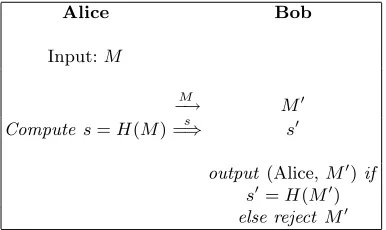
BSSW protocol [1] is the first NIMAP based on collision resistant hash functions. The protocol is shown in Figure 4. The massageM and its hash are sent over the insecure channel and the manual channel, respectively. It can be shown that a (T, ǫ)-collision finding adversary can be transformed to a (T+µ,1, ǫ)- breaking adversary against this NIMAP, whereµis the overall time complexity of the protocol (i.e., overall time complexity of Alice to respond to one query.) Therefore any collision finding adversary using only offline computations (based on Birthday attack) can be used to break this protocol.
Alice Bob
Input:M
M
−→ M′
Computes=H(M)=s⇒ s′
output (Alice,M′)if
s′=H(M′)
else reject M′
Fig. 4.BSSW protocol
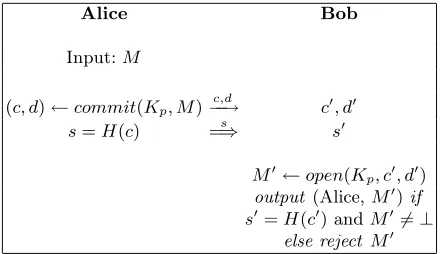
algorithm in equivocable commitment schemes or byextract(.) algorithm in extractable commitment schemes. The protocol is shown in Figure 5. This NIMAP uses a weak security property of a hash function (i.e. second preimage resistance) but needs a secure trapdoor commitment scheme in CRS model (which is stronger than the standard model) as well.
The two algorithms,commit(.) andopen(.) are used to generate (com-mit, decommit) values (represented by (c, d)) and to recover message, respectively. Both these algorithms have access to the CRS, Kp. The commit(.) algorithm is probabilistic (randomized) algorithm andopen(.) is deterministic. In case of any error,open(.) outputs a special symbol⊥. More details can be found in [22, 17].
Alice Bob
Input:M
(c, d)←commit(Kp, M)−−→c,d c′, d′
s=H(c) =s⇒ s′
M′←open(Kp, c′, d′)
output (Alice,M′)if
s′=H(c′) andM′6=⊥
else reject M′
Fig. 5.PV protocol
As noted before the two message flows in PV protocol can be trans-formed into the form shown in Figure 1, by using open(.) function to obtain M and consider the message (M, x) = (M,(c, d)) as the message over insecure channel.
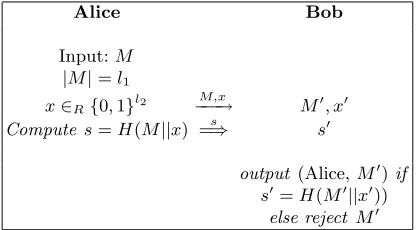
MS protocol [12] is a manual channel NIMAP which uses a hash function and requires the hash function to be Hybrid Collision Resis-tance(HCR) as defined in [12]. The protocol is in weak manual channel model and requires the same bandwidth for the manual channel as PV protocol (to reach to the same level of security). MS protocol is shown in Figure 6.
B On security notions for hash functions
Alice Bob
Input:M
|M|=l1
x∈R{0,1}l2
M,x
−−−→ M′, x′
Computes=H(M||x) =s⇒ s′
output (Alice,M′)if
s′=H(M′||x′))
else reject M′
Fig. 6.MS protocol
crucial step in formally defining and comparing security notions is to make it clear that what one means by saying a certain secure hash function. There are usual two ways to view a hash function, namely seeing it asa hash function familyor asa fixed hash function. Modeling a hash function as a Random Oracle can be seen as an extreme case in which one assumes a hash function family in which the family consists of all possible function with specified domain and range.
A hash function familyHis a class of functions, each is from domainD to range {0,1}n, indentified by an element from {0,1}k. In other words a hash family is a two-argument mapping H : {0,1}k ×D → {0,1}n. More specifically, {0,1}k represents the set of strings of length k bits, whose elements are used as a key to select a function from the family, D represents the domain of function family, andnis the hash length of the ouput in bits. In this setting H is also named as keyed hash function. A member of this family (i.e. a fixed hash function belonging to this family) is selected by a key K ∈ {0,1}k and is denoted as H(K, .) or HK(.). If domainDis the set of all strings of arbitrary length (in practice of length less than a huge number) the family is called an arbitrary-input-length hash function family or simply a hash function family. If domain only consists of strings of a fixed length (i.e., D={0,1}m for a fixed m) the family is called afixed-input-length hash function family or acompression function family.
A fixed (unkeyed) hash function H is a function (a one-argument mapping)H:D→ {0,1}n. Similarly we have an (arbitrary-input-length) hash function or a compression function, if domainDis{0,1}∗ or{0,1}m
(for some fixed m), respectively.
as a single function (not a family) and security of the protocol on some security assumptions on the hash function, e.g. assuming some properties like CR, SPR or PR from the hash function..
Here we reiterate a problem in giving a formal definition for collision resistance notion. It is well-known that treating a hash function as a fam-ily and not a single function, is the only way to give a formal definition of collision resistance notion. Defining CR as a game between an adversary and challenger for a fixed hash function (and saying that it is computa-tionally hard to win this game) is problematic as there is no challenge from the challenger and so an adversary with a priori knowledge of a colliding pair for the function cannot be ruled out. More details on this can be found in[2, 18, 21]. We discuss this matter briefly at the end of this subsection.
For some of security notions for hash function (exempt CR notion), like second preimage resistance notion, there are both sensible formal def-initions for a family of hash functions and a fixed hash function. But it is worth noticing that to compare two different security notions (i.e. study-ing their relative strength or showstudy-ing separation results) both notions should be defined in the same setting, in order to stay away from funda-mental formalization problems arise regarding mathematical meaning of definitions (like in CR notion as above).
Rogaway and Shrimpton [18] gave formal definitions in concrete secu-rity framework for basic secusecu-rity notions (CR, SPR, PR) of hash functions and some of their variants. These definitions are given in the setting of keyed hash functions, i.e. considering a family of a hash function rather than one fixed hash function. They also studied all relations (implications and separations) between these notions (in the keyed setting).
To point out some relations between a security notion defined for a family of hash functions and required security assumption(s) on a fixed hash function (to be a member of that family), we consider two secu-rity notions , called aSec and aPre and defined in [18], for a family of hash functions. The notions are defined in terms of games in which a key that is known to the adversary is chosen first and then the chal-lenger chooses a random challenge. (Alternatively the key can be cho-sen by the adversary using the best strategy.) Here we point out the fact that existence of an aSec or aPre family of hash functions, say
dis-tribution and some specific disdis-tribution, respectively.
Game(SPR[m],A) Game(PR[m],A)
M ← {R 0,1}m M ← {R 0,1}m;Y =H′(M) M′ ←$ A(M) //M′ ∈ {0,1}∗ M′←$ A(Y) //M′ ∈ {0,1}∗
A wins the game if: A wins the game if: M 6=M′ and H′(M) =H′(M′) H′(M′) =Y
We say that the hash functionH′is (T, ǫ)−SP R[m]or (T, ǫ)−P R[m]if
no adversary with time complexity at most T can win the corresponding game with probability at leastǫ. If H′ is compression function (i.e., H′ :
{0,1}m → {0,1}n), all inputs will have the same length and one can drop superscript m from notations( i.e., just say (T, ǫ)−SP R or (T, ǫ)−P R compression function).
Stinson [21] studied relations between security notions (Zero-Preimage, CR, SPR, and PR) for a fixed hash function via related games. To show an implication between two notions, a black-box reduction is used from any adversary winning one game to an adversary that wins the other game.
Let us end this brief overview by considering the notion of collision resistance. The formal definition of CR notion for a hash function fam-ily was proposed by Damgard [5, 6], in asymptotic security framework. A rephrased variant of this formal definition for a hash function family
H:{0,1}k×D→ {0,1}n , in concrete security framework (as in [18]), is as follows:
Game(CR,A)
K ← {R 0,1}k
(M, M′)←$ A(K) // M, M′∈D
A wins the game if: M 6=M′ and H
K(M) =HK(M′)
A hash function familyH is said (T, ǫ)-CR if no adversary with time complexity at mostT can win the CR game above with a probability not smaller than ǫ.
that already saved a colliding pair M, M′ in her/his memeory. Such a colliding pair is assured if hash function is compressing and so existence of such a simple adversary is already assured for any fixed (compressing) hash function. This may seem somewhat puzzling because security of many of protocols is based on CR property of a fixed hash function to be used in the protocol. Some options can be imagined for treating this matter. If it is possible modify the protocol to make it use a weaker than CR notion. Or modify it to let application of a hash function family (instead of only a single hash function) and then use a provably secure CR hash function family in it. But what if one wants to study and compare protocols as they are? An (informal) option is pointed out by Brown [4] (see also [21]) assuming CR as astrong property that “ there isno known
(T, ǫ) adversary” instead of assuming that “there is no (T, ǫ) adversary at all ”.
Recently, Rogaway [19] has introduced an interesting way out of this CR formalization dilemma.
C On hardness of eSPR game in random oracle model
(T, L, ǫ)-eSPR property for a given (fixed) compression function is just a security assumption whose validity can be verified by the best cryptanal-ysis results against the specified compression function, and this is also the case for all other properties defined for a fixed compression function (not for a family of functions). For example considering a compression function like md5 : {0,1}128+512 → {0,1}128 used in the MD5 hash function, one can assume as a security notion that md5 is SPR or PR, but validity of such an assumption is not provable and one can have some feelings about this due to the fact that the best practical cryptanalysis results cannot do much so far.
Regarding the fact that eSPR notion is a very recent one at present we should wait for cryptanalysis results to evaluate popular practical hash functions like MD5 (not so popular now due to recent attacks like [23]) and SHA1. In the following we provide an intuition about hardness of eSPR game compared to SPR game under Random Oracle Model. The proof of following proposition is very similar(with some small modification) to that of HCR game as shown by Mashatan and Stinson[12].
Proposition 1 (eSPR difficulty in random oracle model).Assume
that H is a random function from the set of all functions with domain
than 2n. Then for any adversary Eve making at most T = 2t queries to oracle H, an upper bound on the probability of the adversary winning eSPR game is ǫ≤2t−n+ 22t−2n−b.
Proof (Hint). Note that because of modeling H as a random oracle we should only consider eSPR adversaries with L = 2, for by repeated in-vocation of random oracle, the output distribution (related to evaluated part in eSPR game) does not change. The rest of proof is very similar to proof of HCR difficulty in [12].