95 |
P a g e
RECENT TRENDS IN THE MANUFACTURING
PROCESSING OF METAL MATRIX COMPOSITES:
PRIMARY PROCESSING
Sarbjit Singh
PEC University of Technology, Chandigarh (India)
ABSTRACT
The growing steel prices have significantly affected the manufacturing expenditure in automobile and house hold industries, thus making a strong case for substituting steels with other light weight and high strength to weight ratio materials. The aluminium and its alloy have outstanding properties like light weight, wear resistance andcorrosion resistance that make them suitable in numerous industrial applications. These materials, comprehensively used in automobile and aerospace industries have nearlytouched their limit of practicality. Therefore, substantial investigations in the area of materials science and engineering have been focused towards the growth of newfangled materials like composites. The research in the field of materials science has established that composites cansubstitute conventional materials because of their light weight as well as better mechanical and chemical properties.The present research paper explore the status of primary processing of metal matrix composites in the various domains of applications in Industry.
Keywords: Metal Matrix Composites; Stir Casting, Primary processing; Aluminium
I INTRODUCTION
The composites can be developed from metals and their alloys, ceramics, plastics or polymers through casting,
powder metallurgy, metal alloying, injection molding, hand lay-up technique etc., to obtain the desired
properties. MMCs were developed in early seventies and the primary support for their development was from
aerospace industry. At present, as per the survey, more than eighty percent of MMCs are used for ground
transportation (Figure 1). Therefore, the primary support for the development of MMCs is from transportation
industry. The transportation industry is looking for efficient and cost effective methods for the processing and
assembly of the MMCs.
96 |
P a g e
The synthesis of metal matrix composites (MMCs) has been taken place from last four decades with the help of
different casting routes. The commercial use of MMCs with improved physical and mechanical properties as
compared to monolithic materials started after 1990. MMCs fundamentally comprise of two different materials.
The main constituent is called matrix, and another constituent known as reinforcement is added in different
volume fractions to the matrix material in the form of particles, whiskers and fibers. These composites are
mainly classified as continuous and discontinuous MMCs, depending upon whether the reinforcement is
fiber/whisker or particle. Properties of MMCs can be customized for numerous industrial applications through
appropriate combination of matrix material, reinforcement and manufacturing techniques. The particle
reinforced metal matrix compositeshave proved tobe economical due to less expensive reinforcement particles
and use of low cost production methods such as casting or liquid metallurgy route [2].
II PRESENT STATE OF RESEARCH IN MANUFACTURING
The state of research in manufacturing can be classified in four categories as following:
Existing technologies applied to existing materials.
Existing technologies applied to new materials.
New technologies applied to existing materials.
New technologies applied to new materials.
Here, existing technologies denotes to those which are effectively being used in the industries, whereas
new technologies are those which are either at laboratory stage or relatively new and not frequently practiced.
Conventional stir casting, powder metallurgy, squeeze casting etc., have been considered in the former while
vacuum infiltration, hybrid casting etc., have been considered in the later. On the other hand, new materials
cover super alloy composites which are still in the research stage or in the stage of infancy.
III CURRENT DIRECTION IN THE PRIMARY PROCESSING OF METAL MATRIX
COMPOSITES
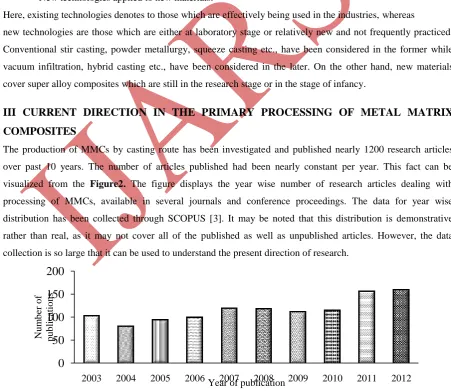
The production of MMCs by casting route has been investigated and published nearly 1200 research articles
over past 10 years. The number of articles published had been nearly constant per year. This fact can be
visualized from the Figure2. The figure displays the year wise number of research articles dealing with
processing of MMCs, available in several journals and conference proceedings. The data for year wise
distribution has been collected through SCOPUS [3]. It may be noted that this distribution is demonstrative
rather than real, as it may not cover all of the published as well as unpublished articles. However, the data
collection is so large that it can be used to understand the present direction of research.
Figure 2 Research Publications Related to the Production of MMCs
0
50
100
150
200
2003 2004 2005 2006 2007 2008 2009 2010 2011 2012
Nu
m
b
er
o
f
p
u
b
licatio
n
s
97 |
P a g e
In order to analyze the worldwide research efforts in the broad area of manufacturing of MMCs, a study has
been made undertaken. The articles available in international journals and conference proceedings in the year
2012 have been analyzed (on the basis of data accessible with SCOPUS [3]). Above 170 articles were reported
for the year 2012. From study point of view, these articles have been categorized into three groups as following:
Manufacturing process for the production of MMCs
Analysis of process/ procedure
Application/objective
The following inferences can be drawn from the exhaustive study of research articles(Figure 3 (a, b and c)):
1. A number of methods have been developed by the researchers for the production of MMCs. The most
commonly used method for MMCsproduction is stir casting(Figure 3 (a)).
2. Mostly experimental work has been carried out to study the behavior of processing parameters (Figure 3
(b)).
3. Improvement in the mechanical and wear properties are the main research objectives by attaining uniform
distribution of the reinforcement(Figure 3 (c)).
4. Machinability of the developed/procured MMCs has been investigated for optimum quality characteristics
such as; tool wear, cutting forces, surface finish etc., (Figure 3 (c)).
5. Aluminium alloy matrix materials are extensively used by the research community.
6. The MMCs reinforced with abrasive particles are extensively developed as compared to whisker reinforced
or long fiber reinforced composites.
7. Average grain size of the reinforcing abrasive particles (SiC, Al2O3)used for the production of MMCs is
more than 25 microns. Very little information is available for the production of composites with smaller size
of reinforcement particles. Among the particulates used as reinforcement, silicon carbide (SiC) has achieved
aprimary position for production of MMCs.
(a)
(b)
0
10
20
30
40
Stir Cast Squeeze Casting Centrifugal Casting Hybrid Procured
P
erc
entag
e
of
article
s
Processing technique
0
50
100
Experimental Modeling Application based
P
er
ce
n
tag
e
o
f
ar
ticles
98 |
P a g e
(c)
Figure 3(a, b and c) Classification of Research Articles in the Area of Processing of MMCs
IV PRODUCTION OF METAL MATRIX COMPOSITES (MMCS)
Solid, liquid and vapor state processing methods are used for the production of MMCs.The solid state
processing methods are powder metallurgy, diffusion bonding etc. The liquid processing methodsare liquid
infiltration, stir-casting, squeeze casting, spray deposition, reactive processing, compo-casting etc. The vapor
phase processing methods are physical vapor deposition (PVD), chemical vapor deposition (CVD) etc. Further
the production of the MMCs are categorized as ex-situ or in-situ processes. In ex-situ process,
reinforcingparticles are added externally in the liquid matrixin form of whiskers or powder, and in the case of
in-situprocess chemical reaction between the constituents of matrix causes the formation of reinforcements
under controlled environment.
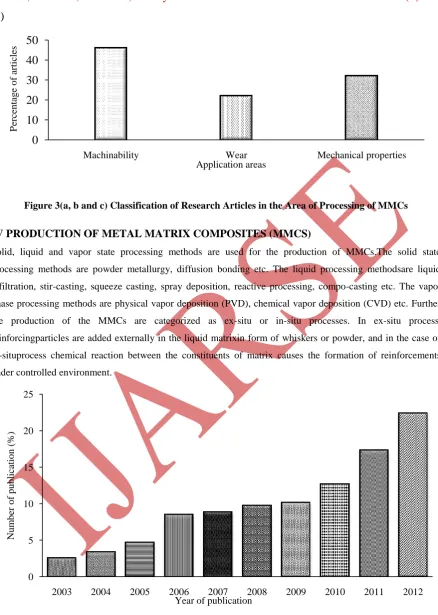
Figure 4Year Wise Distribution of Published Articles in the Area of Stir Casting
Stir casting route has been prominently used as a production technique as shown in Figure 4 but it faces
technical challenges as well. The main research challenge is to get a uniform distribution of the reinforcement in
the matrix with minimum porosity [4-6]. Theconventional foundry technology with a little modification in the
design of furnace and stirring method can be used for the production of MMCs by ex-situ process. Stir-casting
0
10
20
30
40
50
Machinability Wear Mechanical properties
P
er
ce
n
tag
e
o
f
ar
ticles
Application areas
0 5 10 15 20 25
2003 2004 2005 2006 2007 2008 2009 2010 2011 2012
Nu
m
b
er
o
f
p
u
b
licatio
n
(
%)
99 |
P a g e
route employs distribution of ceramic reinforcement such as SiC or Al2O3 into the liquid matrix and stirring the
mixture at designed velocity for a period of time to create vortex formation for uniform distribution of
reinforcement.The poor wettability of the reinforcement with the molten matrix is the major problem for the stir
casting route. It causes weak interfacial bonding and deterioration in mechanical properties. The problem
becomes more complex when fine reinforcement particles are used. Continuous improvement has beenmade to
produce sound castingswith comparatively improved dispersion and appropriate wetting ofparticles by
governing and optimizing the casting process parameters.
The matrix material used for the production of MMCs are aluminium and its alloys, magnesium and its alloy,
copper and its alloys and other low melting point metallic materials. Amongst them, aluminium and its alloys
are extensively used as matrix because of their outstanding physical andmechanical properties and
comparatively low cost as compared to other matrix materials.Further, the addition of reinforcement in
aluminium and its alloy is easy as compared to other matrix materials.
The appropriate combination of matrix, reinforcement, reinforcement size, and processing methods lead to
improved physical, mechanical and corrosion properties required for a specific applications. The elastic-plastic
behavior of MMCs is observed during stress strain analysis. The elastic-plastic behavior is based upon the
ductility and fracture toughness of the MMCs. The MMCs behave like conventional monolithic materials, but
their ductility and fracture toughness is reduced due to the presence of brittle reinforcement phase [7]. Improved
mechanical properties of MMCs can be attained through proper selection ofmatrix and
reinforcementcombination and standardization of processing methods. Stir-castingmethod is extensively used
for the production of metal matrix composites to obtain near net shape withenhanced mechanical and chemical
properties. The properties of stir cast components can be further improved with the help of squeeze casting,
which promotes the forced wettability of the reinforcement with matrix and results in reduced porosity [7-8].
V CONCLUSIONS
From this review article onrecent trends in processing of metal matrix composites: primary processing, the
following conclusions can be
drawn:-1. The most commonly used method for MMCs production is stir casting
2. The main research objectives of the researchers are improvement in mechanical and wear propertiesby
attaining uniform distribution of the reinforcement.
3. The researchers extensively investigated for optimum quality characteristics such as; tool wear, cutting
forces, surface finish etc.
4. The MMCs reinforced with abrasive particles are extensively developed as compared to whisker reinforced
or long fiber reinforced composites.
5. Average grain size of the reinforcing abrasive particles (SiC, Al2O3)used for the production of MMCs is
more than 25 microns. Very little information is available for the production of composites with smaller
size of reinforcement particles. Among the particulates used as reinforcement, silicon carbide (SiC) has
100 |
P a g e
REFERENCES
1. http://www.bccresearch.com/report/metal-matrix-composites-market-avm012d.html
2. Huda D., El Baradie M.A., Hashmi M.S.J., 1993, “Metal-matrix composites: Manufacturing aspects. Part I”, Journal of
Materials Processing Technology, Vol. 37, Issues 1-4, pp.513-528.
3. SCOUPS DOCUMENTS, Available at: http://www.scopus.com.citation, (Accessed 05 April 2013).
4. Hashim J., Looney L., Hashmi M. S. J., 2001, “The wettability of SiC particles by molten aluminium alloy”, Journal of
Materials Processing Technology, Vol.119, Issues 1-3, pp.324-328.
5. Hashim J., Looney L., Hashmi M. S. J., 2002, “Particle distribution in cast metal matrix composites-Part I”, Journal of Materials
Processing Technology, Vol. 123, Issue 2, pp.251-257.
6. Mahmut D., and Kemal Aldas., 2006, “Experimental and numerical investigation of effect of particle size on particle distribution
in particulate metal matrix composites”, Journal of Materials Processing Technology, Vol. 177, pp.300-307.
7. Suresh S., Mortensen A., Needleman A. (1993) Fundamentals of metal-matrixComposites.Butterworth-Heinemann, Stoneham,
MA.
8. DvivediAkshay., 2008, “Electric discharge machining of Al6063-SiC MMC produced by stir casting process”, Ph.D. thesis,
![Figure 1Application of MMCs[1]](https://thumb-us.123doks.com/thumbv2/123dok_us/7747835.1269692/1.595.65.521.217.760/figure-application-of-mmcs.webp)