R E S E A R C H
Open Access
Closed-form solution for minimizing power
consumption in coordinated transmissions
Qimei Cui
1*, Bing Luo
1, Xueqing Huang
1, Alexis Dowhuszko
2and Jun Jiang
3Abstract
The growth in the demand of energy, and its consequent contribution to the greenhouse effect, gives rise to new challenges in the design of future wireless networks. Keeping in mind these requirements, in this article we study the power allocation problem in the downlink of anorthogonal frequency division multiple access(OFDMA) system, where two (or more)coordinated transmission points(CTPs) should find the best way to allocate their transmit power through the multiple orthogonal sub-channels of the system. The ultimate goal of the power allocation scheme is to minimize the joint power consumption of the system, but verifying at the same time the target throughput and the individual power constraint per CTP. The power allocation problem is formulated as a constrained optimization problem, and a group of closed-form power allocation solutions are derived. Based on the derived solutions (that take the form of the traditional water-filling but demanding cooperation among CTPs), a novelpower allocation algorithm withjoint minimization power consumption (JMPC-PA) is proposed. Numerical results are presented to verify the optimality of the results that were obtained by the JMPC-PA scheme. It is important to note that, due to the flexibility that exist in the definition of CTPs in this article, the derived power allocation scheme is valid for any kind of network that incorporates the coordinated multipoint transmission feature in its design.
Keywords:power Allocation, coordinated point transmission (CoMP), orthogonal frequency division multi-plexing access (OFDMA), water-filling (WF)
1. Introduction
Orthogonal frequency division multiplexing access
(OFDMA) is a promising technique for high data rate transmission in wideband wireless systems [1,2]. In OFDMA systems, the total bandwidth is divided into many orthogonal narrowband subcarriers, with different subcarriers allocated to different users to enable flexible multi-user access. Transmission power allocation repre-sents an effective way to increase the throughput of wireless communication systems [3]. According to dif-ferent optimization objectives and constraints, adaptive power allocation schemes for OFDMA systems can be roughly divided into two categories:rate adaptive(RA) schemes and margin adaptive (MA) schemes. Rate adaptive schemes seek the maximization of the system throughput under a total and/or individual transmit
power constraints [4-6], while MA schemes try to mini-mize the overall transmission power with constraints on individual and/or system data rates [7-9]. It is shown that the optimal power allocation policy of the above schemes often leads to the form of a WF solution. How-ever, traditional WF solutions are simple to evaluate because all of them consider a single power constraint (known as waterlevel). As a consequence, it is quite straightforward to compute the solution numerically. However, some other optimization problems (such as multi-user or multiple transmission points) would result in complicated non-convex problems. For such cases, it may be difficult to obtain closed-form solutions or prac-tical algorithms.
Recently, the concept of cooperative communications has been proposed for wireless networks, such as macrocellular networks and wireless ad-hoc networks [10-13]. The basic idea behind cooperative communica-tions is to allow the nodes in the wireless networks to transmit their information signals coordinately, to
* Correspondence: [email protected] 1
Key Laboratory of Universal Wireless Communications, Ministry of Education, Beijing University of Posts and Telecommunications, Beijing, China Full list of author information is available at the end of the article
improve the quality of the communication (via spatial diversity) or to increase the achievable data rates (through spatial multiplexing). In both cases, the ulti-mate goal is to boost the system performance and achieve a better usage of the system resources. One typical technology in this context is the so-called coor-dinated multi-point transmission/reception (CoMP), which has been considered as an effective tool to improve the coverage of high data rates and the cell-edge throughput for 3GPPlong term evolution (LTE) advanced [14].
Motivated by the coordinated feature of CoMP, a new cooperative power allocation scheme was presented in [15], where two coordinated transmission points(CTPs) allocated jointly their constrained transmit power to the multiple orthogonal subchannels based on theirchannel state information(CSI) that they exchanged. In order to maximize the system throughput, a closed-form solution known as joint-waterfilling (Jo-WF) solution was obtained by Luo et al. [15], when solving the con-strained non-convex optimization problem that arose in that situation. The solution turned out to take the form of tradition WF, and also had a cooperative feature. In green radio framework, however, the myopic maximiza-tion of system throughput does not make much sense. On the contrary, it is more important to minimize the total cost of transmission (i.e., the transmission power), while setting the constraints in the individual transmit power of each CTP power to attain a given target throughput.
In this article, we extend our previous study and ana-lyze the dual power allocation problem in an OFDMA system. We present an effective way to coordinate the transmission between adjacent CTPs, seeking the mini-mization of the total transmit power while meeting the throughput requirements. To simplify the analysis we assume that the subchannels that are available to serve a given user are selected beforehand, e.g., using an arbi-trary scheduling algorithm. This simplification allows us to put the emphasis in the design of the power alloca-tion scheme, focusing our attenalloca-tion in the formulaalloca-tion of our objective task into a non-convex optimization problem. A group of closed-form solutions are obtained. Based on the derived solutions, a novelpower allocation
algorithm withjoint minimization power consumption
(JMPC-PA) is proposed. Numerical simulation results allow to show that, when compared to equal power
allo-cation (EPA) scheme, the proposed JMPC-PA scheme
provides a significant gain in terms of total power consumption.
Motivated by the regular theoretical derivation that was obtained in the two-CTP case, we also extend the derived results into an arbitrary K-CTP case, an scenario
that can be considered more significant for practical networks. Due to the definition of CTP in this study is very flexible (i.e., it could represent both, a base station or a relay node), it is important to highlight that the JMPC-PA scheme can be applied to any kind of cooperative networks, such as next-generation macrocel-lular networks, heterogeneous networks, and ad-hoc networks.
The rest of the article is organized as follows. Section 2 presents the coordinated transmission model. Section 3 introduces the closed-form power allocation solutions for the 2-CTP case, while Section 4 extends the analysis to the more generic K-CTP (i.e., with an arbitrary large number of coordinated sources). Simulation results are presented in Section 5. Finally, the concluding remarks of the paper are summarized in Section 6.
2. Coordinated transmission model
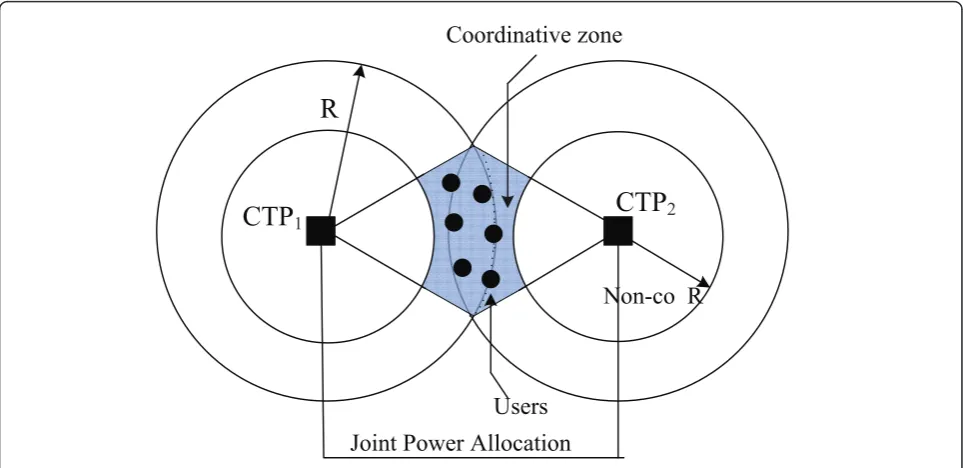
We consider a downlink multi-user OFDM system, in which two CTPs coordinately transmit their power to the coordinative zone users as depicted in Figure 1. In Figure 1, the CTPs are denoted by the solid squares and the users are denoted by the circles. Each CTP has all the information intended to the users in the coordina-tive zone via a wireline connection. In order to simplify the mathematical derivation, we assume that the two CTPs have the same power constraintP0, and that they
share the same overall bandwidth B, which is divided into Northogonal narrow-band subcarriers. Each user feeds back the CSI to its corresponding CTP via a feed-back channel, and the instantaneous CSI can be exchanged reliably and fast between the two CTPs.
In order to focus solely on power allocation, we do not explicitly consider subcarrier scheduling here. How-ever, it is noted that the power allocation results pre-sented in this article are valid for any scheduling strategy.a Besides, in this article we only focus on the total system capacity, leaving aside fairness issues con-cerning the way in which the common resources are shared among users. We also emphasize that our analy-sis is valid for any kind of coordinated transmission net-work, as long as the sum of orthogonal subcarrier capacities is a relevant performance metric.
R=
N
j=1
Rj= N
j=1
B Nlog2
⎛ ⎜ ⎜ ⎜ ⎝1 +
2
i=1
Pi,jHi,j2
σ2
j
⎞ ⎟ ⎟ ⎟
⎠, (1)
where σj2=N0B/N represents the power of additive
white Gaussian noise at the jth subcarrier,Pij denotes the allocated transmission power from CTPito the jth subcarrier, andHi,jrepresents the corresponding chan-nel gain between the CTPiand thejth subcarrier.
The aim of this article is to minimize the joint trans-mit power for both CTPs, while satisfying at the same time the system throughput requirementRS as well as the individual transmit power constraint per CTP. In mathematical terms, this is equivalent to solve the fol-lowing optimization problem:
minimize Poverall=
N
j=1
P1,j+ N
j=1
P2,j
subject toR=RS, N
j=1
Pi,j≤P0, i= 1, 2.
(2)
3. Closed-form power allocation solutions
We search for the optimal coordinated power allocation by approaching the following optimization problem:
P∗i = (P∗i,1, ...,P∗i,N) = arg min
Pi∈N
Poverall, i= 1, 2, (3)
where
N=P
i∀j∈ {1, ...,N}, 0≤Pi,j≤P0,
N
j=1Pi,j≤P0
is the feasible set. SinceΩNis a closed and bounded set, andR:ΩN®ℝis continuous, function (1) has a solu-tion [[16], Theorem 0.3].
For the sake of mathematical derivation, we denote
γi,j=
P0Hi,j
2
/σj2 and xi,j=Pi,j/P0. It is indicated that gi,j is the SNR associated with CTP iover the jth sub-channel when assuming the entire power P0is allocated
to thejth subchannel, andxi,j represents the power allo-cation ratio. Since the logarithm is monotonically increasing function, the objective (2) combined with the constraints can be described as
minimize Z=Poverall/P0=
N
j=1
x1,j+ N
j=1
x2,j
subject to
N
j=1
1 +
2
i=1 γi,jxi,j
= 2
RS/
B
N
= 2R∗S,
N
j=1
xi,j≤1, i= 1, 2,
(4)
whereZ ≤2 represents the total power consumption ratio.
In order to obtain a closed-form expression for the required power allocation, we divide the constrained problem into two different cases:
1 2
a) The power constraint is assumed to be large enough, so that solving the primal objective is equiva-lent to solving an unconstrained problem. In this case, the power constraint at each CTP (i.e., Nj=1xi,j≤1 for
i= 1, 2) is always satisfied.
b) The power constraint is not large enough, so that one of the CTPs may exceed the power constraint if the distribution of the users is not even. In this situa-tion, the solution in (a) leads to Nj=1x1,j>1 or
N
j=1x2,j>1. In this situation the exceeded CTP should
provide its full power for transmission, while the other CTP should increase its transmit power until it meets the throughput requirement for the system. In mathe-matic terms, the constraint in the primal objective should be changes to Nj=1x1,j= 1 andNj=1x2,j≤1, or
to N
j=1x2,j= 1 and
N
j=1x1,j≤1. Actually, this case is
more meaningful in practical systems.
3.1. Optimal solution for the unconstrained case
It is noted that for arbitrarygi,j, the likelihood of having g1,j =g2,j forj Î {1, 2} in an actual system is almost zero. Without loss of generality, we divide the N sub-channels into two parts: the first part contains M sub-channels that satisfy g1,m >g2,m for m Î {1, 2,..., M}, while the second part contains K subchannels that satisfy g1,k <g2,k for k Î {1,2,..., K}. According to this model,N = M + K.
We first present the following lemma:
Lemma 1: When ignoring the power constraint
N
j=1x1,j≤1;Nj=1x2,j≤1, the objective problem (4)
can be degenerated into the unconstrained function
minimize Z=
Proof:To prove this lemma we usereductio ad absur-dum. Assume that vectors P1∗= (x1,m∗,. . .,x1,k∗= 0,. . .) and P2∗= (x2,m∗= 0,. . .,x2,k∗,. . .) are optimal solutions
for m Î {1,..., M} and kÎ {1,..., K}, which satisfy the throughput requirement and achieve the minimum Z*. However, we could find another set of vectors
P1∗∗= (x∗∗1,m=x∗1,m+ (γ2,m/γ1,m)x∗2,m,. . .,x1,k∗∗= 0. . .) and
P2∗∗= (x2,m∗∗= 0,. . .,x∗∗2,k=x∗2,k+ (γ1,k/γ2,k)x∗1,k,. . .)
which also satisfy the throughput requirement, and achieve a smallerZ**, due tog1,m>g2,m,g1,k<g2,kand
Therefore, the objective (4) could be equivalently transformed into (5). The degeneration implies that a group ofM subchannels (that verifyg1,m>g2,m) should
receive power allocation from CTP 1, while the other
K = N - M subchannels (that verify g1,k <g2,k) should
receive power allocation from CTP 2. In other words, to achieve the goal of minimizing the total transmit power in the system, each CTP should select the better sub-channels (according to the channel quality) to allocate power on them.
The degraded objective function (5) is strictly convex. Then, by Lagrange dual function we have that
Z=
First, we derivelas
λ= 1
Then, the closed-form solution for the power alloca-tion ratio at each CTP is obtained as follows:
x1,m=λ2R
Finally, the minimum total power consumption ratio is given by the following expression:
Z=N
Note: As mentioned before, formula (9) only repre-sents the optimal solution for the primal objective when the power constraint Nj=1xi,j≤1 for i = 1,2
holds. However, when the power constraint is not large enough and the user density is not evenly distributed, one of the CTPs may exceed its individual power con-straint. In this situation, the solution in (9) leads to
N
j=1x1,j>1 or Nj=1x2,j>1. Therefore, the exceeded
recalculated to meet the throughput requirement for the system. The analyisis for this case is specified in the following section.
3.2. Optimal solution for the constrained case
Without loss of generality, we assume that CTP 1 is the overloaded transmission point. Thus, it is straightfor-ward to know that CTP 1 should provide its full power for transmission (i.e., Nj=1x1,j= 1). Then the objective
(4) can be redefined as
minimize Z= 1 +
Before going forward in the analysis, we first need to present the following lemma.
Lemma 2:In order to minimize the overall power con-sumption, the optimal power allocation strategy consists in transmitting simultaneously from both CTPs in only one of theN-subchannels. The rest of the subchannels should be divided in two groups, one per CTP. The selection of the subchannels for each group should be carried out accord-ing to the individual subchannel gains from each CTP.
Proof:By Lagrange dual function we have that
= 1 +x2,1+· · ·+x2,N−λ{(1 +γ1,1x1,1+γ2,1x2,1)· · ·
[1 +γ1,N(1−x1,1− · · · −x1,N−1) +γ2,Nx2,N]−2R
∗ S}. (12)
For the sake of mathematic simplification, we denote
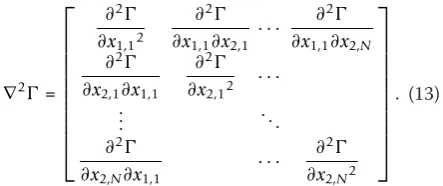
Aj= (1 +g1,jx1,j+g2,jx2,j) and obtain the Hessianmatrix
The first-order principal minor determinant of∇2Γis given by ∂2/∂x
1,12=−2γ1,1γ1,NA2A3. . .AN−1<0, while
the second-order principal minor determinant attains the form
Therefore, the Hessian ∇2Γ is indefinite since both, the first-order and the second-order principal minor determinant are negative. This means that function (12) has no extreme points, and as a consequence, the mini-mum value must be achieved on the domain boundary [17]. In other words, one of thexi,1fori Î{1,2} equals
to 0; i.e.,A1 = (1 +g1,1x1,1+g2,1x2,1) should be
degener-ated to A1 = (1 +γi,1xi,1) foriÎ {1, 2}.
Similarly, for arbitraryAj= (1 +g1,jx1,j +g2,jx2,j), we
still have the following equation
∂2
Hence, in order to achieve the minimum, all theAj= (1+g1jx1j+g2jx2j),jÎ{1, ..., N-1} ought to be degenerated
2. Thus, function (12) has been degenerated into strictly convex.
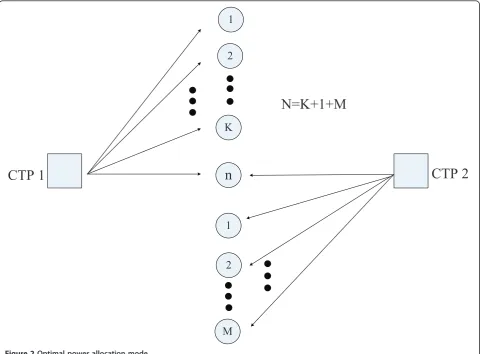
Based on the above analysis, the optimal power alloca-tion mode (as depicted in Figure 2) is that only one of the N-subchannels (i.e., a certain An) should be trans-mitted together by the two CTPs; the others, according to the different subchannel gains, should be separated into two parts (i.e., x1,jor x2,j) and transmitted by an
individual CTP.
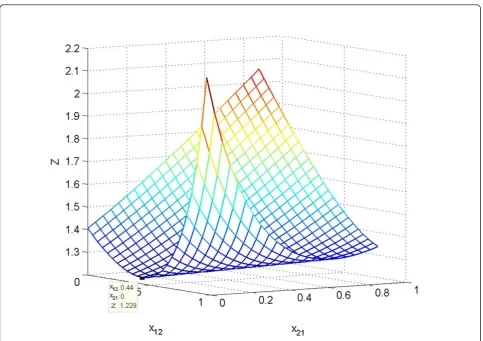
A specific 2-subchannel overloaded case is presented here to illustrateLemma 2 by numerical simulation (see Figure 3). As an example of function (11), we assume 2R∗S= 10. Considering the power constraint, path loss
attenuation, shadowing, and noise, we randomly generate gi,jas follows:g1,1= 3.205,g2,1 = 2.311,g1,2= 4.108,g2,2=
3.406. Figure 3 shows the minimum power consumption
Zversus ergodic power allocation ratio. Based on this fig-ure it is possible to see that, the total power consumption reaches its minimum value (i.e., 1.229) when (x1,2= 0.44, x2,1= 0) and (x1,1= 0.56,x2,2= 0.229). Note that this set
of values verifies Lemma 2, that stated that the optimal power allocation is obtained on the domain boundary, when only one of the available subchannels is being used simultaneously by the two CTPs.
and the second group of K = N-M-1 subchannels is used solely by CTP 2. Thus, the objective function (12) can be expressed as
= 1 +x2,n+x2,1+. . .x2,K−λ
M
m=1(1 +γ1,mx1,m)·
K
k=1(1 +γ2,kx2,k)
·
1 +γ1,n
1−
M
m=1
x1,m
x1,n+γ2,nx2,n
−2R∗
S}.
(16)
By partial derivation on (16), it is possible to see that
λ= 1 2R∗S
⎛ ⎜ ⎜ ⎜ ⎝
(γ1,n/γ2,n)M2R
∗ S
γ2,n· M
m=1γ 1,m·
K
k=1 γ1,k
⎞ ⎟ ⎟ ⎟ ⎠ 1
N
. (17)
Then, the optimal solution is obtained as follows:
⎧ ⎪ ⎪ ⎨ ⎪ ⎪ ⎩
x1,m= γ2,n
γ1,nλ
2R∗S− 1 γ1,m
, x1,n= 1− M
m=1
x1,m,
x2,k=λ2R
∗
S− 1
γ2,k
, x2,n=λ2R
∗
S−1 +γ1,nx1,n γ2,n
. (18)
Remark: It is seen that the solutions (9) and (18) turn out to take the form of traditional WF solution, but hav-ing a coordinated feature. The coordinated feature here means that the optimal power allocation ratiox1,m corre-lates not only withg1,mformÎ (1,...,M) andg2,kfor kÎ (1,...,K), but also depends on the relationship g2,n/g1,nin (18). The optimal solution can be only obtained through perfect coordination between both CTPs. According to the derived solution, both CTPs have to determine jointly the power ratio that they should allocate on each of their active subchannel, to achieve an effective minimization of the overall power consumption of the system.
Finally, bygi,j= (P0|Hi,j|2)/N0ΔBandxi,j=Pij/P0, the
optimal power allocation is given by
P1∗= (P1,1∗,. . .,P1,M∗,P1,n∗, 0," #$ %. . ., 0
K
),
P2∗= (0," #$ %. . ., 0
M
,P2,n∗,P2,1∗,. . .,P2,N−M−1∗),
M= arg
M∈{1,...,N−1}
minPoverall.
(19)
1
2
K
n
1
2
M
CTP 1
CTP 2
N=K+1+M
The intuition behind the optimal power allocation in (9) and (18) is also to take advantage of good channel conditions: when subchannel condition is good, more power (and a higher data) rate is sent over the subchan-nel. On the other hand, as the subchannel quality degrades, less power (and a lower data rate) is sent over the channel. It is emphasized that the solution should be satisfied by Pi,j ≥ 0; i.e., if the channel SNR falls below the cutoff threshold, the channel is not used and
Pi,j∗= [Pi,j]+= max{0,Pi,j} (20)
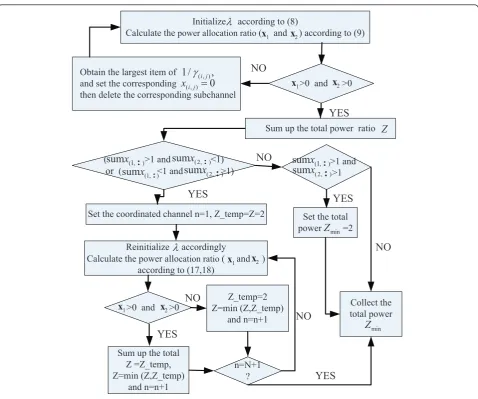
results. Hence, an iterative JMPC-PA algorithm is pre-sented (as depicted in Figure 4), not only to determine the optimal power allocation vectors P1∗ and P2∗, but
also to evaluate the solutions numerically.
4. Optimal solution for the arbitrary K-CTP case
This section extends the previous analysis and lemmas from the simple 2-CTP case to the more general K-CTP situation. It is important to note that the assumptions in this section are similar to the ones that have been already presented in the previous section.
The general form for the objective function (2) in presense ofKCTPs attains the form
minimize Z=
N
j=1
x1,j+ N
j=1
x2,j+. . . N
j=1
xK,j
subject to (1 +γ1,1x1,1. . .+γK,1xK,1). . .(1 +γ1,Nx1,N. . .+γK,NxK,N) = 2R ∗
S . (21)
Regularity features for the objective function in for K-CTP case can be easily found following a similar mathe-matical procedure to the one presented in the 2-CTP case. It is possible to see that theHessianmatrix of the objective, the first-order principal minor determinant, and the second-order principal minor determinant, have the same structure as the 2-CTP case. As a conse-quence, it is possible to claim that the degradation pro-cess for the K-CTP case follows the same structure as in the 2-CTP one.
According to Lemma 1, based on the reductio ad absurdum method, the above objective function should degraded to
minimize Z=N j=1
x1,j+ N
j=1
x2,j+. . . N
j=1
xK,j subject to K1
k1=1(1 +γ1,k1x1,k1)
K2
k2=1(1 +γ2,k2x2,k2). . .
KK
kK=1(1 +γK,kKxK,kK) = 2R
∗
where gi,j for i Î (1,... K) is biggest in Ai, with
K
i=1Ki=N. The degradation implies that K1
subchan-nels should be allocated power by CTP 1, K2
subchan-nels by CTP 2, and so on.
By Lagrange dual function, we have that
=
First, we derivelas
λ= 1
Then, the closed-form solution of power allocation ratio for each CTP is obtained as follows:
x
1,k1=
λ
2
Finally, the minimum total power consumption ratio is given by Initialize according to (8)
Calculate the power allocation ratio( and ) according to (9)
>0 and >0 Obtain the largest item of
and set the corresponding
then delete the corresponding subchannel
Sum up the total power ratio
according to (17,18) 2
x
x x2 Z=min (Z,Z_temp)Z_temp=2
and n=n+1 Set the coordinated channel n=1, Z_temp=Z=2
NO
It is indicated that Zminin (26) is the optimal solution
of the primal objective only when the power constraint
Ki
ki=1xi,ki ≤1 for i Î {1,...,K} holds. However, if the
user density is uneven distributed, some of the CTPs may exceeds the power constraint, and the solution in
(9) leads to Ki
ki=1xi,ki >1 for i Î {1,...,K}. Therefore,
the overloaded CTPs should provide their full power for transmission and, in order to meet the throughput requirement, the power allocation in the other CTPs needs to be recalculated. Without loss of generality, we assume S CTPs exceed their power constraint. In this situation, the problem can be described as
minimize Z= 1 +" #$ %· · ·+ 1
By Lagrange dual function we have
= 1 +" #$ %· · ·+ 1
For the sake of mathematic simplification, we also denoteAj= (1 +g1,1x1,1... +gK,1xK,1) and obtain the Hes-sianmatrix∇2fas follows
∇2=
The first-order principal minor determinant and the second-order principal minor determinant have the same structure as the 2-CTP case, which means the Hessian ∇2Γ is indefinite since both the first and sec-ond-order principal minor determinant are negative. Therefore, the minimum value must be achieved on the domain boundary, and the degradation process also fol-lows the 2-CTP case.
According to Lemma 2, it is known that only one of theN-subchannel should be transmitted together byS+1
CTPs (the added one has the biggestgS+t, n fortÎ(S+ 1,..., K) inAn); the others, according to their different channel gains, should be separated into Kparts and transmitted by single CTP Without loss of generality, we assume the nth subchannel is the common subchannel. Then, a group of K1 subchannels is selected to be used
exclusively by CTP 1, another group ofK2subchannels is
selected to be used solely by CTP 2, and so on (i.e., until 2
1
3
theKCTPs receive their own set of channels). Then, the objective function (27) can be expressed as
= 1 +" #$ %· · ·+ 1 S
+ N
j=1
xS+1,j· · ·+ N
j=1
xK,j −λ
&K1
k1(1 +γ1,k1x1,k1). . .
KK
kK
(1 +γK,kKxK,kK)(1 +γ1,nx1,n. . .+γS,nxS,n+γS+t,nxS+t,n)−2R ∗
S ' (30)
wheregS+t,nfor tÎ(S+1,... K) is biggest inAn, and
Ki
ki=1xi,ki+xi,n= 1 foriÎ{1,...S} withK1· · · +KK+ 1 = N. By Lagrange dual function, we derivelas
λ= 1
2R∗S
⎛ ⎜ ⎜ ⎜ ⎝
2R∗S( γ1,n γS+t,n
)
K1 ( γ2,n
γS+t,n
)
K2
. . .(γS,n γS+t,n
)
KS
γS+t,n K1
k1=1
γ1,k1 K2
k2=1
γ2,k2· · · KK
kK=1 γK,kK
⎞ ⎟ ⎟ ⎟ ⎠
1
N
. (31)
Similarly, according to Equations (9) and (18), closed-form solutions forK-CTP system can be obtained.
5. Numerical simulations
In this section, the performance of 2-CTP and 3-CTP systems are considered, since they represent a more rea-sonable network topology for a practical system imple-mentation. In order to compare the proposed JMPC-PA scheme with EPA, we consider that scheduling is done in aRound Robin fashion. We assume that 20 indepen-dent and iindepen-dentically distributed (i.i.d.) Rayleigh-faded users are uniformly located within the coordinative zone (i.e., the colored zone of Figure 1 and Figure 5). Let us assume that distance Ris 1000 meters, while distance No-coR is 600 m. Path loss model is Okumura-Hata: l(d) = 137.74 + 35.22 lg(d) in dB. Standard deviation for
0 0.2 0.4 0.6 0.8 1 1.2 1.4 1.6 1.8 2
0 0.2 0.4 0.6 0.8 1 1.2 1.4 1.6 1.8 2
Total Throughput Requirement Rs (Mbps)
Total Power Consumption Ratio (Z
mi
n
)
JMPC−PA EPA
shadowing is 3.65 dB. For the sake of simplification, we assume that the total bandwidth isB =1 MHz, that the total number of subchannels is N = 25, and that the noise power in downlink iss2 = -105 dBm in all subcar-riers. The total power consumption of each power allo-cation scheme is averaged over 1000 independent realizations of users’ location by Monte-Carlo
simulation.
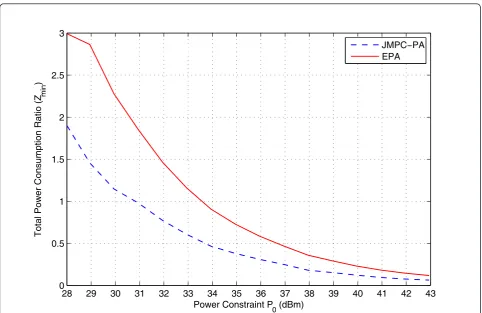
Under different total throughput constraintsRS and each CTP’s power constraintsP0(dBm), the minimum
total power consumption of the proposed JMPC-PA scheme and EPA are compared.
(1) 2-CTP case
Given a transmission power constraintP0 = 42 dBm,
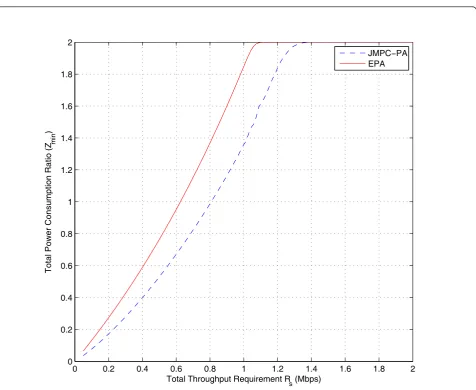
Figure 6 indicates that the proposed power allocation
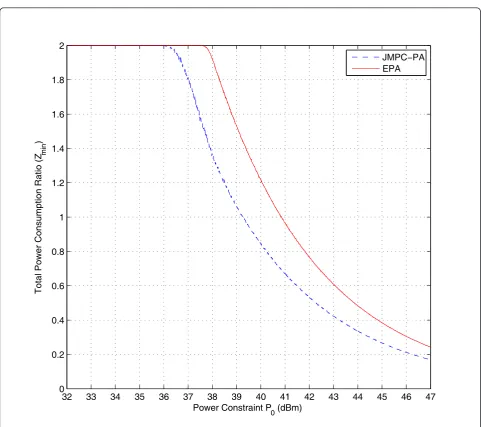
scheme consumes less power than EPA under different throughput requirement (e.g., when Rs= 1Mbps, EPA needsZ = 1.22 while JMPC-PA only requiresZ = 0.86). Actually, the ability of achieving throughput in EPA is 1.1 Mbps, due to the power constraint at each CTP. How-ever, in our proposed JMPC-PA, the achieving through-put is 1.38 Mbps when both he transmitted power reached the constraint. Figure 7 shows that under a given throughput requirement Rs = 0.5 Mbps, the proposed scheme consumes less power compared to EPA at both, low power constraint and high power constraint (e.g., whenP0= 40 dBm, EPA needsZ= 1.86 while JMPC-PA
only requires Z = 1.36). It can be seen that when the power constraint is lower than 36 dBm, neither of the two schemes could achieve the throughput requirement
32 33 34 35 36 37 38 39 40 41 42 43 44 45 46 47
0 0.2 0.4 0.6 0.8 1 1.2 1.4 1.6 1.8 2
Power Constraint P0 (dBm)
Total Power Consumption Ratio (Z
mi
n
)
JMPC−PA
EPA
Rs= 0.5 Mbps. Yet, the proposed JMPC-PA can meet the throughput requirement when the power constraint is larger than 36 dBm, compared to the 37.5 dBm that are required in the EPA scheme. Actually, when the power constraint is large enough, the“cooperating”transmitting mode will not occur (this is the explanation for the reduction in the gain gap that is observed as the power constraint increases). To sum up it is possible to con-clude that, under the perfect coordinated transmission between two CTPs, the proposed JMPC-PA scheme pro-vides an important improvement in the total power con-sumption of the system.
(2) 3-CTP case
The power constraint of each CTP in the 3-CTP case is equal to the one in the 2-CTP case plus 10 log10(2/3)
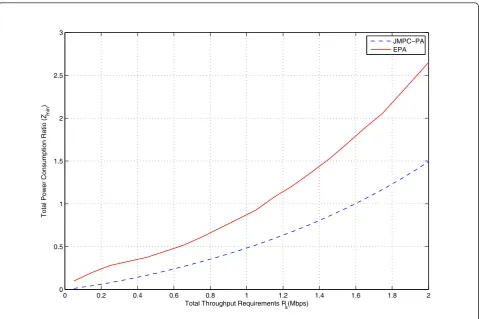
dBm, so that the total power that is available in the sys-tem is identical in both cases (and fair comparisons are possible). As expected, the results in this case are similar the the ones obtained for the 2-CTP situation. Figure 8 indicates the proposed JMPC-PA scheme consumes less power than EPA in presence of different throughput requirements. Similarly, Figure 9 shows that when the throughput requirement isRs= 0.5 Mbps, the proposed JMPC-PA scheme consumes less power compared to
EPA in both, low power constraint and high power con-straint. However, comparing Figure 8 with Figures 6, 7, and 9, we observe that the performance of the 3-CTP case is better than the performance of the 2-CTP case for both, JMPC-PA scheme and EPA scheme. The rea-son for this behavior is that in the 3-CTP case, the sys-tem has more options to choose the power allocation in each CTP to provide better service.
6. Concluding remarks
A novel power allocation scheme for the downlink of an OFDMA system that implements CoMP transmission was investigated in this article. The ultimate goal of the proposed scheme was to minimize the total transmit power consumption, verifying at the same time the tar-get throughput of the system and the individual power constraint per CTP. The closed-form solution for the optimal power allocation was obtained, not only for the simpler 2-CTP case, but also for the more generalK -CTP case with an arbitrary number of coordinated sources. Based on the derived solutions, a novel power
allocation algorithm with JMPC-PA was proposed.
Important reductions on the power consumption were observed in different situations, when comparing the
0 0.2 0.4 0.6 0.8 1 1.2 1.4 1.6 1.8 2
0 0.5 1 1.5 2 2.5 3
Total Throughput Requirements Rs(Mbps)
Total Power Consumption Ratio (Z
mi
n
)
JMPC−PA EPA
performance of the JMPC-PA scheme with the one pro-vided by the simple EPA approach. These results show the potential gains that exist when implementing joint power allocation in CoMP transmissions, particularly when energy efficiency issues become a main concern.
Endnote a
Note that different scheduling strategies simply induce different channel gain statistics for the selected subcar-riers [18].
Acknowledgements
This study was supported by China-EU International Scientific and Technological Cooperation Program (0902), National Nature Science Foundation of China (Grant No. 61001119) and Fund for Creative Research Groups of China (Grant No. 61121001).
Author details
1Key Laboratory of Universal Wireless Communications, Ministry of Education, Beijing University of Posts and Telecommunications, Beijing, China 2Department of Communications and Networking, Aalto University, Helsinki, Finland3StarPoint Communication Software Company Ltd., Beijing 100102, China
Competing interests
The authors declare that they have no competing interests.
Received: 30 June 2011 Accepted: 27 March 2012 Published: 27 March 2012
References
1. H Sampath, S Talwar, J Tellado, V Erceg, A Paulraj, A fourthgeneration MIMO-OFDM broadband wireless system: design, performance, and field trial results. IEEE Commun Mag.40(9), 143–149 (2002). doi:10.1109/ MCOM.2002.1031841
2. TS Rappaport, A Annamalai, RM Buehrer, WH Tranter, Wireless
communications: past events and a future perspective. IEEE Commun Mag. 40(5), 148–161 (2002)
3. AJ Goldsmith, SG Chua, Variable-rate variable-power MQAM for fading channels. IEEE Trans Commun.45, 1218–1230 (1997). doi:10.1109/26.634685 4. J Jang, KB Lee, Transmit power adaptation for multiuser OFDM systems.
IEEE J Sel Areas Commun.21(2), 171–178 (2003). doi:10.1109/ JSAC.2002.807348
5. Z Shen, JG Andrews, BL Evans, Adaptive resource allocation in multiuser OFDM systems with proportional rate constraints. IEEE Trans Wirel Commun.4(6), 2726–2737 (2005)
6. W Rhee, JM Cioffi, Increasing in capacity of multiuser OFDM system using dynamic subchannel allocation, inProc Vehicular Tech Conf 2000 Spring, Tokyo, Japan, (May, 2000)
7. CY Wong, CY Tsui, RS Cheng, KB Letaief, A realtime sub-carrier allocation scheme for multiple access downlink OFDM transmission, inProc Vehicular Tech Conf 1999 Fall, Amsterdam, Holland, (September, 1999)
8. HS Kim, JS Kwak, JM Choi, JH Lee, Efficient subcarrier and bit allocation algorithm for OFDMA system with adaptive modulation, inProc Vehicular Tech Conf 2004 Spring, Milan, Italy, (May, 2004)
9. D Kivanc, G Li, H Liu, Computationally efficient bandwidth allocation and power control for OFDMA. IEEE Trans Wirel Commun.2, 1150–1158 (2003). doi:10.1109/TWC.2003.819016
28 29 30 31 32 33 34 35 36 37 38 39 40 41 42 43
0 0.5 1 1.5 2 2.5 3
Power Constraint P0 (dBm)
Total Power Consumption Ratio (Z
mi
n
)
JMPC−PA
EPA
10. A Scaglione, DL Goeckel, JN Laneman, Cooperative communications in mobile ad hoc networks. IEEE Signal Process Mag.23(5), 18–29 (2006) 11. Y Jing, B Hassibi, Distributed space-time coding in wireless relay networks.
IEEE Trans Wirel Commun.5, 3524–3536 (2006)
12. M-k Chang, S-y Lee, Performance analysis of cooperative communication system with hierarchical modulation over rayleigh fading channel. IEEE Trans Wirel Commun.8(6), 2848–2852 (2009)
13. L Venturino, N Prasad, X Wang, Coordinated scheduling and power allocation in downlink multicell OFDMA networks. IEEE Trans Veh Technol. 58(6), 2835–2848 (2009)
14. 3GPP TR 36.814 V0.4.1. Further Advancements for E-UTRA Physical Layer Aspects, (Feb 2009)
15. B Luo, QM Cui, H Wang, XF Tao, P Zhang, Closed form solutions of joint water-filling for coordinated transmission. IEICE Transmission Commun. E93-B(12), 3461–3468 (2010). doi:10.1587/transcom.E93.B.3461
16. JL Troutman,Variational Calculus and Optimal Control: Optimization with Elementary Convexity, 2nd edn. (Springer-Verlag, New York, 1996) 17. S Boyd, L Vandenberghe,Convex Optimization, (Cambridge University Press,
Cambridge, UK, 2004)
18. M Andrews, K Kumaran, K Ramanan, A Stoylar, P Whiting, R Vijayakumar, Providing quality of service over a shared wireless link. IEEE Commun Mag. 39(2), 150–154 (2001). doi:10.1109/35.900644
doi:10.1186/1687-1499-2012-122
Cite this article as:Cuiet al.:Closed-form solution for minimizing power consumption in coordinated transmissions.EURASIP Journal on Wireless Communications and Networking20122012:122.
Submit your manuscript to a
journal and benefi t from:
7Convenient online submission 7Rigorous peer review
7Immediate publication on acceptance 7Open access: articles freely available online 7High visibility within the fi eld
7Retaining the copyright to your article