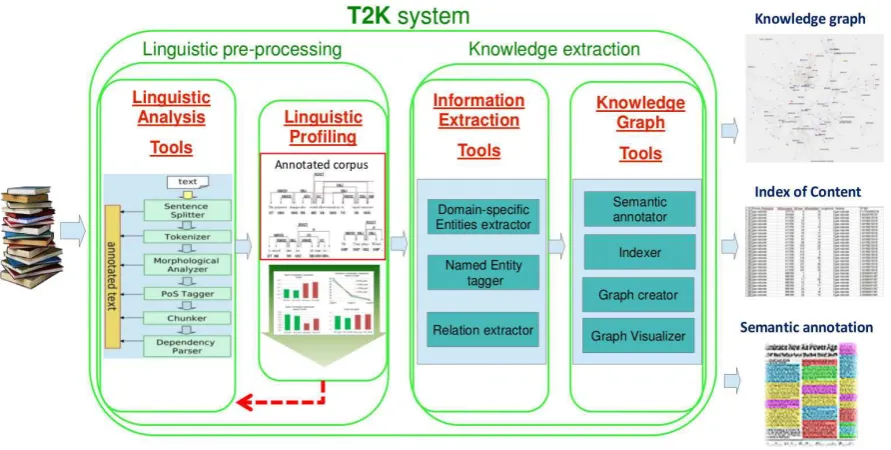
Figure 1: T2K2workflow.
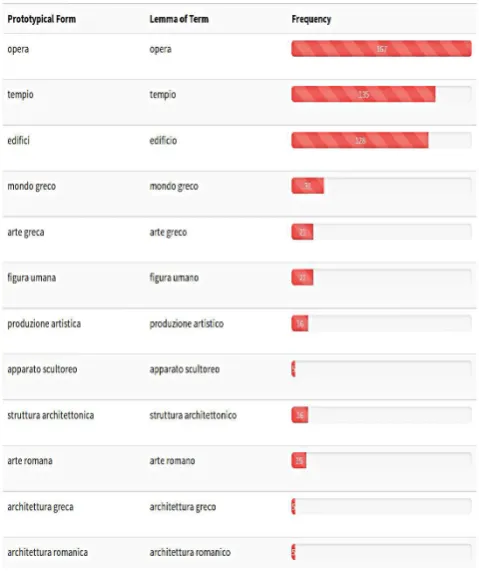
of the acquired domain–specific terms and an index of the input documents with respect to the extracted terminology. For each term in the glossary, the following information types are provided: the prototypical form, corresponding to the term form most frequently attested in the acquisition corpus, the lemmatized form and the frequency of occur-rence of the term (in all attested forms) within the whole document collection. As pointed out in Lenci et al. (2009), the choice of representing a domain term through its pro-totypical form rather than the lemma (as typically done in ordinary dictionaries) follows from the assumption that a bootstrapped glossary should reflect the actual usage of terms in texts: in fact, domain–specific meanings are often associated with a particular morphological form of a given term (e.g. plural). The index is in tabular format where each column contains the following information types:
• the prototypical form of the indexed entity;
• the identifiers of the document and of the sentence containing the entity mention as well as of the start– token;
• the length of the term denoting the entity (calculated in terms of tokens);
• the variants of the indexed entity attested within the in-put corpus. Following Nenadic et al. (2004) and Lenci et al. (2009), different types of term variation are con-sidered, i.e. orthographic, morphological as well as structural.
• the TF/IDF score (Salton and Buckley, 1988) measur-ing the relevance of the indexed entity with respect to the specific document.
Both the glossary and the index can be downloaded by the user for them to be used as input for external tools. In addition, T2K2 allows downloading the input corpora in
CoNLL format where the start–, internal– and final–token of the POSs sequences representing each domain term are annotated using the IOB labeling format (Ramshaw and Marcus, 1995), where the start–token is annotated with “B” (marking the begin of the entity mention), the internal– and final–tokens with “I” (marking the internal tokens) and all other tokens with “O”.
2.2.2. Named Entities
T2K2 includes a multi–lingual module to extract Named Entities called ItaliaNLP NER. This module is a classifier based on Support Vector Machines using LIBSVM (Chang and Lin, 2001) that assigns a named entity tag to a token or a sequence of tokens. ItaliaNLP NER uses 5 kinds of features:
• orthographic features, i.e. the orthographic character-istics of the analyzed token, e.g. capitalized letters, presence of non–alphabetical characters, etc.;
• linguistic features, i.e. lemma, Part–Of–Speech, prefix and suffix of the analyzed token;
• dictionary look–up features, marking whether the an-alyzed token is part of an entity name occurring in one of the “People”, “Organization” and “Geo– political” gazetteers. The “Organizations” and “Peo-ple” gazetteers were automatically generated from Wikipedia1, while the “Geo–political” gazetteer was downloaded from the United Nations Economic Com-mission for Europe web site2.
• contextual features, referring to orthographic, linguis-tic and dictionary look–up features of the context words of the analyzed token(s);
1http://en.wikipedia.org/wiki/Category:Lists of organizations
and http://en.wikipedia.org/wiki/Lists of people
2
Figure 2 exemplifies the output of the term extraction step, where terms are ordered on the basis of their domain rel-evance within the input corpus: for each term the abso-lute frequency is also reported. Figure 3 shows a fragment of the index. The terms are alphabetically ordered: each line refers to a single occurrence of a given term within a document. For example, the multi–word termarchitettura greca ‘Greek architecture’ occurs in five lines, four times in theStoria dell’Arte 4volume and one time in theStoria dell’Arte 5volume. The column reporting the T F/IDF
score shows that this entity is more relevant in theStoria dell’Arte 4volume, with a score of 0.00704 (against 0.0046 for the other volume).
In Figure 4 the domain–specific terms are organized into fragments of taxonomical chains, for examplearchitettura greca ‘Greek architecture’,architettura longobarda ‘Lon-gobard architecture’, architettura romana ‘Roman archi-tecture’,architettura romanica‘Romanesque architecture’ share the same semantic headarchitettura‘architecture’. A short list of extracted named entities (ordered by decreas-ing frequency) is reported in Figure 5, with each line con-taining a single entity mention.
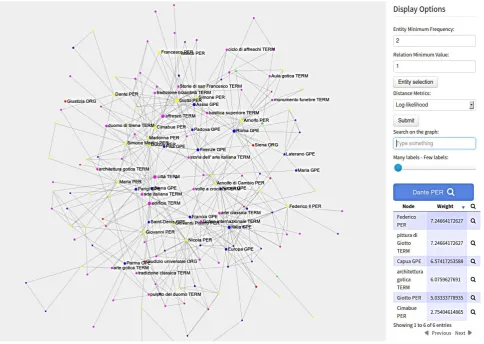
Figure 6 shows the visualization of the Knowledge graph, where domain–specific terms and named entities are rep-resented by nodes, and the relations linking them by arcs. The different entity types are marked by different colors, whereas the size of nodes is proportional to the frequency of the corresponding entity. T2K2allows the user to create graph views focusing on specific relation types (i.e. co-occurrence or similarity) and using different weight mea-sures (i.e. frequency or log-likelihood). As described in Section 2.3., T2K2permits the visualization of sub–graphs of selected entities and/or relations: this is exemplified in Figure 7 showing the sub–graph of the Person (PER) Giotto, while Figure 8 reports the relations shared by two named entities, i.e.GiottoandCimabue. Figure 9 reports a T2K2screenshot with a ternary relation linkingGiottoand Cimabuewith the domain specific entitybasilica superiore ‘superior basilica’. The textual box reports the text span mentioning the extracted relation: it is said thatGiottoand Cimabuedecorated the superior basilica of St. Francesco in Assisi in different periods.
3.
Ongoing Applications
T2K2is currently being tested and specialized in the frame-work of different ongoing projects aimed at extracting and organizing knowledge from different Italian domain– specific corpora:
• Legal Text Mining: building semantic networks to sup-port advanced queries in legal textual corpora (JU-RNET), a project funded by the Tuscany Region and aimed at accessing the knowledge contained in case law corpora;
• iSLe – intelligent Semantic Liquid eBook, a project funded by the Tuscany Region and aimed at i) de-veloping an innovative software platform for digi-tal educational publishing augmented with NLP-based
progetto-isle/.
Figure 2: An excerpt of the glossary with extracted domain–specific terms.
Figure 3: An excerpt of the term index.
functionalities for knowledge management and at ii) supporting authors during the creation of educational textbooks using the knowledge graph extracted from domain–specific corpora;
Figure 6: A screenshot of the extracted knowledge graph.
T2K2 is also being tested on English texts in studies fo-cused on the analysis of technical documents such as patents and system requirements with the final aim of help-ing engineers to discover relevant concepts and relations:
• The contrastive analysis performed by T2K2was used by Ferrari et al. (2013) to extract domain–specific en-tities from brochures. Identifying and comparing the features provided by the other vendors might greatly help during the market analysis. However, mining common and variant features of from the publicly available documents of the competitors is a time con-suming and error–prone task. In this scenario, they used the domain specific entities extracted by T2K2to perform commonality and variability mining. A case study was carried out to qualitatively evaluate the proach in the metro systems domain: the proposed ap-proach demonstrated its expected time–effectiveness.
• T2K2 was used to detect and extract information about the functions, the physical behaviour and the states of the system directly from patents (Fantoni et al. (2013)). In the field of automatic patent anal-ysis a number of domain specific ontologies have been successfully proposed in a variety of research projects, mostly focusing on upper level concepts hand–crafted by domain experts. However, realisti-cally large knowledge–based applications need
com-prehensive ontologies that should be continuously up-dated. To overcome this problem, they used the ter-minology extraction approach developed by T2K2on automatically crawling patents belonging to specified patent classes and subclasses for automatically acquir-ing a collection of entities characterizacquir-ing the anal-ized domain. Acquired entities were used to create a knowledge base representing a key ingredient in the proposed approach to disambiguate, gather, select and organize information from technical documents.
• Ferrari et al. (2014) applied T2K2on system require-ments specifications. They proposed two metrics that take into account the relevant terms of the input doc-uments, and the relevant relationships among terms to measure and improve the completeness of the requiments with respect to the input docurequiments of the re-quirements definition phase, such as preliminary spec-ifications, transcripts of meetings with the customers, etc. They use T2K2within their system named Com-pleteness Assistant for Requirements (CAR) to extract relevant concepts and relations mentioned in the input documents.
Figure 4: An excerpt of extracted taxonomical chains.
named entities; we are currently developing methods for clustering and labeling domain specific entities and for in-dexing the input document collection on the basis of them. For what concerns relation extraction, we are implement-ing limplement-inguistically driven methods relyimplement-ing on the syntactic structure of the text: T2K2will exploit linguistic informa-tion both to automatically extract domain–specific relainforma-tions and to allow the user to define syntactic patterns convey-ing them. Last but not least, we are also devisconvey-ing methods for graph mining: in particular, we are integrating in T2K2 algorithms for frequent subgraph mining, graph clustering and community discovery to detect graph areas that are the-matically homogeneous as well as algorithms for detecting hub nodes in order to identify relevant topics of the input corpus.
5.
References
G. Attardi and F. Dell’Orletta. 2009. Reverse revision and linear tree combination for dependency parsing. In Pro-ceedings of NAACL–HLT 2009, pages 261–264.
G. Attardi. 2006. Experiments with a multilanguage non-projective dependency parser. InProceedings of CoNLL-X 2006, pages 166–170.
F. Bonin, F. Dell’Orletta, G. Venturi, and S. Montemagni. 2010. A contrastive approach to multi-word term extrac-tion from domain corpora. In Proceedings of the 7th International Conference on Language Resources and Evaluation, pages 3222–3229.
M.T. Cabr`e. 1999. The terminology. Theory, methods and applications. John Benjamins Publishing Company. A. Caruso, A. Folino, F. Parisi, and R. Trunfio. 2014. A
statistical method for minimum corpus size
determina-Figure 5: An excerpt of extracted Named Entities.
tion. In Proceedings of JADT2014 (Journ´ees Interna-tionales d’Analyse des Donn´ees Textuelles), Paris, 3-6 Juin 2014.
C. Chang and C. Lin. 2001. LIBSVM: a library for support vector machines. Software available at http://www.csie.ntu.edu.tw/ cjlin/libsvm.
F. Dell’Orletta, A. Lenci, S. Marchi, S. Montemagni, V. Pir-relli, and G. Venturi. 2008. Dal testo alla conoscenza e ritorno: estrazione terminologica e annotazione seman-tica di basi documentali di dominio. AIDA Informazioni, Proceedings of the National Conference Ass.I.Term I-TerAnDo, AIDA, n. 1-2/20085:185–206.
F. Dell’Orletta, S. Montemagni, and G. Venturi. 2013. Lin-guistic profiling of texts across textual genre and read-ability level. an exploratory study on italian fictional prose. InProceedings of RANLP-2013, pages 189–197. F. Dell’Orletta. 2009. Ensemble system for part-of-speech
tagging. InProceedings of Evalita’09.
T. Dunning. 1993. Accurate methods for the statistics of surprise and coincidence. Computational Linguistics, 19(1):61–74.
G. Fantoni, R. Apreda, F. Dell’Orletta, and M. Monge. 2013. Automatic extraction of function-behaviour-state information from patents. Journal of Advanced Engi-neering Informatic.
A. Ferrari, G. Oronzo Spagnolo, and F. Dell’Orletta. 2013. Mining commonalities and variabilities from natural lan-guage documents. InProceedings of the 17th Interna-tional Software Product Line Conference (SPLC-2013). A. Ferrari, F. Dell’Orletta, G. Oronzo Spagnolo, and
complete-Figure 7: The sub–graph ofPerson(PER)Giotto.
ness of natural language requirements. InProceedings of the 20th International Working Conference on Re-quirements Engineering: Foundation for Software Qual-ity (REFSQ 2014).
K. Frantzi and S. Ananiadou. 1999. The c-value / nc value domain independent method for multi-word term extraction. Journal of Natural Language Processing, 6(3):145–179.
A. Lenci, S. Montemagni, V. Pirrelli, and G. Venturi. 2009. Ontology learning from italian legal texts. In Proceed-ings of the 2009 Conference on Law, Ontologies and the Semantic Web, pages 75–94, Amsterdam, The Nether-lands. IOS Press.
D.D. Lewis, Y. Yang, T. Rose, and F. Li. 2004. Rcv1: A new benchmark collection for text categorization re-search. Journal of Machine Learning Research, 5:361– 397.
B. Magnini, E. Pianta, C. Girardi, M. Negri, L. Romano, M. Speranza, V. Bartalesi Lenzi, and R. Sprugnoli. 2006. I-cab: the italian content annotation bank. In Proceed-ings of the 5th International Conference on Language Resources and Evaluation.
G. Nenadic, S. Ananiadou, and J. McNaught. 2004. En-hancing automatic term recognition through term varia-tio. InProceedings of Coling 2004.
J. Nivre, J. Hall, S. K¨ubler, R. McDonald, J. Nilsson, S. Riedel, and D. Yuret. 2007. The conll 2007 shared task on dependency parsing. InProceedings of EMNLP-CoNLL 2007, pages 915–932.
L.A. Ramshaw and M.P. Marcus. 1995. Text chunking us-ing transformation-based learnus-ing. InProceedings of the
Figure 8: The relations involving the two named entities
GiottoandCimabue.
Figure 9: The ternary relation linkingGiottoandCimabue withbasilica superiore‘superior basilica’.
Third ACL Workshop on Very Large Corpora, pages 82– 94.
L. Ratinov and D. Roth. 2009. Design challenges and mis-conceptions in named entity recognition. InProceedings of the Thirteenth Conference on Computational Natural Language Learning, pages 147–155.
E.F.T.K. Sang and F. De Meulder. 2003. Introduction to the conll-2003 shared task: Language-independent named entity recognition. In Walter Daelemans and Miles Os-borne, editors,Proceedings of CoNLL-2003, pages 142– 147. Edmonton, Canada.
M. Speranza. 2009. The named entity recognition task at evalita 2009. InProceedings of Evalita’09.